Saturday, June 29, 2013

End of an Era

Six years after it began, the second Big Three era in Boston has officially come to an end.

A few months from now Doc Rivers, the team's head coach for nine seasons, will be drawing up alley oops for Chris Paul and Blake Griffin. Kevin Garnett and Paul Pierce, the greatest Celtics since Larry Bird and Kevin McHale, will be suiting up for the Brooklyn Nets. And Ray Allen, who broke Reggie Miller's career three-point record with the Celts, will be back with the Miami Heat helping them gun for their third straight NBA championship.

The thought of all that, of Pierce and KG not retiring with the Celtics, of Rivers coaching against them, of Allen helping LeBron James instead of hurting him, is hard for me to wrap my head around. It shouldn't, because this day was a long time coming. Danny Ainge said over and over that he wasn't going to repeat Red Auerbach's mistake of keeping McHale and Bird into their golden years instead of trading them when they still had value. Red's unwillingness to break up the original Big Three (along with the death of Len Bias and not getting Tim Duncan in the '97 draft) was a big reason why the team went 21 years between Finals appearances.

Ainge took that lesson to heart. There's no room for sentimentality in sports. When the time came, he'd do what needed to be done, no matter how much it hurt.

So now, with his stars approaching the twilight phases of their careers and the team in a state of transition, he pulled the trigger on a pair of blockbuster trades to reshape his roster and start preparing for life after Pierce, Garnett, and Allen.

Still, a small part of me didn't want to let them go. I wanted to see Pierce and Garnett play their last games wearing the Celtics green. I wanted Doc to guide them through the rebuilding process. I wanted a chance to say good-bye.

Now, all that's left of the Big Three is the memories, the fondest of which have been fading for quite some time.

There was the title year of 2008, when the Celtics were just as good as everyone thought they'd be. Boston's new super-team ran roughshod over the league, winning 66 regular season games and hoisting the franchise's 17th Finals trophy on the Parquet floor in June after thoroughly dismantling Kobe Bryant's Lakers. At the time it felt like we were witnessing the birth of the next Celtics dynasty, when in reality it was just the beginning of a prolonged hunt for that elusive 18th title.

Then came the much-anticipated title defense of 2009, as Boston looked to become the franchise's first repeat champions since Bill Russell's 1968-'69 teams. They probably would have done it, too, had they not lost Kevin Garnett to a season-ending knee injury in February, forcing them to lean heavily on Brian Scalabrine and Glen Davis during the playoffs.

That was followed by the crushing near-miss of 2010, when the Celtics went up 3-2 in their finals rematch with the Lakers, only to have Kendrick Perkins' knee explode in Game 6 and blow a 13 point third quarter lead in Game 7. In 2011 Perkins was traded to the Thunder for Jeff Green, dealing an emotional blow to a team that felt like it would have beaten the Lakers had Perkins remained healthy. Demoralized and depleted, they were bounced from the first round by Miami's juggernaut and seemed to be finished as serious championship contenders.

But in 2012, the Celtics made everyone believe again. Dismissed as too old and slow, they somehow willed themselves to within one win of the NBA Finals before the Heat snuffed out their hopes for one last shot at a title. The Celtics had no business getting that far, but they defied the odds and penned a heartwarming postseason story. Perhaps with the right moves, they'd be able to fight Father Time for another year and keep their championship window open just a bit longer.

We didn't know it at the time, but that was the beginning of the end. It started when Ray Allen--the greatest pure shooter of all time--defected to the Miami Heat for less money. He felt disrespected after Ainge tried to trade him (twice) and brought in Jason Terry. At the end of the day, money wasn't everything, especially for a man who'd earned nearly $200 million of it. Allen knew joining forces with James, Dwyane Wade and Chris Bosh greatly improved his chances of winning another ring. Sure enough, Allen got the last laugh when he helped the Heat clinch another NBA title.

Back in Boston, Terry and Courtney Lee weren't the answer and the team's playoff hopes went up in smoke when Rajon Rondo shredded his ACL in late January. Ainge missed a prime opportunity to tear the team apart at the trading deadline, instead deciding to hold out and explore his options after the season. To their credit, the resilient C's fought on without Rondo, hanging tough with the New York Knicks for six games in the first round. However, it was obvious the once proud Celtics had deteriorated into a .500 team, good enough to make the playoffs but not nearly talented enough to compete for a championship. Drastic changes were required.

Rivers saw the writing on the wall and jumped ship. He made it clear that he didn't want to stay, essentially forcing his way out of town a la Dwight Howard and Carmelo Anthony. He turned his back on a front office that stuck with him during the rough times early in his tenure and recently made him the league's highest paid coach. In return, all the Celtics could fetch for him was an unprotected first round pick in 2015, not Eric Bledsoe and/or DeAndre Jordan as they originally hoped.

I hate the manner in which Rivers left Boston, bailing out with three years left on his contract, but if he couldn't commit to the rebuilding process then he wasn't the right man for the job. You don't want to be here? Fine. Go. Good riddance. Besides, I've always felt that he's better handling veterans than he is with fostering the growth of young players (not that there were many of those in recent years). The Celtics would benefit from a new voice on the bench, a patient coach willing to put the work in now and reap the rewards later.

That said, the Clippers are lucky to have Rivers, a spiritual leader who connected with his players and always seemed to squeeze the most out of them. He's also the best coach in the league when it came to drawing up plays out of time outs. Rivers represents a significant upgrade over Vinny Del Negro, whose incompetence has prevented the Clippers from reaching their full potential these past two years. With Rivers at the helm, LA looks like a serious championship contender.

So do the Nets, who now boast a starting five of Pierce, Garnett, Joe Johnson, Deron Williams, and Brook Lopez. Pierce and Garnett are old, but they can still play at a high level. The future Hall of Famers are much better than the men they'll replace: Kris Humphries and Gerald Wallace.

The Celtics, on the other hand, aren't going to raise that 18th championship banner anytime soon. Realistically, it'd be in their best interest to tank this season and land a top draft slot in next year's draft, which is shaping up to be one of the best in years. The last time they tried that they missed out on Kevin Durant and Greg Oden, but ended up trading for Allen and Garnett so everything worked out.

In the meantime, Boston is officially Rajon Rondo's team, which I suspect is how he always wanted it to be. They've been his team at various points in recent seasons, especially during the playoffs, but now they're really his team. He'll have to make the most out of a less than stellar supporting cast--Humphries, Wallace, Jared Sullinger, and Avery Bradley--but the onus is on him to elevate his game (read: scoring) and play like the superstar he's shown himself capable of being when he wants to be (aka national TV Rondo).

Boston fans can only hope he gets along better than the new coach than he did with Rivers. Otherwise, it won't be long before he gets pushed out the door, too.

Sunday, June 23, 2013

Pujols Putting Slow Start Behind Him

Albert Pujols is no stranger to sluggish starts.

Statistically speaking, April and May are the two worst months of his career by OPS. He's not quite Mark Teixeira, but in recent seasons he's looked like a shadow of himself during the spring. For the third year in a row, he slumped so badly out of the gate that many questioned whether we've seen the end of Albert Pujols as we know him--an elite offensive force and one of the best hitters of all time.

Once again, Pujols has proved such talk to be premature. Since June 4th he's belted five home runs, driven home 15 runs, and batted a Pujolsian .338/.400/.631 in 16 games.

He's back, which is hardly surprising. We've seen this movie before, so we know how it ends:

2011
Pujols slumped at the beginning of his walk year after his contract negotiations with the St. Louis Cardinals fell through. The slugger went a month between home runs (April 23rd to May 23rd). Through May 29th was batting just .257/.326/.395 and had already grounded into 16 double plays

Rest of the way .322/.388/.623

2012
Many players struggle immediately after signing a big contract (Carl Crawford, Josh Hamilton, Adrian Beltre), and Pujols was no exception. After signing the third largest deal in baseball history behind Alex Rodriguez's two megadeals, he didn't make a good impression with his new team. Pujols went homerless in April and didn't launch his first big fly of the season until May 6th. Through May 14th he was batting just .197/.235/.275, reminiscent of the brutal cold spells endured by David Ortiz in 2009 and '10.

Rest of the way .312/.374/.589

2013
After hitting well--albeit without much power--in the first few weeks of April, Pujols went into an extended funk that saw his batting line plummet to .243/.315/.408 through June 3rd. There's no denying that age and injuries have diminished the three-time MVP, but he's raked since then, and will probably continue to rake throughout the rest of the summer. His rate stats aren't going to climb back up to his career marks, but he's a good bet to reach 30 home runs (something he's done every season) and 100 RBI (every year except 2011).

Tuesday, June 18, 2013

Kyle Blanks Breaking Out (Again)

By now, most baseball fans are familiar with the rollercoaster of a career arc experienced by Alex Gordon. Hailed as the next George Brett, Gordon ripped up minor league pitching but failed to satisfy those lofty expectations once he reached the majors. After four frustrating seasons with Kansas City, Gordon finally broke through in 2011 and has since settled into one of baseball's best (and most underrated) outfielders.

Gordon's come to epitomize the post-hype sleeper, a player who attracted lots of attention early in his career and eventually realized his talent, but only after injuries/subpar performance sidetracked his career and caused people to forget about (or even give up) on him.

Chris Davis is one such player. Kyle Blanks is another.

Drafted by the San Diego Padres in the 42nd round (1,241st overall) of the 2004 draft, then 17 year-old Blanks didn't make much of an impression. Like most teenagers, he was raw, unpolished, and inexperienced. Even so, he excelled in the minor leagues, becoming the Padres top prospect after being named the organization's Minor League Player of the Year in 2008. The following year he was promoted to the Show on June 19th when Cliff Floyd went on the Disabled List, never to play again.

It took the 22 year-old a month to get his feet wet before he exploded. From July 21st onward he batted .296/.389/.653 with 10 home runs in 113 plate appearances before plantar fasciitis ended his power binge and his season on August 28th.

Accordingly, expectations were high for Blanks in 2010. He was installed as the club's cleanup hitter behind Adrian Gonzalez and homered on Opening Day, but his season only went south from there as pitchers began exploiting the holes in his swing. The strikeouts piled up and his batting average plunged below the Mendoza Line. Six weeks into the season, his year was mercifully cut short by elbow reconstruction surgery.

Blanks began 2011 on the Disabled List and didn't return to the majors until July 22nd. He hit well in August (.890 OPS) but went homerless in September. Despite his horrendous finish to the season, he could feel good about cutting his strikeout rate from 38.3 percent to 26.8 percent.

With his re-tooled approach, there was hope Blanks would make good on his promise in 2012. His body did not cooperate, however, and he appeared in only four games before tearing the labrum in his left (nonthrowing) shoulder.

Free of the burdens that weighed down his first few seasons and finally healthy, Banks has come back strong. He played well during spring training, only to find there was no room for him on the big league roster with Yonder Alonso holding down first base and Carlos Quentin patrolling left field. He didn't have to wait long for the opportunity to prove himself, though. In mid-April Quentin got suspended for his role in a fight, opening up space for Blanks. An injury to Cameron Maybin gave him additional job security and allowed him to play everyday.

After a slow start he's hit his stride; since the calendar flipped to June he's belted five home runs, knocked in 13 runs and compiled a 1.003 OPS, moving his batting line up to .282/.362/.507 on the year. His strikeout rate is all the way down to 21.5 percent--easily the best mark of his career. At 26 the hulking slugger seems to have finally figured it out and should be a major offensive force for the Padres going forward.

Monday, June 17, 2013

Baseball's Best Father-Son Combos

Like father, like son
In honor of Father's Day, here are my choices for the five best father-son duos in baseball history:

1. Bobby Bonds and Barry Bonds
Both Bonds blended power and speed better than anyone since Mickey Mantle and Willie Mays. The elder Bonds slugged 332 home runs and stole 461 bases. Barry inherited those abilities and took them to another level, stealing 514 bags and smashing 762 big flies to break Hank Aaron's career home run record. The Bonds hold the record for most individual 30/30 seasons with five apiece.

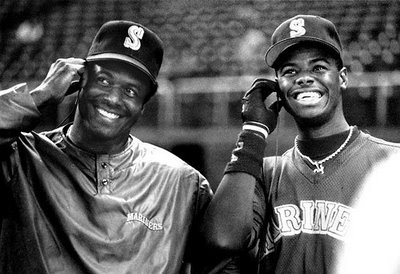
2. Ken Griffey Sr. and Ken Griffey Jr.
Griffey Sr. was a fine outfielder, compiling over 2,000 hits in a big league career that spanned 19 seasons. However, when it came to power he couldn't hold a candle to his son, who slammed 630 home runs and led the league four times. Griffey Jr. also won 10 straight Gold Gloves and made 13 All-Star teams in his 22 seasons. Both Griffeys played together on the Seattle Mariners in 1990 and 1991, playing 51 games together and even hitting back-to-back home runs off Kirk McCaskill on September 14th, 1990.

3. Gus Bell and Buddy Bell
Gus starred for the Cincinnati Reds during the 1950s, making four All-Star teams and driving in 100 runs four times. His son, Buddy, was also good with the stick but earned a reputation as one of the best defensive third baseman to ever play the game. Buddy received six straight Gold Gloves for his work at the hot corner and played long enough to amass more than 2,500 hits.

4. Cecil Fielder and Prince Fielder
"Big Daddy" starred as the game's premier power hitter during the early '90s, smashing 51 homers in 1990 and 44 the following year while finishing second in the MVP voting both times (to Rickey Henderson and Cal Ripken Jr., respectively). In 2007, his son emerged as an elite slugger by blasting 50 home runs at the tender age of 23. Prince has since joined Miguel Cabrera in Detroit to form one of the scariest slugging tandems in modern times.

5. Felipe Alou and Moises Alou
Both played 17 seasons and accumulated over 2,100 base hits. Felipe made three All-Star squads and twice led the majors in hits. His son Moises was a bit more accomplished, making six All-Star teams, slugging 332 home runs and batting .303/.369/.516 for his career.

Honorable mention: Mel Stottlemyre and Todd Stottlemyre, Ray Boone and Bob Boone, Sandy Alomar Sr. and Roberto Alomar

Sunday, June 16, 2013

Working the Count Works

Some sportswriters, Tom Verducci among them, have called out the passive approach of major league hitters who take pitches in the hopes of grinding out at-bats and drawing walks. Because hitters are striking out more than ever before, the critics say the "Moneyball approach" not working.

Never mind the fact that hitters are seeing the same amount of pitches per plate appearance as they did 20 years ago, or that contact rates have more or less held steady. I came across some interesting numbers in today's Boston Globe, numbers that made me think. Here are the four players who have taken the most called strikes this year:

1. Matt Carpenter (.324/.408/473)
The leadoff man for Mike Matheny's St. Louis Cardinals is a patient hitter, and even though he leads the league in called strikes he doesn't whiff very often with a 12.6 K%.rate. He can afford to take pitches because he's so great at making contact; Carpenter gets the bat on the ball on over 97 percent of pitches in the strike zone that he swings at.

2. Joe Mauer (.327/.415/.482)
Plunging contact rates on pitches outside the strike zone have cause Mauer's strikeout rate to rise every year since 2010, but that hasn't stopped him from producing excellent results at the plate. More K's haven't translated into more power from Mauer, who hasn't come remotely close to matching the 28 bombs from his '09 MVP campaign.

3. (tied) Mike Trout (.301/.375/.547) and Mike Napoli (.262/.347/.467)
Trout's numbers are down slightly from his superlative rookie season even though he's trimmed his strikeout rate from 21.8% to 18.1%. Napoli's fanned in over one-third of his plate appearances so far, but he's always been a feast-or-famine hitter. Chris Carter is the only player who's struck out more this year, but Napoli's made up for it with lots of doubles and RBI.

Those are four tremendous ballplayers. Mauer's an MVP, Trout should have been MVP, and Napoli's a former All-Star. Carpenter deserves to make the All-Star team this summer, as do Mauer and Trout. Doesn't sound like taking strikes is adversely affecting their performance at the plate. Maybe more, not fewer, hitters should do the same.