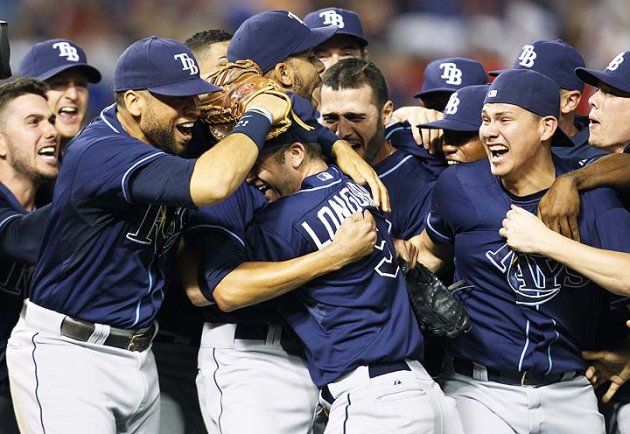
Division series play begins tonight, so here's my abbreviated look at the first round of postseason matchups.
Red Sox (97-65) vs. Rays (92-71)
I think Tampa Bay holds the slight edge with their starting pitching, but the well-rested Red Sox should be able to hold their own with Jon Lester, Clay Buchholz, John Lackey, and Jake Peavy. Whatever advantage the Rays hold on the mound is more than made up for by Boston's bats, which scored more runs than every team in baseball this year. That, plus their homefield advantage, should be enough to put them over the top in what will be a hard-fought series between these divisional rivals.
Red Sox in 5
A's (96-66) vs. Tigers (93-69
Not only does Detroit have the best hitter in baseball (Miguel Cabrera) anchoring a top-shelf offense, but they also boast what may be the most fearsome rotation in these playoffs with likely Cy Young winner Max Scherzer, former Cy Young winner/MVP Justin Verlander and AL ERA leader Anibal Sanchez (plus the always-underrated Doug Fister). Better yet, they're not missing any major pieces because of injuries. The Moneyball A's are well-constructed for the regular season (read: super-deep), but the Tigers have so much more talent. Besides, Billy Beane's teams almost always lose in the Division Series.
Tigers in 4
Cardinals (97-65) vs Pirates (94-68)
The Pirates have the better narrative, but St. Louis is clearly the superior team. Their 101-61 Pythagorean Record speaks for itself. They have a devastating lineup that paced the NL in runs, doubles, and OBP, a legit MVP candidate (Matt Carpenter) and a bona fide ace in Adam Wainwright. Pittsburgh has the likely MVP in Andrew McCutchen, but will he have enough help? I don't see Neil Walker, Starling Marte, and the strikeout-prone Pedro Alvarez having much of an impact. I'm not ready to trust either A.J. Burnett or Francisco Liriano, either.
Cardinals in 3
Dodgers (92-70) vs Braves (96-66)
Even without Matt Kemp, Andre Ethier and Josh Beckett, the star-studded Dodgers still have more than enough talent to make a World Series run. Injuries to Kemp and Ethier make the lineup more top-heavy, but it remains dangerous with Yasiel Puig, Hanley Ramirez, Carl Crawford and Adrian Gonzalez. LA's rotation, spearheaded by former Cy Young winners Clayton Kershaw and Zack Greinke, is truly frightening.
Atlanta's all-or-nothing approach at the plate produced the most home runs and strikeouts in the Senior Circuit in 2013, but given that a) the cold weather makes it harder to go yard and b) strikeouts are more prevalent in the postseason due to superior pitching, this trade-off will likely hurt the Braves more than it helps them. And while Atlanta's arms posted the best ERA in the National League, I still prefer LA's big guns on the mound in a short series such as this.
Dodgers in 4
Thursday, October 3, 2013
Tuesday, October 1, 2013
Rays Win Game 163
| After their 5-2 win last night the Rays live to play another day (Yahoo Sports) |
This game--Game 163--wouldn't have happened two years ago. Instead, both teams would be lamenting how they finished one game behind the Cleveland Indians--the true Wild Card winners. But the times, and rules, have changed, so both teams were given a second shot at October baseball.
The Rangers were red-hot, having won seven straight games to close out the year. That sprint to the finish left Ron Washington unable to start Yu Darvish or Derek Holland. He went with 22 year-old rookie Martin Perez, who acquitted himself well this year but wouldn't have been anyone's first choice to start a game of this magnitude.
That's what made the Rays clear favorites to win. In this do-or-die, win-or-go-home cage-match,Tampa Bay turned to its ace and reigning AL Cy Young winner David Price. Putting his postseason struggles against Texas aside, the three-time All-Star is widely considered to be one of baseball's best pitchers and his availability seemed likely to swing the game in Tampa Bay's favor.
Sure enough, it did. Price pitched the Rays into the playoffs by going the distance, scattering seven hits and allowing just two runs. Tampa Bay staked him to an early lead, drawing first blood on Delmon Young's sac fly in the top of the first. The Rays led from that point forward, and with Price pitching their lead was never seriously threatened.
Perez didn't pitch poorly, but simply wasn't good enough to outduel Price. He departed in the sixth after striking out Ben Zobrist to open the frame, giving way to Alexi Ogando. Texas was losing 3-1 at the time, but doubles from Evan Longoria and David DeJesus made that deficit 4-1 before Ogando could close out the inning.
The Rangers responded with a run in their half of the inning on an RBI double from Alex Rios, but Price shut them out for the rest of the night. Tampa added an insurance run in the top of the ninth to make the score 5-2. Rather than tap into his bullpen, Joe Maddon let Price, who had thrown 108 pitches through eight, come back out to finish what he started. He finished strong, setting down Adrian Beltre, A.J. Pierzynski and Nelson Cruz in order.
(Speaking of Cruz, all the hoopla surrounding his return from a 50 game suspension turned out to be much ado about nothing. Cruz was a non-factor, going 0-for-4 with a strikeout).
Price put the team on his back, but so did Evan Longoria, who continued his run of monster games on the final day of the season. Longo went 3-for-4 with a single, double, and two-run homer. The long ball was his seventh career blast on the final day of the season, breaking a tie with Stan Musial. Longoria clearly understands the importance of saving his best for last.
So for the second year in a row, the Rangers are headed home after narrowly missing the postseason and Washington will likely be fired as a result. The Rays travel to Cleveland, where they will take on Terry Francona's Indians tomorrow night in another sudden-death affair--the Wild Card (aka coin toss) playoff game. Tampa Bay will pin its playoff hopes on Alex Cobb, while Cleveland will ride rookie Danny Salazar, who has just ten big league starts under his belt.
Obviously this game could go either way, but my gut tells me the Rays will come out on top. I say Tampa Bay 4, Cleveland 3.
My Award Ballot
AL MVP
1. Miguel Cabrera
2. Mike Trout
3. Chris Davis
4. Robinson Cano
5. Josh Donaldson
6. Adrian Beltre
7. Evan Longoria
8. Adam Jones
9. David Ortiz
10. Jason Kipnis
Felt bad leaving out: Dustin Pedroia, Edwin Encarnacion, Manny Machado
AL Cy Young
1. Max Scherzer
2. Chris Sale
3. Yu Darvish
4. Hisashi Iwakuma
5. Anibal Sanchez
Felt bad leaving out: Bartolo Colon, Clay Buchholz, Felix Hernandez
AL Rookie of the Year
1. Wil Myers
2. Chris Archer
3. Jose Iglesias
AL Comeback Player of the Year--John Lackey over Victor Martinez
AL Manager of the Year--Terry Francona over John Farrell
NL MVP
1. Andrew McCutchen
2. Paul Goldschmidt
3. Matt Carpenter
4. Clayton Kershaw
5. Joey Votto
6. Carlos Gomez
7. Freddie Freeman
8. Yadier Molina
9. Shin-Soo Choo
10. Hanley Ramirez
Felt bad leaving out: Jay Bruce, Buster Posey, Matt Holliday
NL Rookie of the Year
1. Jose Fernandez
2. Yasiel Puig
3. Julio Teheran
Felt bad leaving out: Shelby Miller, Jedd Gyorko, Nolan Arenado
NL Cy Young
1. Clayton Kershaw
2. Adam Wainwright
3. Jose Fernandez
4. Cliff Lee
5. Matt Harvey
NL Comeback Player of the Year--Francisco Liriano over Jorge De La Rosa
NL Manager of the Year--Clint Hurdle
1. Miguel Cabrera
2. Mike Trout
3. Chris Davis
4. Robinson Cano
5. Josh Donaldson
6. Adrian Beltre
7. Evan Longoria
8. Adam Jones
9. David Ortiz
10. Jason Kipnis
Felt bad leaving out: Dustin Pedroia, Edwin Encarnacion, Manny Machado
AL Cy Young
1. Max Scherzer
2. Chris Sale
3. Yu Darvish
4. Hisashi Iwakuma
5. Anibal Sanchez
Felt bad leaving out: Bartolo Colon, Clay Buchholz, Felix Hernandez
AL Rookie of the Year
1. Wil Myers
2. Chris Archer
3. Jose Iglesias
AL Comeback Player of the Year--John Lackey over Victor Martinez
AL Manager of the Year--Terry Francona over John Farrell
NL MVP
1. Andrew McCutchen
2. Paul Goldschmidt
3. Matt Carpenter
4. Clayton Kershaw
5. Joey Votto
6. Carlos Gomez
7. Freddie Freeman
8. Yadier Molina
9. Shin-Soo Choo
10. Hanley Ramirez
Felt bad leaving out: Jay Bruce, Buster Posey, Matt Holliday
NL Rookie of the Year
1. Jose Fernandez
2. Yasiel Puig
3. Julio Teheran
Felt bad leaving out: Shelby Miller, Jedd Gyorko, Nolan Arenado
NL Cy Young
1. Clayton Kershaw
2. Adam Wainwright
3. Jose Fernandez
4. Cliff Lee
5. Matt Harvey
NL Comeback Player of the Year--Francisco Liriano over Jorge De La Rosa
NL Manager of the Year--Clint Hurdle
Monday, September 30, 2013
Werth Worth it
In a season where they won 86 games, finished second in their division and made a late push for the playoffs, the Washington Nationals were considered disappointments. But Jayson Werth, their highest paid player, put together a terrific season while starting to shed the "bust" label that described his first two and a half seasons with Washington.
How Werth came to be not just the most expensive National, but the 14th most expensive player in baseball history, is well understood. It was autumn, 2010, and Werth was coming off a career year. He had just led the National League in doubles with 46, scored 106 runs, batted .296/.388/.532 and produced around five wins above replacement. He'd also finished eighth in the NL MVP voting for his contributions as the top position player on a 97-win Philadelphia Phillies squad.
Still, the Scott Boras client did not seem likely to command a nine-figure contract on the open market. He was a late-blooming outfielder on the wrong side of 30 who'd never batted .300 or driven in 100 runs in any of his eight seasons. While a very good complementary player, he was not somebody to build a franchise around.
That's what made it so surprising when the Nationals gave him a seven year deal for $126 million, way more than he deserved and way more than anyone else was willing to give him. It was a curious move by Washington at the time given that they had just lost 93 games and were still a few years away from contending. To be fair, they did have a huge void to fill in the middle of their order following the departure of Adam Dunn, who signed his own free agent deal with the Chicago White Sox two days prior. Werth could never dream of matching Dunn's power numbers, but he was a vastly superior all-around player who contributed additional value with his defense and baserunning.
The Nationals improved to 80-81 in 2011, but not because of anything Werth did on the diamond. His OPS plunged more than 200 points, he struck out a career-high 160 times and knocked in only 58 runs. Put it all together and he was barely a one-win player. Washington's fans and media, many of whom weren't excited about Werth's arrival in the first place, soured on him.
In 2012 Werth's performance rebounded, but he missed three months with a broken wrist and didn't hit for much power. He played 81 games that year, his fewest since 2003. FanGraphs and BR both agree that Werth was worth just 0.7 WAR. That didn't stop the Nats from winning 98 games, most in baseball. Young superstars Bryce Harper and Stephen Strasburg sucked up all the press with their flamboyant style of play, so nobody cared too much that Werth's numbers projected to 10 home runs and 62 RBI over the course of a full season.
2013 appeared to bring more of the same disappointing results. Werth got off to a slow start and was hitting just .260/.308/.400 through May 2nd before a strained hamstring forced him back to the Disabled List. He missed a month, but the time off seemed to do him some good. He returned to action on June 4th, and from that day forward he was one of the best hitters in the National League. The 34 year-old batted .334/.421/.569 with 21 homers and 72 RBI the rest of the way, prompting Davey Johnson to move him down from the two hole to maximize his RBI opportunities. For the first time in his Nationals career, Werth proved himself capable of shouldering the offensive burden that a middle-of-the-order hitter is expected to carry.
Werth, who got stronger as the season wore on, was particularly lethal over a two month stretch from June 30th-August 29th in which he batted a scalding .393/.484/.669. When Washington roared back into contention in September, they were able to do so largely because Werth's heavy hitting had kept them afloat all summer. Though the Nats ultimately fell short of the postseason, Werth established personal bests in batting average (.318), OPS (.931), OPS+ (154) and bWAR (4.8). He led the team in most major offensive categories and was the team's most valuable position player.
While Werth's big season has done much to salvage his reputation, he still has four years and $83 million remaining on his backloaded contract. As he gets deeper into his thirties, Werth will have a hard time staying healthy and productive enough to justify that salary. But let the record show that in 2013, at least, he was worth every penny.
How Werth came to be not just the most expensive National, but the 14th most expensive player in baseball history, is well understood. It was autumn, 2010, and Werth was coming off a career year. He had just led the National League in doubles with 46, scored 106 runs, batted .296/.388/.532 and produced around five wins above replacement. He'd also finished eighth in the NL MVP voting for his contributions as the top position player on a 97-win Philadelphia Phillies squad.
Still, the Scott Boras client did not seem likely to command a nine-figure contract on the open market. He was a late-blooming outfielder on the wrong side of 30 who'd never batted .300 or driven in 100 runs in any of his eight seasons. While a very good complementary player, he was not somebody to build a franchise around.
That's what made it so surprising when the Nationals gave him a seven year deal for $126 million, way more than he deserved and way more than anyone else was willing to give him. It was a curious move by Washington at the time given that they had just lost 93 games and were still a few years away from contending. To be fair, they did have a huge void to fill in the middle of their order following the departure of Adam Dunn, who signed his own free agent deal with the Chicago White Sox two days prior. Werth could never dream of matching Dunn's power numbers, but he was a vastly superior all-around player who contributed additional value with his defense and baserunning.
The Nationals improved to 80-81 in 2011, but not because of anything Werth did on the diamond. His OPS plunged more than 200 points, he struck out a career-high 160 times and knocked in only 58 runs. Put it all together and he was barely a one-win player. Washington's fans and media, many of whom weren't excited about Werth's arrival in the first place, soured on him.
In 2012 Werth's performance rebounded, but he missed three months with a broken wrist and didn't hit for much power. He played 81 games that year, his fewest since 2003. FanGraphs and BR both agree that Werth was worth just 0.7 WAR. That didn't stop the Nats from winning 98 games, most in baseball. Young superstars Bryce Harper and Stephen Strasburg sucked up all the press with their flamboyant style of play, so nobody cared too much that Werth's numbers projected to 10 home runs and 62 RBI over the course of a full season.
2013 appeared to bring more of the same disappointing results. Werth got off to a slow start and was hitting just .260/.308/.400 through May 2nd before a strained hamstring forced him back to the Disabled List. He missed a month, but the time off seemed to do him some good. He returned to action on June 4th, and from that day forward he was one of the best hitters in the National League. The 34 year-old batted .334/.421/.569 with 21 homers and 72 RBI the rest of the way, prompting Davey Johnson to move him down from the two hole to maximize his RBI opportunities. For the first time in his Nationals career, Werth proved himself capable of shouldering the offensive burden that a middle-of-the-order hitter is expected to carry.
Werth, who got stronger as the season wore on, was particularly lethal over a two month stretch from June 30th-August 29th in which he batted a scalding .393/.484/.669. When Washington roared back into contention in September, they were able to do so largely because Werth's heavy hitting had kept them afloat all summer. Though the Nats ultimately fell short of the postseason, Werth established personal bests in batting average (.318), OPS (.931), OPS+ (154) and bWAR (4.8). He led the team in most major offensive categories and was the team's most valuable position player.
While Werth's big season has done much to salvage his reputation, he still has four years and $83 million remaining on his backloaded contract. As he gets deeper into his thirties, Werth will have a hard time staying healthy and productive enough to justify that salary. But let the record show that in 2013, at least, he was worth every penny.
Labels:
2013,
Baseball,
Jayson Werth,
MLB,
Nationals,
Washington
Saturday, September 28, 2013
Cano's Crazy Contract
| How valuable is Cano? We're about to find out (NBC) |
He's ridiculous, right? Nobody, except maybe Mike Trout, is worth that kind of investment. He wants more money than Alex Rodriguez and Albert Pujols, who signed their record-deals at roughly the same age and were already much more accomplished. By the time they turned 30 they were slam-dunk Hall of Famers, two of the greatest players of all-time. Cano, who has zero Hall of Famers among his ten most similar batters, still has quite a ways to go.
First on that list is Chase Utley, who dropped off significantly after turning 31--the same age Robinson Cano will be on October 22nd. Cano's second closest comp is David Wright, who signed a lengthy contract extension with the other New York team just last winter. Wright received an eight year deal worth $138 million that made him the highest paid player in franchise history.
$138 million is a lot of money. It's also a long way from $305 million.
But Cano's been better than Wright, and just about every other ballplayer, for that matter, over the past four years. Since Opening Day 2010 only Miguel Cabrera has been more valuable per FanGraphs WAR and only by about half a win per season. Only Prince Fielder has played more games. Only Cabrera has more RBI. Nobody has more doubles. Cano has emerged as the best player on a team loaded with All-Stars and future Hall of Famers. He is a superstar in every sense of the word.
But Cano will be 31 when his next contract begins, and aging curves for second basemen in their thirties are pretty scary. He may have a few more big seasons, but his best years are probably already behind him. With so much money tied up to Rodriguez, Mark Teixeira, and CC Sabathia, the last thing New York needs is another albatross contract weighing down its payroll. Even though they have the money they can't afford to break the bank for Cano, not if they want to get under the laxary tax threshold any time this decade.
It's obvious the Yankees need to keep Cano, but at what cost? His market value will be determined by the level of interest he draws from other teams. If nobody makes Cano a serious offer, New York will have all the power at the bargaining table. But if someone like the Dodgers gets involved in a bidding war, then the Yankees will have a tough decision to make.
Will they do what they've always done: open up their checkbooks and pay top-dollar to secure elite talent? Or will they change course by tightening their belt and letting their most indispensable player walk?
I'm pretty sure New York will pay almost any price to keep Cano in pinstripes. I have no idea how high they're willing to go, but I'm willing to bet it's a good deal short of $300 mil.
Subscribe to:
Posts (Atom)