Monday, January 12, 2015

Should Shields Get Nine Figures?

James Shields is going to become very rich very soon (Sports Now)
The first big name starting pitcher to go off the board this winter was Jon Lester, who set the market by inking a six-year, $155 million deal with the Chicago Cubs. James Shields, Lester's former AL East rival, appears next to go. According to Ken Rosenthal, Shields has received a reported five-year, $110 million contract offer from an unknown team. Since his agent isn't Scott Boras, the offer may well be legit.

The obvious question: is Shields worth that kind of money?

Up to now and in a vacuum, Shields's' performance suggests he is. In three of the past four years he was worth north of $20 million, and in the one year he wasn't (2012) he was valued at $17.4. Adjusting for inflation, $22 million per year seems perfectly reasonable for someone who's a) been worth it in the past and b) a free agent, thus requiring a mark-up for his services.

Pitchers are inherently risky investments because of their propensity for getting hurt, but Shields is as safe as any hurler can be. He's topped 30 starts and 200 innings eight years running, leading the sport in innings pitched during that time. The definition of a workhorse, Shields has never spent a day on the Disabled List. He takes the ball every fifth day and can be counted on to pitch deep into games. Last year, for instance, he completed at least six innings in all but four of his 34 starts. Shields soaks up innings and preserves the bullpen.

What's more, Shields is also a great pitcher. Over the past four years, while averaging 233 innings per year, he's posted a 3.17 ERA (124 ERA+), 1.16 WHIP, 3.49 FIP, and 3.51 K/BB ratio. Shields has been one of the 10 most valuable pitchers in baseball during that time, beating out the likes of Zack Greinke, Madison Bumgarner, and Jered Weaver. Aside from his rookie year and a disastrous 2010, he's been a better than average pitcher every year of his nine-year career.

Problem is, all those innings take a toll on a pitcher's arm, making it fair to ask how Shields will hold up. Last year, he threw more pitches than anyone else in baseball, something that will likely come back to haunt him next year. It's also worrisome that his strikeout rate, which plummeted from almost a better per inning in 2012 to 7.1 K/9 last year--roughly league average. He's not missing bats with the same regularity, and thus relying more on his defense and park for success. That was fine in Tampa Bay and Kansas City, where he benefitted from pitcher-friendly parks and strong defenses behind him (not to mention the Royals' shutdown bullpen), but might not be the case elsewhere. His hit rate has risen every year since 2011, and will continue to do so should his strikeout rate continue to fall.

On that note, it's also concerning that Shields has allowed more than a home run per inning throughout his career despite pitching in home parks that are notoriously tough on power hitters. It's hardly surprising given his fly ball tendencies, but definitely something to keep an eye on. A move to a homer-friendly venue would definitely be troublesome for him.

At 33, Shields is also in the decline phase of his career, even more so than a position player of the same age because pitchers typically peak earlier. To earn his keep, Shields will need to be worth about three wins per year over the life of the contract, which will cover his age 33-37 seasons. That would entail replicating his 2014 season (3.3 bWAR) five times over, which doesn't seem likely to happen. His 2014 (3.3 bWAR) was already a bit of a step down from his great 2013 campaign (4.1 bWAR).

If we project a similar annual decline going forward, then Shields will only have one season that comes close to matching his paycheck. If we conservatively estimate he'll lose about half a win per season, then he'll have three more average to above average seasons but will still come up short on value. I see this as the most likely scenario; that Shields will be effective for two or three more years, than probably fall apart. The only way Shields will be worth nine figures is if he a) stays healthy and b) suffers no noticeable drop-off in performance. He'll need to be a rich man's Mark Buehrle for the next half-decade.

Based on how many recent aces have broken down in their mid-30s, that seems virtually impossible. Pedro Martinez had his last great year at 33 and started just 57 games over the ensuing four years, which proved to be the final seasons of his career. Roy Halladay was Cy Young runner-up at 34, mediocre at 35, and a dud at 36. Johan Santana, though not officially retired, last pitched at 33 and is probably done for good. Josh Beckett just retired at 34. CC Sabathia, who carried a similarly large workload for more than a decade, has been a disaster at 32 and 33. Justin Verlander, the best pitcher on the planet in 2011 and 2012, looks washed-up, and he's not even 32 yet. The list goes on an on.

Jay Jaffe showed there's almost no way Shields will be worth the money (on what will probably be his last contract), but any team that signs him has to know that. They're banking on a few more good years from Shields and will be okay with absorbing a loss on the back end. After all, a team that adds Shields is trying to win now, and there's no question he'll help them do so. He's a boon to any rotation, likely an ace or strong number two depending on where he lands. He'd be better off pitching in the National League and/or in a big ballpark, obviously, but his solid defense-independent numbers suggest that he'll thrive wherever he goes.

And while his plunging strikeout rate is discouraging, there's nothing else to suggest he's going to fall off a cliff next year. Accordingly, Steamer projects him to top 200 innings again next year and be worth three fWAR. If he does that, he'll not only earn his paycheck, but he'll also be making a big difference for a team in the postseason hunt. That's why I'd like to see the Red Sox go after him, if only because they don't have anyone who bears even a passing resemblance to an ace (not that one is a requisite for making the postseason, but it sure would be nice to have one). With Shields, they'd be the best team in the AL East, but it doesn't look like that's going to happen.

Whoever lands Shields is going to get a great pitcher, but not for long.

Saturday, January 10, 2015

Pats Beat Baltimore

Amendola was the unlikely hero with two TD catches (NY Post)
The New England Patriots won a nailbiter, narrowly edging out the Ravens 35-31 in today's divisional playoff game.

Their fifth playoff bout produced an instant classic, a grueling fight to the finish on a bitterly cold day in Foxborough. Twice the Patriots went down by 14 points, and twice they stormed right back. Baltimore burst from the gate, scoring touchdowns on their first two drives and jumping out to a 14-0 cushion. New England rallied to tie in the second quarter and was driving towards the end of the half, only to have their potential go-ahead possession busted by a Tom Brady pick. Joe Flacco made the Pats pay, slinging his third TD pass of the game to Owen Daniels shortly before the first half closed.

New England got the ball to start the second half, but once again Baltimore scored first, this time on a Flacco pass to Justin Forsett. That gave the Ravens their second 14-point advantage of the evening, but again they failed to hold it. Brady and the Pats came storming down the field, using a succession of quick passes that culminated with a end zone strike to Rob Gronkowski

The highlight of the game came New England's next possession. It was a flawlessly executed flea-flicker where Brady passed to Julian Edelman on his left. Edelman, a quarterback for three years at Kent State, turned and fired a perfect pass down the sideline to Danny Amendola, who ran into the endzone for a most unlikely touchdown (and his second of the game).

The score remained locked at 28-28 into the fourth quarter, but not for long as the Ravens took their third lead of the game on a Justin Tucker field goal. The Patriots immediately answered with Brady's third passing TD of the game (and fourth overall). The pass to Brandon LaFell was Brady's 46th career postseason touchdown, passing Joe Montana for most ever.

More importantly, New England had its first lead of the game. The Patriots locked it down by intercepting Flacco in their own end zone with little more than two minutes remaining. It was the second time they picked off Flacco in the second half, whose streak of 198 consecutive passes without a pick in the postseason came to an end at the worst possible time. 

Flacco had been impeccable up to that point, adding to his sterling postseason resume by tallying four touchdown passes and outplaying Brady for much of the game. But when his team needed him the most, with him engineering a season-saving drive on the road, he choked. His deep throw went off target, fell into the hands of Duron Harmon, and that mistake effectively doomed their chances.

The $120 million quarterback, whom the NBC announcers annointed Mr. January at some point during the game (looks like they spoke too soon!), got the ball back with four seconds left in regulation. He received the snap, eluded New England's pass rush, and hurled a heart-stopping hail mary into New England's endzone. Thankfully, the Patriots' defenders far outnumbered the Ravens' receivers, and Devin McCourty was able to bat Flacco's prayer out of the end zone to seal the victory.

It doesn't get much closer than that. Thankfully, the Patriots live to fight another day and will host the AFC title game next weekend, likely against Peyton Manning's Denver Broncos. After exacting revenge on the Ravens for the 2013 AFC championship game, it would be nice if New England could do the same against Denver for last year's title game. With the weather expected to be much less favorable than the balmy 60 degree day in Colorado last January, look for Brady to get the best of his archrival once again.

Howard Has to Go

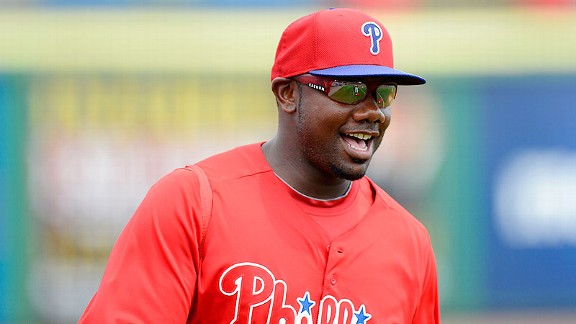
The Phillies have made it clear that Howard has to go, but where? (ESPN)
After reading up on the latest Ryan Howard rumors, I've concluded that he's the least desirable player in baseball. His team doesn't want him, and apparently neither does anyone else. Probably because he's the new (and more expensive) Adam Dunn, by which I mean the washed-up version of Dunn who struggled to hit .200 with 20 home runs and still struck out a ton last year.

Howard has always been a three true-outcome hitter, but that was perfectly fine when he was cranking 45 home runs and driving in 140 runs. Those days are long gone, however, and they're never coming back. Howard's two beneficial outcomes--walks and homers--are happening less frequently while his worst outcome (the dreaded strikeout) is occurring more often:

Year
HR%
BB%
K%
2011
5.1
11.7
26.7
2012
4.8
8.6
33.9
2013
3.5
7.3
30.3
2014
3.6
10.3
29.3

These troubling trends have diminished Howard from a great hitter in 2011 (126 OPS+) to a below average one by 2014 (93 OPS+). Already a liability in the field and on the bases, Howard is now deficient in all areas of the game. Sure enough, he was below replacement level last year (and in 2012, for that matter).

Like the recently-retired Dunn, Howard is unplayable on defense, so incompetent in the field that even first base is out of the question. The 35 year-old is a DH-only at this point. Problem is, he plays for a National League team (the Phillies). Philadelphia would love to trade him, but good luck finding someone to take him off their hands.

Because in addition to being a big-bodied 35 year-old in steep decline, Howard still has two years remaining on his ill-advised five-year, $125 million contract extension he signed with Philadelphia prior to the 2012 season, plus a team option for 2017 that, barring a Barry Bonds or David Ortiz-esque renaissance, seems guaranteed to be bought out (at a cost of $10 million). In order to move Howard, the Phillies are going to have to eat a considerable chunk of that, but it's better than cutting him outright for nothing in return.

Even Ruben Amaro, Jr., Philly's clueless GM, has realized it's time to move on. He's finally kickstarting the rebuild process in Philadelphia, albeit two or three years too late. He already traded Jimmy Rollins, who was actually still useful. Jonathan Papelbon is likely headed out the door, and Cliff Lee will probably be gone next summer, too. Pretty soon it's going to be Chase Utley and a bunch of guys.

So it's clear Howard has to play elsewhere next year, but where will he land? Surely someone could find a spot for him, as he's not completely useless at this point. He still has above average power and gets on base at a league average rate. He's not an everyday player anymore, especially against lefties, but he'd be a great fit for an AL team seeking power, especially if said team plays in a hitter-friendly park.

He'd probably do really well with the Yankees, but they've got plenty of DH options between Alex Rodriguez and Carlos Beltran. The Orioles could use him after losing Nelson Cruz, and like New York have a ballpark that's well-suited to Howard's strengths. The Indians, perhaps? The Tigers? (if they want to see firsthand how Prince Fielder would have aged?).

Wherever he goes, the Phillies have made one thing abundantly clear. It's closing time, Ryan Howard, and you can't stay here.

Best Power Pitchers

With the recent, near-unanimous election of Randy Johnson to the Hall of Fame, I started thinking about power pitchers. After all, Johnson blew into Cooperstown the same way he blew away batters. But was he the best power pitcher of all-time? It's close, but I don't think so.

The candidates (based purely on strikeouts and K/9):

Nolan Ryan
The Ryan Express fanned an unfathomable 5,714 hitters over the course of his 27-career. He also holds the single-season record with 383 whiffs in 1973, a record that seems unlikely to ever be broken in the age of five-man rotations (Ryan completed 326 innings that year). Ryan won 11 strikeout titles and led the league in K/9 a dozen times. His 6.6 H/9 rate is also the best of all-time.

Randy Johnson
Johnson's 4,875 strikeouts are second-highest all-time and most ever for a lefty. He won nine strikeout titles (10 including 1998, when he switched leagues midway through the season), topping 300 in a season seven times and 290 three other times. Eight times he had the highest strikeout rate in baseball, and his 10.6 K/9 rate is the best of all-time. Had the Big Unit pitched as many innings as Ryan, he would have totaled 6,349 strikeouts.

Roger Clemens
Clemens is third on the all-time list with 4,672 punchouts. Rocket led the league in that statistic five times and three times had the highest strikeout rate. Though he never reached 300 strikeouts in a single season, he surpassed 200 12 times.

Bob Feller
Even before missing four prime seasons to World War II, Feller's legacy as one of the all-time great power pitchers was secure. The Heater from Van Meter (Iowa) paced the majors in strikeouts in the four seasons before the war and in the three seasons immediately after, including a record 348 in 1946 (since broken). Rapid Robert also led the loop in K/9 five times, and when he retired in 1956 only Cy Young and Walter Johnson had accumulated more strikeouts. Unlike the others, who all remained great pitchers deep into their 30s and 40s, he peaked very early and never won a strikeout title after turning 30. His lack of longevity will hurt him in these rankings.

Walter Johnson
Johnson was like the Babe Ruth of pitchers, with strikeouts instead of home runs. The Big Train won eight consecutive strikeout crowns from 1912-1919 and a dozen in all. He had the Junior Circuit's highest K/9 rate seven times. True, those were the days when 150 strikeouts were enough to lead the league, but Johnson regularly exceeded 200 during his prime (seven straight years from 1910 to 1916) and even topped 300 twice. 300 strikeouts back then would be equivalent to around 500 today. He retired second in strikeouts behind the one and only Cy Young. Of course, much of Johnson's best years came during the deadball era, so I have to discount his statistics significantly. Once the live ball was introduced in 1920, he wasn't nearly as dominant, though I'm sure age and insane workloads had something to do with that as well.

The list:
1. Ryan
2. R. Johnson
3. W. Johnson
4. Clemens
5. Feller

Best Second Basemen

Hornsby has to be considered the best second baseman of all-time (I70Baseball)
Craig Biggio's overdue election to the Hall of Fame got me thinking about where he ranks among the best second basemen of all-time. Here's the list I came up with.

1. Rogers Hornsby (127 bWAR, 130.3 fWAR, 97.5 WAA)
While Babe Ruth was dominating the American League during the Roaring Twenties, Hornsby was doing the same to the National League. The best righthanded hitter the game has ever known batted over .400 three times, establishing the modern record of .424 in 1924, and averaged .382 from 1920 through 1929, winning seven batting titles. Rajah also had exceptional power for a second baseman, winning two Triple Crowns and nine slugging titles on his way to blasting 301 home runs and 541 doubles. Oh, and I'm just realizing this now, but he has a 1.010 career OPS (175 OPS+). Not a misprint. He may have been mediocre in the field and on the bases, but when you hit like that (.358/.434/.577) it makes up for a multitude of sins.

2. Eddie Collins (123.9 bWAR, 120.5 fWAR, 78.8 WAA)
Collins compiled some astonishing statistics in a Hall of Fame career that spanned 25 years. A .333 career batter, he stroked 3,315 hits, scored 1,821 runs, drove in another 1,300, stole 741 bases, and worked 1,499 walks. He ranks 10th all-time in WAR by position players (13th overall), 11th in oWAR and hits, 12th in OBP (at .424) and triples, and eighth in steals. He also had a winning reputation, starring on four World Series champs and six pennant winners.

3. Nap Lajoie (107.4 bWAR, 102.2 fWAR, 68 WAA)
Lajoie was a slightly better hitter than Collins because of his superior power, but Collins had more speed and was the better all-around player. He was also better for longer, which gave him the slight edge. Lajoie's final numbers are actually very similar to Collins's, as he batted .338 for his career with 3,243 hits. Until Ty Cobb came along, he was the best hitter in the American League, winning five batting crowns and batting as high as .426 in 1901, when he won the sabermetric Triple Crown. His 657 doubles are seventh-most all-time.

4. Joe Morgan (100.3 bWAR, 98.8 fWAR, 63.2 WAA)
At his peak in the mid-70s, Little Joe was one of the most complete ballplayers there ever was. The back-to-back MVP contended for batting titles, walked a ton, hit for power, drove in and scored loads of runs, stole 60+ bases, and provided Gold Glove defense. fWAR has him as the best position player of the 1970s, and I agree. Still, as good as Morgan's numbers were, it's important to remember how depressed they were by playing his entire career during a pitcher's era and spending the first nine years of it in Houston. His neutralized batting line of .285/.408/.447 adds 36 points to his actual OPS. He also would have come close to 300 home runs, surpassed 2,000 walks and added an extra 200 runs and hits. Morgan's the best second baseman of the integrated era, for sure.

5. Charlie Gehringer (80.6 bWAR, 78.6 fWAR, 45.4 WAA)
Whereas Morgan was hurt by the era in which he played, Gehringer definitely received a boost from his. Not only did his peak coincide with the high-scoring 1930s, but he also reaped the benefits of playing half his games at Tiger Stadium. When neutralized, his OPS falls nearly 60 points as his .320/.404/.480 batting line becomes .298/.379/.448. Still phenomenal for a second baseman, but not as gaudy as his raw totals suggest. Nicknamed the Mechanical Man, he was machine-like in that he was a lock to score 100 runs, bang out 200 hits, and bat well over .300 every year. He was one of the five best position players during the Depression years, a notch below Jimmie Foxx, Lou Gehrig, and Mel Ott but better than just about everyone else.

Sandberg was the NL's best second basman in the '80s and early '90s (MyCubsToday)
6. Ryne Sandberg (67.5 bWAR, 60.9 fWAR, 38.1 WAA)
A Cubs icon, Sandberg was an outstanding two-way second baseman for much of his 16-year career. He won an MVP, made 10 straight All-Star trips, received nine consecutive Gold Gloves, and earned seven Silver Sluggers. Offensively, he was a great blend of power and speed with 282 home runs, 344 steals, and three 20/20 seasons. He hit as many as 40 home runs in a season--leading the league in 1990--and topped 25 on five other occasions. Remember that he accomplished all this mostly during the 1980s and early 90s, when offense wasn't so easy to come by. For 11 years, from 1982 to 1992, he ranked as one of the five-best position players in baseball. He was also dynamite in the postseason, batting a scorching .385/.457/.641 in 47 October plate appearances. While it's true that the Cubs haven't won a World Series, it's hardly Sandberg's fault.

7. Roberto Alomar (66.8 bWAR, 63.9 fWAR, 32.3 WAA)
The ideal second baseman, Alomar could do it all. He was great in the field (10 Gold Gloves), on the bases (474 steals at 80.6 percent success rate), and at the dish (career .300/.371/.443 hitter). He was the top second baseman when he played (1988-2004), earning 12 straight All-Star nods, four Silver Sluggers, and five top-six finishes in the MVP vote. Fell just eight votes shy of being a first-ballot Hall of Famer only because of a regrettable spitting incident with umpire John Hirschbeck in 1996. Spitting didn't keep Ted Williams out of the Hall of Fame. He's very close to Sandberg, but just a tick below because Sandberg was a better fielder and had more power despite playing in a offense-depressed era.

8. Craig Biggio (65.1 bWAR, 65.1 fWAR, 28.7 WAA)
Biggio was a bit of a compiler--hanging on at the end to get his 3,000th hit--but he was still a very good player for most of his 20-year career. He was tremendous at his peak in the mid-to-late '90s; a doubles machine who walked a lot, stole bases, scored runs by the truckload, and played Gold Glove defense. He was like a better version of Dustin Pedroia for two decades, and as a result his career numbers are absolutely staggering; 1,844 runs, 3,060 hits, 668 doubles, 291 homers, 414 steals, 1,160 walks, and 4,711 total bases. He's also took one for the team more than anyone else, getting plunked 285 times (ouch!). He was easy to overlook when lumbering sluggers like Mark McGwire, Sammy Sosa, Barry Bonds, and Frank Thomas took over the game, but there were few players as well-rounded as Biggio.

9. Bobby Grich (70.9 bWAR, 69.1 fWAR, 43.4 WAA)
Grich was the best second baseman in the American League when he played (1970-1986) and was second only to Joe Morgan, and there's hardly any shame in that. A four-time Gold Glove recipient and six-time All-Star, Grich combined good power (224 home runs) with patience (.371 OBP) and strong defense. He also added a dash of speed, stealing 104 bases throughout his 17 year career. His era and home parks severely dampened his numbers, which in turn led to him failing to get past the first round of Hall of Fame voting. Even so, he's clearly one of the 10 best to ever play the position.

10. Lou Whitaker (74.9 bWAR, 68.1 fWAR, 42.5 WAA)
Whitaker was excellent from start to finish, winning AL Rookie of the Year honors in 1978 and retiring after a career-high .890 OPS in his final season. Whitaker was the American League's top second baseman during the 1980s, when he made five straight All-Star teams, four Silver Sluggers, and three Gold Gloves. He was also remarkably steady, routinely posting high on-base percentages and solid power totals while providing great defense up the middle. The lifelong Tiger teamed with Alan Trammell to form the best double-play combination in baseball history. Last but not least, Whitaker was one of the 10 most valuable position players over the course of his career, nestled between George Brett and Ozzie Smith.

Grich and Whitaker are virtually inseparable value-wise, but I ultimately decided Grich was a hair better because his numbers were severely depressed by the parks he played in while Whitaker was helped by Tiger Stadium. After neutralizing their numbers, Grich's OPS jumps 43 points, from .794 to .837. Whitaker's, on the other hand, rises just 15 points, from .789 to .804. Grich was also better at his peak and relative to his peers. While Trammell was one of the 10 best players of his day, Grich was among the top five.

Note: I didn't include Rod Carew (81 bWAR, 72.3 fWAR, 46 WAA) because he actually spent more time at first base than second.

Honorable Mention: Jeff Kent, Willie Randolph, Joe Gordon, Frankie Frisch