Saturday, October 24, 2015

Mets Miracle Run Continues

The Mets have been unbeatable over the past three months (CBS New York)
Three months ago the New York Mets were one game over .500. Now they're in the World Series.

Back in April, not even the most optimistic Mets fans would have predicted that, While New York looked promising with all its young starting pitching, it lacked the bats to complement their bounty of arms. What's more, their rotation was woefully short on experience (excepting Bartolo Colon, of course, who I believe began his career during the Deadball Era). None of their four best starters had completed more than one full season in the Show. Rookie phenom Noah Syndergaard, who began the season in the minors, hadn't started a major league at all, and Matt Harvey was coming off Tommy John surgery. So while the Mets' rotation had the potential to be great, it was also a real wild card.

Their offense, on the other hand, wasn't scaring anybody. New York's lineup looked pretty thin, even by National League standards, and their best hitters (David Wright, Curtis Granderson) were in decline. If anyone needed to load up on bats last winter, it was the Mets, but the best they could get was Michael Cuddyer. When that's you're biggest move of the offseason--signing an oft-injured corner outfielder about to turn 36--and you haven't had a winning season since the second Bush administration, then you're probably not bound for World Series glory.

Especially since the NL East was already a foregone conclusion, what with the Nationals assembling the best team in baseball (on paper). And with three great teams residing in the NL Central, not to mention the Dodgers and reigning World Series champs in the NL West, there just didn't seem to be any room for New York at the postseason table this year. The Mets were still a year or two away.

Or so they seemed. Washington, plagued by injuries and a team-wide malaise, never got going. That allowed the Mets to stay close all summer, even after losing Zack Wheeler for the entire season and Wright for most of it. They weren't playing exceptionally well, barely staying above .500, but the door was wide open if they could just get on a roll.

But for that to happen, New York needed help. Their pitching was great, better than advertised even, but their punchless lineup wasn't scoring enough runs. So Sandy Alderson injected some life into his floundering offense, landing the impact bat New York desperately needed by dealing a pair of minor leaguers to the rebuilding Tigers for Yoenis Cespedes. While at the time viewed as a consolation prize for their failed try at Carlos Gomez, Cespedes was exactly what the Mets needed: a righthanded slugger.

In baseball we tend to overstate the importance of deadline deals. Two-thirds of the season is already in the books by the time these moves are made, so any additions or subtractions aren't going to move the needle much. Had Bryce Harper or Mike Trout been dealt on July 31st this year, they only would have added about three wins to their new teams, which would have made a difference for maybe a handful of clubs. Often times, when teams get hot after adding talent at the deadline, what we're really seeing is a random hot streak (part of the game's natural variance) or an underperforming team playing up to its true talent level (as we saw with this year's Blue Jays). One man can only do so much in baseball, and that's especially true when his impact is limited to just two months.

But as a fan, it's so easy to be seduced by a simple narrative. Toronto wasn't doing so hot, but then they got David Price, and he pitched really well, and they won the division. New York was treading water, until they added Cespedes, and suddenly their anemic offense went bananas. The Blue Jays and Mets were mediocre before they got those guys but were great after so, ipso facto, Price and Cespedes made them become great teams. Obviously that's not true, because we've seen in past years how not even a full season of Mike Trout can turn a flawed team around, but it fulfills our most basic human logic requirements. It makes for a good story--bad at the beginning, acquired elite player in the middle, great by the end.

That's why so many people have been touting Cespedes as an NL MVP candidate, never mind the fact that he spent two-thirds of the season on an American League team. Yes, New York's offense did go crazy after Cespedes arrived, setting a club record for home runs in August and nearly matching their scoring output from the season's first four months in its final two. In truth, though, the Mets' offense dramatically improved for a bunch of reasons; Wright came back, Travis d'Arnaud had a big second half, and other guys started hitting. Cespedes was one of those reasons, but not the reason.
Cespedes sparked New York to the playoffs, or so the story goes (Fox Sports)
But all of that is besides the point. The bottom line is, with Cespedes on board, the Mets took off. They immediately won seven in a row, moving into a tie of first on August 2nd and taking it over for good the following day. Towards the end of August, they won seven in a row again, lengthening their division lead to 6.5 games. The Nats had finally begun playing better but couldn't catch the streaking Mets. New York won eight in a row in early September, burying Washington for good with three weeks left in the season. They stormed to the finish line, winning the division by seven games over the disappointing Nationals.

Then it was on to the NLDS, where they squared off with the star-studded Dodgers. Faced with the seemingly impossible task of beating a team that could throw the two best pitchers in baseball this year--Clayton Kershaw and Zack Greinke--four times in a five game series, the Mets squeaked by, advancing after a come-from-behind 3-2 win in Game 5.

In the NLCS they encountered one of the few teams hotter than them since the trade deadline in the Chicago Cubs. With their bruising, fastball-feasting lineup and a pair of aces, the Cubs appeared to have the upper hand. If any team was equipped to beat New York's flamethrowing rotation, it was Chicago.

The Cubs went down in four.

Now New York is headed to the World Series, something that seemed impossible just a few short months ago (or even a week ago, when they were up against Greinke on the road in Game 5). Despite winning the fewest regular season games of the NL's five playoff teams, the Mets are the last ones standing. They've already accomplished much more than anyone thought possible of them, no matter what happens against the Royals next week, Winning it all would be the cherry on top, but even if they lose the sundae will still taste amazin'.

Thursday, October 22, 2015

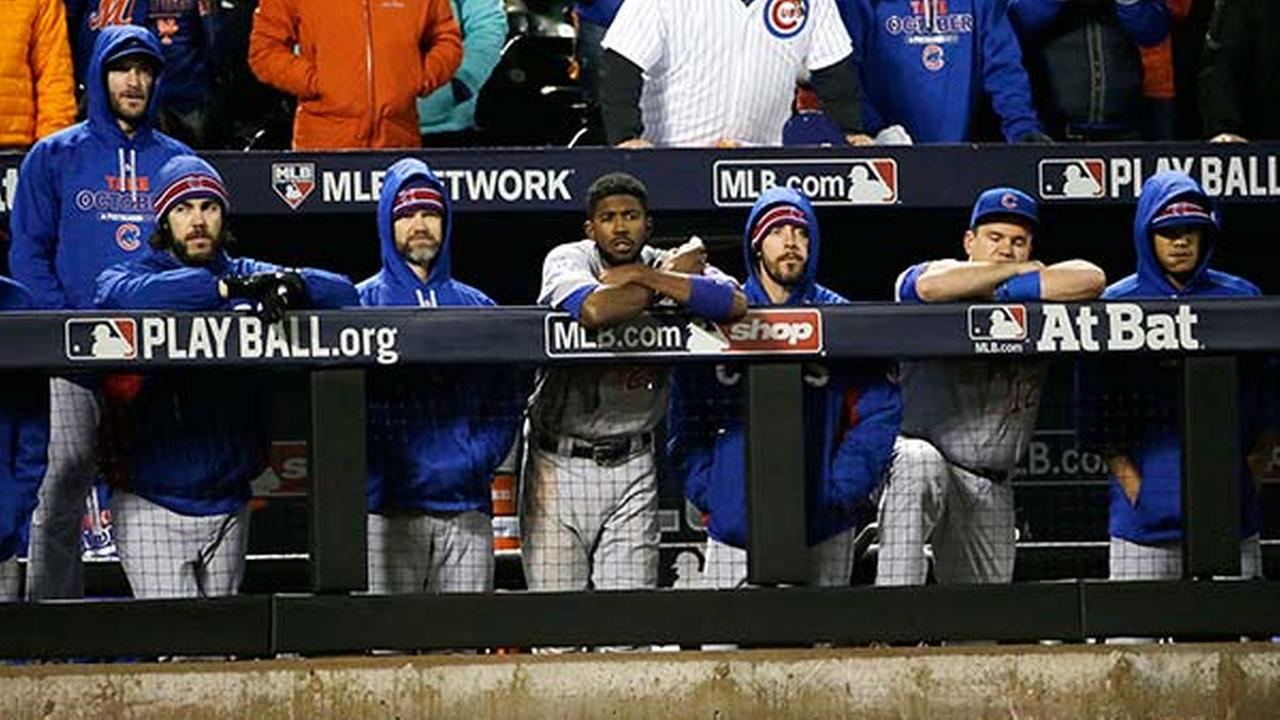
Cubs Come Apart

Chicago's season came to an end last night (ABC Chicago)
To answer my own question, yes.

Great pitching can stop great hitting. Dead in its tracks.

If anyone seemed immune to New York's talented trio of fireballers (messrs. Matt Harvey, Jacob deGrom, and Noah Syndergaard), it appeared to be the Cubs. Chicago's stacked lineup feasted on fastballs, and nobody throws harder than the Mets--the only team with more than one starter whose average fastball velocity exceeded 95 miles per hour during the regular season (they had three, actually. Care to take a guess?). They had an ace coming off the greatest second half ever, another with a sterling postseason record, and the best manager in baseball. What could go wrong?

Chicago getting swept out of the NLCS seemed unfathomable a week ago. The Cubs were on such a roll, it didn't seem like anyone could stop them. They had the best record in baseball from July 29th onward, then proceeded to eliminate the only two teams with better regular season records than them. Everyone was hitting, Jake Arrieta was untouchable, and the defense and bullpen were rock solid. Just four wins shy of the club's first World Series appearance in 70 years, Chicago appeared to be coming together at the perfect time.

Then, against the Mets, they completely unraveled. The hottest team in baseball never even had a lead. New York's vaunted pitching shut down Chicago's vaunted offense, limiting the Cubs to eight runs and 21 hits over the four games.

After taking a commanding 3-0 series lead, the Mets pressed down on the gas pedal in Game 4. They put the game away early, building up a 6-0 lead after two and sending Jason Hammel to an early shower. They cruised from there, extending their lead to 8-1 after adding a pair of insurance runs in the eighth before finally winning 8-3.

And so the 42,000+ crammed into Wrigley's cozy confines hoping to witness the beginning of a miracle comeback instead saw their team's season come crashing down, realizing the wild ride they'd been on for the better part of three months was over. There was no hope in Wrigleyville last night, no illusions about the Cubs coming alive at the 11th hour. Their bats had shown not an ounce of life during the previous three games, and last night was no different as Steven Matz and co. mowed them down once more.

Better to get your brains beaten in than lose by a whisker, as the Royals did last year's World Series, There's nothing heartbreaking about getting blown out--only demoralizing.

In the end, New York's incredible starting pitching and Daniel Murphy (seriously, where did that come from?) proved too much to overcome. I'm just shocked the Cubs, who took down baseball's lone 100-win team in the NLDS, lost four straight. I thought for sure they'd win at least one of the two started by Jon Lester or Jake Arrieta, but when they lost both those games they were effectively done. Once they lost Game 3, too, they were toast. Theo Epstein may be their president, but they are not the 2004 Red Sox.

Sunday, October 18, 2015

NLCS Preview: Can Great Pitching Stop Great Hitting?

Rizzo and his teammates will give the Mets fits (Athlon Sports)
This year's NLCS is, at its core, a battle between the arguably the best starting rotation and best lineup in baseball. The Cubs have good pitchers, of course, and the Mets have some bats too, but that's basically what this series boils down to. Can New York tame Chicago's fearsome lineup?
 
If anyone's up to the challenge, it would be the Mets' nasty trio of Matt Harvey, Jacob deGrom, and Noah Syndergaard, any one of whom is capable of dominating any time they take the mound. They'll need to, as New York's bullpen is pretty iffy before you get to Jeurys Familia in the ninth. Give Cubs hitters enough at-bats against the Mets' soft middle relief, and pretty soon it's going to turn into batting practice.
 
But if anyone's capable of sending those guys to an early exit, it's Chicago.  Because for all New York's pitching, the Cubs simply have too much firepower. There are no holes in that lineup, which is stuffed with power and led the National League in walks. Chicago does strike out a lot--more than any other team in the majors this year--which could easily be exploited by a Mets staff that fanned 8.2 batters per nine during the regular season. But with Anthony Rizzo, Kyle Schwarber, and Kris Bryant all a threat to go yard at any time, the Cubs can make the Mets pay for the few mistakes they make.
 
Chicago's pitching staff is no joke, either, led by Cy Young candidate Jake Arrieta and Jon Lester--a proven postseason stud. If the Mets can beat either of those guys then they'll be in good shape, but the Cubs have a formidable bullpen capable of preventing further damage, thus allowing Chicago's bats to get back into the game.  It also helps that the Cubs have master tactician Joe Maddon at the helm, which ensures that they won't be undone by any Grady Little-esque errors of lunacy.
 
There's no question about who was the better team during the regular season. The Mets won 90 games in a division where three out of the five teams lost at least that many while the Cubs, winners of 97, finished third in their division. New York's lineup is average at best, not to mention heavily dependent on Lucas Duda, Yoenis Cespedes, and Curtis Granderson for production. Neutralize them, and the Mets will be hard-pressed to score. Stifle Chicago's top hitters, however, and the Cubs can still put runs on the board. They can hurt you in so many ways.
 
Like the ALCS, this has all the makings of a great series. Also like the ALCS, I think the team with the better bats will win. Cubs in six.

Saturday, October 17, 2015

ALCS a Heavyweight Showdown

The reigning AL champs are itching to get back to the Series (Bleeding Royal Blue)
Because of baseball's division format, added wild card games, and the sheer randomness that ensues in a best-of-five series, it's become exceedingly rare that the two best teams (record-wise) meet up in the league championship series. This is only the fourth such time in the American League since the wild card era began in 1995.

But in a year where all but three American League teams finished within seven games of .500 (how's that for parity?), the Toronto Blue Jays and Kansas City Royals were head and shoulders above everyone else. The Royals had the league's best record (95-67), and the Blue Jays its top run-differential (+221). They were the only AL teams to top 90 wins this year.

How they got here is quite interesting. The defending AL champs appeared to take a step back over the winter, losing ace James Shields to free agency and making a host of questionable free agent signings. Experts thought they'd be lucky to crack .500, let alone return to the postseason. But Kansas City got off to a hot start and never looked back, spending just 19 days out of first and never a day below second. They took over first place for good on June 8th, running away with a middling AL Central. Two months later they'd built up a double-digit lead and maintained it the rest of the way, winning their division by a whopping 12 games.

But whereas Kansas City cruised through the regular season, Toronto spent most of the year playing catch-up. After an active offseason in which they traded for Josh Donaldson and signed Russell Martin, the Jays were a popular pick to make the playoffs, if not win the division.

So it was surprising when Toronto started slow, playing losing baseball for the first two months. They'd slipped to last in the AL East by Memorial Day and were still seven games below .500 one week later. They begin digging themselves out with a sizzling June, only to flounder again in July. Toronto limped into the break with a losing record, having dropped 10 of 14 leading up to the Midsummer Classic. Their struggles continued throughout the rest of July, only coming to an end when the team acquired David Price and Troy Tulowitzki just before the trade deadline.

When Troy Tulowitzki came over on July 28th, the Jays were still one game below .500. Supplemented by David Price two days later, they won 14 of their next 15 and began steamrolling the American League. The Blue Jays became the hottest team in baseball, winning 43 of their final 61 games, good for a ridiculous .705 winning percentage--this from a team that hadn't managed to win even half its games for four solid months.

Toronto wasn't the only team to land a pair of big names at the deadline, though. Kansas City also made waves, fetching an ace in Johnny Cueto and bolstering its lineup with Ben Zobrist.
Both teams instantly took on the look of World Series contenders, so it's only fitting that they're playing each other for the rights to be in the Fall Classic.

The Royals, of course, were just there last year, and would have won were it not for a herculean effort by Madison Bumgarner. After coming oh so close, Kansas City is determined not just to get back to the Series, but to win it.

So are the Blue Jays, who just snapped the longest active postseason drought in American professional sports. With Price a free agent at season's end and many of their best players about to join him soon, the time to win is now. This could be their last, best chance for awhile.
Toronto's power makes them a formidable opponent (Betting Talk)
A few days ago, it didn't look like either one would survive the ALDS. Both were on the cusp of losing to inferior teams, just one game away from elimination. Toronto went down 0-2, dropping the first two games to Texas at home. When the Jays lost Game 2, blowing an eighth-inning lead and losing in extra innings, it felt like Toronto's fans had just seen the last game at the Rogers Centre this year. The Blue Jays' season was about to end in disappointment.

But Texas, who recently failed to win a World Series despite being one strike away twice, was once again unable to finish the job. Toronto battled back, winning both games in Arlington to force Game 5 and return the series north of the border. Having burned through Price in Game 4 and facing Cole Hamels, however, the Jays appeared to be at a major disadvantage, especially after the Rangers grabbed an early lead and still led after the seventh-inning stretch. Once again, it looked like Toronto's season would end in tragedy.

Until the Rangers imploded, committing three straight errors and choking away the game in one of the craziest innings I've ever seen.

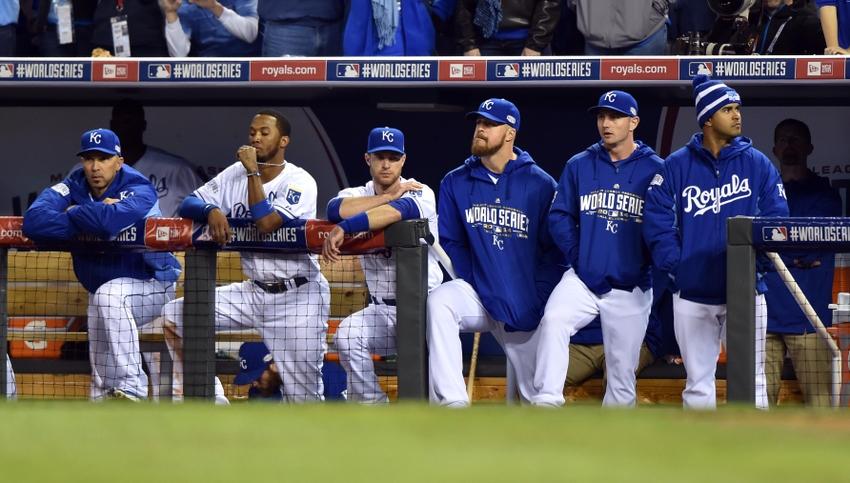
The Royals were in similarly dire straits, losing two of three to begin the series and staring down a four-run deficit in Game 4. With just six outs left in their season, the odds of them living to play another day were three percent.

But for the second year in a row, the Royals rallied from down four runs in a must-win elimination game, snatching victory from the jaws of defeat. They stunned Houston with a five-run frame, then tacked on two more in the ninth for good measure. Back in Kansas City, they won Game 5 two days later, overcoming another early deficit to send the Astros packing.

So now that they're here, who's the better team? The Royals were the American League's best team wire-to-wire, but the Blue Jays were the best team in baseball after the All-Star Break. We know momentum doesn't matter heading into a playoff series, but both teams have to be feeling pretty good about themselves after cheating death in the ALDS.

The Blue Jays were actually a much better regular season team than the Royals despite winning fewer games. They played in a tougher division and outscored Kansas City by 167 runs--more than one per game. Their run prevention was nearly as good, too, allowing only 29 more runs than Kansas City. According to Bill James's pythagorean model, which estimates how many games a team should have won based on its run differential, Toronto should have won 102 games this year--or nine more than they actually won. The Royals--winners of 95--would have been expected to win 90.

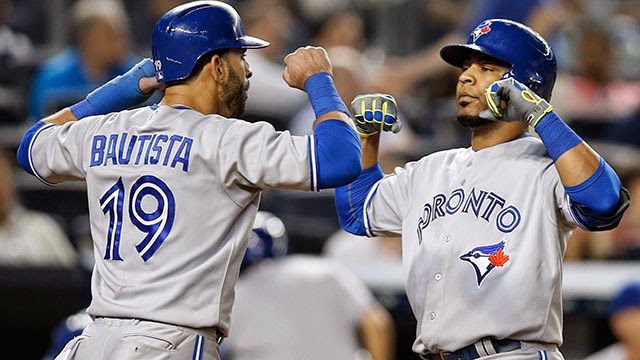
The gulf in talent becomes obvious after a quick comparison between the two rosters. Toronto boasts an All-Star lineup with Donaldson, Martin, Tulo, Jose Bautista, and Edwin Encarnacion. They also have the AL's best pitcher at the moment in Price, who might, as Bumgarner showed last year, win the series all by himself.

Which is why even though Kansas City sports the superior regular season record (and thus home field advantage), I sense that Toronto is the better team. This series won't prove that, of course, and the Royals are obviously good enough to win. I just think the Jays have more talent. I was originally going to say Toronto in six, but after Kansas City's Game 1 win I'm revising it to Toronto in seven.

Monday, October 12, 2015

NL Awards Preview: Can Kershaw Repeat?

Who deserves the NL MVP? That's a clown question, bro (CBS Sports)
First let me apologize, for the title and picture above are a little misleading. While technically an awards (plural) preview, 90 percent of this piece is devoted to the controversial Cy Young race. Whereas all three AL races are virtual toss-ups, the only tight one in the NL is for the Cy Young award, though it might be the closest I've ever seen. The MVP award has belonged to Bryce Harper since May, and Kris Bryant pulled ahead of Joc Pederson for rookie of the year honors months ago. That leaves us with the NL Cy Young, which could go to one of three candidates, two of whom are teammates.

You could argue any of them for MVP as well, but you really have to bend over backwards to find a way not to elect Bryce Harper. Because let's face it; Harper has been the league's undisputed MVP since Memorial Day. Head over to the NL leaderboards, and you'll see Harper's name in numerous top spots. Baseball-Reference and FanGraphs both rated him as the most valuable player in baseball per wins above replacement, which you might have figured based on his major league-leading .460 OBP, .649 slugging, 1.109 OPS, and 195 OPS+. The Nats were massive busts, they don't stay in contention into September without Harper's monster season.

The Rookie of the Year is also a foregone conclusion, having been Kris Bryant's to lose since his big league debut. Joc Pederson hung with him throughout the first half, only to tail off after the All-Star Break as his flaws became exposed. His 26 home runs, .346 OBP, and .206 ISO are nothing to sneeze at for a rookie center fielder, but his defense leaves a lot to be desired and he doesn't have make an impact with his legs the way most center fielders do (Mike Trout he is not).

Bryant's OPS was nearly 100 points higher than Pederson's, still a sizable advantage even after accounting for their home parks. Like Pederson he struck out a lot, but unlike Pederson he did more than just hit home runs when he made contact. He would have knocked in 100 runs had he been given his rightful place on the Opening Day roster, played a solid third base, and was actually a really good baserunner--with 13 steals and nearly a win's worth of value on the basespaths. More than just a slugger, he turned out to be a well-rounded player.

So yeah, if you choose anyone other than Harper and Bryant for these two awards, then you need to have your head examined. But the NL Cy Young race is the closest one in recent memory. Often times two candidates have very similar numbers, as Felix Hernandez and Corey Kluber did last year or Clayton Kershaw and R.A. Dickey did in 2012, but it's quite rare that a trio of pitchers post nearly identical stat lines, as Kershaw, Zack Greinke, and Jake Arrieta did this year. They finished top-three in WAR, ERA, and WHIP, among several other advanced stats. How on earth do you choose?

Joe Posnanski's right; I think who you vote for here says something about what you value in pitchers. If you value wins and strong second half performances, then Arrieta's your guy. If you stress run prevention and keeping runners off the bases, then you go Greinke. If you're all about defense-independent metrics, i.e. strikeouts and FIP, then awarding Kershaw his third straight Cy.

Wins are a garbage stat, so while it's cool that Arrieta racked up 22 of them, that honestly doesn't mean a thing to me. He could have won 12 and his candidacy wouldn't change in my eyes. I also don't buy into the whole reward someone for a big second half thing, since every game counts the same regardless of when it's played (in the regular season, that is). So while it's neat that he had the lowest second-half ERA ever, that doesn't strengthen his case in my eyes.

Where I do think Arrieta's being underrated is that he had the lowest hit and home run rate in the majors despite contending with Wrigley's friendly confines in half his starts. That's damn impressive given the way the ball flies there during the summer. It's equally impressive that his ERA was virtually identical to Greinke's, considering that a) Greinke calls Dodger Stadium home and b) the NL Central was the toughest division in baseball this year with three 90 win teams. Arrieta's environment was much more conducive to offense, and yet he allowed runs at nearly the same rate as Greinke. Arrieta also logged more innings, racked up more strikeouts, and compiled a lower FIP.
Still the best pitcher on the planet, Kershaw deserves his fourth Cy (My Weekly Sports)
According to FanGraphs, the only pitcher more valuable than Arrieta was Greinke's teammate Kershaw. That's because FG makes pitcher valuations based off DIPS, whereas B-R assesses pitchers based on how well they prevented runs. Since we know the latter is largely beyond a pitcher's control, influenced by a multitude of factors such as the weather, ballpark, hit sequencing, bad hops, defense behind him, and relievers that come in after him, I don't feel comfortable relying on ERA as a guide. I give more weight to stats like FIP and xFIP, which judge pitchers based on things they have more (but not total) control over; home runs, walks, and strikeouts.

By those measures, Kershaw comes out on top. His 1.99 FIP was the best in the majors, and his xFIP was right in line with last year's. Part of the reason both were so good was that he struck out 301 batters, becoming the first pitcher since 2002 to exceed 300 K's in a season. He also led the majors in innings pitched--an underrated stat--as well as complete games and shutouts, which I value because those are almost always wins.

As Jonah Keri wrote yesterday, the most useful stat in settling this whole debate is probably Deserved Run Average (DRA), created by the folks over at Baseball Prospectus. An all-encompassing stat similar to pitcher WAR (but better), DRA captures a pitcher's overall contribution to his team. By that metric, Kershaw is number one, though it's awfully close.

No matter how you slice it, it's a ridiculously tough call. There really should be a three-way tie, because they're all equally worthy. To pick one you have to split hairs, and depending on which hairs you split you'll get your answer. Mine is Kershaw, but yours probably isn't, and that's okay. I'm not trying to tell you why Greinke and Arrieta are the wrong choices, because they're not. There is no wrong choice. I just happen to think Kershaw's the best choice, and only by the slimmest of margins.