 |
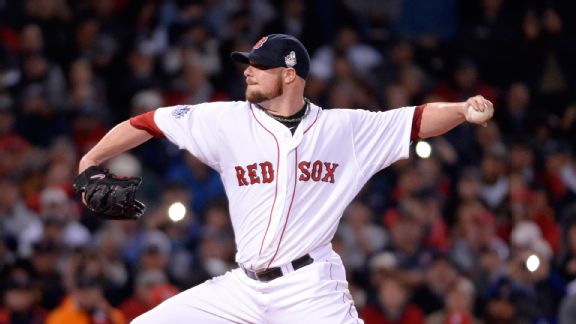
| Lester is one of the top lefties in Red Sox history, but where does he stand? |
Since there aren't that many (turns out Fenway Park is a really tough place for lefty throwers to thrive), here are the six best I could come up with.
Honorable Mention: Bill Lee (3.92 FIP 110 ERA+ 18.9 bWAR 5.2 WAA)
Had Spaceman not gotten involved in a career-altering Yankees-Red Sox fray early in the 1976 season, he likely would rank higher on this list. As it is, he must settle for just missing the top-five. 29 at the time of the brawl, Lee was coming off three straight 17-win seasons in which he compiled a 3.38 ERA across 827 innings. Though he pitched until 1982 the one-time All-Star was never the same, for only once more after that would he make more than 25 starts or complete more than 180 innings in a season. His legacy would also be much different had he held on to win the seventh game of the 1975 World Series, rather than allow Tony Perez to launch his "Leephus" pitch to the moon. Or had he not antagonized Don Zimmer so much, Lee might have actually pitched some meaningful games for the Red Sox as their 14 and 1/2 game lead over the Yankees slipped away in the second half of 1978. Two months after Boston completed its epic collapse, his ten-year Red Sox career came to an end when he was unceremoniously swapped with utilityman Stan Papi of the Montreal Expos.
5. Babe Ruth (2.76 FIP 125 ERA+ 20.8 bWAR 9.9 WAA)
Before the Babe became the best slugger in baseball history, he was one of the game's premier pitchers. A two-time 20-game winner, Ruth compiled a 2.19 ERA in his six seasons with the Sox, winning the 1916 ERA crown with his 1.75 mark (maintained over 323.67 innings, I might add). His nine shutouts that year are still a record for an American League lefthander, since tied by Ron Guidry in 1978. The following season he was almost as good, with a 2.01 ERA in 326 and 1/3 innings and 35 complete games. After that the Red Sox realized how valuable the Bambino's bat was and limited his workload. But even after he became more renowned for his exploits as a hard-hitting outfielder Ruth remained effective when he toed the rubber, posting a 2.22 ERA in 1918 and 2.97 mark in 1919, his final year with the Red Sox. The Sultan of Swat also strung together 29 and 2/3 consecutive scoreless innings in World Series play, a record that stood until Whitey Ford bested it in the 1961 Fall Classic.
4. Dutch Leonard (2.39 FIP 129 ERA+ 27.2 bWAR 14.6 WAA)
Leonard spent his first six seasons with Boston, compiling a 2.13 ERA in his time there. After notching a 2.39 ERA across 259 and 1/3 innings as a 21 year-old rookie in 1913, for an encore he set the single season ERA record (post-1900) with his 0.96 mark the following year. He did not allow a single home run that year in 224 and 2/3 innings (it was the Deadball Era, after all) and also paced the majors in adjusted ERA, FIP, WHIP, H/9 and K/9. All told, Leonard's historic campaign was valued at 9.2 bWAR. His ERA rose to 2.36 in 1915-'16, years he helped Boston win the World Series with complete game victories in each Fall Classic. He also achieved two no-hitters with the Sox, his first in 1916 and his second two years later shortly before he had to leave the team because of World War I. The Olde Towne Team won the World Series without him that fall and traded him to Detroit, the team he'd no-hit just a few months earlier. Already on his way down, Leonard was unable to sustain the success that made him one of the best pitchers in baseball history through age 25.
3. Jon Lester (3.61 FIP 120 ERA+ 31 bWAR 16.6 WAA)
A three-time All-Star with Boston, Lester topped 15 wins and 200 innings in a season five times. Consistently great in the regular season save for his poor 2012, Lester was at his absolute best in October, helping the Sox capture two World Series titles with his 2.11 ERA in 13 postseason appearances (11 starts). He deserved to share last year's World Series MVP with David Ortiz after allowing just one earned run in 15 and 1/3 stellar innings. In 2008 he became the first Sox lefty in 52 years to pitch a no-hitter when he blanked the Royals at Fenway on May 19th, three weeks after holding the Blue Jays to one hit in eight innings. Lester is one of only three Red Sox pitchers (Roger Clemens and Pedro Martinez are the others) to strike out 15 batters in a single game.
2. Mel Parnell (3.79 FIP 125 ERA+ 27.4 bWAR 13.5 WAA)
Parnell pitched his entire ten-year career with the Red Sox, making two All-Star teams and drawing MVP votes four times. His 1949 campaign was Cy Young caliber, with his 25 wins, 27 complete games and 7.9 bWAR tops in baseball to go along with his league-leading 2.77 ERA, 295 and 1/3 innings, and 0.2 HR/9. He started that year's Midsummer Classic and nearly pitched Boston to the pennant before Joe McCarthy exhausted him down the stretch. Overused during his early years Parnell burned out fast but still had flashes of former brilliance, as he did when he twirled a no-hitter in his final season, 1956, on July 14th against the White Sox at Fenway. It was the first by a Boston pitcher since Howard Ehmke's 1923 no-no, and it would take 52 years before a Sox southpaw hurled another. Nearly 60 years after his last game, Parnell still holds the franchise records for most starts, innings, and wins by a lefthander.
1. Lefty Grove (3.60 FIP 143 ERA+ 44.7 bWAR)
The Pedro of his era, Grove wasn't known for his durability but still put up outstanding numbers in the face of high-scoring times. Like Josh Beckett, Grove's first season in Boston was a nightmare but he pitched well after that, winning four ERA titles (each time with the best league and park-adjusted ERA in baseball) and leading the league in pitcher bWAR in 1935, '36, and '37. One of Tom Yawkey's most prized possessions, the former Philadelphia Athletics star made five straight All-Star teams from 1935-39 and won the final 105 games of his Hall of Fame career in eight seasons wearing the Boston uniform, including his 300th (and last) victory in 1941. While Grove was past his physical prime when he joined the Red Sox at age 34, he perfected his curveball and, using it as an out pitch, remained an elite pitcher throughout his 30s, making it (just barely) to 300 wins. It makes sense that the best lefthanded pitcher of all-time (sorry, Sandy Koufax worshipers) is also the best lefthanded pitcher in Red Sox history.
 |
| Grove overcame arm troubles and put together a strong second act with Boston |


