Showing posts with label All-Star. Show all posts

Tuesday, January 8, 2019

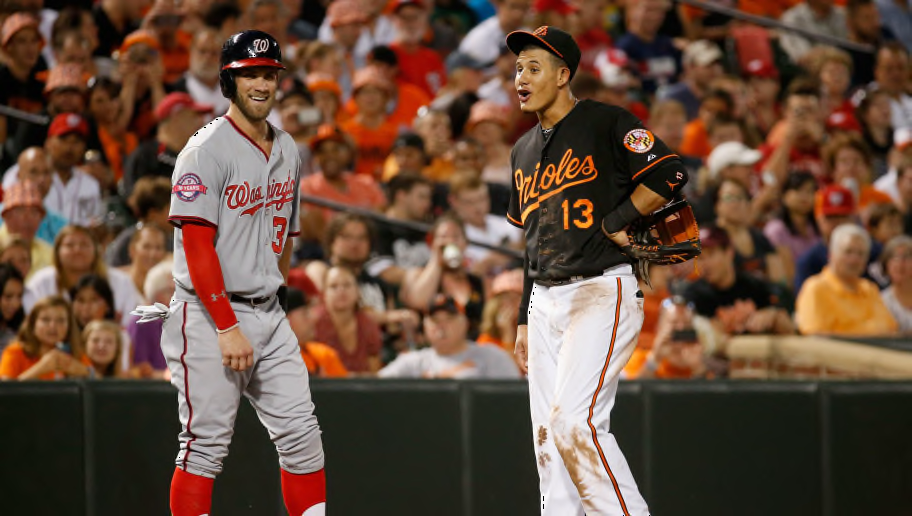
Harper and Machado Waiting it Out

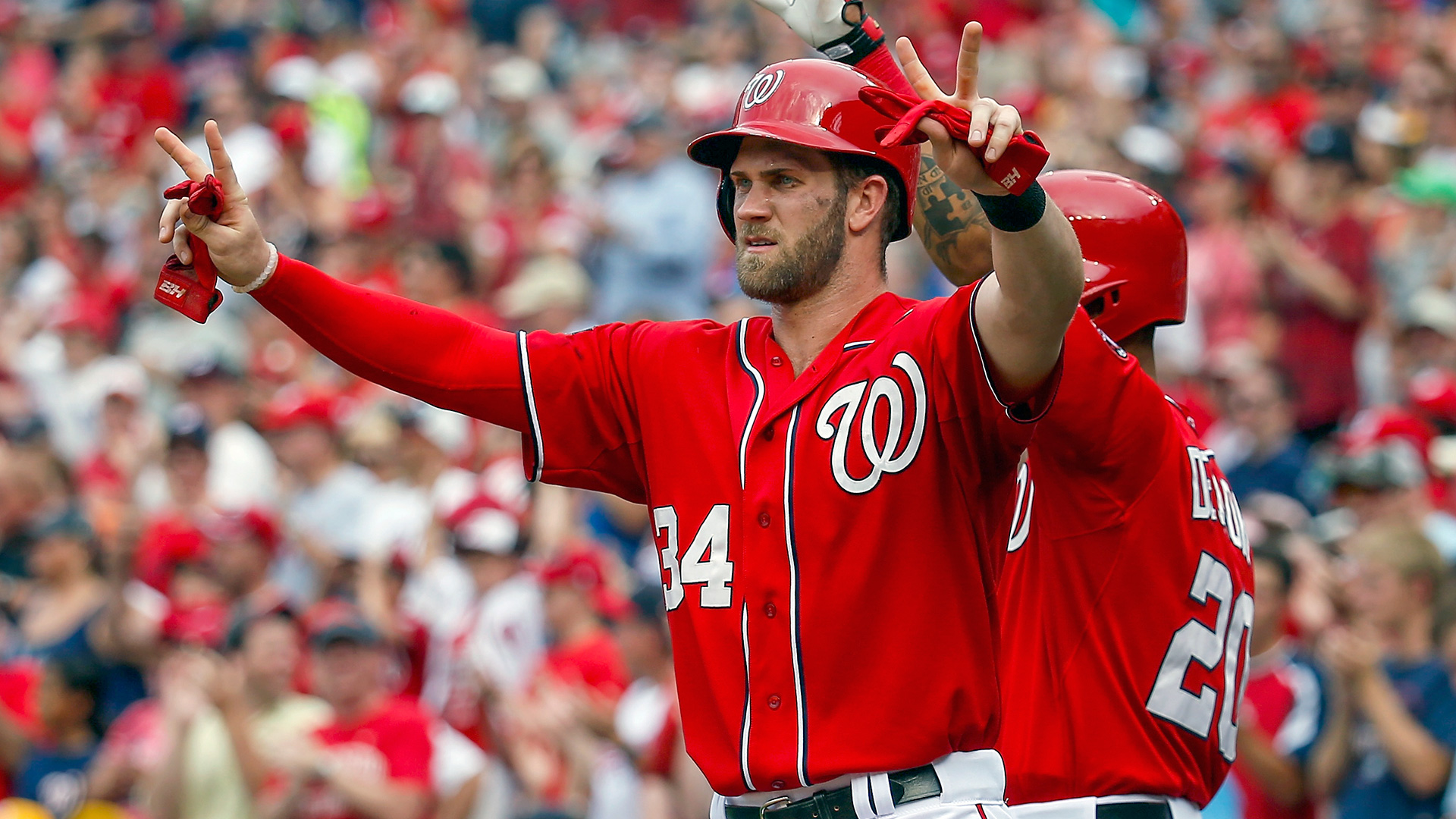
Harper (left) and Machado are holding out for record paydays (12Up)
For nearly two decades, Alex Rodriguez has held the record for the largest free-agent contract in American professional sports. On December 11, 2000, Rodriguez signed a 10-year, $252 million deal with the Texas Rangers, doubling the contract of the highest paid professional athlete at the time --Kevin Garnett of the NBA's Minnesota Timberwolves. Seven years later, Rodriguez opted out of that deal to sign an even bigger one with the New York Yankees worth $275 million over 10 years, with the potential to earn an additional $30 million in incentives for reaching certain home run milestones (which later became controversial following his PED admissions).

Records are made to be broken, but so far neither deal has been surpassed by a free agent* in any sport. The closest anyone's gotten were Albert Pujols and Robinson Cano, who both signed 10-year, $240 million deals in 2011 and 2013, respectively. That's going to change this winter, however; it's only a matter of when.

[*Giancarlo Stanton (13 years/$325 million) and Miguel Cabrera (10 years/$292 million) both later eclipsed Rodriguez via contract extensions, not as free agents. The highest paid athlete is boxer Canelo Alvarez, who's currently on an 11-fight, $365 million deal.] 

Bryce Harper and his agent, Scott Boras (the same agent who negotiated Rodriguez's first megadeal), have had their sights set on the record since Harper was smashing 500-foot homers and making magazine covers as a teenager. He debuted with the Washington Nationals at 19 in 2012, making his first All-Star team en route to winning NL Rookie of the Year honors. He was an All-Star again in 2013 before putting together one of the greatest offensive seasons ever in 2015, when he won the NL MVP unanimously. The Chosen One had arrived.

While Harper hasn't been able to replicate that historic campaign, he showed what his ceiling can be. He showcased it again last summer by winning the Home Run Derby at Nationals Park, wowing the hometown crowd with a display for the ages that included 14 homers in the final 47 seconds and 45 overall. While injuries have often prevented Harper from reaching his full potential, he's still been one of baseball's 12 most valuable position players throughout his career. He's slugged at least 20 homers and been an All-Star in all but one of his seven seasons, and he was headed for a second MVP award in 2017 before hyperextending his knee after slipping on a wet base. Harper's 26 years old, he just led the Major Leagues in walks, and he has MVP potential. He is, in other words, a superstar.

He's not the only one whose services are available this winter, however. Manny Machado, last seen during the World Series with the Los Angeles Dodgers, is arguably just as good as Harper. Machado, who's just four months older than Harper, also debuted in 2012 and immediately emerged as one of the best players in baseball. In 2013 he was an All-Star en route to leading the AL in doubles, and starting in 2015 he's topped 30 homers every year.

While not quite the force that Harper is at the plate, Machado's a comparable baserunner and an elite defender at a more challenging position, earning a pair of Gold Gloves for his outstanding work at the hot corner (he can also play shortstop, but not as well as third). He's one of 15 position players to compile at least 30 fWAR since 2012, tallying virtually the same amount as Harper in one fewer game. That hasn't translated to an MVP yet, but it has helped the four-time All-Star to three top-10 finishes despite playing for mostly mediocre teams in Baltimore. And whereas Harper has struggled with injuries, Machado has been extremely durable, appearing in at least 156 games in five of his last six seasons.
Nearly 20 years later, A-Rod's superdeal is still the standard (SI)
Baseball hasn't had a free agent so good and so young since 2000, when Rodriguez was a 25-year-old shortstop coming off three straight 40-homer seasons with the Seattle Mariners. Now it has two, in the same winter, no less.

In the old days, that would have sparked a feeding frenzy between baseball's richest teams. The Red Sox Yankees, Cubs, and Dodgers would've opened up their vaults for them, spawning a bidding war the likes of which baseball has never seen. But, as last winter's slow-moving market proved, times have changed. Teams are not willing to pursue free agents as aggressively as they used to, not when it means committing large sums of money to ageing players who will cost them compensatory draft picks, luxury tax penalties, and payroll flexibility. Better to drag out negotiations and drive down the price once Spring Training is underway and players start getting desperate.

But if there was ever a player to break the bank for, it's Machado and Harper. Sure, they have red flags and rub a lot of people the wrong way, but they're young and athletic and certifiable stars. There's not too many of those left in baseball these days, so they're sure to attract eyeballs and sell jerseys. Neither has won a championship, which should continue to drive them after the ink dries on their new contracts. They'll instantly transform whichever lineup they join and add multiple wins to a team by themselves. Not everyone can afford them, but everyone could use them.

It's hard to reconcile, then, why both remain unsigned despite playing different positions and negotiating with different teams. The Dodgers have the money and the roster space for Harper after trading away Matt Kemp and Yasiel Puig, while the Phillies, White Sox, and Yankees all need Machado on the left side of their infields. So what's taking so long?

It's not as though teams haven't tried to sign either player. Harper rejected a 10-year, $300 million offer from the Nationals, which would have made him the richest free agent ever (Washington has reportedly since upped its offer). Machado received an offer from the White Sox, albeit a smaller one closer to $200 million. Both are worth more than that, and they know it. But is there a team willing to give it to them?

We'll just have to wait and see.

Wednesday, July 12, 2017

Breaking Down Boston's All-Stars

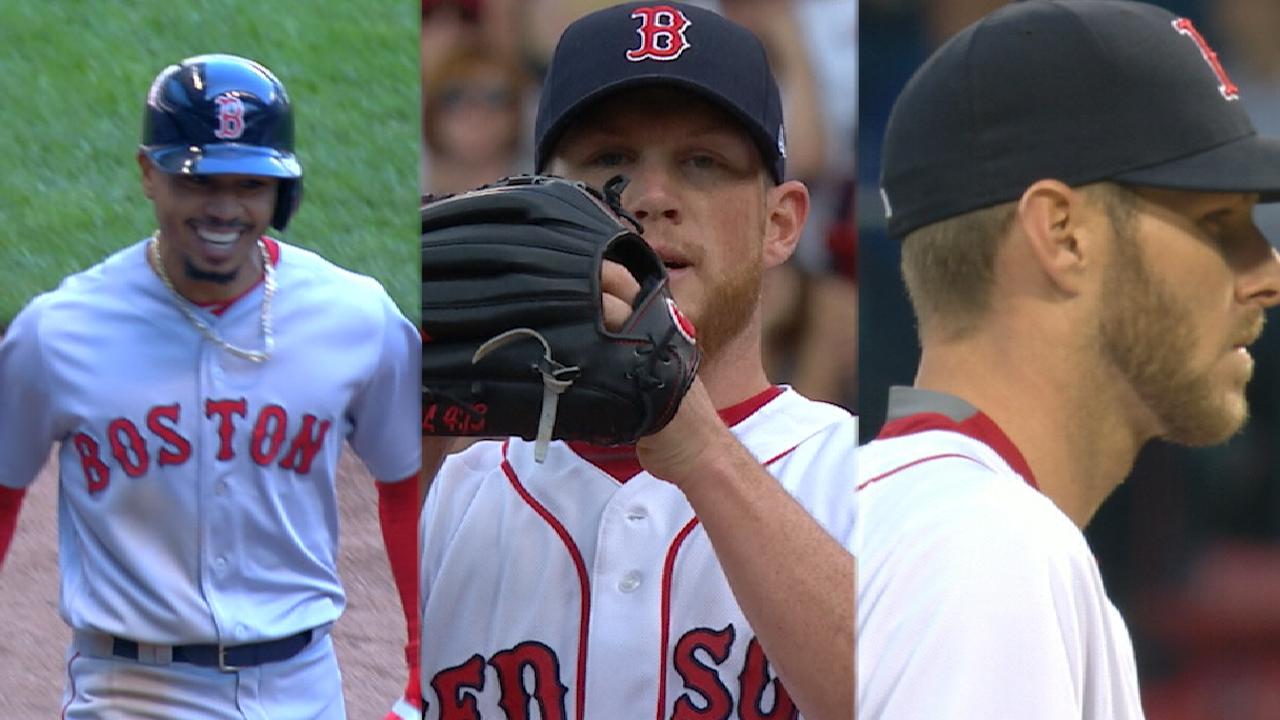
Betts, Kimbrel, and Sale are in the midst of terrific seasons (MLB.com)
The Red Sox sent three players to the All-Star Game in Miami last night, and all three played a role in the American League's 2-1 victory. Chris Sale started and tossed two scoreless innings, Craig Kimbrel earned the win in relief, and Mookie Betts made a pretty good throw. They were at their best against the National League's best, and I'm sure the American Leaguers were happy to have them on their side.

So are the Red Sox, given how well the trio has performed this year:

Chris Sale (3.9 bWAR)
Sale has been the best pitcher in the American League this year and arguably the best pitcher in baseball. He's gone at least seven innings while allowing three or fewer runs in 12 of his 18 starts and has a dozen starts with double-digit strikeouts, including eight in a row at one point that tied his own (and Pedro Martinez's) record. These strong showings have been reflected in his awesome GameScores, which have exceeded 70 nine times and have averaged 67 (he only has one lower than 54). He's currently leading the Majors in strikeouts (178), FIP (2.09) and K/9 rate (12.5) while also pacing the AL in innings (127 2/3), WHIP (0.90) and K/BB ratio (8.1). Assuming his arm doesn't fall off in the second half, he looks like a lock for his first Cy Young award.

Mookie Betts (4.3 bWAR)
Offensively, the Red Sox have gotten the 2015 version of Betts rather than last year's version who finished second to Mike Trout in the MVP race, but he's compensated by taking his defense to new heights. After winning his first Gold Glove last year with an incredible 32 fielding runs per Baseball-Reference, Betts is on pace to surpass that number with 20 under his belt already. With a glove like that, anything he provides on offense should be considered a plus, except that his bat was nearly as valuable as his leather last year (30 batting runs). He's slipped a bit offensively due to another slow start, but he's still leading the Majors in doubles (29) and has a shot at 30 homers and 30 steals. Betts has also shown flashes of breaking out recently, suggesting he might have another big second half in store. Even if he doesn't, he's still one of the league's 10, if not 5, most valuable players.

Craig Kimbrel (2.3 bWAR)
Kimbrel's numbers had been trending in the wrong direction before he was traded to Boston, and his first season with the Red Sox was a disappointment. He got hurt, struggled with his command (5.1 BB/9) and posted a career-worst 3.40 ERA. Heading into 2017, there was talk that Kimbrel might be a problem rather than a solution in the bullpen. Well, that hasn't been the case this year, as the flamethrowing righty has silenced the critics by reclaiming his status as one of the game's premier closers. You need a microscope to see his 0.50 WHIP, as he's stopped walking people (five of the 134 batters he's faced) and is more unhittable than ever, striking out nearly two batters per inning and limiting opponents to a .110/.157/.181 batting line. He's been lights-out when he gets the call -- converting 23 of his 25 save opportunities -- and he hasn't suffered a loss yet after dropping a career-worst six decisions last year. If he keeps it up, Sale won't be the only Boston pitcher on Cy Young ballots.

So yeah, they've all been pretty good. Any game that Sale starts and/or Kimbrel finishes is as good as a win, and with Betts always a threat to have a monster day at the plate, he's capable of winning ballgames all by himself, too.

Tuesday, July 11, 2017

Red Sox Roll into Second Half

Boston's strong finish to the 1st half looks like a sign of things to come (CBS)
Well, it's officially the All-Star break and the Red Sox are right where they're supposed to be; leading the AL East and on pace for 90-plus wins. It hasn't been the smoothest ride, but Boston had an uneven first half last year too en route to winning 93 games and the division. And although they limped into the break by losing four of their last five, that came on the heels of a six-game winning streak that equaled their season-high. Overall, the Sox are in good shape heading into the second half, having gone 29-16 since May 21 as several of their top hitters and pitchers have come around.

On the hitting side of things, Boston rates fourth in the AL in runs per game and total runs despite ranking dead last in home runs. They've compensated with a contact-heavy approach that's yielded the league's second-highest batting average and third-fewest strikeouts. The lineup has proven to be deep and balanced, with regulars posting an OPS+ over 100 at every position except catcher and third base. Dustin Pedroia and Xander Bogaerts are both batting .303, Mitch Moreland's having one of the best years of his career, and each member of the Killer B's outfield has an OPS north of .800. Hanley Ramirez had another slow first half, but he caught fire towards the end and looks poised to go on a tear post-All-Star break.

Still, this clearly isn't the same offense that led the sport in runs last year. They've missed David Ortiz in the heart of their lineup, as it seems unlikely that anyone will replicate his standard 30 homers and 100 RBIs (not to mention his leadership). Catcher and third base have been black holes, with the Sox tied for last in the AL in fWAR at both positions. Third base has been a revolving door thanks to Pablo Sandoval's ineptitude, and while Christian Vazquez and Sandy Leon are fine receivers, neither can hit. Not much can be done about the catching situation given the dearth of quality backstops available, but Todd Frazier is on the block should Boston be inclined to upgrade externally rather than promote Rafael Devers.

The Red Sox have graded out as top-10 defensive team, which isn't surprising given their young, athletic outfield and their stellar double-play combination of Pedroia and Bogaerts. This has undoubtedly aided the pitching staff, which hasn't been the super-rotation that some predicted but still ranks second in the AL in ERA. BoSox pitchers have been terrific on their own merit, however, issuing the fewest walks in the league and ranking third in strikeouts with more than one whiff per inning. So while their offense has been predicated on avoiding whiffs, their pitchers have thrived by racking them up.

It's impossible to over-state the impact that Chris Sale has had this year, as he's accounted for 1/6 of the team's innings and has been arguably the best pitcher in baseball. Boston hasn't had a pitcher this dominant since Pedro Martinez, and he's been a true savior since the day he donned a Red Sox uniform, making up for Rick Porcello's regression and the injury woes of David Price and Eduardo Rodriguez (both of whom have been effective when healthy). He's their MVP of the first half. Drew Pomeranz has also stepped up and appears to have settled into Boston after struggling in the second half last year and early this year.

The bullpen has also flourished despite getting nothing from two of the club's top relievers, Carson Smith and Tyler Thornburg. Craig Kimbrel has rebounded after scuffling in his first year with Boston and is having one of the best seasons ever by a modern closer. Joe Kelly has been nearly as good setting him up, becoming the shutdown reliever everyone knew he would be once he was finally freed from the rotation. Matt Barnes and Heath Hembree have been solid in middle relief, while Fernando Abad has pitched much better than his last name would suggest. This strong stable of relievers have helped Boston maintain a winning record (11-9) in one-run games and, more importantly, should be enough to prevent Dave Dombrowski from shipping out more prospects at the trade deadline.

Add it all up and the Red Sox have played as well as their record suggests, with a 51-38 Pythagorean W-L record (plus-65 run differential) to match their 50-39 actual record. They've been lucky in extra-inning games (7-1), but everything else about them appears legitimate and they are trending in the right direction. The rotation will finally be at full strength when Rodriguez returns after the All-Star break, which could allow Boston to pull away from the pack if everyone stays healthy. The Red Sox will also look to capitalize on a favorable schedule that puts 42 of their remaining 73 games at home, where they've gone 25-14 (.641) this year.

Accordingly, the Red Sox don't need to make any major moves at the trade deadline. They're a well-rounded, mostly-complete team with few holes to fill. An upgrade at the hot corner would be nice, but not worthwhile if the plan is to bring Devers up in September (or, if by some miracle, Jhonny Peralta finds his swing in Triple-A). Pitching depth is always appreciated, but not a priority. Firing John Farrell would be a dream come true, but for now that's all it is; a dream.

Thursday, July 6, 2017

2017 NL Final Vote Analysis

Turner is having a year reminiscent of peak George Brett (Los Angeles Times)
If you haven't cast your ballot for the All-Star Game Final Vote, it's not too late! Polling closes at 4 PM EST, so make sure you get those votes in. After deciding that Logan Morrison was the most worthy of the five American League candidates, it's time to take a look at the National League five, ranked in order of FanGraphs WAR:

Justin Turner (3.9 fWAR .384/.473/.571 182 wRC+ .446 wOBA)

Anthony Rendon (3.7 fWAR .297/.398/.549 145 wRC+ .397 wOBA)

Kris Bryant (2.5 fWAR .263/.394/.505 135 wRC+ .381 wOBA)

Justin Bour (1.8 fWAR .289/.365/.557 138 wRC+ .384 wOBA)

Mark Reynolds (0.7 fWAR .286/.372/.517 116 wRC+ .378 wOBA)

There's a much bigger range here than in the AL, where four of the five candidates were clustered in the 2-3 win range. We can immediately eliminated Bour and Reynolds, who have posted lesser numbers at first base compared to their league-mates at third. Reynolds has been a product of Coors Field with a 1.084 OPS there compared to .729 everywhere else. Bour is having a fine season with 19 home runs, but he's clearly had an inferior year to the three hot-corner men on the ballot.

And that's where it gets tricky, just as separating the trio of AL shortstops proved difficult. Bryant is the reigning MVP and undoubtedly the biggest star on the ballot, but he's also fallen off a bit from last year and hasn't been as good as Rendon or Turner. What you do with him depends on your philosophy of what the All-Star Game should be. If you feel the Midsummer Classic should showcase the game's household names, then Bryant's your guy. If you feel the best players of the first half should be honored (as I do, to a point), then you're looking elsewhere.

While Rendon's having a fantastic year, his numbers can't compete with Turner's, which are truly remarkable. Aside from Freddie Freeman, he's been the National League's best hitter this year, with only the otherworldly Mike Trout and Aaron Judge surpassing him in the American League. Only Joey Votto and Paul Goldschmidt have produced more offensive value in the Senior Circuit, and both play first base. The best hitter on the NL's most dominant team should be a no-brainer.

2017 AL Final Vote Analysis

LoMo is the clear-cut choice in the AL (CBS Sports)
The All-Star Game's Final Vote closes at 4 PM EST today, so it's time to make some last-minute picks! In the American League, we have a pair of slugging corner infielders pitted against a trio of good-hitting shortstops. Who deserves to go Miami next week? Let's dive in with a quick glance at the candidates (ranked in order of FanGraphs WAR):

Logan Morrison (2.9 fWAR .256/.366/.579 145 wRC+ .386 wOBA)

Xander Bogaerts (2.6 fWAR .308/.362/.448 110 wRC+ .345 wOBA)

Elvis Andrus (2.2 fWAR .301/.347/.473 114 wRC+ .350 wOBA)

Didi Gregorius (2.2 fWAR .302/.331/.477 112 wRC+ .341 wOBA)

Mike Moustakas (1.6 fWAR .269/.305/.559 120 wRC+ .356 wOBA)

We can one we can eliminate right off the bat, and that's Moustakas. While his 25 home runs are impressive, his on-base percentage is on par with the three shortstops' batting averages. With no steals and uninspiring defense at third base, Moustakas has been a mostly one-dimensional slugger who can be dismissed in favor of the three shortstops -- who have rivaled his offense while playing a more demanding position -- and Morrison, who has been a much better hitter.

It's almost impossible to separate the three shortstops, who rank 5-7 in fWAR among MLB players at their position with at least 100 plate appearances. Gregorius (2.2 fWAR) has been arguably the best hitter of the trio on a per at-bat basis, but he's also played the least due to a lengthy stay on the Disabled List that delayed his season debut until April 28. He's shown the most pop with 10 homers and 12 doubles in 239 at-bats, but he's also worked only nine walks and hasn't made the same impact on the bases (two steals in three tries). He'd need to have a clear edge in rate stats to compensate for his lesser playing time, but since he doesn't he's the next to go.

Bogaerts (2.6 fWAR) has the best average (.308) and on-base percentage (.362) of the trio, but is also toting a considerably lower slugging percentage (.448) despite playing his home games in Fenway Park. He's still recovering from his 41-game homerless streak to start the season, although he's gone deep six times in 39 games since. He's stolen nine bases in 10 attempts and is playing solid defense, but he's essentially been a slightly lesser version of Andrus, who has nearly twice as many homers (11) and more than double the steals (20, although he's been caught seven times) while posting a slightly stronger batting line.

That brings us to our most deserving candidate, Mr. Morrison (2.9 fWAR), who's blown the other four candidates out of the water in terms of offensive production and rates the highest for overall value. He was inexplicably snubbed in the first round of fan voting and was also passed over for the Home Run Derby in favor of Gary Sanchez, which he's rightfully ticked about. In any case, Morrison should have gotten the starting nod to begin with, as he's third among all first basemen in fWAR behind only Paul Goldschmidt and Joey Votto, who are having MVP-caliber seasons. He's putting up the same numbers as starting first baseman Justin Smoak, albeit in a much tougher ballpark for hitters. Morrison is having a career year and should be rightfully honored for it.

Thursday, June 29, 2017

My NL All-Star Picks

Harper has the potential to dominate the ASG (Sporting News)
Voting ends in under 10 hours! Here are my National League picks (more tough ones than in the American League, I think), with all stats current through yesterday:

C Buster Posey
It's Posey and everyone else in the Senior Circuit this year, as he's been one of the few bright spots on a putrid Giants team with his .344/.422/.529 line (155 wRC+). His 10 homers are tied with Yasmany Grandal for most at the position in the NL, and his 3.0 fWAR lead the field comfortably (nobody else has two).

1B Paul Goldschmidt
The best offensive player in baseball deserves the nod here. Eric Thames and Ryan Zimmerman have cooled down considerably from their hot starts, while Freddie Freeman still hasn't returned from the wrist injury he sustained in May. Joey Votto is having a great first half for once, but he's essentially been a lesser version of Goldschmidt.

2B Daniel Murphy
Josh Harrison's neck-and-neck in WAR but Murphy blows him away on offense, as he's essentially replicating the MVP-caliber year he had at the plate last season with a .339/.391/.578 line and 14 homers.

3B Justin Turner
Arenado's locked into a ridiculously close race with Kris Bryant, but the real battle should be between Anthony Rendon and Justin Turner, who are presently tied atop the NL WAR leaderboard with 3.3 apiece. Rendon's had a sneaky-good year for Washington despite being overshadowed by Bryce Harper, Max Scherzer, and others, while Turner is batting an insane .379/.466/.535 thanks to his .414 BABIP. Turner's clearly been the best hitter at the position this year in either league, putting up numbers that shouldn't be possible in Coors Field, let alone the pitcher's paradise of Dodger Stadium. It's telling that Turner leads NL third basemen in FanGraphs offensive value despite playing just 55 games thus far, which is why I'm giving him my vote (it also helps that he's been a plus on defense).

SS Corey Seager
This is a two-horse race between Zack Cozart and Corey Seager, who are almost indistinguishable in terms of value. Cozart has been the best-hitting shortstop in the NL this year, but Seager gets on base at the exact same rate and has played 15 more games. Defensively they're both excellent, and offensively it's very close when you account for their home parks, as Seager's is brutal on hitters whereas Cozart's is quite generous. When it's too close to call for All-Star candidates I defer to the one with more star power (it is an All-STAR game, after all), which in this case is Seager.

OF Bryce Harper
When your life's mission is making baseball fun again and you have hair like this, you kind of have to be in the All-Star Game.

OF Marcell Ozuna
Having a very underrated season, batting .315/.378/.565 with 20 homers already. If you asked fans to pick a Marlins outfielder Giancarlo Stanton would win in a landslide, but Ozuna has the same number of homers and leads his teammate in most offensive categories, hence why his fWAR total is nearly twice as great (2.7 - 1.5). Ozuna got off to a huge start last year before fading in the second half, so it remains to be seen if he can sustain this level of play for an entire season.

OF Cody Bellinger
It's close between him and Charlie Blackmon, but Bellinger has the same number of fWAR (2.4) in 19 fewer games and has been obliterating baseballs lately. He's much more fun to watch than Blackmon and is a far better hitter after taking their home parks into account. He's also on pace for a bajillion home runs (roughly) and needs to be on the field so someone can replicate this picture with him and Aaron Judge.

If fans got to pick a starter I'd vote Max Scherzer, who's surpassed Clayton Kershaw as the best pitcher in baseball this year (for now).

My AL All-Star Picks

Houston's double-play combo deserves to start the All-Star Game (MLB.com)
All-Star voting ends at midnight tonight, which means it's time to cast those last-minute votes for the Midsummer Classic if you haven't already. Here are mine, with all stats through June 28:

C Alex Avila
Gary Sanchez is a bigger star, Salvador Perez has larger counting stats, and Brian McCann is having a vintage season, but Avila has been the American League's top catcher in the first half with a .321/.435/.597 slash line (174 wRC+) in 191 plate appearances (only 14 fewer than Sanchez). He's been the best-hitting backstop in baseball this year and leads AL receivers in fWAR with 2.4 (nobody else has more than 1.9), making him a fairly easy choice.

The only problem is Avila's not on the ballot, so I have to write him in. This is the problem with starting All-Star voting in April, as James McCann was Detroit's primary catcher at the time with Avila relegated to backup duties. Their roles have flipped, however, due to McCann's slow start and
Avila's monstrous performance.

Avila's resurgence has been one of the biggest surprises of the first half given that he'd batted just .222/.337/.362 from 2012-2016, making his 2011 All-Star nod look like a fluke and distant memory. Now 30, he's looking like a Comeback Player of the Year candidate after playing fewer than 70 games in a backup role each of the past two seasons.

1B Logan Morrison
Tough call here between LoMo, Yonder Alonso and Justin Smoak, since all three have almost identical batting lines. I immediately eliminated Smoak on the basis of his home park being much friendlier, then give Morrison the edge over Alonso for sustaining his performance over an additional 50 plate appearances (roughly 1/6 of the season thus far). It's also a point in Morrison's favor that his 22 dingers are tops for an AL first-sacker.

2B Jose Altuve
Altuve enjoys a comfortable lead in fWAR at the position with 3.5 -- more than a win higher than anyone else. His traditional stats back it up, as he's slashing .328/.402/.527 (150 wRC+ -- the highest for a qualified second baseman) with 11 homers and 14 steals.

3B Jose Ramirez
Miguel Sano should have been the pick here, but a .167/.242/.333 slump since June 9 has caused his OPS to fall more than 100 points, allowing the surging Ramirez to edge ahead:

Ramirez: .322/.377/.557 145 wRC+ .391 wOBA 2.9 fWAR
Sano:      .274/.375/.548 140 wRC+ .384 wOBA 2.3 fWAR

Ramirez is also a superior fielder and has maintained his numbers over 25 more PA's, so Sano would need to have a significant offensive lead to wrestle the spot away. This is a good example of why you should wait until the last possible moment to vote, as a few good or bad weeks can dramatically alter a player's candidacy.

SS Carlos Correa
Francisco Lindor jumped out to an early lead and Xander Bogaerts isn't far behind, but Correa's recovered from a slow start to lead AL shortstops in a host of categories, including counting stats like fWAR (2.8), homers (14, tied with Lindor), runs (52) and RBIs (49), as well as rate stats such as slugging (.514), OPS (.900), wRC+ (141), and wOBA (.380).

OF Aaron Judge
Obviously.

OF Mike Trout
Hasn't played in a month, but he was so good during his first two months that he still deserves a spot. He's been an All-Star every year since 2012, so let's preserve the streak.

OF George Springer
Has as many fWAR as Trout, albeit in 27 more games and 126 additional plate appearances. Still, it's not too often he'll be able to say that. There's a pretty big drop-off from Judge and Trout to Springer, but then there's another big drop-off from Springer, making him an easy choice for the third spot.

DH Corey Dickerson
Dickerson's rate stats are almost identical to Springer's. He's batting a robust .333/.373/.583 (154 wRC+) with a league-leading 103 hits, including 17 homers. He's producing like he did at Coors Field, except now he plays his home games in Tampa Bay's hitter's graveyard. The DH field is wide open this year without David Ortiz, and Edwin Encarnacion is still digging himself out from a miserable start. Dickerson's .381 BABIP suggests he won't necessarily be an All-Star in the second half, but right now he's the obvious choice.

If fans got to pick the starting pitcher, my vote would go to Chris Sale.

Wednesday, June 28, 2017

Is Carlos Beltran a Hall of Famer?

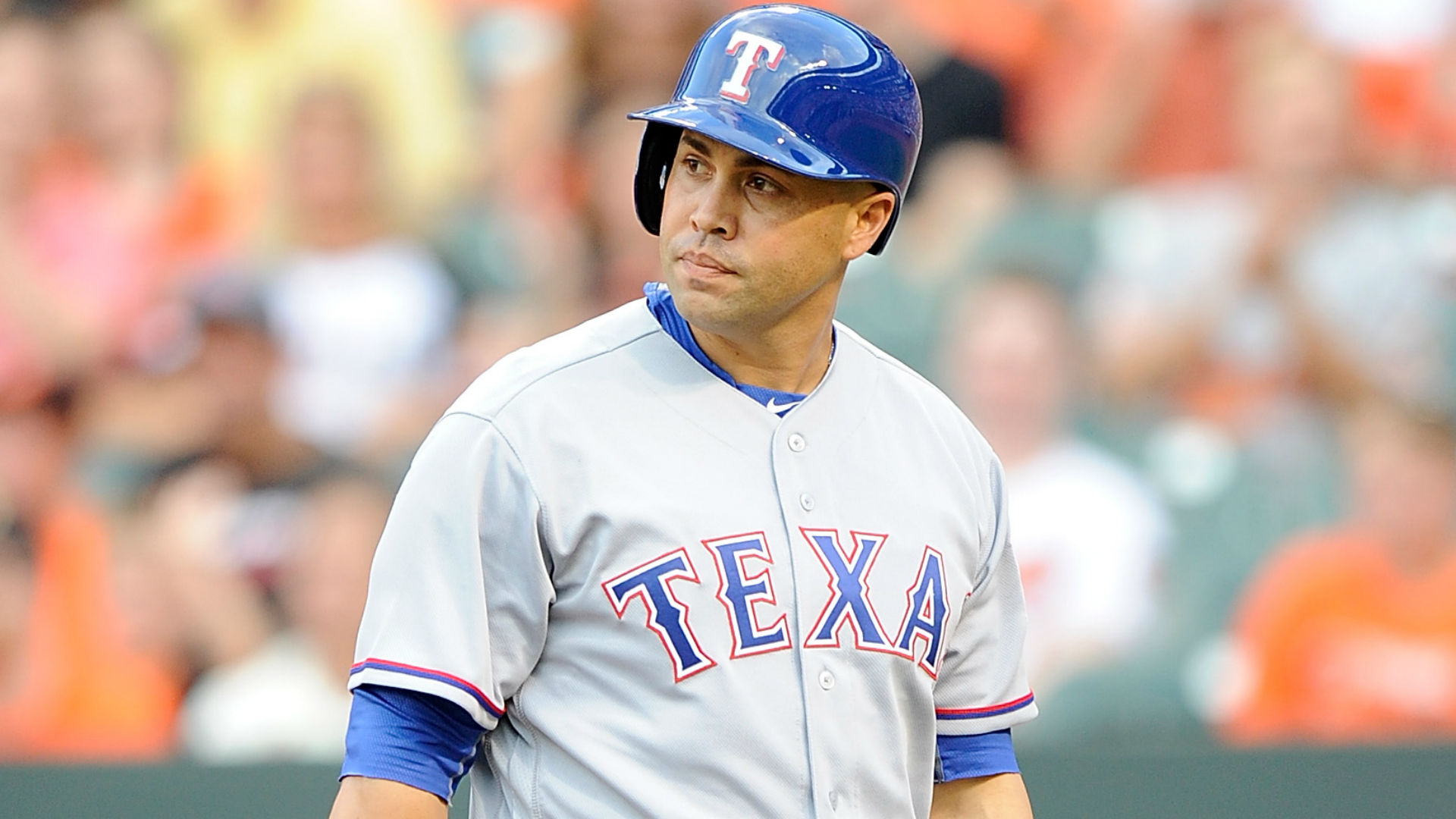
Beltran, pictured with the Rangers last season, is a worthy Hall of Famer (Sporting News)
A couple weeks ago when the Red Sox were playing the Astros, a friend asked me if Carlos Beltran is a Hall of Famer.

I answered in the affirmative, with the caveat that he won't get in on the first ballot and may need a few rounds of voting before receiving his plaque in Cooperstown. While Beltran is a clear Hall of Famer from a statistical standpoint, I can see why the support for his candidacy won't be overwhelming. His case has been built quietly over time, as he was never a player who could claim to be the best in baseball during any of his 20 seasons. He never dominated discussions or statistical leaderboards, and was never even a serious candidate for MVP. The fact that my friend posed this question in the first place reflects the doubt that exists among knowledgeable baseball fans who witnessed his entire career.

There shouldn't be much of a debate, however, as Beltran is one of the 10 greatest center fielders in baseball history by several measurements (Hall of Stats has him seventh, JAWs puts him eighth, and he's ninth in FanGraphs career WAR).  He's a near-perfect match for the average Hall of Famer at his position in terms of peak and career bWAR, with his career value almost evenly divided between peak (52%) and longevity (48%) per Hall of Stats. He's well above the Bill James Hall of Fame Monitor threshold as well, grading out a score of 126 when 100 gives a player a strong chance at induction.

All of that aligns with what Beltran produced on the field. For over a decade he was one of the best all-around players in baseball, routinely clearing 25 homers/steals and 100 runs/RBIs with a bat that was about 20 percent better than average after adjusting for league and park. His speed and smarts on the bases made him one of the 20 best baserunners of all time, helping him steal over 300 bases at a mind-bending 86.4 percent success rate (the highest ever for a player who spent at least a decade in the Major Leagues). He was also one of baseball's best defensive outfielders before knee surgery forced him to shift to right field in 2011, earning three consecutive Gold Gloves for his efforts. He might have won more had he not been so graceful, making difficult plays look easy.

Even after his defense and speed deteriorated in his mid-30s, he retained value until his 40th birthday as a slugging corner outfielder. That's what separates him from many borderline Hall of Famers who fell off in their early 30s, as lots of players have worthy peaks but lack the longevity needed to stand out. Beltran has both. There was a brief period at the start of the decade when his career appeared to be in decline, but he remained mostly healthy throughout the remainder of his 30s and had the kind of 20-homer, 2-3 WAR seasons that round out a Cooperstown resume. After appearing in just 145 games combined in his age-32 and 33 seasons, he averaged 138 games per year from ages 34-39 without suffering a drop-off in production:

Beltran 1999-2010: 134 G 23 HR 88 RBI .282/.359/.494 (119 OPS+)
Beltran 2011-2016: 138 G 24 HR 79 RBI .280/.343/.487 (126 OPS+)

Staying productive for so long enabled him to compiled some impressive career totals. By season's end, he'll have close to 1,600 runs and RBIs and more than 2,700 hits, which will include upwards of 550 doubles and 430 homers. Depending on which website you use, he'll either be just over or just under 70 career WAR -- squarely in the middle of the 60-80 range of most Hall of Famers. He's also one of only five players with at least 400 homers and 300 steals - a testament to his rare combination of elite speed and power.

While Beltran was never named MVP or led the league in any significant offensive category, he was consistently one of the baseball's top players for nearly two full decades, as evidenced by his nine All-Star selections. Since his Rookie of the Year campaign in 1999, Beltran has been the fifth-most valuable position player in terms of fWAR, trailing only Alex Rodriguez, Albert Pujols, Adrian Beltre, and Miguel Cabrera -- all of whom are surefire Hall of Famers. He was worth roughly eight more wins than Ichiro Suzuki -- another first-ballot Hall of Famer -- during that same span despite playing fewer games. While that works out to be only half a win per season, over time it adds up to be an additional MVP-caliber season that Beltran provided for his teams. And again, we're talking about a slam-dunk Hall of Famer in Ichiro.

So why won't Beltran get in right away? There's a couple reasons, I think. He bounced around a lot, suiting up for seven different teams and spending roughly half of his career in each league (when he gets in, he'll have a difficult choice to make about which hat to put on his plaque). As a result, he had several seasons that were split between two teams, including his near 40/40 season in 2004, when he switched leagues for the first time. '04 was the second-best season of his career after '06, but he only has a 12th place NL MVP vote to show for it because he spent the first half of the year in the Junior Circuit.

He was also doomed to be underrated for being great at everything rather than shining at one or two things, which is why his Baseball-Reference page is conspicuously devoid of black ink. He never had a signature season that stood out above the rest, as his career was defined more by sustained excellence than a brilliant peak (only one top-five MVP finish). Some of his brightest seasons occurred in relative obscurity with Kansas City in the early 2000s, when they were the laughingstock of baseball. Even though he won Rookie of the Year in '99, it took people a while to catch on, as he didn't draw MVP votes until 2003, wasn't named to an All-Star team until 2004, and didn't win his first Gold Glove until 2006. His Mets career is viewed as a mild disappointment, as his best years there were marred by late season collapses and playoff failure (the signature highlight of his career is not a game-winning homer or a spectacular catch, but the called strike three he took to end the 2006 NLCS). He also dealt with injuries and was traded away during the final year of his contract, after which he became a journeyman bat for hire.

He was a beast in October (David Ortiz-esque), but his team never won it all. That could change this year, as Beltran's Astros are looking like the Cubs from last year, albeit without much help from Beltran, who's suddenly showing his age at 40. That would be a nice way for Beltran to end his career, as his contract's up at the end of the season and he's unlikely to find work unless his hitting picks up in the second half. There would be nothing left for him to accomplish, anyways. He's already done enough -- more than enough -- to earn a plaque in baseball's Hall of Fame.

Monday, June 19, 2017

Nashville-Born Ballplayers

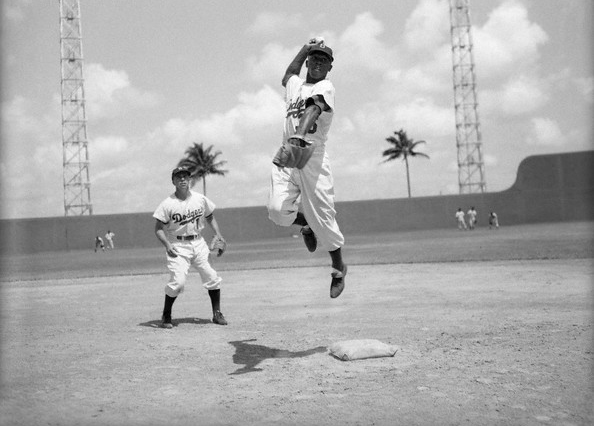
Junior Gilliam has a street named after him in Nashville (90 Feet of Perfection)
While walking around Nashville last weekend during CMA Fest, I noticed there was a street running through the heart of the city named "Junior Gilliam Way," not far from Rosa Parks Boulevard. That made me wonder what other players hail/hailed from Smashville, and if Gilliam was truly the best (and thus worthy of the distinction as the city's only ballplayer with a street named in his honor). Turns out there were quite a few players born in Nashville -- 39 and counting according to Baseball-Reference. While none are Hall of Famers (yet), there were a few who came close, as well as one who will likely go into Cooperstown one day wearing the cap of my beloved Boston Red Sox.

Best Players:

Ben Chapman (41.3 bWAR)
Chapman barely edges out Gilliam in terms of career value, but he was never going to have a street named after him following his shameful treatment of Jackie Robinson while managing the Phillies in 1947. While he was clearly a despicable human being, Chapman was also a pretty good ballplayer, leading the Major Leagues in steals four times (but also caught-stealing four times) and batting .302/.383/.440 (114 OPS+) for his career. His most memorable highlight as a player, however, was being told by Ted Williams, "I'll be back, and I'll make more money in this bleeping game than all three of you (Boston's outfield) combined!" after being sent down from Spring Training in 1938. With Chapman playing for Cleveland the following year, Williams arrived for good and set about delivering on that promise.

Jim Gilliam (40.7 bWAR)
Gilliam, more popularly known as "Junior," spent his entire 14-year career with the Dodgers. Despite spending most of those seasons on the trading block, he was only Boy of Summer from the '50s who was still a meaningful contributor during the Sandy Koufax-Don Drysdale era. The speedy switch-hitter proved to be a lesser version of Robinson -- his predecessor at second base -- with his baserunning, defensive versatility, and table-setting skills. A two-time All-Star, Gilliam won NL Rookie of the Year honors in 1953 and drew MVP votes four times, finishing in the top-six twice. He also played in seven World Series, winning four. Had he not begun his career in the Negro Leagues, he might have made it to the Hall of Fame.

Roy Cullenbine (31.4 bWAR)
Cullenbine was similar to Gilliam, as both were patient switch-hitters who made two All-Star teams, received MVP consideration four times, and led their league in walks once while playing the outfield a lot. A journeyman outfielder from 1938 to 1947, Cullenbine possessed one of the sharpest batting eyes in baseball history. He posted a career 17.8 percent walk rate and set a record by drawing a walk in 22 consecutive games, finishing with a career .408 OBP. He also developed power later in his career, slugging 73 of his 110 home runs over his final four seasons. Cullenbine played for a pair of pennant winners despite switching teams seven times in his career, helping Detroit win it all in 1945. With his solid pop, strong throwing arm and elite ability to get on base, he would have had a much longer and more stable career had he been born half a century later.

Best Names:

So many good ones. Here's a smattering: Tiny Graham, Noodles Hahn (think he had a weak arm, or just really liked spaghetti?), Ray Hamrick, Foster Castleman, Mickey Kreitner, Bubber Jonnard (brother of Claude Jonnard), Ike Fisher (brother of Bob Fisher), Clyde McCullough (say that one ten times fast). There were also a pair of "Lefty"s -- Lefty Davis and Lefty Sullivan. Now I'm wondering if a team has ever had two "Lefty"s at the same time...

Greatest What-if?

Johnny Beazley (4.6 bWAR)
Beazley burned bright and fast like a comet, going 21-6 with a 2.13 ERA and a 1.18 WHIP at age 24 to help his St. Louis Cardinals upset Joe DiMaggio's New York Yankees in the 1942 Fall Classic (the only World Series that DiMaggio would ever lose). Then he went into the service, and when he returned three years later he wasn't the same. Who knows how his career would've played out had he come up after the war instead of before.

Current Stars:

Mookie Betts (21.1 bWAR)
Just four seasons into his career, Betts has already accumulated more than half the WAR of any other Nashville-born player. A tremendous defensive outfielder with elite power, speed, and contact skills, he's arguably the American League's best all-around player not named Mike Trout. And the best part is -- he's only 24.

R.A. Dickey (20.8 bWAR)
Okay, maybe not a current star given how awful he's been this year, but he enjoyed a brief run as one of the game's top pitchers. In 2012, he prevented Clayton Kershaw from joining Greg Maddux and Randy Johnson as the only hurlers to win four straight Cy Young awards (Kershaw won in 2011, then again in 2014 and '15). The Mets, knowing how fickle knuckle-ballers can be, wisely traded the then-38-year-old for a package of prospects that included Noah Syndergaard. Dickey's reverted into a Tim Wakefield-esque innings-eater since then, but 15 years and nearly 2,000 innings in the Majors are nothing to sneeze at.

Sonny Gray (10.1 bWAR)
Gray's career got off to a promising start with Oakland, as he went 33-20 with a 2.88 ERA over his first three seasons and finished third in the 2015 AL Cy Young vote. He struggled during an injury-plagued 2016 and is still trying to get back on track this year. He's only 27, though, so hope remains that he will once again be a quality starter.

While not stars, this is where I give shout-outs to Andrew Triggs and Caleb Joseph.

Not bad, Nashville. While not as prolific as pumping out ballplayers as you are at country music stars, you can still lay claim to a National League Rookie of the Year and Cy Young winner, a likely future Hall of Famer, and a Hollywood villan.

Friday, May 26, 2017

Remembering Ryan Howard

With Howard's career likely over, it's time to do some reflecting (MLB.com)
It's been a couple weeks since the Braves released Ryan Howard from his Minor League contract, effectively bringing an end to the 37-year-old's career. The news didn't come as a shock to anyone who's watched him flail away over the past five seasons, but it's always sad whenever one of baseball's greats is told he can no longer play the game.

It's sadder still when one of those players starred during your childhood. When they retire, it feels like they're taking a small part of it with them. The player becomes great only in your memory, YouTube tributes, and grainy highlight reels. It also makes you realize how much time has passed since you first started cheering for them.

I wasn't a Phillies fan and never owned him in one of my fantasy leagues, so I can't say I truly rooted for Ryan Howard. But I remember the summer he exploded onto the national consciousness, establishing himself as a household name and one of the most feared hitters in baseball.

Bill Simmons once wrote somewhere that sports never matter more than when you're 14 years old. Now 10 (soon to be 11) years removed from that semi-magical age, I have to agree with him. The more I think back on it, the more sports memories I'm able to unearth from that time. It's like I'm drilling for oil, and the summer of 2006 is my Alaskan pipeline.

I think that's because I watched more Baseball Tonight (RIP) in that two-month stretch than I have before or since (this was in the dark ages before MLB Network, mind you). Every night, I'd go down into the basement and flip on BT or Sportscenter (whichever was on, though BT was infinitely better) while working out in preparation for eighth grade football.

So, yeah, I saw a lot of baseball highlights that summer, many of which involved Ryan Howard sending another meatball deep into the night.

By then, it was clear that Howard was having a special season. Expectations were high for him that spring, as they always are for players who've just won Rookie of the Year. Howard's were astronomical, though, given that his rookie numbers projected to 40 homers, 115 RBIs, and 325 total bases over a 162-game season.

Most people thought those numbers were Howard's ceiling. Few could have imagined that he'd blow them away.

Many rookies take a step back in their second season, especially strikeout-prone sluggers like Howard. The league adjusts to them, their weaknesses become exploited, and before long they look lost at the plate. There are strikeouts and pop-ups and growing pains, but it's all part of the process. The MLB learning curve is steep, sometimes taking years to master (just ask Jose Bautista).

Very rarely does a guy come up and rake from the start. A few of the all-time greats did -- Ted Williams, Joe DiMaggio, Albert Pujols -- but many didn't, including Mickey Mantle, Willie Mays, and Mike Trout. Some don't hit their stride until their 30s, like Raul Ibanez or Daniel Murphy.

Not Howard. He took off like a rocket ship, homering off reigning NL Cy Young winner Chris Carpenter on Opening Day and batting over .300 through the end of April. In May he barrelled through the stratosphere, slugging 13 homers and driving in 35 runs, but somehow did not win NL Player of the Month honors. Let me repeat that: A guy hit 13 homers and had 35 RBIs in one month and did not win Player of the Month. Some guy named Jason Bay (remember him?) did, with 12 homers, 35 RBIs, and a 1.090 OPS (72 points higher than Howard). 2006 was a different time.

When Howard didn't slow down in June (nine homers, 21 RBIs, .987 OPS), that's when I really began to take notice. Towards the end of the month, he ripped two homers and drove in all seven of his team's runs in a 9-7 loss to the Yankees while becoming the first player to hit a ball into the third deck in right field at Citizens Bank Park. When I saw his stat line in the box score the following day, I remember wishing the season would end already so I'd know what Howard's final numbers would like. My summer vacation had just started, and I was already pining for October.
Howard became an MVP frontrunner with his stretch run surge (Philly Phever)
A little more than a month later, after he'd been named to his first All-Star team and competed in the Home Run Derby, Howard produced the ultra-rare 0-for-0 stat line while playing a complete game. The Marlins walked him five times -- only once intentionally -- although I'm sure several were of the unintentionally-intentional kind. That was in the first game of a doubleheader. Florida pitched to him in the second game, but Howard made them pay with three hits, including a homer.

The five-walk game (which tied a Major League record) reflected a shift in how Howard was being approached. Prior to the All-Star break, he walked 31 times (five intentionally) in 352 plate appearances. In 352 PA's after the break, he walked 77 times, a whopping 32 of which were intentional. Only three men in baseball history received more intentional walks in a season; Barry Bonds, Willie McCovey, and Albert Pujols.

Seeing fewer strikes did nothing to slow Howard's roll in August, as he slammed 14 homers and drove in 41 runs (the highest monthly total since 1962) to win NL Player of the Month. He did not go more than three games without a tater, and he ended the month with six homers and 17 RBIs -- a great month for most players -- in his final nine games. When the dog days of August drew to a close, he had 49 homers (a new Phillies record) and 128 RBIs.

The Phillies, who had a losing record for much of the summer, had been out of the playoff picture for months by the time September rolled around, but their slugging first baseman continued to mash. After playing both ends of a doubleheader on the 2nd, he smashed three big flies in the first game of a second twin ball the following day and added two hits in the night cap for good measure. Following another multi-homer game on September 8th, he'd amassed 13 homers and 26 RBIs in his previous 16 games. With the season entering its final phase, Howard had found another gear.

And even though he had 56 homers with over three weeks to go, there was little talk of him reaching 60. The once-magic number had been cheapened by Bonds, Mark McGwire, Sammy Sosa surpassing it six times in the previous eight seasons, and fans had become de-sensitized to gaudy home run totals. Thanks to the tireless efforts of Congress and Jose Canseco, they'd recently become aware that America's pastime was teeming with bulked up roiders, causing the home run's once-mythic power to wane considerably in the public's eye. Howard's numbers were undoubtedly impressive, but were met with a collective shrug from the baseball world. Pretty cool, Ryan, but you're still a long way from 73.

Making matters worse for Howard was that, at precisely that moment, opposing pitchers and managers decided to stop pitching to him altogether. With teams battling for postseason berths and September call-ups trying to make names for themselves, no one could afford to get cute with Howard. So they hardly bothered, walking him 28 times (14 intentional) over his final 100 plate appearances. It was the closest thing we'd seen to the Barry Bonds treatment since, well, how pitchers were treating Barry Bonds that year, who was intentionally walked 38 times (one more than Howard) at age 41. The strategy worked, limiting Howard to just two long balls and 11 RBIs over his final 21 games. Despite reaching base 53 times via hit, walk, hit-by-pitch, or error during that span (excluding his two homers), he was driven in a mere eight times, indicating just how little protection there was for Philadelphia's cleanup man.

Howard was named Player of the Month again for September after slashing .385/.562/.750, and when the dust settled on October 1st his final numbers were extraordinary; .313/.425/.659 with 58 homers (the most ever by a player in his second season), 149 RBIs, 104 runs and 108 walks (37 intentional). His home runs and RBIs paced the Major Leagues, as did his 383 total bases. Still, one can only wonder what his stats might have looked like had opponents not waved the white flag in September, or if Charlie Manuel hadn't batted him fifth throughout the first half, thereby costing him several plate appearances. 60 homers, 160 RBIs, and 400 total bases were all within reach. As great as it was, Howard's season could have been legendary.

Even so, it was still pretty monstrous. So blinding were Howard's Triple Crown numbers that he momentarily convinced baseball writers he was better than the reigning NL MVP -- the best hitter in baseball, who also happened to be an elite defensive first baseman. After all it was Albert Pujols, not Howard, who led the Majors in slugging (.671) and OPS (1.102) that year while mashing a career-high 49 homers, winning a Gold Glove and leading St. Louis to a World Series title. Had he not landed on the DL for the first time in his career, he would have surpassed 50 homers as well and possibly 150 RBIs, in which case there would have been no debate as to which first sacker had the superior season.

While Howard followed up his MVP with several more remarkable seasons, he never again reached the heights of 2006. He never came close to batting .313 again, finishing at .258 for his career, and had only one other season with an OBP above .360. He never had another 50-homer season or slugged .600 again, as pitchers soon learned that he could be neutralized with breaking stuff low and away. He quickly became unplayable against left-handed pitchers and his body began to break down. After averaging 44 homers and 133 RBIs from 2006-2011, he was below replacement level in every season except one from that point forward. It was unfortunate that he fell off a cliff as soon as his five-year, $125 million contract extension kicked in, turning him into a punchline during his final seasons.

But even at the end, when his batting average fell below .200 and he could no longer hit lefties to save his life, the power remained. He went deep 25 times in his final season in just 331 at-bats, besting his rookie rate of 22 homers in 312 at-bats. The only difference was that his OPS was 214 points lower, and that he was a 36-year-old at the end of the line than a 25-year-old kid with his whole career ahead of him.

It's a shame Howard never got to DH (his natural position) full-time, as he had the size and strength to keep hitting home runs forever. The Yankees just should have put him in that Stadium and milked a few more seasons out of him for minimal cost. They still can, I guess, especially since he'd make a nice platoon partner for Matt Holliday, but the last thing Brian Cashman wants right now is another aging bat on his roster.

Man, 2006 really was a long time ago...
Thursday, December 15, 2016

Sandoval Shaping Up

Can a slimmed-down Sandoval save his career? (Boston CBS Local)
Pablo Sandoval was probably pretty disappointed when he found out he was going to need season-ending shoulder surgery last May. Nobody wants to be told they’re done for the year when it’s only just begun, especially when your only memorable highlight was busting your belt. If there’s a silver lining from Sandoval's lost season, however, it’s that surgery might yet save his career.

Because let’s face it; even if he'd stayed healthy, Sandoval wasn't going to offer much last year. Coming off the worst season of his career, he arrived at spring training overweight (again), failed to bat said weight and wound up losing his starting job to a player making $17 million less than him. Sandoval rode the pine in April, appearing in just three games as Travis Shaw and the Red Sox got off to torrid starts.

Sandoval was stuck. His team had little use for him while his contract and recent performance made him untradeable. So he wasted away on the bench, watching Shaw’s success systematically destroy whatever shot he had at redemption in 2016.

Now, with Shaw out of the picture, Sandoval has another opportunity to get back in Boston’s good graces. He wisely used his time off to get in "the best shape of his life" and prove he’s serious about his conditioning. Hopefully he also used that time to fix his swing and work on his defense, but both should improve if he maintains his svelte physique.

A year off could do Sandoval wonders. It certainly did for John Lackey, another West Coast star who initially struggled upon signing a big contract with the Red Sox. After pitching at a historically awful level in 2011, Lackey missed all of ’12 recovering from Tommy John surgery. It was a turning point in his career, as a slimmed-down Lackey returned to form in 2013 and is still going strong into his late 30s.

After last year, Sandoval has nowhere to go but up. It’s not hard to imagine him having a similar renaissance in 2017, given that he’ll only be 30. He’ll also be extra motivated to prove himself after everything that's happened since he landed in Boston.

On the other hand, going under the knife may only hasten Sandoval’s decline. Adrian Gonzalez fell off significantly as a hitter following the same procedure, which doesn’t bode well for Sandoval -- a much lesser hitter to start with. He may also find that taking a whole year off severely disrupts his timing, which could prevent him from having the kind of start he needs to secure regular playing time again (Shaw may be gone, but Brock Holt and Rafael Devers are looming).

How the rest of Sandoval’s career plays out will likely be decided by what he does over the next calendar year. If he keeps the weight off and recovers the skills he showed in San Francisco, he'll return from the abyss. But if his body balloons and his struggles persist, he may lose his job for good.