Showing posts with label Pedro Martinez. Show all posts

Friday, January 9, 2015

Props to Pedro

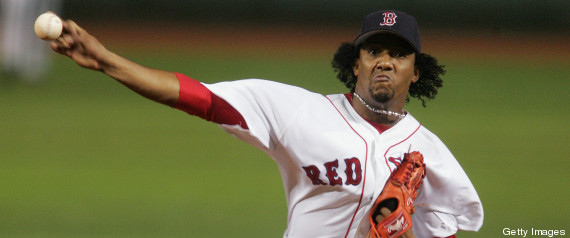
Martinez shown here in 2004--his final Red Sox season (Huffington Post)
When I was a kid growing up I had two baseball jerseys. Nomar Garciaparra's number 5, of course, and Pedro Martinez's 45.

Because for a few years around the turn of the century, Pedro and Nomar were the Red Sox. Or at least that's how it felt; them and a bunch of guys. Then they started getting reinforcements; Manny Ramirez, Johnny Damon, David Ortiz, and Curt Schilling, and that's when they became a true juggernaut and won the World Series, reversing the curse and all that.

Those guys were great--the team of a lifetime--but I'll always have a soft spot in my heart for Pedro. He was the first ace I ever knew. By the time I came of age as a Sox fan in the late 1990s, Roger Clemens was a member of the hated Yankees. Martinez was at his absolute zenith. When he was on the mound, the Red Sox felt unbeatable. Victory was assured provided they score a handful of runs, and with that lineup they usually did.

And man, I loved the way Pedro went after the Yankees. He fanned the flames of that burning rivalry like no other. He didn't just want to beat the Yankees; he wanted to dominate them. Pedro could always be counted on to dish out a little pain. He loved to intimidate, and was like Bob Gibson in that way. His starts were electrifying, mostly because he was always a threat to whiff 18 and pitch a perfect game, but also because there's was a good chance he'd kill someone with a fastball to the head.

But Pedro was more than just a Nolan Ryan-type gunslinger. He was an artist. His starts were masterful, his command impeccable. Martinez didn't just blow away hitters, he carved them up like he was Greg Maddux. Embarrassed them. Fooled them so bad they might as well have stayed on the bench. It was like a grown man pitching to Little Leaguers. You almost felt bad for hitters, because you knew they had no chance.

Pedro's run with the Red Sox was nothing if not extraordinary. He was the undisputed best pitcher in the American League during his seven years in Boston and second only to Randy Johnson in pitcher value. His 1999 and 2000 seasons are in the discussion for best of all-time, and he probably should have won another Cy Young in 2002. He was already a great pitcher when he joined the Red Sox (their then-GM Dan Duquette somehow traded for him a second time, which is akin to winning the lottery twice), but it was his time in Boston that made him a Hall of Famer.

All I can say is that I'm thankful Theo Epstein let him leave after '04, as he had only one good season left in the tank and turned out to be a poor investment for the Mets (then again, who isn't?). His 2004 season was subpar for him, and he hated playing second fiddle to Schilling. He lost his alpha dog status, and his bruised ego was evident in his diminished performance. His demeanor just wasn't the same. He lost his mojo (I blame the hair).

Though Martinez caught a lot of flak for his struggles against the Yankees, he was vital in helping Boston to four postseason appearances. Martinez never shied away from the spotlight and pitched a lot of big games. Who can forget his impeccable relief outing to clinch Game 5 of the 1999 ALDS in Cleveland? Or how he outdueled Rocket in Boston's only ALCS victory that same year? Remember how well he pitched in Game 7 of the '03 ALCS before Grady Little left him in to implode?

Then, of course, there was his dominant World Series start against the Cardinals in 2004, the last game of his Red Sox career. It put St. Louis down 3-0, essentially cinching the Series. In all, Martinez was 6-2 with a respectable 3.40 ERA and 1.12 WHIP in 13 postseason appearances with Boston (11 starts). Against some stacked Indians, Yankees, A's, and Cardinals lineups, that is truly impressive. Until Schilling came along (followed by Josh Beckett and Jon Lester), he was the guy. 

Martinez is a Hall of Famer, and a well-deserving one at that. Congrats Pedro, you earned it.

Friday, February 7, 2014

Rocket, Pedro, and Nomar Join Red Sox Hall of Fame

From L to R: Clemens, Garciaparra and Martinez (CBS)
On Wednesday the Red Sox inducted three of their most well-known players from the last 30 years into their Hall of Fame: Roger Clemens, Pedro Martinez and Nomar Garciaparra. Longtime radioman Joe Castiglione was also voted in by the 16-man panel comprised of team historians, executives, media members, and booster club reps.

All of them are no-brainers. Clemens and Martinez are easily the greatest pitchers in Red Sox history and deserve plaques in Cooperstown, and Garciaparra is probably the best shortstop the team has ever had (though Joe Cronin, Vern Stephens, Rico Petrocelli and John Valentin were great as well). Castiglione has been the voice of the team since 1983, which coincidentally was the same year that Clemens became a member of the Red Sox organization when they drafted him out of college.

Interestingly enough, Rocket and Nomar were teammates briefly in 1996 before Clemens was allowed to leave via free agency. Martinez, who replaced Clemens as the ace of Boston's staff, was traded to the Red Sox 11 months after Clemens signed with Toronto. The trio came within an eyelash of playing together. As it were, Martinez and Garciaparra were the team's dominant players and personalities in 1999 and 2000, after Clemens and Mo Vaughn left but before Manny Ramirez, and later Johnny Damon, Kevin Millar, Curt Schilling, David Ortiz, et. al. arrived.

Though all were immensely popular during their playing days, none of them finished their careers with the Red Sox. Clemens and Martinez signed elsewhere as free agents, and Garciaparra was famously traded away three months before the Red Sox ended their 86-year championship drought.

Even so, they left Red Sox fans with plenty of fond memories from their dazzling performances. Clemens and Martinez's starts were electrifying--they had the ability to throw a perfect game on any given day and were absolutely fearless on the mound. Garciaparra's drawn-out at-bats were the stuff of legend, watching him tap his cleats and toy with his batting gloves before lashing a line drive off the big green wall in left. On defense he was acrobatic and could go into the hole with the best of them.

I was too young to remember Clemens but old enough to recall plenty of Pedro and Nomar. They'll always hold a special place in my heart. Here are some of their accomplishments:

Roger Clemens (1984-1996)
Clemens burst onto the scene as a 21 year-old rookie in 1984, just 11 months after Boston drafted him in the first round. By 1986 he was a star: the All-Star Game MVP and American League MVP as well as a unanimous choice for the AL Cy Young award (Fun fact: Rocket was the only starting pitcher to be named MVP between Vida Blue in 1971 and Justin Verlander in 2011). He was named Cy Young the following year, and won again in 1991, sandwiched between a second place finish the year before (to Bob Welch) and a third place finish the year after. Clemens would win the award four more times after leaving Boston to finish with a record seven for his career.

Clemens won four ERA titles with Boston, including three in a row from 1990-1992, and led the league in strikeouts three times. He twice fanned 20 batters in a single game, still the record for most whiffs in a 9-inning game (though later equaled by Kerry Wood) in 1986 and 1996.  Clemens is the franchise leader in strikeouts and pitching WAR, while his 192 wins and 38 shutouts in a Red Sox uniform are tied with Cy Young for the most ever. Nobody has worn his #21 since he left the team.

Nomar Garciaparra (1996-2004)
A personal favorite of mine, Garciaparra became an instant sensation in Boston, where he was celebrated as a member of the Holy Trinity of shortstops in the late '90s (better than Derek Jeter and on par with Alex Rodriguez). He was AL Rookie of the Year (unanimously) in 1997, MVP runner-up to Juan Gonzalez in 1998, and the league batting champion in 1999 and 2000, becoming the first righthanded hitter to win back-to-back batting crowns since Joe DiMaggio. Like Dustin Pedroia, his line drive swing was built for the Green Monster, which he routinely cleared when he wasn't peppering it with doubles.

Unfortunately, he suffered a wrist injury in 2001 and was never really the same after that:

1996-2000: .333/.382/.573, 140 OPS+, 27.8 bWAR, one HR per 20.8 AB
2001-2009: .297/.345/.480, 111 OPS+, 16.4 bWAR, one HR per 28.4 AB

Garciaparra was still great in 2002 and 2003, but age, nagging injuries, contract squabbles, shaky defense and a sour attitude contributed to a down 2004 in which Theo Epstein dealt him to the Chicago Cubs in a trade that brought Gold Glovers Doug Mientkiewicz and Orlando Cabrera to Boston. Garciaparra returned to the team in 2010, signing a one-day contract so he could retire with the Red Sox.

Pedro Martinez (1998-2004)
The Sandy Koufax of modern times, Martinez reached his zenith in Boston. He was the reigning National League Cy Young winner when he joined the Red Sox prior to the 1998 season, then went out and added two more trophies to his mantle in 1999 and 2000, when he was otherworldly. In his final season with the Red Sox, he teamed with Curt Schilling to form a lethal 1-2 punch at the top of Boston's rotation that helped the team win 98 regular season games and the World Series.

During his time in Boston, Pedro made four All-Star teams and won four ERA crowns, three strikeout titles, and two Cy Young awards (also finishing second twice, third once and fourth once). He went 117-37 (.760 winning percentage, best in Red Sox history) with a 2.52 ERA, 190 ERA+ and 0.98 WHIP. Considering the context--pitching half his games at Fenway Park during the height of the Steroid Era--and it's easy to see why many regard his Boston years as the most dominant stretch a pitcher has ever had. His #45 has not been assigned since he left to sign with the Mets. He's now a special assistant to GM Ben Cherington.

Thursday, January 24, 2013

Best Pitching Season of the 1990s

Martinez delivers during his sensational All-Star Game performance
1999 Pedro Martinez (9.5 bWAR)

Martinez was already recognized as one of the best pitchers in the game at the end of the Twentieth Century, but it was his 1999 season that established his reputation as one of the best pitchers of all time. His success that year elevated him into the same stratosphere as Sandy Koufax, Juan Marichal and Bob Gibson, not to mention outstanding contemporary hurlers like Roger Clemens, Randy Johnson and Greg Maddux.

Fully acquainted with the Junior Circuit after switching leagues following his 1997 Cy Young season, the 27 year-old Martinez put together one of the finest seasons a pitcher ever had. He won the pitching Triple Crown by leading the league with 23 wins, 313 strikeouts and a 2.07 ERA, which was nearly a full run and a half better than runner-up David Cone's 3.44. Aside from the traditional stats, he topped all pitchers in just about every statistic imaginable, from WAR and Winning Percentage to WHIP and ERA+.

His greatness was on display for all to see in that year's Midsummer Classic at Fenway Park. Baseball celebrated its legends past and present, but Martinez stole the show with his electrifying performance. He began the game by striking out Barry Larkin, Larry Walker, and Sammy Sosa, the first time any pitcher opened an All-Star Game by striking out the side. When he whiffed Mark McGwire to lead off the second, he became the first pitcher to strike out the first four batters of an All-Star Game. Matt Williams reached on an error by Roberto Alomar, but Pedro bounced back to punch out Jeff Bagwell while Ivan Rodriguez gunned down Williams on a strike-him-out, throw-him-out. Martinez earned All-Star Game MVP honors for his modern day re-enactment of Carl Hubbell's historic performance in the 1934 All-Star Game when Hubbell struck out five future Hall-of-Famers in a row: Babe Ruth, Lou Gehrig, Jimmie Foxx, Al Simmons, and Joe Cronin.

(By the way, who in 1999 would have believed that of the five men Martinez struck out, Larkin would be the only one with a plaque hanging in Cooperstown more than a dozen years later?  That Larkin would be in and McGwire and Sosa, the sluggers who obliterated Roger Maris's single season home run record the previous summer, would be out? A lot has changed since then).

In a game that actually counted, he tossed a one-hitter at Yankee Stadium two months later on September 10th. After plunking Chuck Knoblauch to open the game, Martinez mowed down the Bronx Bombers and outdueled Andy Pettitte to lead Boston to a 3-1 victory over its arch-rivals. Long before Martinez tipped his cap to the Yankees and called them his Daddy, he punched out 17 of them and allowed just one hit, a solo home run to Chili Davis. He silenced a Yankees lineup that won 98 games and scored 900 runs that season with big bats such as Derek Jeter, Paul O'Neill, Tino Martinez, and Bernie Williams.

Martinez's dominance continued into the postseason. Despite facing two high-powered offenses in the Cleveland Indians and aforementioned Yankees, he was untouchable. Martinez answered the call, firing 17 shutout innings with 23 strikeouts and just five hits allowed. Nursing a strained back, he no-hit Cleveland for six innings in the final game of the ALDS, holding the line while Boston's bats built a four-run lead that propelled the Red Sox into the League Championship Series. Though the Sox lost in five to their nemeses, who were in the midst of winning four World Series in five years, Martinez quieted New York in his lone start of the series. He blanked the Yanks over seven innings, allowing just two hits (both singles) while the Bosox battered the Rocket/their former ace in a 13-1 rout.

Martinez collected his second Cy Young award (unanimously) but narrowly lost out to Ivan Rodriguez in the controversial MVP race. Despite receiving the most first place votes, Martinez was omitted from a pair of ballots because two writers--George King from New York and LaVelle Neal of Minnesota--did not deem pitchers to be worthy all-around players (even though King cast votes for two pitchers--David Wells and Rick Helling--the year before). Martinez may have also been hurt by teammate Nomar Garciaparra, who finished seventh after winning the batting title and posting a 1.022 OPS.

Voters traditionally have a hard time voting for starting pitchers, and there's a lot of bias against the men who take the ball every fifth day. For instance, no National League hurler has taken home the hardware since Bob Gibson 45 years ago. Not Steve Carlton, Tom Seaver, nor Dwight Gooden. Not Greg Maddux, Tom Glavine nor Randy Johnson. It's always tricky comparing position players to pitchers, but bWAR says Martinez was worth 3.4 more wins than Rodriguez. The disparity in FanGraphs' measurement is even greater; 5.2 wins in Martinez's favor. The writers obviously blew it here and robbed Martinez of the trophy he so clearly deserved.

Some more points of interest from Martinez's masterful 1999:
  • Martinez was named AL pitcher of the month in April, May, June, and September, something nobody had ever accomplished before
  • Opponents batted just .205/.248/.288 against him
  • His average GameScore was a 69
  • Incredibly, he surrendered just nine home runs despite pitching half his games in Fenway Park. He have up just three long balls in his 14 road starts and never allowed multiple bombs in any game he pitched that year
  • Including the postseason, the Boston Red Sox went 29-5 (.853) when Martinez toed the rubber and 69-69 (an even .500) when he didn't
  • Strung together seven consecutive starts with ten or more strikeouts from April 15th to May 18th, then rattled off eight straight starts with double digit strikeouts to end the regular season
  • Had six games with at least 15 strikeouts. Justin Verlander, who's made 232 regular season starts in his career, has never struck out 15 batters in a single game
  • Became the eighth modern pitcher with multiple seasons with 300 strikeouts, joining Nolan Ryan, Rand Johnson, Sandy Koufax, Walter Johnson, Rube Waddell, Sam McDowell, Curt Schilling, and J.R. Richard
  • His 13.2 K/9 rate broke the record set by Kerry Wood the year before, but the new record lasted all of two seasons before the Big Unit shattered it in 2001
  • Martinez had just three starts all year in which he allowed three earned runs and only two others in which he surrendered more than three earned runs. Interestingly, they were both against interleague teams (Montreal and Florida). Check out his earned run breakdown from his 29 starts:                                                  
  • 0 runs--5 starts                                                                                                                                 1 run--10 starts                                                                                                                                2 runs--9 starts
    3 runs--3 starts
    4+ runs--2 starts
As good as his 1999 masterpiece was, his follow-up campaign was even better.

Best offensive season of the 1990s--Mark McGwire (1998)

Thursday, January 17, 2013

Best Pitching Season of the 2000s

Martinez was at the top of his game in 2000 (FanNation)
After selecting the best offensive seasons of each decade last March, which I will link to at the bottom of each page, I think the time has come to choose the best pitching seasons of each decade.

The 2000s will be remembered for performance enhancing drugs and high levels of run-scoring, but the truth is that there were a host of incredible pitching performances during the aughts as well. Randy Johnson, Johan Santana, Zack Greinke, Tim Lincecum and Roy Halladay, to name a few, all put up some remarkable numbers. But none of them can hold a candle to the maestro who spoiled the Fenway Faithful with his electrifying starts.

2000 Pedro Martinez (11.4 bWAR)

I feel pretty comfortable saying that during the late 1990s and first few years of the new millennium  Pedro Martinez was the best pitcher on the planet. I would even go so far to claim that, during his prime, he was the best pitcher in baseball history. Better than Sandy Koufax, Greg Maddux, Tom Seaver. More dominant than Roger Clemens, Nolan Ryan, and Justin Verlander. Given the context--Fenway Park as his home field, in a leaue with the Designated Hitter, during the highest offensive period in baseball history when steroids helped hitters put up videogame numbers--his performance represents the highest peak for any pitcher in baseball history.  Needless to say, Martinez should be a first ballot Hall of Famer when he comes up for election in 2015.

In the year Y2K, Martinez secured his third Cy Young award in four years, earning a unanimous vote (as he did the year before) for what I believe is the greatest season a pitcher ever had. He led the league in just about every category that matters and was the most valuable player in baseball that year according to bWAR. In many ways this season was even better than his masterful 1999 campaign, for Martinez had a lower ERA and WHIP, more bWAR, threw more innings, and maintained a higher K/BB ratio in 2000. The numbers are staggering, and they back me up:

  • Pedro posted the ninth highest single season bWAR total of any starting pitcher since 1900, including the fourth highest in the integrated era behind Steve Carlton (1972), Roger Clemens (1997) and Wilbur Wood (1971)
  • His 0.74 WHIP rates as the best of all time, as does his 291 ERA+ (discounting Tim Keefe's 1880)
  • Became the only pitcher in history to have more than twice as many strikeouts (284) as hits allowed (128)
  • is 8.88 K/BB ratio ranks as the fourth best mark in the modern era, trailing Bret Saberhagen (11.0 in 1994), Cliff Lee (10.3 in 2010) and future teammate Curt Schilling (9.6 in 2002), but rates as the best mark for an American League pitcher while his 5.3 H/9 also ranks fourth
  • On April 15th, his streak of ten consecutive starts with at least ten strikeouts, a major league record, came to an end when he whiffed nine Oakland A's. Interestingly, the streak originated against them on August 19th, 1999
  • Recorded double digit strikeouts in 15 of his 29 starts, and had 9 six other times
  • The Red Sox went 21-8 (.724) when Martinez pitched, 64-69 (.481) when he didn't. Somehow, he failed to receive a single first place MVP vote and finished fith behind sluggers Jason Giambi, Frank Thomas Alex Rodriguez, and Carlos Delgado
  • In his six losses, Martinez averaged eight innings per start and had a 2.44 ERA, 0.79 WHIP, and 60/8 K/BB ratio
  • On May 6th, Martinez came up on the short end of a 1-0 pitching duel with Steve Trachsel (the pitcher Mark McGwire took deep to break Roger Maris's home run record two years earlier) but fanned 17 Tampa Bay Devil Rays while going the distance. His next time out Martinez fired another complete game, this time wracking up 15 Ks in Baltimore as he two-hit the Orioles. His 32 whiffs in consecutive starts tied Luis Tiant's  American League record set in 1968, the Year of the Pitcher
  • His average GameScore was a 73
  • Held opponents to a .167/.213/.259 triple slash line. The batting average and OBP set new modern records
  • His best performance of the year came at the end of the summer in Tampa Bay. Facing the league's worst offense, albeit one that featured potent bats in Fred McGriff, Greg Vaughn, Jose Guillen and Aubrey Huff, Pedro began the game by plunking Gerald Williams. Williams charged the mound and dropped Martinez before Jason Varitek tackled his pitcher's assailant. Martinez got back up, dusted the dirt off his shoulders and proceeded to mow down the next 24 batters in a row. He took a no-hitter into the bottom of the ninth, only to lose it to John Flaherty, of all people, when the backstop roped a leadoff single with two strikes
  • A road warrior, Martinez went 12-1 outside of Fenway's friendly confines
  • Outside of a three-start stretch in the middle of the summer when he served up seven gopher balls, he allowed just ten home runs in his other 26 starts
  • His 1.74 ERA was the league's lowest since 1978, when Ron Guidry also posted a 1.78 ERA. Martinez's mark is truly remarkable considering the park-adjusted league ERA was 4.97. His ERA was nearly two full runs higher than second place Roger Clemens' 3.70 and never rose higher than 1.81 that year
  • Had just two starts all year--June 25th in Toronto and August 24th in Kansas City--when he allowed more than three earned runs. Look at his earned run breakdown:
    0 runs--10 starts
    1 run--7 starts
    2 runs--5 starts
    3 runs--5 starts
    4+ runs--2 starts
Best offensive season of the 2000s--Barry Bonds (2004)