The Boston Red Sox have had a busy holiday weekend so far. General Manager Ben Cherington reached agreements with all eight of Boston's arbitration-eligible players, listed below. He also came to terms with Mike Napoli, who signed with the Red Sox six weeks ago but was flagged after his physical revealed a hip condition. The new deal is much cheaper; a one-year, $5 million contract that could be worth up to $13 million with incentives.
Jacoby Ellsbury: one-year, $9.5 million
-Possibly the last paycheck Ellsbury ever receives from the Boston Red Sox, for the Scott Boras client is expected to cost a pretty penny when he hits the free agent market next winter. If he walks, expect the speedy center fielder to go out with a bang (read: big contract year).
Joel Hanrahan: one-year, $7.04 million
-Boston's new closer nearly doubled his 2012 salary but will still earn little more than half of what the Philadelphia Phillies are paying Jonathan Papelbon.
Craig Breslow: two-year, $6.25 million
-The well-traveled southpaw has put together a solid career coming out of the bullpen and continued to pitch well after the Arizona Diamondbacks shipped him up to Boston for Scott Podsednik and Matt Albers. His deal includes an option for a third year.
Alfredo Aceves: one-year, $2.65 million
-Thrust into the closer's role when Bailey got hurt last year, Aceves struggled from the outset and never looked comfortable. Buried himself in Bobby Valentine's doghouse by the end of the summer, so Ace should benefit from a fresh start under new manager John Farrell. Expect him to be the dependable middle reliever he was for Boston in 2011, when he went 10-2 with a 2.61 ERA.
Andrew Bailey: one-year, $4.1 million
-The former Rookie of the Year will serve as a setup man for the first time in his career and might need some time to adjust to his new role. I'm willing to chalk up his failed 2012 to injury and give him a second chance in 2013.
Daniel Bard: one-year, $1.86 million
-Moving Bard to the starting rotation backfired last year, but hopefully he can put the failed experiment behind him and dominate hitters like he did for most of 2011.
Franklin Morales: one-year, $1.49 million
-Has been a solid addition to Boston's bullpen since Theo Epstein purchased him from the Colorado Rockies in the spring of 2011. Morales stunk with the Rockies but has revived his career with Boston, where he's averaged nearly a strikeout per inning and holds a 117 ERA+. There's been talk that Morales, who made nine starts in 2012, may be converted into a starting pitcher, especially if John Lackey bombs in his return to the rotation.
Andrew Miller: one-year, 1.48 million
-The former first round draft pick cost the Red Sox a playoff spot two years ago, when Terry Francona gave him a dozen starts in place of the injured Clay Buchholz. Working exclusively out of the bullpen, the perennial disappointment settled down last year and developed into a useful reliever for Bobby V. Miller maintained an impressive 11.4 K/9 over his 53 relief appearances to complement his 3.35 ERA (131 ERA+) and 1.19 WHIP.
After addressing the team's most pressing concerns, Cherington's payroll currently sits around $145 million. Spring training starts in a month, so he's likely done with major moves for the winter. While he's improved the team considerably without overpaying for big name free agents such as Josh Hamilton, Zack Greinke, and Anibal Sanchez, I don't think he turned the Red Sox back into contenders overnight. Napoli, Hanrahan, Shane Victorino, and Ryan Dempster are all good players, but can they do enough to help a 93 loss-team reach the postseason?
We'll find out soon enough.
Sunday, January 20, 2013


Thursday, January 17, 2013
LeBron Youngest to 20,000
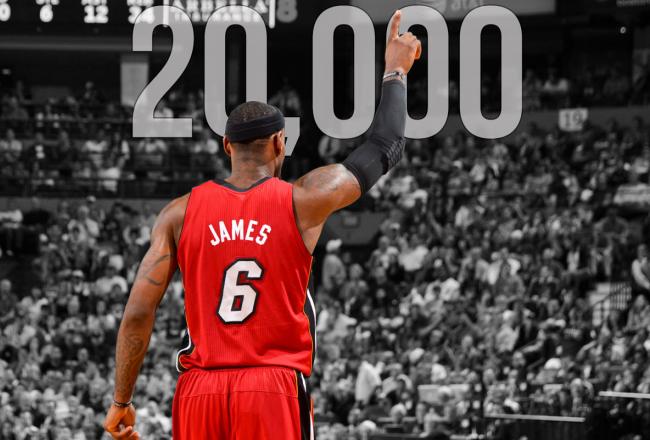
He was 28 years and 17 days old when he took the court in Oakland, needing 18 points to reach the benchmark. Aggressive from the start, King James didn't wait around. He came out shooting and got his milestone by halftime, helping Miami build a 14-point lead over the Golden State Warriors. With his scoring goal accomplished, James started spreading the ball around and found open teammates. He had already notched his 5,000th career assist in the first half as well (joining Kobe Bryant and Kevin Garnett as the only active players with 20K points and 5K helpers), but kept passing and finished the game with ten dimes to go along with his 25 points and seven rebounds. With LBJ facilitating their offense, the Heat built their lead up to 34 points in the third quarter. Miami cruised to a 92-75 blowout from there, allowing Erik Spoelstra to rest his starters in the fourth quarter. With the win, Spo's squad held on to their one game lead over the New York Knicks for first place in the Eastern Conference.
The Heat had struggled on their current roadtrip, losing three games to Indiana, Portland and Utah. Even so, the shorthanded Warriors, without Andrew Bogut (ankle) and Stephen Curry (knee), never stood a chance. Mark Jackson's squad struggled to get good looks against Miami's defense and shot just 36.3 percent from the floor, including 25 percent from beyond the arc. It also didn't help that they committed 21 turnovers, ten more than Miami. But it wasn't all bad for Golden State. In his first start of the season, Jarrett Jack filled in for Curry and scored 16 points on 7-of-14 shooting. David Lee and Carl Landry both notched double-doubles. The Warriors get a day off to lick their wounds, only to face another challenging matchup tomorrow night when they square off with Tim Duncan, Tony Parker and the San Antonio Spurs.
James just set one record, but he still has a long way to go (18,380 points to be exact, more than Isiah Thomas, Magic Johnson, Chris Webber, and Kevin McHale scored in their entire NBA careers) to tie Kareem Abdul-Jabbar's record for most career points. He's already more than halfway there, but that's a lot of ground to make up. To reuse a comparison I made two summers ago, Alex Rodriguez was the youngest player to 500 home runs, well on his way to passing Babe Ruth, Hank Aaron and Barry Bonds. Now, based on his declining performance and inability to stay healthy, I'm skeptical he'll hit 700 home runs, much less the 800 some once projected him for. To some extent, the same thing is happening to Albert Pujols as well.
It's impossible to predict injuries. LBJ is built like an Abrams tank and never gets hurt, but you could have said the same thing about A-Rod five years ago. Forecasting athletic careers is a dangerous game. A lot can change very quickly. Father Time catches up to everyone eventually, and luck contributes more to athletes' health than we would like to believe. Especially in basketball, where a mistimed jump or awkward landing can spell doom. You're always one play away from a catastrophic career-altering injury. The bottom line is that even the best players break down in their thirties, and who's to say James will still be playing like Michael Jordan ten years from now?
But the real reason I'm not betting on him to break is the scoring drop-off that resulted from his joining forces with Dwyane Wade and Chris Bosh. Despite improving his efficiency--his field goal percentage has improved every year since 2006-2007--his slight slip in shot attempts, especially those from the charity stripe and three-point range, have cut into his scoring numbers. Excluding his rookie year, James averaged 29 points on 21.1 field goal attempts per game-- 4.5 of which were of the three-point variety--and 9.5 free throw attempts per game in his last six seasons with Cleveland. Since taking his talents to South Beach, his scoring has dropped to 26.7 points on 18.7 shots per game. He's getting to the line less often than at any point since his rookie season, and his three point attempts are down 33 percent. There's no denying that James is a much better player and more polished scorer than he was in his early days with the Cavs, but now that he's surrounded by a great supporting cast he simply doesn't need to score as much. My money's on Kevin Durant to break Jabbar's record (assuming Kobe Bryant doesn't get there first) and think James will end up somewhere in the 35,000-36,000 point range.
The Heat wrap up their West Coast swing tonight against the Los Angeles Lakers in a must-see battle of the Big Threes: James, Wade, and Bosh versus Bryant, Steve Nash and Dwight Howard (Pau Gasol will receive limited minutes in his first game back from a concussion). A few months ago this game looked like a preview of the NBA finals, and while the Heat have held up their end of the bargain LA is languishing four games below .500. After firing Mike Brown just five games into the season, the aging Lakers have yet to gel under Mike D'Antoni. They endured a six-game losing streak to begin the new year, but are coming off back-to-back wins against Cleveland and Milwaukee. The Lakers are going to turn it around at some point and get on a roll, but can they do it tonight against the top team in the Eastern Conference?
Tune in to TNT tonight to find out.
Best Pitching Season of the 2000s
 |
| Martinez was at the top of his game in 2000 (FanNation) |
The 2000s will be remembered for performance enhancing drugs and high levels of run-scoring, but the truth is that there were a host of incredible pitching performances during the aughts as well. Randy Johnson, Johan Santana, Zack Greinke, Tim Lincecum and Roy Halladay, to name a few, all put up some remarkable numbers. But none of them can hold a candle to the maestro who spoiled the Fenway Faithful with his electrifying starts.
2000 Pedro Martinez (11.4 bWAR)
I feel pretty comfortable saying that during the late 1990s and first few years of the new millennium Pedro Martinez was the best pitcher on the planet. I would even go so far to claim that, during his prime, he was the best pitcher in baseball history. Better than Sandy Koufax, Greg Maddux, Tom Seaver. More dominant than Roger Clemens, Nolan Ryan, and Justin Verlander. Given the context--Fenway Park as his home field, in a leaue with the Designated Hitter, during the highest offensive period in baseball history when steroids helped hitters put up videogame numbers--his performance represents the highest peak for any pitcher in baseball history. Needless to say, Martinez should be a first ballot Hall of Famer when he comes up for election in 2015.
In the year Y2K, Martinez secured his third Cy Young award in four years, earning a unanimous vote (as he did the year before) for what I believe is the greatest season a pitcher ever had. He led the league in just about every category that matters and was the most valuable player in baseball that year according to bWAR. In many ways this season was even better than his masterful 1999 campaign, for Martinez had a lower ERA and WHIP, more bWAR, threw more innings, and maintained a higher K/BB ratio in 2000. The numbers are staggering, and they back me up:
- Pedro posted the ninth highest single season bWAR total of any starting pitcher since 1900, including the fourth highest in the integrated era behind Steve Carlton (1972), Roger Clemens (1997) and Wilbur Wood (1971)
- His 0.74 WHIP rates as the best of all time, as does his 291 ERA+ (discounting Tim Keefe's 1880)
- Became the only pitcher in history to have more than twice as many strikeouts (284) as hits allowed (128)
- is 8.88 K/BB ratio ranks as the fourth best mark in the modern era, trailing Bret Saberhagen (11.0 in 1994), Cliff Lee (10.3 in 2010) and future teammate Curt Schilling (9.6 in 2002), but rates as the best mark for an American League pitcher while his 5.3 H/9 also ranks fourth
- On April 15th, his streak of ten consecutive starts with at least ten strikeouts, a major league record, came to an end when he whiffed nine Oakland A's. Interestingly, the streak originated against them on August 19th, 1999
- Recorded double digit strikeouts in 15 of his 29 starts, and had 9 six other times
- The Red Sox went 21-8 (.724) when Martinez pitched, 64-69 (.481) when he didn't. Somehow, he failed to receive a single first place MVP vote and finished fith behind sluggers Jason Giambi, Frank Thomas Alex Rodriguez, and Carlos Delgado
- In his six losses, Martinez averaged eight innings per start and had a 2.44 ERA, 0.79 WHIP, and 60/8 K/BB ratio
- On May 6th, Martinez came up on the short end of a 1-0 pitching duel with Steve Trachsel (the pitcher Mark McGwire took deep to break Roger Maris's home run record two years earlier) but fanned 17 Tampa Bay Devil Rays while going the distance. His next time out Martinez fired another complete game, this time wracking up 15 Ks in Baltimore as he two-hit the Orioles. His 32 whiffs in consecutive starts tied Luis Tiant's American League record set in 1968, the Year of the Pitcher
- His average GameScore was a 73
- Held opponents to a .167/.213/.259 triple slash line. The batting average and OBP set new modern records
- His best performance of the year came at the end of the summer in Tampa Bay. Facing the league's worst offense, albeit one that featured potent bats in Fred McGriff, Greg Vaughn, Jose Guillen and Aubrey Huff, Pedro began the game by plunking Gerald Williams. Williams charged the mound and dropped Martinez before Jason Varitek tackled his pitcher's assailant. Martinez got back up, dusted the dirt off his shoulders and proceeded to mow down the next 24 batters in a row. He took a no-hitter into the bottom of the ninth, only to lose it to John Flaherty, of all people, when the backstop roped a leadoff single with two strikes
- A road warrior, Martinez went 12-1 outside of Fenway's friendly confines
- Outside of a three-start stretch in the middle of the summer when he served up seven gopher balls, he allowed just ten home runs in his other 26 starts
- His 1.74 ERA was the league's lowest since 1978, when Ron Guidry also posted a 1.78 ERA. Martinez's mark is truly remarkable considering the park-adjusted league ERA was 4.97. His ERA was nearly two full runs higher than second place Roger Clemens' 3.70 and never rose higher than 1.81 that year
- Had just two starts all year--June 25th in Toronto and August 24th in Kansas City--when he allowed more than three earned runs. Look at his earned run breakdown:
0 runs--10 starts
1 run--7 starts
2 runs--5 starts
3 runs--5 starts
4+ runs--2 starts
Tuesday, January 15, 2013
Hall of One
 |
| Aaron Sele a Hall of Famer? Somebody thought so (Bleacher Report) |
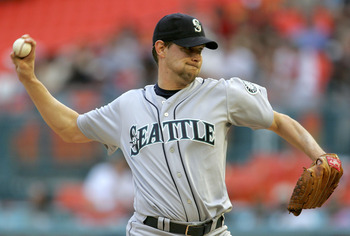
But Sele is not the first unqualified player to snag a vote for the Hall, and he won't be the last. The BBWAA has cast votes for the Hall of Fame every year since 1966, and in that time 118 candidates ended up with a singular vote. While most of these players would have a hard time persuading their own mothers to vote for them, there were also a handful that definitely deserved more support. Denny McLain, for instance, won back-to-back Cy Young awards and was the 1968 American League MVP when he produced one of the best seasons for a pitcher since Jackie Robinson broke the color barrier. He won 114 games before he was 26, and like Dwight Gooden the young hurler seemed destined for Cooperstown. Instead, he got into too much trouble off the field and never pitched a game after his 29th birthday. I liken his career to that of a shooting star--bright but short--like the pitching equivalent of Roger Maris. Think of it this way. If Justin Verlander got on the wrong side of the law and retired today, don't you think he'd get more than one Hall of Fame vote?
But I digress. Without further adieu, here is the list of everyone who received exactly one vote for baseball's Hall of Fame since 1966, the year Ted Williams was inducted:
2014: Armando Benitez, Kenny Rogers, Jacque Jones
2013: Aaron Sele
2012: Javy Lopez and Eric Young
2011: Benito Santiago (1987 NL Rookie of the Year) and Bret Boone
2010: Pat Hentgen (1996 AL Cy Young winner), Kevin Appier and David Segui
2009: Jesse Orosco
2008: Chuck Knoblauch (1991 AL Rookie of the Year), Shawon Dunston, Chuck Finley, Todd Stottlemyre, and David Justice (1990 NL Rookie of the Year)
2007: Jay Buhner, had three straight 40-homer seasons
2006: Walt Weiss, 1988 AL Rookie of the Year
2005: Tony Phillips and Terry Steinbach
2004: Cecil Fielder (Prince Fielder's father), Terry Pendleton (1991 NL MVP over Barry Bonds) and Randy Myers
2003: Mark Davis, Danny Tartabull and Darren Daulton
2002: Lenny Dykstra and Tim Wallach
2001: Tom Browning, John Kruk, Ron Darling, Jose Rijo, Jim Deshaies, and Steve Bedrosian
2000: Lonnie Smith, Bruce Hurst, Bob Welch (1990 AL Cy Young winner over Roger Clemens), and Bill Gullickson
1999: John Candelaria
1998: Rick Dempsey
1997: Two Terrys--Terry Kennedy and Terry Puhl
1996: Chet Lemon (no relation to Bob Lemon)
1995: Jim Sundburg, Mike Krukow, and Chris Speier
1994: Ray Knight, immortalized by Vin Scully for scoring on Mookie Wilson's grounder that scooted through Bill Buckner's legs
1993: Bill Campbell, one of the first big name free agents in baseball history
1992: Toby Harrah and Dennis Leonard
1991: Richie Hebner, Burt Hooton (one of the three pitchers Reggie Jackson took deep in Game 6 of the 1977 World Series), John Lowenstein, Jeff Burroughs (1974 AL MVP), Mike Jorgenson, Ellis Valentine, and Mike Hargrove (1974 AL Rookie of the Year)
1990: Jim Bibby, Greg Luzinski, Mike Torrez (will forever live in infamy for serving up the gopher ball to Bucky Dent), and Torrez's then-teammate Jerry Remy
1989: Don Money and Gene Tenace, who would have been a poster boy for Billy Beane
1988: Al Hrabosky
1986: George Scott, Bud Harrelson, Jose Cardenal, and Jack Billingham
1985: Jesus Alou (younger brother of Felipe Alou and Matty Alou) Dock Ellis, and Rico Carty
1984: Clay Carroll, Bob Bailey and Nelson Briles
1983: Dave Giusti, Tommy Helms (1966 NL Rookie of the Year), and Felix Millan
1982: Leo Cardenas and Claude Osteen
1981: Sonny Siebert, Gates Brown, Jim Northrup, Lindy McDaniels, Leo Cardenas, and Glenn Beckert
1980: Sonny Jackson, Jim Hickman, and Don McMahon
1979: Hal Lanier, Johnny Callison and Chris Short
1978: Denny McLain (baseball's last 30-game winner), Camilo Pascual and Clete Boyer (homeless man's Brooks Robinson)
1975: Rocky Colavito (the Junior Circuit's best right-handed slugger from the Boomer years not named Harmon Killebrew) and Bill Virdon (1955 NL Rookie of the Year)
1973: Harvey Haddix and Smoky Burgess
1972: Jackie Jensen (1958 AL MVP)
1971: Bill Bruton
1970: Gil McDougald (1951 AL Rookie of the Year), Preacher Roe, Jackie Jensen, and Eddie Lopat
1969: Jackie Jensen
1968: Vic Raschi (ace of Casey Stengel's Yankee squads that won five straight World Series from 1949-'53)
1967: Clint Courtney, Ned Garver, Billy Martin (favorite drinking buddy of Mickey Mantle and Whitey Ford), Grady Hatton, Walt Dropo (1950 AL Rookie of the Year/RBI leader), Andy Pafko, and Jim Hearn
1966: Bobby Adams, Bob Porterfield, Jim Hearn, Chico Carrasquel, Solly Hemus
Monday, January 14, 2013
Chipper's Cooperstown-Worthy Career
With the bitter aftertaste of Cooperstown's most recent voting fiasco still lingering in my mouth, I wanted to examine the career of Chipper Jones, a shoo-in to gain entry on the first ballot when he comes up for election in 2018.
According to JAWS, Jones ranks as the fifth best third baseman of all time, behind only Mike Schmidt, George Brett, Wade Boggs and Eddie Mathews. The lifelong Atlanta Brave is also one of the best switch-hitters who ever lived. Along with his stellar career numbers, Jones was also a class act who played the game the right way for 20 years. A quiet, humble man, he did not show up pitchers, admire his 468 home runs or loaf to first base. Most importantly, there's no PED-created cloud hanging over his career, even though he played at a high level past his 40th birthday.
Like Dale Murphy before him, he was the face of baseball in the South for generations of fans who admired his humble personality, beautiful swing and marvelous consistency. Like Mickey Mantle, he played through aches and pains while dealing his share of issues off the field. Like David Ortiz, he struck fear into New York fans with his knack for delivering big hits at the expense of their team.
Our final memory of Jones as a player is a fitting one; sprinting down the first base line, legging out an infield single with Atlanta down to its final out in the 2012 National League Wild Card playoff game. Hustling all the way as Daniel Descalso's throw pulled Allen Craig off the bag. A competitor to the very end.
So in honor of number 10, here are ten of his resume's most impressive credentials:
According to JAWS, Jones ranks as the fifth best third baseman of all time, behind only Mike Schmidt, George Brett, Wade Boggs and Eddie Mathews. The lifelong Atlanta Brave is also one of the best switch-hitters who ever lived. Along with his stellar career numbers, Jones was also a class act who played the game the right way for 20 years. A quiet, humble man, he did not show up pitchers, admire his 468 home runs or loaf to first base. Most importantly, there's no PED-created cloud hanging over his career, even though he played at a high level past his 40th birthday.
Like Dale Murphy before him, he was the face of baseball in the South for generations of fans who admired his humble personality, beautiful swing and marvelous consistency. Like Mickey Mantle, he played through aches and pains while dealing his share of issues off the field. Like David Ortiz, he struck fear into New York fans with his knack for delivering big hits at the expense of their team.
Our final memory of Jones as a player is a fitting one; sprinting down the first base line, legging out an infield single with Atlanta down to its final out in the 2012 National League Wild Card playoff game. Hustling all the way as Daniel Descalso's throw pulled Allen Craig off the bag. A competitor to the very end.
So in honor of number 10, here are ten of his resume's most impressive credentials:
- He was the first overall pick of the 1990 draft, which produced Mike Mussina, Carl Everett, Jeromy Burnitz, Tony Clark, and Rondell White. Atlanta almost selected future mega-bust Todd Van Poppel, but TVP said he would not sign with them. Jones went on to become the youngest player in the league when he debuted on September 11th, 1993. Originally a shortstop, Jones moved to the hot corner in the minors
- After missing all of 1994 with a torn ACL, he came back strong and was the '95 NL Rookie of the Year runner-up to Hideo Nomo, the Japanese sensation who led the league in strikeouts, shutouts and K/9 rate. Jones got the more coveted hardware when Atlanta won the World Series by defeating the Cleveland Indians in six games. The Braves returned to the Series the following year to defend their title, but were dispatched by the New York Yankees, who swept Atlanta in a rematch three years later
- In 1997 he recorded the last hit at Atlanta-Fulton County Stadium, home of the Braves since 1966
- Chipper Jones made eight All-Star teams, but was not an All-Star in 1999, the year he won his only Most Valuable Player award (and his age 27 season). Matt Williams and Ed Sprague (?) were chosen over Jones, who got off to a slow start but still finished the first half with 21 homers, 57 RBI and a .313/.422/.589 triple slash line. Jones continued to rake after the Break and topped a stacked MVP ballot highlighted by monster seasons from Jeff Bagwell, Mark McGwire, Sammy Sosa, Larry Walker, Mike Piazza, and Barry Bonds. While I'm on the subject, Jones made just one All-Star team in his nine seasons between 2002 and 2010, his lone appearance coming in '09 when he posted the highest batting average (.364) and OBP (.470) in the major leagues. It boggles the mind considering he averaged a .937 OPS and compiled nearly 40 bWAR during that timeframe. For instance, Jones did not make the team in 2007, when he placed sixth in the MVP race and topped the league in OPS and OPS+
- Jones was one of those rare switch-hitters without a major platoon split. From the left side he batted .303/.405/.541, nearly identical to his .304/.391/.498 figures batting right-handed. The only other switch-hitter to bat .300 from both sides over the course of his career was Frankie Frisch, who starred in the 1920s and '30s when .300 batting averages were commonplace.
- His 1,623 RBI lead all third baseman and rate second to Eddie Murray among switch-hitters. Jones had nine seasons with at least 100 RBI, including eight straight from 1996-2003. Interestingly, Jones scored nearly as many runs (1,619) as he knocked in
- He is the only switch-hitter with a .300 career batting average and at least 400 home runs. Mickey Mantle, with his 536 dingers and .298 average, just missed being the first
- Is one of five players, along with Stan Musial, Babe Ruth, Ted Williams, and Lou Gehrig, with at least 2,500 hits, 500 doubles, 450 home runs, 1,500 runs, walks, and RBI with a .300/.400/.500 batting line. Just goes to show how well-rounded he was as a hitter, but perhaps the best reflection of his hitting ability is that he never struck out 100 times in any season
- He was the only player named Chipper in baseball history until last year, when the Miami Marlins drafted Chipper Smith, a pitcher, out of Cumberland University. Smith has some pretty big shoes to fill...
- Like contemporaries Derek Jeter, Bernie Williams, and Manny Ramirez, Jones practically lived in the postseason. He was a mainstay in October from his first full season to his last, helping Bobby Cox's teams win the division every year from 1991 through 2005 (minus '94, when the player's strike wiped out the playoffs). Although Atlanta has failed to win the NL East since (coinciding with the departures of Cox, Greg Maddux, John Smoltz, Tom Glavine, and Andruw Jones), they made the postseason via the Wild Card in 2010 and 2012 sandwiched around a historic meltdown in 2011. For all their regular season success, the Braves have not won a postseason series since 2001. Jones, like Jeter, developed a clutch reputation early on in his career that allowed him to skirt criticism whenever he struggled in October
Subscribe to:
Posts (Atom)