 |
Rizzo got hit by more pitches and played more games than any other National Leaguer (SOE)
|
Anthony Rizzo is good at a lot of things. He's good at hitting for power, as evidenced by his career .206 ISO. He has a knack for hitting in the clutch, for he led all of baseball in Win Probability Added last year. He boasts a great batting eye, which is reflected in his 10.9 percent career walk rate.
Unlike most first basemen, Rizzo's skills extend beyond the batter's box. He's smooth around the bag, ranking in the top three for Total Zone Runs and in the top five for Range Factor among NL first-sackers in each of the past three years. He's even a good baserunner, quick enough to steal 17 bases last year--second only to Paul Goldschmidt at the position.
Rizzo has one other skill, a skill that tends to get underrated when evaluating ballplayers; durability. Over the past three years, Rizzo has played 460 of a possible 486 games. Only 16 men have played more. His only significant injury was a mild back strain that cost him three weeks in 2014, from which he returned to bat .395/.521/.684 the rest of the way (had Chicago not been out of contention, he might have come back sooner).
I bring this up because last year, Rizzo played more games--160--than anyone in the Senior Circuit. He played Chicago's first 79 games before sitting out, then didn't take another day off until the season's final week. With the Cubs fighting for home field advantage in the wild card game, he couldn't exactly afford many rest days, but his attendance is still impressive nevertheless.
What I found interesting was that Rizzo was able to lead the league in games played despite getting plunked 30 times, most in the majors*. On the one hand, getting hit by so many pitches is rather unfortunate (though Rizzo is mostly to blame for standing so close to the plate), but on the other hand he was incredibly fortunate to avoid injury, as one misplaced fastball is enough to end a player's season, or even his life. Cubs fans should thank their lucky stars one of those beanballs didn't shatter Rizzo's wrist or smash his cover-boy face.
*Leading one's league in hit by pitches and games played is not as rare as I originally thought. Recent examples include Prince Fielder in 2012, Carlos Delgado in 2000, and Craig Biggio in 1997.
What I found even more interesting than Rizzo's strange feat was that he paced his circuit in games played despite missing multiple contests. The last time that happened in the National League, as far as I can tell, was never (in the modern era, at least).
It's amazing how much the games played leaderboards have changed in just the last few years. In 2005, for instance, 10 players played every game. This year, there was only one--22 year-old Manny Machado*--even though there's more young talent proliferating the sport than ever before (young players, theoretically, should be more able to play full slates).
*I would have thought this impossible after the gruesome knee injury he suffered in 2013. Professional ballplayers are just different animals, I guess...
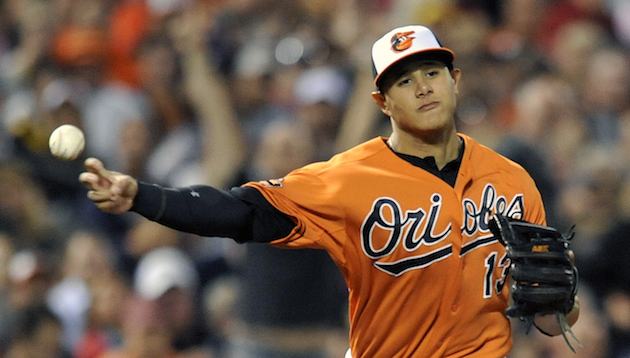 |
Machado was the only player to appear in every game last year (CBS Sports)
|
It appears the days of Iron Men like Cal Ripken, Jr., Miguel Tejada, and Steve Garvey are over. I'm sure some of that has to do with the decrease of performance enhancing drugs in the game; players simply can't maintain the stamina needed to survive a 162 game season. They can't train as hard in the offseason, so they wear down faster during the regular season. Training regimens have also shifted, stressing weightlifting more than endurance-boosting cardio, which makes players less flexible and more prone to muscle tears.
I think the real reason for this change, though, is that managers are smarter about how to manage their players. Gone are the days of slave-drive skippers who held little regard for their players' well-being, penciling the same names into their lineup cards everyday as long as they could stand. The new, more understanding breed--the proverbial "player's manager"--is keen on providing "maintenance" days throughout the year to keep his club fresh for the stretch drive. Roster expansion allows them, heck, encourages them to employ scrub-heavy lineups over the season's final month. And those rare times when doubleheaders occur, it's even rarer to see someone play both ends of it.
Some of that, I'm sure, has to do with how much players are paid these days. Teams invest too much in their stars--the guys you'd want playing everyday--to risk them getting hurt overexerting themselves (injuries are more likely to occur when you're over-fatigued, as that's when mechanics break down). They don't want their best players on the field everyday because they have the long-term interests of the players in mind, whereas before they weren't as concerned with protecting their assets. Players aren't disposable when they're signed to nine-figure contracts. You want to take care of that new Lamborghini in the garage, not run it into the ground.
Money has also changed how players view the game. They see it as a career more than just a temporary profession, and they'll do everything in their power to extend their playing careers, and thus their earning potential, as long as possible. They don't want to play 162 games if they don't have to, as every additional game carries the risk of a career-altering injury. And don't forget, they get paid the same for playing 162 as they do for playing 62. There's no incentive for playing every game, so why do it? Taking a few days off here and there versus playing through an injury could mean the difference of millions of dollars, so how can you blame someone for erring on the side of caution?
Lastly, I get the sense that players don't have the same amount of pride their predecessors got from playing every game. Playing all 162 used to be a badge of honor, a sign of strength. It takes a tough SOB to endure 162 ballgames. Perfect attendance was an achievement to be proud of, like batting .300 or driving in 100 runs. Remember, before free agency jacked salaries through the roof, players didn't play major league baseball solely for money; they played because they loved the game. Of course they wanted to play everyday (thinking of you, Ernie Banks).
It's not that players aren't capable of playing full seasons anymore, it's just that there aren't any good reasons to. That, and nobody's forcing them to..


