Showing posts with label MLB. Show all posts

Saturday, January 26, 2019

Stottlemyre the Savior

Stottlemyre helped extend the post-war Yankees dynasty one more year (NYT)
Earlier this month, former MLB pitcher and pitching coach Mel Stottlemyre passed away from cancer. He was 77.

In an 11-year playing career spent entirely with the New York Yankees, Stottlemyre distinguished himself as one of the best pitchers in franchise history. A five-time All-Star, Stottlemyre averaged 15 wins per season while compiling a sparkling 2.97 ERA for his career. He was also a workhorse, topping 250 innings every year from 1965-1973 and leading the American League in complete games twice.

That success on the mound served Stottlemyre well over the next three decades, first as a roving instructor and then as a pitching coach. He tutored some of baseball's best hurlers during stints with the Mariners, Mets, Astros, and Yankees, including Dwight Gooden, Roger Clemens, Andy Pettitte, Felix Hernandez, Mike Mussina, and the great Mariano Rivera. While he never won a World Series as a player, his teams won five championships with him on the bench.

Stottlemyre's greatest accomplishment on the field, however, was helping pitch the Yankees to the 1964 pennant as a 22-year-old rookie. After winning 104 games and the pennant in '63, New York got off to a slow start in '64 under new skipper Yogi Berra, who had trouble reining in the same players who'd been his teammates and drinking buddies the year before. When Stottlemyre arrived in August to stabilize the rotation, the Yanks were in third place and 3 1/2 games out of first, putting them in jeopardy of missing the World Series for the first time in five years.

The season seemed to be slipping away when Stottlemyre took the hill for his first Major League start on Aug. 12 against the second-place Chicago White Sox, who had taken the first two games of a four-game set at Yankee Stadium. Having lost seven of their previous nine, the Yankees were in desperate need of a spark from the fresh-faced 22-year-old, who was leading the International League (AAA) with 13 wins, six shutouts and a 1.42 ERA at the time of his call-up.

Stottlemyre answered the bell, tossing a complete-game seven-hitter to halt New York's skid. Even the offense appeared rejuvenated, bashing four homers in support of the rookie, who hadn't even received an invitation to Spring Training just a few months before. It was, in the words of New York sportswriter Til Ferdenzi, "movie script stuff."

Stottlemyre's next pressure-packed start came four days later in Baltimore against the first-place Orioles, led by eventual league MVP Brooks Robinson. That didn't faze Stottlemyre, however, who limited the O's to just one run on five hits over 8 2/3 sterling innings. A rare error by Clete Boyer with two outs in the ninth prevented Stottlemyre from notching his second straight complete game, but once again he had come up big for the Yankees.

Stottlemyre wasn't getting much help from his teammates, however, who promptly dropped six in a row before his next turn on Aug. 22, falling 5 1/2 games back of the Orioles and seemingly out of the race. The sputtering Yankees once again turned to Stottlemyre to stop the bleeding, and once again he responded, delivering a complete-game shutout in the nightcap of a doubleheader at Fenway Park to keep their pennant hopes alive.

The win proved to be a turning point, igniting a furious 30-11 run by the Yankees to close out the season that featured six additional Stottlemyre victories -- three of which were complete games. He won five straight starts during the heart of that stretch, including the game that moved New York into first place for good on Sept. 17. When the dust settled in early October, Stottlemyre had gone 9-3 with a 2.06 ERA across 96 innings, helping New York overtake Chicago and Baltimore in the standings to capture the pennant by a single game.

After putting the Yankees over the top during the regular season, he nearly did the same in the World Series. After New York lost Game 1 in St. Louis, Stottlemyre bested the Cardinals' Bob Gibson in Game 2 to even the series. The duo squared off again in Game 5 at the Stadium, with Stottlemyre twirling seven innings of two-run ball. The Yankees lost in the 10th, however, after Tim McCarver belted a crushing three-run homer to put St. Louis up in the series. The Yanks bounced back to win Game 6, forcing a Game 7 showdown between Stottlemyre and Gibson, both of whom were working on two days' rest.

The pair traded zeroes through three innings before Stottlemyre stumbled in the fourth, giving up three runs after shortstop Phil Linz threw away a potential double play ball. Berra lifted his young star for a pinch-hitter in the top of the fifth, only to watch the bullpen immediately surrender three more runs in the bottom of the frame. A 6-0 deficit against Gibson proved to be insurmountable for even the mighty Yankees, who rallied for three homers but ultimately fell short, losing 7-5.

Still, the future appeared bright for Stottlemyre, who appeared poised to be the next great Yankee ace. He lived up to his end of the bargain in '65, winning 20 games even as the team crumbled around him. Despite toiling for generally mediocre clubs, he established himself as one of the best pitchers in baseball over the next decade, ranking fifth in wins and second in innings from 1965-1973. Had his career not ended when he was just 33 years old, he'd probably be in the Hall of Fame, alongside several pitchers he later went on to coach.

So while the Yankee dynasty died a painful death in the mid-60s, Stottlemyre helped wring one more pennant out of its aging core, proving to be one of the most impactful midseason call-ups in baseball history. It may not have had the ending he or his teammates wanted, but it still made for a pretty good story.

Tuesday, January 8, 2019

Harper and Machado Waiting it Out

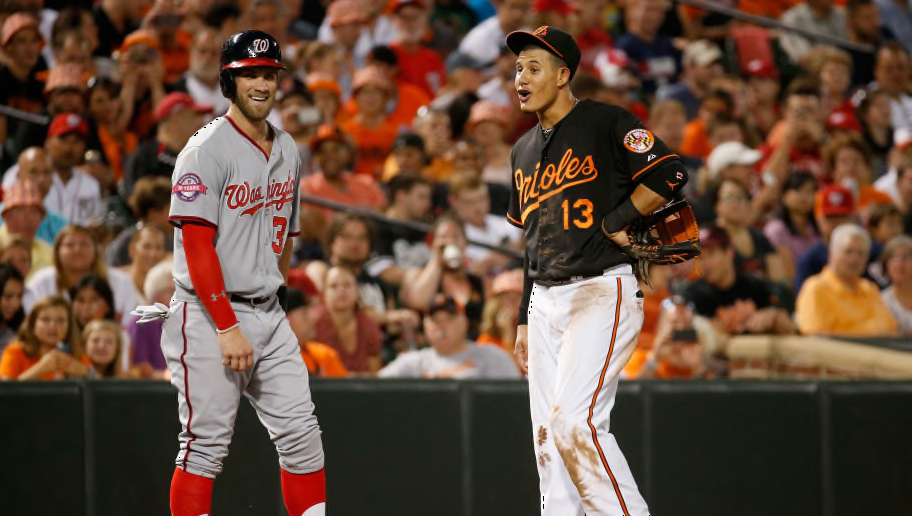
Harper (left) and Machado are holding out for record paydays (12Up)
For nearly two decades, Alex Rodriguez has held the record for the largest free-agent contract in American professional sports. On December 11, 2000, Rodriguez signed a 10-year, $252 million deal with the Texas Rangers, doubling the contract of the highest paid professional athlete at the time --Kevin Garnett of the NBA's Minnesota Timberwolves. Seven years later, Rodriguez opted out of that deal to sign an even bigger one with the New York Yankees worth $275 million over 10 years, with the potential to earn an additional $30 million in incentives for reaching certain home run milestones (which later became controversial following his PED admissions).

Records are made to be broken, but so far neither deal has been surpassed by a free agent* in any sport. The closest anyone's gotten were Albert Pujols and Robinson Cano, who both signed 10-year, $240 million deals in 2011 and 2013, respectively. That's going to change this winter, however; it's only a matter of when.

[*Giancarlo Stanton (13 years/$325 million) and Miguel Cabrera (10 years/$292 million) both later eclipsed Rodriguez via contract extensions, not as free agents. The highest paid athlete is boxer Canelo Alvarez, who's currently on an 11-fight, $365 million deal.] 

Bryce Harper and his agent, Scott Boras (the same agent who negotiated Rodriguez's first megadeal), have had their sights set on the record since Harper was smashing 500-foot homers and making magazine covers as a teenager. He debuted with the Washington Nationals at 19 in 2012, making his first All-Star team en route to winning NL Rookie of the Year honors. He was an All-Star again in 2013 before putting together one of the greatest offensive seasons ever in 2015, when he won the NL MVP unanimously. The Chosen One had arrived.

While Harper hasn't been able to replicate that historic campaign, he showed what his ceiling can be. He showcased it again last summer by winning the Home Run Derby at Nationals Park, wowing the hometown crowd with a display for the ages that included 14 homers in the final 47 seconds and 45 overall. While injuries have often prevented Harper from reaching his full potential, he's still been one of baseball's 12 most valuable position players throughout his career. He's slugged at least 20 homers and been an All-Star in all but one of his seven seasons, and he was headed for a second MVP award in 2017 before hyperextending his knee after slipping on a wet base. Harper's 26 years old, he just led the Major Leagues in walks, and he has MVP potential. He is, in other words, a superstar.

He's not the only one whose services are available this winter, however. Manny Machado, last seen during the World Series with the Los Angeles Dodgers, is arguably just as good as Harper. Machado, who's just four months older than Harper, also debuted in 2012 and immediately emerged as one of the best players in baseball. In 2013 he was an All-Star en route to leading the AL in doubles, and starting in 2015 he's topped 30 homers every year.

While not quite the force that Harper is at the plate, Machado's a comparable baserunner and an elite defender at a more challenging position, earning a pair of Gold Gloves for his outstanding work at the hot corner (he can also play shortstop, but not as well as third). He's one of 15 position players to compile at least 30 fWAR since 2012, tallying virtually the same amount as Harper in one fewer game. That hasn't translated to an MVP yet, but it has helped the four-time All-Star to three top-10 finishes despite playing for mostly mediocre teams in Baltimore. And whereas Harper has struggled with injuries, Machado has been extremely durable, appearing in at least 156 games in five of his last six seasons.
Nearly 20 years later, A-Rod's superdeal is still the standard (SI)
Baseball hasn't had a free agent so good and so young since 2000, when Rodriguez was a 25-year-old shortstop coming off three straight 40-homer seasons with the Seattle Mariners. Now it has two, in the same winter, no less.

In the old days, that would have sparked a feeding frenzy between baseball's richest teams. The Red Sox Yankees, Cubs, and Dodgers would've opened up their vaults for them, spawning a bidding war the likes of which baseball has never seen. But, as last winter's slow-moving market proved, times have changed. Teams are not willing to pursue free agents as aggressively as they used to, not when it means committing large sums of money to ageing players who will cost them compensatory draft picks, luxury tax penalties, and payroll flexibility. Better to drag out negotiations and drive down the price once Spring Training is underway and players start getting desperate.

But if there was ever a player to break the bank for, it's Machado and Harper. Sure, they have red flags and rub a lot of people the wrong way, but they're young and athletic and certifiable stars. There's not too many of those left in baseball these days, so they're sure to attract eyeballs and sell jerseys. Neither has won a championship, which should continue to drive them after the ink dries on their new contracts. They'll instantly transform whichever lineup they join and add multiple wins to a team by themselves. Not everyone can afford them, but everyone could use them.

It's hard to reconcile, then, why both remain unsigned despite playing different positions and negotiating with different teams. The Dodgers have the money and the roster space for Harper after trading away Matt Kemp and Yasiel Puig, while the Phillies, White Sox, and Yankees all need Machado on the left side of their infields. So what's taking so long?

It's not as though teams haven't tried to sign either player. Harper rejected a 10-year, $300 million offer from the Nationals, which would have made him the richest free agent ever (Washington has reportedly since upped its offer). Machado received an offer from the White Sox, albeit a smaller one closer to $200 million. Both are worth more than that, and they know it. But is there a team willing to give it to them?

We'll just have to wait and see.

Saturday, November 17, 2018

Despite Flaws, Sox Among Best Ever

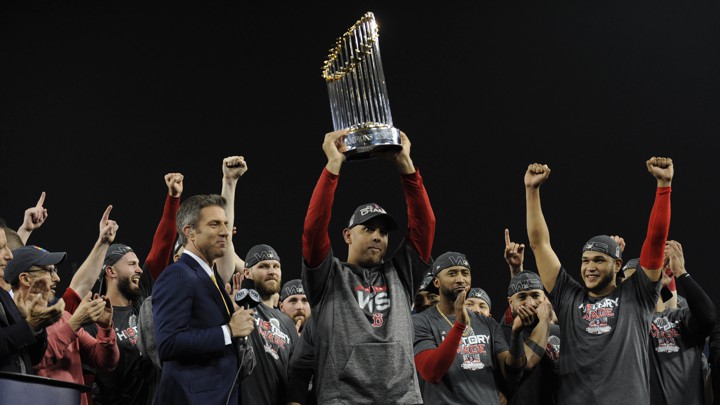
Despite facing numerous obstacles, Boston made it look easy (The Atlantic)
The 2018 Boston Red Sox will go down as one of the greatest teams in baseball history. After storming their way to a franchise-record 108 wins during the regular season, they proceeded to blitz through October, going 11-3 against the Yankees, Astros and Dodgers to capture the club’s fourth World Series title of the century and ninth overall. All told, their 119 victories were the second-most for a World Series champion, trailing only the 1998 New York Yankees.

Obviously, a lot has to go right for a baseball team to win that many games, and a lot did go right for this year’s Red Sox. Mookie Betts turned in one of the greatest individual seasons ever, amassing 10.4 fWAR en route to AL MVP honors. J.D. Martinez had a strong case for the award as well after threatening the Triple Crown with 43 homers, 130 RBIs and a .330 batting average. Andrew Benintendi avoided the dreaded sophomore slump after finishing second to Aaron Judge in the 2017 Rookie of the Year race. Xander Bogaerts and Eduardo Rodriguez overcame injuries and finally started living up to their potential. Chris Sale was arguably the best pitcher in baseball on a per-inning basis, and Rick Porcello bounced back from leading the Majors in losses in 2017 to leading the team in wins. David Price recovered from an injury-marred 2017 to go 16-7 with a 3.56 ERA before exorcising his playoff demons. Craig Kimbrel continued being one of baseball’s best closers, and the rest of the bullpen was surprisingly solid. Midseason trades for Nathan Eovaldi and World Series MVP Steve Pearce paid huge dividends, especially during the postseason. Rookie manager Alex Cora made his job look easy, navigating a full season in Boston’s fishbowl without a hint of controversy and pushing all the right buttons in October.

And yet, the Red Sox were a great team in spite of everything that went wrong for them. They endured 26 separate DL stints – only seven teams had more. Hanley Ramirez slashed .254/.313/.395 through 44 games before being released in late May. Dustin Pedroia was limited to just three games due to knee injuries, and his replacements (Eduardo Nunez, Ian Kinsler, Brock Holt, the ghost of Brandon Phillips) struggled to pick up the slack. Boston’s catching corps was the worst in baseball, ranking dead last in wRC+ (44) and fWAR (-2.1). Jackie Bradley Jr. didn’t hit during the first half, and Mitch Moreland didn’t hit during the second. Benintendi eluded the sophomore slump, but Rafael Devers didn’t. Sale hardly pitched during the final two months of the season and was noticeably diminished during the playoffs. Price scuffled in the first half and continued to flounder against the Yankees. Drew Pomeranz turned into a pumpkin. Steven Wright, Tyler Thornburg, and Carson Smith missed most of the season for the second year in a row. Joe Kelly was plagued by inconsistency. Blake Swihart wasted away on the bench as his development continued to stall. Kimbrel saw his walk rate balloon during the regular season before nearly blowing multiple games during October. The farm system is still utterly barren, and Boston will have to pay luxury tax penalties after outspending every team in baseball this year – partially because they paid Pablo Sandoval and Rusney Castillo a combined $30 million to play in San Francisco and Pawtucket.

So no, the Red Sox were not a lucky team by any stretch of the imagination – but it’s scary to think how good they could have been if they were.

Tuesday, August 8, 2017

Stanton Finally Realizing Potential

It's taken Stanton nearly a decade to put it all together (SI.com)
Last night, Giancarlo Stanton matched his career high for home runs in a season...at 37.

That number feels preposterously low for a slugger of Stanton's stature and caliber. After all, we're talking about a guy with one of the five best HR-per-AB ratios in baseball history. We're talking about a guy who's absurdly strong, a guy who did this. And this. Annnd this (don't worry, there's plenty more where those came from). Every time he goes deep he seems to re-write the record books by hitting a ball where no one has before. He is, without a doubt, one of the most powerful and most electrifying players in baseball history, not to mention the highest paid professional athlete on the planet.

By comparison, his numbers have always felt supremely disappointing. You look at Stanton's Baseball-Reference page and think Really? That's it? No 50-homer seasons, or even a 40-homer season. No MVPs. There's some black ink there, but it's pretty sparse. His list of most similar batters is even more underwhelming, littered with the likes of Richard Hidalgo, Brad Hawpe, Mark Trumbo, Carlos Quentin, and Russell Branyan. There's not a single Hall of Famer in his top 10, or anyone who came even remotely close, for that matter. Pretty soon you start asking yourself; the Marlins paid $325 million for this guy?!

They sure did, and at the time, nobody questioned it. Everyone knows what Stanton's capable of, even if his statistics have only provided a glimpse.

Like most players with Cooperstown-level ability, Stanton was destined for greatness from the beginning. After earning a promotion to the Majors at age 20 in 2010, he proceeded to belt 22 home runs in his first 100 games. He followed that up with 34 the following year and 37 in 2012, despite missing 39 games because of knee surgery. With his home run totals on the rise and still several years away from his prime, Stanton seemed poised to dominate the leaderboards for years to come.

Because of injuries, however, that hasn't happened. Stanton slumped to .249 with 24 homers in 2013 while missing two months with a strained hamstring. He bounced back in 2014 and was challenging Clayton Kershaw for NL MVP honors before a fastball to the face ended his season on September 11th, leaving him stuck on 37 homers. He was so far ahead of the pack that year that he still led the National League in long balls and total bases (299) despite missing the last three weeks of the season.

When Stanton returned in 2015, he was a man on a mission. By the final week in June he already had 27 home runs and 67 RBIs in 74 games. He was just laying waste to the league, and it seemed like everything was coming together for the 25-year-old. Until he broke the hammate bone on his left hand, ending his season on June 26th. We'll never know what he would have done during the second half, when power figures started rising across the sport.

2016 brought more of the same for Stanton, who slumped to .240 but still slugged 27 homers in 119 games.  Many were beginning to wonder if he would ever stay healthy. enough to log a full season. In his first seven, he averaged only 118 games and 426 at-bats per year, missing roughly a quarter of the season each year. He had reached his prime and still wasn't a dominant player, with just one home run crown and one 100-RBI season under his belt. Six players hit more home runs from 2010-2016, all of whom are well into their 30s or retired now. The next Babe Ruth he was not.

This year, at the magic age of 27, that's finally changed. Stanton's healthy, having played all but two of Miami's 110 games, and he's crushing the ball. He's taken advantage of the new home run environment to match his best home run total in 15 fewer games than 2012 and 37 fewer games than 2014. He's not going to win MVP as long as Bryce Harper's healthy, but he should blow most of his previous career highs out of the water in a season that finally feels worthy of the hype (and the money).

(*August 9th update: Stanton slugged his 38th home run last night, establishing a new career high. He now has five home runs in his last five games and leads the Majors with 12 dingers since the All-Star break)

Friday, August 4, 2017

Adrian Beltre's Weird Career

Beltre salutes Rangers fans after doubling for his 3,000th hit (New York Times)
Adrian Beltre has had a weird career. A great career, to be sure, one that will ultimately see him enshrined in Cooperstown, but a weird one nevertheless. In his 20s it was full of ups and downs before he settled into one of baseball's best and most consistent players in his 30s. It goes without saying that this is not a normal aging curve.

Let's start at the beginning. Did you know the Dodgers broke MLB rules to sign Beltre out of the Dominican Republic when he was 15? It's true. Less than four years later he was up in the big leagues, struggling to bat his weight during the summer of Mark McGwire and Sammy Sosa.

It didn't take long for Beltre to adjust, however, and the following year saw him bat .275/.352/.428 (102 OPS+) with 15 homers while ranking as one of the league's best defensive third basemen. His 18 steals and 61 walks from that season remain career highs. In 2000 he was even batter, hitting .290/.360/.475 (114 OPS+) with 20 homers and 12 steals. Still several years away from his physical prime, he appeared to be a superstar in the making.

Then he was derailed by an appendectomy, of all things, which kept him out of the lineup until mid-May and caused his OPS to tumble more than 100 points in 2001. His defense cratered as well, as he was below average in the field for the first and only time in his career. While his power and glovework bounced back in 2002-'03, his patience never did, and his average continue to fall along with his BABIP, which bottomed out at .253 in 2003. With his early flashes of stardom receding in the rearview, he seemed to be settling into a solid but unspectacular third baseman.

Then came 2004, the year Beltre finally put everything together. He more than doubled his home run output from the previous season to lead the Majors with 48. His average soared to .334 as he trimmed his strikeout rate from 16.9 percent to 13.2 percent, and his walk rate rebounded as well. He was worth 9.5 bWAR and, in an alternate universe where Barry Bonds doesn't become a freak of nature, he wins the MVP over Albert Pujols in a photo finish. Instead he finishes second, unable to overcome Bonds' record-setting .609 OBP, which is just 20 points lower than Beltre's slugging percentage in '04.

A free agent heading into his age-26 season, Beltre has timed his monster season perfectly. He is going to get paid, and it is the Mariners who land him. He signs for five years and $64 million, giving him another crack at free agency when he's 30.

The next half-decade nearly ruins Beltre, who doesn't come close to replicating his 2004 season. He wins a pair of Gold Gloves but his bat regresses, stymied by Safeco Field and the cool, damp air currents of the Pacific Northwest. The strikeouts rise and the walks fall, reflecting a player pressing to prove he is worth the money and put a stop to the "overrated" jeers he hears on a nightly basis. Seattle slips into mediocrity, which only exacerbates the criticism. Beltre has duped the Mariners and their fans. He is not the player they thought they were getting, the slick-fielding home run champion who, for a season, rivaled Bonds and Alex Rodriguez as the best player in the game. He becomes a poster-boy for the walk-year phenomenon.

In 2009, Beltre's final season in Seattle, he becomes a punchline. After scuffling in the spring, his summer hot streak is interrupted when a grounder takes a bad hop and nails him in the groin. Beltre isn't wearing a cup and lands on the DL. He finishes the year with eight home runs and 44 RBIs, his lowest totals since his rookie year. Having reaped the rewards of free agency after his best season, he struggles to find a contract in the wake of his worst.

The Red Sox, knowing a good deal when they see one, scoop him up on a one-year deal. Free of Seattle's toxic environment and finally aided by his home park for the first time in his career, Beltre returns to form. He racks up 7.8 bWAR and makes his first All-Star team, batting .321 with 28 homers, 102 RBIs and an MLB-high 49 doubles (he's no Fenway fluke, either, hitting for a higher average and notching 30 of his doubles away from home). He is not flashy enough for the Sox, however, and they let him walk in free agency.

Since then Beltre's been with Texas, where he's turned his Hall of Fame chances from unlikely to a first-ballot lock. He's become a steady .300 hitter while posting four of the five highest home run totals of his career, taking advantage of Arlington's homer-friendly environment. He's also continued to showcase his excellent defense at third, adding three Gold Gloves to his trophy case. After years of underrating him, the press finally caught on to his greatness and have rewarded him with five top-10 MVP finishes this decade, during which he's been baseball's third-most valuable position player behind Mike Trout and Joey Votto.

Now 38, Beltre has shown no signs of slowing down. He's still batting close to .300 with power and playing a mean third base. He looks like the next version of David Ortiz, a player who will leave on his own terms rather than being forced into retirement by diminishing skills. With several milestones such as 500 home runs and 700 doubles potentially in reach, he may want to stick around a few more years after his contract expires next season. He still hasn't won a World Series, either, which has to be a motivating factor after coming oh-so close in 2011.

Whenever he decides to retire, though, we'll look back on his career as one of the most unusual ones we've ever seen.

Thursday, August 3, 2017

Bellinger Blasts Way Into Record Books

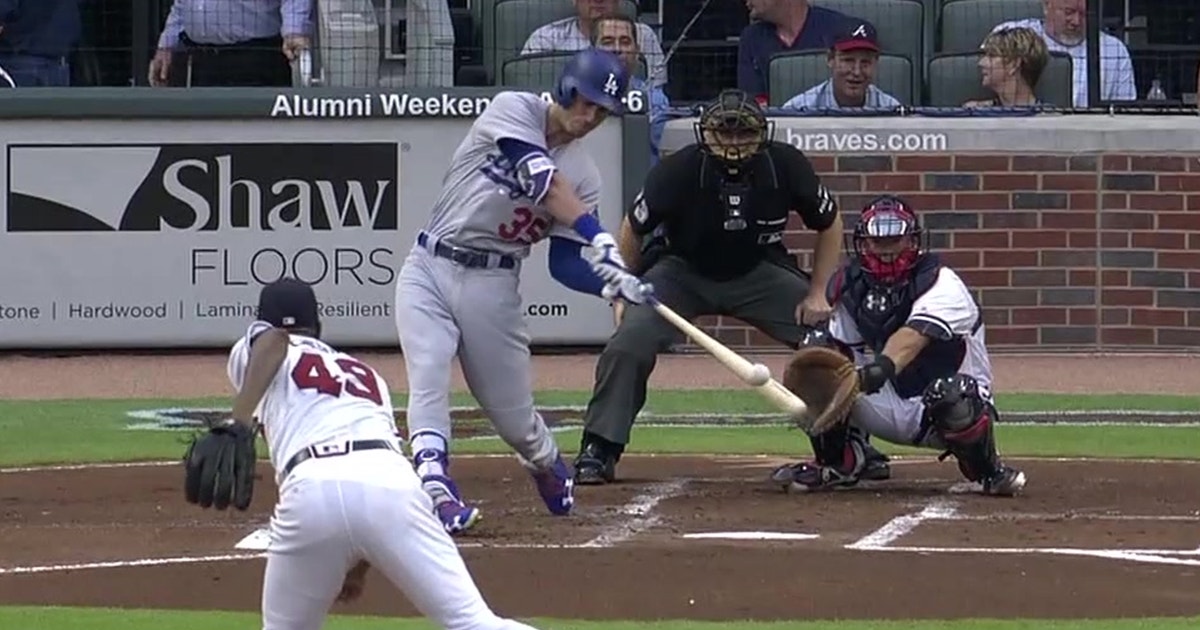
Bellinger leads off the second innings with a 410-foot moon shot (Fox Sports)
Last night Cody Bellinger launched another homer, his second in as many days and his 30th of the season. The milestone blast put the 22-year-old freshman in rare company, making him just the 10th rookie in National League history with at least 30 bombs. That Bellinger reached the mark in only 87 games is even more impressive, as most of the others required a full season. The only one who came close to matching his breakneck pace (which projects to 56 homers over 162 games) was Ryan Braun, who needed 91 games to club 30 homers back in 2007 -- the last time an NL rookie hit that many (as did Chris Young).

With a third of the season to go, Bellinger is a lock to break the Senior Circuit rookie long-ball record of 38 shared by Wally Berger and Frank Robinson, which hasn't been matched since 1956. He still has an outside shot at breaking Mark McGwire's all-time rookie record of 49, although Aaron Judge -- who leads the Majors with 34 -- has better odds. In addition to playing his home games at the homer-friendly Yankee Stadium, where New York will play 29 more times this year, he gets six more games in Toronto, three in Boston, and three in Baltimore (not to mention three in Texas). He could easily go deep multiple times in any of those series, especially against the lesser pitching staffs of the Blue Jays, Rangers, and Orioles.

The deck remains stacked against Bellinger, however, who plays in one of baseball's toughest home run parks and probably baseball's least long-ball friendly division. While the Dodgers only have 21 of their remaining 55 games at home, the constant travel may wear down Bellinger during the dog days of August and September. He's already cooled off considerably from his torrid start, going deep six times in his last 30 games after belting 24 in his first 57. His 26.4 percent strikeout rate isn't doing him any favors, either.

The talk in June of Judge and Bellinger both breaking McGwire's record now appears premature. I still like Judge's chances, but his second-half slump is certainly a concern. Bellinger would have a few more dingers under his belt had he not spent most of April in Triple-A, which may wind up costing him the record. Even if they both fall short, however, they should each clear 40 with relative ease, which would be the first instance in baseball history of multiple rookies with 40 homers in the same season. McGwire is still the only one to reach that rarefied air, but he should have some company before long.

Monday, July 31, 2017

Bags, Rock & Pudge


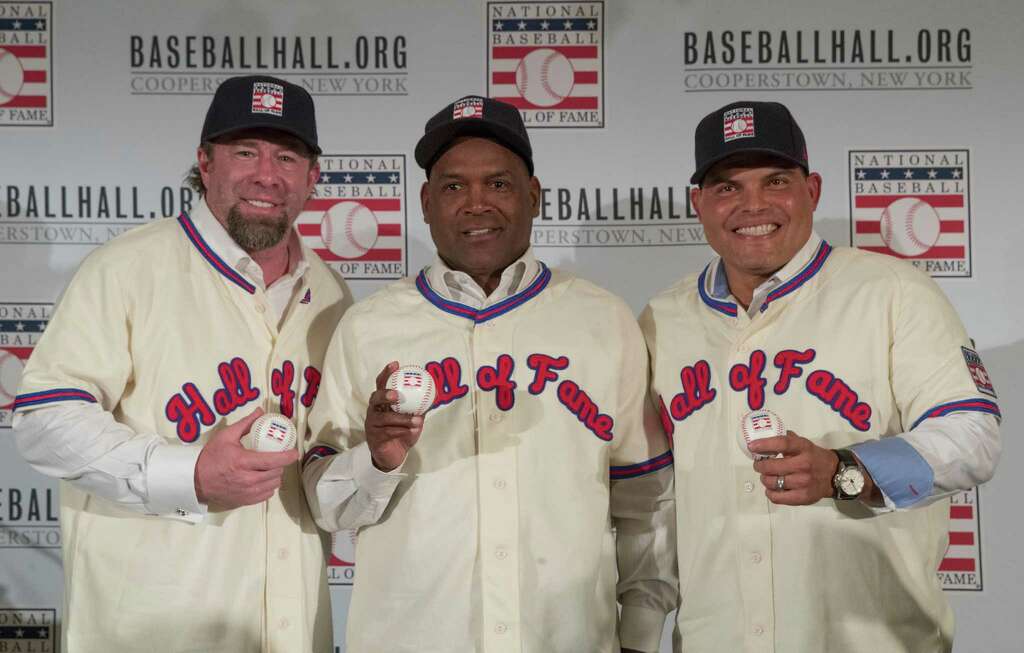
This weekend Ivan Rodriguez, Jeff Bagwell, and Tim Raines joined the Cooperstown ranks alongside executives Bud Selig and John Shuerholz. Trevor Hoffman and Vladimir Guerrero narrowly missed joining them, falling just a handful of votes short of election. Both are virtual locks to make it next year.

Even without the greatest closer not named Mariano Rivera and one of last decade's most exciting players, this year's class was a formidable one. It had arguably the greatest catcher of all-time (or at least the greatest since Johnny Bench), the greatest basestealer of all-time (in terms of success rate), and perhaps the greatest first baseman of the integrated era (or at least until Albert Pujols came along).

If  Rodriguez is not the greatest backstop of all-time, then he is certainly the best defensively. Both Baseball-Reference and FanGraphs have him leading the position easily in defensive WAR, with each putting him in the top 10 all-time for all positions. FanGraphs has him as the fourth-most valuable defender ever, ranking behind only Ozzie Smith, Brooks Robinson, and Mark Belanger. The drop-off between him and other backstops is so severe that it's hard to imagine anyone challenging his title, much less his record (for a catcher) of 13 Gold Gloves (Yadier Molina is still five away, in case you're wondering). Throw in his sizeable offensive contributions -- 311 home runs, 2,844 hits, a .296 lifetime average -- and it's clear that he's one of the three greatest catchers ever along with Bench and Yogi Berra.

It's hard to argue that Raines was the greatest base-stealer ever, especially since Rickey Henderson already claimed the title for himself. He never stole 100 bases in a season, which has been done 21 times throughout baseball history (he topped out at 90), and the difference in total thefts between him and Henderson is a whopping 598 -- more than all but 18 players have stolen in their entire careers. But Henderson got caught a lot more than Raines -- 189 times more, to be exact. As such, Raines' 84.7 percent success rate is considerably better than Henderson's 80.8 percent. It's also the highest of all-time for anyone who stole that many bases. So while Raines may not have been the most prolific base-robber of all-time, he was the best at combining volume and efficiency. And like Rodriguez, Raines brought a lot to the table with his bat, too, slashing .294/.385/.425 (123 OPS+) for his career with 2,605 hits and far more walks (1,330) than strikeouts (966). Add it all together and Raines was the second-greatest leadoff hitter of all-time, which somehow took the BBWAA 10 years to recognize.

And last but not least there's Bagwell, who was Pujols before Pujols. Check out their averages through their first 14 seasons:

Bagwell: 151 G 665 PA 108 R 32 HR 108 RBIs .297/.408/.542 (150 OPS+) 99 BB 110 K 14 SB
Pujols: 150 G 660 PA 108 R 37 HR 114 RBIs .317/.403/.588 (162 OPS+) 80 BB 65 K 7 SB

Pujols hit for a higher average and a bit more power while striking out less, but Bagwell walked more and stole twice as many bases. They were both good fielders, winning Gold Gloves for their play at first base, but the metrics say Pujols was better. Overall, you have to give the edge to Pujols, but it's close.

And yet, it took Bagwell seven tries to get into the Hall of Fame, whereas Pujols will be a slam-dunk as soon as he's eligible. The difference is that Bagwell played just 39 games in his 15th season and retired at 37, leaving him well short of several notable milestones such as 500 homers and 500 doubles. Pujols, whose contract runs until he's 42, has continued to play on through debilitating lower body injuries that have rendered him a full-time designated hitter. He's padding his career totals without adding much value on the field, socking his 600th homer this season in a year where he's been over a win below replacement level. A lifetime National Leaguer, Bagwell never had that option except during interleague games, playing a grand total of 10 games as a DH. Perhaps the DH would have lengthened his career, but we'll never know.

If nothing else, this year's class raises the bar for the average Hall of Famer. Next year we'll get Hoffman and Guerrero, along with likely newcomers Chipper Jones and Jim Thome. It's good to see the stars of the '90s and 2000s get the recognition they deserve. Now if we could only do something about the '70s and '80s...

Lee May's Miserable Timing

Lee May was never in the right place at the right time (UPI)
Lee May was a good hitter for many years. He slugged 354 home runs -- more than Joe DiMaggio -- and had 11 straight seasons with at least 20. He played more than 2,000 games and amassed over 2,000 hits. A three-time All-Star, he received MVP consideration in six seasons, finishing in the top 10 twice. His career OPS+ was 116, which is equal to Barry Larkin's and Roberto Alomar's and Ken Boyer's, despite a mediocre .313 OBP.

Lee May was not good at reaching round numbers. He had three seasons with over 100 RBIs, but in four years he finished with either 98 or 99 and in another year, he had 94. He had one season with 39 home runs, and another with 38. Similarly, he had one year with 29 long balls, and another with 28. He usually missed 10-15 games per season, but with better luck he could have had a pair of 40-homer seasons on his resume and seven or eight 100-RBI campaigns.

Those are impressive numbers in any era, but they really would have stood out during his playing days. He debuted in 1965, during the heart of the Second Deadball Era, and had his breakout season in 1968, the Year of the Pitcher. He came up with Cincinnati but was shipped out after the 1971 season, bringing back Joe Morgan in the trade that jump-started the Big Red Machine. He then spent three prime seasons in purgatory, playing half his games in the pitcher's paradise formerly known as the Astrodome. While the Reds won a pennant in their first season without him, May's Astros finished third, 10.5 games behind Cincinnati. The Reds repeated as division champs the following year and won 98 games in '74; meanwhile, the Astros barely reached .500 both years.

After that May was dealt to Baltimore, having just missed their dynastic run in the late '60s and early '70s. The Orioles made only one postseason appearance in his seven years there, losing to Pittsburgh in the 1979 Fall Classic. May began the decade on World Series losers in Cincinnati and ended it on World Series losers in Baltimore, failing to reach the playoffs in between.

By then May was 36 and had played his last full season as a regular. With his career winding down, he played sparingly over the next three seasons, the last two of which came with the Royals. He had missed their epic postseason clashes with the Yankees in the late '70s and their World Series appearance in 1980. Kansas City give him one last crack at October baseball in '81 but fell short, and May retired after '82.

Timing, they say, is everything in life. If you put May on the Orioles during his Cincinnati years, he wins two championships, and if you put him on the Reds during his Baltimore years, he wins two more. If that had happened, perhaps he'd be remembered a bit more fondly by fans in those cities, the way Tony Perez and Boog Powell are celebrated.

Thursday, July 27, 2017

Why Wasn't Williams Called Up?

Williams quickly proved too good for his Minor League assignment (Esquire)
Much has been made about all the games Ted Williams lost to World War II and Korea, which amounted to nearly five full seasons. But what about the time at the beginning of his career, before it even started?

By the time Williams arrived to the Major Leagues in 1939, he was already a finished product. Having destroyed American Association pitching the previous year, he promptly set fire to the Majors with one of the greatest rookie seasons ever. In addition to leading the loop in RBIs with 145, the 20-year-old Williams batted .327/.436/.609 with 31 home runs en route to a fourth-place MVP finish.

Williams had been ready for some time, however, and should have debuted in 1938. He didn't make the team out of Spring Training, unable to crack Boston's veteran outfield of Joe Vosmik, Ben Chapman, and Doc Cramer, all of whom would bat .300 that year. None of them could hit for much power, however, slugging just 15 homers between them, with Cramer hitting none. Williams had already showed his natural power stroke the year before with San Diego, swatting 23 home runs as a skinny 18-year-old in the Pacific Coast League, and would have added thump to a lineup that was starved for power beyond Jimmie Foxx.

Furthermore, the men Williams might have replaced in the outfield weren't fan favorites or established stars with the team, as none had spent more than two years with the Red Sox. While veterans are always given a chance to keep their jobs and rookies tend to be treated with kid gloves, nobody's feathers would have been ruffled had Joe Cronin benched one of them in favor of Williams.

While it's understandable that the Red Sox wanted Williams to get regular at-bats rather than sit on the bench behind the aforementioned trio, they should have called him up later in the season. By August they were out of the pennant race and it was clear that Williams had nothing more to learn with Minneapolis, where he won the league's Triple Crown with 43 homers, 142 RBIs and a .366 average. Chapman was months away from being traded and clearly wasn't in the club's long-term plans, so why not give the Kid a shot? With Foxx having a season for the ages, setting a then-franchise record with 50 homers, Boston already had the perfect lineup protection for Williams, who could have cut his teeth on a steady diet of fastballs hitting in front of Double X.

The Red Sox had other motivations for keeping Williams down on the farm longer than necessary, however, namely his maturity. He had rubbed many teammates and coaches the wrong way with his big mouth, and it was felt that he needed time in the Minors not just for seasoning, but to grow up. If Williams had been less of an annoyance, the Sox might have been willing to give him a chance. Instead, they may have hoped to humble him with the demotion.

It all worked out in the long run, however; as fate would have it, Rogers Hornsby was one of the Millers coaches that year. Williams learned a lot from the best right-handed hitter of all-time, namely "get a good pitch to hit." The Splendid Splinter took that to heart, walking more than 2,000 times in his career, but it's possible that he wouldn't have been so patient had he never come under Hornsby's tutelage.

Wednesday, July 26, 2017

Debunking Some Ted Williams Myths

The Boston press attacked Williams with invented weaknesses (SI.com)
Last week I got around to reading Impossible Dreams, an excellent anthology of Red Sox writing compiled by Glenn Stout that's well worth a look for all Sox fans. One of the sections centers on Ted Williams, of course, given that he inspired more copy than any athlete in Boston sports history--most of it overwhelmingly negative. 

The Boston press, which featured nine newspapers at the time, was hostile to him for most of his career. One such instance came at the beginning of the 1954 season when Williams, 35 and just back from Korea, was contemplating retirement. Although he had returned from the war zone with a bang the previous summer, batting .407/.509/.901 with 13 homers and 34 RBIs in 37 games, the writers were hardly begging him to stay. Instead, they dared him to quit, imploring him to hang up his spikes immediately rather than wait until season's end. Thankfully, Williams played out the season and several more, sticking around until 1960. 

Anyways, the 1954 piece I'm referring to (which was penned by either Dave Egan or Harold Kaese -- his two most vicious attackers) levelled several common criticisms of the day against Williams, namely that he struggled against the Yankees, tanked in the clutch, and was more concerned with his own statistics than helping the Red Sox win.

Writers rarely supported their arguments with statistics back then, but if they had they would have had no ground to stand on. Williams batted .345/.495/.608 against New York in his career, nearly identical to his overall .344/.482/.634 slash line. So how did writers get the notion that he wilted against the Yankees? Likely after the final days of the 1949 season, when Boston dropped its final two games at Yankee Stadium to blow the pennant while Williams went 1-for-5, losing the batting title to George Kell in the process. Williams did not choke, however, reaching base in four of his eight trips to the plate and scoring two of Boston's seven runs. The press, which had a long memory with Williams when it came to his failings but borderline amnesia regarding his successes, also apparently forgot that just one week before, Williams had led the Sox to a two-game sweep of the Yanks at Fenway Park by homering in each game. 

The last two games of '49 were lumped in with the 1948 pennant tiebreaker game against Cleveland (in which he went 1-for-4) and his poor World Series performance in 1946 as evidence that Williams couldn't perform when it counted most. In the 10 biggest games of his life, writers often reminded their readers, he was 7-for-34 (.206) with no extra-base hits and just one RBI. However, 10 games is much too small of a sample size to draw any meaningful conclusions from, especially since Williams was hurt during the Fall Classic and the other three contests came at the end of long, grueling pennant races. It was seldom mentioned that Boston wouldn't have gotten that far in the first place without Williams, who earned MVP honors in 1946 and '49 while finishing third in '48. But since the Red Sox always fell short in the end, their failures magnified those of Williams when people went searching for explanations.

Looking at Williams' overall body of work (and not cherry-picking 10 games from a career of 2,292), however, there's ample evidence that suggests he was actually pretty good in the clutch. In high leverage situations, for instance, he batted .329/.467/.607 -- not far off his career marks. When games were late and close, he performed at a .312/.449/.613 clip -- not quite his career levels, but still outstanding. And when there were two outs and runners in scoring position, he batted .315/.524/.647. 

That last stat line (note the on-base percentage) drew the ire of sportswriters who blasted Williams for refused to expand his strike zone with men on base. He was selfish, they said, because he would rather take a walk than help the team by driving in a run (which is often said about Joey Votto today). It's been proven, however, that the occasional RBI gained by swinging at balls is not worth the trade-off of making more outs. Besides, Williams drove in plenty of runs despite often being pitched around in such situations, leading the league four times and racking up 1,839 in all (130 per 162 games). He was hardly the only Boston batter capable of driving in runs, either, as he often had great RBI men behind him such as Jimmie Foxx, Bobby Doerr, Vern Stephens, and Jackie Jensen. The best thing a hitter can do to help his team is avoid making outs by getting on base, and no one in baseball history was better at that than Williams, whose .482 career OBP is still the highest of all time.

As a hitter, Williams was pretty much flawless. The press made up weaknesses so they'd have something to write about, and they got away with it because great sites like Baseball-Reference didn't exist yet. But now that they do, we can see how the Knights of the Keyboard exaggerated the few (but memorable) failures in Williams career to create these illusive shortcomings. 

Wednesday, July 12, 2017

Aaron Judge is Also the New Babe Ruth

A couple weeks ago I wrote that Aaron Judge is the new Mike Trout. With Trout coming back on Friday, however, Judge needs a new comparison, and quick. Thankfully his epic Home Run Derby performance revealed his true colors.

Judge is not Mike Trout 2.0: he's a modern-day Babe Ruth. Both are larger than life (literally, in Judge's case) who demolish baseballs, strike out a lot and play right field for the Yankees. I don't believe in re-incarnation, but Judge might actually be Ruth brought back to life.

That might even be under-selling Judge a little. Ruth hit some long ones during his day, but I'm not sure he could do this:

Tuesday, July 11, 2017

Red Sox Roll into Second Half

Boston's strong finish to the 1st half looks like a sign of things to come (CBS)
Well, it's officially the All-Star break and the Red Sox are right where they're supposed to be; leading the AL East and on pace for 90-plus wins. It hasn't been the smoothest ride, but Boston had an uneven first half last year too en route to winning 93 games and the division. And although they limped into the break by losing four of their last five, that came on the heels of a six-game winning streak that equaled their season-high. Overall, the Sox are in good shape heading into the second half, having gone 29-16 since May 21 as several of their top hitters and pitchers have come around.

On the hitting side of things, Boston rates fourth in the AL in runs per game and total runs despite ranking dead last in home runs. They've compensated with a contact-heavy approach that's yielded the league's second-highest batting average and third-fewest strikeouts. The lineup has proven to be deep and balanced, with regulars posting an OPS+ over 100 at every position except catcher and third base. Dustin Pedroia and Xander Bogaerts are both batting .303, Mitch Moreland's having one of the best years of his career, and each member of the Killer B's outfield has an OPS north of .800. Hanley Ramirez had another slow first half, but he caught fire towards the end and looks poised to go on a tear post-All-Star break.

Still, this clearly isn't the same offense that led the sport in runs last year. They've missed David Ortiz in the heart of their lineup, as it seems unlikely that anyone will replicate his standard 30 homers and 100 RBIs (not to mention his leadership). Catcher and third base have been black holes, with the Sox tied for last in the AL in fWAR at both positions. Third base has been a revolving door thanks to Pablo Sandoval's ineptitude, and while Christian Vazquez and Sandy Leon are fine receivers, neither can hit. Not much can be done about the catching situation given the dearth of quality backstops available, but Todd Frazier is on the block should Boston be inclined to upgrade externally rather than promote Rafael Devers.

The Red Sox have graded out as top-10 defensive team, which isn't surprising given their young, athletic outfield and their stellar double-play combination of Pedroia and Bogaerts. This has undoubtedly aided the pitching staff, which hasn't been the super-rotation that some predicted but still ranks second in the AL in ERA. BoSox pitchers have been terrific on their own merit, however, issuing the fewest walks in the league and ranking third in strikeouts with more than one whiff per inning. So while their offense has been predicated on avoiding whiffs, their pitchers have thrived by racking them up.

It's impossible to over-state the impact that Chris Sale has had this year, as he's accounted for 1/6 of the team's innings and has been arguably the best pitcher in baseball. Boston hasn't had a pitcher this dominant since Pedro Martinez, and he's been a true savior since the day he donned a Red Sox uniform, making up for Rick Porcello's regression and the injury woes of David Price and Eduardo Rodriguez (both of whom have been effective when healthy). He's their MVP of the first half. Drew Pomeranz has also stepped up and appears to have settled into Boston after struggling in the second half last year and early this year.

The bullpen has also flourished despite getting nothing from two of the club's top relievers, Carson Smith and Tyler Thornburg. Craig Kimbrel has rebounded after scuffling in his first year with Boston and is having one of the best seasons ever by a modern closer. Joe Kelly has been nearly as good setting him up, becoming the shutdown reliever everyone knew he would be once he was finally freed from the rotation. Matt Barnes and Heath Hembree have been solid in middle relief, while Fernando Abad has pitched much better than his last name would suggest. This strong stable of relievers have helped Boston maintain a winning record (11-9) in one-run games and, more importantly, should be enough to prevent Dave Dombrowski from shipping out more prospects at the trade deadline.

Add it all up and the Red Sox have played as well as their record suggests, with a 51-38 Pythagorean W-L record (plus-65 run differential) to match their 50-39 actual record. They've been lucky in extra-inning games (7-1), but everything else about them appears legitimate and they are trending in the right direction. The rotation will finally be at full strength when Rodriguez returns after the All-Star break, which could allow Boston to pull away from the pack if everyone stays healthy. The Red Sox will also look to capitalize on a favorable schedule that puts 42 of their remaining 73 games at home, where they've gone 25-14 (.641) this year.

Accordingly, the Red Sox don't need to make any major moves at the trade deadline. They're a well-rounded, mostly-complete team with few holes to fill. An upgrade at the hot corner would be nice, but not worthwhile if the plan is to bring Devers up in September (or, if by some miracle, Jhonny Peralta finds his swing in Triple-A). Pitching depth is always appreciated, but not a priority. Firing John Farrell would be a dream come true, but for now that's all it is; a dream.

Thursday, July 6, 2017

2017 NL Final Vote Analysis

Turner is having a year reminiscent of peak George Brett (Los Angeles Times)
If you haven't cast your ballot for the All-Star Game Final Vote, it's not too late! Polling closes at 4 PM EST, so make sure you get those votes in. After deciding that Logan Morrison was the most worthy of the five American League candidates, it's time to take a look at the National League five, ranked in order of FanGraphs WAR:

Justin Turner (3.9 fWAR .384/.473/.571 182 wRC+ .446 wOBA)

Anthony Rendon (3.7 fWAR .297/.398/.549 145 wRC+ .397 wOBA)

Kris Bryant (2.5 fWAR .263/.394/.505 135 wRC+ .381 wOBA)

Justin Bour (1.8 fWAR .289/.365/.557 138 wRC+ .384 wOBA)

Mark Reynolds (0.7 fWAR .286/.372/.517 116 wRC+ .378 wOBA)

There's a much bigger range here than in the AL, where four of the five candidates were clustered in the 2-3 win range. We can immediately eliminated Bour and Reynolds, who have posted lesser numbers at first base compared to their league-mates at third. Reynolds has been a product of Coors Field with a 1.084 OPS there compared to .729 everywhere else. Bour is having a fine season with 19 home runs, but he's clearly had an inferior year to the three hot-corner men on the ballot.

And that's where it gets tricky, just as separating the trio of AL shortstops proved difficult. Bryant is the reigning MVP and undoubtedly the biggest star on the ballot, but he's also fallen off a bit from last year and hasn't been as good as Rendon or Turner. What you do with him depends on your philosophy of what the All-Star Game should be. If you feel the Midsummer Classic should showcase the game's household names, then Bryant's your guy. If you feel the best players of the first half should be honored (as I do, to a point), then you're looking elsewhere.

While Rendon's having a fantastic year, his numbers can't compete with Turner's, which are truly remarkable. Aside from Freddie Freeman, he's been the National League's best hitter this year, with only the otherworldly Mike Trout and Aaron Judge surpassing him in the American League. Only Joey Votto and Paul Goldschmidt have produced more offensive value in the Senior Circuit, and both play first base. The best hitter on the NL's most dominant team should be a no-brainer.

2017 AL Final Vote Analysis

LoMo is the clear-cut choice in the AL (CBS Sports)
The All-Star Game's Final Vote closes at 4 PM EST today, so it's time to make some last-minute picks! In the American League, we have a pair of slugging corner infielders pitted against a trio of good-hitting shortstops. Who deserves to go Miami next week? Let's dive in with a quick glance at the candidates (ranked in order of FanGraphs WAR):

Logan Morrison (2.9 fWAR .256/.366/.579 145 wRC+ .386 wOBA)

Xander Bogaerts (2.6 fWAR .308/.362/.448 110 wRC+ .345 wOBA)

Elvis Andrus (2.2 fWAR .301/.347/.473 114 wRC+ .350 wOBA)

Didi Gregorius (2.2 fWAR .302/.331/.477 112 wRC+ .341 wOBA)

Mike Moustakas (1.6 fWAR .269/.305/.559 120 wRC+ .356 wOBA)

We can one we can eliminate right off the bat, and that's Moustakas. While his 25 home runs are impressive, his on-base percentage is on par with the three shortstops' batting averages. With no steals and uninspiring defense at third base, Moustakas has been a mostly one-dimensional slugger who can be dismissed in favor of the three shortstops -- who have rivaled his offense while playing a more demanding position -- and Morrison, who has been a much better hitter.

It's almost impossible to separate the three shortstops, who rank 5-7 in fWAR among MLB players at their position with at least 100 plate appearances. Gregorius (2.2 fWAR) has been arguably the best hitter of the trio on a per at-bat basis, but he's also played the least due to a lengthy stay on the Disabled List that delayed his season debut until April 28. He's shown the most pop with 10 homers and 12 doubles in 239 at-bats, but he's also worked only nine walks and hasn't made the same impact on the bases (two steals in three tries). He'd need to have a clear edge in rate stats to compensate for his lesser playing time, but since he doesn't he's the next to go.

Bogaerts (2.6 fWAR) has the best average (.308) and on-base percentage (.362) of the trio, but is also toting a considerably lower slugging percentage (.448) despite playing his home games in Fenway Park. He's still recovering from his 41-game homerless streak to start the season, although he's gone deep six times in 39 games since. He's stolen nine bases in 10 attempts and is playing solid defense, but he's essentially been a slightly lesser version of Andrus, who has nearly twice as many homers (11) and more than double the steals (20, although he's been caught seven times) while posting a slightly stronger batting line.

That brings us to our most deserving candidate, Mr. Morrison (2.9 fWAR), who's blown the other four candidates out of the water in terms of offensive production and rates the highest for overall value. He was inexplicably snubbed in the first round of fan voting and was also passed over for the Home Run Derby in favor of Gary Sanchez, which he's rightfully ticked about. In any case, Morrison should have gotten the starting nod to begin with, as he's third among all first basemen in fWAR behind only Paul Goldschmidt and Joey Votto, who are having MVP-caliber seasons. He's putting up the same numbers as starting first baseman Justin Smoak, albeit in a much tougher ballpark for hitters. Morrison is having a career year and should be rightfully honored for it.