Monday, February 16, 2015

MLB Offseason Winners

The Padres added a ton of talent this winter (UT San Diego)
With spring training just days away, it's time to take stock of what teams did over the past few months and crown this winter's winners and losers. Here are the five most-improved teams in my opinion.

Boston Red Sox
The Red Sox added a lot of punch to what was a woefully thin offense last year, inking two of the market's top hitters in Pablo Sandoval and Hanley Ramirez. They also overhauled their rotation, trading for Rick Porcello and Wade Miley in addition to signing Justin Masterson. After losing 91 games and finishing last in the AL East in 2014, Boston's back to being one of the best teams in baseball.

Chicago Cubs
An 89-loss team last year, the youthful Cubbies enter 2015 on the brink of contention. Their abundant young talent is about to bloom, and they brought in a good deal of veteran talent by landing Jon Lester, bringing back Jason Hammel, and trading for Dexter Fowler as well as Miguel Montero. Look for Chicago to make a big leap forward this year and challenge St. Louis for the NL Central crown.

Chicago White Sox
The White Sox made several good moves this winter that should at least get them over .500 after dropping 89 games a year ago. The Jeff Samardzija trade gives them a formidable top of the rotation alongside Chris Sale and Jose Quintana, and the offense should be better with Melky Cabrera and Adam LaRoche on board. I don't like the White Sox as much as their crosstown rivals, but both teams project to be relevant for the first time in a while.

San Diego Padres
No team upgraded more this offseason than the Padres, who signed James Shields last week to cap their busiest winter in recent memory. Shields should thrive in Petco Park and the offense looks dynamite after trades for Matt Kemp, Justin Upton, Wil Myers, Derek Norris, and Will Middlebrooks. Yes, their outfield defense looks terrible and their infield might be atrocious, but San Diego should be able to take advantage of a relatively weak NL West outside of the Dodgers.

Toronto Blue Jays
The Blue Jays committed to their win-now approach by signing Russell Martin--a top-five catcher--and trading for Josh Donaldson--one of baseball's best players period. Both should benefit from the homer-friendly conditions in Toronto and will join with Jose Bautista, Edwin Encarnacion, and Jose Reyes to form an incredibly lethal lineup. The Jays have underachieved the past two years, but I think this is the year they finally break through and make some noise in the AL East.

Honorable Mentions: Houston Astros, Los Angeles Dodgers, Miami Marlins

Tuesday, February 10, 2015

San Diego Signs Shields

Shields solidifies what was already a strong rotation in San Diego (Sports Talk Florida)
The San Diego Padres put the exclamation mark on their whirlwind offseason by landing big-name starting pitcher James Shields this week.

San Diego fetched Shields, the last remaining member of this winter's hallowed free agent starter trio, for considerably less than his asking price. Shields, 33, sought a five-year deal worth upwards of $100 million. When nobody ponied up for a pitcher on the wrong side of 30 who's logged more innings than anyone else over the last eight years, Shields was forced to settle for the more modest but still lucrative sum of approximately $75 million over four years.

I wouldn't have gone over nine figures for Shields (and am glad the Red Sox didn't), but that price is much more reasonable. Consider that Victor Martinez, a 36 year-old DH, got roughly the same deal (4/68), and Shields looks like a pretty good bargain, especially now that the former catcher just underwent knee surgery.

"Big Game James" looks like a steal compared to Jon Lester, who netted twice as much, and Max Scherzer, who tripled Shields's haul. Lester, who debuted alongside Shields in 2006, has outWAR'ed the latter by roughly six wins over the course of their careers, a difference of less than one win per season (in Lester's defense, though, he is two years younger, throws lefty, and has an actual track record of postseason success). Since 2008, when Scherzer came into the league, Shields has been only four and a half wins less valuable than the new National, which again works out to be less than a one win difference per season (though Scherzer won a Cy Young and is only 30). Shields is the worst and oldest of the three, but not substantially so, and I would have been thrilled if Cherington brought him to Boston at that price.

But it was San Diego who won the Shields sweepstakes and, in my opinion, the offseason. Remember the flurry of moves they made back in December? The Padres completely overhauled their offense by trading for Matt Kemp, Wil Myers, Justin Upton, Derek Norris, and Will Middlebrooks. After fielding a historically punchless lineup last year, San Diego projects to have one of the scariest batting orders this year.

On paper, the Padres appeared to have a pretty good rotation as well, comprised of Tyson Ross, Andrew Cashner, Ian Kennedy, Odrisamer Despaigne, and either Cory Luebke or Brandon Morrow at the back end. The addition of Shields gives San Diego a strong front three with him, Ross (an All-Star last year), and Cashner (2.87 ERA over his last 300 innings), with Despaigne (a prime breakout candidate) and Kennedy rounding out the rotation.

That's a good team. I still like Los Angeles to win the NL West again, but San Diego looks like the second-best club in that division right now. They look significantly stronger than the Giants, who didn't do squat this winter, while the Rockies and Diamondbacks are still a joke. A 77-win team in 2014, San Diego should improve by at least 10 wins, which would put them in contention for a wild card berth. That's a big step for the Padres, who have had just one winning season out of the last seven and haven't reached the postseason since 2006.

Who knows: they might even exceed 90 wins for the first time since 1998. That would be quite a feat.

Wednesday, January 28, 2015

Top Catchers For 2015

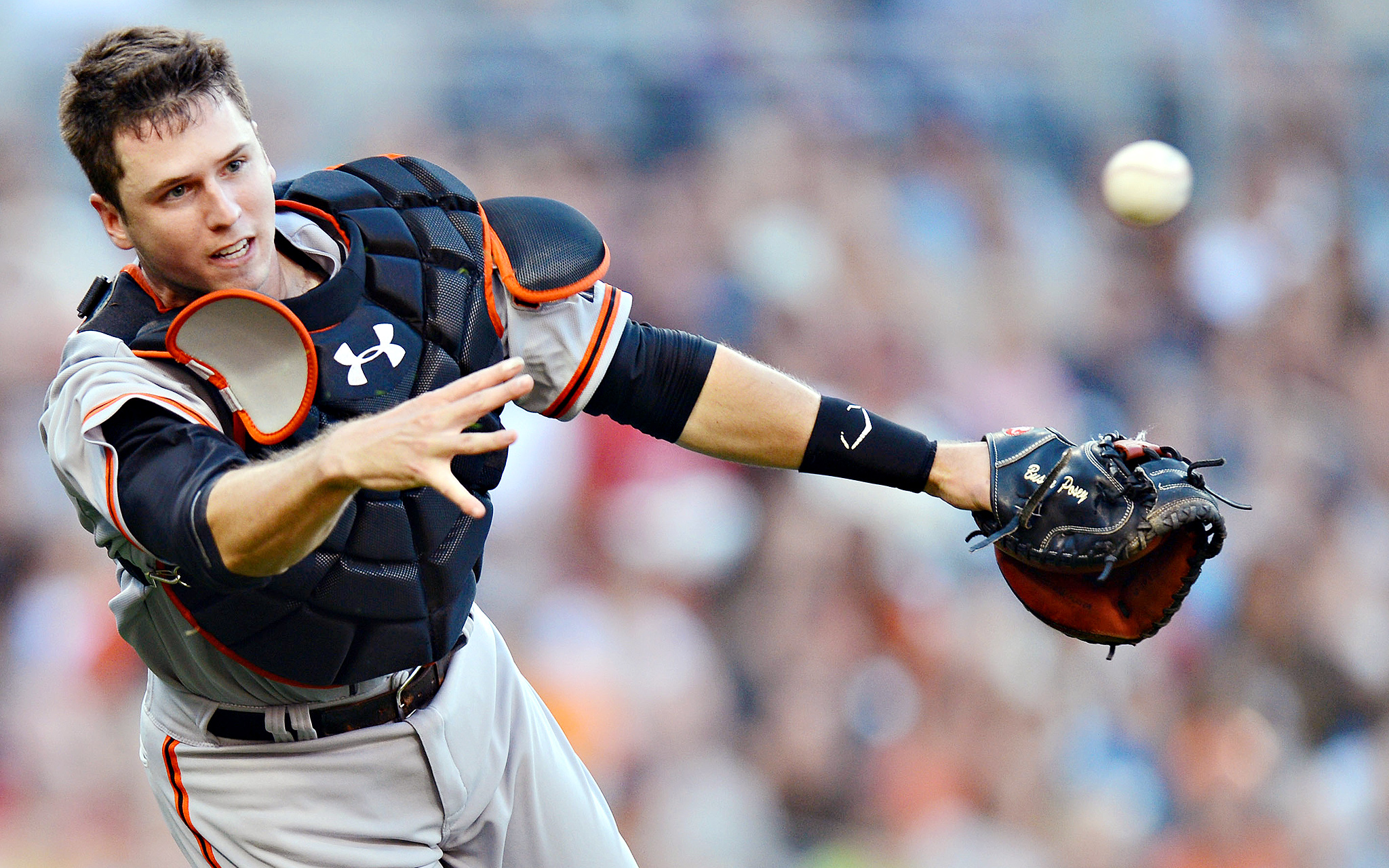
Buster Posey is one of the best players in the game today (ESPN)
Reviewing Devin Mesoraco's new contract extension got me thinking about where he ranks among today's catchers. To determine this list I relied heavily on data from the three previous seasons, giving more weight to 2013 and 2014, of course.

Note: I am excluding Evan Gattis, who joins a crowded catcher situation in Houston and will probably see more time at DH, first base, and in the outfield.

1. Buster Posey
There's no question that Posey's the top catcher in the game today. Offensively, he is without peer at the position,  having batted .311/.381/.497 (147 wRC+) since the start of the 2012 season, and he's a quality defender as well. The 2012 NL MVP and batting champion also adds extra value by handling first base about 30 times a year, thus keeping his bat in the lineup almost everyday. He's putting together a Joe Mauer-ish run here and is already a three-time World Series champion at 28, putting him on the Cooperstown track for now.

2. Jonathan Lucroy
Lucroy's quietly evolved into the best-hitting catcher not named Posey, batting .297/.359/.472 (128 wRC+) with 43 home runs and 95 doubles over the past three years. The Brewers backstop is also durable, having caught 125 games or more in three of the past four seasons. More importantly, he's one of the best pitch-framers in the business. Put it all together, and you have someone just a tick below Posey who might very well win the MVP if he's able to turn a significant portion of last year's 53 doubles into homers.

3. Yadier Molina
A longtime defensive stalwart with seven straight Gold Gloves to prove it, Molina has recently developed into one of the game's best offensive catchers as well.  The youngest Molina brother batted .313/.361/.481 (132 wRC+) from 2011-2013, leading all backstops in fWAR during this time. The lifelong Cardinal was on his way to another good season before a thumb injury cost him seven weeks in July and August, then negatively impacted his swing by limiting him to just .269/.309/.317 with no home runs after returning. Molina's getting up there in years--he'll turn 33 this July--and has logged nearly 11,000 innings behind the plate, but he's showed no signs of slowing down and will be considered an elite catcher until he proves otherwise.

4. Russell Martin
Sure, he's about to turn 32 and has a ton of miles on him, but he also just had the best offensive season of his career and is moving to the launching pad in Toronto. Defensively, the former Gold Glover is one of the game's best, and he's never had a bad year offensively due to his strong on-base skills (.354 career OBP) and decent power (six seasons with double-digit home runs). I'm not a fan of the recent contract he got from the Blue Jays, but I also happen to think he'll be pretty good for at least another year or two.

5. Salvador Perez
Coming off back-to-back Gold Gloves and All-Star nods, Salvy, who turns 25 this spring, is poised to be one of the AL's best catchers for the rest of the decade. The American League's answer to Molina isn't a polished batter, but he's a proven .300 hitter and his home run totals have improved every year he's been in the league. Hardly ever walks because he hacks at everything, which is okay so long as he bats over .300, as he did from 2011-2013 but won't be if he hits .260 again like he did last year. There's still some upside here (could hit .300 with 20 bombs), but if he doesn't become more patient then I don't see him reaching his full potential as a hitter.

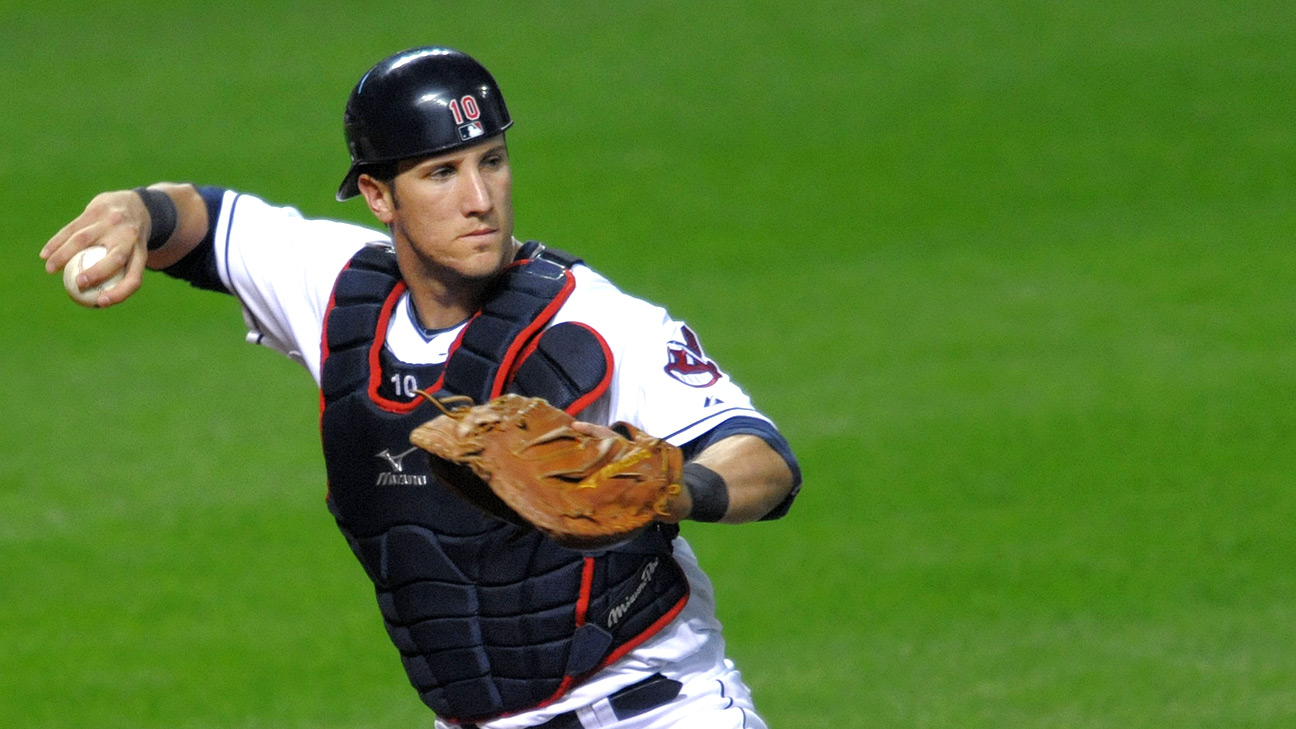
Gomes supplanted Carlos Santana as Cleveland's everyday catcher (ESPN)
6. Yan Gomes
The 2014 AL Silver Slugger recipient is coming off strong back-to-back seasons that saw him hit a combined .284/.325/.476 (125 wRC+) with 8.2 fWAR between 2013 and 2014. He's shown tremendous power for a backstop, slugging 21 home runs and 25 doubles last year in his first full season, and is a good bet to replicate those numbers in his age-27 season. My only concern is that he's struck out more than four and a half times for every walk (cue Will Middlebrooks flashbacks), but it's possible he improves his plate discipline with more experience.

7. Matt Wieters
Wieters was off to a hot start last year before undergoing Tommy John surgery, making him an enticing rebound candidate for 2015. Wieters never developed into the superstar many thought he would become, but he's turned out to be plenty valuable as a good defensive catcher with 20 home run power. The Orioles are counting on their switch-hitting backstop to return strong this year at age 29, and I wouldn't bet against it.

8. Devin Mesoraco
Tough to rank Mesoraco given his relative lack of experience, but if he can prove last year was legit he'll shoot into the top-five easily. For now he's comfortably in the top-10, albeit towards the lower end. I think he's probably more of a .250-20-70 guy than the .273-25-80 guy he was last year, but that's still pretty darned good. 2015 is also going to be his age-27 season, and you know what that means...

9. Wilin Rosario
Rosario has flown under the radar thanks to his presence on some terrible Rockies teams, but when healthy he's one of the best-hitting catchers out there. Injuries hampered his production last year, but in the two seasons before that he crushed 49 home runs and posted an .820 OPS (107 OPS+). Like the rest of his teammates (looking at you, Carlos Gonzalez and Troy Tulowitzki), he needs to avoid the Disabled List, but I see the soon-to-be 26 year-old getting back to his mashing ways in 2015. It doesn't hurt that he plays half his games in Coors Field, either.

10. Brian McCann
As McCann enters his age-31 season, the Yankees have to be concerned about his recent slippage. He's batted below .260 in each of the past three seasons, hitting a combined .238/.305/.419 and becoming  liability on offense. McCann's still a good defensive catcher, however, and his power has held steady with 20 or more home runs in all three of those seasons, so he still has plenty of value. He's just not the perennial All-Star/Silver Slugger candidate he was with the Braves.

Honorable Mention: Miguel Montero, Carlos Ruiz, Jarrod Saltalamacchia, Wilson Ramos, Derek Norris

Tuesday, January 27, 2015

Mesoraco Move Makes Sense

Mesoraco was an All-Star and an elite hitter in 2014 (Fantasy Baseball Dugout)
The Cincinnati Reds haven't done much to applaud this offseason, mainly because they haven't done much at all. Cincy made an outstanding move yesterday, however, locking up catcher Devin Mesoraco with a four-year, $28 million extension that will cover his three arbitration seasons and first year of free agency.

Given that teams are paying roughly $6 million for a win on the open market these days and accounting for inflation, Mesoraco will only need to be worth about one win above replacement per year over the life of the contract to earn his keep. Seeing as how he was worth around 4.5 WAR last year alone, he should have no problem accruing a similar value over the next four years combined (which, by the way, also happen to cover the prime ages of 27-30).

Unless, of course, Mesoraco turns out to be a massive fluke, but I don't think he is (neither does ESPN's David Schoenfield). One might question last year's 25 home runs and .893 OPS (149 OPS+) in light of his 16 home runs and .641 OPS (74 OPS+) from 2011-2013, but I wouldn't. I see Mesoraco's breakout as a product of age (he was 26 last year) and increased experience (he had just 589 major league plate appearances before last year). Catchers also tend to bloom later than other position players, not that there's anything out of the ordinary about a 26 year-old putting it all together.

As for the how/why behind Mesoraco's breakthrough, Jeff Sullivan over at FanGraphs provides a detailed explanation. From what I can see, the Reds' receiver enjoyed a huge boost in BABiP, which at .309 is only 10 points higher than the league average but represents a mammoth improvement over his career average. That was strange to see, considering that a) his line drive rate remained about the same as 2013, b) he hit more fly balls than ground balls last year, and c) he's slow as molasses. Perhaps last year was mere regression to the mean after three straight years of horrendous luck on batted balls, but a .309 BABiP just doesn't jibe with Mesoraco's 2014 hit distribution. Accordingly, I'd project him to be a .250 hitter going forward rather than the .273 batter he was last year.

And what about the power? Mesoraco can hit .250 all he wants if he keeps hammering 25 balls out of the yard every year, something only Brian McCann and Wilin Rosario have proven to be capable of doing among the current crop of backstops. Given the large increases in his strikeout and fly ball rate, Mesoraco appears to have sold out for the long ball by lengthening his swing, which certainly worked for him last year (and should continue to in Great American Ball Park). That said, in 2014 his fly balls left the yard about twice as often as they had in the past and more frequently than the league average, which leads me to believe he's due for a bit of regression in this area. Not much, but enough to cap him at roughly 20 big flies rather than 25 or 30.

I guess this is all a long-winded way of saying that I think Mesoraco's true talent level is probably closer to what he did during the second half last year. He was a monster in the first half, doing his best Mike Piazza impression by batting .320/.387/.667 through June 24th. After that, natural regression combined with pitcher adjustments limited him to .244/.342/.449 the rest of the way. Those are still terrific numbers for a catcher in today's offense-challenged times, and I'll readily admit that Mesoraco could make his own adjustments this year. It's just highly unlikely he'll be as good as he was last year, if only because he was so exceptionally good last year.

Then again, he doesn't have to be. If he's only 75-80 percent of the player he was last year, he's still an awesome hitter. And if last year does turn out to be a fluke, and he's only a so-so hitter from this point onward, then he'll still comfortably exceed one WAR per year so long as he's healthy. The Reds aren't banking on four more All-Star seasons from Mesoraco; they're merely paying him to be an everyday catcher. If his bat turns out to be legit, then he'll wind up being an incredible bargain, but he'll still be one even if it doesn't.

Sunday, January 25, 2015

12 Greatest Shortstops

At a time when pitchers ruled the sport, Wagner towered over the game (ESPN)
With the recent passing of Ernie Banks and retirement of Derek Jeter, I was thinking about where they rank among shortstops. This is by no means definitive, as it gets really close after the top five and 6-12 could be ranked in almost any order, but I did my best:

1. Honus Wagner (131 bWAR, 138.1 fWAR, 92 WAA)
Almost a full century after his last game, Wagner is still the greatest shortstop who ever lived. The Flying Dutchman was the best position player in baseball history until Ty Cobb came along, and probably would have won five or six MVPs had the award existed back then. The amount of black ink on his Baseball-Reference page is staggering; eight batting and OPS titles, seven doubles titles, and five stolen base and RBI crowns, to name a few. Wagner dominated the game, and I think it's pretty telling that when the first Hall of Fame class was inducted in 1936, he received as many votes as Babe Ruth.

2. Alex Rodriguez (116 bWAR, 111 fWAR, 77.4 WAA)
The enduring image of Alex Rodriguez as a baseball player will be that of an aging, broken-down, scandal-ridden third baseman. That's too bad, because for the first decade of his career he was a full-time shortstop, and an otherworldy one at that. PEDs aside, what A-Rod did during his time in Seattle and Texas defied belief. He reeled off six straight 40-homer seasons, when no other shortstop had so many at all, let alone consecutively. He had back-to-back 50-homer seasons, shattering Banks's single-season record for most home runs by a shortstop, then breaking his own mark the very next year with an unthinkable 57. He went 40/40, something only three other people in baseball history have ever done.  Rodriguez was a great defender, too, winning consecutive Gold Gloves in 2002 and 2003 before joining the Yankees and moving over to third in deference to Jeter (an inferior player, by the way). I often wonder how his career would have turned out had he just stayed the Rangers shortstop and captain. It couldn't have turned out any worse.

3. Cal Ripken Jr. (95.5 bWAR, 92.5 fWAR, 53.1 WAA)
People remember Ripken so much for the streak that they forget just how great he was during his prime. He was a two-time MVP who had at least 21 home runs and 81 RBI every year from 1982 to 1991, when he was arguably the best player in baseball. He was an All-Star 19 times, winning eight Silver Sluggers as well as a pair of Gold Gloves. And yes, Iron Man was a freak of nature who played 2,632 consecutive games and 3,001 in all (and yet was only a liability in his final season). Ripken played the game the right way--the Ripken way.

4. Ernie Banks (67.5 bWAR, 63.3 fWAR, 28.5 WAA)
Until Alex Rodriguez came along, Banks set the standard for power-hitting shortstops, which were exceedingly rare until the 1980s. Mr. Cub was at his absolute best from 1955-1960, batting .294/.359/.579 (148 OPS+) with 47.3 bWAR and five 40 homer/100 RBI seasons. Only Mickey Mantle and Willie Mays were more valuable during this span, which saw Banks win back-to-back MVPs and lead all players in home runs and RBI. A knee injury suffered during the 1961 season forced him to first base full-time, but his prime years were truly a thing of greatness.

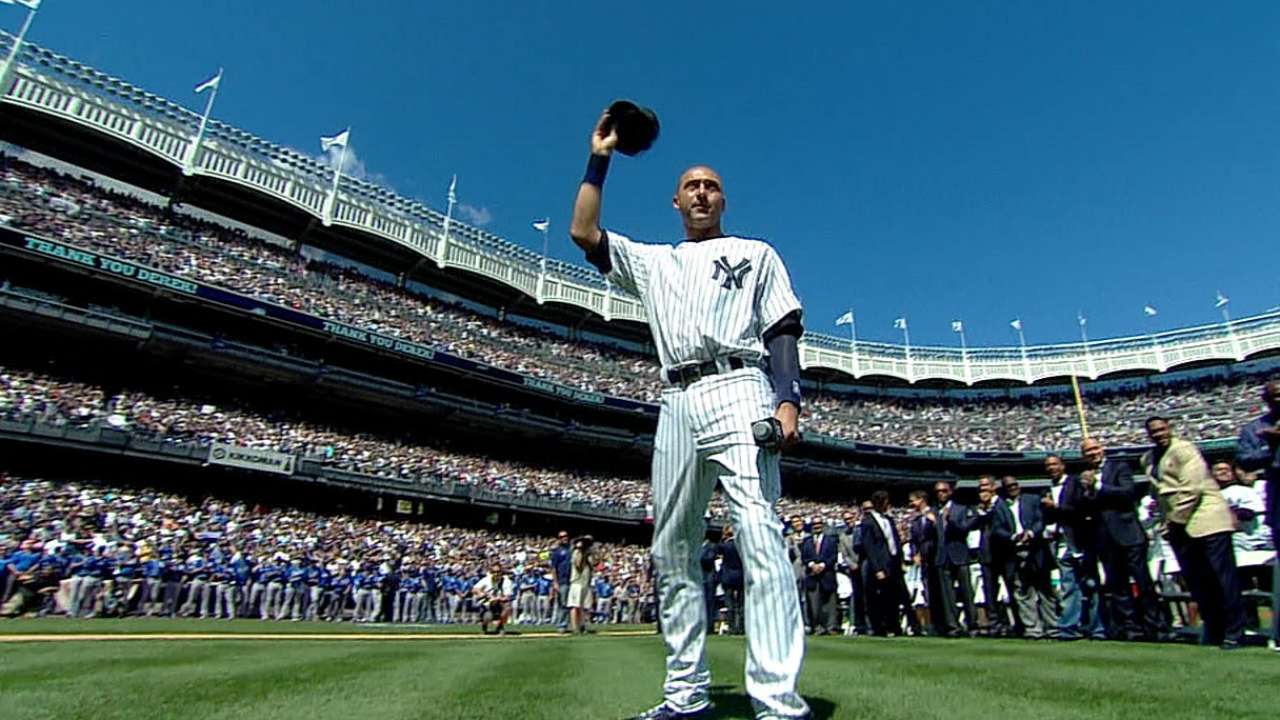
5. Derek Jeter (71.8 bWAR, 73.5 fWAR, 30.4 WAA)
Jeets would rank much higher if not for his terrible defense, which cost the Yankees a lot of runs and wins over the years. He also struck out a lot for a guy with medium power and was largely a singles hitter in the final third of his career. That said, Jeter played shortstop at a high level for almost two full decades (notwithstanding his horrible last couple seasons) and finished with impressive career statistics, his 3,465 hits chief among them. In his prime he was a durable 20/20 guy who hit well over .300, got on base a ton, and played passable defense. He was also a "winner" who came through time and time again for the Yankees during the postseason.

Jeter is one of the five greatest shortstops ever (MLB)
6. Robin Yount (77 bWAR, 66.5 fWAR, 37 WAA)
It took Yount, who debuted at 18, a good half decade to develop into an above average hitter. But once he did, he became one of the best all-around players in baseball. He owned the 1980s, winning two MVP awards and compiling 55.1 bWAR/50 fWAR during the decade. According to FanGraphs, only Rickey Henderson, Wade Boggs, and Mike Schmidt were more valuable than Yount, who batted .305/.365/.485 (135 OPS+) for the decade while leading all players in hits and doubles (and ranking second in runs). Yount was a center fielder during his 30s but played over half his games at shortstop, which explains why he's included here. Like Ripken, Yount combined several elite seasons with longevity, playing long enough to surpass 3,000 hits.

7. Arky Vaughan (72.9 bWAR, 72.6 fWAR, 47.3 WAA)
Vaughan is one of the most underrated ballplayers ever, probably because he spent his prime years on lousy Pittsburgh teams during the Depression. Sure, he played in a fantastic era for hitters, but a .318/.406/.453 (136 OPS+) stands out in any case. Also, this is not a misprint; in 1935 he batted .385/.491/.607 (190 OPS+) en route to a 9.2 bWAR campaign. Even more astounding is that he was not named NL MVP that year (he finished third, behind Gabby Hartnett and Dizzy Dean).  Vaughan didn't play very long--only 14 seasons--so his counting numbers aren't that great, but for the bulk of his career he was one of the three best position players in baseball. Had he not voluntarily sat out three seasons in his early 30s, he probably would have ended up with close to 1,500 runs and 2,500 hits.

8. Barry Larkin (70.2 bWAR, 67.6 fWAR, 42.2 WAA)
Larkin was basically Jeter value-wise, only he wasn't able to stay as healthy. So while Larkin, just as good a hitter and a better baserunner/defender, was better than Jeter on a per-game basis, I can't overlook the fact that Jeter played almost 600 more games and had nearly 3,600 more plate appearances. From 1988-2000, Larkin wasn't just the best shortstop in the National League; he was one of the five most valuable position players in baseball. There were Barry Bonds, Ken Griffey Jr., and everyone else, but Larkin was at or near the top of the everyone else list.

9. Luke Appling (74.5 bWAR, 72.7 fWAR, 41.5 WAA)
Appling's another guy who seems to have been forgotten, which is hard to reconcile given his .310 career average, .399 OBP, and 2,749 hits. Like Vaughan, he had one monster season in the heart of the Depression, putting up a .388/.474/.508  (139 OPS+) line and 128 RBI in 1936, only to come up short in the MVP voting (Appling finished second to Lou Gehrig, who was absolutely the right call with his 49 home runs and 1.174 OPS). Appling was a lot like Vaughan, actually, albeit with less power. Appling was also phenomenal old player, batting .301 with 121 walks in 1949 at age 42. If not for World War II costing him almost two full seasons, he would have been a good bet to reach 3,000 hits, 1,500 runs, and 500 doubles.

10. Alan Trammell (70.4 bWAR, 63.7 fWAR, 40.2 WAA)
Trammell was a skilled defensive shortstop (four Gold Gloves) who also had a number of strong offensive seasons, none better than his 1987 campaign when he batted .343/.402/.551 (155 OPS+) with 28 home runs and 105 RBI. The six-time All-Star did everything well; defense, hitting for power, speed, getting on base, et. al. He teamed with Lou Whitaker for two decades to form the best double-play tandem baseball has ever seen.

11. Ozzie Smith (76.5 bWAR, 67.6 fWAR, 41.6 WAA)
Smith was nothing special offensively (career 83 OPS+), but was so dazzling on the field and bases that he was able to cruise into Cooperstown on his first try with over 91 percent of the vote. Rewarded with a (shortstop) record 13 consecutive Gold Gloves from 1980-1992, Smith is widely considered to be the best defensive shortstop all-time. The Wizard was also a phenomenal basestealer, swiping 580 at a 79.6 percent clip. So while he wasn't much with the stick and had virtually no power to speak of (only 28 career big flies), the 15-time All-Star compensated by getting on base enough (.337 OBP) and winning games with his legs.

12. Joe Cronin (66.4 bWAR, 66.6 fWAR, 35.9 WAA)
With a .301/.390/.468 (119 OPS+) career line, Cronin was one of the best-hitting shortstops of all-time. He was an excellent RBI man, topping 90 every year but one from 1930-1941 and piling up 1,424 in all. Cronin also had really good power for a shortstop, with 803 of his 2,285 hits going for extra bases. A seven-time All-Star, he finished in the top-seven of MVP voting five times. His defense has been called into question, however, and his numbers are less impressive after accounting for context (he played mostly in the 1930s and spent a lot of years at Fenway Park).

HM: Jimmy Rollins, Vern Stephens, Omar Vizquel, Miguel Tejada, Lou Boudreau