Wednesday, August 15, 2012

Pesky Remembered


Pesky is gone, but will never be forgotten
It is a sad day in Red Sox Nation.  Not because the Old Towne Team is underachieving again, two games below .500, 64-79 since last September 1st, and eleven and a half games out of first place.  Not because nearly everyone on the team has been injured at some point, and those who haven't--Jon Lester, Adrian Gonzalez--are underperforming. And no, not because tragedy already befelled them earlier in the year when they lost beloved PA announcer Carl Beane to a heart attack/car accident (this is getting depressing).  So in a season where everything has gone wrong, it was like pouring salt in an open wound when Red Sox legend Johnny Pesky passed away yesterday at the age of 92.  Appropriately, he lived long enough to take the field for Fenway Park's 100th anniversary celebration back in April, when more than 200 former players and coaches attended the ballpark's giant birthday party.  After all, having a Fenway centennial without Johnny Pesky would be comparable to eating Oreos without milk; you can't have one without the other.

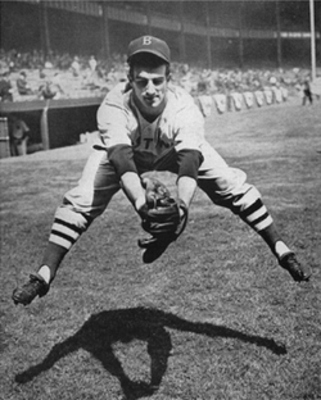
Pesky made an immediate impact with one of the
more underrated rookie seasons in baseball history.
John Michael Paveskovich, the son of Croatian immigrants, lived a long and full baseball life that spanned 73 years.  It began when the Boston Red Sox signed him as an amateur free agent in 1940.  After batting .325 in each of his two years of minor league seasoning, Pesky was clearly ready for the Show.  He hit the ground running by putting together one of the more underappreciated great rookie campaigns of all time in 1942.  Penciled in at the two-hole from day one, the 22 year-old shortstop used his remarkable bat control to spray line drives all over the field.  Pesky was worth 5.2 bWAR after scoring 105 runs and pacing the majors with 205 base knocks.  He batted .331/.375/.416, helping spark Joe Cronin's second place Red Sox to 93 wins and earning a third place finish in the AL MVP balloting behind Joe Gordon and Ted Williams for his efforts.  He finished second to Williams (who won the major league Triple Crown that season) in the batting race and laid down a major-league best 22 sacrifice hits.  What a teammate!

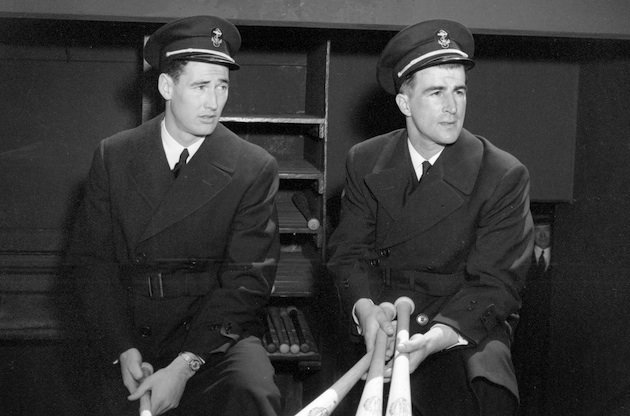
But World War II interrupted his career, as it did for stars of the time such as Bob Feller, Hank Greenberg, and Joe DiMaggio.  Pesky served in the navy, losing all of 1943, '44 and '45.  Based on his 1942 and 1946 production, one can assume that he missed out on at least 300 runs scored and 600 hits. Had he remained healthy during those years and maintained his production, he would have ended up with around 1,200 runs scored, 2,100 hits, 300 doubles, 800 walks and 2,600 total bases. Not first-ballot Hall of Fame numbers by any means, but he probably would have gained entry through a Veteran's Committee as contemporary shortstops Phil Rizzuto and Pee Wee Reese did. Even with the three missed seasons, his numbers are still in the same ballpark as Rizzuto's and Lou Boudreau's. I'm not saying he belongs in Cooperstown, but you could certainly make the case. To see a more detailed comparison/argument, read Jay Jaffe's article for SI.com.
Williams (left) and Pesky both sacrificed three prime years to the war effort
Pesky didn't skip a beat upon returning in 1946, the best year of his career.  He finished fourth in the MVP voting and set personal bests with 208 hits (first in the AL), 43 doubles,.335 batting average, .427 SLG, .827 OPS, 125 OPS+, 265 total bases, and 6.4 bWAR  He earned his only All-Star selection that year as the Junior Circuit's starting shortstop in the Midsummer Classic, joining teammates Teddy Ballgame, Dom DiMaggio, double play partner Bobby DoerrRudy York, Dave Ferriss, and Mickey Harris. Fenway Park hosted the event that year, the first of three All-Star games that have been played in its friendly confines.  Pesky went hitless in two at-bats, bouncing into a double play before Vern Stephens replaced him in what became a 12-0 rout of the National League.  But Pesky and his comrades had their eyes set on a much bigger prize, for this was the year a juggernaut Boston squad won 104 games and cruised into the World Series, heavily favored to dispose of Stan Musial's St. Louis Cardinals.  Pesky struggled in his lone Fall Classic appearance, batting just .233 with no extra-base hits, zero RBI and only two runs scored.  Worst of all, he became the scapegoat for Boston's Game 7 loss when he reportedly held the ball as Enos Slaughter made his mad dash for home, a play that defined his career and established his role in Boston's fabled "Curse of the Bambino."  Pesky would spend much of his life denying any hesitation in that critical moment, and the film evidence backs him up (though he didn't get much on his relay throw the plate).  The Red Sox would not capture another AL pennant until 1967, long after Pesky and company hung up their spikes for good.

"The Needle" didn't let that one mistake come back to haunt him in '47, as he once again led the league in hits, scored more than 100 runs and batted .324.  But Boston's starting rotation was decimated by arm troubles to Ferriss, Harris and Tex Hughson, causing the defending AL champs to slip to third in the standings. In 1948 he shifted over to third base to accomodate Stephens (something captain Derek Jeter refused to do for Alex Rodriguez more than half a century later), and while his batting average tumbled to .281 he set personal bests in runs scored with 124 and home runs with three.  His strong play wasn't enough to save the Red Sox from their own manager Joe McCarthy, who infamously bypassed Mel Parnell in favor of journeyman Denny Galehouse to start the do-or-die one-game playoff game against the Indians with the pennant on the line.  Galehouse was bombed, and the Sox went home empty-handed. From 1949-'51 Pesky continued to floruish, batting north of .300 and posting OBPs well above .400 each season, but Boston just couldn't get over the hump.

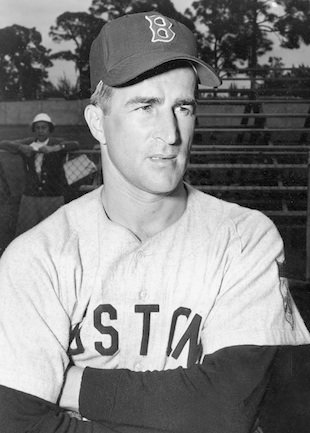
Pesky in 1952, his final season playing
with the Bosox
Then, like so many players of the day, Pesky couldn't sustain his success for long as his career fizzled out in his early thirties. Boston included him in a massive nine player trade with Detroit on May 27th, 1952, a deal that also featured 1950 Rookie of the Year Walt Dropo, former batting champion/future Hall of Famer George Kell, plus All-Stars Hoot Evers and Dizzy Trout. After enduring an abysmal start to the season (.149/.313/.179 through 35 games) in Beantown, Pesky failed to improve much in the Motor City. His days as an everyday player were behind him. The following season he slid over to second base and bounced back to bat .292. But his resurgence was short lived, and his career was winding down.  In 1954 he found himself riding the pine more often than not.  Detroit swapped him with Washington's Mel Hoderlein, a professional benchwarmer, indicating that the end was near. Fittingly, Pesky played his final game at Fenway Park against the Red Sox on September 24th, 1954.  The Senators released the 35 year-old veteran during the offseason, then the Orioles took a flier on Pesky before they, too, released him just before the '55 season got underway.

The playing phase of his career was over, but the second stage of his baseball life had just begun.

Ironically, he got his first coaching gig with the New York Yankees organization in 1955 for their Triple-A organization.  He returned to Detroit as a manager in their farm system from '56 through 1960.  In '61, the year Mickey Mantle and Roger Maris captivated the naiton with their thrilling home run chase, Pesky's career came full circle when he rejoined the Boston Red Sox, first as a Triple-A manager in the Pacific Coast League.  After guiding the Seattle Rainiers to a pair of winning seasons, Tom Yawkey named him as Red Sox manager after promoting Pinky Higgins to general manager.

Unfortunately, Pesky inherited a team with a reputation as a country club because it was neither very good nor very motivated.  The once-proud franchise was mired in a lengthy rut as they paid the price for being the last team to integrate, and were content to finish in the second division while the Yankees ran away with the pennant every year.  To his credit, Pesky tried to change that culture and light a fire under his team, but the stubborn veterans did not co-operate (Four years later, Dick Williams brought the same intentions and succeeded because the "Impossible Dream" team was so young and impressionable).  As always, the 1963 Bosox had a formidable lineup headed by the slugging "Dr. Strangeglove" Dick Stuart, slick-fielding All-Star third baseman Frank Malzone and Carl Yastrzemski, the Splendid Splinter's replacement in left field who would win the first of three batting titles that season.  Surprisingly, the Sox jumped out to an 18-11 start and were in first place as late as May 19th, but couldn't maintain their hot start and quickly faded as the weather heated up.  The pitching faltered and the beleaguered Bostonians finished with 76 wins, the same number of games they won the year before. In '64 they were even worse, dropping 90 games before Pesky was dismissed with two games remaining on the schedule (which the Red Sox would lose under new skipper Billy Herman).  The potent lineup, bolstered by teenage rookie sensation Tony Conigliaro, simply couldn't score enough runs to cancel out the damage done by an atrocious pitching staff.  At a time when baseball was becoming dominated by pitching, Pesky simply didn't have the necessary arms at his disposal to compete.

Pesky remained a familiar face at Fenway well
into his golden years
After a four year hiatus with the Pirates organization, Pesky returned to the Red Sox for good in 1969.  And the rest, as they say, is history.  He served as a color commentator on both radio and TV, then donned the Red So uniform again in 1975 as a first base coach under manager Darrell Johnson, who helmed a colorful bunch--led by Gold Dust Twins Jim Rice and Fred Lynn--to the American League pennant.  Three decades later it must have felt like deja vu for Pesky given the many parallels between the trajectories of the late 1970s Red Sox and their forefathers from the 1940s; the Sox coasting to the Series but just miss out on the title by falling short in Game 7.  Boston's young, talented nucleus poised to launch a dynasty that never was, thwarted by incompetent managers, bad breaks and late season collapses while the hated Yankees continued to add to their impressive October history.  In 1980 he was both a batting coach and a bench coach before filling in as interim manager after Don Zimmer was fired with five games left in the season (the slumping Sox were defeated in all but one).  He resumed his duties as a coach through 1984 before becoming a special instructor, the title that he held until his final breath.

Some more interesting stats from Pesky's playing career;
  • He finished his career with 662 walks versus just 218 strikeouts, an incredible 3:1 ratio.  In 1951 he drew 100 free passes while whiffing just 19 times in 573 plate appearances.  Times sure have changed.
  • One thing Pesky didn't do was hit for power, as his seventeen career homers--only six of which came at Fenway--.386 SLG and .079 ISO (that's Juan Pierre territory) can all attest.  In 1947, he piled up 719 plate appearances and somehow went homerless.  His diminuitive, Dustin Pedroia-like stature (5'9, 168 pounds) probably had something to do with that.  In fairness though, his job was to get on base and set the table for Boston's big bats, a role in which he excelled. His phenomenal career .394 on-base percentage would make Billy Beane smile, ranking higher than greats such as Rod Carew, Joe Morgan, Frank Robinson and Tony Gwynn. As he matured he began trading hits for walks, reaching triple digit walk totals in 1949 and 1950. 
  • Pesky wasn't a good basestealer, either, as he was caught stealing in 49 of his 102 attempts.  Interestingly, 20 of his 53 stolen bases came in the month of August.
  • .321 career batting average at Fenway Park.
  • Had six seasons where he batted north of .300.
  • His career OBP is six percentage points higher than his SLG, a rarity.
  • Was a second half player, batting .319/.403/.397 after the All-Star break compared to .293/.385/.374 before it.
  • Hit just one home run in April, and one in September.
Sadly the man who was born on the day Babe Ruth played his last game for the Boston Red Sox, who accepted less money to sign with them and went on to dedicate 61 years of his life--sticking with them through the good times and the bad--to the organization, who has the right field foul pole named after him and his number six retired on the grandstand roof in America's most beloved ballpark, who became a franchise icon, a Red Sox ambassador and member of the team's Hall of Fame, is gone.

But the memories, his accomplishments, and the impact he had on the game lives on.  We'll miss you, Johnny Pesky.  The Red Sox won't be the same without you.
Pesky tips his cap to the Fenway Faithful

Monday, August 13, 2012

25 Stats that are Hard to Believe


1. Mike Trout has scored 88 runs in 92 games played
2. 36 year-old David Ortiz, just one of many Red Sox to land on the DL this season, still leads the American League in OBP, SLG and OPS
3. Fantasy zombie Ryan Ludwick has one fewer home run (21)  than team leader Jay Bruce
4. Since returning from the Disabled List on July 6th, Ryan Howard has whiffed 40 times in 100 at-bats
5. Jon Lester and Josh Beckett combined have won fewer games than Jake Westbrook, Jason Vargas, and Max Scherzer, among others
6. Brandon Morrow, who hasn't made a start since June 11th, is the major league leader in shutouts with three (tied with Felix Hernandez)
7. Joe Blanton has the best K/BB ratio in the bigs with 5.86 whiffs per walk
8. Nobody has more losses or wild pitches than Tim Lincecum, who also leads the NL in earned runs
9. The Red Sox led the American League in OBP last season, largely because they were second in walks.  This year only three AL teams are walking less frequently
10. The two top home run-hitting catchers thus far are A.J. Pierzynski and Jarrod Saltalamacchia.  Pat yourself on the back if you saw that one coming
11. The Baltimore Orioles, at 62-53 are nine games above .500 despite having a -49 run differential on the season. According to their Pythagorean W-L, they should be eleven games under .500.  I'm still waiting for regression to bite them in the butt, but it hasn't happened yet and there's only six weeks left in the season
12. Speaking of the O's, Adam Jones is their only player with more than six stolen bases on the year
13. Among National League third baseman, Chase Headley ranks second in home runs (behind Pedro Alvarez) and RBI (behind David Wright).  That's even more impressive because he plays half his games at Petco and has almost no supporting cast to speak of
14. If you extrapolate Kevin Youkilis's numbers since joining the White Sox over the course of 152 games, he would score 108 runs, crank out 40 homers, knock in 116 and draw 92 walks.  In related news, the man who replaced him in Boston--Will Middlebrooks--will miss the remainder of the season with a broken wrist.
15. 40 year-old Chipper Jones is batting .310/.390/.496 on the season, which will be the last of his illustrious Hall of Fame career.  Good to see him go out on a high note
16. Brothers Rickie Weeks and Jemile Weeks have both crossed home plate 50 times this season.
17. Brothers B.J. Upton and Justin Upton have both driven in 46 runs this season
18. Desmond Jennings is 21 for 22 in stolen base attempts.  That's a 95 percent success rate
19. Alfonso Soriano has gone yard at least 20 times in eleven consecutive seasons.  He now has 360 (and counting) career big flies
20. Emilio Bonifacio has stolen two more bases (30) than Jose Reyes despite playing in 52 fewer games
21. Cincinatti's starting five of Johnny Cueto, Mat Latos, Bronson Arroyo, Homer Bailey and Mike Leake have started all 115 of the Reds' games this year
22. Josh Reddick has 25 home runs, more than Albert Pujols, Prince Fielder, Mark Teixeira, and Andrew McCutchen, among others
23. Among National Leaguers only Carlos Beltran and Matt Holliday have piled up more RBI than Jason Kubel
24. Aramis Ramirez leads the Senior Circuit in extra base hits
25. Since the beginning of last season, Ryan Vogelsong has a 2.51 ERA, almost as good as Johnny Cueto's 2.38 mark

Sunday, August 12, 2012

Can the Nationals Win 100 Games?

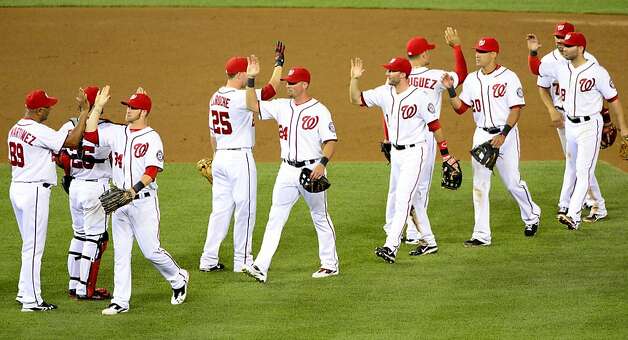
The Nats lining up for celebratory high-fives has been a common occurrence this season
The Washington Nationals, current owners of the best record in baseball at 71-44 (.617), are pretty much the only team with a realistic chance of finishing the season with at least 100 victories.  All they have to do to reach the century mark is win 29 of their final 47 games which, as it turns out, would require a .617 winning percentage the rest of the way.  If the Nats continue winning ballgames at their current pace, they will wind up with 100 wins exactly (For what it's worth, coolstandings.com projects them to fall just short with 98.4).

Kind of hard to believe, isn't it?

It didn't take long for Washington to transform from NL East doormats to the winningest team in baseball.   Three short years ago they lost 103 games,  their second straight year hitting triple digits in the loss column.  No, they didn't become contenders overnight like the Rays, but once the pieces were in place it didn't take long for everything to click.  After dropping 93 games in 2010, the Nationals fell just one win shy of a .500 season last year. Everyone could see that the team was loaded with young talent and promise, especially after a busy offseason bolstered the starting rotation, but they weren't preseason favorites by any means.  I remember some optimists picked them to sneak into the postseason with the second wild card in play, but even 90 wins seemed like a longshot.  Certainly nobody expected them to wrestle the division title away from the star-studded Phillies (winners of 102 games in 2011), Braves, or even the new look Marlins who threw money around like they were the Yankees by splurging on pricy free agents Jose Reyes, Mark Buehrle and Heath Bell.

And yet, more than two-thirds of the way through the season, here they are.  Number one.  Poised to bring playoff baseball to Washington for the first time since the height of the Great Depression in 1933. On their way to setting the record for most wins in franchise history.  I don't want to jinx them, and a lot can change over the next two months, but I think they're going to represent the NL in the Fall Classic. They have the best pitching in the National League with a staff that ranks first in ERA, innings pitched and fewest hits allowed.  It ranks second in strikeouts behind only the Brewers.  The humming offense has rounded into form, highlighted by a nice blend of power and speed.  The defense is strong, too, one of the best in the league.  See?  Washington winning the pennant doesn't sound so far fetched after all. 

But back to my original question; can they win 100 games?  I think can.  Here are my three main explanations that support the possibility of Washington accomplishing this feat.

1. The lineup is finally getting healthy/coming around
For much of the spring the Nats lineup was depleted by injuries to its core of key position players (count your lucky stars, Adam LaRoche and Danny Espinosa), necessitating Bryce Harper's much anticipated call-up at the end of April.  The rookie sensation provided a spark with a hot start to his major league career. The past two months have been rough on him, though.  Since June 13th he's batting .207/.285/.300 with just three home runs and 13 RBI. It's not surprising to see the 19 year-old struggle, especially since Mike Trout, with whom Harper is often compared, hit just as poorly in his brief debut last year.  Most young players go through an adjustment period when the pitching catches up with them/exploits their flaws, and Harper is no different.  Fortunately, his wounded teammates have returned to health and started to pull their weight. 

Michael Morse-Washington was counting on the late-bloomer to produce the way he did the past two seasons when he batted a combined .298/.357/.539 with a 142 OPS+.  Instead the 30 year-old began the season on the DL with a strained back and didn't take the field until June 2nd.  Initially he struggled to rediscover his power stroke, slugging.411 (.123 ISO) with only four long balls and an ugly 41/5 K/BB rate in his first 40 games back.  But over the past three weeks he's mashed like the middle-of-the-order threat he's supposed to be by belting seven big flies and slugging a robust .577 (.268 ISO).  With hits in all but two of his past 28 games, Morse looks fully recovered and has put that slow start in the rearview mirror.

Ryan Zimmerman-As recently as six weeks ago, 2012 was shaping up to be a lost season for the franchise cornerstone, not exactly what the organization was expecting after locking him up through the remainder of the decade (and making him highest paid third baseman in MLB history not named Alex Rodriguez) with a six year contract extension worth $100 million with a $24 million club option for 2020.  After a sluggish start Zimmerman landed on the DL with shoulder inflammation in late April and slumped horribly after returning to action on May 8th.  He hit rock bottom on June 23rd, when his second straight 0-for-4 against the Orioles dropped his batting line to a measly.218/.285/.305 on the year.  He had committed to playing through the pain for the remainder of the year, but looked like he was barely going to last until the All-Star Break.  But since receiving a cortisone shot (which may or may not have contained some combination of magic pixi dust, anabolic steroids, or Michael Jordan's "secret stuff" from Space Jam) in his right shoulder before the series finale against Baltimore, he's looked like a new man.  He picked up a pair of hits in the game, kicking off a torrid stretch during which he's batted an Albert Pujols-ian .352/.423/.665 with 13 home runs, 42 RBI and 40 runs scored.  Cortisone shots wear off, but Zimmerman is in such a groove at the plate that he should finish the season with his typically strong numbers. 

And let's not forget the team's most expensive position position player Jayson Werth, who missed nearly three months after breaking his wrist on May 6th.  Since returning from the disabled list on August 2nd Werth has hit the ground running, recording at least one base knock in nine of ten games and raking at a .412/.512/.529 clip.  And while he hasn't gone deep since the game before he broke his wrist, his power seems to be coming around too after smacking four doubles in the past four games.  His batting eye looks good too with a 7/4 BB/K ratio (it's usually the other way around for him, with two strikeouts per every walk).  This is the player Washington thought they were getting when they signed him to a much-criticized seven year, 126 million dollar contract before the 2011 season.  Werth appears to be much more comfortable and relaxed at the plate this year.  He's not pressing, not trying to do too much, and has really settled down (the same also applies to Boston's Carl Crawford). 

The only regular (besides backstop Wilson Ramos, lost for the year with a torn ACL) still on the shelf is shortstop Ian Desmond, out since July 21st with a torn oblique. The first time All-Star took batting practice this weekend and hopes to return by the end of the month. He'll look to build upon a stellar first half in which the 26 year-old batted .286 with 17 home runs and 15 steals.  If he can pick up where he left off and Harper gets back in a groove, this offense is going to score runs in bunches down the stretch. 

2. The starting rotation is deep, young and talented
Some might say San Francisco or Philadelphia have the best rotation in the National League, but top to bottom I think Washington is the clear-cut choice. Before the Angels traded for Zack Greinke, adding the 2009 AL Cy Young winner to a rotation that already featured Jered Weaver, C.J. Wilson, Dan Haren and Ervin Santana, you could have made the case that the Nats possessed the best rotation in baseball. The starting five has remained healthy and durable; Strasburg, Zimmermann, Gonzalez, Jackson haven't missed a turn, while Detwiler sacrificed a handful in late May/early June when he shifted to the bullpen before rejoining the rotation.  Combined, the rotation has posted a 3.19 ERA, 1.17 WHIP, and a 2.98 K/BB ratio.  Basically, Davey Johnson is sending Matt Cain to the bump every day.  Oh, and it probably helps that they're all still in their twenties.

Stephen Strasburg-His inning limit of 180 (not 160 as originally believed) shouldn't curtail his season too much.  After missing most of 2011 recovering from Tommy John surgery, Strasburg has resumed pitching the way he did during his electrifying but abbreviated 2010 debut.  While you can argue that he hasn't been the best pitcher in the league this year (Johnny Cueto, R.A. Dickey and Clayton Kershaw), you'd be hard-pressed to find a hurler that's been more dominant.  His 166 punchouts and 11.2 K/9 rate are both tops in the Senior Circuit.  Four times he's racked up double digit strikeouts in a single game, and three other times he finished with nine.  The Nats went 12-2 in their ace's first 14 starts.  The innings limit will likely cost him in the Cy Young voting this year, but I have a feeling he's probably going to win at least one somewhere down the line.

Jordan Zimmermann-After being limited to 160 innings last year--his first campaign back from Tommy John surgery--he proved his right arm could withstand the rigors of a full season.  He's been set free this year--the kid gloves are off--and he's responded with a season worthy of Cy Young consideration. He leads the National League with a 169 ERA+ while his 2.35 ERA and 4.4 bWAR are second only to Ryan Vogelsong and Johnny Cueto, respectively, among NL hurlers.  He has yet to allow more than four earned runs in a game this season and has completed at least six innings in all but one of his 23 starts.  He hasn't been a big strikeout guy since the surgery--his 7.0 K/9 over the past three years is both pedestrian and a far cry from the impressive 9.1 mark he posted pre-surgery as a rookie in 2009--but he makes up for it by limiting baserunners and home runs as his 1.06 WHIP and 0.7 HR/9 rate are superlative.   Hasn't recorded a loss since interleague play ended and the Nats have won eight of his previous nine turns.

Gio Gonzalez-Oakland GM Billy Beane sent him packing to the other league and other coast last winter, but it didn't take long for GG to get comfortable in his new surroundings.  Gonzalez has thrived in his new digs, making his second consecutive trip to the Midsummer Classic and finding his name plastered all over the Senior Circuit pitching leaderboards. After leading the bigs with 91 walks allowed last year he's improved in that department, trimming his BB/9 rate from 4.1 last season to 3.4 this season.  That reduction should prevent him from turning into the second coming of Jonathan Sanchez, another erratic southpaw who posted impressive strikeout rates but was undone by his swelling walk totals.  Nobody does a better job at keeping the ball in the yard, either, as his miniscule 0.4 HR/9 rate leads both leagues.  He served up just one gopher ball--to Josh Harrison (four career big flies) of all people--through his first 88 and two-thirds innings of the year.  No wonder the Nats won 14 of his 17 first half starts.  If he keeps this up, he just might win 20.

Edwin Jackson-Has been rock solid in his role as middle of the rotation glue. After settling for a one year, $11 million deal with Washington in the offseason,  the one-time All-Star is well on his way to another year as an above average starter.  His 7-7 record doesn't accurately reflect how well he's pitched because he hasn't received much run support; in ten of his 22 starts the Nats have scored three runs or less, including a painful stretch at the end of May when they put just one run on the board in each of his three starts.  No wonder he was only 4-4 through June 23rd despite a sparkling 2.91 ERA!  Since then he's struggled to the tune of a bloated 5.48 ERA in eight starts, but Jackson is notoriously inconsistent.  Why do you think he's played for six teams in five years?  Remember that we're talking about a guy who walked eight Tampa Bay Rays when he twirled a no-hitter at the Trop in 2010.  Given that his career ERA is 4.38, this slump can be chalked up to simple regression to the mean.  He'll look to turn it around against the fading Mets on Friday.

Ross Detwiler-The team's number five starter (aside from a brief stint in the bullpen when Chien-Ming Wang--remember him?--came off the disabled list) has been everything you could ever ask for and more.  The lefty groundballer has maintained a nifty 2.99 ERA and 1.18 WHIP, numbers that most teams would love to get out of their aces, let alone the worst starter in their rotation.  He's been even stingier of late with a 1.93 ERA in his five second half starts, four of which have been quality.  It's safe to say he's overachieved with the help of some good fortune, and there's no way he can keep this up much longer, but I don't hear anyone complaining.  Especially not when he's earning less than half a million dollars this year.

3. The bullpen is top notch
The relief corps has been nearly as good as the rotation with their 3.31 ERA and limiting opponents to a collective .226 batting average.  This gives Johnson the luxury of not having to push his starters into the seventh or eighth inning too frequently, therefore keeping their pitch counts low and protecting their arms.  All-Star setup man Tyler Clippard stepped into the closer's role in late May with Drew Storen sidelined and has performed admirably, converting 24 of 28 save opportunities with a 2.88 ERA since taking over the closing duties full-time.  Storen has been back for several weeks now, but the job remains Clippard's to lose.

But Clippard isn't the only fireman who's been lights-out this year.  In fact, it's nearly impossible to find fault with any of the bullpen's members.  Henry Rodriguez (5.83 ERA) is the only one who's struggled, but everyone else has been tremendous;  Craig Stammen (2.29 ERA), Sean Burnett (1.81 ERA, 0.96 WHIP), Ryan Mattheus (2.68 ERA), Mike Gonzalez (2.31 ERA) and Tom Gorzelanny (3.35 ERA) own the late innings.  You won't see Washington blow too many leads with that crew.

Please note: except for team record, all stats through Saturday, August 11th.

Saturday, August 11, 2012

Dwight Howard Trade Reaction

DwightDrama is over.  For now.

After months of sulking and pouting, hemming and hawing, flipping and flopping (a repeat of the 'MeloDrama engendered by Carmelo Anthony the season before, but much more awkward and sans the midseason trade) the superstar center no longer plays for the Orlando Magic.  After months of trade rumors and speculation, a deal has been brokered.  In the wake of a blockbuster trade that involed four teams, five draft picks and a dozen current NBA players, Howard has a new home (even if it's not his first choice).

He is now a member of the...drumroll please.. Los Angeles Lakers. 

How does this landscape-altering move affect the players and their teams?  Let's take a look.

Dwight Howard, Chris Duhon and Earl Clark to Lakers
Last season Howard proved that even when playing listless, uninspired basketball, he's still the league's best center and one of the premier two-way players in the Association.  Despite mailing it in every night and missing a dozen games (18 percent of the season) in a season cut short by a herniated disk in his back that required offseason surgery, he still paced the NBA in total rebounds.  He ranked first in boards per game for the fourth time in five seasons.  He averaged north of 20 points per game.  Just imagine how well he would have played if he had been motivated!  Nobody defends the paint better than the elite shot-blocker, though Tyson Chandler comes close.  It's frustrating that he's plateaued offensively, that he resembles Shaquille O'Neal when it comes to free throws, and that he'll never realize his limitless potential, but at the end of the day he's still one of the best basketball players around/a clear upgrade over Bynum, even if the two post similar numbers next season (durability is Howard's key advantage; heading into the 2011-2012 campaign Howard had missed just seven games in his entire career--one per season).  It will be interesting to see if he can gel with the talent already assembled in LA, since he's never had the benefit of playing with a top point guard (sorry, Jameer Nelson) nor has he had to compete with a fellow alpha dog for touches.  On the one hand Nash is an amazing distributor who makes his teammates better, and the mere thought of he and Howard running the pick and roll must give coaches nightmares. But on the other hand Bryant is a ball-hog, a volume shooter who seems both unable and unwilling to accept a reduced role on offense even as he enters his mid-thirties.  And if I remember correctly, the Shaq-Kobe relationship didn't end on the best of terms (but that was nearly a decade ago, so Bryant is much more mature, right?).  With a better supporting cast around him, Howard's gaudy statistics should take a small hit but will still leap off the page.  Clark supplies additional size off the bench, and Duhon slides in as the backup point guard.

Obviously, the Lakers look like an All-Star team on paper with the ageless Steve Nash running the point, Kobe Bryant playing two guard, the always reliable Pau Gasol (thought for sure he was going to be dealt) at power forward and Superman himself at center. Who needs a Big Three when you can have a Fab Four? With that group age and injury has to be a concern, but Lakers are on the short list of favorites to win the 2013 NBA championship. After a pair of disappointing playoff exits that window seemed closed, but by signing Nash and trading for Howard the Lakers have propped it open again, however temporarily (he wanted to play in Brooklyn, and might bail when he becomes a free agent next summer). Gun to my head, I'm still taking the Oklahoma City Thunder to win the Western Conference, but it's close. Really close. I'm not sure all four can coexist because their styles of play don't mesh, but they'll have to find a way to make it work if Los Angeles is going to earn its sixth NBA title of the new milennium.  Expectations are going to be sky high, so LA is sure to face harsh criticism if they struggle out of the gate.

Andre Iguodala to the Nuggets
Iguodala left America a 76er, but will return a Nugget.  Currently in London with the men's Olympic basketball team, Iggy will bring his trademark lockdown defense to a Nuggets team that allowed the second most points per game last season.  Hopefully that skill set rubs off on his new teammates, who could all learn a thing or two from one of the best perimeter defenders in the NBA (right up there with LeBron James and Dwyane Wade).  Offensively he's solid, but won't have to do too much heavy lifting with Ty Lawson and Danilo Gallinari expected to carry much of the load. He settled into the role of point-forward in Doug Collins system, but is so athletic that he would flourish in a faster offense that looks to score in transition. A fresh start might be exactly what Iguodala needs after being the face of the Sixers franchise for several years and disappointing the fans who expected him to be the next Allen Iverson.  The pressure and contract seemed to burden him at times, so he should be more comfortable in the relaxed Rocky Mountain atmosphere.  I foresee a big season out of AI2.

Denver is one of those balanced teams that looks great during the regular season but always seems to fizzle out once the playoffs roll around.  They're a young, interesting team with a good mix of speed, and shooting, but not serious threats to LA, OKC or San Antonio in my opinion.

Andrew Bynum and Jason Richardson to 76ers
While D-Ho held on to his status as the best center and basketball, the emerging Laker wasn't too far behind.  He always had the potential for stardom but health was never on his side.  After averaging just 51 games played over the past four years, the oft-injured Bynum managed to stay healthy during the lockout-shortened season and enjoyed the best season of his young career.  Averaging upwards of 35 minutes per game and getting more touches than ever before, Bynum set personal bests with 18.7 points, and 11.8 boards per game.  His post game is much improved, his defense is top notch and, unlike, Howard, he doesn't kill you from the free throw line.  Bynum doesn't turn 25 until October and is just coming into his prime.  More importantly, he has proven that he's capable of being the centerpiece of a team.    He should thrive in the city of Brotherly Love, where he will be the focal point of the offense and no longer has to defer to Kobe or Pau on offense (the flip side is that opponents will pay more attention to him and he will face more double teams).  I belive his numbers from last year are a good baseline, but could easily see him eclipsing 20 points per game so long as he can stay on the court.

I'm less optimistic about Jason Richardson, a streaky shooting guard who joins a crowded backcourt teeming with youngsters Evan Turner, Jodie Meeks and Lou Williams.  J-Rich didn't fit well in Orlando, and it seems safe to say he won't in Philly either since both clubs are built around an elite center, emphasize defense and run slow, plodding offenses.  It's clear he's much better suited for the run-and-gun teams of the West, as he just hasn't been the same since switching conferences late in 2010 when the Suns dealt him, Clark and Hedo Turkoglu to the Magic for Vince Carter, Marcin Gortat, Mickael Pietrus, cash, and a 2011 first round draft pick (Nikola Mirotic).  He's more of a complementary player now, still an above average three point shooter who can stretch the floor for Bynum. The 31 year-old is coming off his worst professional season and seems to be at a crossroads here.  Has he already entered the decline phase of his career?  Or can he provide some much needed offense and recapture some semblance of the Joe Johnson/Jason Terry type of player he was in his prime?  I doubt the change of scenery will give him a boost, but perhaps Philadelphia's up-and-comers will motivate him by threatening his job security.  I'm not ready to label him washed up just yet, but to me he's an average shooting guard at best with a ceiling of around 14-15 points per game.

The Sixers showcased a top shelf defense last year but lacked the offensive firepower necessary to advance beyond the conference semis. Thus, it makes sense that they traded away their top defender for a Dwight Howard-lite . Their perimeter defense will suffer with the loss of Iguodala, but adding Bynum vastly improves the interior defense. Despite falling one win short of making the Eastern Conference Semis, I was skeptical the eighth seed would return to the postseason given their lack of polish on offense and 15-22 finish to the regular season.  But with Bynum on board to supplement their maturing youth, Philadelphia is a legitimate contender.  Not championship material, but they should have no problem making the playoffs again.

Arron Afflalo, Al Harrington, Nikola Vucevic, Moe Harkless, Josh McRoberts, and Christian Eyenga to Magic
I'll admit I'd never heard of Vucevic and Eyenga prior to the trade, so forgive me if my analysis is rather simplistic.  I'll start with the 26 year-old Afflalo, the best player heading to Orlando.  He's an underrated shooting guard who derives much of his value from efficiency with his excellent career .466/.405/.800 FG/3PT/FTshooting splits.  He's one of the rare two guards who doesn't need to jack up a lot of shots to be effective because he's a steady, solid all-around performer.  Harrington enjoyed a nice bounce back season coming off the bench last year as Denver's Sixth Man and can contribute three-pointers, but is a poor rebounder/defender for his size. Plus he'll turn 33 next February, which is even more troublesome because he entered the NBA straight out of high school.  It might be tough for both Afflalo and Harrington to adjust from the fast paced Nuggets offense to the slow halfcourt Magic offense, but I expect their production to remain the same more or less.  Vucevic, a 21 year-old Swiss power forward just completed his rookie season with the Sixers and is still very raw.  McRoberts, another power forward, is nothing special with no upside. Eyenga is an inexperienced 23 year-old small forward from the Congo. Last but not least, Harkless (a small forward) was Philadelphia's first round draft pick, and probably has the most potential of this group.  Overall I'd rate the quantity-over-quality package as piss-poor.  Optimists can point to the good blend of youth and size, but it's hard to get too excited when Arron freaking Afflalo is the best player you get in return for Dwight Howard.  You can't build a team around any of these guys, and nobody is a superstar in the making.  On the bright side, the Magic also receive five draft picks (three first round, two second round) so they should be able to acquire some nice building blocks over the next several years.

My gut reaction is that new-look Orlando Magic will miss the playoffs next year.  I don't have much confidence in the overhauled roster, which is balanced but lacks a go-to scorer.  The organization is in a state of flux, so it's hard to get a feel for how next season is going to play out.

Wednesday, August 8, 2012

NL Paces

I know I'm a day or two late, but a couple games don't have too much impact on paces so long as nobody goes off for a Josh Hamilton-esque performance (circa May, 2012).  To see AL paces, scroll down or click here.

-Adam LaRoche, who's been a mainstay in the heart of Washington's lineup all season long, is in line for 35 homers, 108 RBI, 297 total bases, and 150 strikeouts.
-Gio Gonzalez is quietly establishing himself as a top notch pitcher with the Nats; he's on pace to win 20 games, strike out 221 batters and allow just nine home runs.
-Even in a "down" season for Brian McCann, he's still on pace to swat 27 homers and knock in 86 runs.
-Dan Uggla's disappointing season still has him on pace for 92 runs and 99 walks.
-2011 NL Rookie of the Year Craig Kimbrel is on pace to fan 110 batters while walking just 17 in 63 innings of action.  He's also in line for 47 saves.
-Daniel Murphy is on pace for 50 doubles
-Ike Davis is not having a good season (.214/.278/.431), but is still on pace for 30 dingers and 92 RBI.
-R.A. Dickey hasn't been the same pitcher since the All-Star Break, but is still in line to go 21-5 with 234 strikeouts in 230 innings
-Mark Buehrle is on pace to complete 212 innings, which would mark his twelfth straight season with at least 200 innings pitched.
-Michael Bourn is on pace for 110 runs, 198 hits, 12 triples, 12 home runs, 44 steals, 287 total bases and 164 strikeouts.  Odd to see a leadoff hitter whiff so much, especially when he lacks power, but tons of K's are nothing new to the Braves speedster who could pile up 700 at-bats this season.
-The notoriously punchless Juan Pierre, who's playing everyday, is on pace for 18 extra base hits.
-Cliff Lee is on pace to win all of four games
-In his Phillies debut, Jonathan Papelbon is on pace to finish 63 games.
-Ryan Ludwick is on pace to smash 30 home runs but cross home plat just 48 times.
-Johnny Cueto is on pace to win 21 games, complete 230 innings and rack up 6.9 bWAR
-MVP candidate Andrew McCutchen is on pace for nine bWAR, 113 runs, 219 hits, 35 home runs, 104 RBI, 21 steals and 371 total bases.
-Pedro Alvarez is on pace for 32 home runs but has yet to go deep in August
-Joel Hanrahan is on pace to save 48 games
-A.J. Burnett is enjoying his time in the National League, as he's become a Cy Young candidate and is on pace for 21 wins.
-Erik Bedard is on pace to lose 18 games.
-Yadier Molina, who averaged half a dozen longballs from 2004-'10, is on pace to jack two dozen out of the park this year
-Carlos Beltran is on pace for 98 runs, 39 long balls, 117 RBI, 15 steals and 315 total bases
-Lance Lynn is on track for 20 wins and 200 K's.
-Aramis Ramirez is on pace for 56 doubles, 300 total bases, 81 extra-base hits and 105 RBI.  Not quite Prince Fielder numbers, but respectable in their own right.
-Reigning NL MVP (nope, still not over it) Ryan Braun is at it again in 2012, on pace for 110 runs, 44 taters, 111 RBI, 29 thefts and 344 total bases.
-Alfonso Soriano doesn't have the same legs that once made him the fourth 40/40 player of all time, but he can still pop one out every now and then.  He's on pace to slug 29 home runs and drive in 96 runs
-Give credit to Jose Altuve, currently on pace to score 92 runs despite not having any quality bats capable of driving him in
-Melky Cabrera is on pace for 112 runs, 228 hits, 35 doubles, 15 triples, 17 home runs, 84 RBI, 18 steals, and 342 total bases.  Quite a stat line, no?
-Buster Posey has officially become the best hitting backstop in the major leagues.  Not only is the 2010 NL Rookie of the Year sporting a robust .328/.394/.542 batting line, but he's also on pace for 177 hits, 27 big flies, 110 RBI and 293 total bases.
-Tim Lincecum is on pace for fewer than ten wins and 200 innings pitched, benchmarks he hasn't missed since his rookie season in 2007, but he's still in line for 209 strikeouts.  He's also in danger of reaching 20 wild pitches.
-Despite missing approximately two full months of action, Matt Kemp is still on target for 30 home runs (but only six steals) if he can stay healthy the rest of the way.
-Matt Cain is eyeing a personal best 213 strikeouts (previous career high 186)
-Andre Ethier is on pace for 100 RBI and 45 doubles, but only 17 home runs, in his contract year
-Dodgers closer Kenley Jansen is on pace for 116 punchout in 75 innings pitched.
-Justin Upton, for all his struggles, is still on pace to score 110 runs
-Teammate Jason Kubel is on pace for some big time power numbers in his D-Backs debut with 35 home runs, 110 RBI, and 303 total bases
-Paul Goldschmidt is on pace for 50 doubles
-Chase Headley, always so underrated, is on pace for 93 RBI and 93 walks
-Edinson Volquez is on pace to issue 120 free passes
-Carlos Gonzalez is repeating his monster 2010 season with paces for 110 runs, 194 hits, 38 doubles, 30 home runs, 111 RBI,  21 steals and 336 total bases
-Dexter Fowler is on target for 17 doubles, 17 triples and 18 home runs as he tries to become the first player since Curtis Granderson to get at least 20 two-baggers, three-baggers and four-baggers.
-Wilin Rosario is looking like the NL J.P. Arencibia with his woeful .280 OBP but 27 home run pace