Showing posts with label NBA. Show all posts

Monday, June 6, 2016

Cavs' Poor Defense Puts Them Down 0-2

Cleveland's defense had no answer for the Warriors in Games 1 & 2 (TopBET.eu)
This submission comes from friend of the think tank Glen Krebs, who was probably wearing his Steph Curry Davidson jersey while writing this:

For the second straight game, the Cleveland Cavaliers' defensive issues from the regular season (but were masked by their dominance of the Eastern Conference) were exposed by the Golden State Warriors, as the Warriors trounced them by 33 points at the Oracle Arena on Sunday night.  

It's hard to believe this is the same Cleveland team that coasted to its second straight Finals, rolling over the rest of the East with its superior talent level.  Going against one of the best teams in history, however, its deep-seeded flaws have come to the forefront.  Heading back home for Game 3, the Cavaliers find themselves in a position they haven’t been in since 2008: down 0-2 in a playoff series. 

What has to be most concerning for the Cavs is that they seem to be running out of adjustments to make on defense.  Their personnel have put Tyronn Lue between a rock and a hard place in terms of defensive game planning.  Cleveland played defense at the beginning of Game 2 the same way they did in Game 1, with their guards fighting over off-ball screens and switching on off-ball screens.  Their defensive communication was still sloppy, however, leading to a series of easy lay-ups and open shots for Golden State during the first quarter.  

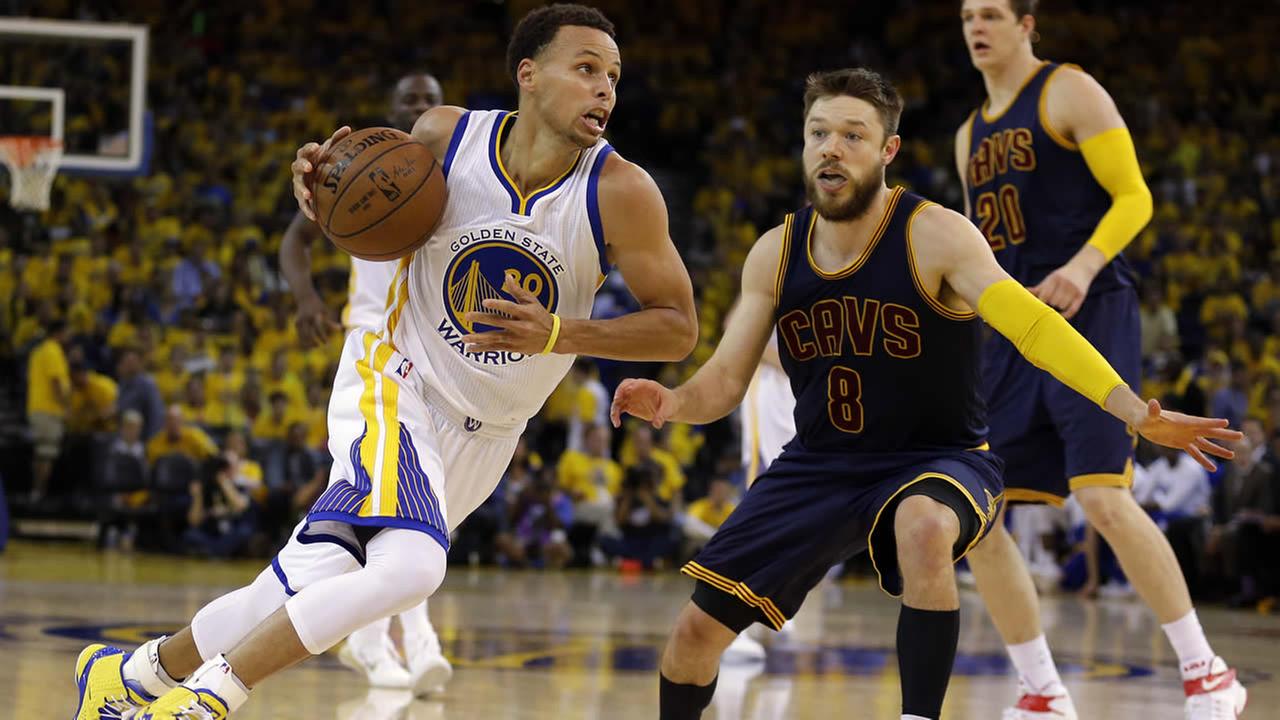
Lue adjusted by having the Cavs switch on everything, which incurred disastrous results as Kevin Love and Tristan Thompson were repeatedly switched onto Stephen Curry and Klay Thompson.  The two bigs have shown no indication that they can adequately guard either of those two on the ball, forcing Lue back to his original game plan early in the second quarter. After that, it was all Warriors.

Although Lue seems to be running out of options, there is one key change he can make to try and (literally) slow Golden State down.  After Kyrie Irving went down with a fractured kneecap in Game 1 of last year's Finals, David Blatt reconfigured the offense to feature LeBron James catching the ball in the high post and running iso-heavy sets through him.  Although the strategy had mixed results as James had a historically inefficient Finals on offense, it did slow the Warriors down enough to keep the series competitive for the next five games. Now would seem to be the best time for Lue to return to that, as his players have repeatedly blown assignments in transition that have either led to wide-open threes or defensive mismatches that the Warriors capitalized on immediately.

LeBron must be more assertive in Game 3 (CheatSheet.com)
It will be interesting to see what LeBron’s mindset is at the beginning of Game 3.  Although he finished Game 2 with 19 points and a near triple-double, it never felt like James was in attack mode.  He seemed focused on getting his teammates involved early, finishing the first quarter with no points and five assists.   If LeBron really is the “offensive coordinator” of the Cavs as claims to be, then it was clear he wanted to spoon feed Irving and Love to get them in an early rhythm.  

While the reasoning behind this makes sense--if Irving and Kevin Love get going early they will have more confidence at the end of games--the best thing for Cleveland might be for James to attack early and often.  The consummate team player throughout his career (often to a fault), LeBron might have to let the other All-Stars worry about getting their shots while he’s on the bench.  The most important thing for him looking ahead will be getting Andre Iguodala in foul trouble at the beginning of Game 3 by using the home atmosphere to get some calls that went against him in Game 2. 

Finally, the Cavs were also out-rebounded on both ends of the floor.  Coming into the series, that was supposed to be one of their biggest advantages over the Warriors.  That was not the case in Game 2, however, as Golden State annihilated Cleveland on the boards, 46-34.  If the Cavaliers are to have any shot at making this series competitive, they need to reverse this trend immediately.  

That seems unlikely to happen, however. As much of a toll as the OKC series took on the Warriors, it forced them to focus on both individual and team rebounding in a way they hadn't all season.  Their newfound dedication to improving that weakness has completely snuffed out any advantage that the Cavs had on the glass.  Andrew Bogut and Draymond Green were active in the early going, with Bogut doing a commendable job boxing out Tristan Thompson and keeping offensive chances alive by tapping them off the glass.  After having to deal with Steven Adams and Serge Ibaka for the last two weeks, Bogut and Green must feel like a baseball player swinging a bat without the weights on it.  Barring a major injury or divine intervention, it feels like the Warriors are going to cap off the best season of all-time with a ring.

Random Musings from Game Two

1.     LeBron’s Post Problems
a.      If it’s possible for the best player in the world to improve upon anything this offseason, it’s his postgame.  The King has done a masterful job of transitioning his game to being almost completely interior-based to accommodate the strengths of Love and Irving.  Although James is a mismatch against any small forward and most traditional fours, he still has a tendency to end his post-ups by finding himself underneath the basket with a crowd of people around him.  If he can start his post moves with more of a plan and sprinkle in some counters when he gets stopped initially, he should be the best back-to-the-basket player in the league.  That’s a scary thought for the rest of the Association, considering he’s already a supersized Blake Griffin in his current iteration. 

2.     The Curious Case of Harrison Barnes
a.      For as much as Harrison Barnes has struggled this year, he has found new life against Cleveland.  Lue has tried to hide J.R. Smith and Kyrie Irving on Barnes sporadically throughout the first two games without any success.  Barnes has done a great job exploiting Irving and Smith’s ball-watching tendencies by cutting for open looks close to the basket and driving to a spot that puts the defense at a disadvantage and opens up playmaking for his teammates.  Although Barnes struggles at creating his own shot and often seems to get in his own head, his smart play on both ends of the court show he is still a valuable asset for Golden State.

3.      Richard Jefferson’s Last Stand

a.      One Finals story that never gets old is that of the veteran role player, long past his glory days who knows this is his last real chance at a ring.  Jefferson is that guy this year.  He was ignominiously traded from Golden State in 2013 to clear up cap space fir Iguodala, his four year $39 million contract suddenly an albatross.  Although Jefferson is nowhere close to the player he was as an All-Star with the New Jersey Nets of the early 2000’s, he has aged gracefully as a backup small forward for these Cavaliers.  He was one of their few bright spots in Game 2, tallying 12 points and five rebounds in a throwback performance  Here’s to hoping to he’ll be able to continue that success as the series progresses.  

Wednesday, June 17, 2015

Warriors Win, LeBron Loses

Curry and the Warriors are flying high after winning the NBA Finals (SFGate)
Three games. That's how long it took the Golden State Warriors to figure out that they were the better team, and how to start playing like it. That's how long it took the Warriors, winners of 67 regular season games, to realize what they were up against: a 53-win team (from, it must be said, the weaker conference) without two of its three best players. That's how long it took Golden State to realize that they could pretty much let LeBron James do whatever he wanted, because in the end he simply didn't have the supporting cast needed to win a seven game series against the best team in the NBA.

The tide turned in Game 4, with the Warriors staring at an improbable 2-1 series deficit and faced with a must-win scenario in Cleveland. They came out and crushed the Cavs, winning by 21--the most lopsided game of the series. Aside from the first quarter and a few moments early in the third, Cleveland was never really in the game. Golden State quickly pulled away, both in the game and in the series.

Steve Kerr starting Andre Iguodala for the first time this season in Game 4 changed the entire dynamic of the series. Not only was he a force to be reckoned with on offense, scoring as many points (22) and draining as many threes (four) as MVP teammate Stephen Curry, but he also stifled James with his defense, limiting LeBron to 20 points on 7-of-22 shooting.

Freed from the bench, Iguodala re-emerged as the two-way force he was during his 76ers days. The former point-forward led the team in minutes in Game 5, stuffing the box score with 14 points, 8 rebounds, 7 assists (a team-high), and three steals (also a team-high), helping Golden State to a 104-91 victory. He was at it again in last night's series-clincher, dropping a team-high 25 points while chipping in five rebounds and assists along with two steals. Fittingly, Iggy was named Finals MVP for helping Golden State get over the hump, even if he couldn't hit a free throw to save his life.

The award just as easily could have gone to Curry, though, who averaged 26 points, 6.3 assists, and 5.2 boards per game. He never seemed to tire despite averaging over 42 minutes a night, logging just 20 fewer than LeBron over the course of the series. Curry was a true warrior, fighting his way through double teams, mesmerizing Cleveland's defense with his remarkable ball-handling skills, and coming up with big shots when he needed to. After earning his fair share of criticism for struggling with his shot early in the series, he bounced back to provide MVP-level production and lead his team to the promised land.
James did all he could, but in the end it wasn't enough (Yahoo Sports)
In reality, the true MVP of this year's NBA Finals did not play a single minute for the Warriors. Disregarding wins and losses, LeBron James was far and away the most valuable player of this series. He averaged close to 46 minutes per game, which is almost unfathomable. He outscored Curry by nearly 60 points--roughly 10 per game--while also leading both sides in rebounds and assists. James's performance was nothing short of legendary, and yet it wasn't nearly enough.

One has to wonder how the series would have played out had Kyrie Irving and Kevin Love both been healthy. At the very least, their presence would have relieved some of the massive burden placed upon LeBron's broad shoulders. The series probably would have gone seven games. Cleveland could have won.

But without them, the Cavs never stood a chance. No matter how well James played, it was never going to be enough. He's only one guy, after all, and one mortal being can only do so much. His ragtag supporting cast immediately brought to mind memories of the last and only other time Cleveland made the finals, when a 22 year-old James dragged them there in 2007, only to be squashed by the Spurs in four games. James has changed a lot since then--he has matured by eight years and is infinitely more comfortable on the game's greatest stage--but the rest of the Cavs proved just as useless.

To his credit, or perhaps to his detriment, James kept them involved throughout the entire series. He trusted them the same way he'd trusted Dwyane Wade and Chris Bosh in Miami, feeding them for open looks and giving them every opportunity to contribute.

Problem is, James Jones, Iman Shumpert, and Josh Smith are not Wade, Bosh, and Ray Allen. I wouldn't trust those guys with a 20 point lead during the regular season, let alone in crunch time during the freaking NBA finals.

But James seemed not to notice nor care just how incompetent his teammates were. He kept dishing them the rock, almost instinctually, often passing up good looks close to the rim to hit them for open shots on the perimeter. More often that not, they bricked those shots, which is why there won't be a Game 7 tomorrow night. James executed, but the rest of his team did not.

LeBron's selflessness has always been a double-edged sword for him, at once his greatest asset and undoing. Nobody with LeBron's size and scoring ability should be able to pass like he does, always finding his teammates with laser passes in the most unbelievable of places, like he has eyes in the back of his head. It's his Steve Nash-esque court vision that makes him a cut above the Kevin Durants and Kobe Bryants of the world. He has the eyes of a point guard in the body of a bulldozer.

It was obvious from the start, however, that Cleveland wasn't going to win this series with LeBron playing the role of facilitator. The Cavs were only going to win if James took over and averaged 40+ points a night. With his supporting cast reduced to ashes, LeBron needed to adopt the Kobe Bryant mentality for this series, the give-me-the-damn-ball-and-get-the-hell-out-my-way mindset. If he truly is the greatest player in the world, which this series proved he is, then he needed not just to play like it, but to act like it. He needed to get mean. He needed to be selfish.

LeBron may be able to do that for spurts, but he has proved incapable of doing that for prolonged stretches. He is too nice, too trusting of his teammates. He's hardwired to pass the basketball, to get it into the hands of open comrades. He shares too much. He's too generous.

It's also hard to be a killer when you run out of gas, as James and his teammates clearly did. He missed six of his last nine shot attempts last night and was a non-factor in the frantic final two minutes, when Josh Smith, of all people, nearly willed Cleveland back into the game with a barrage of unlikely threes. James, passive and exhausted, seemed to quit when his team needed him most, settling for lazy jumpers rather than attacking the hoop with his customary ferocity. He played to the score rather than the clock, and in the end it might have cost the Cavs the game.

When the chips were down and all hope seemed lost, LeBron reverted into the passive, gun-shy, scared little kid who disappears during the game's critical moments, like he's melted right into the court. There one minute, gone the next. Poof.

I'm hesitant to criticize James too much because he really gave it his all in his series. Without his heroic performances, the Cavs would've been swept. A lot of people seem to think they wouldn't have even made the playoffs without him, which I don't necessarily buy (if the Celtics and Nets could make the playoffs, then a team with two legit superstars definitely could, especially in the East) but still see their point. James single-handedly made this series interesting, even if he couldn't carry his team to the finish line. He played his heart out.

If only he'd had some help.

Tuesday, April 7, 2015

Celtics Must Finish Strong

Against all odds, the Celtics are one the brink of a playoff berth (MassLive)
I don't want to jinx it, but the Boston Celtics are almost there. The regular season ends one week from tomorrow, and when it does Boston might be playoff-bound.

In order to hold onto the 8th seed, however, the Celtics have to close out the year strong. They currently hold a one game lead over the Indiana Pacers, who just got Paul George back from the nasty leg injury he suffered last August. There is no margin for error.

Boston's schedule isn't exactly a cakewalk, either. They play the Pistons in Detroit tomorrow, then the Cavs in another road game Friday. They return home to face Cleveland again on Sunday, play their final home game versus the Raptors Tuesday, then fly out to Milwaukee to wrap up their season against the Bucks.

That's five games in eight days against some pretty good teams, not to mention thousands of miles of travel. The Pistons are one loss away from being eliminated, but they're not dead yet so you can bet they'll put up a fight tomorrow. The Cavs are settled in as the number two seed, so they don't have much to play for, but they're still a much better basketball team than the Celtics what with LeBron James, Kevin Love, and co. Cleveland's also red-hot, having won eight of their last ten games. The best Boston could hope to do would be to top Detroit, then earn a split with Cleveland.

The Raptors are still vying with the Bulls for the third seed/trying to avoid letting the Wizards knock them out of the fourth seed, but at least the Celtics will have home court advantage for that one. Then it's on to Milwaukee, which could be a must-win for Boston depending on how the next week plays out. Let's hope it isn't, because winning the second game of a back-to-back on the road after flying 1,000 miles is going to be damn-near impossible. The Bucks will have probably locked up their own playoff berth by then, but if not then that game is going to be a knockdown, dragged out fight to the death.

If Boston can go 2-3 over the next week, then that should be good enough to put them in the playoffs. because even with George back, the Pacers probably aren't going to win four out of five. The easiest way for the Celtics to do that is to beat Detroit tomorrow night and steal Sunday's game from the Cavs, as Cleveland could be resting regulars on the road. If not, they might have to wait until the season finale to clinch, which hopefully doesn't happen. Boston's been on such a tear recently--19-12 since February 2nd--that I don't think it will.

The Celtics are so close to making the playoffs that I can taste it. Now they just need to finish the job.

Wednesday, February 25, 2015

Will the Hornets Make the Playoffs?

This article was contributed by friend of the think tank Robert Simms:

The Hornets currently sit in the 9th spot in the Eastern Conference, tied with the Detroit Pistons and the Indiana Pacers. The three teams are currently just a single game back of the Brooklyn Nets, who at 23-31, currently hold possession of the 8th and final playoff spot in the East. With only 28 games left, the Hornets have an uphill battle ahead of them if they hope to claim that spot. Charlotte made the playoffs last year as the 7th seed, earning themselves a first round drubbing at the hands of LeBron James and the final iteration of the Big Three Era Miami Heat. Though the Hornets (at the time still the Bobcats) were swept in that series, the organization and the fan base entered this season with higher expectations.

The team had an established star in Al Jefferson, a blossoming franchise point guard in Kemba Walker, and talented young players on rookie contracts who seemed poised to make mini-leaps in Cody Zeller and Michael Kidd-Gilchrist. The team even made a splash in free agency, signing versatile wing Lance Stephenson away from the Pacers for what seemed a fair market price. The season has not panned out as expected, to say the least. Jefferson has looked old, Walker has been banged up, and the Stephenson experiment has been something of a disaster. The youngsters have not produced as hoped, and rookie first round pick Noah Vonleh has barely seen the court, having taken on 26 shots all season.

In what is his 11th season in the league, it seems possible that Jefferson’s age may have finally caught up to him, even though he is still miraculously only 30 years old. His scoring and rebounding have both undergone significant declines; Big Al has gone from a legit 20 point-10 rebound guy last season to barely breaking 17-8 this year. The diminished stats coincide with a dip in both minutes and field goal percentages. As his playing time and effectiveness shrink, I fear we may be seeing one of the last star quality seasons of Big Al’s career. As Jefferson’s role has receded, one would hope that Walker, Charlotte’s other star, has risen to assume a larger role. 

This has not been the case. Walker has battled multiple nagging injuries this season that have kept him out of a dozen games, and though his scoring is up a bit this year, his assist and rebound numbers have both fallen off slightly after he set career highs in both last season. Walker is a nice player; an explosive slasher with a quick first step and a terrific step back jumper who so far seems to have lived up to the “clutch” reputation that followed his college heroics. But he can’t do it on his own. Walker can create shots for himself, but these shots are often inefficient mid-range jumpers, shots that he does not hit at a high enough rate to justify taking. He is a below average three point shooter, a fact that opponents clearly make note of when they slough off Walker to prevent his dribble drives. His limited stature (listed at a generous 6’1”) hurts him in the paint, where he struggles to finish at an above-average level.

It is unfair to lump the Hornets offensive struggles entirely on Walker though because he really has done a serviceable job with the mediocre cards he has been dealt. Much of the blame can be directed towards the team’s general manager, Rich Cho, who has created one of the weirder teams in the league through a variety of puzzling personnel moves. For one, he has illogically surrounded Jefferson with non-shooters. Despite his dip in productivity, Jefferson is still the centerpiece of Charlotte’s offense. He is a post-up beast who scores well in isolations and thus frequently garners double teams that draw defenders away from their perimeter assignments. Big Al can pass fairly well out of these double teams, but a common result of these passes this season have been missed outside jumpers. That’s because none of the team’s perimeter players can effectively and efficiently shoot threes.

Of Hornets players who have played over 10 minutes per game this season, only Jeff Taylor, a seldom used wing player, is shooting above league average from deep. Unsurprisingly, the team is last in the league in three point FG%. This inability to shoot from range allows defenders to slough away from their assignments and sag towards the middle of the floor, where they can disrupt post-ups by Jefferson and crowd against Walker’s probing drives. In doing so, teams have been able to absolutely smother the Hornets half-court scoring this season. The Hornets offense currently ranks 29th in points per 100 possessions and ranks dead last in Effective Field Goal percentage, a statistic that takes into account the increased point value of a three point shot. Charlotte’s offense has been so dismal this year that despite having the 8th ranked defense in terms of points allowed per 100 possessions, the team’s net rating is still negative.

All is not lost for the team’s playoff hopes though. Of the Hornets’ remaining schedule, only 12 games are home. The remaining 16 are on the road, where the Hornets are 9-16 so far this season. This looks grisly, but is actually an easier slate than their competitors face. Each of the Pistons, Pacers, and Nets all have 10 or fewer home games remaining. If the Hornets can tread water at .500 or a bit above, they should be able to secure the 8 seed. The next two week stretch will be crucial. They are scheduled to face Boston, Orlando, LA (Lakers), Brooklyn, Toronto, and Detroit. If the Hornets can go 5-1 (or more realistically 4-2) against that sheet, with victories against Brooklyn and Detroit, they could set themselves up in the driver’s seat for the remainder of the season. Note also that of their remaining 28 games, only 11 are against teams with winning records. 11. They get the Celtics, Nets, and Kings twice, while drawing the Pistons three times. That is not too tough of a road.

The Hornets entered the year with expectations of surpassing their playoff progress from last season. Though the East is still the minor leagues compared to the grueling Western Conference, several playoff teams from the East have taken steps forward over the past year. Chicago, Atlanta, Toronto and Washington have all upgraded their rosters, not to mention the radical transformation that occurred in Cleveland. With the improvement of their playoff peers from a year ago, it comes as no surprise that the Hornets are still an incomplete team. I think the best case scenario for the Hornets would be to capture the 8 seed and to hopefully avoid a sweep at the hands of the Hawks, current holders of the league’s best record. With that in mind, the team might be better served going the way of Philadelphia and tanking for a better draft pick.

*All stats per nba.com and espn.com

Monday, July 7, 2014

What Does Detroit Do With Josh Smith?

Smith is a talent, but a frustrating and expensive one at that (CBSSports)
The following article was contributed by Robert Simms:

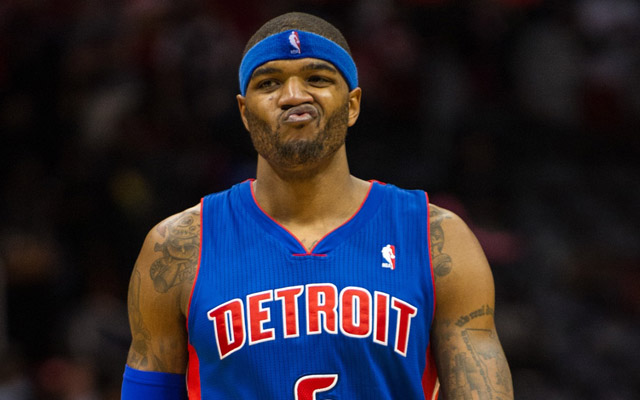
There is a team in Detroit that is unhappy with one of their big men. That team of course is the Pistons, and that big man in question is forward Josh Smith, a stretch power forward who refuses to accept that he is not a wing player. Smith is an incredible athlete who could flourish in the right system, if last season serves as any indication of the future then Detroit is not the right system.

It was almost a year ago to the day that the Pistons signed Smith to a large near-max contract by Detroit's then-GM Joe Dumars. The organization almost immediately regretted the deal, a four-year, $56 million dollar gamble in a player who had never made an All-Star team. The vision Dumars had in mind when he signed Smith was to play bully-ball in a league infatuated with going small. He believed the triumvirate of Smith, Andre Drummond, and Greg Monroe would pound teams down low and dominate the glass. What he failed to account for, however, was the utter lack of spacing that would exist when the three bigs played together.

The entire league knows that Josh Smith can’t shoot. The only person who doesn’t know that is Josh Smith. After improving his shot selection his last few years in Atlanta, Smith regressed to his old habits his first year in Detroit, taking over a fifth of his shots from beyond three point range while making only 26.4% of them. That is atrociously inefficient basketball. In the past five seasons, there is only one player who has shot more than 250 threes in a season while making less than 27% of them, and that player was Josh Smith this past year. Ew. When Smith plays small forward alongside Drummond and Monroe, his defender consistently sinks off him towards the paint, crowding the airspace of Drummond and Monroe.  

In other words, when Smith plays on the perimeter with two traditional, non-shooting big men, he is a liability. Smith spent most of this season in Detroit as a perimeter player and finished with an Offensive Win Shares rating of -1.4. That means that Smith’s offense took away 1.4 wins from his team. I mean, any time you can pay a guy $13.5 million to make your team worse, you have to do it right? When the three big men were on the court together, the Pistons’ offense sputtered and their defense was even worse. It should come as no surprise that Joe Dumars is no longer with the Pistons.

Though he is a terrible outside shooter, when Smith plays close to the rim he performs at near elite levels. Smith shot 71% from within three feet of the hoop last year, a rate up near LeBron James territory. However, in order to get Smith down low he needs to be playing power forward. Smith doesn’t have the body of a traditional 4, but his athleticism gives him mismatches against the larger, slower nominal power forwards who guard him. Smith has the size and strength to battle with most big men (Zach Randolph types are the exception) while also possessing the quickness and agility to score around them. This athleticism is largely wasted at small forward though, since it is hard to blow by a defender slacked six feet away. For Smith to be effective, he can’t be on the wing. He absolutely needs to play power forward.

Unfortunately for him, that is something the Pistons do not need right now. Detroit’s new head coach, Stan Van Gundy, has publicly stated that he thinks Drummond and Monroe are an “ideal pairing” and is seeking to give the two more minutes together. Van Gundy also stated that Smith would be playing primarily power forward this coming season in order to maximize his strong inside game. If Drummond and Monroe play the same number of minutes as they did last year, Smith is left with less than 30 at power forward after accounting for the minutes Detroit’s other bigs will play. Smith is far too proud (and talented) to play less than 30 minutes a night, considering he hasn’t averaged less than 32 minutes per contest since his rookie year. 

This leaves the Pistons with a few choices. They could bite the bullet and play Smith at small forward, but that is a doomed strategy they know doesn’t work. They could increase Smith’s minutes at power forward at the expense of Monroe and Drummond’s playing time but the organization is committed to developing them and would be reluctant to cut their minutes. A third option (and in my opinion the smartest) would be to trade Smith. 

One year after signing with Detroit, Smith appears to be odd man out (RantSports)
The Pistons have been open about their desire to deal Smith, but so far no trades have happened. ESPN’s Marc Stein reported that the Pistons were in talks with Sacramento regarding the Kings sending a package including Derrick Williams and Jason Thompson in exchange for Smith. Thankfully for the Kings, these talks have died down. Pairing the volatile Smith with consistently grumpy DeMarcus Cousins would ruin any chemistry the Kings built last season. Not to mention, a starting front court of Rudy Gay, Smith, and Cousins would have spacing nearly as bad as Detroit’s.

The Pistons are allegedly not asking for much in exchange for Smith, but teams around the league are loath to take on his gargantuan contract. A team that might consider doing so would be the Love-less Boston Celtics. After failing to trade for the Timberwolves’ Kevin Love, the rebuilding Celtics find themselves with a ton of assets but no real talent and appear to be headed for another sub-par season. During the season, NBC Sports’ Dan Feldman floated the idea of the Celtics sending Gerald Wallace and Jeff Green in exchange for Smith. Though that deal seemed reasonable at the time, I think the Celtics could get Smith for cheaper than that, especially since Smith would definitely cause a stink were he to be brought off the bench behind Drummond and Monroe, a strategy Van Gundy would likely employ.

If Boston offers Detroit a trade package of Gerald Wallace, Jared Sullinger, and Jared Sullinger’s ass, who says no? Detroit would be out from underneath Smith’s albatross of a contract and the Celtics would receive a top ten power forward to unite with star point guard Rajon Rondo. Wallace’s contract is almost as undesirable as Smith’s, but it becomes an expiring contract after this season and the Celtics would certainly have to include it in the trade in order to accommodate Smith’s deal and remain under the cap. Sullinger is young and Boston likes him, but he is nowhere near the athlete Smith is and never will be. This deal could happen tomorrow and both teams would be improved.

It also helps that Smith and Rondo have expressed a strong desire to play together. The two were teammates in high school at Oak Hill Academy in Virginia and have remained close friends. Though both players have proven troublesome to coaches in the past, the pair’s friendship might keep them both grounded. A starting five of Rondo, Avery Bradley, Jeff Green, Smith, and Kelly Olynyk might be enough for the Celtics to compete for a playoff spot in the decrepit East.

This deal won’t happen of course, and that is because Celtics’ GM Danny Ainge –along with most other GMs in the league-- understands that Josh Smith is a broken player. Smith can’t shoot but for some reason refuses to stop. Were a coach to hypnotize Smith into finally believing he is a post player, he would be great. But $13.5 million a year is far too expensive a price tag for someone who might only be great under hypnosis. Ainge is too smart for that. Fortunately for Detroit, there are dumber GM’s out there but in all likelihood, Detroit will end up stuck with Smith.

This will lead them to consider dealing a different one of their three bigs: Monroe. He has much more appeal around the league and is signed to a much more reasonable deal. Monroe is in the last year of a deal that will pay him around $5.4 million this year, a number that is well worth it for a quality center. Monroe has stated that he wants the max but Detroit doesn’t have the resources to retain him on a big deal, especially since they are expected to give Drummond a huge contract extension soon. There has been a consensus around that league that Monroe is not worth the full max either. I would bet he ends up getting something in the neighborhood of 5 years, $70 million, a deal that would pay him slightly more than the Wizards just agreed to pay Marcin Gortat.

There are many teams around the league in need of a quality center like Monroe, but GMs are wary of taking on a player in the last year of a contract for fear he might bolt at the end of the season. A solution here for both sides could be executing a sign-and-trade. Detroit could sign Monroe to a deal and then promptly swap him to one of his many potential suitors. In exchange, the Pistons would probably expect quality wing help and maybe a pick or two. Atlanta, Orlando, and Portland are the three teams that have expressed the strongest interest in acquiring Monroe, again according to ESPN’s Marc Stein. 

Orlando makes sense. The Magic could use a reliable big man to pair with Nikola Vucevic and they have assets they could send to Detroit. Portland and Atlanta are a bit trickier to understand. Both teams already have solid centers that fit well within their systems in Robin Lopez and Al Horford. Adding a guy like Monroe to the mix would leave them with too many cooks in their proverbial kitchens, but sending one of their current centers back to Detroit would leave the Pistons in the same predicament they are already in.

The Pistons were not very good last year, and unless they sort out their frontcourt issues they are not going to be very good this year either. Van Gundy is a sharp basketball mind, but he won’t solve Detroit's issues on his own. He’ll need help from around the league because if Smith and Monroe both stay put this season, the Pistons will be hard pressed to improve. But Van Gundy's a smart man, and I'd wager a bet that he has something up his sleeve.

Sunday, June 29, 2014

Is Vince Carter Hall of Fame Worthy?

Carter's had his ups and downs, but few have reached the heights he has (ABC)
The first of hopefully many articles contributed by Robert Simms, a new writer for SB Nation's Celtics Blog:
When people think of Vincent Lamar Carter, they tend to think of one thing: dunking. This is justifiably so. Carter is widely regarded as one of the best in-game dunkers of all time. His performance in the 2000 NBA All-Star Dunk Contest is the stuff of legend and his monstrous slam over 7’2" French center Frederic Weis in the 2000 Summer Olympics is remembered as "le dunk de la mort", the dunk of death, by the French media. 
But Carter does not deserved to be remembered solely as a dunker. That is a legacy better reserved for high-flying specialists like the Suns' Gerald Green. Vince Carter deserves to be remembered in a way befitting someone as accomplished as he is. Vince Carter deserves to be remembered as a Hall of Fame player.
Carter’s NBA career began in 1998 with a draft day trade that sent him from the Golden State Warriors to the Toronto Raptors in exchange for college teammate and close friend Antawn Jamison. The Raptors were a fledgling franchise and, like most expansion teams, they struggled in their first few years. Carter, along with cousin Tracy McGrady, instantly changed this. Carter followed up his 1999 Rookie of the Year campaign by making the All-Star team in 2000 and leading the Raptors to their first-ever playoff berth. 
Carter and McGrady were the stars of that team, but veteran big man Charles Oakley was the backbone. Though Oakley's level of play slipped as he aged, his presence provided vital emotional leadership for a young Raptors team. Both Carter and McGrady have stated that Oakley’s mature veteran guidance had a huge impact on their developments in the league. 
After suffering a 3-0 sweep at the hands of the Knicks in the first round of the 2000 playoffs, the Raptors conducted a sign-and-trade deal that sent McGrady to Orlando, separating the pair of talented wing scorers. And yet, the ensuing 2001 season turned out to be a success for the Raptors, as they won the Atlantic Division with a franchise-record 47 wins. After beating the Knicks in the first round of the 2001 playoffs –revenging their loss from the prior season—the Raptors faced off against the eventual Finals runners-up Philadelphia 76ers.
Carter starred in the series--a seven game gem--taking center stage against Sixers point guard Allen Iverson. Carter performed impressively in his first trip to the Conference Semis, averaging over 30 points, 6 rebounds, and 5 assists per contest, including a 50 point effort in Game 3. Unfortunately, Iverson dropped two 50 point games of his own in the series and the Sixers ultimately escaped Game 7 with a victory after Carter missed a go-ahead jumper with two seconds remaining. Despite the loss, the season was not a disappointment for the Raptors organization, who saw a bright future ahead.
Carter is now booed whenever he returns to the Air Canada Center, largely because of his behavior and performance in the seasons following that Game 7 loss to the Sixers. When Charles Oakley left in the 2001 offseason, Carter lost his mentor and the Raptors lost a veteran presence capable of keeping their young star grounded. Frustrated by a perceived (and perhaps real) lack of ambition in Toronto's front office, Carter’s production suffered over the coming years. Carter’s camp will point out that much of the dip in production can be attributed to injuries, and to an extent they are correct. But many of Carter’s ailments were fictitious and even the legitimate ones were often drawn out. Carter’s milking of small injuries is reminiscent of the way Manny Ramirez used to remove himself from lineups for phantom infirmities during his days with the Boston Red Sox. 
Carter’s lack of effort is not justifiable, but his frustration is certainly explainable. After a few consecutive terrible seasons, team president Richard Peddie cleaned house and hired Sam Mitchell as the Raptors’ new head coach and Rob Babcock as the new GM. Babcock quickly expressed his interest in rebuilding the team, slowly. He publicly stated that the team was "not worried about how many wins we get right away, or whether we make the playoffs within the first year or two." 
For someone accustomed to winning like Carter, this was bad news. He had already endured multiple seasons in the basement of the Eastern Conference and was not interested in remaining there much longer. Carter’s negative attitude put a stink on the whole team, resulting in frequent fourth quarter benchings. With his discontentment abundantly clear to team management, Carter was traded to the New Jersey Nets.
Carter had an instant impact for his new team and returned to his All-Star level of play as he entered the prime of his career. In his five seasons with New Jersey, Carter averaged just under 24, 6, and 5 per game. These Nets teams starred the memorable trio of Carter, Jason Kidd, and Richard Jefferson and made the playoffs in each of Carter's first three seasons there. After getting knocked out of the 2007 playoffs by the eventual runners-up Cavaliers, the Nets traded Jason Kidd midway through the 2008 season, finishing under .500 that year and the next. Carter was also dealt--to the Orlando Magic--in a move that effectively ended his days as a superstar player. Carter had a few forgettable seasons in Orlando and then Phoenix before finally settling in Dallas, missing their 2011 title over LeBron James, Dwyane Wade and Chris Bosh by one year. It is Dallas where he has reinvented himself as a role player, making use of his still excellent three-point range to contribute off the bench. 
While no longer a star, Carter remains a key contributor for the Dallas Mavs (FoxSports)
In many ways, Carter has had a prototypical Hall of Fame level career. Following impressive high school and college years, he immediately proved his worth in the pros. From there he quickly grew to become a franchise player, earning several All-Star nods and making a pair of All-NBA squads. Towards the tail end of his career he morphed from a star into a quality role player where he has served as a valuable veteran scorer and contributed some big playoff moments (such as his game-winning three against San Antonio in the first round this year). Carter has had a definitive career arc filled with enough substance to earn a spot in the Hall of Fame.
Some of you might be asking me to pump the breaks here, but if you look at the full body of Carter’s career, you might be surprised by how impressive it is. For instance, did you know that Carter is 25th on the NBA’s all-time scoring list? He has scored more points than several legendary Hall of Fame scorers like Larry Bird, Clyde Drexler, Bernard King and Elgin Baylor. Assuming he plays two more seasons, it is conceivable that Carter could finish his career as high as 23rd on the list, just ahead of Charles Barkley. Realistically, he’ll end up 24th because it’s a safe bet that LeBron James will pass him during the coming season. Looking at it another way, Carter was the 27th player in league history to reach 23,000 points. Every other player that has accomplished that feat is either already in the Hall or is a lock to get in once eligible. 
23,000 points?! That’s a lot of dunks! Well, yes and no. While it’s true that Carter is known primarily for his action above the rim, he is also one of the league’s most prolific long distance shooters, ranking seventh all-time in three pointers made. By now it should be pretty clear that Vince Carter was a scoring machine who scored, well, a lot. And I mean A LOT.
Carter’s first ten years in the league compare favorably with the first decades of other Hall of Famers. Here are the stat lines for four players through their first ten seasons in the league:
Player A: 751 games played, 23.1 ppg, 4.3 rpg, 3.9 apg, 1.6 stocks, .463/.399/.845 shooting splits
Player B: 758 games played, 20.9 ppg, 6.1 rpg, 5.8 apg, 2.8 stocks, .485/.285/.787 shooting splits
Player C: 697 games played, 23.8 ppg, 5.5 rpg, 4.2 apg, 2.1 stocks, .447/.375/.794 shooting splits
Player D: 707 games played, 23.9 ppg, 5.1 rpg, 4.5 apg, 2.1 stocks*, .451/.336/.834 shooting splits
*stocks = steals per game + blocks per game
The numbers look pretty similar, don’t they? Player A is Mitch Richmond, the high scoring shooting guard who was just inducted into the Hall of Fame. Player B is Clyde Drexler, another Hall of Fame wing scorer and notable member of the 1992 Olympic Dream Team. Player C is Vince Carter. Notice how similar his numbers are to the others listed here, Player D in particular. Much like Carter, Player D was also renowned as an explosive offensive force gifted with incredible dunking ability. Likewise, Player D also contributed to the souring of a locker room environment and essentially forced a trade to another team towards the end of his first decade in the league.á¶Ÿ Player D also milked injuries during times when his team had a down year. 
Player D, believe it or not, is Kobe Bryant. Though Kobe’s career has certainly been more successful than Carter’s overall, their careers after one decade in the league are nearly identical statistically. In the second half of their careers, Kobe has vastly outperformed Carter, but so what? A poor man’s Kobe Bryant is still a Hall-worthy player. And that’s exactly what Vince is. A little less hard-working, a little less competitive, and a little less talented (arguably a little less moody as well). 
I’m going to remember Vinsanity’s dunking for the rest of my life. One transcendent skill does not a Hall of Famer make, (see: Gerald Green) but when that skill is complemented by a worthy career, the player’s chances of entry to the Hall should be high. If Ray Allen were merely a three point shooter, would he be in the discussion? Probably not. If Dirk only had his midrange game, would he be? Unlikely. The same applies to Vince. Were he only a dunker, he would not be worth discussing. But Vince was not only a dunker. Vince was a star. A star that just happened to shine brightest above the rim.
All stats courtesy of BasketballReference

Sunday, June 15, 2014

Spurs Hammer Heat

The Spurs wrote the latest chapter of their dynasty by beating the Heat in five
There will be no three-peat for the Miami Heat. For the fifth time since 1999 but first since 2007, the San Antonio Spurs are NBA champions.

I said it three years ago when the Mavs brought down the Heat, so I might as well say it again: all is right with the world.

It only took five games for the Spurs to dispatch their star-studded opponents, who appeared thoroughly overmatched in the final three games of this series. The Heat barely put up a fight, losing by 19 and 21 on their home court, then getting blown out of the AT&T Center in a must-win Game 5. They were steamrolled by Greg Poppovich's finely tuned machine, which was firing on all cylinders and outplayed Miami in every aspect. San Antonio had the edge in rebounding, passing, defense, outside shooting, post play, and depth. Top to bottom, the Spurs were the superior team, and it showed.

It was evident during the regular season, when they won 62 games and had the NBA's best record. It was confirmed throughout the postseason, as San Antonio outlasted Dallas in seven games, then Portland in five, and finally OKC in six to earn another trip back to the NBA Finals, where they were defeated by Miami in seven games last year after blowing a five point lead late in Game 6, the basketball equivalent of Mookie Wilson's grounder scooting through Bill Buckner's legs.

It took the Red Sox 18 years to get back to the World Series after Buckner's gaffe. It only took the Spurs one year. Motivated by their soul-crushing defeat, they stormed back for retribution and redemption, hushing any whispers of decline and closing championship windows along the way. San Antonio possessed the drive, desire, and determination necessary to survive a grueling regular season and two-month postseason, asserting their dominance at every turn.

Which is not to say Miami wasn't driven to three-peat, something that hasn't been done since Phil Jackson coached the Shaquille O'Neal and Kobe Bryant Lakers to three straight titles from 2000-2002. But the Heat clearly coasted during the regular season, winning eight fewer games than the Spurs and settling for the second seed in the East, biding their time until the postseason rolled around. Sure enough, they kicked it into high gear once the playoffs started, sweeping Charlotte, breaking Brooklyn in five and edging out Indiana in six. The Heat seemed to be hitting their stride at the perfect time and were favored to win their rematch with the Spurs, even though San Antonio had home court advantage*.

Speaking of home court advantage, Miami did not lose a playoff game on their home court this year until the Spurs came to town and blasted them by 40 points in the two games combined. So much for that.

The most shocking outcome of this series was that Miami was outscored by 76 points in the five games (15.2 per game, including their Game 2 win). I can't imagine anyone saw San Antonio's aging Big Three outplaying Miami's Big Three to such a degree. Tim Duncan, Manu Ginobili and Tony Parker were all at the top of their games. LeBron James, cramps aside, was the best player in this series (as expected), but Dwyane Wade crapped the bed and Chris Bosh was merely good. All too often it felt as though James was taking on the entire Spurs team by himself, and as great as James is he proved with the Cavs that he's incapable of winning a championship without help. Nobody can.

But what really doomed the Heat was the stellar play of Kawhi Leonard and the Spurs' complementary players. The Finals MVP obviously had an exceptional series on both ends of the court, but he had plenty of (somewhat unexpected) help from the likes of Patty Mills, Danny Green, and Boris Diaw. The Spurs gelled, and it was truly magnificent to watch. Nobody seemed afraid of the moment and everyone stepped up when needed.

The Heat, however, received no such heroics from their own role players: Norris Cole, Mario Chalmers, Rashard Lewis, and Chris Andersen were nonfactors for most of the series. Ray Allen hit plenty of shots, but not enough to sway the final outcome. San Antonio's depth was too much for Miami to handle, and so the Heat were done in by their dearth of quality options off the bench. Say what you want about Erik Spoelstra's coaching ability, but he was outgunned and outmanned in these finals.

So when the Spurs executed as flawlessly as they did and played great basketball for long stretches of time, the Heat couldn't compete. Their flaws--poor interior defense, iffy outside shooting, lack of depth--were exposed and, as the lopsided scores of Games 3, 4, and 5 indicated, became painfully obvious. From the start of the season to the end of it, San Antonio was the better team. And, as is so often the case in team sports, the better team won.

Friday, June 13, 2014

D-Wade: the NBA's Derek Jeter

If the Heat lose, it will be Wade's fault, not LeBron's
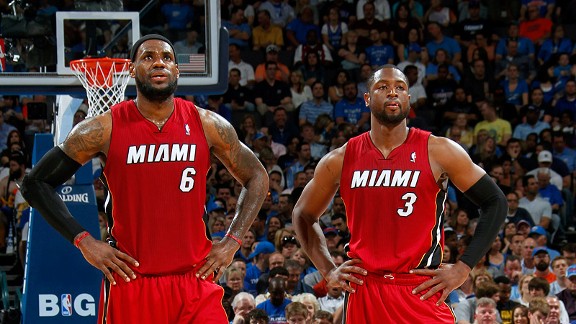
The more I think about it, the more I believe the dynamic/relationship between LeBron James and Dwyane Wade is the basketball version of the one between Alex Rodriguez and Derek Jeter.

I already knew that LeBron shares a lot in common with A-Rod, but I hadn't thought about how much Wade shared with Jeter.

Wade, like Jeter, was a winner before their more talented teammates decided they wanted out from their mediocre Midwestern franchises and wanted a ring. Jeter and Wade were already established stars and proven winners. Both were captains of their respective teams, and were approximately the same ages when their new teammates arrived. Wade was 28, Jeter was 29, both slightly older than LeBron and Rodriguez (Jeter has more than a year on A-Rod, while Wade has nearly two on LeBron).

It had been four years since the Heat had last been champions, and four years since the Yankees were World Series champions. Wade, who was drafted the same year as LeBron and debuted the same year (2003), had seen his career overlap perfectly with LeBron's. Both were high first round picks, with A-Rod and LeBron going first and Wade taken fifth/Jeter sixth. Jeter's breakout season--1996 when he won AL Rookie of the Year--paralleled A-Rod's breakout/MVP runner-up, and both had been stars ever since.

While LeBron took his game to another level with the Heat, improving his post moves as well as his three-point shot, Wade remained essentially the same player. He never bothered to add the three-point shot to his arsenal, even though it would have made him and his team much better. Wade, apparently not driven to be the best player he can be, decided he could live with his flaws and so has remained a league average free throw shooter and a subpar three-point shooter. A shooting guard who wasn't a particularly good shooter.

While Rodriguez effortlessly learned a new, demanding position, Jeter maintained the status quo. He did not move to third so that Rodriguez could play shortstop, even though that would have been the best for the team. He did not improve his power stroke, cut down on his strikeouts, take more walks or steal more bases. His defense, always his greatest flaw, remained so. He did make a concerted effort to improve his defensive positioning late in his career, but by then his range and arm strength had diminished too much to make much of a difference. Forget his Gold Gloves; Jeter rates as the worst defensive shortstop in baseball history.

The irony is that even though Wade and Jeter were clearly less talented and contributed less to their teams' successes than James and Rodriguez, both were able to avoid or deflect most of the flak whenever things turned sour. For instance, when the Heat fell to the Mavs in 2011 and when they inevitably lose to the Spurs in the next few days, much of the blame was placed on LeBron's shoulders. He was ripped as a passive, unclutch choker while Wade, because he was a lesser player, coasted. Even though Miami's stars and scrubs structure dictates that Wade plays well in order to win, he has never caught as much heat as LeBron has (which I suspect is related to Wade being less visible and more likable). Wade defers to LeBron, and so when the game is on the line it's usually James's to win or lose. Wade can throw up a stinker like he did last night, and all anyone's going to remember about this series is how LeBron cramped up in Game 1.

Ditto Jeter, who's always walked on water in New York and has always been above criticism there. Nobody blamed him when the Yankees choked to the Red Sox, even though Jeter batted a measly .200/.333/.233 in that series with just one extra base hit (a double). People looked the other way in 2007 when he hit into as many double plays (3) as base knocks against the Indians in the ALCS. No one said a word in 2010 or 2011, when he batted .250 in both postseasons with sub-.290 OBPs in each and a combined .344 slugging percentage. Has there ever been any mention of the fact that Jeter hasn't hit a postseason home run since October 19th, 2009, a span of 146 plate appearances?

Granted, as a complementary player/table setter, Jeter has different expectations than Rodriguez, a middle-of-the-order run-producer. But Jeter plays the more valuable defensive position and bats higher in the order, so his role is just as valuable. And yet, since the start of the 2004 playoffs, both have performed virtually the same in the postseason:

Jeter --287 PA   7 HR  28 RBI  24 BB  56 K 5 SB  .814 OPS
A-Rod 269 PA 10 HR  33 RBI  36 BB  59 K 7 SB  .807 OPS

You wouldn't know it by reading the newspapers.

Wade and Jeter have skirted criticism, skating by while their more talented teammates took the brunt of the criticism because they were more polarizing, but also because more was expected from them. Wade and Jeter were left mostly untouched, and from the relative safety of dry land neither ever made much of an effort to do anything about it. Their attempts to defend James and Rodriguez were halfhearted at best, non-existent at worst.

Wade is the Robin to James's Batman, as Scottie Pippen was to Michael Jordan and Pau Gasol was to Kobe Bryant. That's why they've clicked. Jeter should have been Rodriguez's Robin, but always maintained that the Yankees were his team, which in turn created a great deal of tension and friction in the Yankee clubhouse. It's incredibly disappointing that Rodriguez's ten-year tenure with the Yankees yielded only one championship. It may have had something to do with the fact that Jeter was more like Joe DiMaggio, for better and for worse, than we realize.

It's fitting then, that he's retiring a year after what could be Rodriguez's final game. It wouldn't surprise me one bit of Wade and James do the same some day. That is, if Wade can actually stay on the court.
A-Rod and Jeter didn't achieve their full potential as teammates (BronxBaseball)