Showing posts with label Brooklyn. Show all posts

Sunday, May 31, 2015

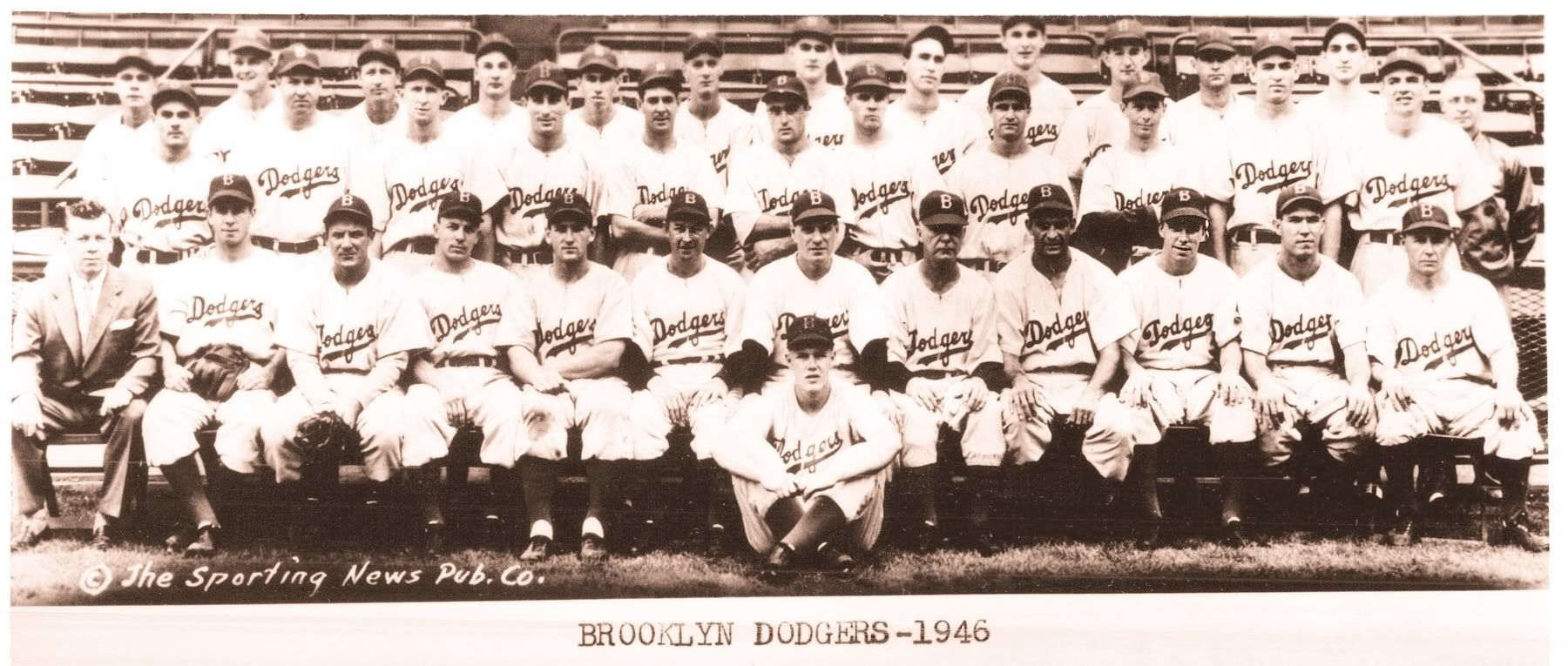
Remembering the 1946 Brooklyn Dodgers

Brooklyn's last non-integrated team went 96-60 (Baseball Fever)
In honor of June--the unofficial start of summer--and this being the 60th anniversary of when the Bums finally won it all, I'm going to recall and ultimately rank the fabled "Boys of Summer" teams that captivated the borough of Brooklyn in the dozen seasons immediately following World War II, before the Dodgers moved to Los Angeles after the 1957 season.

'Dem Bums emerged as a powerhouse immediately before the war, eclipsing 100 wins in the 1941 and 1942 seasons before star players departed to join the war effort. Brooklyn remained competitive during the war years, albeit not nearly as dominant as they'd been beforehand. The Dodgers fielded winning records in 1943 and 1945, finishing 20 games over .500 in '45.

The 1946 edition, Brooklyn's last all-white team, was unlike the hitting-heavy clubs that proceeded it in that it was buoyed by outstanding pitching. The Bums compiled a 3.05 ERA, which was good for second best in the majors, while pacing the National League in strikeouts, saves, and fewest hits allowed. The rotation was led by the trio of rookie Joe Hatten, All-Star Kirby Higbe, and sophomore Vic Lombardi, all of whom were versatile enough to make at least 25 starts and 10 relief appearances each. In all, six of the seven hurlers who started 10 games or more posted an above average adjusted ERA, with starters combining for a 3.04 ERA. The bullpen, led by reliable fireman Hugh Casey, was nearly as effective, leading the league in saves and compiling a 3.07 ERA.

Brooklyn's lineup was less impressive, with 35 year-old All-Star Dixie Walker being the only regular to bat over .285, knock in more than 75 runs, and top an .800 OPS. Only two players reached double digit homers, with Pete Reiser's 11 leading the team, and nobody registered 30 doubles. Even with their astounding lack of power, the Dodgers still finished second in the NL in runs scored and OPS, largely because they led the loop in OBP, walks, steals, and triples. Brooklyn's punchless lineup expertly manufactured runs like a finely tuned machine, much like last year's Royals.

After falling 5-3 to the Braves, then of Boston, on Opening Day, Leo Durocher's Dodgers ripped off eight straight wins to vault into first place. They remained there for much of the summer, spending just one day out of first between May 22nd and August 25th. Brooklyn fell behind the hard-charging St. Louis Cardinals at the end of August and played catch-up for most of September despite going 21-8 that month. The Dodgers finally tied the Cardinals for first on September 28th--the regular season's penultimate day--but incredibly both teams lost home games the next day against clearly inferior teams to finish the season at 96-58, forcing the first-ever pennant tiebreaker.

Brooklyn won the coin-toss to determine home field advantage for the best-of-three series and opted to play the first game in St. Louis, which meant games two and three would be played at Ebbets Field. The Dodgers clearly did not think this through, as that entailed traveling from New York to St. Louis by train, then immediately turning around and heading back to New York. The Cardinals, who were already in St, Louis, did not need to go anywhere for the first game and were thus well-rested when the weary Dodgers arrived.

Not surprisingly, the Cardinals took game one 4-2 behind a complete game from Howie Pollet. Meanwhile, visiting starter Ralph Branca--a name that would become infamous five years later--failed to make it out of the third inning. The Dodgers doubled their scoring output in the second game, but so did the Cardinals and that was that. St. Louis headed back to the World Series, their fourth in five seasons, where they would upset the Boston Red Sox in seven games. The Dodgers went home empty-handed, left to wonder how they would have fared against Ted Williams and co. Who knows how the series would have played out had it begun in Brooklyn, forcing St. Louis to make the nearly 1,000 mile journey before Game 1.

One also has to wonder how Brooklyn would have fared with Jackie Robinson, Don Newcombe, and Roy Campanella--all cutting their teeth in its farm system that year--on the major league roster. Newcombe, who turned 20 that summer and didn't debut until 1949, probably wouldn't have made the team, but Campanella (24) and Robinson (27) likely would have been starters, especially since the Dodgers relied on a rookie catcher, 22 year-old Bruce Edwards, and 21 year-old first baseman Ed Stevens, neither of whom could hold a candle to the Hall of Fame talents of their eventual successors. Given their more advanced age and how well they played upon arriving in the big leagues, it seems safe to say that Campy and Jackie would have helped Brooklyn win at least one more regular season game and thus avoid the playoff series altogether.

It's just a shame they didn't get the chance.

Tuesday, December 17, 2013

Hodges Hall-Worthy

Taking all of his accomplishments into consideration, Hodges is a Hall of Famer
I've been thinking about the Hall of Fame a lot lately, mainly about how it's such a mess (watch Greg Maddux make it in, but nobody else) and how the entire voting procedure needs to be overhauled. First and foremost, the arbitrary ten-player limit on ballots must be removed. It serves absolutely no purpose. Second, the standard for induction must be lowered from 75 percent, a barrier that doesn't make the Hall any more exclusive than a simple majority and serves only to prolong the wait players must endure before they finally get the call.

Scaling down the 50 percent sounds like a big drop-off, but it isn't when you consider that every player, except for one, who crossed that threshold was ultimately inducted into Cooperstown. That one player is Gil Hodges, of course, and he should be in, too. He spent 15 years on the ballot and exceeded 60 percent three times, topping out at 63.4 percent in his last try.

Now, a lot of people don't think Hodges is Hall-worthy because he wasn't dominant when he played. It is true that he never led the league in any significant offensive statistic of the day. That is reflected in his poor MVP showings--he never finished higher than seventh, and he was often overshadowed by his Hall of Fame teammates Roy Campanella (a three-time winner), Duke Snider and Jackie Robinson. His 120 career OPS+ is good but nothing special, tying him for 356th all-time with the likes of Willie Horton, Shawn Green, Paul O'Neill, and Richie Sexson, none of whom are getting into the Hall without a ticket.

But if Hodges wasn't dominant, he didn't miss by much. He had a terrific nine-year run starting in 1949. He batted .284/.372/.515, good for  130 OPS+, while averaging 32 home runs, 108 RBI and 95 runs per year. He drove in more than 100 runs in the first seven of those seasons, made the All-Star team every year but one, and twice topped 40 homers. He ranked as the league's seventh most valuable player, compiling 40.9 of his 45 bWAR during this span.  In the 1950s he was exceeded only by Duke Snider in home runs (310) and RBI (1,001). Hodges also had a great defensive reputation, known for his exceptional hands which helped him win the first three Gold Gloves awarded to National League first basemen.

But great defense at first base isn't nearly as valuable as great defense at premium positions,and  looking strictly at Hodges' numbers, he doesn't quite measure up with his fellow first basemen. JAWS rates him 33rd all-time at the position, in the same neighborhood as Don Mattingly, Carlos Delgado, and Mark Grace. The only two Hall of Famers below him are Jim Bottomley and High Pockets Kelly, both of whom are considered to be among the weakest players in the Hall. There's not a single Hall of Famer among his ten most similar batters, a list that includes good-not-great players such as Norm Cash, George Foster, Jack Clark, Rocky Colavito, and Lee May. As a player, Hodges was very good but falls just short of the Hall.

But Hodges should get extra credit for his other accomplishments. He was one of the fabled "Boys of Summer" who brought Brooklyn its first and only World Series title in 1955. It was Hodges who plated both Dodger runs in Brooklyn's 2-0 victory in Game 7, giving Johnny Podres the run support he needed to beat the Yankees. One of the most popular players in Brooklyn history, Hodges returned to New York as one of the original members of the horrid '62 Mets, later managing them to their first World Series championship in 1969. He famously finished his career with more grand slams than anyone except for Lou Gehrig. When he retired his 370 home runs ranked tenth all-time and second only to another great first baseman--Jimmie Foxx--among righthanded hitters.

More importantly, Hodges was an outstanding teammate and human being, a class act who, like Stan Musial, played the game the right way and never caused trouble with anyone. When he died suddenly in 1972 at the age of 47, more than 10,000 people came to his wake. If the character clause can be used to keep Barry Bonds and Roger Clemens out, why can't it work the other way?

So yeah, I'll readily admit that on numbers alone, Hodges isn't a Hall of Famer. But throw his managerial skills and status as a Brooklyn legend, and I think that's just enough to put him over the top. Lord knows the Hall of Fame would be a better place with Hodges than without him.

Wednesday, April 17, 2013

Jackie Robinson By the Numbers

In honor of the new Jackie Robinson biopic 42 (it's about time), here's a look at some of Robinson's statistical achievements from his ten big league seasons:
  • Won baseball's first ever Rookie of the Year award in 1947 after scoring 125 runs, batting .297, topping the National League with 29 steals and leading the Brooklyn Dodgers to the NL pennant
  • Became the first African American to win an MVP award in 1949, when he set career highs in numerous categories, won the batting crown with his .342 average, paced the major leagues in steals (37) and was worth an ML-best 9.6 bWAR
  • Robinson made six straight All-Star teams from 1949-'54, which also happened to be the six years he batted north of .300 and posted an OPS above .900 (coincidence? I think not!)
  • Led the league in bWAR three times from 1949, '51 and '52, but like Chase Utley he did not receive the level of attention he deserved from MVP voters (outside of '49, that is)
  • One of the more impressive feats of his career is that he slugged above .500 five times despite never hitting 20 homers in a season. By comparison, Adam Dunn popped 41 dingers last year and slugged just .468
  • It's too bad the circumstance (team, era, conventions of the time) hindered Robinson's prowess as a basestealer; it would have been fun to see him run wild during the '60s, '70s or '80s alongside speedsters like Lou Brock, Tim Raines and Rickey Henderson 
  • Robinson developed a reputation as a big game player, but you'd never know it just by looking at his World Series numbers: .234/.335/.343 in six Fall Classics, all against the New York Yankees. However, his outstanding performance in clutch situations--.341/.446/.545 in late and close opportunities--indicates that his reputation was hardly undeserved
  • Like most great hitters of the day, Robinson rarely struck out. He never fanned more than 40 times in any season and drew more than 2.5 walks for every whiff. Only five percent of his plate appearances ended in a strikeout 
  • One of the most underrated aspects of his game was his plate discipline. Robinson finished his career with a .409 OBP and walked in 12.8 percent of his plate appearances. He had just one year--1948--with a walk rate below 10 percent
  • He was also a stellar defender who probably would have won his fair share of Gold Gloves based on his strong fielding percentages and range factors
  • Though Robinson was targeted by his fair share of pitchers, he did not get beaned as often as one might expect. Only once--in 1952--was he plunked more than nine times, though he did lead the league in that department in 1948 with seven HBP
  • Offensively he was a lot like Derek Jeter, a high average hitter with good pop who scored a lot of runs while playing premium defensive positions. Furthermore, they were recognized as team leaders and winners. Check out their 162 game averages:
          Robinson:  111 runs  32 2B  16 HR  86 RBI  23 SB  .311/.409/.474
          Derek Jeter: 117 runs  33 2B  16 HR  79 RBI  22 SB  .313/.382/.448
  • Even though he only played ten years and was unable to compile impressive career numbers, he was elected into the Hall of Fame on the first ballot with 77.5 percent of the vote, going in side-by-side with Bob Feller
  • The versatile Robinson played every non-pitcher position except for catcher and center-fielder, where Brooklyn featured two future Hall of Famers in Roy Campanella and Duke Snider
The unfortunate thing about Robinson is that so much of his legacy is tied up in the fact that he was the guy to break the color barrier. People forget just how good of a player he really was, especially at his peak when he was nearly a ten-win player. With an uninterrupted career, he probably would have approached 3,000 hits and challenged Rogers Hornsby, Charlie Gehringer, and Joe Morgan for the honor of best second baseman in baseball history. But unlike Josh Gibson, Oscar Charleston, Cool Papa Bell, and the generations of Negro League stars that preceded him, at least we'll never have to wonder how he would have fared against major league talent.


Wednesday, February 13, 2013

Best Pitching Season of the 1920s

Dazzy Vance 1924 (10.3 bWAR)

Coming off back-to-back 18 win seasons, Vance enjoyed the best year of his Hall of Fame career at the age of 33. He won the major league pitching Triple Crown by topping both leagues with 28 wins, 262 strikeouts and a 2.16 ERA, which worked out to be an ML-best 174 ERA+. He completed 30 of his 34 starts, amassed over 300 innings pitched and still maintained the sport's best WHIP, hit rate, strikeout rate and K/BB ratio.

On August 23rd, Vance set the then-NL-record for strikeouts in a nine-inning game by fanning 15 Chicago Cubs in his complete game victory. A month later, he again made history at Chicago's expense by fanning three Cubbies on nine pitches, becoming the fifth National League pitcher/seventh major leaguer to toss an "immaculate inning."

Though his Brooklyn Robins were unable to unseat John McGraw's New York Giants in the National League standings, Vance beat out Rogers Hornsby for league MVP honors. I can't say I agree with that one considering Hornsby batted .424--still the modern record--and was worth 12 (!) wins above replacement. Rajah was most likely penalized because his St. Louis Cardinals finished two dozen games below .500, though without him they probably would have been three dozen games under .500. Interestingly, Walter Johnson took home the AL trophy. The only other time both MVP awards went to non position players? 1968, the Year of the Pitcher, when Denny McLain and Bob Gibson won.

Some more notes from Vance's terrific campaign:

  • Opponents batted just .213/.269/.279 off Vance that year
  • His average GameScore was a 69
  • Brooklyn went 29-6 (.829) when Vance pitched, 63-56 (.529) when he didn't 
  • Of Vance's ML-best 30 complete games, just three were shutouts
  • Went beyond nine innings on five occassions. On May 17th in St. Louis, he lasted 13 innings to earn the complete game W
  • Surrendered multiple home runs in a game just once all year
  •  His 262 strikeouts were more than any two pitchers combined and nearly twice as many as runner-up Burleigh Grimes. He also compiled more than two times the bWAR of any NL hurler
  • By himself, Vance accounted for almost eight percent of the Senior Circuit's strikeouts
  • Had eight games in which he whiffed ten or more batters
  • Won 14 games at home and 14 on the road
  • Earned run breakdown
        0 runs--7 starts 
        1 run--7 starts
        2 runs--6 starts
        3 runs--7 starts
        4 runs--3 starts
        5+ runs--4 starts

Best Offensive Season of the 1920s--Babe Ruth (1921)