Showing posts with label St. Louis. Show all posts

Saturday, December 26, 2015

Cardinals Plug Leake

Leake fills a hole in the Cardinals rotation (SI)
Mike Leake got a nice Christmas present this year--a five-year, $80 million contract from the St. Louis Cardinals.

When I saw those figures for the first time, my immediate reaction was shock; in what world is Mike Leake worth $80 million?

After all, Leake has been the very definition of average since debuting in 2010. He's never been an All-Star and his career ERA+ is 101. He's never won 15 games in a season, and only once has he exceeded 200 innings. He's a contact pitcher with one of the worst strikeout rates in the game, which makes him susceptible to the long ball. Baseball-Reference and FanGraphs agree he's been worth roughly 1.8 wins above replacement per year over the past five seasons, when an average major league regular is typically worth close to two.

But since teams are currently paying about $8 million for one WAR on the open market, average major leaguers like Leake are worth $16 million a year. A five-year contract for a durable 28 year-old makes sense as well, since Leake figures to maintain his current level of production for the next half-decade. Even if he slips a bit in his early 30s, the cost of a win will be higher with inflation, meaning he should still be worth his salary.

Leake's one of baseball's most consistently effective starters, and that has value. Over the past three years, he's been worth 7.4 bWAR by averaging 200 innings with a 3.59 ERA and 3/1 K/uIBB (unintentional walk) ratio. Despite not missing many bats, he excels by keeping the ball on the ground with a 50.2 GB% for his career. While he's outproduced his FIP by 33 points, pitching in a friendlier home park with a better defense behind him should help him continue to do so, as should throwing to one of the game's best signal-callers in Yadier Molina.

Jeff Sullivan also pointed out that Leake is more than just a solid midrotation starter; his athleticism makes him one of the better hitting and fielding pitchers in the game. His glove and bat are capable of adding up to an extra win of value, elevating him a cut above your typical hurler.

In past years, Leake getting a John Lackey-type deal would have seemed ridiculous, but with so much money going to starting pitchers this offseason Leake's contract doesn't look crazy at all. Consider that Jeff Samardzija got the same number of years and $10 million more despite being three years older and having a more volatile track record than Leake. St. Louis preferred the latter, and based on Leake's superior career numbers and younger age they were right to do so.

After losing Lackey to the Cubs and Lance Lynn to injury, the Cardinals needed a starter. In Leake, they got one of the youngest and most reliable arms on the market at a reasonable cost, without sacrificing their top draft pick. If Leake stays healthy, this won't be an overpay at all. It might even be a bargain.

Saturday, December 5, 2015

Lackey, Lester Reunited

Lackey has showed no signs of slowing down as he enters his late-30s (Fox Sports)
On July 31st, 2014, Ben Cherington broke up the 2013 World Series champions by trading Jon Lester and John Lackey, among others, to the Oakland A's and St. Louis Cardinals, respectively. Sixteen months later, they have been reunited under former Sox GM Theo Epstein, the man who developed Lester and signed Lackey in Boston, with the Chicago Cubs.

Lester joined the Cubs last winter, signing for more money than any free agent besides Max Scherzer. Lackey stayed in St. Louis, earning the league minimum because of an injury clause in his contract. Both were terrific in their first full seasons as National Leaguers, pitching their respective clubs to the postseason and squaring off in Game 1 of the NLDS. Lackey got the best of Lester, allowing just two hits over 7 and 1/3 scoreless innings, but in the end it was Chicago who advanced to the NLCS (only to be mercilessly swept by the Mets).

Now, the onetime beer buddies and former division rivals are teammates once more. It was reported yesterday that Lackey and the Cubs had agreed to a two-year, $32 million deal. Lackey joins Lester and Jake Arrieta in the Windy City, giving Chicago a formidable trio at the top of its rotation. The Cubs have plenty of hitting, so they were wise to add a starter, snapping him at up at a reasonable price to boot.

While nowhere near the bargain the Cardinals got with Lackey last year, this still figures to be a pretty favorable contract for Chicago. They get a great starting pitcher at a fraction of the cost that David Price, Zack Greinke, and Jordan Zimmermann just inflicted on their new clubs. Even if Lackey's only half the pitcher he was last year, when he was worth roughly 4.7 WAR (after splitting the difference between B-R and FanGraphs) with a 2.77 ERA over 218 innings, he'll still be worth the money. And since it's only a two-year pact, the Cubs won't be stuck with him if he bombs.

Which, at his age, is a very real possibility. Lackey just turned 37 and has churned out over 2,600 innings (postseason included) on a Tommy John-repaired arm. Pitchers at his age are susceptible to losing it overnight, as we recently saw with Roy Halladay, Roy Oswalt, and others. It's hard to say how he'll fare in Wrigley Field seeing as how he's started all of two games there, but there's no question his new home is tougher on hitters than his old one (I'm not too concerned about this, however, as Lackey's not a flyball pitcher--the kind who are susceptible to Wrigley's wind--and he had success at Fenway)

Lackey's due for some regression after outpitching his FIP by 0.8 R/9 and enjoying baseball's second-highest strand rate, but even if he's only average pitcher he'll still have plenty of value if healthy. That's a pretty big risk at this stage in his career, but it's absolutely a risk worth taking.

Thursday, June 25, 2015

Boston's Former Cardinals Crash and Burn

Joe Kelly will try to figure it out in the minors (Yahoo Sports)
With Joe Kelly's demotion to Triple-A Pawtucket today, the Red Sox have officially lost last summer's trade with the St. Louis Cardinals--the one that sent John Lackey packing to St. Louis in return for Joe Kelly and Allen Craig, neither of whom are currently on the big league roster..

In fact, I think it might be the worst trade Ben Cherington has ever made. Kelly and Craig have both been massive busts in Boston, while Lackey has continued to be an effective starter for the Cards. Kelly has not developed into a viable starting pitcher, much less the Cy Young winner he predicted he'd be. With a 5.67 ERA and 1.50 WHIP, he's been one of the worst starting pitchers in baseball this year. At this point, his best bet is to take his heater to the bullpen, where he may enjoy a renaissance a la Andrew Miller.

As for Craig, he has yet to rediscover the stroke that made him a .300 hitter and one of the league's best RBI men. Not even Fenway Park could help restore the former All-Star's bat, as he's hit a meager .130/.235/.192 since joining the Red Sox. His age, injury history, non-existent production, and costly price tag (he'll earn $11 million next year) makes him all but untradeable.

Meanwhile, Lackey has continued to thrive in St. Louis. He faded down the stretch last year but has bounced back strong this year, posting a 3.41 ERA, 1.22 WHIP, and 3.14 K/BB ratio. He's been one of the most reliable starters for the first-place Cardinals, leading the staff in innings pitched and helping pick up the slack in Adam Wainwright's absence. Even at 36, he shows no signs of slowing down.

At the time, trading a veteran starter in his mid-30s for a hard-throwing hurler in his mid-20s made plenty of sense, but taking on Craig's costly contract and expecting him to bounce back proved to be too much of a gamble. Boston really could have used Lackey in its rotation this year, and had absolutely no need for Craig given its already-crowded outfield situation when he arrived. Now it looks like the Sox are stuck with him, unless they can convince somebody that regular playing time will rejuvenate the soon-to-be 31 year-old's bat.

I still think Kelly has a future as a shut-down reliever, but that's not as valuable as a reliable starting pitcher, especially given the struggles of Boston's rotation this year. This trade is just one of many reasons why the Red Sox have underperformed this year, but it's now clear that they'd be better off had Cherington never done this deal.

Sunday, May 31, 2015

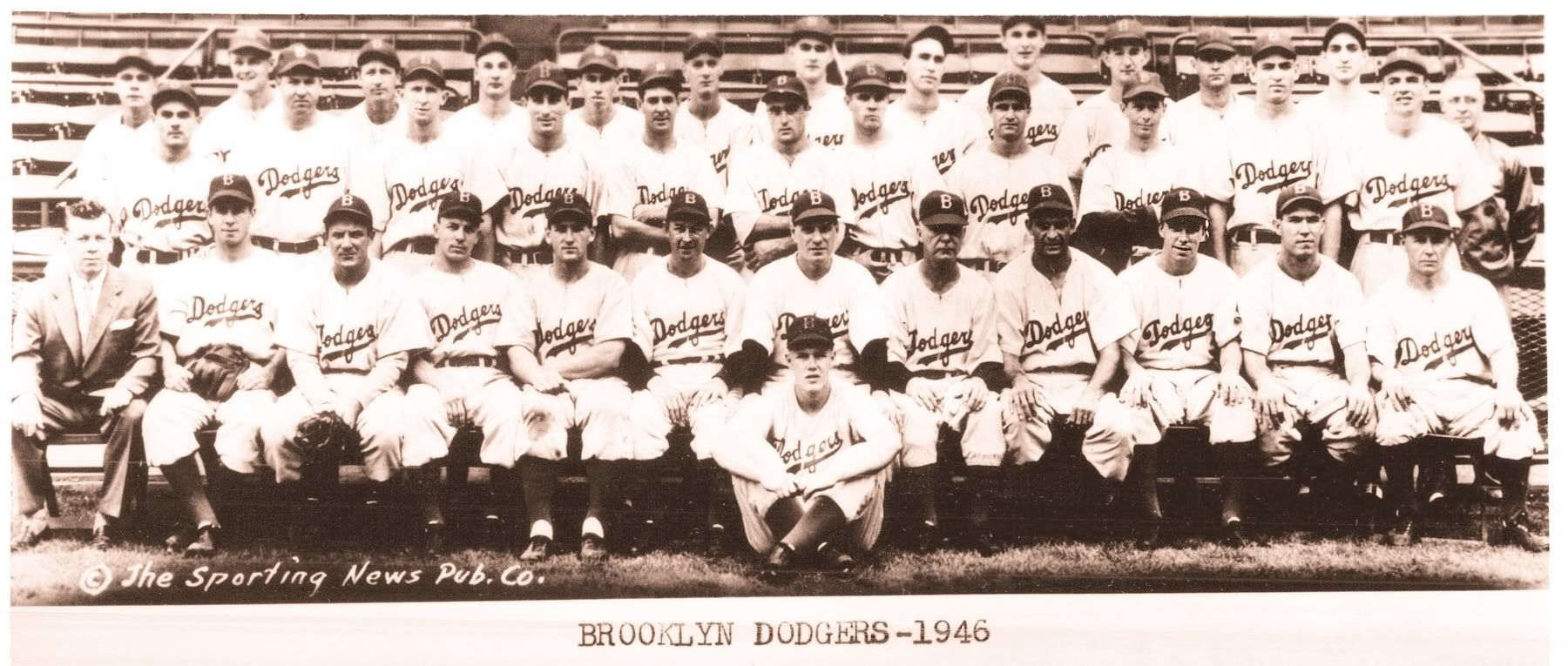
Remembering the 1946 Brooklyn Dodgers

Brooklyn's last non-integrated team went 96-60 (Baseball Fever)
In honor of June--the unofficial start of summer--and this being the 60th anniversary of when the Bums finally won it all, I'm going to recall and ultimately rank the fabled "Boys of Summer" teams that captivated the borough of Brooklyn in the dozen seasons immediately following World War II, before the Dodgers moved to Los Angeles after the 1957 season.

'Dem Bums emerged as a powerhouse immediately before the war, eclipsing 100 wins in the 1941 and 1942 seasons before star players departed to join the war effort. Brooklyn remained competitive during the war years, albeit not nearly as dominant as they'd been beforehand. The Dodgers fielded winning records in 1943 and 1945, finishing 20 games over .500 in '45.

The 1946 edition, Brooklyn's last all-white team, was unlike the hitting-heavy clubs that proceeded it in that it was buoyed by outstanding pitching. The Bums compiled a 3.05 ERA, which was good for second best in the majors, while pacing the National League in strikeouts, saves, and fewest hits allowed. The rotation was led by the trio of rookie Joe Hatten, All-Star Kirby Higbe, and sophomore Vic Lombardi, all of whom were versatile enough to make at least 25 starts and 10 relief appearances each. In all, six of the seven hurlers who started 10 games or more posted an above average adjusted ERA, with starters combining for a 3.04 ERA. The bullpen, led by reliable fireman Hugh Casey, was nearly as effective, leading the league in saves and compiling a 3.07 ERA.

Brooklyn's lineup was less impressive, with 35 year-old All-Star Dixie Walker being the only regular to bat over .285, knock in more than 75 runs, and top an .800 OPS. Only two players reached double digit homers, with Pete Reiser's 11 leading the team, and nobody registered 30 doubles. Even with their astounding lack of power, the Dodgers still finished second in the NL in runs scored and OPS, largely because they led the loop in OBP, walks, steals, and triples. Brooklyn's punchless lineup expertly manufactured runs like a finely tuned machine, much like last year's Royals.

After falling 5-3 to the Braves, then of Boston, on Opening Day, Leo Durocher's Dodgers ripped off eight straight wins to vault into first place. They remained there for much of the summer, spending just one day out of first between May 22nd and August 25th. Brooklyn fell behind the hard-charging St. Louis Cardinals at the end of August and played catch-up for most of September despite going 21-8 that month. The Dodgers finally tied the Cardinals for first on September 28th--the regular season's penultimate day--but incredibly both teams lost home games the next day against clearly inferior teams to finish the season at 96-58, forcing the first-ever pennant tiebreaker.

Brooklyn won the coin-toss to determine home field advantage for the best-of-three series and opted to play the first game in St. Louis, which meant games two and three would be played at Ebbets Field. The Dodgers clearly did not think this through, as that entailed traveling from New York to St. Louis by train, then immediately turning around and heading back to New York. The Cardinals, who were already in St, Louis, did not need to go anywhere for the first game and were thus well-rested when the weary Dodgers arrived.

Not surprisingly, the Cardinals took game one 4-2 behind a complete game from Howie Pollet. Meanwhile, visiting starter Ralph Branca--a name that would become infamous five years later--failed to make it out of the third inning. The Dodgers doubled their scoring output in the second game, but so did the Cardinals and that was that. St. Louis headed back to the World Series, their fourth in five seasons, where they would upset the Boston Red Sox in seven games. The Dodgers went home empty-handed, left to wonder how they would have fared against Ted Williams and co. Who knows how the series would have played out had it begun in Brooklyn, forcing St. Louis to make the nearly 1,000 mile journey before Game 1.

One also has to wonder how Brooklyn would have fared with Jackie Robinson, Don Newcombe, and Roy Campanella--all cutting their teeth in its farm system that year--on the major league roster. Newcombe, who turned 20 that summer and didn't debut until 1949, probably wouldn't have made the team, but Campanella (24) and Robinson (27) likely would have been starters, especially since the Dodgers relied on a rookie catcher, 22 year-old Bruce Edwards, and 21 year-old first baseman Ed Stevens, neither of whom could hold a candle to the Hall of Fame talents of their eventual successors. Given their more advanced age and how well they played upon arriving in the big leagues, it seems safe to say that Campy and Jackie would have helped Brooklyn win at least one more regular season game and thus avoid the playoff series altogether.

It's just a shame they didn't get the chance.

Monday, November 17, 2014

St. Louis Steals Heyward, Walden

Heyward helps the Cardinals considerably (USAToday)
Needing a short-term, last-minute fix in right field following the tragic and untimely death of Oscar Taveras, the St. Louis Cardinals sacrificed a pair of former first-round draft picks to acquire Jason Heyward, probably the best right fielder in the game not named Giancarlo Stanton. The Cardinals also received a plus reliever in Jordan Walden, who was an All-Star closer for the Los Angeles Angels in 2011. Walden should bolster the Redbirds' bullpen based on his career 3.10 ERA and 10.8 K/9 rate over five big league seasons.

But Walden's just icing on the cake, really, because St. Louis clearly got the best player in this deal. Heyward hasn't developed into the Ken Griffey Jr. clone people thought he'd be during his first season, when he was an NL All-Star and Rookie of the Year runner-up to Buster Posey, but he's still a phenomenal player. A true all-around talent, the two-time Gold Glove recipient has twice stolen 20 bases or more in a season and once hit as many as 27 home runs (in 2012). He also owns a rock-solid .351 OBP for his career, during which time he's been worth 24.5 bWAR and rated as the third-best rightfielder in baseball behind Jose Bautista and Ben Zobrist. Plus, he's only 25, though he will be free agent-eligible after next year.

In return the Braves landed Shelby Miller, who's only one year younger than Heyward but won't be eligible for free agency until after the 2018 season. Miller, a starting pitcher, finished third in the 2013 NL Rookie of the Year award to Jose Fernandez and Yasiel Puig after going 15-9 with a 3.06 ERA and 169 strikeouts in 173 and 2/3 innings. His 3.67 FIP and 1.21 WHIP suggested regression was coming, however, and sure enough Miller was merely a league average starting pitcher last year. His record fell to 10-9, his ERA swelled to 3.74, and his strikeout rate plummeted from 8.8 K/9 in 2013 to a paltry 6.2 K/9 last year. His walk rate increased as well, resulting in a 4.54 FIP that says he was very lucky in 2014. Miller may not completely unravel next year, but he seems doomed for more regression and won't have a very long career if he doesn't improve his command. There's just too much uncertainty about his effectiveness going forward, and right now the signs point to bad.

Atlanta's also getting Tyrell Jenkins, a 22 year-old pitching prospect who has yet to pitch above High-A. It's much too early to tell what kind of impact he'll have if and when he reaches the majors, as he'll likely need a few more years of seasoning before he's ready.

So yeah, clear win for the Cardinals here. They get at least one year of Heyward and two years of Walden for four years of Miller and a complete unknown in Jenkins. A six-win player last year, Heyward could very well end up creating as much or more value in 2015 than Miller does over the next four years, especially if the former finally puts it all together to produce that superstar caliber season we've been waiting for. Walden's already an established big league reliever, while there's a good possibility that Jenkins never throws a pitch in the Show.

This trade makes the Braves considerably worse for 2015, which is not the direction they want to go in after losing 83 games last year. St. Louis, on the other hand, remains a safe bet to win 90-plus games again en route to a third consecutive division title. If you're Atlanta, you have to do better than a league-average starting pitcher/likely project and a raw prospect for an elite outfielder such as Heyward. If you're St. Louis, you deserve a giant pat on the back.


Wednesday, October 15, 2014

Remembering the 1964 St. Louis Cardinals

The '64 Cardinals: a model of integration and loaded with talent (The Baseball Page)
Piggybacking off this morning's post: here's a quick look at the 1964 St. Louis Cardinals team that won it all. Everyone remembers the Phillies' epic collapse that year, but St. Louis made it possible by forging an eight-game win streak in late September to pass Philadelphia, then win the final game of the season to avoid a three-way tie with Philly and Cincinnati.

Without further adieu. your 1964 World Series champions:

C Tim McCarver
McCarver was just 22 years-old but already in his fifth season with the Cards. He batted a very solid .288/.343/.400 while catching 137 games, good for 3.4 bWAR.

1B Bill White
White was one of the team's elder statesmen at 30, but still young enough to continue his run as the National League's top all-around first baseman. An All-Star for the fifth and final time, White won his fifth straight Gold Glove award in addition to batting .303/.355/.474. He finished third in the MVP race thanks to his strong counting numbers: 5.4 bWAR, 21 home runs, 102 RBI, 92 runs, 191 hits, 37 doubles, and 299 total bases.

2B Julian Javier
Javier was barely above replacement level due to his .644 OPS, though his 12 homers and 65 RBI were career-highs up to that point.

3B Ken Boyer
The major league RBI leader (with 119) was also the National League MVP, even if Dick Allen was clearly more deserving. Boyer was outstanding in his last great season, playing every game, batting .295/.365/.489, and compiling 6.1 bWAR. The All-Star third baseman also socked 24 homers, scored 100 runs, and racked up 307 total bases.

SS Dick Groat
The former MVP and batting champion with the Pirates was still among the league's best shortstops at 33. Had no power whatsoever (1 home run) but played all but one game and made the All-Star team for the fifth and final time. Batted .292/.335/.371 with more walks (44) then strikeouts (42). Also ripped 35 doubles.

LF Lou Brock
Acquired midseason from the Cubs via trade, Brock helped ignite the Cardinals to the pennant. The 25 year-old future Hall of Famer batted a scintillating .348/.387/.527 with 12 home runs and 33 steals in 103 games with St. Louis, contributing 5.7 bWAR while hitting out of the two hole.

CF Curt Flood
Flood made his first All-Star squad, won his second Gold Glove, and paced the National League with 211 hits. The Cards' leadoff hitter also batted .311, scored 97 runs, and was worth 4.7 bWAR.

RF Mike Shannon
"Moonman" missed most of the first half with injuries but rebounded with a healthy second half to finish the year with a solid .261/.315/.410 line.

Bench

LF Charlie James
The starting left fielder displaced by Brock, James was relegated to pinch-hitting duties after the trade.

RF Carl Warwick
Warwick helped cover for Shannon while he was out and provided a close approximation of Shannon's slash lines at .259/.306/.373.

RF Bob Skinner
A midseason trade to the Cardinals, Skinner supplemented Shannon in right and was also used as a pinch-hitter.

Rotation

SP Bob Gibson
A pitcher on the rise in '64, Gibson was still a few years away from becoming "Bob Gibson." That said, he was still an incredible talent. His 287 innings, 3.01 ERA, 245 strikeouts and 2.85 K/BB ratio topped the rotation. He also won 19 games, completed 17 of his 36 starts, and was worth six wins above replacement.

SP Curt Simmons
At 35 and in his 17th big league season, Simmons wasn't blowing hitters away (3.8 K/9) but was still crafty enough to fool them. He also had impeccable control, with only 1.8 BB/9. How else do you explain how he completed 244 innings, won 18 games and went the distance in 12 starts?

SP Ray Sadecki
The team's lone 20 game winner, Sadecki was a 23 year-old southpaw still finding his way in the big leagues. He tossed 220 innings but was clearly the team's third-best starter behind Gibson and Simmons.

SP Roger Craig
After a couple rough years with the Mets, Craig appeared to enjoy pitching for a contender. Between his 19 starts and 20 relief appearances, Craig contributed 166 innings of 3.25 ERA-ball.

SP Ernie Broglio
Was pitching decently (3.50 ERA in 11 starts) before being traded for Brock.

SP Ray Washburn
Pitched very well in May and June with a 3.29 ERA in his 10 starts. Was shifted to the bullpen afterwards and struggled there, allowing eight earned runs in only five appearances.

Bullpen

CL Barney Schultz
The aging knuckleballer had a sparkling 1.64 ERA and 0.93 WHIP during the regular season, but he'll always be remembered for giving up Mickey Mantle's walk-off blast in Game 3.

RP Ron Taylor
Led Cardinal relievers with 63 appearances and 101 innings, but was very effective with a 4.62 ERA and 1.40 WHIP.

RP Mike Cuellar
Before he was a 20-game winner and anchor of those great Baltimore Orioles rotations under Earl Weaver, he was a rookie reliever with a 4.50 ERA in 72 innings. Talk about an inauspicious beginning.

RP Bob Humphreys
One of the team's most effective relievers with a 2.53 ERA in 28 appearances.

RP Gordie Richardson
Like Humphreys. very effective (2.30 ERA) in limited action (47 innings)

Manager

Johnny Keane
In his fourth year at the helm of the Cardinals, Keane led them to a repeat of their 1963 record (93-69). While that was only good enough for second place in '63, in '64 it won the pennant. He was on the hot seat for much of the season before his team improbably passed the Phillies in the final weeks of the season. Shockingly, Keane resigned after winning the Series, a decision he'd made in late September at the height of the pennant race. He would manage the Yankees in 1965, replacing Yogi Berra.

After examining both rosters, I think the Cardinals had a better team even though they won fewer games. St. Louis's starting lineup was stronger and more balanced, and stayed healthy enough to prevent Keane from relying on his weak bench. Pound for pound the rotation was just as good as New York's, though the bullpen was definitely weaker. Overall the Yankees had more depth, but St. Louis had more players in their prime and more "stars". Their best players were better than New York's, even if their worst players were worse than New York's. Accordingly, I am not surprised the Cards took the Series in 7.

McCarver, Boyer, and Gibson celebrate (I70Baseball)

October 1964: 50 Years Later

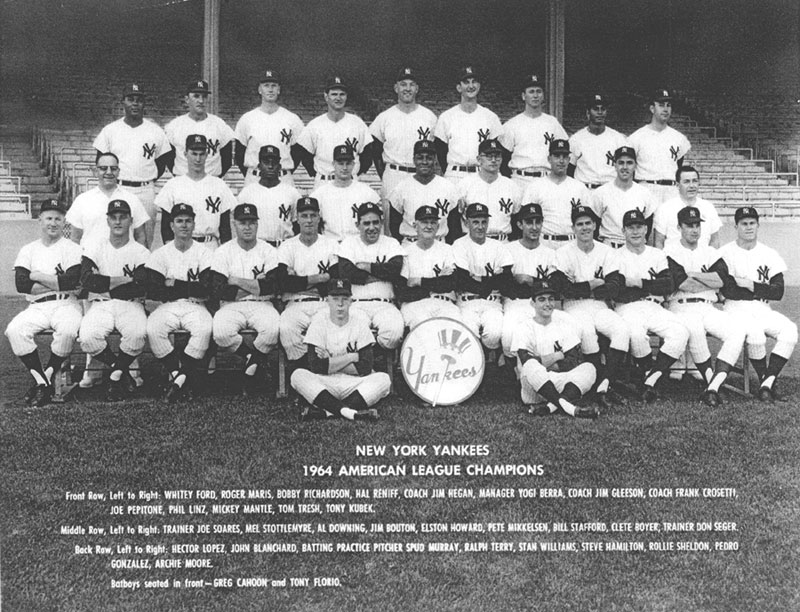
New York's team picture lacks faces of color (TheDeadballEra)
50 years ago today, the St. Louis Cardinals won the World Series by beating the New York Yankees in a decisive Game 7 at Busch Stadium. The Cards won 7-5 behind Bob Gibson, who went the distance in his third Series start despite surrendering three long balls and nine hits in all. It was, David Halberstam wrote 30 years later, a turning point for the sport, the end of one dynasty coinciding with the birth of another. More significantly, the torch was passed from a still largely-white organization to a shining example of integration.

The Yankees, winners of their fifth straight pennant, needed every one of their 99 wins to squeak by the White Sox (98 wins) and Orioles (97). They wouldn't win another pennant until 1976. Here's a quick look at that great Yankees squad (check back later for a breakdown of the Cardinals):

Starting Lineup

C Elston Howard
The 1963 American League MVP finished third in the balloting behind Brooks Robinson and Mickey Mantle. The All-Star receiver batted .313/.371/.455, won his second straight Gold Glove, and played 146 games behind the plate (150 overall). Was worth 5.6 bWAR.

1B Joe Pepitone
All-Star swatted 28 home runs and drove in 100, though his rate stats were horrible at .251/.281/.418.

2B Bobby Richardson
All-Star and Gold Glove recipient. Was limited offensively (.626 OPS), but provided decent counting numbers such as 90 runs, 181 hits, and 11 steals in 13 tries.

3B Clete Boyer
A black hole on offense (.573 OPS) but an elite gloveman at the hot corner, second only to Brooks Robinson.

SS Tony Kubek
Couldn't hit a lick (.615 OPS) but still played good enough defense to be worth two wins above replacement.

LF Tom Tresh
Switch-hitting outfielder struggled compared to his previous two seasons, but still smacked 16 home runs and was a perfect 13-for-13 in stolen base attempts.

CF Mickey Mantle
In his last great season, the MVP runner-up mashed 35 home runs and had 111 RBI. Physically, the Mick (then-32) was a mess, but that didn't stop him from posting the highest OBP (.423), OPS (1.015) and OPS+ (177) in the major leagues. Pitchers wisely avoided him, throwing him four wide ones on 18 occasions, most in the AL.

RF Roger Maris (3.9 bWAR)
In his last good season with the Yankees, Rajah slugged 26 home runs and batted .281/.364/.464.

Bench

Phil Linz
Posted a solid .332 OBP and clubbed 21 doubles in 417 plate appearances.

Hector Lopez
Provided 10 home runs off the bench to go along with his .260/.317/.418 slash line in 313 PAs.

Johnny Blanchard
Blanch batted a robust .255/.344/.435 with as many walks (24) as strikeouts, albeit in only 189 plate appearances.

Pedro Gonzalez
Failed to go yard in 123 plate appearances but still managed to bat a solid .277/.331/.366.

Rotation

Jim Bouton
"Bulldog" followed up his breakout 1963 campaign with another stellar season in '64, posting a 3.02 ERA and 1.06 WHIP over 271 and 1/3 innings--third most in the American League. True to his nickname, the 25 year-old Bouton topped the American League in starts while leading his team in innings and wins. It would be his last great year before arm troubles ruined his career.

Whitey Ford
Sharp as a tack at 35, Ford ranked second to Cy Young winner Dean Chance in the American League with 6.7 pitching bWAR. Slick posted the lowest FIP (2.45) and second-lowest ERA (2.13) of his Hall of Fame career in 244 and 2/3 innings. An All-Star for the eighth and final time, the Chairman of the Board notched his 200th career win in his second start of the season.

Al Downing
Like Bouton, Downing was in the second full season of his career. Also like Bouton, he regressed a bit from his breakout 1963 but still wound up with good numbers in '64. The 23 year-old completed 244 innings and led the American League in strikeouts with 217, but was also wild and paced the Circuit in walks too. He'd become forever famous 10 years later for serving up the gopher ball to Hank Aaron that broke Babe Ruth's career home run record.

Ralph Terry
After throwing 594 and 2/3 innings in 1962 and 1963 combined (World Series included) Terry fell apart in his final season with the Yankees, going 7-11 with a 4.54 ERA and 1.40 WHIP. The scuffling 28 year-old was demoted to the bullpen midseason, and though he returned to the rotation pitched sparingly in September. He'd be dealt to Cleveland after the season, enjoying a bounce back year in 1965 before retiring two seasons later.

Mel Stottlemyre
A 22 year-old rookie, Stottlemyre made his debut in mid-August and stabilized New York's rotation down the stretch. He helped spark the Yankees to the pennant by going 9-3 with a 2.06 ERA.

Rollie Sheldon
One of five Yankees to exceed 100 innings, Sheldon made 12 starts for the Bombers and seven relief appearances. He pitched well with a 3.61 ERA, 1.08 WHIP and 3.17 K/BB ratio.

Bullpen

CL Pete Mikkelsen
The 24 year-old closer was Berra's most-used reliever, leading the club with 50 appearances, 27 games finished and 12 saves.

RP Stan Williams
"Big Daddy," a one-time All-Star with the Dodgers, made 10 starts and 11 relief appearances but failed to distinguish himself.

RP Hal Reniff
"Porky" was second on the team in appearances with 41. He pitched well out of the pen with a 3.12 ERA, 1.11 WHIP, and nine saves

RP Bill Stafford
Not only did Stafford go 5-0 with a 2.67 ERA, but he also started a game, saved four, finished 12, and appeared in 31.

RP Steve Hamilton
The tall, lanky left-hander was New York's primary southpaw reliever.

Manager

Yogi Berra
Upon Berra's retirement in 1963, incumbent skipper Ralph Houk was promoted to general manager and Berra became field manager. While Berra guided his team to another pennant and came within one win of delivering a championship, he was not well-respected by his players, almost all of whom were former teammates. The future Hall of Famer was axed following the '64 Series.

Upon further review, I'm kind of dumbfounded as to how this team won 99 games, even though their Pythagorean Record (98-64) says it was no fluke. The offense had multiple weak spots (pretty much the entire infield save Howard), yet somehow finished second in runs scored despite ranking fifth in OBP, fourth in slugging, and fourth in OPS (all middle-of-the-pack in a 10 team league). They had good power but not much speed. I guess the fact that three regulars carried an OPS+ below 75 was offset by strong bench play, with the four most-used reserves posting an OPS+ of 92 of better.

Their pitching could be explained in a similar way. The rotation had a big three of Ford, Bouton, and Downing, though I'm very shocked they only won 48 games between them given that they accounted for more than half (50.4 percent) of the Yankees' innings. Except for Terry, the fourth and fifth rotation spots were surprisingly decent, especially after Stottlemyre's call-up. The bullpen was solid, with no obvious weak links but no standouts either. It also helped that New York fielded a very strong infield defense, capable outfield (except Mantle, who by that point was a wreck), and a tremendous catcher in Howard.

Nowadays, I think this team would win 90 games. But back then, when there were only 10 teams in the American League, teams could be more flawed and still win.

(From L to R) Pepitone, Tresh, Maris, and Mantle (MyYESNetwork)


Tuesday, August 12, 2014

Ken Boyer Belongs in Cooperstown


Okay, so this long-winded post is admittedly a few years overdue, but better late than never.

Now that Ron Santo has taken his rightful place in baseball's Hall of Fame, shouldn't Ken Boyer get to as well? I mean, they were pretty much the same player when you get down to it. Both were slick-fielding, power hitting third basemen that had 15-year careers in which they won five Gold Gloves apiece and were perennial All-Stars during their heyday. Each was voted one of the National League's 10 most valuable players 4 times, and together they won 10 of 11 NL Gold Gloves handed out at the hot corner between 1958 and 1968, with the stray trophy going to Jim Davenport in 1962.

The similarities don't end there, either. They both spent the majority of their careers with a Midwestern National League club (Boyer with St. Louis, Santo in Chicago). Heck, their careers even overlapped for ten years from 1960--Santo's rookie year--to Boyer's last season in 1969. And just look how similar their career numbers are!

Boyer: 1,104 R 2,143 H 282 HR .287/.349/.462 .810 OPS 116 OPS+ 62.8 bWAR
Santo: 1,138 R 2,254 H 342 HR .277/.362/.464 .826 OPS 125 OPS+ 70.4 bWAR

It should come as no surprise that Boyer rates as Santo's fourth-most similar batter, behind a pair of third basemen who deserve to go into the Hall someday--Adrian Beltre and Scott Rolen--and a classic borderline case in Dale Murphy. With almost identical career slugging percentages, their power was certainly comparable. Boyer enjoyed 12 straight seasons with at least a dozen long balls, one fewer than Santo. Both men had eight years with upwards of 90 RBI.

Santo, because of his advantages in power and on-base ability, has the edge as a hitter, but Boyer was a better baserunner and, according to the metrics, a superior defender as well. Though both played for 15 years, Santo was more durable and thus squeezed about an extra 209 games out of those years. Thus, his counting numbers are more impressive and closer to traditional Hall of Fame levels, whereas Boyer's would seem to fall short.

Boyer has other things in his favor besides better glovework, though. He won an MVP award and a World Series championship, two things Santo never achieved. Boyer also had a bit of speed as well, swiping 105 bases in his big league career with a high of 22 in 1955, his rookie season. Boyer is one of only seven third baseman with more than 250 big flies and 100 stolen bases. Santo, with only 35 career steals, was never the threat on the bases that Boyer was.

Boyer beats the throw home to Yankee catcher Elston Howard in the '64 Series
An excellent two-way third baseman for a decade, Boyer was basically Santo before Santo. He made seven All-Star teams, won five Gold Gloves, and should have cemented his Hall of Fame status when he was named MVP in 1964 after playing all 162 games, leading the major leagues in RBI with 119 (becoming the first third baseman to do so since Home Run Baker in 1912), and batting .295/.365/.489 with 24 home runs for the World Series-winning Cardinals. He came up big in that year's Fall Classic against the Yankees, fueling the Cards' Game 4 victory with a grand slam and stroking three hits--including a double and a homer--to back Bob Gibson in Game 7 (Clete Boyer also homered, marking the first and only time in baseball history that brothers have homered in the same World Series contest). Unfortunately for Santo, he never had the opportunity to prove himself on the game's biggest stage.
.
That proved to be Boyer's last hurrah, as his career quickly went downhill after the '64 Series (ditto Mickey Mantle). The primary problem with Boyer, as it is with so many guys who seemed to fall just short of the hall, is that he stopped hitting in his early 30s. He had ten great years, the last coming in his MVP year at 33, and then was essentially done. The same thing happened to Jim Rice, Vada Pinson, Tony Oliva, Dale Murphy, Dick Allen, and many others who find themselves on the outside looking in when it comes to Cooperstown.

Boyer was also cursed with being boring. Never a flashy player, Boyer was consistent, and consistency is underrated. He hit 24 home runs four years in a row, batted over .300 four years in a row, and ended up with between 90 and 100 RBI six times in the seven seasons spanning 1956 to 1962. Had he come up with the handful of additional RBI necessary to push past 100 those years, he could have finished his career with eight 100 RBI seasons instead of two. I have to think that would have made a big difference in his Hall of Fame case. Voters back then loved big RBI totals and it would have been hard to ignore someone with eight seasons over 100. Likewise, if even just a few of his 24 homer seasons had been 30 homer seasons instead, Boyer would have eclipsed 300 career homers. As it were, he only had one season with more than 28 and managed just 40 over his final five seasons, falling 18 shy of 300 for his career.

As it is, Boyer is still a deserving Hall of Famer, albeit barely. His career bWAR score of 62.8 clears the threshold of 60 that typically defines a Cooperstown-caliber career. What's more, the average JAWS score of a Hall of Fame third baseman is 55.0, and Boyer's right there at 54.5. Though he falls a bit short on longevity, he makes up for it in peak value. He had six seasons where he was worth more than six wins, including two where he was over seven and two others with more than five. His peak WAR score ranks ninth at the position, better than Brooks Robinson and Miguel Cabrera and almost even with those of Adrian Beltre and Chipper Jones. A lot of that value stemmed from his defense, though he was still a terrific hitter. For those who prefer more traditional metrics, during his best seven-year stretch--1958-1964--Boyer averaged 155 games, 26 home runs, 101 RBI, a .303/.372/.500 batting line (128 OPS+), and totaled 45 bWAR.

That's a tremendous peak, something that's evident in his numerous All-Star appearances. Boyer's 11 All-Star Games (six starts) are the most of any third baseman not in Cooperstown, and everyone else who played in nine or more is in or will be (looking at you, Miguel Cabrera). It's one-fewer than Wade Boggs, Eddie Mathews, and Mike Schmidt, for God's sake, and two more than Santo. Obviously All-Star Games aren't everything, but they do reflect a player being recognized as one of the best at his position or in his league during a given year. And yes, Boyer's totals are skewed somewhat by the fact they played two Midsummer Classics per year from 1959 through 1962, so technically Boyer was an All-Star seven times. But still, seven All-Star nods is impressive.

The problem with Boyer is that he didn't have enough good years surrounding that peak. In two of the three seasons before it he clocked a 94 OPS+, and in the five years afterwards his aggregate OPS+ was 97. Boyer's case essentially rests on his first 10 seasons, and in two of those years he was actually subpar with the bat. So that leaves eight good seasons, and while they are very good, they don't jump off the page. I can see why many people don't view Boyer as a Hall of Famer, for the longest time I didn't either.

But now I see that in those ten years, Boyer was the second-best third baseman in baseball to Eddie Mathews. He was baseball's eighth-most valuable position player over that span behind seven slam-dunk Hall of Famers; Willie Mays, Mickey Mantle, Hank Aaron, Mathews, Al Kaline, Frank Robinson, and Ernie Banks. Consider that five of them were in the Senior Circuit in the time, and Boyer being named MVP looks even more impressive.

More than anything else, though, this right here is what put me on Boyer's side once and for all (and no, it wasn't the endorsements of former teammates Stan Musial and Tim McCarver). And that is from 1900 through 1968, Boyer's penultimate season, he was, according to WAR, the best third baseman not named Eddie Mathews. That means until the end of of the '60s, he had a legitimate claim as the second-best third baseman of the modern era, which by that point was near the end of its seventh decade. Case closed. That's enough for me.

Third base has traditionally been an underrepresented position in the Hall of Fame. That Santo, one of the 10 best third basemen ever, had to wait almost 40 years after his last game to go in (posthumously) remains one of the Hall's biggest mistakes. There are several more behind him lined up to go in, namely Boyer, Graig Nettles, and Dick Allen. It's too late for Boyer, who passed away more than 30 years ago, but better late than never. That's what the Veteran Committees are for.

Of course it all comes back to my original argument; if Boyer is basically Santo or just a tick below, and Santo's a deserving Hall of Famer, then by transitive property Boyer is too. It's really that simple.

Friday, August 8, 2014

Holliday Heating Up

After three tough months at the plate, Holliday finally looks locked in
You wouldn't know it by looking at the final numbers, but Matt Holliday got off to a painfully slow start last year. When play began on June 3rd he was hitting .244/.329/.415 with eight home runs through his first 51 games of the season. The early season slump, combined with his age (33) and coming on the heels of back-to-back seasons of declining OPS, led many to speculate that Holliday's best days were behind him.

Only the six-time All-Star wasn't done. Far from it, in fact. Holliday proceeded to snap out of his , of course, and was fine from that point forward. He hit .333/.423/.535 the rest of the way, ending up with a .300/.389/.490 batting line in addition to his 22 home runs and 94 RBI. Another typically excellent offensive campaign for the St. Louis Cardinal, who was one of just nine players last year to top 20 home runs, 90 RBI and a .300 batting average. Only three National Leaguers did it; Paul Goldschmidt, Freddie Freeman, and Holliday. Note that Goldy and Freeman play first base, a less challenging defensive position than left field per Bill James's defensive spectrum.

This season appears to be following a similar script; sluggish start, strong finish. Only this time around, the funk was a little deeper, lasting  about a month longer. Through July 7th Holliday was hitting a disappointing .260/.367/.373 with only five home runs, showing none of the power that helped him swat at least 19 every year for the past nine. Once again, it seemed as though Holliday had seen better days.

And once again, he's done everything he can to dispel that notion. In the four weeks before last night's 0-for-3 against Boston, he batted .307/.381/.653 with seven home runs, going yard more times in those 21 games than he did in the previous 87. The power surge has coincided with an increased strikeout rate for Holliday, who whiffed 21 times over that stretch (one per game) as opposed to 54 times prior to that (.62 per game). Holliday may be consciously trying to sacrifice contact for power, but if that's the case it hasn't negatively affected his average. Or it could merely be that July has traditionally been his best home run month.

Whatever the reason, Holliday's swinging the bat well and it's had a positive impact on St. Louis, which went 12-9 during his hot streak. Currently one game behind the first-place Brewers in the NL Central, the Cards could certainly use a big finishing kick from Holliday like the one he provided last year. Though he leads the team in doubles and RBI and ranks tied for second with Matt Adams in home runs, his .792 OPS could stand to jump another 50 or 60 points between now and the end of the season, if not more. 

At least Mike Matheny needn't worry about his number three hitter. Holliday, who's done nothing but hit for the past decade-plus, is hitting now, so there's really no reason to doubt him. He's dug himself out of a big hole before, and here in 2014 he appears to be doing it again.

Saturday, August 2, 2014

Can Craig Bounce Back?

Once an elite hitter, Craig has struggled at the plate this year (CNN)
Mere hours after trading Jon Lester and Jonny Gomes to Oakland for Yoenis Cespedes on deadline day, the Red Sox dealt their next-best starting pitcher--John Lackey--to St. Louis for another outfield bat (Allen Craig) and starting pitcher Joe Kelly, both of whom competed against Boston in last fall's World Series.

A ground ball pitcher who doesn't strike anyone out, Kelly is a back of the rotation starter at best. Boston will need him to fill in now that 80 percent of its Opening Day rotation is gone, but once the young guns are ready he'll likely be ousted to the bullpen. Though not a difference maker by any means, Kelly is only 26 and won't reach free agency until 2019. That makes him an attractive trade chip, if not someone worth keeping around.

Craig, an All-Star last year and hard-hitting outfielder until recently, would seem to be the bigger get. He was a terrific hitter in the three years before this one, batting over .300 every year, reaching base more than 36 percent of the time and slugging .500. His 139 wRC+ during that span was the eighth-highest among outfielders, sixth after excluding American Leaguers Mike Trout and Jose Bautista. He twice received MVP consideration while averaging 40 doubles, 23 home runs, and 114 RBI per 162 games from 2011 through 2013.

But Craig can't stay healthy. He's never played 135 games in a season, let alone all 162. He's endured several lower body injuries over the years, including a fractured knee in 2011 and foot last injury year that combined with age have limited his mobility and apparently his power. His fly ball rate and home run per fly ball rate are both at career lows, and he's pounding the ball into the ground more than half the time he puts the ball into play--a horrible strategy for someone with no foot speed.

So unfortunately for Boston, Craig appears to be a player in decline. His slugging, OPS and ISO have fallen every year since 2011, a trend that has coincided with increased playing time as well as age, thus suggesting that he's unable to . His walk rate has declined the last two years including this one, and his strikeout rate has gone the other way. This year's been a disaster for Craig, who didn't get his average over .200 until the last day of April, went homerless in June and recorded just six hits in 16 July games.

Craig's been healthy this year and had a full offseason to recover from his ankle sprain, so there's really no excuse for his poor performance. His BABiP has plunged more than 80 points from last year and 50 points below his career mark, which suggests some bad luck, but that's also due to his line drive rate falling from almost 27 percent last year to below 20 percent this year. Craig''s just not hitting the ball with the same authority, and the results have been Billy Butler and Derek Jeter-esque.

Craig, who signed an extension with the Cardinals before last season, will be under team control through 2017 and has an option for 2018. But if his best days truly are behind him and he's going to stay the same or get worse, then he'll be horribly overpaid as his salary escalates over the next few years, especially in 2016-2017 when he's set to make $20 million. And he can forget about his 2018 player option that would net him an additional $13 million.

Could Craig rebound in Boston? It's not out of the question. Barely 30 years old, he's not far removed from his prime and could easily bounce back, especially now that he's playing half his games at Fenway Park. ZiPS and Steamer both project him to finish the season strong, with ZiPS predicting him to bat .278/.330/.440 the rest of the way and Steamer even more optimistic at .295/.348/.470. The offenseively challenged Red Sox are hoping he can turn it around and get back to his old ways, which would give them another run-producer and lengthen the lineup.

But even if Craig does there's really no place for him. He can man left field for now with Yoenis Cespedes covering for Shane Victorino in right, but that's about the only place he can play. His range is too limited to patrol Fenway's expansive right field and the Red Sox already have expensive and productive regulars at DH and first base in David Ortiz and Mike Napoli. Once Victorino comes back Cespedes would likely move to left to accomodate him, though it's possible the Flyin' Hawaiian goes back to center given Jackie Bradley, Jr.'s offensive woes.

Craig could be the odd man out soon, and needs to hit to carve out out playing time for himself. These next two months are essentially an audition for him. If he can get his swing right, John Farrell will find a place in his lineup card for a bat with .300-20-100 potential. But the Red Sox have made it clear that they want to give more playing time to their young stars, which means they won't have much patience for a washed up corner outfielder/first baseman on the wrong side of 30. Should Craig continue to struggle, expect him to be somewhere else come Opening Day.

Wednesday, June 11, 2014

Forecasting Flood's Future

Flood isn't in Cooperstown even though he had Hall of Fame talent (SportsCouchPotato)
Had Curt Flood not sacrificed the second half of his career to challenge baseball's reserve clause, what would his career numbers have looked like, and would he have made the Hall of Fame?

Throughout the 1960s, Flood played at a Hall of Fame level. From 1961 through 1969, when pitching reigned supreme, he batted .302 while averaging 177 hits and 4.3 bWAR per season in addition to playing a terrific center field. At the end of 1969, Flood's age 31 season, he had compiled 1,854 hits, 42.1 bWAR, and won seven straight Gold Gloves. With his skills and speed intact, he was still a solid hitter, plus defender and, above all, a good player worth between three and four wins above replacement.

At that point in Flood's career his most similar player was Willie Davis. Davis aged gracefully and remained a solid regular through age 36, so using his career as a guide it's reasonable to think Flood had around five more decent/good years left in him. After age 31 Davis added about 820 hits, 16 bWAR and two Gold Gloves to his ledger. Doing the same for Flood gives him nearly 2,700 hits, 58 bWAR and nine Gold Gloves, plus probably another All-Star appearance or two.

Would that have been enough for Cooperstown? I say probably, especially if he could have reached double digits in Gold Gloves, which at the time had only been done by Roberto Clemente, Willie Mays and Al Kaline among outfielders. That would have put him in some pretty impressive company. All those Gold Gloves, combined with his large hit total and role on the 1960s Cardinals dynasty teams, probably would have resulted in a Hall of Fame nod (though definitely not on the first ballot and perhaps not even the writer's ballot, but I suspect the Veteran's Committee would have opened the door for him).

Even if we forget White and assume a natural aging curve for Flood in which he declined by 0.5 bWAR per season, he would have posted 3.3 in 1970, 2.8 in 1971, and so on until flatlining at 0.3 in 1976, by which point he would have been 38 and likely too old to play center field. It's well known that Flood, like many players of the time (Mickey Mantle chief among them) lived hard and had a drinking problem, so I doubt he would have lasted to 40 anyways.

That gives him a career bWAR total of 54.6, still a few solid seasons short of the Hall. This is the likely outcome if he had begun to decline significantly around 33 or 34, as many players do, especially back then. In this scenario Flood is not a worthy Hall of Famer, but perhaps makes it in anyways.

A third, and admittedly more crude, way to look at it would be to expect that Flood would have produced roughly half the numbers he'd already compiled. Doing that gives him credit for approximately 425 more runs, 925 more hits, 135 doubles, 20 triples, 40 homers, 300 RBI, 45 steals, and 1200 total bases in about 875 extra games (around seven more years at 125 games per year), good for 21 more bWAR. Though a bit generous, I think that's fair.

So by that measurement, Flood would have ended up with around 1,300 runs, 2,800 hits, 400 doubles, 60 triples, 125 homers/steals, 1,000 RBI, and 3,700 total bases. At 63 bWAR he would have retired as one of the ten best center fielders ever and probably would have been inducted as a result.

I'm inclined to think that because of his hardware, World Series appearances and gaudy hit totals, Flood would have eventually made the Hall of Fame had his career not been curtailed by outside circumstance. Then again, maybe not. His career was obscured by the abundance of great National Leaguers that defined his era; Mays, Hank AaronWillie McCovey, Ernie Banks, Billy Williams, Frank Robinson, Vada Pinson, the list goes on. Flood was never viewed as the best player in the league and was often overshadowed on his own team by Bob Gibson, Ken Boyer, Lou Brock, Bill White, and Orlando Cepeda, which explains why he finished in the top-ten of MVP voting only once. His power numbers were weak for an outfielder, and he didn't provide the elite speed or on-base skills needed to compensate for that deficiency. It's quite possible that Flood would have been overlooked and underrated, much like Dwight Evans and the aforementioned Davis.

Obviously we'll never know if Flood had the finishing kick needed to beef up his Hall of Fame case, especially given his knack for late-night carousing. He wasn't dominant enough at his peak to get in with a short career, and thus needed longevity to compile big counting numbers. Had he remained a great player through the first half of the 70s, he would have approached 3,000 hits and would almost assuredly be in the Hall of Fame today. But if he'd tailed off in the early 70s and retired around 1974-75, then he would have fallen short.

At the very least we can appreciate Flood for what he did do, which was win seven consecutive Gold Gloves, make three All-Star teams, play for three pennant winners and two World Series champions, and compile more hits than all but five players in the 1960s (and more than Mays, Robinson, Banks, Brock, Kaline, Ron Santo, and Carl Yastrzemski). He was one of the best defensive center fielders of all-time and turned out to be a pretty decent hitter, batting better than .300 six times.

So while Flood's career isn't Hall of Fame worthy, it definitely could have been, and I think it would have been had he reported to the Phillies in the spring of 1970.