|
|
Boston won the World Series 100 years ago (Danish Home of Chicago)
|
I saw a cool post a little while ago about how the Yankees have done in seasons that end in 6, as in 1996, 2006, etc. Historically, the Red Sox have fared pretty well in such years, winning one World Series and two pennants. That doesn't mean a thing going into 2016, but when your team has finished last two years in a row you start looking for signs that things are about to turn around.
1906
The Boston Americans, as they were then called, suffered their first losing season in franchise history. In fact, it was one of Boston's worst seasons ever, as they went 49-105 and finished last in the American League. This triggered the first managerial firing in Red Sox history, as player-manager
Jimmy Collins was relieved of his skippering duties and was replaced by
Chick Stahl, who tragically ended his own life during the subsequent offseason. Despite having several players who'd helped them win baseball's first World Series three years prior, including a 39 year-old
Cy Young, the Americans had both the worst offense and worst pitching in the league--not exactly a winning combination. It was a tough year for Boston baseball in general, as both teams (the Braves being the other) lost over 100 games and finished last in their respective leagues.
1916
In 1916 the Great War and Boston's first baseball dynasty were both in full swing, as the Red Sox won their second straight World Series and third in five years. Despite trading
Tris Speaker to Cleveland in early April, Boston still retained two-thirds of its stellar outfield with
Duffy Lewis and
Harry Hooper. Boston's best position player was third baseman
Larry Gardner, who was worth 4.7 bWAR and led the team with his .308 batting average, .372 OBP and 127 OPS+. The Sox didn't hit much, even by Deadball era standards, but their pitching was outstanding. 21 year-old
Babe Ruth emerged as the best southpaw in the game, winning 23 games and the ERA title in a season worth 10.4 bWAR. He had plenty of help from rotation-mates
Dutch Leonard,
Carl Mays, and
Ernie Shore--all 25 or younger--who combined for 52 wins and a 2.45 ERA in just under 745 innings.
Rube Foster was the rotation's elder statesman at 28, but excelled in the fifth-starter role by going 14-7 with a 3.06 ERA. Together, those five completed 73 games and accounted for all but 160 of the team's innings that year.
Boston's World Series with Brooklyn was close, with three of the five games decided by one run, but the superior pitching of the Red Sox ultimately prevailed.
1926
By the Roaring Twenties, Boston's baseball dynasty had been reduced to ashes. Following Harry Frazee's infamous and ill-fated sale of Babe Ruth to the Yankees, New York immediately usurped them as the nation's pre-eminent sports franchise. The Red Sox, meanwhile, traded away most of their talent and soon became cellar-dwellers. They followed up a 105-loss season in 1925--their first 100-loss season since 1906--with 107 losses in '26, the most in franchise history at that point. The hapless Sox went on to endure another 100-loss season in 1927, while the Babe was busy beating his home run record, and would not return to contention for over a decade.
1936
After a decade and a half of mediocrity, the Red Sox started showing signs of life in the mid-30s. Under new owner Tom Yawkey, the team began acquiring top-flight stars such as
Lefty Grove,
Joe Cronin, and
Jimmie Foxx in an effort to return to contention. 1936 was Foxx's first year on the club, and he did his part with 41 home runs, 143 RBI, and a 1.071 OPS. He didn't have much help, however, and despite his monster season Boston finished second from the bottom in runs. That was the main reason why they finished six games below .500, as their pitching was actually quite good.
Wes Ferrell, whose brother (and future Hall of Famer)
Rick Ferrell was the team's catcher, won 20 games while Grove won 17 and led the league in ERA. All four members of the starting rotation posted an above average ERA after adjusting for league and park, giving Boston the second-best ERA in the American League that year. For once, it was the club's hitting and not their pitching that was their downfall.
1946
The
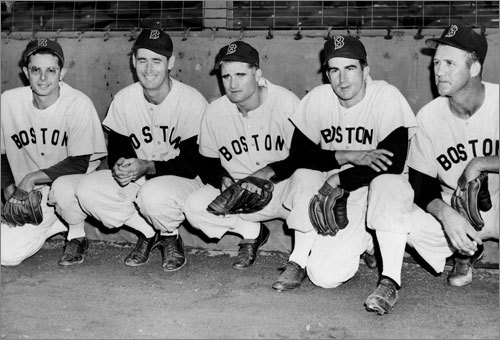
most dominant Red Sox team since their early-century dynasty ran away with the pennant in baseball's first year back from war, winning 104 games and the AL flag by a dozen over Detroit. Boston had the best offense in baseball, anchored by MVP
Ted Williams along with his good friends
Bobby Doerr,
Dom DiMaggio, and
Johnny Pesky. First baseman
Rudy York chipped in with 17 homers and 119 RBI--second on the team only to Williams' 123. The rotation was just as outstanding, featuring four solid starters in
Dave Ferriss,
Tex Hughson,
Mickey Harris and
Joe Dobson. Hughson won 20 games with a 2.75 ERA in a team-high 278 innings while Ferris won 25 and recorded an ML-best .806 win percentage. The Red Sox even had a good bullpen--a rarity for teams during those days--headed by relief specialists
Earl Johnson and
Bob Klinger. It was surprising, then, when they lost the World Series to the Cardinals in seven games, victimized by
Enos Slaughter's mad dash around the bases. Even more puzzling is how all that talent
failed to win another pennant.
|
|
The 1946 Red Sox were one of the best teams in franchise history (Fair Trade Milwaukee)
|
1956
The Sox were solid in '56, going 84-70 and finishing fourth. As usual, Boston featured a fearsome lineup but came up short on pitching. This team featured one of the better-hitting outfields in club history with Williams (1.084 OPS), Jimmy Piersall (a team-high 40 doubles) and
Jackie Jensen (97 RBI and a .901 OPS) leading the offense. They also squeezed a great year out of 38 year-old first baseman
Mickey Vernon, who slashed .310/.403/.511. The team had two terrific starters in
Tom Brewer and
Frank Sullivan, who went 19-9 and 14-7 with mid-three ERAs in 240-odd innings apiece, but the rest of the staff was a nightmare.
Mel Parnell pitched gallantly in his final season, contributing a 3.77 ERA and pitching a no-hitter along the way.
1966
The Impossible Dream was preceded by a recurring nightmare, as the Sox suffered their eighth straight losing season by going 72-90. There appeared to be a light at the end of the tunnel, however, as that marked a 10-game improvement over the previous year. It was also encouraging that Boston had the third-best record in the American League after July 3rd, going 44-39 to close out the season.
Though they had the youngest lineup in the MLB (only one of the team's 12 players who received 200 plate appearances,
Don Demeter, was older than 29), the Red Sox featured an above average offense led by
Tony Conigliaro,
Joe Foy,
George Scott, and
Carl Yastrzemski. Their youthful rotation wasn't as effective, but several starters such as
Jim Lonborg and
Jose Santiago showed promise. More importantly, Boston's staff as a whole improved after the All-Star break, lowering its ERA from 4.31 to 3.44 to fuel the team's second-half surge. With their young nucleus primed for a collective breakout under new manager
Dick Williams, who had managed many of them in the minors, the Red Sox had the pieces in place to make their miracle run in '67.
1976
After coming within one game of winning it all the previous October, Boston regressed into an 83-win, third place team in '76. The Sox started slow under manager
Darrell Johnson, who was replaced by
Don Zimmer midway through the season (much to
Bill Lee's chagrin). The summer of America's bicentennial was not a happy one around Fenway, as the team's beloved owner Tom Yawkey passed away on July 9th, his dreams of bringing a World Series championship to Boston unfulfilled.
On the field, the Sox fielded a potent lineup that led the league in home runs, total bases, slugging, and OPS. Boston's Gold Dust Twins--
Fred Lynn and
Jim Rice--followed up their outstanding rookie seasons with strong sophomore campaigns, while a timeless Yastrzemski continued to hit pacing the team with 102 RBI. The Red Sox got next to nothing from third basemen
Butch Hobson and
Rico Petrocelli, however, the latter of whom retired at season's end.
Boston received great pitching from its formidable trio of
Luis Tiant,
Rick Wise, and
Fergie Jenkins, but Lee missed nearly two months after getting hurt in a
dust-up with the Yankees. They were often betrayed by their bullpen, however, which struggled at inopportune times and contributed to the team's 22-29 record in one-run games. Flip those figures and the Sox would have won 90 games which, along with their 87-75 pythagorean record, suggests this team under-performed its true talent level.
1986
The most painful season in Red Sox history, 1986 was the year that led many to believe the team was cursed. Three times the Sox were one strike away from winning their first Fall Classic in 68 years, and three times those pesky Mets staved off elimination.
Then this happened.
Up until that moment, however, '86 had been a banner year for Boston.
Dwight Evans slammed the first pitch of their season out of Tiger Stadium,
Wade Boggs won another batting title, Jim Rice had his last great season, and
Roger Clemens set a major league record by whiffing 20 Seattle Mariners in addition to copping the league's MVP and Cy Young honors. The good times continued in the playoffs, as the Sox overcame 3-1 ALCS deficit to the California Angels after being down to
their last strike. Somewhere,
Dave Henderson is
leaping for joy.
1996
The Sox slipped a bit after winning the division in '95, dropping to 85 wins and third place in '96--the Rocket's final season in Boston and Nomah's first. Sunk by a 6-19 start, they failed to repeat as division champs despite a torrid second half. Their offense was only average even though reigning MVP
Mo Vaughn had the best year of his career, mashing 44 home runs to go along with 143 RBI and a 1.003 OPS.
Jose Canseco added firepower from the DH spot with 28 homers and a .989 OPS, while
Mike Stanley (24 homers, .889 OPS) enjoyed a terrific season behind the plate. Clemens was once again the ace of the staff, striking out a league-high 257 batters--including 20 in a game for the second time. The rest of the rotation was a disaster, however, and the bullpen was equally atrocious. The 'pen's lone bright spot was closer
Heathcliff Slocumb, who notched 31 saves and a 3.02 ERA in his Red Sox debut. General manager Dan Duquette would make a huge mistake by letting Clemens leave in free agency, but he redeemed himself the following summer by trading Slocumb to the Mariners for
Derek Lowe and
Jason Varitek.
2006
This was a disappointing season for Boston, who missed the playoffs after making three straight trips. The BoSox faded down the stretch after spending most of summer in first place, going 9-21 in August and getting swept by the Yankees in a five-game series at Fenway. The Red Sox ended up in third place--their worst finish since 1997. On the bright side,
David Ortiz broke Jimmie Foxx's franchise home run record, slamming 54 to lead the American League. It was a big year for Big Papi, who finished third in the MVP race after topping the circuit in walks, RBI, and total bases. He and
Manny Ramirez (35 homers, 102 RBI, and a league-best .439 OBP) proved to be a lethal tandem in the heart of
Terry Francona's order. They had help from newcomers
Mike Lowell (20 homers, 80 RBI, 47 doubles) and
Kevin Youkilis, who broke out in his first full season by batting .279/.381/.429 with 42 doubles and 100 runs. Rookie closer
Jonathan Papelbon was untouchable, posting a 0.92 ERA and 35 saves. The rest of Boston's pitching was a problem, though, especially since
Josh Beckett struggled in his transition to the American League.
Curt Schilling surprised everyone, however, by bouncing back from an injury-plagued 2005 to win 15 games and surpass 200 innings for the final time at age 39.
2016
Stay tuned...