Showing posts with label Ivan Rodriguez. Show all posts

Monday, July 31, 2017

Bags, Rock & Pudge


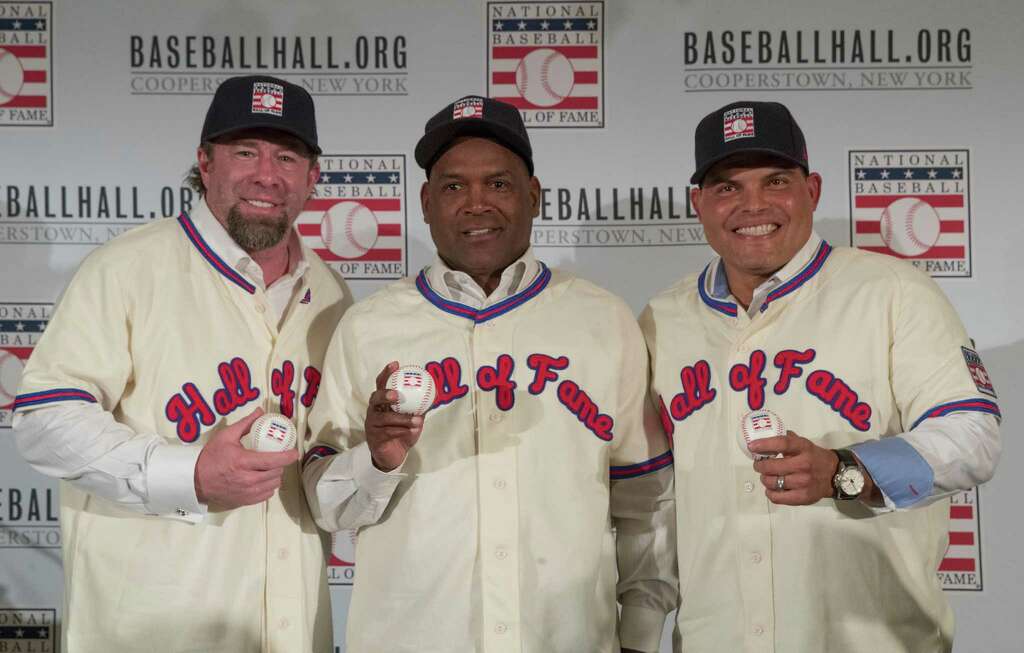
This weekend Ivan Rodriguez, Jeff Bagwell, and Tim Raines joined the Cooperstown ranks alongside executives Bud Selig and John Shuerholz. Trevor Hoffman and Vladimir Guerrero narrowly missed joining them, falling just a handful of votes short of election. Both are virtual locks to make it next year.

Even without the greatest closer not named Mariano Rivera and one of last decade's most exciting players, this year's class was a formidable one. It had arguably the greatest catcher of all-time (or at least the greatest since Johnny Bench), the greatest basestealer of all-time (in terms of success rate), and perhaps the greatest first baseman of the integrated era (or at least until Albert Pujols came along).

If  Rodriguez is not the greatest backstop of all-time, then he is certainly the best defensively. Both Baseball-Reference and FanGraphs have him leading the position easily in defensive WAR, with each putting him in the top 10 all-time for all positions. FanGraphs has him as the fourth-most valuable defender ever, ranking behind only Ozzie Smith, Brooks Robinson, and Mark Belanger. The drop-off between him and other backstops is so severe that it's hard to imagine anyone challenging his title, much less his record (for a catcher) of 13 Gold Gloves (Yadier Molina is still five away, in case you're wondering). Throw in his sizeable offensive contributions -- 311 home runs, 2,844 hits, a .296 lifetime average -- and it's clear that he's one of the three greatest catchers ever along with Bench and Yogi Berra.

It's hard to argue that Raines was the greatest base-stealer ever, especially since Rickey Henderson already claimed the title for himself. He never stole 100 bases in a season, which has been done 21 times throughout baseball history (he topped out at 90), and the difference in total thefts between him and Henderson is a whopping 598 -- more than all but 18 players have stolen in their entire careers. But Henderson got caught a lot more than Raines -- 189 times more, to be exact. As such, Raines' 84.7 percent success rate is considerably better than Henderson's 80.8 percent. It's also the highest of all-time for anyone who stole that many bases. So while Raines may not have been the most prolific base-robber of all-time, he was the best at combining volume and efficiency. And like Rodriguez, Raines brought a lot to the table with his bat, too, slashing .294/.385/.425 (123 OPS+) for his career with 2,605 hits and far more walks (1,330) than strikeouts (966). Add it all together and Raines was the second-greatest leadoff hitter of all-time, which somehow took the BBWAA 10 years to recognize.

And last but not least there's Bagwell, who was Pujols before Pujols. Check out their averages through their first 14 seasons:

Bagwell: 151 G 665 PA 108 R 32 HR 108 RBIs .297/.408/.542 (150 OPS+) 99 BB 110 K 14 SB
Pujols: 150 G 660 PA 108 R 37 HR 114 RBIs .317/.403/.588 (162 OPS+) 80 BB 65 K 7 SB

Pujols hit for a higher average and a bit more power while striking out less, but Bagwell walked more and stole twice as many bases. They were both good fielders, winning Gold Gloves for their play at first base, but the metrics say Pujols was better. Overall, you have to give the edge to Pujols, but it's close.

And yet, it took Bagwell seven tries to get into the Hall of Fame, whereas Pujols will be a slam-dunk as soon as he's eligible. The difference is that Bagwell played just 39 games in his 15th season and retired at 37, leaving him well short of several notable milestones such as 500 homers and 500 doubles. Pujols, whose contract runs until he's 42, has continued to play on through debilitating lower body injuries that have rendered him a full-time designated hitter. He's padding his career totals without adding much value on the field, socking his 600th homer this season in a year where he's been over a win below replacement level. A lifetime National Leaguer, Bagwell never had that option except during interleague games, playing a grand total of 10 games as a DH. Perhaps the DH would have lengthened his career, but we'll never know.

If nothing else, this year's class raises the bar for the average Hall of Famer. Next year we'll get Hoffman and Guerrero, along with likely newcomers Chipper Jones and Jim Thome. It's good to see the stars of the '90s and 2000s get the recognition they deserve. Now if we could only do something about the '70s and '80s...

Wednesday, December 14, 2016

Pudge Deserves First Ballot

Rodriguez might be the best catcher ever (Century21 Riverpointe)
Nineteen former players are eligible to be inducted into baseball's Hall of Fame for the first time this year. While a couple should be slam-dunks based on their numbers alone (Manny Ramirez says hello), it's possible none of them will be elected, especially with holdovers Jeff Bagwell, Tim Raines, and Trevor Hoffman all coming off near-misses last year (each received at least 67 percent of the vote). As such, the BBWAA may continue clearing the backlog of deserving candidates rather than welcome anyone new this year, although it's possible one lucky newcomer will break through.

Ivan Rodriguez is easily the strongest addition to this year's ballot, and an inner-circle Hall of Famer by any measure. He won an MVP and a World Series, along with seven Silver Sluggers (six consecutively from 1994-1999) and 13 Gold Gloves -- the most ever by a pitch-caller. He leads the position in numerous statistics, including games caught, runs, hits, doubles, and weighted runs created.  Fourteen times he was an All-Star.

Rodriguez was the perfect catcher. He hit for power (311 career homers) and average (.296 lifetime). He had speed (127 steals). He was also, as you may have inferred from his Gold Glove total, the best defensive backstop the game has ever seen. Baseball-Reference and FanGraphs both have him ranked number one, and by a considerable margin. Although his bat declined in his later years, he remained a top-notch receiver until the very end, placing fifth among NL catchers in Total Zone Runs in his final season despite playing just 44 games. Even as a 39-year-old backup catcher who couldn't hit, he was still above replacement level.

Based on defense alone, Pudge is worthy of a place in Cooperstown, but it's his contributions with the stick that make him worthy of first-ballot induction. In addition to slashing .296/.334/.464 (104 wrC+) for his career, he also approached 3,000 hits and 600 doubles, settling at 2,844 and 572, respectively. He drove in and scored more than 1,300 runs. He was an offensive force in 1999 -- the year he edged Pedro Martinez for MVP honors -- and again the following year, when he had a 1.042 OPS before a fractured thumb ended his season in late July.

Put it all together, and Rodriguez has a legitimate case as the greatest catcher in baseball history. Jay Jaffe's JAWS metric, which combines career value with peak value, ranks him third behind Johnny Bench and Gary Carter. Pudge combined Bench's defense with the longevity and offense of the previous Pudge -- Carlton Fisk. He was remarkably durable and consistent for a catcher; according to FanGraphs, he was worth at least three wins every year from 1995 through 2005 (and worth 2.9 WAR in 2006, when he batted .300 for the final time and helped lead Detroit to a pennant).

And yet, despite all that, Rodriguez will likely be barred from the Hall this year due to rumors of steroid use during his career. He never tested positive, but Jose Canseco claimed Rodriguez juiced during their time together in Texas, and Canseco's been right about these things more often than not. Some may also see Rodriguez's slimmer physique and declining home run totals during the testing era as proof, but by that point he was in his early 30s and should have been declining naturally (his last season as an above average hitter came at 32). It is suspicious, however, that he was able to catch more games than anyone in history despite spending 13 seasons in the Texas heat. He seemed especially superhuman during the late '90s, when he was putting up monster offensive numbers while catching more than 140 games per year.

Based on what happened with similar cases (Bagwell and Mike Piazza), steroid suspicion will likely prevent Rodriguez from gaining entry on the first ballot. Now that Piazza's in, however, there's no legitimate reason for keeping Rodriguez out. He was a better defender and compiled superior counting stats, plus won an MVP and was a key leader on a World Series winner. The electorate has become more forgiving of PED-associated players in recent years, but my guess is that Rodriguez may fall just short of election this year. Hopefully they prove me wrong.