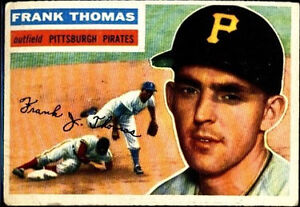
Before there was Frank Thomas--"The Big Hurt" and one of the greatest righthanded hitters of all-time--there was Frank Thomas, another righthanded slugger by the same name.
The original Frank Thomas, if you will, actually put together a pretty decent career. He came up as a center fielder with the Pirates in 1951, but before long he was a corner outfielder and ultimately a first baseman. In 1953, his first full season, he smashed 30 home runs and drove in 102. He made the All-Star team the two years after that, then again in 1958--his final season in Pittsburgh. That was the year he played third base everyday set numerous personal bests, including home runs (35), RBI (109) and OPS (.863). He finished fourth in the MVP race that year behind a trio of guys you may have heard of: Ernie Banks, Willie Mays, and Hank Aaron.
After leaving Pittsburgh (who went on to win the World Series without him in 1960), Thomas seemed to suit up for a different team every year. He spent 1959 with Cincinnati (two years before they won the pennant), 1960 with the Cubs, then got traded to the Braves early in '61. After that he joined the Mets for their inaugural season and was one of the few players to play at the major league level (34 homers and 94 RBI in his last good season). Mercifully, he was dealt to the Phillies midway through 1964, just in time for their infamous September collapse. In 1965 he was traded twice--first to the Astros, then back to the Braves--before returning to the Cubs in 1966 and finishing out his career (two years after his final game, almost to the exact day, Frank Thomas was born).
Astoundingly, he switched teams eight times and played for seven different ballclubs in his 16 years, and not once did he leave the National League. "The Big Hurt" played his first 16 seasons with one team, the Chicago White Sox, and did so in the free agent era, no less. Thomas the first wasn't a bad player, by any means, but pretty much all of his value came from his power and he never really found his natural position. Had he come along a couple decades later, he probably would have been a great DH, just like that other guy named Thomas.
Friday, December 13, 2013
Tuesday, December 10, 2013
Thoughts on Bobby Doerr
| Was Doerr under-appreciated during his day? |
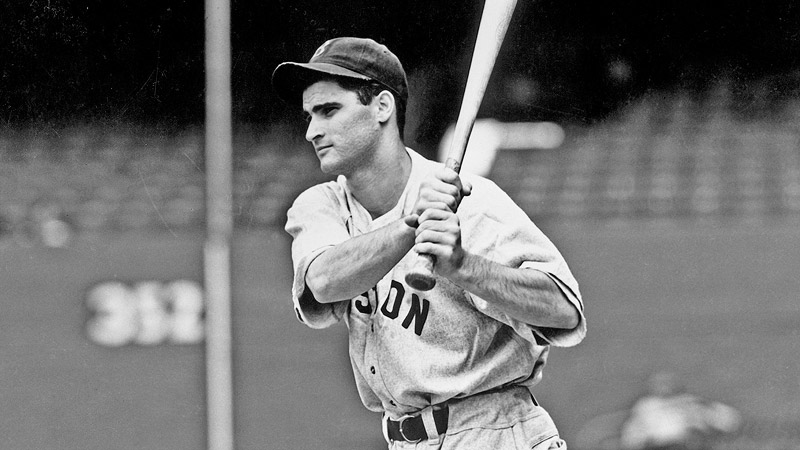
All this Robinson Cano talk got me thinking about second basemen, and since I'm a Red Sox fan I naturally thought about the two greatest keystone defenders in franchise history: Dustin Pedroia and Bobby Doerr. Seeing as how I wrote at length about Pedroia over the summer, I decided to jot down a few thoughts on Doerr:
- Had a) Boston beaten St. Louis in the 1946 World Series and b) the World Series MVP award existed at the time, Doerr would have been a favorite to win it. Johnny Pesky's double play partner batted .409/.458/.591 in a losing cause for the Sox.
- How did Doerr not get more MVP consideration, especially in the five seasons after World War II? He finished third in '46, but Ted Williams was the runaway favorite that year, and never again finished in the top-15. I just don't get it. Doerr did everything that baseball writers loved to see during those days. He hit for good averages, drove in lots of runs, played a key position for winning ballclubs and was a respected team leader (He was also good at hitting into double plays, which maybe the writers held against him). Obviously having Williams on the same team didn't help, but then Derek Jeter's fared pretty well in the voting even though he was more of a really good complementary player. You have to figure that if the Red Sox hadn't unraveled at the end of 1948 and '49, Doerr would have seen a slight boost in his vote totals.
- Like Pedroia, the right-handed Doerr loved hitting at Fenway Park. He was a .315/.396/.533 hitter there compared to .261/.327/.389 on the road. Had he played anywhere else, he probably wouldn't be in the Hall of Fame.
Monday, December 9, 2013
Halladay Hangs it Up
| Halladay is calling it quits after back-to-back down seasons |
Starting in 2002, Halladay put together a ten-year run that's about as good as any pitcher has ever had. He went 170-75 with a 2.97 ERA (148 ERA+) and a 1.11 WHIP. He also sustained a ridiculous 4.57 K/BB ratio and averaged nearly 220 innings per year, despite making just 40 starts in 2004 and 2005 combined. He made eight All-Star teams and was easily the most valuable pitcher in baseball during that stretch, which is reflected by his strong Cy Young vote totals. A two-time winner (in 2003 and 2010), he also finished runner-up twice, third once, and fifth two other times. He polled in the top five every year from 2006 through 2011.
His combination of command and durability made him one of the game's elite. During a time when pitchers were often criticized for not pitching as deep into games as their predecessors, Halladay bucked the trend. He routinely logged more than 230 innings per season, leading the league in that department four times, and compiled as many as 266 in his first Cy Young campaign in 2003, the most any American League hurler had thrown since Roger Clemens in 1991. No one in either league has come within ten innings of that mark since. He was so efficient, so economical with his pitches, that he was pretty much a lock to go at least seven innings every time he toed the rubber. No wonder he led the league in complete games seven times in nine years, including a season (2005) when he made 19 starts. He was truly in a league of his own.
Of course, there's more to Halladay than his impressive innings totals. His 3.38 ERA is also very good, especially for someone who pitched the first half of his career in the so called "steroid era" and spent 12 of his 16 seasons in the AL East. He almost never walked anybody, and in the second half of his career he began posting impressive strikeout totals as well.
Based on the level of dominance he displayed in his early 30s, Halladay's career seemed to be following the trajectory of Curt Schilling's. Then in 2012, the year he turned 35, he hit a brick wall. His walk rate ballooned, his strikeout rate dropped, and opponents began taking him yard more regularly. His velocity plummeted and he had difficulty locating his pitches. Over the last two years, he just wasn't the same pitcher. Age and injuries reduced him to a shell of his former self. But that doesn't diminish how exceptional he was during his prime.
Thanks to that incredible peak, JAWS rates him comfortably within the top 50 starting pitchers of all-time, sandwiched between Bob Feller and Juan Marichal--two no-doubt Hall of Famers. but a bit below the average inductee at the position. Although Halladay's peak stacks up well against most Hall of Famers, his lack of longevity (only eight seasons with more than 25 starts) means his career totals are slightly lacking. He's a good Hall of Fame candidate, especially since he was widely regarded as one of baseball's best pitchers when he played (and threw a no-hitter in the postseason to boot), but isn't the slam-dunk that some of his peers--Greg Maddux, Tom Glavine, Pedro Martinez, and Randy Johnson--are. He won't get in on the first-ballot, but should get enshrined eventually.
Halladay had a heck of a run, and I for one am sad to see it end.
Labels:
Baseball,
Cy Young,
MLB,
Retires,
Roy Halladay
Sunday, December 8, 2013
Red Sox Re-Sign Napoli
| As expected, Napoli will return to Boston next year |
Napoli, who set career highs with 38 doubles and 92 RBI last year, also batted .259/.360/.482 with 23 home runs in his Red Sox debut. He played a surprisingly strong first base as well, rating as one of the league's top defenders at the position. To top it all off, he delivered several timely hits during Boston's title run, including a go-ahead solo home run off Justin Verlander in the LCS and a bases clearing double against Adam Wainwright in Game 1 of the World Series.
Given his age (32), the crazy amounts of money being thrown around this winter and the lack of available first basemen, Napoli probably could have gotten more money had he wanted to play elsewhere. But he chose to remain with Boston, and the Red Sox rewarded his allegiance with a multi-year deal that will pay him $16 million annually. Combined with the $13 million he earned last year, Napoli is getting a better deal compared to the three-year, $39 million contract he originally signed with Boston last winter, only to have that reduced to one year and five million dollars (plus another eight in performance incentives, which he earned). So, in total, he'll earn $45 million from his three seasons with Boston, which is exactly what Carlos Beltran just got from the New York Yankees.
Considering that Beltran's a future Hall of Famer, that's not bad company at all.
Saturday, December 7, 2013
Hot Stove Update: The Bronx is Burning
| Granderson stayed in New York but defected to the Mets |
Mets sign Curtis Granderson for four years, $60 million
I'm pretty surprised Grandy Man didn't have to settle for a one-year contract somewhere to re-establish his value after an injury-marred 2013 in which he played just 61 games and posted his worst OPS since his 2004 debut. Then again, he's just one season removed from a 43 homer campaign. Still, if I'm a Mets fan I don't love this deal. Age--he'll be 33 at the start of the contract--is a concern, but what's more troubling is how Yankee Stadium turned Granderson into an all-or-nothing hitter. In 2012 he batted .232 and fanned 195 times, whiffing in 28.5 percent of his plate appearances. The trend continued last year with his .229 batting average (a new career low) and 28.1 K%. I see more low batting averages and high strikeout rates in his future, but far fewer home runs without a short porch in right to aid him. Furthermore, he's a poor defensive center fielder who should be shifted to a corner spot.
Yankees sign Carlos Beltran for three years, $45 million
Beltran makes his return to the Big Apple after spending six and a half seasons with the Mets from 2005 through 2011. The Yankees were hot on Beltran's tail in the winter of 2005, only to see him sign with the Mets for $119 million. At the time, he was widely regarded as one of baseball's most talented players, a Gold Glove center fielder with 40/40 potential. Now he's a 36 year-old corner corner outfielder/DH with creaky knees and zero speed. He can still hit a bit, as he proved with St. Louis, and his power should translate well to Yankee Stadium. At this stage in his career he's more of a 2-3 win type of player than the 5-6 win beast he was in his prime, but that's still a significant upgrade over what Ichiro Suzuki is these days.
Yankees bring back Hiroki Kuroda for one year, $16 million
This ends the speculation that Kuroda would retire or return to Japan to pitch in the NPB. He emerged as the Yankees ace last season in what was a down year for CC Sabathia. Kuroda was tremendous for most of the season before fading down the stretch, going 0-6 with a 6.56 ERA over his final eight starts as opponents walloped him to the tune of .316/.364/.551. Was it just a bad stretch by an otherwise excellent pitcher? Or was that the beginning of the end for the soon-to-be 39 year-old? The Yankees are gambling $16 million to find out if he has anything left in the tank.
Kelly Johnson signs with Yankees for one year, $3 million
New York nabbed Johnson as an insurance policy in case Cano signed elsewhere, and good thing they did. Johnson's not an everyday second baseman anymore, not after batting .226/.307/.395 in the last three years combined, but he's still a solid platoon option against righties with decent pop (16 homers in each of the past two seasons). He can't hold a candle to Cano, but then again few players can.
Subscribe to:
Posts (Atom)