Showing posts with label 1964. Show all posts

Saturday, January 26, 2019

Stottlemyre the Savior

Stottlemyre helped extend the post-war Yankees dynasty one more year (NYT)
Earlier this month, former MLB pitcher and pitching coach Mel Stottlemyre passed away from cancer. He was 77.

In an 11-year playing career spent entirely with the New York Yankees, Stottlemyre distinguished himself as one of the best pitchers in franchise history. A five-time All-Star, Stottlemyre averaged 15 wins per season while compiling a sparkling 2.97 ERA for his career. He was also a workhorse, topping 250 innings every year from 1965-1973 and leading the American League in complete games twice.

That success on the mound served Stottlemyre well over the next three decades, first as a roving instructor and then as a pitching coach. He tutored some of baseball's best hurlers during stints with the Mariners, Mets, Astros, and Yankees, including Dwight Gooden, Roger Clemens, Andy Pettitte, Felix Hernandez, Mike Mussina, and the great Mariano Rivera. While he never won a World Series as a player, his teams won five championships with him on the bench.

Stottlemyre's greatest accomplishment on the field, however, was helping pitch the Yankees to the 1964 pennant as a 22-year-old rookie. After winning 104 games and the pennant in '63, New York got off to a slow start in '64 under new skipper Yogi Berra, who had trouble reining in the same players who'd been his teammates and drinking buddies the year before. When Stottlemyre arrived in August to stabilize the rotation, the Yanks were in third place and 3 1/2 games out of first, putting them in jeopardy of missing the World Series for the first time in five years.

The season seemed to be slipping away when Stottlemyre took the hill for his first Major League start on Aug. 12 against the second-place Chicago White Sox, who had taken the first two games of a four-game set at Yankee Stadium. Having lost seven of their previous nine, the Yankees were in desperate need of a spark from the fresh-faced 22-year-old, who was leading the International League (AAA) with 13 wins, six shutouts and a 1.42 ERA at the time of his call-up.

Stottlemyre answered the bell, tossing a complete-game seven-hitter to halt New York's skid. Even the offense appeared rejuvenated, bashing four homers in support of the rookie, who hadn't even received an invitation to Spring Training just a few months before. It was, in the words of New York sportswriter Til Ferdenzi, "movie script stuff."

Stottlemyre's next pressure-packed start came four days later in Baltimore against the first-place Orioles, led by eventual league MVP Brooks Robinson. That didn't faze Stottlemyre, however, who limited the O's to just one run on five hits over 8 2/3 sterling innings. A rare error by Clete Boyer with two outs in the ninth prevented Stottlemyre from notching his second straight complete game, but once again he had come up big for the Yankees.

Stottlemyre wasn't getting much help from his teammates, however, who promptly dropped six in a row before his next turn on Aug. 22, falling 5 1/2 games back of the Orioles and seemingly out of the race. The sputtering Yankees once again turned to Stottlemyre to stop the bleeding, and once again he responded, delivering a complete-game shutout in the nightcap of a doubleheader at Fenway Park to keep their pennant hopes alive.

The win proved to be a turning point, igniting a furious 30-11 run by the Yankees to close out the season that featured six additional Stottlemyre victories -- three of which were complete games. He won five straight starts during the heart of that stretch, including the game that moved New York into first place for good on Sept. 17. When the dust settled in early October, Stottlemyre had gone 9-3 with a 2.06 ERA across 96 innings, helping New York overtake Chicago and Baltimore in the standings to capture the pennant by a single game.

After putting the Yankees over the top during the regular season, he nearly did the same in the World Series. After New York lost Game 1 in St. Louis, Stottlemyre bested the Cardinals' Bob Gibson in Game 2 to even the series. The duo squared off again in Game 5 at the Stadium, with Stottlemyre twirling seven innings of two-run ball. The Yankees lost in the 10th, however, after Tim McCarver belted a crushing three-run homer to put St. Louis up in the series. The Yanks bounced back to win Game 6, forcing a Game 7 showdown between Stottlemyre and Gibson, both of whom were working on two days' rest.

The pair traded zeroes through three innings before Stottlemyre stumbled in the fourth, giving up three runs after shortstop Phil Linz threw away a potential double play ball. Berra lifted his young star for a pinch-hitter in the top of the fifth, only to watch the bullpen immediately surrender three more runs in the bottom of the frame. A 6-0 deficit against Gibson proved to be insurmountable for even the mighty Yankees, who rallied for three homers but ultimately fell short, losing 7-5.

Still, the future appeared bright for Stottlemyre, who appeared poised to be the next great Yankee ace. He lived up to his end of the bargain in '65, winning 20 games even as the team crumbled around him. Despite toiling for generally mediocre clubs, he established himself as one of the best pitchers in baseball over the next decade, ranking fifth in wins and second in innings from 1965-1973. Had his career not ended when he was just 33 years old, he'd probably be in the Hall of Fame, alongside several pitchers he later went on to coach.

So while the Yankee dynasty died a painful death in the mid-60s, Stottlemyre helped wring one more pennant out of its aging core, proving to be one of the most impactful midseason call-ups in baseball history. It may not have had the ending he or his teammates wanted, but it still made for a pretty good story.

Wednesday, October 15, 2014

Remembering the 1964 St. Louis Cardinals

The '64 Cardinals: a model of integration and loaded with talent (The Baseball Page)
Piggybacking off this morning's post: here's a quick look at the 1964 St. Louis Cardinals team that won it all. Everyone remembers the Phillies' epic collapse that year, but St. Louis made it possible by forging an eight-game win streak in late September to pass Philadelphia, then win the final game of the season to avoid a three-way tie with Philly and Cincinnati.

Without further adieu. your 1964 World Series champions:

C Tim McCarver
McCarver was just 22 years-old but already in his fifth season with the Cards. He batted a very solid .288/.343/.400 while catching 137 games, good for 3.4 bWAR.

1B Bill White
White was one of the team's elder statesmen at 30, but still young enough to continue his run as the National League's top all-around first baseman. An All-Star for the fifth and final time, White won his fifth straight Gold Glove award in addition to batting .303/.355/.474. He finished third in the MVP race thanks to his strong counting numbers: 5.4 bWAR, 21 home runs, 102 RBI, 92 runs, 191 hits, 37 doubles, and 299 total bases.

2B Julian Javier
Javier was barely above replacement level due to his .644 OPS, though his 12 homers and 65 RBI were career-highs up to that point.

3B Ken Boyer
The major league RBI leader (with 119) was also the National League MVP, even if Dick Allen was clearly more deserving. Boyer was outstanding in his last great season, playing every game, batting .295/.365/.489, and compiling 6.1 bWAR. The All-Star third baseman also socked 24 homers, scored 100 runs, and racked up 307 total bases.

SS Dick Groat
The former MVP and batting champion with the Pirates was still among the league's best shortstops at 33. Had no power whatsoever (1 home run) but played all but one game and made the All-Star team for the fifth and final time. Batted .292/.335/.371 with more walks (44) then strikeouts (42). Also ripped 35 doubles.

LF Lou Brock
Acquired midseason from the Cubs via trade, Brock helped ignite the Cardinals to the pennant. The 25 year-old future Hall of Famer batted a scintillating .348/.387/.527 with 12 home runs and 33 steals in 103 games with St. Louis, contributing 5.7 bWAR while hitting out of the two hole.

CF Curt Flood
Flood made his first All-Star squad, won his second Gold Glove, and paced the National League with 211 hits. The Cards' leadoff hitter also batted .311, scored 97 runs, and was worth 4.7 bWAR.

RF Mike Shannon
"Moonman" missed most of the first half with injuries but rebounded with a healthy second half to finish the year with a solid .261/.315/.410 line.

Bench

LF Charlie James
The starting left fielder displaced by Brock, James was relegated to pinch-hitting duties after the trade.

RF Carl Warwick
Warwick helped cover for Shannon while he was out and provided a close approximation of Shannon's slash lines at .259/.306/.373.

RF Bob Skinner
A midseason trade to the Cardinals, Skinner supplemented Shannon in right and was also used as a pinch-hitter.

Rotation

SP Bob Gibson
A pitcher on the rise in '64, Gibson was still a few years away from becoming "Bob Gibson." That said, he was still an incredible talent. His 287 innings, 3.01 ERA, 245 strikeouts and 2.85 K/BB ratio topped the rotation. He also won 19 games, completed 17 of his 36 starts, and was worth six wins above replacement.

SP Curt Simmons
At 35 and in his 17th big league season, Simmons wasn't blowing hitters away (3.8 K/9) but was still crafty enough to fool them. He also had impeccable control, with only 1.8 BB/9. How else do you explain how he completed 244 innings, won 18 games and went the distance in 12 starts?

SP Ray Sadecki
The team's lone 20 game winner, Sadecki was a 23 year-old southpaw still finding his way in the big leagues. He tossed 220 innings but was clearly the team's third-best starter behind Gibson and Simmons.

SP Roger Craig
After a couple rough years with the Mets, Craig appeared to enjoy pitching for a contender. Between his 19 starts and 20 relief appearances, Craig contributed 166 innings of 3.25 ERA-ball.

SP Ernie Broglio
Was pitching decently (3.50 ERA in 11 starts) before being traded for Brock.

SP Ray Washburn
Pitched very well in May and June with a 3.29 ERA in his 10 starts. Was shifted to the bullpen afterwards and struggled there, allowing eight earned runs in only five appearances.

Bullpen

CL Barney Schultz
The aging knuckleballer had a sparkling 1.64 ERA and 0.93 WHIP during the regular season, but he'll always be remembered for giving up Mickey Mantle's walk-off blast in Game 3.

RP Ron Taylor
Led Cardinal relievers with 63 appearances and 101 innings, but was very effective with a 4.62 ERA and 1.40 WHIP.

RP Mike Cuellar
Before he was a 20-game winner and anchor of those great Baltimore Orioles rotations under Earl Weaver, he was a rookie reliever with a 4.50 ERA in 72 innings. Talk about an inauspicious beginning.

RP Bob Humphreys
One of the team's most effective relievers with a 2.53 ERA in 28 appearances.

RP Gordie Richardson
Like Humphreys. very effective (2.30 ERA) in limited action (47 innings)

Manager

Johnny Keane
In his fourth year at the helm of the Cardinals, Keane led them to a repeat of their 1963 record (93-69). While that was only good enough for second place in '63, in '64 it won the pennant. He was on the hot seat for much of the season before his team improbably passed the Phillies in the final weeks of the season. Shockingly, Keane resigned after winning the Series, a decision he'd made in late September at the height of the pennant race. He would manage the Yankees in 1965, replacing Yogi Berra.

After examining both rosters, I think the Cardinals had a better team even though they won fewer games. St. Louis's starting lineup was stronger and more balanced, and stayed healthy enough to prevent Keane from relying on his weak bench. Pound for pound the rotation was just as good as New York's, though the bullpen was definitely weaker. Overall the Yankees had more depth, but St. Louis had more players in their prime and more "stars". Their best players were better than New York's, even if their worst players were worse than New York's. Accordingly, I am not surprised the Cards took the Series in 7.

McCarver, Boyer, and Gibson celebrate (I70Baseball)

October 1964: 50 Years Later

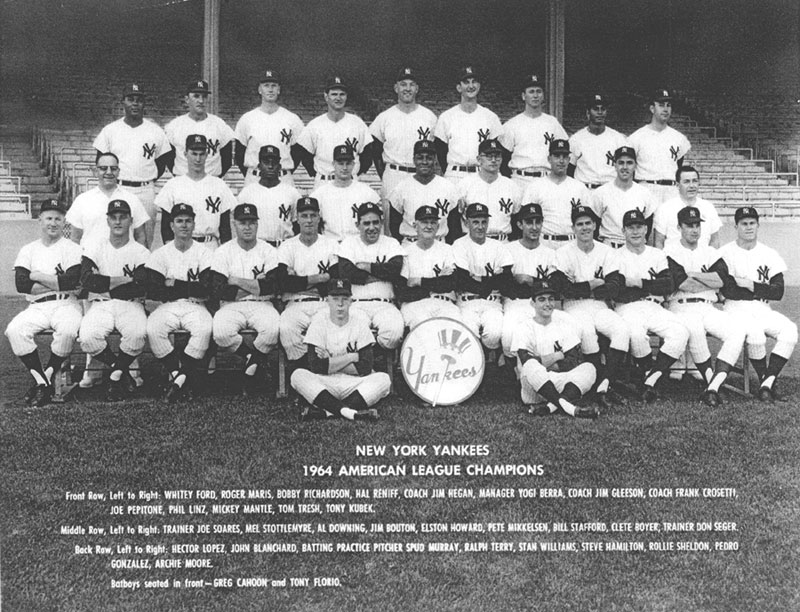
New York's team picture lacks faces of color (TheDeadballEra)
50 years ago today, the St. Louis Cardinals won the World Series by beating the New York Yankees in a decisive Game 7 at Busch Stadium. The Cards won 7-5 behind Bob Gibson, who went the distance in his third Series start despite surrendering three long balls and nine hits in all. It was, David Halberstam wrote 30 years later, a turning point for the sport, the end of one dynasty coinciding with the birth of another. More significantly, the torch was passed from a still largely-white organization to a shining example of integration.

The Yankees, winners of their fifth straight pennant, needed every one of their 99 wins to squeak by the White Sox (98 wins) and Orioles (97). They wouldn't win another pennant until 1976. Here's a quick look at that great Yankees squad (check back later for a breakdown of the Cardinals):

Starting Lineup

C Elston Howard
The 1963 American League MVP finished third in the balloting behind Brooks Robinson and Mickey Mantle. The All-Star receiver batted .313/.371/.455, won his second straight Gold Glove, and played 146 games behind the plate (150 overall). Was worth 5.6 bWAR.

1B Joe Pepitone
All-Star swatted 28 home runs and drove in 100, though his rate stats were horrible at .251/.281/.418.

2B Bobby Richardson
All-Star and Gold Glove recipient. Was limited offensively (.626 OPS), but provided decent counting numbers such as 90 runs, 181 hits, and 11 steals in 13 tries.

3B Clete Boyer
A black hole on offense (.573 OPS) but an elite gloveman at the hot corner, second only to Brooks Robinson.

SS Tony Kubek
Couldn't hit a lick (.615 OPS) but still played good enough defense to be worth two wins above replacement.

LF Tom Tresh
Switch-hitting outfielder struggled compared to his previous two seasons, but still smacked 16 home runs and was a perfect 13-for-13 in stolen base attempts.

CF Mickey Mantle
In his last great season, the MVP runner-up mashed 35 home runs and had 111 RBI. Physically, the Mick (then-32) was a mess, but that didn't stop him from posting the highest OBP (.423), OPS (1.015) and OPS+ (177) in the major leagues. Pitchers wisely avoided him, throwing him four wide ones on 18 occasions, most in the AL.

RF Roger Maris (3.9 bWAR)
In his last good season with the Yankees, Rajah slugged 26 home runs and batted .281/.364/.464.

Bench

Phil Linz
Posted a solid .332 OBP and clubbed 21 doubles in 417 plate appearances.

Hector Lopez
Provided 10 home runs off the bench to go along with his .260/.317/.418 slash line in 313 PAs.

Johnny Blanchard
Blanch batted a robust .255/.344/.435 with as many walks (24) as strikeouts, albeit in only 189 plate appearances.

Pedro Gonzalez
Failed to go yard in 123 plate appearances but still managed to bat a solid .277/.331/.366.

Rotation

Jim Bouton
"Bulldog" followed up his breakout 1963 campaign with another stellar season in '64, posting a 3.02 ERA and 1.06 WHIP over 271 and 1/3 innings--third most in the American League. True to his nickname, the 25 year-old Bouton topped the American League in starts while leading his team in innings and wins. It would be his last great year before arm troubles ruined his career.

Whitey Ford
Sharp as a tack at 35, Ford ranked second to Cy Young winner Dean Chance in the American League with 6.7 pitching bWAR. Slick posted the lowest FIP (2.45) and second-lowest ERA (2.13) of his Hall of Fame career in 244 and 2/3 innings. An All-Star for the eighth and final time, the Chairman of the Board notched his 200th career win in his second start of the season.

Al Downing
Like Bouton, Downing was in the second full season of his career. Also like Bouton, he regressed a bit from his breakout 1963 but still wound up with good numbers in '64. The 23 year-old completed 244 innings and led the American League in strikeouts with 217, but was also wild and paced the Circuit in walks too. He'd become forever famous 10 years later for serving up the gopher ball to Hank Aaron that broke Babe Ruth's career home run record.

Ralph Terry
After throwing 594 and 2/3 innings in 1962 and 1963 combined (World Series included) Terry fell apart in his final season with the Yankees, going 7-11 with a 4.54 ERA and 1.40 WHIP. The scuffling 28 year-old was demoted to the bullpen midseason, and though he returned to the rotation pitched sparingly in September. He'd be dealt to Cleveland after the season, enjoying a bounce back year in 1965 before retiring two seasons later.

Mel Stottlemyre
A 22 year-old rookie, Stottlemyre made his debut in mid-August and stabilized New York's rotation down the stretch. He helped spark the Yankees to the pennant by going 9-3 with a 2.06 ERA.

Rollie Sheldon
One of five Yankees to exceed 100 innings, Sheldon made 12 starts for the Bombers and seven relief appearances. He pitched well with a 3.61 ERA, 1.08 WHIP and 3.17 K/BB ratio.

Bullpen

CL Pete Mikkelsen
The 24 year-old closer was Berra's most-used reliever, leading the club with 50 appearances, 27 games finished and 12 saves.

RP Stan Williams
"Big Daddy," a one-time All-Star with the Dodgers, made 10 starts and 11 relief appearances but failed to distinguish himself.

RP Hal Reniff
"Porky" was second on the team in appearances with 41. He pitched well out of the pen with a 3.12 ERA, 1.11 WHIP, and nine saves

RP Bill Stafford
Not only did Stafford go 5-0 with a 2.67 ERA, but he also started a game, saved four, finished 12, and appeared in 31.

RP Steve Hamilton
The tall, lanky left-hander was New York's primary southpaw reliever.

Manager

Yogi Berra
Upon Berra's retirement in 1963, incumbent skipper Ralph Houk was promoted to general manager and Berra became field manager. While Berra guided his team to another pennant and came within one win of delivering a championship, he was not well-respected by his players, almost all of whom were former teammates. The future Hall of Famer was axed following the '64 Series.

Upon further review, I'm kind of dumbfounded as to how this team won 99 games, even though their Pythagorean Record (98-64) says it was no fluke. The offense had multiple weak spots (pretty much the entire infield save Howard), yet somehow finished second in runs scored despite ranking fifth in OBP, fourth in slugging, and fourth in OPS (all middle-of-the-pack in a 10 team league). They had good power but not much speed. I guess the fact that three regulars carried an OPS+ below 75 was offset by strong bench play, with the four most-used reserves posting an OPS+ of 92 of better.

Their pitching could be explained in a similar way. The rotation had a big three of Ford, Bouton, and Downing, though I'm very shocked they only won 48 games between them given that they accounted for more than half (50.4 percent) of the Yankees' innings. Except for Terry, the fourth and fifth rotation spots were surprisingly decent, especially after Stottlemyre's call-up. The bullpen was solid, with no obvious weak links but no standouts either. It also helped that New York fielded a very strong infield defense, capable outfield (except Mantle, who by that point was a wreck), and a tremendous catcher in Howard.

Nowadays, I think this team would win 90 games. But back then, when there were only 10 teams in the American League, teams could be more flawed and still win.

(From L to R) Pepitone, Tresh, Maris, and Mantle (MyYESNetwork)