Showing posts with label Fall Classic. Show all posts

Monday, November 2, 2015

Royals Rally to Win Championship

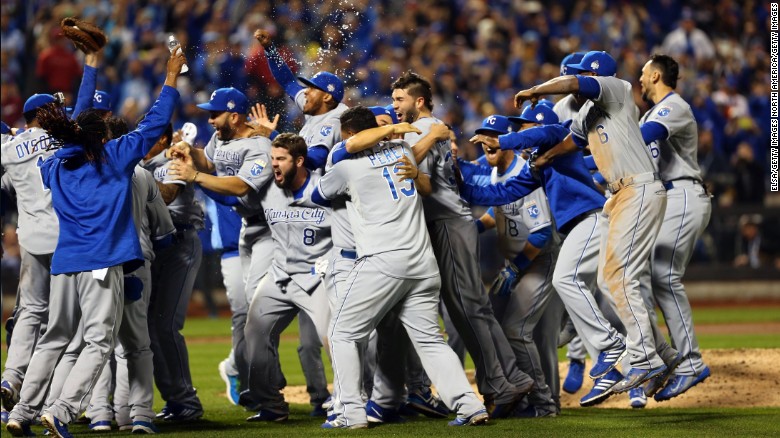
Three of Kansas City's four wins in this series were come-from-behind (CNN)
It is easy to envision a scenario in which the New York Mets, and not the Kansas City Royals, were the ones celebrating their first championship in three decades yesterday.

In Game 1, the Mets took a 4-3 lead into the bottom of the ninth. After Jeurys Familia, who had been lights-out all year, got Salvador Perez to ground out, New York's chances of winning stood at 89 percent. The Mets were two outs--two stinking outs--away. They should have won this game. Alex Gordon homered, however, and the Royals ultimately prevailed in 14 innings.

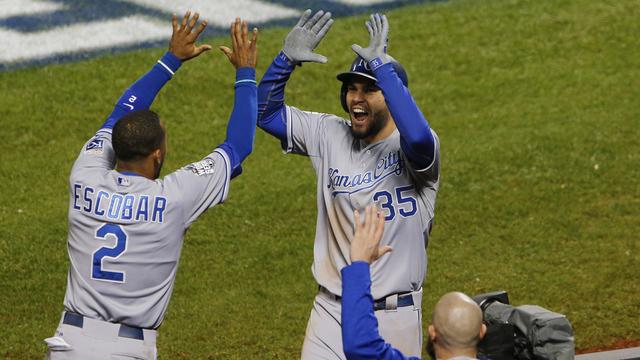
In Game 4, the Mets looking to even the series at two games apiece after winning Game 3. They led 3-2 through seven. After Alcides Escobar grounded out to lead off the eighth, New York's odds of victory improved to 82 percent. Then Tyler Clippard (a mess all playoffs) issued two consecutive walks, bringing Familia into the game, and since Familia was clearly cursed this week of course things went south from there.

Familia got Eric Hosmer, the other hero of Game 1, to tap a slow-roller towards Daniel Murphy at second. Murphy came charging in, reached down to scoop it with his glove...and came up with nothing but air. Ben Zobrist scored, a sure out had been lost, and the game was tied. Back-to-back singles followed, giving Kansas City a 5-3 lead. The Royals, in case you hadn't noticed, don't blow 5-3 leads in the eighth inning or later. Like, ever. And they didn't.

As painful as those two losses were, both paled in comparison to the gut-wrenching defeat New York suffered in Game 5. With the Mets one loss away from elimination and Edinson Volquez throwing gas, they needed a gem from Matt Harvey. They got one, as he fired eight shutout innings, allowing just four hits and one walk while striking out nine. In the biggest game of his life, a game his team absolutely had to win, he'd been almost perfect.

Harvey walked off the mound after needing just nine pitches to get through a 1-2-3 top of the eighth. Citi Field's roaring applause followed him to the dugout, where he exchanged handshakes and high-fives with his teammates and coaches before collapsing onto the bench. Though the temperature had dropped into the 50s by that point, his face was covered in sweat.

While the Mets were batting in the bottom of the eighth, pitching coach Dan Warthen came over to inform Harvey that he was coming out of the game.

"No way," Harvey said. "No way, no way, no way."

Warthen was still talking, trying to tell the pitcher what a great job he did, but Harvey wasn't listening.

"No way," he repeated. "No way." In this moment, Harvey's vocabulary had been reduced to two words. He wouldn't take no for an answer.

Warthen hadn't finished talking yet when Harvey walked away, down the bench in search of Terry Collins. When he found him, he repeated what he'd said to Warthen.

"No way," Harvey said again. "No way am I coming out of this game."
Collins lets Harvey convince him to remain in the game (NY Post)
When Murphy struck out to conclude the eighth, Harvey hopped out of the dugout and strolled back to the pitcher's mound, much to the crowd's surprise. This was his game to win, or lose. He had gotten the Mets 89 percent of the way there, recording 24 of 27 outs. He only needed to get three more.

Players will say the last three outs of a ballgame are the toughest to get. History says otherwise, but against the Royals that is 100 percent accurate. For whatever reason, Kansas City has a knack for late game heroics. Just when it looks like you're about to finish them off, they jump back from the ropes and deliver a haymaker to the temple. Or, more appropriately, straight to the stomach.

It also helped that this time, Terry Collins was having a Grady Little moment. He'd sent a tired ace back out after throwing 102 pressure-packed pitches, not to mention 216 innings--postseason included--in his first year back from Tommy John surgery (the recommended limit is 160-180). The situation called for Collins to bring in his closer to finish out he game, which entailed facing Kansas City's 3-4-5 hitters, but Collins let Harvey have his way. Maybe he was spooked by Familia's meltdowns in Game 1 and Game 4. Maybe he was as mesmerized by Harvey as the Royals had been. Maybe he was swayed by Harvey's passionate plea to let him stay in. All we know is in that moment, he did not make the move he would have made in any of the 175 games that preceded this.

In all likelihood, it wouldn't have mattered. These Royals were a team of destiny, and they would have rallied no matter who Collins chose to pitch the ninth. But their odds were greatly improved by the presence of a gassed Harvey as opposed to a fresh reliever out of the 'pen. While their odds of winning were technically only six percent, they suddenly seemed much greater.

Any Red Sox fan could tell you what happened next. Harvey lost Lorenzo Cain on a full count and walked him, driving his pitch count up to 109. On pitch number 110, Cain stole second. On pitch 111, Hosmer launched a double down the left field line, scoring Cain and cutting New York's lead in half.

Collins had seen enough, and did what he should have done two batters beforehand. He took the ball out of Harvey's hands and summoned Familia.

The decision to let Harvey stay in looked even worse when Familia got three consecutive groundouts, the second of which scored a run only because there had been a man on second when he entered the game. Had he been allowed to start the inning, obviously, that would not have been the case.

And so the last game of the World Series, like the first one, went to extra innings. Not surprisingly Kansas City, with its superior bullpen, came out on top again. For the third time in a week, the Royals had come back to win a World Series game where they'd trailed in the eighth inning or later. For the third time in a week, the Mets had blown a game they had at least an 80 percent chance of winning.

And that is how we'll remember the 2015 World Series. The Mets faltering late in games, committing costly errors and not getting the big outs when they needed to, and the Royals, once again, proving they are impossible to kill.

Unless you have Madison Bumgarner.

Sunday, November 1, 2015

New York Needs a Miracle

Kansas City came back to win Game 4 (CBS Sports)
After yet another comeback win, the Kansas City Royals are one victory away from winning the World Series. The New York Mets, on the other hand, need to win three more times--in a row, including twice on the road--to capture the flag. Simple math would seem to favor the Royals.

But while the Mets are down, you can't say they're out. Not when they have Matt Harvey pitching tonight, Jacob deGrom going on Tuesday, and Noah Syndergaard starting Game 7 if needed. Those three rank among the best, hardest-throwing pitchers in baseball. When you have them lined up like that, you have a fighting chance against anybody.

It's just weird that the Mets find themselves in this position. After never trailing in the NLCS, New York has been playing catch-up this whole series, or at least since they lost Game 1. I felt at the time that their inability to hold onto that ninth inning lead would come back to haunt them, and sure enough, it has completely altered the Fall Classic's dynamic. If Alex Gordon flies out to the track there, or even hits it off the wall, the Series would be tied at two rather than 3-1 Royals. But in a best-of-seven, you can't afford to make those mistakes. Teams wins 95 percent of games they lead going into the ninth inning. During the most important games of the year, you better not have one of those 5 percent games, but the Mets have basically had two in five days.

Tonight's game will be a rematch between Game 1 starters Edinson Volquez and Matt Harvey, who compiled nearly identical stat lines in the Series opener. Volquez has been tough since suddenly finding an extra foot on his fastball, but Harvey's still the superior pitcher. He's had one very good start sandwiched between two decent turns this postseason, but he'll have to be at his absolute best tonight. When your team is one loss away from being eliminated, there's no margin for error.

Friday, October 31, 2014

Poor Royals


While the San Francisco Giants are basking in the glory of their third championship in five years (which I guess makes them a dynasty), the Kansas City Royals are surely reeling from such a heartbreaking defeat. Losing Game 7 by one run is tough, especially when you're on your home field and especially when you last made the playoffs in 1985. It's tougher still when the game ends with the tying run standing on third base.

With Alex Gordon 90 feet away after Gregor Blanco misplayed his two out single, Salvador Perez needed only a single, just a little single, to tie the game and possibly chase Madison Bumgarner from it. All he needed was for a blooper to fall in, for a ground ball to find a hole, and it would have been a brand new ballgame.

Bumgarner, well aware of Perez's aggressive tendencies, fed the catcher a steady diet of high fastballs. Perez couldn't resist. On the sixth one, he popped up.

Pop ups, at least in my opinion, are the most disappointing type of out a player can make. The ball goes up, and right away you know nothing good can happen. The best case scenario is that it lands in the seats--foul--or that the fielders can't get to it in time or they miscommunicate and it falls harmlessly to the ground. By the time it's reached its apex you can usually tell whether it's going to be caught or not. And then you wait, wait for it to drop into the fielder's mitt below.

A pop out is perhaps the easiest out to predict before it happens, because so much time passes between the ball leaving the bat and settling into the fielder's glove. It allows time to think, and more importantly to recognize what is about to transpire. When Perez popped up and Pablo Sandoval chugged under it, we knew the game was over. The series was over, and with it the season. The Royals had lost. The Giants had won. Game, set, match..

Other teams have come closer--the 1986 Red Sox and 2011 Texas Rangers come to mind, one strike away from victory. But man, the Royals were right there. If only they'd held on to win Game 4. If only Eric Hosmer hadn't dived into first base. If only Gordon sprinted out of the box on that soft single to center. If only.

The 1967 Red Sox couldn't overcome Bob Gibson. The Yankees were helpless against Curt Schilling and Randy Johnson, then Josh Beckett two years later. And the 2014 Royals couldn't figure out Madison Bumgarner. Better luck next year.

Thursday, October 30, 2014

San Francisco's Sneaky Dynasty

Watching the Giants win the last game of the season has become commonplace
It took the Giants 53 seasons to win a World Series after leaving New York following the 1957 season. The drought, snapped in 2010, has been followed by a deluge, as San Francisco has won two more championships since, all under the guidance of future Hall of Fame manager Bruce Bochy.

The Giants have done it with solid all-around teams. None of those title teams had a 30 home run hitter or a 20 game winner, but they were all deep and balanced. Kudos to GM Brian Sabean for building winning rosters year after year.

The first of those teams--the 2010 edition--was a good one. The '10 Giants won 92 games and the NL West, scoring nearly 700 runs while allowing below 600 for a strong run differential of +114. They were middle of the pack offensively but fielded an elite pitching staff that led the National League in ERA and strikeouts. Matt Cain and Tim Lincecum fronted a rotation that included a 20 year-old rookie named Madison Bumgarner. The bullpen featured Brian Wilson at the peak of his powers (48 saves, 1.81 ERA) along with a pair of dominant relievers in Sergio Romo and Santiago Casilla.

Minus Bumgarner, the pitching staff was largely comprised of players in their prime. The starting nine was an odd mix of young (20 year-old Buster Posey in his rookie season, 23 year-old Pablo Sandoval in his third) and mostly old veterans and cast-offs (Aubrey Huff, Aaron Rowand, Pat Burrell, Edgar Renteria). But pretty much everyone could hit for some power and get on base, and so the Giants cobbled together a surprisingly effective lineup. They beat the Braves in four in the NLCS, toppled Philadelphia in six for the pennant, then glided past the Texas Rangers in five games for the championship.

After missing the playoffs with an 86-win season in 2011, the Giants won their division again in 2012. Though they won two more games than and outscored their 2010 predecessors by 21 runs (thanks almost entirely to Posey's MVP-season, Melky Cabrera's PED-fueled outburst, a career year from Angel Pagan, and Hunter Pence's late-season contributions), their pitching wasn't as good and their run differential slipped to +69.

Looking back, it's hard to believe how that lineup scored more than 700 runs when only one guy (Posey) hit more than a dozen home runs and only three reached double digits. Similarly, only those three exceeded 60 RBI, with Posey the only one over 65. But while the Giants did not have much power, ranking dead last in home runs with 100, they did excel at getting on base and getting hits. With many of the veterans from the 2010 squad gone or phased out, San Francisco was a younger and more athletic team (as evidenced by their 118 steals).

The key to that team's success was a rotation that remained remarkably healthy. The starting five of Bumgarner, Cain, Lincecum, Barry Zito, and Ryan Vogelsong started all but two games that year. Lincecum went off the rails (10-15, 5.18 ERA), but the rest of the rotation was formidable enough to compensate. The bullpen was still led by Casilla, Romo, and Javier Lopez though Wilson had become irrelevant. Jeremy Affeldt, a member of the 2010 outfit, emerged as one of the team's best relievers to give San Fran a strong relief corps.

Those 2012 Giants were lucky to even reach the World Series. They went the distance against the Reds in the NLDS and prevailed over St. Louis in Game 7 of the NLCS. After that it was smooth-sailing, as they swept the heavily-favored Tigers in the World Series.

2013 was a nightmare season for San Francisco, which lost 86 games and was never really in contention. The Giants were better in 2014, good enough to make the playoffs but still not a great team. They earned a wild card berth with 88 wins and a +51 run differential mostly because of torrid second halves from Buster Posey and Jake Peavy.

The lineup, as always, had few standouts but was solidly constructed, overcoming significant injuries to four of the nine main contributors. Of the 10 players with the most plate appearances on the club, all but one (Brandon Hicks) had an OPS+ above 100. Like the 2010 version, they could all get on base and hit for a bit of pop, which goes a long way. The speed from the 2012 team was absent, however, as the plodding Giants swiped just 56 bases and finished last in the NL.

With Cain hurt and Lincecum ineffective, Bumgarner was the clear-cut ace. He had help in the form of Tim Hudson and, in the second half, Peavy, but San Fran's rotation was pretty thin (as exposed by the weak-hitting Royals in the Fall Classic). The bullpen was still headed by Affeldt, Romo, Lopez, and Casilla in addition to Jean Machi. Like the rotation, it was neither great nor terrible, which explains how San Francisco was so average.

But while this year's championship edition was the worst of the three, it had the easiest run up to the World Series. The Giants cruised past the Pirates in the play-in game, washed away the Nationals in four games in the NLDS, then upset the Cards in five games. They stumbled in the Fall Classic, nearly going down three games to one before rallying to win Games 4, 5, and 7. They may have needed plenty of help from Mr. Bumgarner, but at the end of the day they still got the job done.


The Magnificent Madison Bumgarner

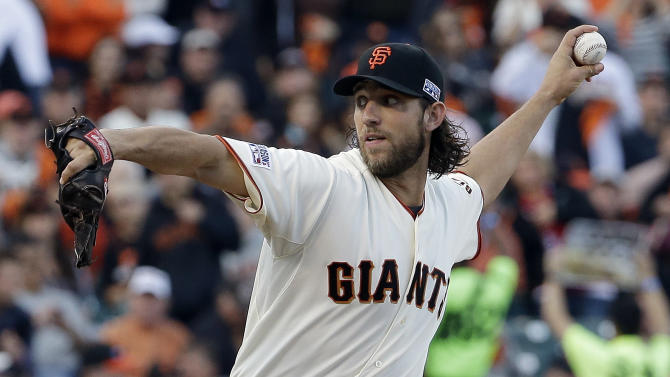
Bumgarner capped a stellar postseason with a marvelous World Series (Yahoo)
Even before last night, we knew Madison Bumgarner's 2014 postseason run was spectacular, one of the best ever, in fact. We knew it represented a pitcher at his absolute best. We knew we were witnessing a level greatness rarely sustained for long during playoff time.

What we did not know, however, was how that run would end. We knew Bumgarner was going to make a relief appearance in Game 7 three days after spinning the first Series shutout in over a decade. Nobody could have known how long he'd stay in or how effective he would be.The general consensus was that he'd pitch one to three innings.

He went five, closing out the game and the series with the most memorable postseason relief appearance this side of Pedro Martinez.

Bumgarner, as he was all month, was absolutely nasty. Once again he proved to be the Royals' kryptonite, muting their bats over five scoreless innings. Kansas City managed just two hits against him, both singles. For the third time in the series, they were completely and utterly helpless against him.

They were hardly the only ones looking overmatched against him this fall (his ERA this postseason: 1.03). First he blanked the Pirates on the road in the wild card play-in game, and that was just the appetizer. He turned in seven strong innings in his lone NLCS start versus the Nationals, then seven and 2/3 scoreless frames in St. Louis in Game 1 of the NLCS. Back at home for Game 5, he went eight innings and allowed three runs in the pennant clinching game.

By the time the World Series rolled around, the 25 year-old southpaw was all warmed up. He pitched the Giants to an easy victory in Game 1 with seven innings of one-run ball. He hurled a four-hit shutout in Game 5 to bring San Francisco within one game of the title. And, after Jake Peavy and Tim Hudson faltered in Kansas City, Bumgarner took his team all the way with five scoreless frames.

MadBum was as deserving as a World Series MVP possibly can be. He put the team on his back, carried them on his shoulders, and delivered them to their third World Series title in five years. While he was credited with the save in Game 7 (Jeremy Affeldt got the win), for all intents and purposes he won three games in this series.

Bumgarner's stat lines from this series are just ridiculous. There's the one earned run in 21 innings, of course, which works out to a 0.43 ERA. He walked only one batter over that span (Lorenzo Cain in Game 1) and allowed just nine hits (only three of which went for extra bases), resulting in a 0.48 WHIP. Of the 74 batters he faced, he retired 63 of them (85 percent), 17 by way of the K. Opponents batted just .127/.151/.197 against him, and he threw 70 percent of his 291 pitches for strikes.

What we saw was a great pitcher at the peak of his powers, and the result was probably the best postseason any pitcher has ever had. Even more incredible is that Bumgarner was able to do what he did after tossing a career high 217 and 1/3 innings during the regular season. Including his five inning relief appearance, he basically made 40 starts this year and remained sharp to the last out.

Bumgarner's been a great pitcher for several years now (did you know he was a two-time All-Star?), but this World Series felt like his coming out party the way 2003 was for Josh Beckett. Madison Bumgarner is now a household name the way Clayton Kershaw and Justin Verlander are. The best part is; he's barely 25.

Wednesday, October 29, 2014

Stats that Don't Mean Anything Tonight

Here are 7 stats that won't mean a thing in tonight's winner-take-all Game 7:

1. The Royals have never lost a Game 7.
Why it's meaningless: They've only played two.

2. Tim Hudson is the oldest pitcher to ever start a Game 7.
Why it's meaningless: Hudson was an All-Star this year and has a dozen postseason starts under his belt. I'd trust him more than I'd trust Jeremy Guthrie.

3. Buster Posey does not have an extra base hit in these playoffs.
Why it's meaningless: Posey's one of the best pure hitters in baseball, coming off a regular season in which he batted .311/.364/.490 with 22 home runs. Posey has plenty of pop, even if his power has been absent in October.

4. Alex Gordon is batting .125 with no walks in the World Series.
Why it's meaningless: Gordon was Kansas City's clear MVP this year. All good players go through slumps, and there's no doubt that Gordon's in one, but he's such a good all-around player that he's still an asset even when his bat is quiet.

5. Only one of the games in this World Series was decided by fewer than five runs.
Why it's meaningless: Despite the lopsided scores of every game except the third, these teams are very evenly matched. KC has won 100 games this year, San Francisco has won 99. The Royals have scored 25 runs in this series, the Giants have plated 27. Any way you look at it, this game's a toss-up.

6. Madison Bumgarner has never made a relief appearance in the World Series before.
Why this is meaningless: MadBum's enjoying one of the most dominant postseason runs of all time and has baffled the Royals. He can't lose.

7. Nobody has lost a World Series Game 7 at home since 1979.
Why it's meaningless: That streak will end eventually.

Royals Rout Giants, Force Game 7

The Royals staved off elimination with a blowout victory (TheStar)
It was a game the Kansas City Royals absolutely had to win, and it was over by the third inning.

Faced with a win-or-go-home scenario in Game 6 of the 2014 World Series, just two days removed from managing a mere four hits against Madison Bumgarner, Kansas City broke out the bats. The Royals hung seven on the board in the second, equaling in one inning what they scored across 27 in San Francisco, and plated 10 in all. Kansas City's Game 6 run total exceeded its output in Games 1, 3, 4, and 5 combined.

The offensive outburst couldn't have come at a better time. There will be a Game 7 after all.

For that the Royals can thank Jake Peavy, who followed up his poor Game 2 start with an abysmal outing. He recorded only four outs before departing, leaving San Francisco's bullpen to mop up the remaining six and 2/3 innings. Peavy was about as bad as a pitcher can be, allowing five runs on six hits and giving the home team a commanding early lead. The poor Giants never even had a chance.

Then again, Peavy could have pitched brilliantly and still would have lost, as San Francisco scored nary a run. The Giants certainly had their chances, as 11 of them reached base, but the visitors came up empty in their six opportunities with runners in scoring position. They were thus shutout by Yordano Ventura, then Jason Frasor, and finally Tim Collins.

Speaking of Ventura, what a performance! 23 years old and fresh off his first full big league campaign, he rose to the occasion in the biggest game of his life. With five walks in seven innings he wasn't quite Bumgarner-esque, but nevertheless shut down San Francisco to eliminate whatever slim hopes there were of a comeback. Move over, James Shields; there's a new big game pitcher in town.

Of course, Ventura's effort will be in vain if Kansas City loses tonight. With a championship on the line, in the biggest baseball game the city has seen in three decades, the Royals will be counting on...Jeremy Guthrie, a thoroughly mediocre pitcher in 2014 with a 4.13 ERA and 1.30 WHIP across 202 and 2/3 innings. Guthrie earned the win in Game 3 but has failed to complete more than five innings in either of his postseason starts. It's a good thing Kansas City's bullpen is well-rested after Ventura's outing, because Ned Yost is going need all hands on deck for this one.

The Giants will counter with Tim Hudson, a grizzled veteran of 39 years, 16 of them spent in the big leagues. Still searching for a ring in his seventh postseason, Huddy has the chance to decide his team's destiny tonight. He was the tough-luck loser in Game 3 and will be looking to erase an entire career's worth of October frustration. Does his right arm, which has logged more than 3,000 innings in the big leagues, have enough bullets to keep Kansas City's spotty lineup at bay? The Giants' third title in five years depends on it. He has so much at stake in terms of pride and reputation, combined with such a distinguished track record, that I can't envision him pitching poorly. If he loses, it's going to be close, and it's going to hurt.

Adding to the intrigue is that both Yost and Bruce Bochy can call upon their aces if necessary. With two days rest, Shields and Bumgarner would typically use today as a throw day, but given the circumstances will be available to come out of the bullpen. That has to be a terrifying thought for the Royals, who've been utterly helpless against MadBum in this series. They better jump out to an early lead against Hudson, because if they have to deal with Bumgarner late in the game they're screwed.

I've said all along that the Giants were going to win this thing, and I'm not going back on my prediction now. I say they take Game 7 by a score of 4-2.

Monday, October 27, 2014

Bumgarner Delivers

Bumgarner was lights-out in the crucial fifth game of the World Series (NYDailyNews)
Madison Bumgarner was spectacular once again last night, pitching the San Francisco Giants to within one game of their third World Series title this decade.

MadBum was electric in front of a capacity crowd at AT&T Ballpark, gifting the fans with one of his best performances in the final game of the season there. He was truly masterful, yielding only four hits and no walks while striking out eight as he shut out the Royals. Only twice did he allow runners to reach scoring position. For the second time this series, in which he now has a 0.56 ERA, the 25 year-old southpaw got the better of "Big Game" James Shields.

Shields, to his credit, pitched well, scattering eight hits over six innings and permitting just two runs. He redeemed his poor Game 1 performance by keeping his team in the game before turning said game over to the bullpen, which for the second night in a row gave the game away. Kelvin Herrera surrendered two runs in his lone inning of work (the seventh), and Wade Davis allowed one in his (the eighth). The way Bumgarner was pitching, spotting him a five run lead may as well have been 15.

Offensively the Giants were led by Hunter Pence and Pablo Sandoval, who continued their monster series with two hits and two runs apiece. Pence is now batting a ridiculous .474/.545/.737 in this Fall Classic, while Sandoval is raking at a .364/.364/.455 clip. Yordano Ventura and the Kansas City bullpen must find a way to neutralize them in Game 6, as well as the always-dangerous Buster Posey, if they're going to have any chance of playing Game 7. Ventura pitched well enough in Game 2, making it into the sixth inning after allowing two runs on eight hits, but given the Royals' recent bullpen woes he may need to be even stingier.

With the series shifting back to Kansas City, San Francisco has two chances to close out the title. In Game 6 the Giants will try to do so behind Jake Peavy, who pitched poorly in Game 2 (four runs in five innings). He'll need to be better than that against Kansas City's live-armed rookie, otherwise his team will be in the unenviable position of playing a Game 7 on the road.

I like the Royals' chances tomorrow night, back at home and with the superior pitcher on the mound. I'd also love to see a Game 7. Hopefully the home team can pull it out.

Sunday, October 26, 2014

Royal Collapse

The Royals appeared to have the series well in hand, until the Giants came back (ESPN)
When the San Francisco Giants inevitably win this World Series, we will point to the second half of Game 4 as the moment when it all fell apart for the Kansas City Royals, just as one looking to explain Detroit's collapse in last year's ALCS need only mention David Ortiz's series-shifting grand slam off Joaquin Benoit.

Because the Giants, for all intents and purposes, were toast. Done. Finished. They entered the bottom of the fifth inning of Game 4 down 4-2 in the game and 2-1 in the series. It goes without saying that if San Francisco loses that game their season's essentially over, because they have to beat James Shields in Game 5, then travel to Kansas City and win back-to-back games on the road. No way they were winning three straight against a team that began this postseason 8-0.

So San Francisco, with its back basically to the wall, rallied. More than that, the Giants exploded for nine runs, all against a Kansas City bullpen that had previously been untouchable. San Fran scored two in the fifth to tie it, three in the sixth to pull ahead, and four in the seventh to put the game out of reach. When the smoke cleared at game's end, the home team had pounded the Royals for 11 runs and 16 hits, equaling their run total from the series' first three games.

Now, with the series even at two games apiece and their ace, Madison Bumgarner, on the mound tonight, the Giants have new life. They have the best pitcher in the series going for them, one who has been nothing but filth these playoffs (1.40 ERA in five starts). The 25 year-old southpaw is on such a roll right now that he can't lose, nor will he in the most important game of the season. Bumgarner, like Josh Beckett and Curt Schilling before him, is going to come through for his team when they need him the most.

The same can't be said about Shields, who's tarnished his "Big Game" nickname with his recent lackluster performance.  He was battered in Game 1 to the tune of five runs and seven hits in three innings, spiking his 2014 playoff ERA to 7.11 and his career postseason mark to 5.74. Shields is better than that and still the best starting pitcher Kansas City has, but if I'm Ned Yost or a Royals fan I definitely don't feel too great about my chances tonight.

The irony is that Shields was brought to Kansas City for precisely this moment; a must-win playoff game. Dayton Moore was willing to give up Wil Myers to have Shields available for a game like this. But with the Royals in their first postseason since 1985, Shields has been more of a detriment than asset. The free agent-to-be has the chance to redeem himself tonight, in what will most certainly be the final game he ever pitches for the Royals. But if he gets shelled again, then the Royals' losing the World Series is going to be on him, and Moore's going to have to live with the fact that he traded Myers for the wrong guy.


Thursday, October 23, 2014

Royals Return Favor

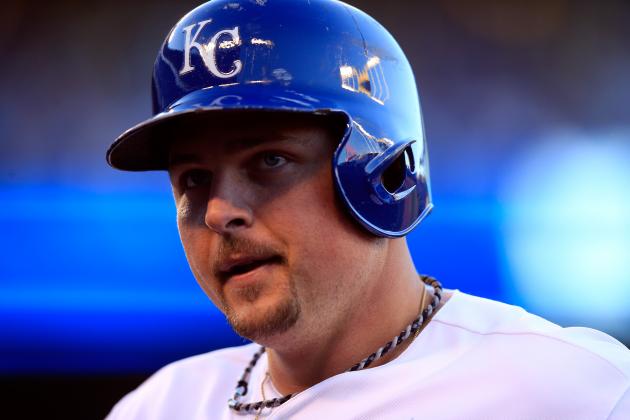
Billy Butler came up big for the Royals with a pair of RBI singles (BleacherReport)
After getting pounded 7-1 by the San Francisco Giants in Game 1, the Kansas City Royals responded with a 7-2 victory in Game 2 to even the World Series at one win apiece.

Though the scores of the games were nearly identical, they played out very differently. Game 1 was all Giants from the outset, as they jumped all over James Shields for three runs in the first and led the entire game. San Francisco was in control from start to finish. Game 2, at least through the first five innings, was closely contested.

Once again the Giants drew first blood, this time on a Gregor Blanco leadoff homer. Unfazed, Yordano Ventura regained his composure and set down the next three Giants in order. Kansas City responded with a run of its own in the bottom half to knot the score at one on a Billy Butler RBI single. The Royals took their first lead of the series the following inning when Alcides Escobar doubled home Omar Infante. After a scoreless third, the Giants evened the score at two-all in the top of the fourth on Brandon Belt's RBI double.

The score remained 2-2 until the bottom of the sixth, when Kansas City blew the door down with a five run frame. Giants' starter Jake Peavy was still dealing (Ventura had departed in the top half), but Bruce Bochy quickly lifted him from the game after Lorenzo Cain singled and Eric Hosmer walked to begin the inning. Four pitching changes later, and the Royals had themselves an improbable 7-2 lead. Butler singled Cain home for the go-ahead run, putting Kansas City ahead for good. Following an Alex Gordon fly out, Salvador Perez provided some insurance with a two-run double, preceding Infante's back-breaking two-run shot that finished the Giants.

San Francisco was unable to scrape anything together in the final innings as the Royals went on to win 7-2. The series shifts to San Francisco for Game 3 on Friday night, which will feature Jeremy Guthrie against Tim Hudson. As well as Guthrie pitched in his ALCS start against Baltimore (five innings, one earned run, three hits and two walks allowed) I have to give the edge to Hudson. Huddy's had the better year, the better career, and has the advantage of pitching at home, where he was slightly more effective this year with a 3.76 K/BB ratio, 1.21 WHIP and .704 opponents OPS compared to 3.29, 1.25 and .720 on the road. Expect the Giants to bounce back on their home turf in Game 3.

Wednesday, October 22, 2014

Giants Grab Series Lead

San Francisco won Game 1 behind a brilliant start from Madison Bumgarner (WSOCTV)
The Royals' postseason winning streak of 11 (dating back to the 1985 World Series) was snapped last night as Kansas City lost Game 1 of the World Series, 7-1. The San Francisco Giants, making their third World Series appearance in five years, earned a decisive Game 1 victory on the road to open the Series.

The Royals' meek offense was no match for Giants' ace Madison Bumgarner, who held them to three hits and one run over seven stellar innings. The southpaw continued his month-long run of dominance, lowering his ERA in these playoffs to a microscopic 1.40 while improving his career postseason record to 6-3.

Meanwhile, "Big Game" James Shields failed to live up to his reputation once again, as he was bombed for five runs and seven hits in three innings. Shields struggled from the get-go, allowing hits to five of the first six batters he faced as San Francisco jumped out to an early 3-0 lead. He seemed to settle down with 1-2-3 innings in the second and third, only to unravel again in the fourth. Hunter Pence stroked a leadoff double, Brandon Belt followed with a walk, and Michael Morse singled to drive Pence home.

That was all for Shields, who saw his postseason ERA swell to 5.74 with the poor outing. Danny Duffy came on in relief and walked in a run before getting himself out of a bases loaded, one out jam.

But the damage was done. The Giants would have all the runs they would need on a night when Bumgarner was practically unhittable. San Francisco padded its lead to 7-0 in the seventh, and when Salvador Perez touched MadBum for a solo shot in the bottom half of the frame the game was already out of reach. Bumgarner departed after 106 pitches, having struck out five against only one walk, and the Giants bullpen took it from there.

Tonight's Game 2 becomes a must-win for the Royals, who need to even the series before traveling to San Francisco for Games 3, 4, and 5. They'll send young Yordano Ventura, their 23 year-old flamethrowing rookie, to the mound against Jake Peavy, a major league veteran of 13 years. Peavy, pitching in the Fall Classic for the second year in a row, has been a revelation since being traded from Boston in late July. Ventura was excellent in his ALDS start but struggled against Baltimore in the ALCS, so it's tough to say how he'll perform in his first World Series start. Peavy's on a roll, with a 2.14 ERA since joining San Francisco, and will look to maintain that momentum against a meager Royals lineup that managed just four hits against his teammates last night.

In a matchup of young versus old, Kansas City needs its youth to step up, otherwise there may not be another game at Kaufmann Stadium this year after tonight.

Wednesday, October 15, 2014

October 1964: 50 Years Later

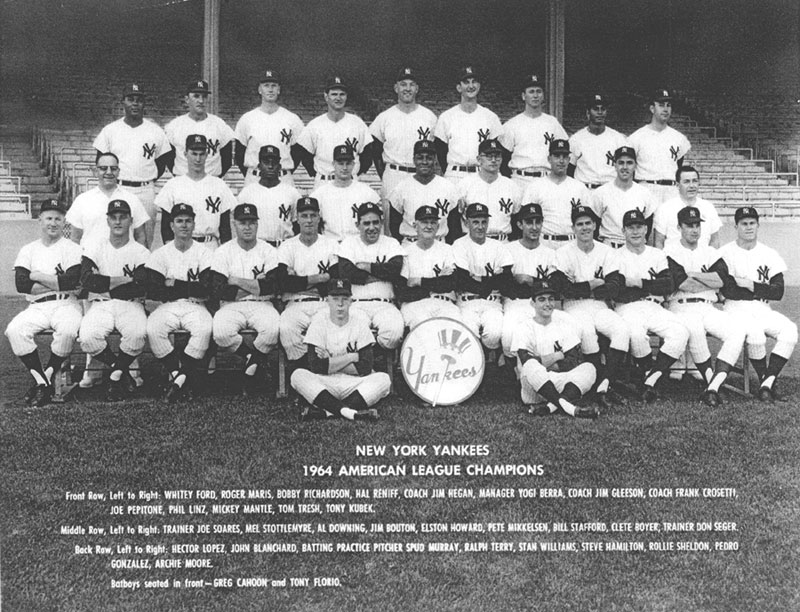
New York's team picture lacks faces of color (TheDeadballEra)
50 years ago today, the St. Louis Cardinals won the World Series by beating the New York Yankees in a decisive Game 7 at Busch Stadium. The Cards won 7-5 behind Bob Gibson, who went the distance in his third Series start despite surrendering three long balls and nine hits in all. It was, David Halberstam wrote 30 years later, a turning point for the sport, the end of one dynasty coinciding with the birth of another. More significantly, the torch was passed from a still largely-white organization to a shining example of integration.

The Yankees, winners of their fifth straight pennant, needed every one of their 99 wins to squeak by the White Sox (98 wins) and Orioles (97). They wouldn't win another pennant until 1976. Here's a quick look at that great Yankees squad (check back later for a breakdown of the Cardinals):

Starting Lineup

C Elston Howard
The 1963 American League MVP finished third in the balloting behind Brooks Robinson and Mickey Mantle. The All-Star receiver batted .313/.371/.455, won his second straight Gold Glove, and played 146 games behind the plate (150 overall). Was worth 5.6 bWAR.

1B Joe Pepitone
All-Star swatted 28 home runs and drove in 100, though his rate stats were horrible at .251/.281/.418.

2B Bobby Richardson
All-Star and Gold Glove recipient. Was limited offensively (.626 OPS), but provided decent counting numbers such as 90 runs, 181 hits, and 11 steals in 13 tries.

3B Clete Boyer
A black hole on offense (.573 OPS) but an elite gloveman at the hot corner, second only to Brooks Robinson.

SS Tony Kubek
Couldn't hit a lick (.615 OPS) but still played good enough defense to be worth two wins above replacement.

LF Tom Tresh
Switch-hitting outfielder struggled compared to his previous two seasons, but still smacked 16 home runs and was a perfect 13-for-13 in stolen base attempts.

CF Mickey Mantle
In his last great season, the MVP runner-up mashed 35 home runs and had 111 RBI. Physically, the Mick (then-32) was a mess, but that didn't stop him from posting the highest OBP (.423), OPS (1.015) and OPS+ (177) in the major leagues. Pitchers wisely avoided him, throwing him four wide ones on 18 occasions, most in the AL.

RF Roger Maris (3.9 bWAR)
In his last good season with the Yankees, Rajah slugged 26 home runs and batted .281/.364/.464.

Bench

Phil Linz
Posted a solid .332 OBP and clubbed 21 doubles in 417 plate appearances.

Hector Lopez
Provided 10 home runs off the bench to go along with his .260/.317/.418 slash line in 313 PAs.

Johnny Blanchard
Blanch batted a robust .255/.344/.435 with as many walks (24) as strikeouts, albeit in only 189 plate appearances.

Pedro Gonzalez
Failed to go yard in 123 plate appearances but still managed to bat a solid .277/.331/.366.

Rotation

Jim Bouton
"Bulldog" followed up his breakout 1963 campaign with another stellar season in '64, posting a 3.02 ERA and 1.06 WHIP over 271 and 1/3 innings--third most in the American League. True to his nickname, the 25 year-old Bouton topped the American League in starts while leading his team in innings and wins. It would be his last great year before arm troubles ruined his career.

Whitey Ford
Sharp as a tack at 35, Ford ranked second to Cy Young winner Dean Chance in the American League with 6.7 pitching bWAR. Slick posted the lowest FIP (2.45) and second-lowest ERA (2.13) of his Hall of Fame career in 244 and 2/3 innings. An All-Star for the eighth and final time, the Chairman of the Board notched his 200th career win in his second start of the season.

Al Downing
Like Bouton, Downing was in the second full season of his career. Also like Bouton, he regressed a bit from his breakout 1963 but still wound up with good numbers in '64. The 23 year-old completed 244 innings and led the American League in strikeouts with 217, but was also wild and paced the Circuit in walks too. He'd become forever famous 10 years later for serving up the gopher ball to Hank Aaron that broke Babe Ruth's career home run record.

Ralph Terry
After throwing 594 and 2/3 innings in 1962 and 1963 combined (World Series included) Terry fell apart in his final season with the Yankees, going 7-11 with a 4.54 ERA and 1.40 WHIP. The scuffling 28 year-old was demoted to the bullpen midseason, and though he returned to the rotation pitched sparingly in September. He'd be dealt to Cleveland after the season, enjoying a bounce back year in 1965 before retiring two seasons later.

Mel Stottlemyre
A 22 year-old rookie, Stottlemyre made his debut in mid-August and stabilized New York's rotation down the stretch. He helped spark the Yankees to the pennant by going 9-3 with a 2.06 ERA.

Rollie Sheldon
One of five Yankees to exceed 100 innings, Sheldon made 12 starts for the Bombers and seven relief appearances. He pitched well with a 3.61 ERA, 1.08 WHIP and 3.17 K/BB ratio.

Bullpen

CL Pete Mikkelsen
The 24 year-old closer was Berra's most-used reliever, leading the club with 50 appearances, 27 games finished and 12 saves.

RP Stan Williams
"Big Daddy," a one-time All-Star with the Dodgers, made 10 starts and 11 relief appearances but failed to distinguish himself.

RP Hal Reniff
"Porky" was second on the team in appearances with 41. He pitched well out of the pen with a 3.12 ERA, 1.11 WHIP, and nine saves

RP Bill Stafford
Not only did Stafford go 5-0 with a 2.67 ERA, but he also started a game, saved four, finished 12, and appeared in 31.

RP Steve Hamilton
The tall, lanky left-hander was New York's primary southpaw reliever.

Manager

Yogi Berra
Upon Berra's retirement in 1963, incumbent skipper Ralph Houk was promoted to general manager and Berra became field manager. While Berra guided his team to another pennant and came within one win of delivering a championship, he was not well-respected by his players, almost all of whom were former teammates. The future Hall of Famer was axed following the '64 Series.

Upon further review, I'm kind of dumbfounded as to how this team won 99 games, even though their Pythagorean Record (98-64) says it was no fluke. The offense had multiple weak spots (pretty much the entire infield save Howard), yet somehow finished second in runs scored despite ranking fifth in OBP, fourth in slugging, and fourth in OPS (all middle-of-the-pack in a 10 team league). They had good power but not much speed. I guess the fact that three regulars carried an OPS+ below 75 was offset by strong bench play, with the four most-used reserves posting an OPS+ of 92 of better.

Their pitching could be explained in a similar way. The rotation had a big three of Ford, Bouton, and Downing, though I'm very shocked they only won 48 games between them given that they accounted for more than half (50.4 percent) of the Yankees' innings. Except for Terry, the fourth and fifth rotation spots were surprisingly decent, especially after Stottlemyre's call-up. The bullpen was solid, with no obvious weak links but no standouts either. It also helped that New York fielded a very strong infield defense, capable outfield (except Mantle, who by that point was a wreck), and a tremendous catcher in Howard.

Nowadays, I think this team would win 90 games. But back then, when there were only 10 teams in the American League, teams could be more flawed and still win.

(From L to R) Pepitone, Tresh, Maris, and Mantle (MyYESNetwork)


Sunday, June 29, 2014

M&M Boys: Mantle and Mathews

Mathews, Mantle and Aaron pose for a picture in spring training
Throughout the 1950s and into the 60s, Eddie Mathews was essentially a poor man's Mickey Mantle. By this I mean no disrespect to Mathews, easily one of the five greatest third baseman of all-time and a most-deserving Hall of Famer. If you're going to be a poor man's version of somebody, after all, you couldn't do much better than The Mick.

It's fascinating how much their personal lives and baseball careers overlapped. They were born one week apart in October, 1931 in the rural Midwest, with Mathews hailing from Texas and Mantle a progeny of Oklahoma. Both signed as amateur free agents in 1949 and played their first full season in 1952 with similar results; Mantle had 23 home runs in 142 games, Mathews slugged 25 in 145, and both drew MVP votes despite leading their respective leagues in strikeouts.

Thus marked the beginning of two outstanding careers that lasted until 1968, when both posted the worst batting averages of their careers and promptly retired, clearly done. But not before they hit milestone homers in that Year of the Pitcher, with Mantle taking Denny McLain deep to pass Jimmie Foxx and Mathews, by then a teammate of McLain's eclipsing Mel Ott with the last home run he'd ever it.

In between they didn't see a whole lot of each other, as they played in different leagues during a time when AL and NL players met twice a year; in the Midsummer Classic and the Fall Classic. They were All-Stars in the same year nine times and crossed paths in two World Series--in 1957 and again the following year. Milwaukee won their first meeting but New York took the rematch, with both series going the full seven. Mathews played better in the first one, Mantle fared better in the second.

In the end, Mantle was clearly the better player and enjoyed the superior career, but some of their numbers look remarkably similar:

Mantle: 2,401 G 2,415 H 344 2B 72 3B 536 HR 1,509 RBI 4,511 TB 109.7 bWAR
Mathews: 2,391 G 2,315 H 354 2B 72 3B 512 HR 1,453 RBI 4,349 TB 96.4 bWAR

They were both patient power hitters who drew their fare share of walks and weren't afraid to strike out. They both established themselves as great young players and peaked early on, but by the same token crashed and burned rather prematurely in their mid-thirties. They ended up as one of the five best to play their respective positions, even if their walk-drawing and run-scoring skills wouldn't get the credit they deserved for many years. Mantle wasn't fully appreciated until Roger Maris arrived midway through his career and took most of the heat off him, and Mathews remains criminally underrated to this day.

Off the field, they both led difficult lives and drank too much, which may have led to their somewhat early demise as players and as men (neither one played past 36 or lived to 70).They were ultimately tragic figures then, exceptional players but flawed human beings with a whiff of unfulfilled potential. The Commerce Comet was frequently criticized for not living up to his great Yankee predecessors of Babe Ruth, Lou Gehrig, and Joe DiMaggio, while it was Mathews' fate to be overshadowed by teammate Henry Aaron.

Not surprisingly, Mathews is rated as Mantle's closest comp on Baseball-Reference. Mantle is the fourth-best match for Mathews, following Mike Schmidt, Ernie Banks, and Willie McCovey. Pretty good company.

With so many similarities, it's easy to see why:
  • Both had four seasons with at least 40 home runs (Mantle topped 50 twice) and 14 with at least 20. Mathews had 10 seasons with more than 30 bombs, one more than Mantle's nine. 
  • Because they walked so much, neither one knocked in as many runs as one would expect given their huge power totals. Mantle exceeded 100 RBI four times, while Mathews did so five times. Each managed five additional seasons in which they plated more than 90 (but less than 100). Additionally, Mathews' career high of 135 barely exceed's Mantle's personal best of 130.
  • Because they walked so much, both scored tons of runs. Mantle had 11 straight seasons with at least 90 runs, including nine with over 100. Mathews had 10 consecutive seasons with 90 or more runs, including eight with at least 100. 
  • Both struck out a lot. Mantle led the league in the dubious K statistic five times, something Mathews did in 1952, when both led their respective leagues, with Mathews' 115 edging Mantle's 111 for the ML-lead. 
  • Both finished their careers with near 1:1 strikeout to walk ratios. Mantle walked 23 more times than he whiffed for a 1.01 BB/K ratio, while Mathews fanned 43 more times than he walked and thus had a 0.97 BB/K ratio.
  • Neither one hit a lot of doubles. Each had only one season with more than 30.
  • Mantle was caught stealing 38 times, one fewer than Mathews.
  • Mathews bounced into 123 doubles plays, Mantle 113. Both had more than 10 in a season only three times, and never bounced into more than 11.
  • Mathews had six seasons with at least 300 total bases, one more than Mantle's five.
  • Mantle was intentionally walked 126 times, but Mathews wasn't far behind at 107. Both were clearly feared by opposing pitchers and managers.
  • They were both All-Stars in 1953, then every year from 1955 through 1962

Monday, October 29, 2012

Giants Sweep Tigers

The Giants waited 52 years to bring their first World Series title to San Francisco after abandoning their home in the Polo Grounds prior to the 1958 season.

The city didn't have to wait too long for their second.

In the ALCS it was the Detroit Tigers who knocked off the New York Yankees in four games. The script flipped in the Fall Classic, when the Giants took four straight from the Tigers and captured their second World Series title in three years. After coming within one loss of elimination in the NLCS, the Giants returned from the brink and didn't lose again.

On paper, the matchup between the looked intriguing and seemingly had the potential to produce an exciting six or seven game series. It never materialized. Game 1 was a good old-fashioned spanking in which the Giants battered Justin Verlander and Series MVP Pablo Sandoval tied a Series record by cranking out three homers. The next two games were tightly contested pitching duels that the Giants won, 2-0. The fourth and decisive game was a hard-fought extra-inning thriller in which the Tigers made their last stand, but ultimately fell short.

Neither Matt Cain nor Max Scherzer brought his best stuff last night, but both lasted deep into the game before turning it over to the bullpens. Once that happened, it was only a matter of time before San Francisco and its superior relief corps prevailed.

The Giants drew first blood in the top of the second when Hunter Pence knocked a ground-rule double over the fence and Brandon Belt drove him home with an RBI triple.The following inning, Triple Crown winner Miguel Cabrera gave the Tigers their first and only lead of the series by poking a two-run homer into the first row of the right field bleachers, thus snapping San Fran's string of 56 consecutive innings without falling behind.

The Tigers lead lasted until the top of the sixth, when likely NL MVP Buster Posey swatted a two-run shot of his own that just managed to stay fair and put San Francisco back on top. The lead was short-lived, though, for ALCS MVP Delmon Young responded wit a solo jack in the bottom of the frame to even the score at three-all.

The game stayed that way into the tenth, when NLCS MVP Marco Scutaro ripped an RBI single up the middle off Phil Coke to plate Ryan Theriot. Sergio Romo entered the game and proceeded to strike out the side by fanning Austin Jackson, pinch-hitter Don Kelly and Cabrera, who took a pitch right down the middle for a called third strike that sealed Detroit's fate.

The Tigers bats suffered from the six day layoff between the ALCS and World Series, and thus went cold at the worst possible time.  Their offense batted a measly .159 with just five extra base hits and six runs scored in the Fall Classic. Prince Fielder went AWOL. Jhonny Peralta was nowhere to be found. But when the chips were down, at least Jim Leyland didn't freak out and pull a Joe Girardi. He didn't frantically reshuffle the lineup in an attempt to stir his slumbering sluggers. He stuck with his guys til the end and went down with his best, whereas Girardi's ship sank with the likes of Alex Rodriguez, Nick Swisher and Curtis Granderson watching from the dugout.

It's too bad, really, because aside from Verlander, Detroit's starting pitching was excellent. Anibal Sanchez, Doug Fister and Scherzer turned in quality starts and pitched well enough for their teams to win. They simply didn't get any run support, and the bullpen didn't do them any favors either.

As far as next year goes, the Tigers front office should focus on adding depth to a top-heavy team. I would let Young walk this offseason (Victor Martinez's return will more than make up for his departure on offense) and pursue a few relievers to bolster their 'pen. Another bat would be nice, too. But even if they decide to sit tight and lick their wounds, they're still the overwhelming favorites to win the AL Central for the third straight year.

As for the Giants? They will look to become the first team to win three World Series titles this millennium. Their outstanding starting pitching always makes them a threat.  Mixed with plus defense, solid hitting and a great bullpen, the Giants have created a recipe for success that makes them perennial contenders. They should let Scutaro leave given his age (37), but will probably re-sign him along with Angel Pagan. A full season from Pence will help, but they also need to find a way to replace Melky Cabrera, who was their first half MVP.

I wouldn't bet on them repeating as champions in 2013. But then again, I wouldn't have bet on them winning it all as recently as two weeks ago.