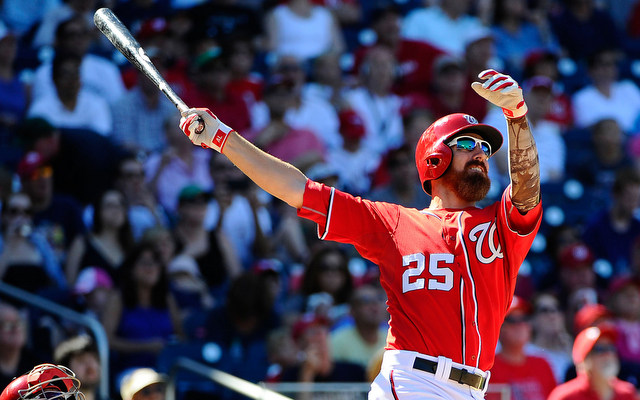
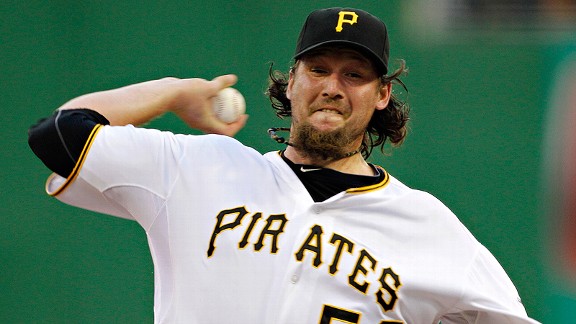
Showing posts with label Adam LaRoche. Show all posts

Wednesday, March 16, 2016

White Sox Lose LaRoche

LaRoche is leaving on his own terms (Chicago Tribune)
It's jarring how quickly athletes lose their talents, their ability to do their jobs. One year they can hit a 95-mile-an-hour fastball, and the next they can't. One day they're hitting shots from everywhere on the court, and a few months later they're missing all the same shots. We've seen it happen so many times, guys going from great to horrible practically overnight. And yet, when it happens, it never fails to surprise us. We can't believe that Peyton Manning is suddenly throwing more interceptions than touchdowns, or that Derek Jeter can no longer reach a ball that isn't hit directly at him. Wasn't it just yesterday that they were making highlight reel plays and seemingly at the top of their games?

It's something most of us can't comprehend because most of us don't have skills that can decline so rapidly. Barring some sort of traumatic brain injury, you're not going to wake up in a year and forget how to type or make a sandwich or drive your car. If you play recreational sports, this happens to a much lesser extent. You feel yourself getting older, slower, thicker, but the same thing is happening to everyone else. The teams aren't being re-stocked with fresh 22-year-olds every year, which is why you can hang on in your pick-up basketball league long after you've lost the ability to jump, and why you can play beer-league softball even after developing a pretty substantial beer gut.

Obviously, that is not the case in professional sports. The level of competition is so high, the margin for error so small, that almost imperceptible drops in performance can make the difference between being a star and washing said star's laundry. Lose a mile on your fastball or a foot on your passes, and you'll be out of a job before long.

It's scary, how quickly it can (and does) disappear. Just ask Adam LaRoche.

***

This time last year, things were looking up for Adam LaRoche. He had just signed a two-year, $25 million deal and was coming off a typical Adam LaRoche season of 26 homers, 92 RBI, .817 OPS. Even though he was 35, some thought he could still improve on those numbers, as he was moving to U.S. Cellular Field (a slugger's paradise) and could focus on his hitting full-time as an everyday DH.

"Physically, I still feel great," he said after joining the White Sox. "I'm looking forward to hopefully being in the middle of that lineup and having a chance to drive some runs in."

Fast forward one year, and he's retiring following the worst season of his career.

It was some career, 12 seasons defined by remarkable consistency, If LaRoche had 12 more seasons like them, he'd be going to the Hall of Fame.

Nine times he swatted 20 or more home runs in a season, but only twice did he top 30. Eight times he drove in at least 78 runs, but never more than 100. His batting average rarely strayed more than 10 points in either direction from .270 before ultimately settling at .260.

Even as the game changed around him, LaRoche remained the same. Every year starting in 2006, the major leagues set a new record for strikeouts, but LaRoche struck out at pretty much the same rate every year. Walk rates continued creeping up as well, but LaRoche didn't become increasingly patient. Batting averages fell as all the walks, strikeouts, and better positioned defenses sucked up hits, but LaRoche's didn't.

Constant changes of scenery never phased LaRoche, either. He changed teams six times in his dozen seasons, but no matter where he played--Atlanta, Chicago, Arizona, Washington--he always seemed right at home.

For nearly a decade, nothing got in the way of LaRoche's eternal quest for those 25 home runs and 80 RBIs. Not age, not defensive shifts, not the expanding strike zone, and not even injury. In 2011 he needed shoulder surgery after batting just .172 in 43 games at age 31. For many first basemen, that would be a death sentence. He came the next year and slugged 25 home runs with 100 RBI--a career high.

LaRoche could never run and didn't play first base particularly well, despite winning a Gold Glove, but he always hit, which is why it seemed like he always would. LaRoche looked like he'd keep on hitting until he was 40, especially after moving to the American League and being able to take advantage of the DH. When he signed that contract with Chicago, it felt as though a new chapter of his career was just beginning.

That chapter turned out to be very short, however, because in 2015 LaRoche finally stopped hitting. He batted .207/.293/.340 with just 12 home runs and 44 RBIs--the worst full-season numbers of his career. He struck out 133 times in only 429 at-bats--the second-worst percentage of his career. I he was worth 1.4 wins below replacement.

It wasn't just a terrible season; it was an embarrassing season. For the first time in his life, his only job was to hit, and he'd responded with the worst offensive campaign of his career. He was often benched against lefties (due to his .383 OPS against them) and struggled versus righties (against whom he had a .697 OPS). Many picked the White Sox to make the playoffs, or at least contend, but instead they finished 10 games below .500. LaRoche barely played in September as Chicago played out the string.

LaRoche could have walked away at any point over the winter, and everyone would have understood. To his credit, though, LaRoche came back. He worked hard during the offseason and showed up to Spring Training, ready for his 13th major league season.

It turned out to be LaRoche's final season, as well as his shortest. It lasted just two Spring Training games before he called it quits, deciding to step away for personal reasons.

And just like that, his career was over.

***

People, myself included, don't appreciate how hard it is to hit consistently at the major league level. As if playing everyday for 7-8 months isn't hard enough, you're constantly traveling, facing new pitchers, and trying to master an ever-changing strike zone. You deal with different weather, altitudes, and hitter's backgrounds. The scouting report on you gets a little longer, so pitchers know how to attack your weaknesses and the defense knows where you're going to hit it before you do. No wonder hitters are like mad scientists, constantly making adjustments, tinkering with their swings, toying with their stances, trying whatever they can think of that might help them gain an edge and hoping to God it actually works.

Whatever Adam LaRoche was doing, it worked pretty darn well for 12 years.

Monday, November 24, 2014

White Sox Add Adam LaRoche

LaRoche landed in the Windy City (CBSSports)
The rebuilding Chicago White Sox injected some much-needed lefthanded power into their lineup by inking first baseman Adam LaRoche to a two-year, $25 million deal.

With reigning AL Rookie of the Year Jose Abreu already entrenched at first base and considerably younger, the 35 year-old LaRoche expects to replace the retired Adam Dunn as Chicago's everyday DH. LaRoche is a great bet to reach or exceed Dunn's 2014 production, which included 20 home runs, 54 RBI, and a .773 OPS (LaRoche has averaged 22, 76, and .811 per season to this point).  Abreu was a disaster defensively, but he's also seven years younger than LaRoche, who has annually rated among the game's more defensively-challenged first basemen, his 2012 Gold Glove notwithstanding. At this stage in LaRoche's career, getting him off the field definitely makes sense.

Besides, the White Sox aren't paying LaRoche for his glove; they made this move because of what he can do in the batter's box. One of the steadiest power bats in the game, LaRoche has exceeded 20 home runs every year but one dating back to 2005, with an injury-riddled 2011 (just 43 games played) the exception. Incredibly durable, LaRoche has played at least 140 games in eight of the past ten seasons.

And while LaRoche's age may be a concern for some, he has showed no signs of slowing down. Last year he batted .259/.362/.455--right in line with his career .264/.340/.462 marks--with 26 home runs and 92 RBI in 140 games. He also posted the best full-season walk rate of his career (14 percent) while posting the second-lowest strikeout rate of his career. His batted ball data didn't change and he didn't have negative run values against any kind of pitch. He also fared well against power pitchers (.800 OPS), finesse pitchers (.821 OPS), and everyone in between (.821 OPS). Like fellow DHs David Ortiz and Victor Martinez, LaRoche has aged gracefully and should continue to do so.

Plus, moving from power-stifling Nationals Park to the homer-friendly U.S. Cellular Field should help alleviate any natural decline. If LaRoche stays healthy, he may have a shot at threatening his high-water mark of 33 home runs and 100 RBI, both reached in 2012. That represents his ceiling, obviously, but his floor is pretty high as well. Only once has he batted below .250 in a full season (2013) or slugged below .450 (also 2013), and his OBP has never been lower than .320. In today's run-parched environment, those are all pretty decent and certainly playable numbers.

So as far as 35 year-olds go, LaRoche is a pretty safe investment.

Wednesday, May 15, 2013

Slow Starts I'm Not Worried About (NL)

It's hard to believe, but we're nearly a quarter of the way through the baseball season. Here are five players who have been major disappointments to their teams, fans, and fantasy owners so far but are bound to get back on track:

Miguel Montero (.192/.291/.280)
The Bad: The Arizona Diamondbacks are in second place in the National League West in spite of their All-Star catcher, who has gotten off to a painfully slow start. The 29 year-old catcher has been unable to find his power stroke with just five extra base hits to date. What's more, he went a full month between his first and second home runs (April 2nd-to-May 3rd). It's not like he's producing in other ways, either, as he's recorded just one multi-RBI game and four-multi-hit efforts to date.

Why he'll turn it around: Montero hasn't lost his batting eye. He posted a career high 12.7 BB% last year and has sustained that improved patience this year. He hasn't responded to his slump by expanding his strike zone and is letting the ball come to him. His .216 BABiP has nowhere to go but up.

Jay Bruce (.258/.306/.403)
The Bad: In addition to piling up strikeouts with frightening regularity (he leads the National League with 52, tied with Dan Uggla), Bruce has seen his walk rate plummet to 6.5 percent. However, the main concern about Bruce is his lack of power. With just three home runs through his first 38 games, he looks nothing like the slugger who averaged 33 dingers per 162 games in his first five seasons.

Why he'll turn it around: Bruce is a streaky hitter, prone to blistering hot streaks and wicked cold ones. He struggled in April but has been much better since the calendar flipped to May, totaling eight extra base hits and 10 RBI in 10 May games. Another sign the long balls are coming is that only 8.3 percent of his fly balls have left the yard so far--less than half of his career rate. That might have something to do with the fact that Bruce has been hitting lots of line drives (almost 30 percent of batted balls) at the expense of fly balls (33.6 percent--around 10 percent below his career norm) so expect that ratio to even out as the season progresses.

Matt Kemp (.276/.325/.345)
The Bad: Kemp just hasn't been the same since hamstring injuries derailed the fast start to his 2012 season. He has just one homer on the season and has shown no signs of ending his power outage. The Dodgers are in last place in the NL West, and Kemp's sluggish start is a big reason why.

Why he'll turn it around: Kemp's HR/FB% sits at anemic 2.6 percent, and in each of the past two years it was north of 21 percent. Sooner or later he's going to have a power surge. Kemp's currently riding a 13-game hitting streak and seems to be finding his groove at the dish.

Martin Prado (.235/.290/.346)
The Bad: While Justin Upton has gotten off to a preposterously hot start in Atlanta, Prado has yet to break free of his early season slump. Manager Kirk Gibson was forced to drop him from the two spot in the batting order. Prado's funk extends beyond the batter's box: after stealing a career high 17 bases last year, he's swiped just one bag so far and has been caught twice. He's not driving in runs either, as he's managed just nine RBI so far.

Why he'll turn it around: Prado's batted ball data is identical to his figures from last year, when he batted .301 with 42 doubles. That, and the fact that his .246 BABiP is bound to improve.

Adam LaRoche (.213/.297/.311)
The Bad: Fresh off signing a two-year, $24 million deal to stay with the Washington Nationals, LaRoche has been a non-threat batting in the heart of Davey Johnson's order. He hasn't homered since April 20th and has knocked in just four runs over that span. His K rate has skyrocketed to just under 30 percent but has not coincided with a power spike.

Why he'll turn it around: Like Mark Teixeira, LaRoche is a perennially slow starter. For his career, his OPS rises each month from .695 in April to .911 in August. His first half OPS (.760) is a full 126 points lower than his second half OPS (.886). LaRoche is working on an 11-game hitting streak and may have already turned the corner. He's socked at least 20 homers in each of his last seven full seasons, so as long as he's healthy his numbers will be there in the end.

Thursday, December 27, 2012

Red Sox trade for Hanrahan

After completing a flurry of moves earlier in the month, the Boston Red Sox bolstered their bullpen by trading for All-Star closer Joel Hanrahan. Hanrahan will supplant Andrew Bailey, a two-time All-Star himself, as the team's primary closer. New skipper John Farrell will relegate Bailey to eighth inning duties.

Bailey was a huge disappointment in his Red Sox debut. The 2009 AL Rookie of the Year injured his thumb during Spring Training and required reconstructive surgery. The injury-prone reliever did not return until August 14th, at which point Boston was below .500 and fading out of the playoff picture. Bailey pitched well initially and replaced Alfredo Aceves as Bobby Valentine's closer down the stretch, but struggled mightily in September. He saved only six games in nine chances last year and finished the season with a bloated 7.04 ERA, not exactly what Ben Cherington had in mind when he traded Josh Reddick and two prospects to acquire Bailey and Ryan Sweeney from Billy Beane's Oakland A's last winter.

364 days later, the Red Sox sent Mark Melancon, Stolmy Pimentel, Ivan De Jesus and Jerry Sands to Pittsburgh in exchange for Hanrahan and second baseman Brock Holt. Hanrahan has quietly been one of baseball's better closers in the last two years. In 2011, his first season as an everyday closer, he saved 40 games, posted a tidy 1.83 ERA and made his first All-Star team. He was named to the All-Star team again last year even though his ERA rose by nearly a full run and his walk rate more than doubled. On the bright side, his K/9 ratio jumped from 8.0 to 10.1, a figure right in line with his career 9.9 mark, and he still saved 36 games.

However, there's underlying evidence that his recent success has been enhanced by good fortune. In 2011 just one of the 54 fly balls he allowed left the park. Last year his opponents mustered a paltry .225 BABiP against him, and Hanrahan managed to strand almost 90 percent of runners that reached base against him. Accordingly, his 4.45 FIP, 4.28 xFIP, 4.26 tERA and 3.80 SIERA were all well above his 2.72 ERA, indicating that he did not pitch nearly as well as his ERA suggests.

Regression to the mean combined with the transition to a less favorable pitching environment could spell trouble for Hanrahan in his American League debut. He's still a plus reliever, just not as dominant as some of his numbers suggest. He's no Jonathan Papelbon but represents a significant upgrade over the wildly inconsistent Aceves-Bailey tandem from last year. Assuming Hanrahan stays healthy and holds on to his closer's job, I'd expect around 35 saves and an ERA in the low-threes from him next year. 2013 is a contract year for the 31 year-old, so hopefully that extra motivation translates into strong results on the field.

The Red Sox are also reportedly pursuing first baseman Adam LaRoche, which indicates the team might back out from the three-year agreement they reached with Mike Napoli. Talks have stalled with the All-Star catcher because of a hip condition discovered during his physical. This health risk prompted Boston's front office to change the language of his new contract to protect themselves should he miss an extended period of time.

LaRoche, 33, is coming off a career year of sorts in which he won a Gold Glove, Silver Slugger, and finished sixth in the NL MVP race. The Washington Nationals would like to bring him back but aren't willing to offer more than two guaranteed years. Unlike Napoli, LaRoche is a first baseman by trade who defends his position better than the converted backstop. I'd still rather have the right-handed slugger, who's two years younger, loves hitting in Fenway and would add more balance to Boston's lineup.

But Laroche is a good plan B. After all, a consistent player who belted 33 home runs last season and amassed 100 RBI in 2010 and 2012 wouldn't be a bad consolation prize.