Showing posts with label Impossible Dream. Show all posts

Wednesday, May 31, 2017

Boston's Lucky Number Seven

Is 7 Boston's lucky number? (Slow Trav)
The last time a year ended with a seven, the Red Sox won the World Series. Heading into 2017, they were favored to win again, which would be their ninth in franchise history and fourth of this millennium. Here's how their seasons have played out in previous years ending in seven (a real mixed bag, with some great seasons offset by some terrible ones):

1907 (59-90, 7th place out of 8)
This was not a good year for the Boston Americans, who would change their name to the Red Sox the following year. A dark cloud hovered over the season following player-manager Chick Stahl's suicide in late March, which left the organization scrambling to replace him on the eve of Opening Day. A franchise-record four managers presided over the club's second straight underwhelming season, although it represented an improvement over their 105-loss last-place finish the year before. Boston's offense was abysmal, averaging 3.12 runs per game and ranking last in scoring, steals, average, OBP, and OPS as none of the regulars batted .290 or posted a .700 OPS. As a result, the pitching staff received little run support and every hurler besides Cy Young (21-15, 1.99 ERA), Cy Morgan (6-6, 1.97 ERA), and Beany Jacobson (two innings) ended up with a losing record. It would be 15 years before Boston endured another season so poor.

1917 (90-62, 2nd place out of 8)
After winning consecutive World Series in 1915-16, the Red Sox finished nine games out after battling the Chicago White Sox for much of the summer. Boston's offense was ordinary, ranking middle of the pack in most categories, but the pitching was phenomenal. 22-year-old Babe Ruth won 24 games and fashioned a 2.01 ERA while completing 35 of his 38 starts -- most in the Majors. He was joined by another 20-game winner in Carl Mays, who went 22-9 and had a slightly better season than Ruth in terms of run prevention (1.74 ERA). Despite all their talent, the Red Sox were unable to match the World Series-winning White Sox, who won another pennant two years later before forever going down in infamy as the Black Sox.

1927 (51-103, 8th place out of 8)
Everyone remembers this season for Ruth's 60 homers, but unfortunately none of them came for Boston. He was now entrenched with the Yankees and part of one of the greatest teams ever assembled in Murderer's Row. Boston, meanwhile, had been stripped for parts and lost over the 100 games for the third straight season. The lineup was once again last in scoring (plus all three rate stats) while none of the regular pitchers had an ERA under four. Unfortunately for the Red Sox, they would endure another half-decade of misery before Tom Yawkey purchased the club and began turning things around.

1937 (80-72, 5th place out of 8)
Boston's 80 wins were their most since 1917 as all of Yawkey's spending began to pay off. Having recently acquired stars such as Joe Cronin, Jimmie Foxx, and Lefty Grove, Boston was finally moving in the right direction. While an improvement over recent editions, the offense was only middle-of-the-road and the pitching staff was thoroughly mediocre aside from Grove and Jack Wilson. Most notable was the debut of 19-year-old second baseman Bobby Doerr, who struggled initially (.626 OPS) but quickly established himself as one of the team's most valuable position players over the next decade and a half, punching his ticket to Cooperstown in the process.

1947 (83-71, 3rd place out of 8)
Hopes were high for Boston following its World Series appearance in '46, but a wave of sore arms dashed any hopes for a repeat. Dave Ferriss, Tex Hughson, and Mickey Harris were all victims, causing the burden to fall on the shoulders of Joe Dobson (a fine pitcher, but no ace) and Denny Galehouse. The offense dropped off some as well, with several players like Doerr and Rudy York proving unable to sustain their '46 performance. One player who did was Johnny Pesky, who led the Majors in hits for the third straight year that he was active (excluding the war years of 1943-1945). Another was Ted Williams, who won his second Triple Crown but was denied a second straight MVP award, as voters inexplicably chose Dom DiMaggio's big brother from the pennant-winning Yanks.
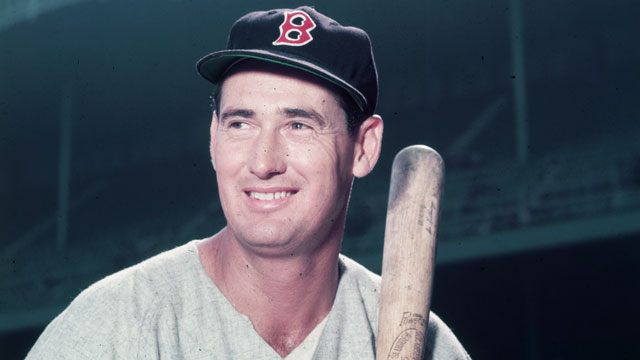
Williams had superb individual seasons on 3rd place clubs in '47 & '57 (ABC News)
1957 (82-72, 3rd place out of 8)
The Red Sox took over third place for good the day after Independence Day, but the highlight of the summer was Teddy Ballgame nearly hitting .400 again, ultimately settling at .388. As Williams told it, word had gone around the league that he could no longer pull the ball with power at age 38, leading opponents to abandon the shift against them. This opened things up for Williams, who also posted the second-highest home run total of his career with 38. Despite leading the Majors in hitting, OBP (.526), SLG (.731), OPS (1.257) and OPS+ (233), Williams lost out on another MVP to a Yankee center fielder (Joe DiMaggio's heir, Mickey Mantle). Offensively, he had help from Jackie Jensen and Frank Malzone (103 RBIs each), while center fielder Jim Piersall paced the club with 103 runs and 14 steals. Frank Sullivan was the staff leader in ERA (2.73) and innings (240 2/3) -- 2 1/3 more than Tom Brewer, who topped the rotation with 16 wins and 128 strikeouts.

1967 (1st place out of 10)
50 years after the Impossible Dream team gave birth to Red Sox Nation, their legacy still endures. At this point pretty much everything about the team is legend, from Billy Rohr's one-hitter and Jose Tartabull's throw to Tony Conigliaro's beaning and Carl Yastrzemski's September heroics. In classic Red Sox tradition, the Cardiac Kids mashed their way to October by leading the loop in nearly every hitting category, making up for a pitching staff that ranked third-to-last in the AL in ERA despite boasting the league's Cy Young winner in Jim Lonborg. And while most Boston teams became infamous for losing the final game of the season when everything was on the line (see: 1948, '49, and '78 editions), this resilient bunch clinched a pair of must-win games at home to close out the regular season and secure their first pennant in 21 years. Unfortunately, Bob Gibson proved too much for them to overcome in the Fall Classic, although things might have turned out differently for the BoSox had they not traded Earl Wilson the previous summer.

1977 (97-64, 2nd out of 7)
The '77 team boasted one of the most potent lineups in franchise history, slugging 213 home runs as five players cleared 25 and three others reached double digits. Carlton Fisk had the best season of his Hall of Fame career, George Scott returned from Milwaukee to belt 33 taters, and Butch Hobson had a career year with 30 homers and 112 RBIs at the hot corner. A resurgent Yaz slugged 28 homers and batted .296 at age 37, while Jim Rice's 39 dingers, .593 SLG and 382 total bases led the league. Even Bernie Carbo posted a gaudy .931 OPS in 86 games. The pitching struggled, however, with nobody exceeding 200 innings or 15 wins as Luis Tiant, Rick Wise, Fergie Jenkins, Reggie Cleveland, and Bill Lee all had underwhelming or injury-plagued seasons. The bright spot of the staff was fireman Bill Campbell, who was an All-Star and led the league in saves after signing on with Boston as one of baseball's first big free agents. His 2.96 ERA was the best on the team and was sustained over 140 innings in 69 appearances, enabling him to lead the staff with 13 wins. A strong September showing (22-9) wasn't enough to win the division, as the Red Sox finished tied for second with Baltimore, 2.5 games behind (who else?) New York. Fun fact; this was the lone season that legendary sports scribe Bob Ryan served as the Sox beat writer for The Boston Globe.

1987 (78-84, 5th place out of 7)
Fresh off a devastating defeat to the New York Mets in the previous year' s Fall Classic, the Red Sox were told by manager John McNamara to forget everything that happened in '86. That included how well they played before literally dropping the ball, as they plummeted to 78-84 and fifth place. Despite the disappoint record, several players enjoyed tremendous individual campaigns. Dwight Evans enjoyed a career year, setting personal bests in all three slash stats (.305/.417/.569) as well as home runs (34) and RBIs (123). He wasn't the only one having a banner year in the power department, as Wade Boggs tripled his home run output from the previous season (with a career-high 24) while winning his third straight batting title (.363) and leading the majors in OBP (.461) and the league in OPS (1.049) and position player WAR (8.3). The only American League worth more wins above replacement was teammate Roger Clemens, who cruised to his second straight Cy Young with the most wins (20), complete games (18), and shutouts (7) in the majors. Other highlights included Bruce Hurst's only All-Star nod and rookie center fielder Ellis Burks going 20/20 (but not receiving a single Rookie of the Year vote).

1997 (78-84, 4th place out of 5)
'97 was a bridge year for the Red Sox, with this being the season following Clemens' departure and Pedro Martinez's arrival. As such, the team did not have enough arms to compete, but it did receive a boost from AL Rookie of the Year Nomar Garciaparra. Nomar instantly became a fan favorite, leading the league in hits (209) and triples (13) while swatting 30 homers, stealing 22 bases, and batting .306/.342/.534. Garciaparra was one of seven Sox players to eclipse .300 over at least 300 plate appearances. Mo Vaughn provided the pop with a team-high 35 homers to go along with 96 RBIs and a .315/.420/.560 slash line. The pitching was a disaster, however, and Boston narrowly avoided finishing last in the division in its first season under Jimy Williams, beating out Toronto by two games.

2007 (96-66, 1st place out of 5)
This was the season that cemented Boston's status as a baseball dynasty in the first decade of the 2000s. The Red Sox won their first division title since 1995, finally breaking the Yankees' stranglehold on the AL East, before sweeping the ALDS and World Series en route to their second championship in four years. While mostly a veteran club with some familiar faces from the '04 title run (David Ortiz, Curt Schilling, Manny Ramirez, Jason Varitek), these Sox were infused by new additions Daisuke Matsuzaka, J.D. Drew, and Julio Lugo while receiving boosts from youngsters like Jacoby Ellsbury, Jon Lester, and AL Rookie of the Year Dustin Pedroia. This team was a powerhouse, posting a Pythagorean record of 101-61, and was also well balanced, leading the league in ERA and fewest hits allowed while running the league's second-highest OPS. This year did not signal a changing of the guard in the AL East, however, as Boston didn't win another division title until 2013.

Monday, April 3, 2017

Earl Wilson Could've Saved the Impossible Dream

Earl Wilson could have been a game-changer for the '67 Red Sox (Boston Globe)
Like every franchise, the Boston Red Sox have made their share of regrettable trades over the years, from dealing Jeff Bagwell and Pee Wee Reese while they were still prospects to sending Sparky Lyle to the Yankees for Danny Cater. And while not a trade, the sale of Babe Ruth will forever haunt them.

One that few Sox fans remember, however, likely cost them the World Series in 1967. Because while the Impossible Dream team had an ace in Jim Lonborg, it could have easily had two.

Earl Wilson is remembered for being the first African-American pitcher in Red Sox history, and their second player of color after Pumpsie Green. But while Green was a utility player who lasted just five seasons, Wilson developed into one of the American League's better pitchers of the 1960s. In addition to becoming the Junior Circuit's first African-American to throw a no-hitter (in 1962), he followed Mudcat Grant as the league's second black 20-game-winner when he tied Lonborg with 22 victories in '67.

Unfortunately for Boston, Wilson was no longer a member of the Sox by then. He had been traded the previous summer following a racist incident during Spring Training, when Wilson was denied service at a bar in Winter Haven, Florida. Wilson reported it to the media against ownership's wishes, and after getting off to a slow start he was dumped to Detroit in June (along with another African-American -- Joe Christopher) for outfielder Don Demeter and pitcher Julio Navarro.

The deal immediately proved disastrous. Free from Boston's bigotry, Wilson finally reached his potential with the more integrated Tigers. He immediately turned his 1966 season around, going 13-6 with a 2.59 ERA and 1.00 WHIP the rest of the way. His success carried over into '67, as he posted a 3.27 ERA over 264 innings while keeping Detroit in the pennant race until the season's final day. He would remain effective through the rest of the Sixties before age and heavy workloads took their tolls.

Navarro never pitched an inning for the Red Sox and Demeter contributed little, playing just 93 games for Boston and hitting fewer home runs than Wilson from that point forward. The Sox salvaged the deal by flipping him the following summer for starter Gary Bell, who was instrumental to their playoff run and was an All-Star in '68. Wilson he was not, however, and Boston wouldn't have needed him to shore up the rotation had they simply held on to Wilson in the first place. Best-case scenario, the Red Sox would have had two 20-game winners in '67, co-aces who would have led them to an easy pennant and potentially a world championship.

The argument can be made, however, that Wilson never would have reached that level in Boston due to its stifling racism, which negatively affected the city's minority athletes for decades. Even if he just continued pitching at the same level, though, his performance would have been on par with Bell's. The difference is that Wilson would have started '67 with Boston rather than joining in June, and thus would have contributed nearly 100 more innings than Bell provided. A full season of Wilson would have been more valuable than two months of Billy Rohr (4.61 ERA in eight starts) and four months of Bell, who combined to produce just 0.4 bWAR for the Sox that year -- a figure Wilson exceeded every year on offense from 1962-1968.

Wilson, who was typically good for around 2-3 WAR per year during his Red Sox tenure, likely would have added a couple wins to Boston's ledger in '67 -- victories that might have made all the difference down the stretch. With Boston needing a win on the season's final day to guarantee at least a tie for the pennant, they were forced to expend Gentleman Jim rather than save him for the Series opener against Bob Gibson. Lonborg turned in dominant efforts in Games 2 and 5 before faltering on short rest in Game 7 against Gibson.

But if Lonborg had twirled his shutout in Game 1 rather than Game 2, he would have edged Gibson and turned a 2-1 Boston defeat into a 1-0 victory. Then, backed by five Red Sox runs, either Wilson or Jose Santiago probably take Game 2 and give the Cardiac Kids some momentum before heading to St. Louis. Boston still would have lost Games 3 and 4, when they scored just two runs combined, and possibly Game 5 as well, when they managed only three.

Even so, the Red Sox win Game 6 (regardless of who pitches) with a four-home-run explosion, setting up a classic Game 7 between a now fully-rested Lonborg and Gibson. Maybe Gibson still comes out on top given his superior postseason track record, but Lonborg was equally devastating in big games and may have gotten the best of him in a redux of Game 1. It's a toss-up, but Boston's odds dramatically improve with Lonborg gaining an extra day of rest (and if Wilson or Santiago pitches a gem in Game 3 or 5, then Game 7 never happens and the Sox take the flag in six).

Wilson might not have swung the Series, but he would have made it more thrilling by facilitating three duels between Gibson and Lonborg rather than just the one. The ending may have been the same for Boston, but at least Red Sox fans wouldn't still be wondering how Lonborg might have fared on regular rest.

Sunday, April 10, 2016

The Cardiac Kids: A Dream Deferred

This year's Red Sox conjure memories of the Impossible Dream (Boston Globe)
With the 2016 season now underway, Red Sox fans have plenty to be excited about. This year's team features one of the best starters in the game (David Price), one of the best relievers in the game (Craig Kimbrel) and, for the final time, the great David Ortiz.

That's all well and good, but what Sox fans should really be psyched about is Boston's youth. Whereas the teams that won World Series in 2004, '07 and '13 were veteran-laden clubs, this year's outfit oozes youth. With Mookie Betts, Xander Bogaerts, Blake Swihart, Henry Owens, Eduardo Rodriguez, Christian Vazquez, Travis Shaw, and Jackie Bradley Jr. 25 or younger on Opening Day, the Sox boast their best young core in years. In fact, one might argue it's been nearly half a century since Boston had such an abundance of twenty-something talent.

If you want to make a Baby Boomer feel old, tell him or her it's been almost 50 years since the Impossible Dream (they'll remember it like it was yesterday). For Red Sox fans, the story of the fabled 1967 Red Sox is as familiar as Paul Revere's midnight ride and the Pilgrims' landing at Plymouth Rock. Tabbed 100-to-1 World Series longshots after after finishing ninth in a ten-team league the year before, the Cardiac Kids shocked the world by by winning the pennant on the season's final day. Then, just as improbably, Boston failed to win another one until 1975, by which point only two Impossible Dreamers remained (three if you count Tony Conigliaro, who played just 21 games and retired that summer) and the Sox had been re-built around a new generation of emerging stars.

The dream was ephemeral, a dream in the truest sense. While the Cardiac Kids are credited with saving baseball in Boston, revitalizing a franchise that had suffered eight losing seasons in a row and gone over two decades without a pennant, their failure to win another flag was somewhat disappointing. The '67 Red Sox were impossibly young, sporting baseball's second-youngest lineup and zero starting pitchers over 30. Considering that young players typically get better or at least stay the same, and that many Boston regulars weren't even in their primes yet, the team should should have improved throughout the late '60s and into the '70s.

Instead, the Red Sox went backwards, following up their pennant with a fourth-place finish and then three straight third-place finishes in their new six-team division. After winning 92 games in '67, the Sox didn't win that many again until 1975.

So why didn't Boston emerge as the powerhouse it seemed poised to become? The main reason is that their resurgence coincided with Baltimore's run as one of the most dominant teams in baseball history. The 1966 AL champs had a down year in '67, hired Earl Weaver midway through '68, and then ripped off three straight 100-win seasons and pennants from 1969-71. Their injury-marred '67 and subsequent re-shuffling opened a brief window for Boston and other teams to contend, but that window quickly slammed shut as Baltimore reloaded under Weaver.

By 1972, Boston's roster looked dramatically different from that which had fallen one game short of winning it all five years earlier. The entire infield had turned over with the exception of Rico Petrocelli, who had moved to third base to accommodate aging future Hall of Fame shortstop Luis Aparicio. Conigliaro, Jim Lonborg, and Dick Williams were all gone, too. Carl Yastrzemski still remained, but at 32 his best days were behind him. It was unusual for teams to dismantle so quickly in the days before free agency, but within half a decade the soul of the Impossible Dream team was gone.
Aside from Yaz, the '67 Red Sox didn't have much staying power (ESPN)
So that's one reason, Boston swapping out most of its pennant winning pieces within a few years. They gave up too soon on Joe Foy and Sparky Lyle, couldn't make it work with Ken Harrelson, failed to realize Reggie Smith's value, dealt their 27-year-old second baseman (Mike Andrews) for a 37-year-old Luis Aparicio, and traded George Scott before the best years of his career (then traded back for him after they'd already happened). Some of those trades worked out and some didn't, but the point is that the Red Sox didn't make themselves any better.

One could also argue that Cardiac Kids simply weren't that good to begin with. They were heavily reliant on Yastrzemski and Lonborg, that year's MVP and Cy Young winners, and were just a handful of wins away from finishing fifth. The problem with that argument is while Boston won the pennant by a combined five games over the three closest teams, they were still the American League's best team that year in several respects, leading the league in scoring, run differential, and road record. Anytime you win a pennant on the season's final day, you're going to need some breaks, but Boston didn't luck into its flag by any means, as they had a losing record in one-run games and extra innings.

It's not like all the Red Sox happened to have career years in 1967, either. Sure, Yaz won the Triple Crown, but he was arguably just as good the following year and again in 1970. The best of George Scott and Reggie Smith was still to come, while the best seasons of Boston's double play combo (Petrocelli and Mike Andrews) remained in the future.

Maybe the real reason the dream ended so soon was that it quickly became a nightmare for two of the team's best players. Tony Conigliaro was just 22 in 1967, but he was already a home run champion as well as the club's second-best hitter after Yastrzemski. The future seemed bright for the Red Sox slugger until a Jack Hamilton fastball crashed into his face on August 18th, costing him the rest of '67 and all of '68, as well as much of the vision in his left eye. Tony C would return to produce effective campaigns in 1969-70, but he was traded to California and played just 95 games after that.  Had Hamilton's heater sailed one foot higher, Conigliaro likely would have remained a star throughout the 1970s and gone on to enjoy a Hall of Fame career. Instead, he was basically finished by 26.

Four months after Conigliaro was carried off the field on a stretcher, another Boston star suffered a career-altering injury. Fresh off signing a $50,000 contract for 1968, Lonborg shredded his knee while skiing at Lake Tahoe just before Christmas. The reigning Cy Young winner made just 44 starts over the next three seasons, effectively wasting his prime years. Losing Lonborg, who had carried much of the load in '67 by ranking second in innings pitched during the regular season before making three World Series starts, was a devastating blow to Boston's rotation. It would be several years before the team found another reliable ace and big-game pitcher in Luis Tiant, whose first season in Boston coincided with Lonborg's last. Had Lonborg stayed healthy, Boston likely would not have traded him following the 1971 season, pairing him with Tiant for years to come.

The dual-loss of Conigliaro and Lonborg likely cost the Sox around eight wins in 1968, as both were four win-players the year before by bWAR (any regression suffered by Lonborg likely would have been negated by a full season and continued improvement from Conigliaro). While manager Dick Williams was able to adequately replace Tony C by shifting first baseman Ken Harrelson to right, a healthy Conigliaro would have let Williams play Hawk at first and bench George Scott instead. The portly first baseman batted a dreadful .171/.236/.237 and was worth 2.8 wins below replacement that year, so Williams could have saved Boston several wins by replacing Scott early on. Throw in a typical Conigliaro season and a less dominant but still effective year from Lonborg, and Boston probably wins more games than they did in '67 and challenges Detroit for the American League pennant. Instead, they slipped from 92 wins to 86 and finished fourth, 17 games off the pace.

After that there was no beating Baltimore, but it seems likely that, had Conigliaro and Lonborg been healthy, the Red Sox would have been consistent 90-95 game winners with them, seeing as how they usually won 85-87 without them. Perhaps that would have convinced Boston's front office to keep the Cardiac Kids together, rather than slowly ship them out one by one until most of them were gone. They had built a team capable of competing with the Orioles; they just never knew it because fate intervened.