Showing posts with label 1967. Show all posts

Thursday, June 1, 2017

Who had the Best Non-Ruthian Season?

Who equalled Ruth's 1927 WAR? The answer may surprise you (Historian Insight)
Quick, without looking at the Baseball-Reference WAR leaderboard, which position player not named Babe Ruth had the most WAR in a single season (remembering of course that Ruth owns the three highest and six of the top 12)?

Your first guess (as mine was) might be Barry Bonds circa the early 2000s, when he broke baseball with his videogame numbers. Bonds is up there, but by then his defense and baserunning had deteriorated just enough for him to fall short.

Knowing that, you'd probably be inclined to pick someone who put up insane numbers while manning a premium position, like Rogers Hornsby or Willie Mays. I was certain it was Mickey Mantle, either his Triple Crown season in '56 or his .365/.512/.665 performance the following year, but once again I was wrong.

Another hint: he played left field for the Boston Red Sox.

Well in that case, it has to be Ted Williams! The man batted .406, for goodness sake, while slugging .735 and reaching base 55.3 percent of the time in 1941. All of those marks led the Majors, as did his 135 runs, 147 walks, 37 homers, and 235 OPS+. He struck out just 27 times in 606 plate appearances, and was about as close to perfect as one can be at the plate.

It wasn't him. It was his successor, Carl Yastrzemski, who everyone agrees was not the player Williams was. A tremendous ballplayer and deserving Hall of Famer in his no right, but no Williams.

But the numbers don't lie: The best non-Ruthian season anyone ever had was Yaz's 1967 when he piled up 12.4 WAR, meaning he was effectively as valuable as two All-Stars and a solid regular combined.

WAR is not the end-all, be-all, obviously, and it's only accurate to a certain point. Ranking players based on fractions of WAR is a fool's errand given the stat's margin for error. Still, the closest non-Ruth position player to Yaz is Hornsby's 1924 (12.1 bWAR), which is even less reliable given how long ago that was. Then you have another Ruth season (his first with the Yankees), two years when Bonds was on 'roids ('01 and '02), Lou Gehrig's 1927 (11.8 bWAR), and another Ruth season (1924) before finally getting to Cal Ripken's 1991, which is valued at 11.5 bWAR -- nearly a full win less than Yastrzemski's 1967 total. A good chunk of Ripken's value comes from his positional adjustment too, so one can say with a fair degree of accuracy that Yaz authored the best season by a non-pitcher since Roaring Twenties.

Anecdotally, that checks out. Yaz was superhuman in '67, willing the Sox to the pennant with clutch hitting, superb fielding, and timely baserunning. When Boston needed a homer, he went yard. When he needed a single, he found a hole. He famously went 23-for-44 (.523) over the final 12 games of the regular season, becoming almost impossible to retire. Hall of Famer Bobby Doerr, who was a coach on that team, called it the greatest season he'd ever seen, and he was Teddy Ballgame's teammate when The Kid batted .406 and won a pair of Triple Crowns. Everyone who saw him play that summer have said similar things over the past half-century, solidifying its place as one of the greatest seasons ever (and only growing with stature when so many seasons passed without another Triple Crown).

From a numbers standpoint, though, I just can't quite wrap my brain around it. His raw stats are great, obviously, but they're not misprints. His Triple Crown figures of 44 homers, 121 RBIs, and a .326 average typically wouldn't be enough to lead one category, let alone all three. There are players who exceeded his .418 OBP and .622 SLG for their whole careers, Williams included, and even Yaz nearly outdid himself three years later. His 193 OPS+ is exceptional, but only the 78th-highest mark of all time. He stole 10 bases but was caught eight times. He played phenomenal defense, but left field is the easiest position to play besides first base (especially in Boston, where there's little ground to cover). '67 was a brutal year for hitters, but Fenway Park was also the best hitter's park in baseball at the time. As such, Yastrzemski's neutralized batting line of .334/.427/.638 is only marginally better than his real one.

WAR doesn't even incorporate Win Probability Added or Base-Out Runs Added, both of which he led the league in and would have given him a considerable boost. So...what gives?

Well, his offense alone was worth nearly 10 wins that year, which is pretty incredible. He generated 69 batting runs--more than Miguel Cabrera ever had. Throw in his outstanding defense (he led AL left fielders in putouts and assists) and plus baserunning, shake it all up in the magic WAR blender, and voila! You get 12.4 bWAR, the same total that Ruth produced during his 1927 season, when he swatted 60 homers.

I guess it's telling that since 1967, three players have exceeded 60 homers (six times in all), but only one man has won a Triple Crown. And for the record, Ruth never won a Triple Crown.

Sunday, April 10, 2016

The Cardiac Kids: A Dream Deferred

This year's Red Sox conjure memories of the Impossible Dream (Boston Globe)
With the 2016 season now underway, Red Sox fans have plenty to be excited about. This year's team features one of the best starters in the game (David Price), one of the best relievers in the game (Craig Kimbrel) and, for the final time, the great David Ortiz.

That's all well and good, but what Sox fans should really be psyched about is Boston's youth. Whereas the teams that won World Series in 2004, '07 and '13 were veteran-laden clubs, this year's outfit oozes youth. With Mookie Betts, Xander Bogaerts, Blake Swihart, Henry Owens, Eduardo Rodriguez, Christian Vazquez, Travis Shaw, and Jackie Bradley Jr. 25 or younger on Opening Day, the Sox boast their best young core in years. In fact, one might argue it's been nearly half a century since Boston had such an abundance of twenty-something talent.

If you want to make a Baby Boomer feel old, tell him or her it's been almost 50 years since the Impossible Dream (they'll remember it like it was yesterday). For Red Sox fans, the story of the fabled 1967 Red Sox is as familiar as Paul Revere's midnight ride and the Pilgrims' landing at Plymouth Rock. Tabbed 100-to-1 World Series longshots after after finishing ninth in a ten-team league the year before, the Cardiac Kids shocked the world by by winning the pennant on the season's final day. Then, just as improbably, Boston failed to win another one until 1975, by which point only two Impossible Dreamers remained (three if you count Tony Conigliaro, who played just 21 games and retired that summer) and the Sox had been re-built around a new generation of emerging stars.

The dream was ephemeral, a dream in the truest sense. While the Cardiac Kids are credited with saving baseball in Boston, revitalizing a franchise that had suffered eight losing seasons in a row and gone over two decades without a pennant, their failure to win another flag was somewhat disappointing. The '67 Red Sox were impossibly young, sporting baseball's second-youngest lineup and zero starting pitchers over 30. Considering that young players typically get better or at least stay the same, and that many Boston regulars weren't even in their primes yet, the team should should have improved throughout the late '60s and into the '70s.

Instead, the Red Sox went backwards, following up their pennant with a fourth-place finish and then three straight third-place finishes in their new six-team division. After winning 92 games in '67, the Sox didn't win that many again until 1975.

So why didn't Boston emerge as the powerhouse it seemed poised to become? The main reason is that their resurgence coincided with Baltimore's run as one of the most dominant teams in baseball history. The 1966 AL champs had a down year in '67, hired Earl Weaver midway through '68, and then ripped off three straight 100-win seasons and pennants from 1969-71. Their injury-marred '67 and subsequent re-shuffling opened a brief window for Boston and other teams to contend, but that window quickly slammed shut as Baltimore reloaded under Weaver.

By 1972, Boston's roster looked dramatically different from that which had fallen one game short of winning it all five years earlier. The entire infield had turned over with the exception of Rico Petrocelli, who had moved to third base to accommodate aging future Hall of Fame shortstop Luis Aparicio. Conigliaro, Jim Lonborg, and Dick Williams were all gone, too. Carl Yastrzemski still remained, but at 32 his best days were behind him. It was unusual for teams to dismantle so quickly in the days before free agency, but within half a decade the soul of the Impossible Dream team was gone.
Aside from Yaz, the '67 Red Sox didn't have much staying power (ESPN)
So that's one reason, Boston swapping out most of its pennant winning pieces within a few years. They gave up too soon on Joe Foy and Sparky Lyle, couldn't make it work with Ken Harrelson, failed to realize Reggie Smith's value, dealt their 27-year-old second baseman (Mike Andrews) for a 37-year-old Luis Aparicio, and traded George Scott before the best years of his career (then traded back for him after they'd already happened). Some of those trades worked out and some didn't, but the point is that the Red Sox didn't make themselves any better.

One could also argue that Cardiac Kids simply weren't that good to begin with. They were heavily reliant on Yastrzemski and Lonborg, that year's MVP and Cy Young winners, and were just a handful of wins away from finishing fifth. The problem with that argument is while Boston won the pennant by a combined five games over the three closest teams, they were still the American League's best team that year in several respects, leading the league in scoring, run differential, and road record. Anytime you win a pennant on the season's final day, you're going to need some breaks, but Boston didn't luck into its flag by any means, as they had a losing record in one-run games and extra innings.

It's not like all the Red Sox happened to have career years in 1967, either. Sure, Yaz won the Triple Crown, but he was arguably just as good the following year and again in 1970. The best of George Scott and Reggie Smith was still to come, while the best seasons of Boston's double play combo (Petrocelli and Mike Andrews) remained in the future.

Maybe the real reason the dream ended so soon was that it quickly became a nightmare for two of the team's best players. Tony Conigliaro was just 22 in 1967, but he was already a home run champion as well as the club's second-best hitter after Yastrzemski. The future seemed bright for the Red Sox slugger until a Jack Hamilton fastball crashed into his face on August 18th, costing him the rest of '67 and all of '68, as well as much of the vision in his left eye. Tony C would return to produce effective campaigns in 1969-70, but he was traded to California and played just 95 games after that.  Had Hamilton's heater sailed one foot higher, Conigliaro likely would have remained a star throughout the 1970s and gone on to enjoy a Hall of Fame career. Instead, he was basically finished by 26.

Four months after Conigliaro was carried off the field on a stretcher, another Boston star suffered a career-altering injury. Fresh off signing a $50,000 contract for 1968, Lonborg shredded his knee while skiing at Lake Tahoe just before Christmas. The reigning Cy Young winner made just 44 starts over the next three seasons, effectively wasting his prime years. Losing Lonborg, who had carried much of the load in '67 by ranking second in innings pitched during the regular season before making three World Series starts, was a devastating blow to Boston's rotation. It would be several years before the team found another reliable ace and big-game pitcher in Luis Tiant, whose first season in Boston coincided with Lonborg's last. Had Lonborg stayed healthy, Boston likely would not have traded him following the 1971 season, pairing him with Tiant for years to come.

The dual-loss of Conigliaro and Lonborg likely cost the Sox around eight wins in 1968, as both were four win-players the year before by bWAR (any regression suffered by Lonborg likely would have been negated by a full season and continued improvement from Conigliaro). While manager Dick Williams was able to adequately replace Tony C by shifting first baseman Ken Harrelson to right, a healthy Conigliaro would have let Williams play Hawk at first and bench George Scott instead. The portly first baseman batted a dreadful .171/.236/.237 and was worth 2.8 wins below replacement that year, so Williams could have saved Boston several wins by replacing Scott early on. Throw in a typical Conigliaro season and a less dominant but still effective year from Lonborg, and Boston probably wins more games than they did in '67 and challenges Detroit for the American League pennant. Instead, they slipped from 92 wins to 86 and finished fourth, 17 games off the pace.

After that there was no beating Baltimore, but it seems likely that, had Conigliaro and Lonborg been healthy, the Red Sox would have been consistent 90-95 game winners with them, seeing as how they usually won 85-87 without them. Perhaps that would have convinced Boston's front office to keep the Cardiac Kids together, rather than slowly ship them out one by one until most of them were gone. They had built a team capable of competing with the Orioles; they just never knew it because fate intervened.

Thursday, October 4, 2012

Cabrera Wins Triple Crown

Cabrera mashed his way to the Triple Crown in 2012 (SBNation)
Miguel Cabrera accomplished something no baseball player has done in 45 years. He led the league in home runs, runs batted in, and batting average, becoming the first man since Carl Yastrzemski to win the Triple Crown. Cabrera’s 44 homers and 139 RBI topped the majors, and his .330 batting average made him the American League batting champ for the second year in a row.

Since 1900, the Triple Crown has been achieved 14 times by a dozen different players (Rogers Hornsby and Ted Williams, the best pure hitters of all time, did it twice) but Cabrera is the only third baseman to win it. He dominated in other statistical categories, too, leading the league in slugging percentage, OPS, total bases and extra base hits. Cabrera could be in line for his first Most Valuable Player award after leading his Tigers to their second consecutive division title.

The scary thing is, 2012 isn't even the best season of his career. Looking at OPS and OPS+, he was better last year, and in 2010, too.

It wasn’t until September that Cabrera emerged as a legitimate threat to win the Triple Crown. Josh Hamilton was leading the league in homers and RBI for much of the season, and Trout seemed to have a stranglehold on the batting crown. Their early success forced Cabrera to play catch-up for most of the summer, and only in the season’s final weeks did he pass them on the strength of his monster second half (.337/.407/.667 with 26 home runs and 68 RBI after the All-Star Break). 

They say slow and steady wins the race. Miguel Cabrera is both painfully slow–he grounded into more double plays than anyone else this year–and he is freakishly steady.

 And sure enough, he won the race.
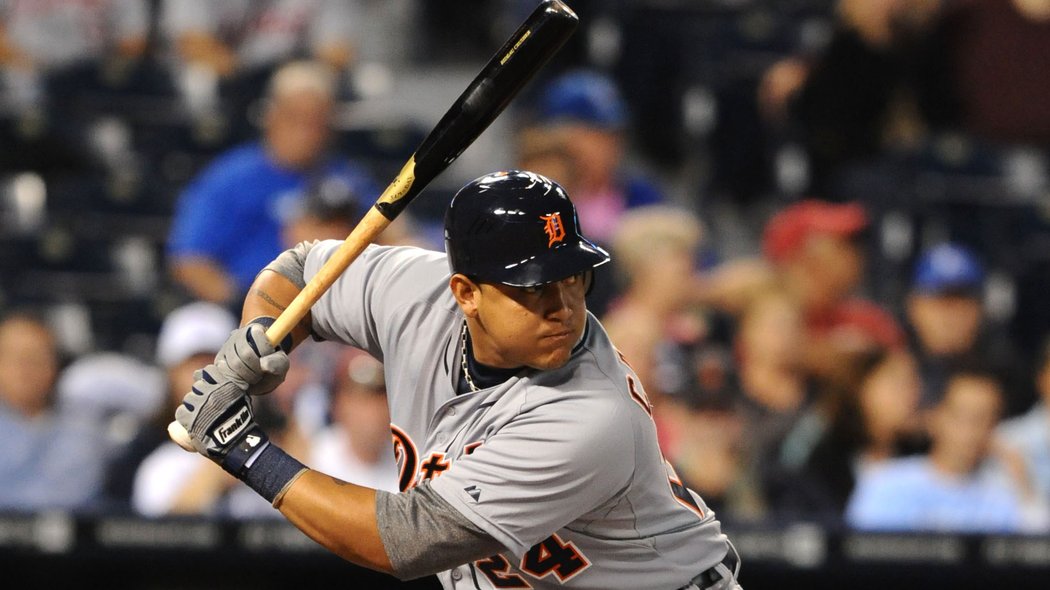
Cabrera receives a standing ovation from the Kansas City crowd (NYTimes)