Cleveland's defense had no answer for the Warriors in Games 1 & 2 (TopBET.eu)
This submission comes from friend of the think tank Glen Krebs, who was probably wearing his Steph Curry Davidson jersey while writing this:
For
the second straight game, the Cleveland Cavaliers' defensive issues from the regular season (but were masked by their dominance of the
Eastern Conference) were exposed by the Golden State Warriors, as the Warriors trounced them
by 33 points at the Oracle Arena on Sunday night.
It's hard to believe this is the same Cleveland team that coasted to its second straight Finals, rolling over the rest of the East with its superior talent
level.Going against one of the best
teams in history, however, its deep-seeded flaws have come to the
forefront.Heading back home for Game 3, the Cavaliers find themselves in a position they haven’t been in since
2008: down 0-2 in a playoff series.
What has to be most concerning for
the Cavs is that they seem to be
running out of adjustments to make on defense. Their personnel have put Tyronn Lue between a rock and a hard
place in terms of defensive game planning. Cleveland played defense at the beginning of Game 2 the same way they
did in Game 1, with their guards fighting over off-ball screens and
switching on off-ball screens. Their defensive communication was still sloppy, however, leading to a
series of easy lay-ups and open shots for Golden State during the first
quarter.
Lue adjusted by having the
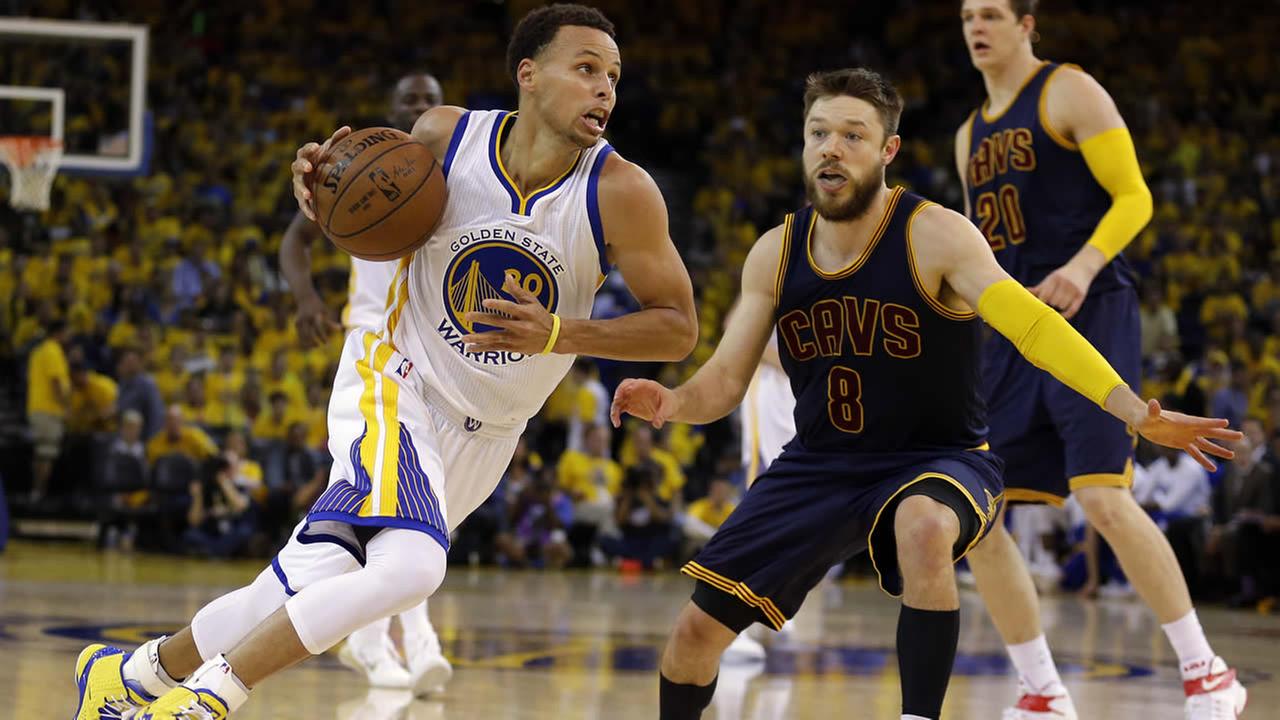
Cavs switch on everything, which incurred disastrous results as Kevin Love
and Tristan Thompson were repeatedly switched onto Stephen Curry and Klay
Thompson. The two bigs have shown no
indication that they can adequately guard either of those two on the ball, forcing Lue back to his original game plan early in the second quarter. After that, it was all Warriors.
Although Lue seems to be running out
of options, there is one key change he can make to try and (literally) slow Golden State down. After Kyrie
Irving went down with a fractured kneecap in Game 1 of last year's Finals,
David Blatt reconfigured the offense to feature LeBron James catching the ball in the
high post and running iso-heavy sets through him. Although the strategy had mixed results as
James had a historically inefficient Finals on offense, it did slow the
Warriors down enough to keep the series competitive for the next five games. Now would seem to be the best time for Lue to
return to that, as his players have repeatedly blown assignments in
transition that have either led to wide-open threes or defensive mismatches
that the Warriors capitalized on immediately.
LeBron must be more assertive in Game 3 (CheatSheet.com)
It will be interesting to see what
LeBron’s mindset is at the beginning of Game 3. Although he finished Game 2 with 19 points and a
near triple-double, it never felt like James was in attack mode. He seemed
focused on getting his teammates involved early, finishing the first quarter
with no points and five assists. If
LeBron really is the “offensive coordinator” of the Cavs as claims to be, then it
was clear he wanted to spoon feed Irving and Love to get them in an early
rhythm.
While the reasoning behind this makes sense--if Irving and Kevin Love get going early they will have more confidence at the end of games--the
best thing for Cleveland might be for James to attack early and often. The consummate team player throughout his
career (often to a fault), LeBron might have to let the other All-Stars worry about getting their
shots while he’s on the bench. The most
important thing for him looking ahead will be getting Andre Iguodala in foul trouble
at the beginning of Game 3 by using the home atmosphere to get some calls
that went against him in Game 2.
Finally, the Cavs were also
out-rebounded on both ends of the floor. Coming into the series, that was supposed to
be one of their biggest advantages over the Warriors. That was not the case in Game 2, however, as Golden State annihilated Cleveland on the boards, 46-34. If the Cavaliers
are to have any shot at making this series competitive, they need to reverse
this trend immediately.
That seems unlikely to happen, however. As much of a toll as the OKC series took on the Warriors, it forced them to focus on both individual and team rebounding in a way they hadn't all season.
Their newfound dedication to improving that weakness has completely snuffed out any
advantage that the Cavs had on the glass. Andrew Bogut and Draymond Green were active in the early going, with Bogut doing a commendable job boxing out Tristan Thompson and keeping offensive chances
alive by tapping them off the glass.
After having to deal with Steven Adams and Serge Ibaka for the last two weeks,
Bogut and Green must feel like a baseball player swinging a bat without the
weights on it. Barring a major injury or
divine intervention, it feels like the Warriors are going to cap off the best
season of all-time with a ring.
Random
Musings from Game Two
1.LeBron’s
Post Problems
a.If
it’s possible for the best player in the world to improve upon anything this
offseason, it’s his postgame. The King
has done a masterful job of transitioning his game to being almost completely
interior-based to accommodate the strengths of Love and Irving. Although James is a mismatch against any
small forward and most traditional fours, he still has a tendency to end his
post-ups by finding himself underneath the basket with a crowd of people around
him. If he can start his post moves with more of a plan and sprinkle in some counters when he gets stopped
initially, he should be the best back-to-the-basket player in the league. That’s a scary thought for the rest of the Association, considering he’s already a supersized Blake Griffin in his current
iteration.
2.The
Curious Case of Harrison Barnes
a.For
as much as Harrison Barnes has struggled this year,
he has found new life against Cleveland. Lue has tried to hide J.R. Smith and Kyrie Irving on Barnes
sporadically throughout the first two games without any success. Barnes has done a great job exploiting Irving and Smith’s ball-watching tendencies by cutting for open looks
close to the basket and driving to a spot that puts the defense at a
disadvantage and opens up playmaking for his teammates.
Although Barnes struggles at creating his own shot and
often seems to get in his own head, his smart play on both ends of the court show he is still a valuable asset for Golden State.
3. Richard Jefferson’s Last Stand
a.One Finals story that never gets old is that of the veteran role player,
long past his glory days who knows this is his last real chance at a
ring. Jefferson is that guy this year. He was ignominiously traded from Golden State in 2013 to clear up cap space fir Iguodala, his four year $39
million contract suddenly an albatross.
Although Jefferson is nowhere close to the player he was as an All-Star
with the New Jersey Nets of the early 2000’s, he has aged gracefully as a backup small forward for these Cavaliers. He was one of their few bright spots in Game 2, tallying 12 points and five rebounds in a throwback performance Here’s to hoping to he’ll be able to continue that success as the series
progresses.
Curry and the Warriors are flying high after winning the NBA Finals (SFGate)
Three games. That's how long it took the Golden State Warriors to figure out that they were the better team, and how to start playing like it. That's how long it took the Warriors, winners of 67 regular season games, to realize what they were up against: a 53-win team (from, it must be said, the weaker conference) without two of its three best players. That's how long it took Golden State to realize that they could pretty much let LeBron James do whatever he wanted, because in the end he simply didn't have the supporting cast needed to win a seven game series against the best team in the NBA.
The tide turned in Game 4, with the Warriors staring at an improbable 2-1 series deficit and faced with a must-win scenario in Cleveland. They came out and crushed the Cavs, winning by 21--the most lopsided game of the series. Aside from the first quarter and a few moments early in the third, Cleveland was never really in the game. Golden State quickly pulled away, both in the game and in the series.
Steve Kerr starting Andre Iguodala for the first time this season in Game 4 changed the entire dynamic of the series. Not only was he a force to be reckoned with on offense, scoring as many points (22) and draining as many threes (four) as MVP teammate Stephen Curry, but he also stifled James with his defense, limiting LeBron to 20 points on 7-of-22 shooting.
Freed from the bench, Iguodala re-emerged as the two-way force he was during his 76ers days. The former point-forward led the team in minutes in Game 5, stuffing the box score with 14 points, 8 rebounds, 7 assists (a team-high), and three steals (also a team-high), helping Golden State to a 104-91 victory. He was at it again in last night's series-clincher, dropping a team-high 25 points while chipping in five rebounds and assists along with two steals. Fittingly, Iggy was named Finals MVP for helping Golden State get over the hump, even if he couldn't hit a free throw to save his life.
The award just as easily could have gone to Curry, though, who averaged 26 points, 6.3 assists, and 5.2 boards per game. He never seemed to tire despite averaging over 42 minutes a night, logging just 20 fewer than LeBron over the course of the series. Curry was a true warrior, fighting his way through double teams, mesmerizing Cleveland's defense with his remarkable ball-handling skills, and coming up with big shots when he needed to. After earning his fair share of criticism for struggling with his shot early in the series, he bounced back to provide MVP-level production and lead his team to the promised land.
James did all he could, but in the end it wasn't enough (Yahoo Sports)
In reality, the true MVP of this year's NBA Finals did not play a single minute for the Warriors. Disregarding wins and losses, LeBron James was far and away the most valuable player of this series. He averaged close to 46 minutes per game, which is almost unfathomable. He outscored Curry by nearly 60 points--roughly 10 per game--while also leading both sides in rebounds and assists. James's performance was nothing short of legendary, and yet it wasn't nearly enough.
One has to wonder how the series would have played out had Kyrie Irving and Kevin Love both been healthy. At the very least, their presence would have relieved some of the massive burden placed upon LeBron's broad shoulders. The series probably would have gone seven games. Cleveland could have won.
But without them, the Cavs never stood a chance. No matter how well James played, it was never going to be enough. He's only one guy, after all, and one mortal being can only do so much. His ragtag supporting cast immediately brought to mind memories of the last and only other time Cleveland made the finals, when a 22 year-old James dragged them there in 2007, only to be squashed by the Spurs in four games. James has changed a lot since then--he has matured by eight years and is infinitely more comfortable on the game's greatest stage--but the rest of the Cavs proved just as useless.
To his credit, or perhaps to his detriment, James kept them involved throughout the entire series. He trusted them the same way he'd trusted Dwyane Wade and Chris Bosh in Miami, feeding them for open looks and giving them every opportunity to contribute.
Problem is, James Jones, Iman Shumpert, and Josh Smith are not Wade, Bosh, and Ray Allen. I wouldn't trust those guys with a 20 point lead during the regular season, let alone in crunch time during the freaking NBA finals.
But James seemed not to notice nor care just how incompetent his teammates were. He kept dishing them the rock, almost instinctually, often passing up good looks close to the rim to hit them for open shots on the perimeter. More often that not, they bricked those shots, which is why there won't be a Game 7 tomorrow night. James executed, but the rest of his team did not.
LeBron's selflessness has always been a double-edged sword for him, at once his greatest asset and undoing. Nobody with LeBron's size and scoring ability should be able to pass like he does, always finding his teammates with laser passes in the most unbelievable of places, like he has eyes in the back of his head. It's his Steve Nash-esque court vision that makes him a cut above the Kevin Durants and Kobe Bryants of the world. He has the eyes of a point guard in the body of a bulldozer.
It was obvious from the start, however, that Cleveland wasn't going to win this series with LeBron playing the role of facilitator. The Cavs were only going to win if James took over and averaged 40+ points a night. With his supporting cast reduced to ashes, LeBron needed to adopt the Kobe Bryant mentality for this series, the give-me-the-damn-ball-and-get-the-hell-out-my-way mindset. If he truly is the greatest player in the world, which this series proved he is, then he needed not just to play like it, but to act like it. He needed to get mean. He needed to be selfish.
LeBron may be able to do that for spurts, but he has proved incapable of doing that for prolonged stretches. He is too nice, too trusting of his teammates. He's hardwired to pass the basketball, to get it into the hands of open comrades. He shares too much. He's too generous.
It's also hard to be a killer when you run out of gas, as James and his teammates clearly did. He missed six of his last nine shot attempts last night and was a non-factor in the frantic final two minutes, when Josh Smith, of all people, nearly willed Cleveland back into the game with a barrage of unlikely threes. James, passive and exhausted, seemed to quit when his team needed him most, settling for lazy jumpers rather than attacking the hoop with his customary ferocity. He played to the score rather than the clock, and in the end it might have cost the Cavs the game.
When the chips were down and all hope seemed lost, LeBron reverted into the passive, gun-shy, scared little kid who disappears during the game's critical moments, like he's melted right into the court. There one minute, gone the next. Poof.
I'm hesitant to criticize James too much because he really gave it his all in his series. Without his heroic performances, the Cavs would've been swept. A lot of people seem to think they wouldn't have even made the playoffs without him, which I don't necessarily buy (if the Celtics and Nets could make the playoffs, then a team with two legit superstars definitely could, especially in the East) but still see their point. James single-handedly made this series interesting, even if he couldn't carry his team to the finish line. He played his heart out.
The Spurs wrote the latest chapter of their dynasty by beating the Heat in five
There will be no three-peat for the Miami Heat. For the fifth time since 1999 but first since 2007, the San Antonio Spurs are NBA champions.
I said it three years ago when the Mavs brought down the Heat, so I might as well say it again: all is right with the world.
It only took five games for the Spurs to dispatch their star-studded opponents, who appeared thoroughly overmatched in the final three games of this series. The Heat barely put up a fight, losing by 19 and 21 on their home court, then getting blown out of the AT&T Center in a must-win Game 5. They were steamrolled by Greg Poppovich's finely tuned machine, which was firing on all cylinders and outplayed Miami in every aspect. San Antonio had the edge in rebounding, passing, defense, outside shooting, post play, and depth. Top to bottom, the Spurs were the superior team, and it showed.
It was evident during the regular season, when they won 62 games and had the NBA's best record. It was confirmed throughout the postseason, as San Antonio outlasted Dallas in seven games, then Portland in five, and finally OKC in six to earn another trip back to the NBA Finals, where they were defeated by Miami in seven games last year after blowing a five point lead late in Game 6, the basketball equivalent of Mookie Wilson's grounder scooting through Bill Buckner's legs.
It took the Red Sox 18 years to get back to the World Series after Buckner's gaffe. It only took the Spurs one year. Motivated by their soul-crushing defeat, they stormed back for retribution and redemption, hushing any whispers of decline and closing championship windows along the way. San Antonio possessed the drive, desire, and determination necessary to survive a grueling regular season and two-month postseason, asserting their dominance at every turn.
Which is not to say Miami wasn't driven to three-peat, something that hasn't been done since Phil Jackson coached the Shaquille O'Neal and Kobe BryantLakers to three straight titles from 2000-2002. But the Heat clearly coasted during the regular season, winning eight fewer games than the Spurs and settling for the second seed in the East, biding their time until the postseason rolled around. Sure enough, they kicked it into high gear once the playoffs started, sweeping Charlotte, breaking Brooklyn in five and edging out Indiana in six. The Heat seemed to be hitting their stride at the perfect time and were favored to win their rematch with the Spurs, even though San Antonio had home court advantage*.
Speaking of home court advantage, Miami did not lose a playoff game on their home court this year until the Spurs came to town and blasted them by 40 points in the two games combined. So much for that.
The most shocking outcome of this series was that Miami was outscored by 76 points in the five games (15.2 per game, including their Game 2 win). I can't imagine anyone saw San Antonio's aging Big Three outplaying Miami's Big Three to such a degree. Tim Duncan, Manu Ginobili and Tony Parker were all at the top of their games. LeBron James, cramps aside, was the best player in this series (as expected), but Dwyane Wade crapped the bed and Chris Bosh was merely good. All too often it felt as though James was taking on the entire Spurs team by himself, and as great as James is he proved with the Cavs that he's incapable of winning a championship without help. Nobody can.
But what really doomed the Heat was the stellar play of Kawhi Leonard and the Spurs' complementary players. The Finals MVP obviously had an exceptional series on both ends of the court, but he had plenty of (somewhat unexpected) help from the likes of Patty Mills, Danny Green, and Boris Diaw. The Spurs gelled, and it was truly magnificent to watch. Nobody seemed afraid of the moment and everyone stepped up when needed.
The Heat, however, received no such heroics from their own role players: Norris Cole, Mario Chalmers, Rashard Lewis, and Chris Andersenwere nonfactors for most of the series. Ray Allen hit plenty of shots, but not enough to sway the final outcome. San Antonio's depth was too much for Miami to handle, and so the Heat were done in by their dearth of quality options off the bench. Say what you want about Erik Spoelstra's coaching ability, but he was outgunned and outmanned in these finals.
So when the Spurs executed as flawlessly as they did and played great basketball for long stretches of time, the Heat couldn't compete. Their flaws--poor interior defense, iffy outside shooting, lack of depth--were exposed and, as the lopsided scores of Games 3, 4, and 5 indicated, became painfully obvious. From the start of the season to the end of it, San Antonio was the better team. And, as is so often the case in team sports, the better team won.
I already knew that LeBron shares a lot in common with A-Rod, but I hadn't thought about how much Wade shared with Jeter.
Wade, like Jeter, was a winner before their more talented teammates decided they wanted out from their mediocre Midwestern franchises and wanted a ring. Jeter and Wade were already established stars and proven winners. Both were captains of their respective teams, and were approximately the same ages when their new teammates arrived. Wade was 28, Jeter was 29, both slightly older than LeBron and Rodriguez (Jeter has more than a year on A-Rod, while Wade has nearly two on LeBron).
It had been four years since the Heat had last been champions, and four years since the Yankees were World Series champions. Wade, who was drafted the same year as LeBron and debuted the same year (2003), had seen his career overlap perfectly with LeBron's. Both were high first round picks, with A-Rod and LeBron going first and Wade taken fifth/Jeter sixth. Jeter's breakout season--1996 when he won AL Rookie of the Year--paralleled A-Rod's breakout/MVP runner-up, and both had been stars ever since.
While LeBron took his game to another level with the Heat, improving his post moves as well as his three-point shot, Wade remained essentially the same player. He never bothered to add the three-point shot to his arsenal, even though it would have made him and his team much better. Wade, apparently not driven to be the best player he can be, decided he could live with his flaws and so has remained a league average free throw shooter and a subpar three-point shooter. A shooting guard who wasn't a particularly good shooter.
While Rodriguez effortlessly learned a new, demanding position, Jeter maintained the status quo. He did not move to third so that Rodriguez could play shortstop, even though that would have been the best for the team. He did not improve his power stroke, cut down on his strikeouts, take more walks or steal more bases. His defense, always his greatest flaw, remained so. He did make a concerted effort to improve his defensive positioning late in his career, but by then his range and arm strength had diminished too much to make much of a difference. Forget his Gold Gloves; Jeter rates as the worst defensive shortstop in baseball history.
The irony is that even though Wade and Jeter were clearly less talented and contributed less to their teams' successes than James and Rodriguez, both were able to avoid or deflect most of the flak whenever things turned sour. For instance, when the Heat fell to the Mavs in 2011 and when they inevitably lose to the Spurs in the next few days, much of the blame was placed on LeBron's shoulders. He was ripped as a passive, unclutch choker while Wade, because he was a lesser player, coasted. Even though Miami's stars and scrubs structure dictates that Wade plays well in order to win, he has never caught as much heat as LeBron has (which I suspect is related to Wade being less visible and more likable). Wade defers to LeBron, and so when the game is on the line it's usually James's to win or lose. Wade can throw up a stinker like he did last night, and all anyone's going to remember about this series is how LeBron cramped up in Game 1.
Ditto Jeter, who's always walked on water in New York and has always been above criticism there. Nobody blamed him when the Yankees choked to the Red Sox, even though Jeter batted a measly .200/.333/.233 in that series with just one extra base hit (a double). People looked the other way in 2007 when he hit into as many double plays (3) as base knocks against the Indians in the ALCS. No one said a word in 2010 or 2011, when he batted .250 in both postseasons with sub-.290 OBPs in each and a combined .344 slugging percentage. Has there ever been any mention of the fact that Jeter hasn't hit a postseason home run since October 19th, 2009, a span of 146 plate appearances?
Granted, as a complementary player/table setter, Jeter has different expectations than Rodriguez, a middle-of-the-order run-producer. But Jeter plays the more valuable defensive position and bats higher in the order, so his role is just as valuable. And yet, since the start of the 2004 playoffs, both have performed virtually the same in the postseason:
Jeter --287 PA 7 HR 28 RBI 24 BB 56 K 5 SB .814 OPS
A-Rod 269 PA 10 HR 33 RBI 36 BB 59 K 7 SB .807 OPS
You wouldn't know it by reading the newspapers.
Wade and Jeter have skirted criticism, skating by while their more talented teammates took the brunt of the criticism because they were more polarizing, but also because more was expected from them. Wade and Jeter were left mostly untouched, and from the relative safety of dry land neither ever made much of an effort to do anything about it. Their attempts to defend James and Rodriguez were halfhearted at best, non-existent at worst.
Wade is the Robin to James's Batman, as Scottie Pippen was to Michael Jordan and Pau Gasol was to Kobe Bryant. That's why they've clicked. Jeter should have been Rodriguez's Robin, but always maintained that the Yankees were his team, which in turn created a great deal of tension and friction in the Yankee clubhouse. It's incredibly disappointing that Rodriguez's ten-year tenure with the Yankees yielded only one championship. It may have had something to do with the fact that Jeter was more like Joe DiMaggio, for better and for worse, than we realize.
It's fitting then, that he's retiring a year after what could be Rodriguez's final game. It wouldn't surprise me one bit of Wade and James do the same some day. That is, if Wade can actually stay on the court.
A-Rod and Jeter didn't achieve their full potential as teammates (BronxBaseball)
PG Chris Paul (26.4 PER)
The ever-efficient Paul continued his reign as the NBA's top point guard by averaging 16.9 points, 9.7 asssists and an NBA-best 2.4 steals per game despite playing a career-low 33.4 minutes per game. Nobody's better at finding their teammates than Paul, who posted the NBA's highest assist percentage and ranked second in total assists and assists per game behind only Greivis Vasquez. Though Paul's three-point percentage dropped below 33 percent--his worst mark since his rookie year--CP3 made up for it by boosting his field goal percentage for the second straight year and sinking a career-best 88.5 percent of this free throws. Improvements in both areas yielded a .594 True Shooting percentage, the second highest of his career. Put it all together and it's easy to see why Paul ranked third in PER behind LeBron James and Kevin Durant.
SG Kobe Bryant (23 PER)
Really close call between the Black Mamba and James Harden, who had an outstanding season in his own right. Their numbers are nearly identical, I'll give the edge to Bryant for rising above the shitstorm that enveloped the Lakers this year and leading them into the postseason. Given the level of talent surrounding him (Steve Nash, Dwight Howard, Pau Gasol) it's almost unfathomable that he averaged 27.3 points per game and tied a career high with six assists per game at the ripe old age of 34. Bryant embraced his role as the alpha dog and took matters into his own hands, notching his eighth season with at least 2,000 points and while posting the highest Effective Field Goal percentage of his distinguished career. His defense continues to suffer, but Bryant is still such a force with the ball in his hands that he more than makes up for it. Although his season ended a down note when he tore his Achilles tendon just before the playoffs, I fully expect the resilient Bryant to return with a vengeance and resume his assault on Kareem Abdul-Jabbar's scoring record. He's showed no signs of slowing down and given us no reason whatsoever to bet against him.
SF LeBron James (31.6 PER)
Another banner year for James has all but assured him of his fourth MVP award. King James continued to improve in his tenth season, playing the best individual basketball anyone's seen since Michael Jordan was in his prime. By honing his post game, James combined his typically stellar all-around numbers--26.8 points, 7.3 assists and a career-high 8.0 rebounds per game--with phenomenal percentages. He drilled a staggering 56.5 percent of his field goals. Even more impressively, James developed into a legitimate three-point threat by shooing above 40 percent from downtown. The only knock on James is that he's still just an average free throw shooter, but if he ever gets his FT% on the right side of 80 he'll be complete as a basketball player.
PF Tim Duncan (24.4 PER)
The soon-to-be-37-year-old enjoyed a renaissance season of sorts, proving that he still has plenty left in the tank. In addition to his usual elite interior defense (highest DRating and third-most blocks per game), Duncan averaged 17.8 points, 9.9 boards and 2.7 dimes per game while shooting north of 50 percent from the floor, helping pick up the slack for a diminished Manu Ginobili. What's more, the Big Fundamental posted the highest free throw percentage--81.7 percent--of his illustrious 16-year career.
C Brook Lopez (24.7 PER)
I thought long and hard about Marc Gasol here, but in the end their PER differential was too great to overlook. Lopez posted the fifth-best PER in the NBA behind James, Durant, Paul, and Carmelo Anthony. Despite logging just 30.4 minutes per game, the league's most polished center still averaged 19.4 points per game on 52.1 percent shooting. He also stepped up his game on the defensive end where he swatted a career-best 2.1 shots per game. His rebounding remains unimpressive for a seven-footer, but to be fair he was more active on the boards this year and reversed a two-year trend of plummeting rebound totals.
Unless you've been living under a rock since Groundhog Day, you probably heard how the Miami Heat put together an insane winning streak that reached 27 games. That's the second longest such stretch in NBA history behind only the 33-gamer submitted by the 1971-'72 Los Angeles Lakers. Those Lakers, coached by Bill Sharman and led by Wilt Chamberlain, Elgin Baylor, Jerry West, and Pat Riley, were a team of destiny that won 69 regular season games and the NBA Finals. Four decades later, the Heat have crafted a modern day parallel to LA's legendary run, needing only another NBA title to cement their status as one of the greatest teams of all-time.
This was the kind of dominance Riley, LeBron James, and millions of basketball fans envisioned when King James declared he was taking his talents to South Beach three summers ago. From February 2nd through March 26th, a span of 53 days, the Miami Heat were undefeated. That's nearly one-third of the season. The streak began with a routine win over the Toronto Raptors to close out a four game road trip. More than seven weeks later, the Heat's streak continued to grow. They had beaten just about every team in the NBA over that span. No matter where they went, no matter who they played, the outcome was always the same.
That is, until the Chicago Bulls stopped the streak by beating the Heat, 101-97 last night. The Bulls were without Derrick Rose, Joakim Noah, Richard Hamilton, and Marco Belinelli due to injuries, forcing Luol Deng and Carlos Boozer to pick up the slack. They did, combining for 49 points and 24 rebounds to lead Chicago past Miami. The Heat fell behind early, as they so often did during their winning streak, only this time they did not recover. Miami had not lost since February 1st, when the Indiana Pacers trounced them 102-89.
Here are some key facts and figures from Miami's epic winning streak:
This winning streak marks the longest of the three-point era, surpassing the 22 game winning streak compiled by Tracy McGrady's Houston Rockets during the 2007-'08 season
The Heat were 29-14 (.674) before their streak began. They held a half game lead over the New York Knicks in the Eastern Conference and had the fourth-best record in basketball. They are now 56-15 (.788), own the NBA's top record and hold an 11.5 game cushion over the Knickerbockers
Miami's previous longest winning streak of the season lasted just six games andwas achieved twice (from 11/15-12/1 and 12/15-12/26). The longest streak of their Big 3 era had been 12 games from 11/29-12/18 in 2010
The Heat averaged 105.3 points per game and allowed 97.1 per game during their winning streak
The most points they scored and allowed came in the one game during their streak that extended beyond regulation; their 141-129 double-overtime triumph over the Sacramento Kings on February 26th
The fewest points they scored and allowed were 86 and 67, respectively, in their February 21st win over Da Bulls
Only three of Miami's wins were decided by one possession (three points or less). Their margin of victory exceeded ten points in 17 of their wins
Their closest win was by one point over the Orlando Magic, of all teams, on Wednesday, March 6th. Miami rallied from a three-point deficit with 40 seconds remaining to win 97-96 and extend the win streak to 16
Miami's most lopsided victory was a 32-point pasting of the Charlotte Bobcats (who else?) last Sunday
LeBron James played all 27 games and averaged 27 points (how fitting), 8.1 rebounds and 8 assists per game, earning the slight edge over Kevin Durant in the MVP race. King James shot 57.5 percent from the floor, 37.4 percent from downtown and posted an average GameScore of 25.5. He also enjoyed a pair of triple-doubles on top of 13 regular double-doubles. LBJ logged at least 30 minutes in all 27 wins and had just four games in which he failed to make at least half his field goal attempts
Dwyane Wade missed two games but played his best ball of the season during the streak, averaging 22.8 points, 5.6 rebounds and 5.8 assists per game. He drilled 53.6 percent of his field goal attempts and posted an average Game Score of 19.4
Chris Bosh also missed two games, but his numbers pale in comparison to the aforementioned dynamic duo. With Wade and James at full strength, Bosh was once again relegated to third-wheel status. He averaged 15.6 points and 6 rebounds per game while converting 52.4 percent of his field goal attempts and recording four double-doubles
The Heat try to launch a new win streak tomorrow night in New Orleans when they take the court against the hapless Hornets.
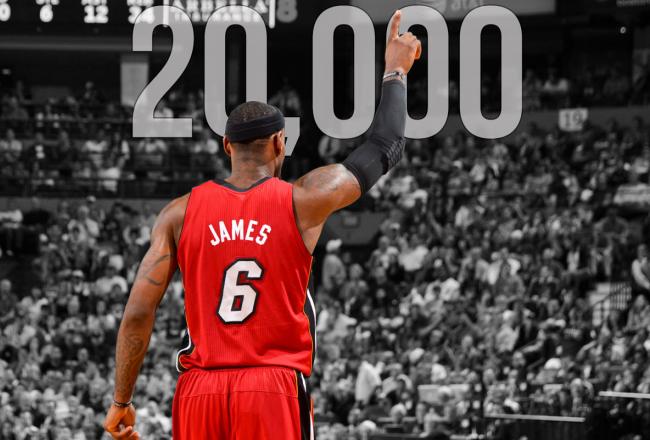
He was 28 years and 17 days old when he took the court in Oakland, needing 18 points to reach the benchmark. Aggressive from the start, King James didn't wait around. He came out shooting and got his milestone by halftime, helping Miami build a 14-point lead over the Golden State Warriors. With his scoring goal accomplished, James started spreading the ball around and found open teammates. He had already notched his 5,000th career assist in the first half as well (joining Kobe Bryant and Kevin Garnett as the only active players with 20K points and 5K helpers), but kept passing and finished the game with ten dimes to go along with his 25 points and seven rebounds. With LBJ facilitating their offense, the Heat built their lead up to 34 points in the third quarter. Miami cruised to a 92-75 blowout from there, allowing Erik Spoelstra to rest his starters in the fourth quarter. With the win, Spo's squad held on to their one game lead over the New York Knicks for first place in the Eastern Conference.
The Heat had struggled on their current roadtrip, losing three games to Indiana, Portland and Utah. Even so, the shorthanded Warriors, without Andrew Bogut (ankle) and Stephen Curry (knee), never stood a chance. Mark Jackson's squad struggled to get good looks against Miami's defense and shot just 36.3 percent from the floor, including 25 percent from beyond the arc. It also didn't help that they committed 21 turnovers, ten more than Miami. But it wasn't all bad for Golden State. In his first start of the season, Jarrett Jack filled in for Curry and scored 16 points on 7-of-14 shooting. David Lee and Carl Landry both notched double-doubles. The Warriors get a day off to lick their wounds, only to face another challenging matchup tomorrow night when they square off with Tim Duncan, Tony Parker and the San Antonio Spurs.
James just set one record, but he still has a long way to go (18,380 points to be exact, more than Isiah Thomas, Magic Johnson, Chris Webber, and Kevin McHale scored in their entire NBA careers) to tie Kareem Abdul-Jabbar's record for most career points. He's already more than halfway there, but that's a lot of ground to make up. To reuse a comparison I made two summers ago, Alex Rodriguez was the youngest player to 500 home runs, well on his way to passing Babe Ruth, Hank Aaron and Barry Bonds. Now, based on his declining performance and inability to stay healthy, I'm skeptical he'll hit 700 home runs, much less the 800 some once projected him for. To some extent, the same thing is happening to Albert Pujols as well.
It's impossible to predict injuries. LBJ is built like an Abrams tank and never gets hurt, but you could have said the same thing about A-Rod five years ago. Forecasting athletic careers is a dangerous game. A lot can change very quickly. Father Time catches up to everyone eventually, and luck contributes more to athletes' health than we would like to believe. Especially in basketball, where a mistimed jump or awkward landing can spell doom. You're always one play away from a catastrophic career-altering injury. The bottom line is that even the best players break down in their thirties, and who's to say James will still be playing like Michael Jordan ten years from now?
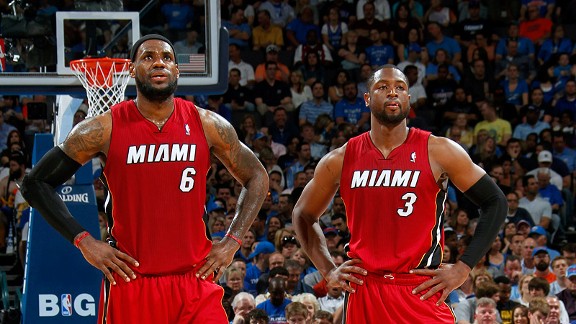
But the real reason I'm not betting on him to break is the scoring drop-off that resulted from his joining forces with Dwyane Wade and Chris Bosh. Despite improving his efficiency--his field goal percentage has improved every year since 2006-2007--his slight slip in shot attempts, especially those from the charity stripe and three-point range, have cut into his scoring numbers. Excluding his rookie year, James averaged 29 points on 21.1 field goal attempts per game-- 4.5 of which were of the three-point variety--and 9.5 free throw attempts per game in his last six seasons with Cleveland. Since taking his talents to South Beach, his scoring has dropped to 26.7 points on 18.7 shots per game. He's getting to the line less often than at any point since his rookie season, and his three point attempts are down 33 percent. There's no denying that James is a much better player and more polished scorer than he was in his early days with the Cavs, but now that he's surrounded by a great supporting cast he simply doesn't need to score as much. My money's on Kevin Durant to break Jabbar's record (assuming Kobe Bryant doesn't get there first) and think James will end up somewhere in the 35,000-36,000 point range.
The Heat wrap up their West Coast swing tonight against the Los Angeles Lakers in a must-see battle of the Big Threes: James, Wade, and Bosh versus Bryant, Steve Nash and Dwight Howard (Pau Gasol will receive limited minutes in his first game back from a concussion). A few months ago this game looked like a preview of the NBA finals, and while the Heat have held up their end of the bargain LA is languishing four games below .500. After firing Mike Brown just five games into the season, the aging Lakers have yet to gel under Mike D'Antoni. They endured a six-game losing streak to begin the new year, but are coming off back-to-back wins against Cleveland and Milwaukee. The Lakers are going to turn it around at some point and get on a roll, but can they do it tonight against the top team in the Eastern Conference?
1. LeBron James
King James won his third MVP award in four seasons and continued to dominate during the playoffs, ultimately securing the championship that eluded him in Cleveland. Later in the summer he led Team USA to another Gold medal with his strong play. He was just named Sportsman of the Year by SI.
2. Kevin Durant
Durantala won his third straight scoring title, finished runner-up to LBJ in the MVP voting and led OKC to their first Finals appearance.
3. Kobe Bryant
Came back from experimental knee surgery in Germany to challenge Durant for the scoring title during the strike-shortened season. With all eyes on the Lakers, he's currently pacing the Association points and points per game while shooting 47.5 percent from the floor, which will set a new career high if he keeps it up.
4. Dwight Howard
Superman missed 18 percent of the strike-shortened season and still accrued more defensive rebounds, total rebounds and boards per game than anybody else. His production has sagged a bit with the Lakers but he's still averaging 17.7 points, 11.9 rebounds and 2.6 blocks per game.
5. Chris Paul
CP3 was phenomenal in his Clippers debut by averaging nearly 20 points a game, leading the league in steals and placing third on the MVP ballot. With Derrick Rose still out, Paul's unquestionably the NBA's premier point guard.
6. Kevin Love
K-Love averaged 26 points, more than 13 rebounds and nearly two treys per game last season. His shooting has been a little rusty after he missed the first few weeks of the season with a broken right hand, but it's only a matter of time before he rounds into form.
7. Russell Westbrook
A rare breed of point guards that can pour in points and still rack up high assist totals. The indestructible athlete fearlessly attacks the basket and is one of the game's best at getting to the charity stripe, where he's a career 81.5 percent shooter.
8. Carmelo Anthony
'Melo disappointed in his first full season with the Knicks as he struggled to coexist with Amare Stoudemire and Jeremy Lin. But with Lin on the Rockets and Stoudemire out with a knee injury, Anthony has regained his status as one of the game's elite players. His three-point production has tripled compared to his career average and his scoring has jumped from 22.6 points per game last year to 28.5 points per game this season.
9. Dwyane Wade
D-Wade has embraced his new role as Lebron's sidekick, the Robin to James' Batman. He's making more than half his field goals and has become a more efficient scorer. Not as explosive as he used to be, but still an incredible defender and superb all-around player.
10. Andrew Bynum
The oft-injured center managed to stay healthy during the abbreviated season and enjoyed a career year. Bynum set personal bests with 18.7 points and 11.7 rebounds per game while displaying an improved post game and top notch defense. Since traded to Philadelphia, he's yet to make his Sixers debut as he recovers from a knee injury.
11. James Harden
Established himself as one of the top shooting guards in the NBA last season and was named Sixth Man of the year. Since being traded to Houston, he's become the focal point of the Rockets' offense and is putting up monster numbers as an everyday starter; 25.8 points, 5.3 dimes and ten free throw attempts per game.
12. Dirk Nowitzki
The lifelong Maverick posted his typically stellar all-around numbers last season despite averaging the fewest minutes per game since his rookie season. He missed the first third of this season recovering from knee surgery and struggled in his first two games back. Look for the German power forward to shake off the rust as he adapts to new teammates Chris Kaman, Elton Brand, O.J. Mayo and Darren Collison.
In a fiercely contested rematch of last spring's Eastern Conference Finals, the Miami Heat once again came out on top. The defending champions received their rings, then proceeded to take down the Boston Celtics, 120-107, in the NBA opener on Tuesday night.
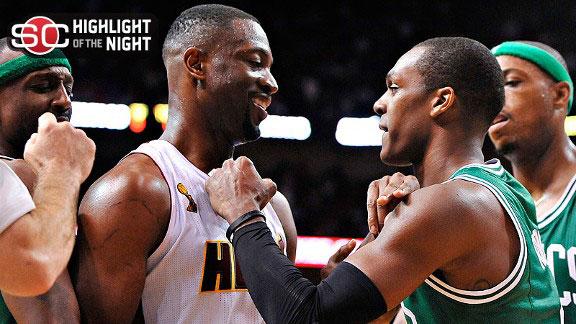
Boston led early on, but Miami was in full control for most of the second half after pulling. away in the third. The Heat built a 19 point lead with eleven minutes to go, but Boston fought back with a Leandro Barbosa fueled run in the fourth quarter. The C's closed the gap to four points with two minutes left to play. But then Boston went cold, missing all four of its field goal attempts while the Heat finished out the game on a 9-0 run to secure the win. But not before Rajon Rondo delivered a flagrant foul on Dwyane Wade by grabbing his neck as he went up to score, a move Wade later referred to as a "punk play." D-Wade clearly overreacted here; even though the game was essentially over, Rondo made the right move by preventing the lay-up with a hard foul, and that's all it was. A hard foul.
What was Wade expecting, a slap on the wrist?
Other notes:
Boston Kevin Garnett struggled offensively, as he scored just nine points and finished the game with more turnovers (five) than field goals (four). On the bright side, he hauled in a dozen rebounds and blocked a pair of shots.
Paul Pierce did his thing, finishing with 23-5-5, drilling two triples and sinking all nine of his free throw attempts.
Brandon Bass put up a double-double with 15 points and eleven boards, six of which came on the offensive end (more than the entire Miami team). He's a great fit here, and I'm glad he re-signed.
Rondo played more than 43 minutes and stuffed the stat sheet with some gaudy numbers; 20 points on 9-of-14 shooting with 13 dimes and seven rebounds. However, nitpickers will point out that he missed both his three point attempts, went just two-of-four at the line and didn't get any steals. I think this will be the year Rondo puts it all together and produces an MVP caliber season.
Courtney Lee looked solid in his Celtics debut before foul trouble forced him to the bench, scoring eleven points on just six field goal attempts. Jason Terry was unimpressive in his first game in Celtic green; JET had turnovers than field goals and failed to connect from beyond the arc. Jeff Green, playing his first game in nearly 18 months, did nothing (three rebounds and no field goals).
Barbosa scored all 16 of his points in the fourth quarter. Talk about a one-man comeback.
Didn't see enough of rookie Jared Sullinger to form much of an opinion about him. Will have to wait for him to emerge during garbage time.
Turnovers were a problem for Boston, as they piled up 15 TOs compared to Miami's 8. When you give the Heat extra possessions, you pay the price.
The Celtics hit three treys in the first quarter and three in the fourth, but didn't hit any in the second and third quarters.
Miami
Ray Allen had an outstanding performance in his first game against his former team. Ray Ray needed only seven field goal attempts to drop 19 points off the bench. He's my early favorite for Sixth Man of the Year (assuming Kevin Martin gets hurt at some point). Rashard Lewis also looked good in his Miami debut, netting ten points and five boards in just under 19 minutes of action. He gives the Heat some much needed depth off the bench and should be in line for a solid season.
Miami's other reserves were useless; Norris Cole, Udonis Haslem and NBA Finals hero Mike Miller combined for three points and three rebounds.
Wade led all scorers with 29 points but posted the worst +/- on the Heat with his -6 (primarily because he was present for Boston's last-ditch comeback).
Mario Chalmers did a great job facilitating and finished with eleven assists.
Lebron James initiated his quest for a fourth MVP trophy by pairing ten rebounds with his 26 efficient points despite logging the fewest minutes of the Heat's starting five.
Chris Bosh went for 19 and 10, but the part of his stat line that surprised me the most was his three blocked shots. Bosh was never a good shot-blocker in Toronto but he's become even worse in Miami, where he's averaged just 0.7 swats per game. You think he'd get at least one per game by shots deflecting off his giraffe neck.
LeBron James finally has his NBA championship ring. It took him nine seasons, seven playoff runs and three Finals appearances, but he finally did it.
And, as much as I hate to say it, good for him. Deep down, I know he deserved it. He's put the time, work, and effort in. He paid his dues in the form of blood, sweat and tears. He (gulp) earned it.
Now, I've never been what you would call a LeBron James fan, and never will be. I began following basketball seriously during the 2006-2007 season, and by then he'd already established himself as one of the top players in the game, so I can't say I followed his meteoric rise to fame. At the start of that season he was just 22 years old, the age of your typical college graduate, and he was already a Rookie of the Year, an All-Star, an All-NBA 1st Team selection, and an All-Star Game MVP. He'd managed to transform a flawed NBA roster of Larry Hughes, Eric Snow, Sasha Pavlovic, and Drew Gooden into a playoff team that won 50 games and nearly upset the reigning Eastern Conference champs. While most kids his age were sitting in job interviews or backpacking through Europe, he signed a three-year contract extension (with a player option for the fourth year) worth $60 million that would keep him in Cleveland's gold trim into 2010. Then he would be an unrestricted free agent along with Dwyane Wade and Chris Bosh, fellow members of the 2003 draft class in which James was selected first overall. It was all part of the plan.
But nobody, not even Magic Johnson and his magic eight ball, could have possibly forecast "The Decision" in the spring of 2007. If you recall, that was when he led Cleveland past the Detroit Pistons, the same Pistons who'd knocked them out of the conference semifinals in seven games the year before. Granted, these Pistons weren't the same team; they were another year older, had lost Ben Wallace to the Bulls via free agency and won eleven fewer games than the year before. Flip Saunders' squad was clearly weaker but remained quite formidable with their veteran core of Chauncey Billups, Richard Hamilton, Tayshaun Prince, and Rasheed Wallace still intact. They look poised to make a third Finals appearance in four years after grabbing a quick 2-0 series lead after back-to-back 79-76 wins at home, but the Cavs responded by taking the next two in Ohio to even the series as it headed back to the Palace for Game 5. James willed his team to victory in this pivotal swing-game by scoring 29 of their last 30 points, including a game-winning lay-up with two seconds left in double-overtime. He poured in 48 points to go along with nine rebounds and seven assists, a stat-stuffing performance that commentator Marv Albert called "one of the greatest moments in postseason history." Color analyst Steve Kerr concurred, adding that it was "Jordanesque." It wasn't the first time he had been compared to "His Airness," nor would it be the last.
This one-man show for the ages had broken Detroit's back, and with Game 6 looming in Cleveland many left them for dead. But the Pistons rallied, refusing to wave the white flag. They battled even though "Big Shot" Billups failed to record an assist and Prince connected on only one of his ten field goal attemtps. Trailing by a single point after three, it wasn't hard to imagine the more experienced Pistons clamping down and forcing a Game 7, especially with James struggling from the floor; he missed eight of eleven shots. But like most older teams (the Celtics come to mind here) they ran out of gas in the fourth quarter, allowing Cleveland to build up a double-digit lead and put the game away. Detroit's usually strong defense bailed James out by sending him to the free throw line 19 times (he hit fourteen), and allowed little-known rookie Daniel Gibson to torch them for 31 points on five three-pointers off the bench. "Boobie" Gibson was the hero of Game 6, but there was little doubt that it was James who had pushed the Cavaliers into their first Finals appearance in franchise history. The clock struck midnight on their Cinderella season when they squared off with Greg Poppovich's battle-tested San Antonio Spurs of Tim Duncan, Manu Ginobili and Tony Parker. The Cavs had as much of a chance as an ant has against the bottom of your shoe. They couldn't even steal a win against the crew that put the finishing touch on their dynasty by sweeping them aside to win their fourth NBA title in nine seasons.
It was a watershed moment in James' young career. He'd reached new heights, raising the bar for both himself and his team. Personally, he'd vaulted himself into rarefied air with one of the greatest postseason performances of all time. With such a dazzling display, he'd convinced even the most skeptical critics that an NBA championship in Cleveland was no longer just a product of wishful thinking; it was well within the realm of possibility. As long as he was in the game, you couldn't count the Cavaliers out. The city worshipped their local kid from Akron. He was annointed the savior, the chosen one, like he was basketball's Jesus Christ. The irony is that all that pressure, the tremendous burden and impossible expectations that were placed on his broad shoulders, probably helped push him out of Cleveland. It must have worn him down, carrying that weight around day after day, game after game, year after year. And for that, I can't blame him.
Just as I can't blame him for trading Cleveland's frigid, snowy winters in for the warm sun and nightlife of South Beach. I can't blame him for wanting a change of scenery after spending seven years with the same organization. I can't blame him for getting fed up at the Cavs front office for not surrounding him with better players. I can't blame him for always coming close, but never getting to puff on the proverbial cigar. I can't blame him for wanting to play alongside his buddies Dwyane Wade and Chris Bosh instead of Antawn Jamison and Mo Williams. I can't blame him for wanting to have fun. I can't blame him for wanting a fresh start. I certainly can't blame him for wanting to win the championship he so desperately needed to validate his career.
And neither should you. We have to remember that athletes are mercenaries, with no obligation to remain loyal to any one team or fan base. That's what makes the Derek Jeters, Chipper Joneses, Paul Pierces, and Tom Bradys of the world so special. Free agents pack up and leave all the time (Albert Pujols is still fresh in my mind). Normally money is the common denominator, but it wasn't in Lebron's case. All he wanted was a championship. Of course the manner in which he left Cleveland (tearing out a city's heart on prime-time television) was shallow, selfish, arrogant, immature, ignorant, bloated, and self-absorbed, pretty much every negative adjective you can think of. It reflected his inflated ego as well as his alarming lack of awareness. Cleveland's fans, who'd done nothing wrong except perhaps shower him with an excessive amount of love and adoration, deserved better. Just as he deserves every taunt, jeer, boo, put-down and profanity thrown his way. He horribly misjudged the situation and made a mistake that blew up in his face, but now it won't define his career. It's a scar that will always be there no matter what he accomplishes, but one that will also fade with the passage of time.
I think James knows that. He grew up this season, became a man almost overnight as he embarked on the long road to redemption. Last summer the Mavericks served him a big slice of humble pie, forcing him to swallow (or choke on) every last bite. After some time to reflect he realized his mistakes, and felt bad about them. And because of that, he made it a lot harder to hate him this year. He'd already suffered his commeuppance, lost some of that signature swagger. You could tell he wasn't the same arrogant, immature punk who thought he could assemble his own superteam and rule the NBA.
So in the land of second chances, it once again became possible to appreciate the fact that he's unquestionably the most physically gifted basketball player we've ever seen. Nobody can match his unique combination of size, strength, agility, and leaping ability. He's the total package who's next triple double is just waiting to happen. When he gets into the paint and barrels toward rim at full speed, he looks more like an NFL running back than anything else. He possesses enough raw talent to challenge Michael Jordan as the greatest basketball player of all time. And it is Jordan. You could make a case that Wilt Chamberlain was more dominant, that Bill Russell was a better leader, or that nobody could match Kareem Abdul-Jabbar's longevity, but that won't get you very far.
Granted, some of Jordan's greatness derives from the fact that his unparalleled marketing campaign helped him evolve into the planet's first truly global athlete. Aside from creating his own brand, he expertly used Nike, McDonald's, Wheaties, and everything else to become an American icon, one who'd grown much bigger than the game he played for a living (Space Jam pretty much sums it up). He received a level of exposure and attention that exceeded what any president, actor or rock star had ever enjoyed. In a way, it was what he did off the court that made him unique. Others scored more points and won more championships, but they didn't do it the way Jordan did. With his tongue sticking out and Air Jordans strapped to his feet.
James had a similar aura about him in Cleveland, when he convinced us that we were watching something special. Then he threw it all away by turning the whole nation against him and becoming one of the most hated athletes in recent memory. His failure to win a championship remained the glaring hole on his otherwise stellar resume, and it provided plenty of ammunition for talking heads and casual fans alike. There had been much speculation where James would rank in history if he could never get over the hump. What would his legacy be? Would he still compare favorably to Jordan, Larry Bird, Kareem, and all the rest? Or would we demote him to the tier of ringless stars that includes Charles Barkley, Patrick Ewing, John Stockton and Karl Malone, as well as contemporaries Steve Nash and Allen Iverson? Fantastic players, sure, but not winners. And in sports, at the end of the day, that's all we really care about, right? Who wins and who loses. It's simple--there's no gray area, no room for debate--and we like it that way, because the rest of life is just too complicated. All the arguments and player analysis and fantasy teams are fun, but they ultimately amount to little more than a sideshow, a distraction from what sports are all about. Competition. That's why you play the game. Not to score 25 points, throw a couple TD's or belt one out of the park (though that's all admittedly fun). We play to win.
Of course, winning a ring is more a reflection of circumstance than a true barometer of talent. Everything has to break your way, and sometimes it's better to be lucky than it is to be good. You have to stay healthy. You have to get the bounces, the calls, the 50/50 plays. All you can do is put yourself in the best position possible to win. It's rare, but every now and then you'll get a team that's so good, so flawless that a title almost seems preordained. That no matter who gets in their way, they're going to wind up on top. Not even Denzel Washington and Chris Pine can stop them. The 1927 Yankees. The 1985-'86 Bears. The 1995-'96 Bulls. Teams of destiny. But more often than not, you have teams that weren't expected to win the championship at the beginning of they season, but they got hot at the right time. You can't tell me that the 83-win St. Louis Cardinals were the best baseball team in 2006. Or that the 2011 Mavericks were better than the Chicago Bulls. Or that the New York Giants were the best football team last season. The best teams don't win championships; it's the teams that play the best when a championship is at stake.
That's why the whole "he needs a ring to be considered great" idea has never held much water with me. A player is just one man, a cog in a machine. So many factors are outside of his control. Teams win championships, not individual players. Plenty of the greatest athletes of all time have failed to win a championship. Ernie Banks. Ted Williams. Barry Bonds. Dan Marino. Barry Sanders. The aforementioned crew of Barkley, Malone, and Ewing. Before the advent of free agency, many great athletes toiled for losing teams their entire careers, helpless to change their fortunes. Eli Manning has won twice as many Super Bowls as his older brother, but even the most passionate Giants fans would have to admit that Peyton Manning is far and away the superior quarterback. The best athletes of all time are not the ones who won the most; they are the ones who best combined talent with winning. Babe Ruth. Wayne Gretzky. And then, of course, there's Michael Jordan with his gaudy stats and half dozen championships.
Their careers, which would have overlapped had Lebron entered this world a year earlier and/or if Jordan had bothered to hang around for another season with the Wiz (imagine that match-up!), share several notable parallels. They both possessed off-the-charts athletecism, wore the number 23 (though James changed his to six after moving to Miami), received multiple MVPs and won their first championships at the end of their age 27 seasons. Last summer I compared James to Alex Rodriguez, another superstar who also struggled to win a ring. Now I will stack him up against the greatest basketball player of all time through his age 27 season/first championship. I value traditional counting stats like rebounds and assists. I value rate stats like field goal, free throw and three-point percentage. I value advanced stats like true-shooting percentage and PER, which is fast becoming the WAR of basketball.
The most significant difference is that James came to the NBA straight out of high school, one of the last great players to do so. Jordan followed the more traditional path by attending college. Like James, I'm sure he would have handled the leap just fine. He spent three years honing his skills at UNC, where he won a national championship and established himself as the best college player in the nation. As a result, through the same age James had played an additional two-plus seasons of NBA games, so many counting numbers are skewed in his favor. That explains why I used per game averages instead of career totals. Lastly, it's important to remember that James is a small forward. Jordan played some small forward, especially during his brief stint with the Wizards, but spent the majority of his career as a shooting guard.
I'll use ten categories to rate each out of ten, with 7.5 representing average. Think of it like a report card; a 7.5 is a C, an 8.5 is a B, a 9.5 is an A, so on and so forth.
Some last food for thought; the player basketball-reference ranks as most similar to James is Barkley. Jordan's closest comp is OsC.R. Robertson.
Durability
James 39.9 minutes per game, misses roughly four games per season
Jordan 38.7 minutes per game, missed roughly nine games per season
LeBron James is indestructible, probably because he's built like an M-1 Abrams Tank. He's already led the league in total minutes played two times and minutes per game once. That he's averaged 40 per game for nearly a decade in the modern age of pampered athletes is simply mind-blowing. He's never missed more than seven games in any season. It's interesting, then, that he's failed to play all 82 games in a season before, topping 80 only twice. That means Kevin Martin, who's made of glass, has as many seasons with 80 games played as Lebron does (go figure). I would have bet almost anything that he had a couple seasons where he didn't sit out. But he tends to miss a handful of games because his aggressive style of play leads to plenty of hard collisions and awkward falls. Over the course of a draining basketball season they add up to a sore, battered body. And, just like the rest of us, he actually gets sick from time to time. So I'll cut him some slack.
Jordan was every bit the Iron Man that James is with a single exception; his sophomore season was marred by a broken foot that caused him to miss 64 games and limited him to just seven starts. Outside of that one year, though, he missed one game in his other six seasons. One. Four times he played more games than anybody else. Three times he led the league in minutes played, twice leading in minutes per game. Throw that one season out the window and he was like the Cal Ripken Jr. of basketball; nothing could keep him out of the starting lineup. Given his unmatched competitive streak, I'm not surprised one bit that Jordan showed up to play everyday. Keep in mind this was "before" the Flu Game.
James: 9.5
Jordan: 9.5
Passing
James: 6.9 assists per game against 3.3 turnovers, 34.1 AST% against 12.1 TOV%
Jordan: 5.9 assists per game against 3.1 turnovers, 27.1 AST% against 10.3 TOV%
What makes James' assist totals so astonishing is that he compiled them despite playing on horribly constructed teams. He could have (and probably should have) pulled a Kobe Bryant circa 2006, taken one look at the guys around him and said "Screw this. Just give me the ball and let me do my thing. I'm not passing unless I absolutely HAVE to." But that's just not in his nature. He's too selfless, and he's at his best when he's getting his teammates involved. Just watch him run a fast-break. Last season he averaged 6.2 dimes, on the low side for him, and that figure was still more than full-time point guards Brandon Jennings, Jameer Nelson and Russell Westbrook. His proficiency in this aspect was on full display in the Game 5 clincher against OKC, when he kept slashing into the lane, drew the defense in and then delivered pinpoint passes to Mike Miller, Mario Chalmers and Shane Battier on the wing for open treys. He piled up 13 assists despite scoring 26 points himself. Like Kevin Garnett, James has been accused of being selfless to a fault, giving the ball away to lesser players and passing up shots in situations when he should be more aggressive, when the score demands that the best player on the court has the ball in his hands.
Jordan never had that problem. He earned a reputation as a selfish player early in his career because of his prodigious scoring totals. But as with Kobe Bryant, those figures undermined the fact that he could be a great facilitator when he wanted to be. In 1988-1989, for instance, he averaged eight assists per game. He was a scorer first, but once sidekick Scottie Pippen matured and the organization surrounded him with better role players such as Kerr he gained a better understanding of passing.
James: 9.5
Jordan: 8.5
Rebounding
James: 7.2 rebounds per game (5.9 defensive, 1.2 offensive), 10.5 TRB%
Jordan: 6.3 rebounds per game (4.5 defensive, 1.8 offensive), 9.4 TRB%
Given Lebron's reputation as an excellent rebounder, I would have guessed the difference between the two would be greater than one measly rebound per game. But Jordan was a good rebounder in his own right, too. I don't put quite as much stock in defensive rebounding because it seems more opportunistic. Obviously it's still a skill--just ask Kevin Love--that requires strength, footwork, positioning, and an innate sense of where the ball is going. Ultimately, you still have to be in the right place at the right time. You can get great positioning, box out and get low, but ultimately you're at the mercy of the ball's bounce. Still, just by being involved in the game and having a pulse, you're probably going to grab a couple rebounds unless refuse to go inside the three point arc, or your name is Nick Young. Anybody can get them. Rebounds are also a product of playing time--the more you play, the more you tend to get.
I've always been much more impressed by players who excel at offensive rebounding. These kind of rebounds are worth their weight in gold, because they extend possessions and create second chance opportunities. Nothing's more demoralizing than playing great defense for twenty seconds, forcing the other team to take an off-balance jumper...and see them get the ball back with a fresh 24. It's like hitting the reset button on your XBox and wiping out all the progress you just made on that Call of Duty mission. In order to get them, you have to aggressively crash the boards. You have to work for them. You make your own luck. Offensive rebounds don't just fall into your hands the way defensive rebounds do.
So you could make the argument that Jordan, despite grabbing fewer boards, is the superior rebounder. I'll call it a wash.
James: 9.5
Jordan: 9.5
Scoring
James: 27.6 points per game, .483 FG%, 115 ORating
Jordan: 32.6 points per game, .529 FG%, 121 ORating
This one's a no-brainer. LBJ had one season, 2007-2008, when he won a scoring title, and has never led the league in total points scored despite pouring in at least 2,000 seven times. Had he remained in Cleveland, he probably could have won the scoring title in each of the past two seasons, when he finished within one point per game of Durant (who already has three consecutive scoring titles). Now that he's part of a Big Three, he's taking fewer shots so the chances of him winning another scoring title have been reduced drastically unless either a) Durant gets hurt or b) Chris Bosh and/or Dwyane Wade miss extensive time, thereby allowing 'Bron to handle the ball more and average more than 20 shots per game as he was with Cleveland. The odds seem to be against him and I think it's very unlikely that he wins another one, but you never know.
For what it's worth, Jordan wasted no time establishing himself as the game's premier scorer. By this point in his career he had reeled off five straight scoring titles, pacing the league in total points every year except his second. In his third season, he scored racked up over 3,000 points while averaging 37.1 per contest. Had he not taken two years off to pursue a career in baseball and had he not retired prematurely following his sixth championship, I sincerely believe he would have amassed more than 40,000 career points.
James: 9
Jordan: 10
Three Point Shooting
James: 33.1 percent on 4 attempts per game
Jordan: 28.6 percent on 1.2 attempts per game
Not exactly a fair comparison because at the same point in their careers, James has jacked up nearly 2,800 three point attempts wheras Jordan had taken just 625, roughly one-fifth of James' total. But even with the much smaller sample size, it's clear that Jordan was no Ray Allen or Reggie Miller. In fact, for the first four seasons of his career, he was about as much as a threat to score from behind the arc as Rajon Rondo, averaging fewer than one attempt per game while shooting a pitiful 16.4 percent when he did fire away which. Simply put, he hadn't developed that part of his game yet. But great players always find ways to make themselves better, and it was only a matter of time before MJ added the long-range bomb to his arsenal. The following year, 1988-198), he launched nearly twice as many threes as he did the previous season, but his success rate more than doubled. From that point forward he remained a capable three point shooter, only getting better with age like Jason Kidd.
Throughout this timeframe, about five percent of MJ's shots were threes. By comparison, approximately one out of every five field goal attempts from James is a triple, and in this regard he has been fairly steady. Since shooting a Jordanesque 29 percent his rookie year, he's consistently remained in the low-to-mid thirties, cementing his status as a league average three point shooter. After coming to Miami his three point attempts have dropped precipitously because his focus has shifted on improving his post up game and taking more efficient shots closer to the basket. This is a move in the right direction for James, who's a streaky outside shooter to begin with, and the strategy is working. This season his 2.4 attempts from downtown represented a career low, but his 36.2 percent success rate and .531 field goal percentage were personal bests.
Check out the trend
2009-2010 5.1 3PA .503 FG%
2010-2011 3.5 3PA .510 FG%
2011-2012 2.4 3PA .531 FG%
James: 7.5
Jordan: 6.5
Free Throw Shooting
James: .746 percent on 8.8 attempts per game
Jordan: .849 percent on 9.6 attempts per game
No surprise here, given that James has been nothing more than an average free throw shooter throughout much of his career. In his defense, he has improved this area of his game throughout his past four seasons, knocking down 76.9 percent of his shots from the charity stripe compared to his 72.8 percent clip throughout his first five seasons. Still, he had one season, 2006-2007, when he dipped below 70 percent, and there's an 8.1 percent gap between his career highs and lows. He mitigates this inconsistency with his sheer volume of attempts; three times he averaged more than ten shots from the free throw line. Jordan, on the other hand, was as steady as they come, never falling beneath 84 percent and topping out at 85.7 percent. Even more impressively, he maintained that high level of success while averaging nearly ten freebies per game, a combination of efficiency and volume matched only by Kevin Durant amongst today's players. Two times he led the league in free throws made and in his third season he averaged a whopping 11.9 attempts per contest.
James: 8
Jordan: 9.5
Defense
James 1.7 steals, 0.8 blocks, 102 DefRating, 4 NBA All-Defensive 1st Teams
Jordan 2.8 steals, 1.1 blocks, 104 DefRating, 4 NBA All-Defensive 1st Teams, 1987-1988 Defensive Player of the Year
If this was baseball, both these guys would have a mantle topped with well-deserved Gold Gloves. James has a reputation as one of the best defenders of the new milennium, along with Andre Iguodala, Kevin Garnett and Dwight Howard. His size, strength, and overall athleticism make him a nightmare for opposing small forwards. Just ask Paul Pierce, who struggled mightily in the Eastern Conference Finals. But I would never, not in a million years, have guessed that Jordan swatted more shots than James, who gives opponents nightmares about his electrifying chasedown blocks. But Jordan produced back-to-back seasons in the late '80s with more than 125 blocks and 1.5 per game, a rate that surpasses what notorious stonewalls Marcus Camby, Joakim Noah and Tyson Chandler averaged this year. That, combined with his quick hands and sharp reflexes, helped him win the 1988 Defensive Player of the Year. He also led the league in steals twice, and didn't have to gamble too much to get them.
Both are defensive stalwarts who could still contribute something even when they weren't feeling it on offense. Getting back to baseball it's like comparing Roberto Clemente to Al Kaline, Brooks Robinson and Mike Schmidt, Carlos Beltran to Andruw Jones. It comes down to personal preference and more than a few split hairs. You can take James and I'll take Jordan.
James: 9.5
Jordan: 10
Individual Honors/Awards
James: 3 MVPs (4.39 shares), eight All-Star games, six All-NBA First Teams, two All-NBA Second Teams
Jordan: 2 MVPs (3.85 shares), seven All-Star games, five All-NBA First Teams, one All-NBA Second Team
Both players were highly decorated; it's safe to say their talents did not go unnoticed (though it is worth noting that James somehow failed to make the All-Star team his freshman year).. Jordan had a tough time winning the Most Valuable Player award early on because Bird and Johnson dominated the voting just as much as they dominated the NBA Finals, combining for five MVPs during his first seven seasons. All he could do was bide his time and settle for a pair of runner-ups and a third place finish. Twenty years later the league has more talent and competition than ever before, so as a result the award has been more up for grabs recently. KG, Steve Nash (twice), Dirk, Kobe, and Derrick Rose have all been named winners during Lebron's career, and Durant is knocking on the door. MJ would win five trophies in all, but considering that Lebron's already 60 percent of the way there at age 27, with quite a few prime years in front of him, I like his chances of matching and exceeding that number some day.
Basketball sabermetrics has lauded James for his efficiency, and according to PER he's been the best player in basketball each of the past five seasons. But had such statistics been popular twenty years ago, those same number-crunchers would have gone bananas over Jordan. His numbers blow away Lebron's, which are already stellar in their own right. Neither player needs sabermetrics to prove their greatness; the numbers merely reinforce what we already know.
Fittingly, both were named Finals MVP after winning their first rings. James finally seemed to turn the corner this postseason, starting about halfway through the Indiana series and not letting his foot off the gas pedal until a championship was secure. With Wade banged up and Bosh out with an abdominal strain, James stepped up and took control of the playoffs. Until then, he had been too up-and-down for a player of his caliber. He put the Cavs on his back in 2007, single-handedly carrying them to a Finals showdown with the San Antonio spurs, but quit on them against the Celtics three years later. In 2011 he methodically disposed of the Celtics and Bulls, only to disappear as Dirk Nowitzki and an inferior Mavericks squad upset his Miami Heat. Much of the criticism surrounding his crunch time play was overblown, but he did appear timid at times and seemed to shy away from the moment. His ability to execute in the clutch was called into question, and he was slapped with the reputation as a choker. That monkey is off his back now.
Jordan's postseason heroics are legendary, even when you omit the Flu Game and The Shot. His stats and reputation speak for themselves. He enjoyed what has to be considered the greatest individual postseason performance of all time when he stepped onto the parquet floor and et a playoff record with 63 points in a double-overtime loss against Boston's juggernaut in 1986, a performance that inspired Larry Bird to comment that they had all seen "God disguised as Michael Jordan" (I like how Lebron is likened to Jesus, but MJ is compared to God). It just took a while for the rest of his team to catch up with him.
James: 8.5
Jordan: 10
Conclusion
Total
James: 89.5
Jordan: 93
It's close, with James coming out ahead in several areas (three point shooting, passing, rebounding), but overall the traditional stats and advanced metrics make it clear that Jordan is still the superior player. No surprise there. But 'Bron is definitely on the right track; the fact that we've been making these comparisons for years, long before Lebron ever won his ring, is a remarkable achievement in and of itself. He's not there yet, but if he can maintain this level of play for at least another half decade, he's going to give Jordan a serious run for his money. Could he surpass the greatest athlete of all time? I think he could.
But then again, he'd probably have to win five more championships to convince Jason Segel.