Showing posts with label Detroit. Show all posts

Monday, December 7, 2015

Tigers Trying to Win Now

The Tigers reversed course by signing Zimmermann (Fox Sports)
More than a week after the news become official, I still can't believe Jordan Zimmermann was the first player in this year's stacked free agent class to land a $100 million ($110 million, actually) payday.

Five years ago it seemed more likely that Zimmermann would be out of baseball by now than collecting a nine-figure check. His first two seasons, which were interrupted by Tommy John surgery, yielded a 4-7 record and 4.71 ERA--hardly a promising start. His third year--and first full one back from TJ--was better, but his strikeout rate dipped below 7.0 K/9--a steep drop from the 9.1 K/9 mark he flashed as a rookie. Given his below-average whiff rates, it was anybody's guess as to whether he'd stick in the Show.

Since then, Zimm's been one of the best dozen pitchers in baseball. His ability to limit mistakes and control the strike zone has helped him stay effective despite middling strikeout rates. He's also been durable, averaging over 200 innings the last four years. Zimmermann's basically Matt Cain, who received an almost identical extension from the Giants in 2012 (Cain was actually two years younger when he signed his deal, but contracts have risen since then due to inflation).

But is he a good fit for the Tigers? Last year Detroit appeared to enter rebuild mode after trading players that were about to become free agents (David Price and Yoenis Cespedes) and finishing last in their division for the first time since 2008. They fired their general manager, Dave Dombrowksi, along the way, signaling the dawn of a new regime in Motown.

After the season however, team manager Brad Ausmus insisted the Tigers were not rebuilding, which sounded like a bunch of hot air at the time. Obviously Ausmus wouldn't admit punting on 2016 just hours after 2015 had ended.

Two months later, it's clear the Tigers are not rebuilding; they are reloading. Rebuilding teams don't sign 29 year-old starting pitchers to $110 million contracts. They are doing what Boston did in 2014, selling at the deadline before regrouping in the offseason.

Detroit hasn't spent this much on a pitcher since giving Justin Verlander a five-year, $140 million extension prior to the 2013 season. Given how poorly that one's worked out, it's not surprising the Tigers were hesitant to pay pitchers similarly large sums in recent years. They decided David Price and Max Scherzer were too rich for their blood, letting them seek massive contracts elsewhere. But Zimmermann came at roughly half the cost of them and Zack Greinke, making him look like a veritable bargain by comparison.

On the surface, a five-year deal to an under-30 pitcher with barely 1,000 major league innings on his arm smells like a great deal. If I'm the Tigers, however, I'm definitely worried about how their new ace will adjust to the American League, especially after coming off his worst season in five years. Zimmermann struggled a bit in 2015 as his walk, hit, and home run rates rose, his strikeout rate dropped, and his ERA rose a full run. He went from being a Cy Young candidate and borderline ace in 2013-2014 to a midrotation-level pitcher in 2015.

Going forward, his 2015 is probably his ceiling. If he sustains that level throughout the life of his contract, or returns to his 2013-2014 norms, he'll be worth it. If last year marked the start of his decline phase, however, than Detroit's going to regret this deal almost as soon as they soured on Verlander's (A likely scenario, given that pitchers without elite strikeout potential are more susceptible to losing it overnight i.e. Cain and Doug Fister)

This deal would look much better had it been signed before last year, as now Zimmermann's future appears less certain. Is he a pitcher on the downswing, or was 2015 merely an off-year? Will he bounce back in 2016, or have we already seen the best of him? Detroit just paid a boatload to find out.

Wednesday, October 28, 2015

Hunter Hangs 'Em Up

Hunter is retiring after a nice final season with the Twins (MLive)
After a stellar and tremendously consistent 19-year career, Torii Hunter is calling it quits.

Hunter had returned to the Minnesota Twins--who drafted him out of high school and watched him develop into one of the best center fielders of his generation--on a one-year deal for 2015. While he didn't explicitly say so, it was assumed he intended to retire as a member of the Twins, whom he played for from 1997-2007. He was going to be 40 in July, and while he'd been productive the last couple years one get the sense that his career was winding down. Why else would he want to come home?

Especially since the Twins have been terrible the last few years. When guys get to be Hunter's age and haven't won a ring yet, they usually want to go where they'll have a chance to do so. A popular, respected player with some juice left in his bat like Hunter could have latched on almost anywhere, had he been willing to take a discount. In need of a bat and veteran leadership for its up-and-coming team, Minnesota paid him above market value to come back.

It seemed like a sentimental move more than anything else. Hunter had been replacement level in 2014 and figured to be worse in 2015. That's nobody's idea of a $10 million player. But if anyone could afford to give a former star one last victory lap, the Twins could. With so much young talent to break in, Minnesota wasn't ready to contend.

As it turned out, the team and Hunter were both much better than expected. The Twins surprised everyone by finishing second in the AL Central, pursuing a wild card berth until the season's final week. Hunter hit 22 home runs--his most in a season since 2011--and played 139 games.

It was a fitting farewell for Hunter, one of the best and most popular Twins of all-time. Drafted by Minnesota in 1993, he made the big club in 1997 alongside David Ortiz, who like Hunter kept hitting throughout his entire 30s.

Also like Ortiz, it took Hunter a few years to get going. He didn't break out until he was 25, by which point he was in his fifth season--but once he did he never looked back. He hit 27 home runs and won his first of nine straight Gold Gloves that year (2001), made his first All-Star team and finished sixth in the MVP vote the following year, and had his first 100 RBI season the year after that. Nicknamed "Spiderman" for his amazing catches, he was quietly one of the best players of the 2000s, racking up eight Gold Gloves and topping 20 homers eight times (11 in all).

By the end of the decade he was an Angel, having moved on after a big walk year in 2007. When Vladimir Guerrero departed he moved over to right, which no doubt extended his career. He'd shown signs of slowing down in his last season as an everyday center fielder, batting .262 with his worst slugging percentage in over a decade.

But before long LA's outfield became too crowded for him, with Mike Trout taking over in center and Josh Hamilton signing on. Hunter found a home in Detroit, where he had two near-identical offensive campaings in 2013 and 2014.

It was towards the end of his first year with the Tigers that he was involved in what may be the most memorable play of his career. It was Game 2 of the ALCS and Boston, and Detroit led 5-1 in the bottom of the eighth. The bases were loaded and David Ortiz, Hunter's old teammate, stood at the plate, facing fresh reliever (Joaquin Benoit) summoned to extinguish the flames.

Ortiz turned on Benoit's first pitch and belted it deep into the night. 37,000 cold, tired fans leapt from their seats as the ball rocketed towards the right field bullpen. Hunter raced back to the wall and leapt, his glove hand stretched as high as it could go. Hunter had robbed many a would-be home run before, and it looked like he might do so again. He timed his leap perfectly, but without time to set his feet  he slammed into the wall, then flipped over it as his momentum carried him out of play. The ball followed him into the bullpen, having just cleared his outstretched mitt.

The game was tied, and within a matter of hours, so was the series. The Red Sox went on to win in six, then proceeded to beat the Cardinals in the World Series. Had Hunter made the catch, Detroit would have won the game and probably the series. It could have been them celebrating after defeating St. Louis. And Hunter, of course, would have been the hero for robbing a would-be game-tying grand slam.

Instead, he retires with the best play of his career occurring in an All-Star Game. It was a superb play, to be sure, but I guarantee Hunter would trade it in a heartbeat for the ALCS grab, especially since he nearly killed himself trying to make it.

But not even that could slow him down. Nothing ever did.

Oh sure, he lost range over time as all mortals do. His defense inevitably slipped, forcing him over to right field and eventually DH. But even as he became a non-factor on the bases and a liability in the field, he remained a threat in the batter's box.

It's rare that centerfielders age as well as Hunter did. I think of Mickey Mantle, Dale Murphy, and Ken Griffey Jr., all of whom broke down in their 30s. Same goes for Andruw Jones, Vada Pinson, Fred Lynn, and Cesar Cedeno. Jim Edmonds couldn't stay healthy. All that running and crashing into walls usually catches up to you.

Not Hunter. He had pretty much the same season every year for 15 years. He'd bat around .280 with 20 homers, 20 steals, and 90 or so RBI. Like clockwork. There were a couple years where he got hurt--in 2005 he was limited to 98 games and in 2009 played only 119--but for the most part he was in the lineup everyday.

You know whose career Hunter's reminds me a lot of? Johnny Damon's. They were never really great, All-Star caliber players, let alone serious MVP candidates, but they were really good for a long time and held up surprisingly well. They played on some terrific teams and were usually in the postseason. They were pretty indestructible, too.

Hunter wasn't quite as good as Damon, but he had a better career than most people realize. His counting numbers are actually very similar to Jim Rice's. He surpassed 350 homers and fell just short of some other big round numbers like 2,500 hits, 500 doubles, 200 stolen bases, 1,400 RBI, and 1,300 runs. Not quite Hall of Fame numbers, but Hall of Very Good for sure.

Most impressively, Hunter went out on his own terms, not because of injury or as some washed up bum on a team he didn't care about. He got to retire as a healthy contributor for his original team after a year in which they almost made the postseason. It's not the perfect final chapter, but it's still a happy ending.

Sunday, April 19, 2015

Gonzalez Going Bananas, Miggy Mashing

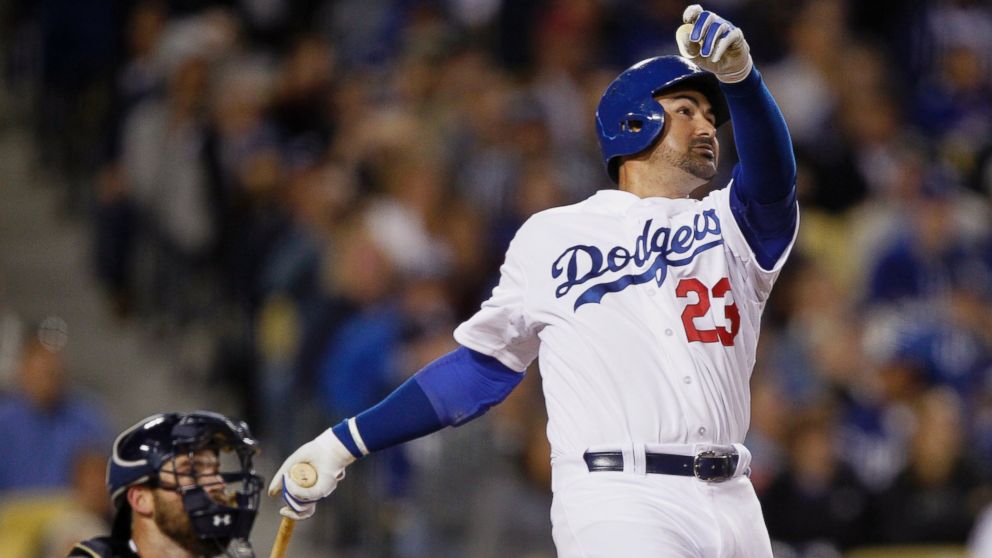
Gonzalez's great start has helped the Dodgers to an 8-3 record (ABC News)
Adrian Gonzalez came up to bat with the bases loaded twice in yesterday's Rockies-Dodgers game. The first time was in the bottom of the third, with the score tied 1-1 and only one out. With nowhere to put Gonzalez, Jordan Lyles had no choice but to pitch to the man from Mildon, who entered the game batting a scintillating .550/.609/1.125.

To his credit, Lyles got Gonzalez to ground into what should have been an inning-ending double play. Gonzalez rolled a tailor-made rally killer to Troy Tulowitzki, who quickly flipped to DJ LeMahieu at second. Though he had plenty of time to get the slow-footed Gonzalez, LeMahieu rushed his throw to first and buried it in the dirt. Justin Morneau was unable to field the hop at first, allowing Gonzalez to reach and the go-ahead run to score.

But that's just how hot Gonzalez is these days. The fielders are just as afraid of him as the pitchers are, and even his outs hurt opposing teams.

In the bottom of the fifth with the score still 2-1, Gonzalez came up in another bases loaded situation. Once again, Lyles was forced to pitch to him, and once again Gonzalez made him wish he hadn't. Gonzalez laced a long, looping drive that one-hopped the center field wall, landing just beyond the reach of a diving Charlie Blackmon. Joc Pederson and Jimmy Rollins scored, giving Los Angeles a 4-1 lead and boosting Gonzalez's RBI total to 14 on the young season. Gonzalez's single would prove to be the game-winning hit, as LA went on to win 6-3.

Gonzalez, who has hit safely in every game thus far and leads the majors in just about every conceivable batting metric, has been unstoppable since starting the season on fire against San Diego. Gonzalez had an opening series for the ages, going 10-for-13 with five home runs, two doubles, seven RBI, and seven runs scored as the Dodgers took two out of three from the Padres. After falling a triple shy of the cycle in each of the first two games, Gonzalez capped his monster series with his first career three-homer game.

Gonzalez has yet to go hard since, but he hasn't stopped hitting in the meantime. For starters, his .523/.580/1.625 line represents season lows in all three categories. Yeah. His plate discipline stats also reflect how locked in he is right now. He's made contact on nearly 90 percent of his swings, getting wood on almost 98 percent of the pitches he's swung at inside the strike zone. His swinging strike percentage, currently below five percent, is half his career rate. He's done his best Victor Martinez impression by striking out only three times.

Gonzalez's hot streak shows that even as his 33rd birthday rapidly approaches, he's still a great player. The quiet, steady first baseman usually doesn't generate many headlines, but right now he's the star of the show. Los Angeles is first in the NL West, but if he was having a Mark Teixeira-type start they wouldn't be. He's either scored or driven in 22 of the team's 56 runs thus far--a whopping 39.3 percent--and is responsible for over a quarter of their total bases.

With Matt Kemp gone and Yasiel Puig struggling to find consistency at the major league level, Gonzalez is clearly the best hitter on his team. If the last two weeks have taught us anything, it's that.
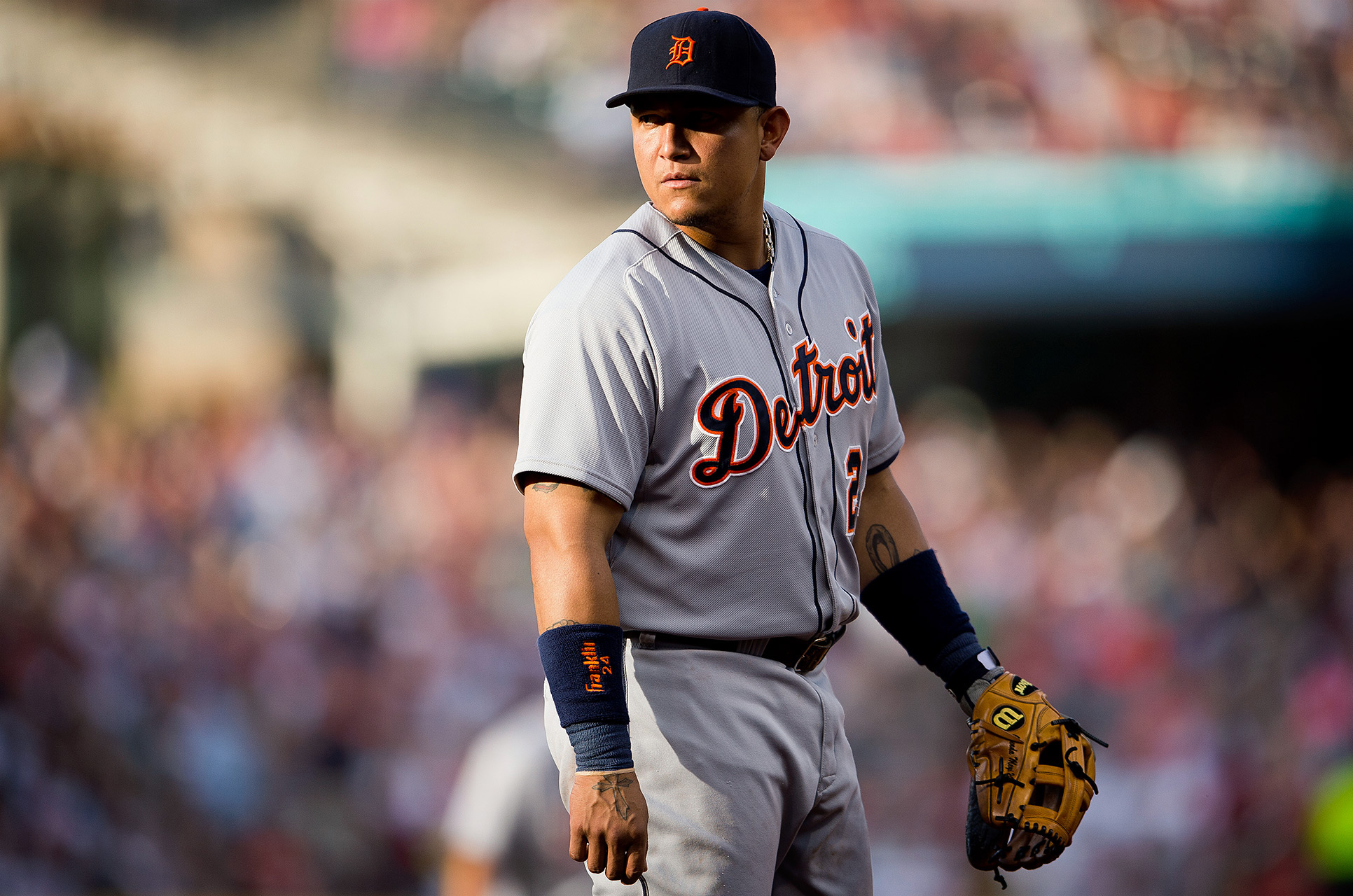
Cabrera can still crank, too (Tigers Sout)
Gonzalez isn't the only 30-something first baseman off to a torrid start. Over in the American League, in a mysterious land called Michigan, Miguel Cabrera has continued to remind everyone why he was considered the best hitter on the planet before last year.

Cabrera, who turned 32 yesterday, has been almost as impossible to get out as Gonzalez. Although his numbers pale in comparison to the latter's gaudy figures, they're still video game worthy. Through 11 games, Cabrera's hitting .442/.510/.674 with an AL-leading 19 hits. He's also driven in 10 runs so far, tied with J.D. Martinez for most on the Tigers.

Like Los Angeles, Detroit is also off to a strong start, having won nine of ten before getting blown up by Chicago yesterday. The Tigers, who many thought might fall apart this year, have resumed their usual perch atop the AL Central, Cabrera once again a big reason why.

While the two-time AL MVP hasn't been as consistent as Gonzalez (he's already gone hitless three times), he did have a series where the other team had no answer for him. In Cleveland last weekend for Detroit's first road series of the season, Cabrera laid waste to Tribe pitching. He went 3-for-5 in the opener and 4-for-5 the next day, but that was just a teaser for the grand finale: a 4-for-4 day with two long balls and a double as Detroit won 8-5 to complete the sweep.

Like Gonzalez, Cabrera hasn't cleared the fences since his mega-game but has continued to rake. He's reached base in every game since Opening Day and currently leads the American League in on-base percentage. The ankle injury that plagued him last year and required offseason surgery appears not to be an issue, and if it is he's hiding it very well. This is an encouraging sign for the Tigers, who won't see Cabrera's eight-year, $248 million contract extension begin until next year.

Before the year, everyone was quick to hand Mike Trout the MVP award (myself included). However, it looks like Cabrera's going to make it an interesting race...

Tuesday, December 30, 2014

Sox Need Ace

Scherzer is out of Boston's price range (Freep)
Yesterday I wrote that the Red Sox need an ace, but how should they go about acquiring one? Here are the three most likely routes I think they'll take:

1. Sign James Shields
Signing "Big Game" James Shields will probably require a five-year, $100 million commitment, which is hardly ideal for a 33 year-old who's thrown more innings than anyone since 2007. Shields has benefited from pitching-friendly venues in Tampa Bay and Kansas City throughout his career, which obviously won't be the case if he has to pitch in front of the Green Monster. It's also concerning that his strikeout rate has declined drastically over the past two seasons, from nearly a batter per inning in 2012 to the league average in 2014, a sign that his decline could already be underway. On the plus side, he has loads of postseason experience, is incredibly durable, and has succeeded in the AL East. His contract would compare favorably to those already signed by Hanley Ramirez and Pablo Sandoval, which is to say it will be expensive on an annual basis but won't linger into the next decade.

2. Trade for Cole Hamels
Hamels has said he wouldn't okay a trade to Boston even though the Red Sox project to be a much stronger team than the Phillies next year (and several after that). Philadelphia would be stupid not to at least entertain some Sox trade proposals, as Boston is rife with prospects while the Phillies' farm system is barren. The Phils have no use for Hamels, as they will be a terrible team with or without him, and by the time they're good again he'll be well past his prime. Hamels would be a great get for Boston, as he has been nothing short of outstanding throughout his nine-year career, with a 3.27 ERA (125 ERA+), 1.14 WHIP, and 3.77 K/BB ratio while averaging 200 innings per season. Like Lester, he's a lefty, a three-time All-Star, and a proven postseason pitcher. He's 31 and has never pitched in the American League, but he represents the closest equivalent to Lester besides Lester himself.

3. Sign Max Scherzer
Scherzer, a Scott Boras client, is going to blow Lester's contract out of the water. The 2013 AL Cy Young winner is almost seven months younger than the new Cubs ace and has been much better over the past three seasons, worth 16.9 bWAR to Lester's 8.3. I've heard reports that his price tag could approach $200 million over seven years, but I'd be surprised if he exceeds the $180 million Justin Verlander got two winters ago. The Tigers seem serious about re-signing him based on their $144 million extension offer last spring, and will push hard for him if they don't think David Price will stay beyond this year. I don't see the Sox committing so much money to one player when they refused to go over $150 million for Lester. Pitchers are just too risky.

Thursday, November 13, 2014

Martinez Deal a Mistake

Martinez was a beast last year, but is he worth the money? (ESPN)
Victor Martinez will likely retire as a member of the Detroit Tigers. The soon-to-be 36 year-old signed a four-year extension with the Tigers that will pay him close to $68 million, or $17 million per year. The deal will end shortly before V-Mart's 40th birthday.

Now, this is exactly the kind of deal teams should not be making. Banking on the second half of a player's 30s is almost always a terrible idea, especially when said player spent the first half of his career behind the plate. Usually when teams do that, it's because they're locking up a player's early 30s as well, so they hope to get some prime years out of him before his inevitable descent. In this case, the Tigers are merely signing up for Martinez's decline phase, and paying him handsomely for it to boot.

Make no mistake, Martinez will decline. There's nowhere for him to go but down after a monster 2014 campaign that saw him lead the major leagues in OPS at .974. The career-high 32 home runs at age 35 were clearly a fluke, as he had never hit more than 25 before and managed just 26 over the previous two seasons combined. His gap power is legit, as he's now exceeded 30 doubles in a season nine times, but the long ball power is not. He'll be lucky to crack 15 homers next year, let alone 20. He's also painfully slow, which explains how he managed to score only 87 runs despite leading the league in OBP and batting in the middle of Detroit's loaded lineup.

It boils down to this: the player that Martinez is going to be, a two-to-three win player (at best) whose value is tied up entirely in his bat, is simply not worth $17 million a year. He won't be next year, and he definitely won't be four years from now, even though his skill set will probably age well (he hardly ever strikes out and improved his walk rate after three straight seasons of middling walk totals). But if he's just a 10-15 homer guy with zero speed and no defensive value, that's not going to justify his paycheck. He'll also prevent Miguel Cabrera from DH'ing on a regular basis, which will lead to more wear and tear on Detroit's near-$300 million investment.

Coming off four straight division titles but still searching for their first championship since 1984, the Tigers are still in win-now mode and will benefit from his bat in the lineup next year. They'll probably get at least another productive season or two out of Martinez, but it's doubtful he'll still be pulling his weight in 2017 or 2018. V-Mart's deal also likely spells the end of Torii Hunter in a Tigers uniform, as Detroit doesn't have room on its roster for a 39 year-old defensive liability with Martinez as the everyday DH.

The best hitters ward off age and remain productive through their late 30s, and Martinez is a great hitter. But history tells us these deals fail more often than they work out. Betting on a player several years past his prime is always a gamble, one that rarely pays off.


Thursday, October 2, 2014

Inconsistent Cabrera

Though his numbers were excellent, Cabrera had an uneven season (FantasySmackTalk)
I was looking at Miguel Cabrera's game log today, trying to figure out how his great season went so unnoticed, and I think I figured it out. The two-time defending AL MVP got off  to a slow start (.728 OPS through May 2nd), which always makes it easier to forget about a player because his numbers are depressed for a good chunk of the season (see: Matt Holliday). But his numbers weren't depressed very long, as he went bananas in May to quickly get his stats back up to his career norms.

Then, over the next three months, he basically became Alex Gordon, minus the exceptional defense and baserunning. In 81 games--that's half a season--he managed just seven home runs and a very unCabrera-esque .278/.355/.431 slash line. His prolonged slump cause his batting line to steadily decline throughout the summer, falling from its peak of .332/.377/.569 at the dawn of June to .299/.363/.486 by the end of August. With "only" 17 home runs and 91 RBI, Cabrera was having an Adrian Gonzalez type of season. Good numbers, to be sure, but also not what we've come to expect from Cabrera after his past few seasons.

So by that point, he'd had four average to below average months and one monster month. No wonder nobody was saying much about him. September turned out be like May, as Cabrera batted .379/.409/.709 (right in line with May's .380/.423/.704) and slugged eight home runs (same as May). That finishing kick enabled Cabrera to hike his OPS 45 points in the season's final month, raising it from .850 to .895 in four weeks.

I suspect Cabrera wasn't appreciated this year because he was mediocre for such a long stretch there, reminiscent of Alex Rodriguez's roller-coaster 2006 campaign, which followed the same pattern of bookending three tough summer months with a huge May and September. Like Rodriguez that year, Cabrera provided the bulk of his production in two months, one of which was May (not exactly the most exciting time in baseball). In those two amazing months combined he mashed 21 doubles, 16 homers, knocked in 52 runs and batted roughly .380/.415/.706. For a third of the season, he was otherworldly. But for the other two-thirds he was merely pedestrian.

An old baseball idiom is that sluggers typically do 50 percent of their damage in a quarter of the season. That was absolutely the case with Cabrera this year. It's funny he was so streaky this year because he's made a reputation out of being machine-like for more than a decade. But that's just what happens as players age--their slumps last longer and their hot streaks become less frequent.

And at 31 with a dozen big league seasons under his belt, Cabrera ain't getting any younger.

Tuesday, September 30, 2014

Cabrera's Forgotten Season

Cabrera was curiously ignored this season despite his impressive numbers (ESPN)
Maybe I wasn't paying close enough attention, but I felt like we just went through an entire baseball season without talking about Miguel Cabrera.

Not only did his Tigers capture their fourth straight division title, but they did so with Cabrera once again posting monster numbers in the middle of their lineup. While his production sagged below his career norms--especially compared to the last four years--it was still outstanding. He batted .313/.371/.524, good for a 147 wRC+ and .384 wOBA (both seventh in the American League). His counting stats were exceptional as well; 25 home runs, 109 RBI, 101 runs, 320 total bases and a league-leading 52 doubles. With 5.4 fWAR he was one of the ten most valuable position players in the American League, but nobody seems to be seriously campaigning for him to win his third straight award.

I just don't get it. The guy puts up huge numbers, his team wins the division, and we forget about him? Like all of the sudden he doesn't exist anymore? What makes this lack of recognition even more strange is that Cabrera was a constant presence, playing all but three games this year. It's not like he got hurt for a few weeks and fell off the face of the earth for a little while. He was out there everyday. How do you think he reached 25 home runs, 100 RBI and 300 total bases for the 11th straight year?

Cabrera's consistency went unnoticed, as a lot of other Tigers got more ink this year. Justin Verlander and Joe Nathan fell apart, and their demise attracted a lot of negative attention. Victor Martinez had a remarkable, MVP-caliber season batting behind Cabrera. Ian Kinsler was phenomenal in his Detroit debut, making everyone forget about Prince Fielder. Torii Hunter somehow warded off age for another year. J.D. Martinez came out of nowhere and emerged as one of the best hitters in baseball. Brad Ausmus replacing Jim Leyland. Detroit trading for David Price at the deadline and still almost not winning the division. Just on the Tigers alone, there were lots of other storylines besides Cabrera this year. He was overshadowed.

Part of me thinks it was a response to Cabrera became a little overrated over the last couple of years. He won the Triple Crown in 2012, something nobody had done in 45 years, but Mike Trout was clearly better. Last year was more of the same. Cabrera once again had awesome statistics, even better than the year he won the Triple Crown, but again Trout was better. Cabrera won the MVP both years even though he was the league's fourth-most valuable player each time. It was like Juan Gonzalez beating out A-Rod, Nomar Garciaparra, and Derek Jeter for MVPs in the late '90s.

Then Cabrera signed that ridiculous contract, the eight-year, $248 million extension that doesn't even kick in until after next year, and for the first time in over a decade baseball's highest paid player wasn't Alex Rodriguez. The love for Cabrera, one of the game's more underrated players for the first ten years or so of his career, had swung too far in the other direction. He'd gone from under-appreciated to horribly overrated.

So, when he had a merely great season this year, nobody seemed to notice. He very clearly declined, but not so much that people started asking "what's wrong with Cabrera?" or began calling him out for being an overpaid bum. He was not extraordinary enough to fawn over like Trout or Giancarlo Stanton or Clayton Kershaw, but he was still productive enough to skirt any criticism that might come his way.

Of course, the Tigers should be worried about Cabrera. Despite moving back to first base, his OPS still fell nearly 200 points compared to last year. He just had the second-worst ISO and third-worst walk rate of his career. After walking more than he whiffed in 2011 and maintaining an almost-even ratio last year, he fanned more than twice as often as he walked this year, something he hasn't done since 2008. He's going to be 32 next April. Alarm bells should be going off. It's Albert Pujols all over again.

But for now Cabrera continues to fly under the radar. That will probably change over the next couple weeks if he comes up with a few big hits or strikes out in key situations. The Tigers are still trying to win their first World Series in 30 years, after all, and if Cabrera helps them do that then he'll be back in the spotlight where he belongs.

Maybe he's not the best hitter on the planet anymore, but he's still among the best, and that's worth talking about.

Thursday, September 18, 2014

The Other Martinez

Martinez has been a force since the calendar flipped to June (CBS)
A lot of praise has been showered on Victor Martinez for his MVP-caliber season, and rightly so. He's been one of the best hitters in baseball this year, putting up monster numbers in the face of sagging offensive production across the sport.

Just don't forget about the "other" Martinez on the Tigers, an unheralded Spring Training pickup who's having an outstanding season in his own right. I'm talking about J.D. Martinez (no relation), this year's Jose Bautista or Adam Lind.

Martinez was virtually unheard of before this year, but so it goes when you're a bad player on an awful team. You see, Martinez was a corner outfielder who didn't hit much or play much in his first three big league seasons, averaging just 84 games per campaign after arriving as a late-July call-up in 2011. Martinez actually hit decently that year with a .274/.319/.423 batting line (104 OPS+) and numbers that, when projected out over 160 games, worked out to be around 40 doubles, 18 home runs and 105 RBI. Martinez, just 23 years-old at the time, was a mild success on an abysmal Astros club that lost 106 games.

2012 wasn't any better for Houston, which lost 107 games, or Martinez, who struggled in his first taste as an everyday player. Despite a strong start his batting line shrunk to .240/.311/.375 (86 OPS+), leaving him below replacement level at -0.6 bWAR. On the plus side he showed a bit more patience and his power held steady, but didn't build off his solid debut so much as he took a step back from it.

2013 marked continued decline for Martinez, who batted an anemic .250/.272/.378 and was worth a full win below replacement despite barely playing half a season (86 games). Whatever strides he'd made in plate discipline the year before had disappeared, as he posted an abominable 82/10 K/BB ratio. The 25 year-old was supposed to be coming into his prime, but instead was merely treading water as a below average player. With minimal contributions in power, speed, and fielding, Martinez was a liability even the horrid Houston Astros couldn't afford to keep around.

So, in March of this year, with Spring Training drawing to a close, the Astros cut him. Based on what they'd seen from him--a .251 batting average, .300 on-base percentage, and sub-.400 slugging percentage in nearly 1,000 plate appearances--they were totally justified in doing so. Most teams would have given up on Martinez as well, I suspect.

The Tigers didn't. They scooped him up two days later, signing him to a minor league contract. Given his age (26) it wasn't entirely unreasonable for them to bank on a breakout, or at least hope he could be a productive fourth outfielder. But I'm guessing not even in their wildest dreams would they ever have expected Martinez to become a full-blown star.

An improved swing has led to better results at the plate (Boston Herald)
That's what happened in June, when Martinez mashed to the tune of .345/.367/.702 with nine doubles, seven home runs and 21 RBI. Given his spotty track record, one would have expected him to cool off sooner or later, but it hasn't happened. He's continued to rake since then and has been especially hot lately with 22 hits, six home runs and 17 RBI already in September. With the Tigers trying to fend off Kansas City, that barrage couldn't have come at a better time.

In Detroit Martinez has not only resurrected his career, but he's also emerged as one of the best hitters in baseball with his .398 wOBA, 157 wRC+, and .928 OPS. With his remade swing he's hitting well over .300, which makes up for his iffy on-base skills (only 25 unintentional walks) but is also completely tied to his .382 BABiP--a ridiculous number given his average footspeed that becomes even harder to explain after seeing only a slight uptick in line drive rate and considerable drop-off in ground ball rate.

But what's been most surprising has been his power. After managing just 24 home runs in his first three seasons (averaging one every 37.5 at-bats) he's already slugged 23 this year, going yard once every 17.6 ABs. He has as many home runs as Miguel Cabrera and his ISo is twice what it was last year. Power progression is to be expected as a player reaches his mid-20s, but seemed unlikely given his shift from a great home run park for righties in Houston to a much tougher one in Detroit. He's hit a few more fly balls than last year, but not enough to explain how he more than doubled his home run frequency.

Rather, that can be explained by his HR/FB ratio, which has more than doubled from last year's 9.5 percent to over 21 percent this year. There's probably some luck in there, as according to the ESPN home run tracker eight of his bombs just barely got out, but even if you take all those shots away he'd still have 15 on the year--a career high.

Martinez has noticeably improved against almost every type of pitch, but none more so than fastballs. After posting negative values against the heater in each of his first three seasons, he's been worth more than 21 runs above average against them this year. That, combined with better success against curveballs, sliders, and changeups, have made him a much more effective hitter.

And that's been huge for the Tigers this year, who've need every one of the four wins above replacement he's provided for them. If Detroit does hold on and win the division, Martinez's breakout season will be a big reason why.


Monday, September 15, 2014

Martinez MVP?

Martinez has had an MVP-caliber season, but does he deserve the hardware? (zimbio)
Now that the Tigers are back in first place there's been some talk about Victor Martinez for AL MVP recently. Setting aside the fact that this award has been Mike Trout's to lose for months now, I want to talk about his candidacy for a minute.

For starters, Martinez is absolutely a legitimate MVP candidate. I think it's pretty safe to say that he's been one of three best hitters this year. He has the third-best wRC+ (162) in baseball, tied with Andrew McCutchen and behind only Trout and Jose Abreu. He's second in wOBA (.407) to Abreu. also has the best OBP (.400) in the majors as well as the second-best batting average and OPS, third-best slugging percentage and adjusted OPS, and a top-10 spot in basically every hitting statistic you can think of.  He's done everything you could ever ask of a hitter: hit for average and power, get on base, drive in runs, and rarely strike out. By old and new-school stats, Martinez has been phenomenal.

But as great as V-Mart's been with the bat this year, he's not the American League's most valuable player. FanGraphs rates his total contributions at about four wins above replacement--a terrific number, but hardly MVP-worthy (behind a couple teammates as well). Baseball-Reference is a bit more generous and has him at 4.7 bWAR--again a great number, but outside the top-10 when looking at position players.

In fact, both sites rate Martinez's value on par with that of teammate Miguel Cabrera, the two-time defending MVP who won't be making it a three-peat due to a pretty substantial decline in offensive production. Though Martinez has been the better hitter this year, Cabrera closes the gap with his defensive value even though there isn't much of it.

So while Martinez has clearly been one of the best hitters in baseball this year, that's not enough to earn MVP honors because he's primarily a DH, having played just 36 games in the field thus far. I don't mean to say that a DH can never be an MVP (Don Baylor won in 1979 while David Ortiz and Edgar Martinez have come close), but rather think winning should be more difficult for them. When it comes to offensive statistics, they should be held to a higher standard than players who have to field a position for nine innings every day.

In my opinion, to win an MVP a DH must have substantially better numbers than anyone else in the league. He has to lap the field, blow everyone else away. He needs to have the best numbers and lead by a considerable margin. When your contributions come solely from your bat (and legs, but most DH's don't run very well, which is often why they're there to begin with), you better have some otherworldly numbers to make up for sitting on the bench the rest of the time.

And Martinez's numbers, great as they are, aren't head and shoulders above everybody else's. Abreu's are equally awesome, and so are Mike Trout's. Jose Bautista's aren't far behind. Martinez might be the best hitter in the American League this year, but not by much
Now if he were hitting around .350 with a four-digit OPS and more power, that would be a different story. He'd have a real case then.

I'll readily concede that Martinez, despite what WAR says, has been the most valuable position player on the Tigers this year. He's been huge out of the cleanup spot for them, providing consistently tremendous production all season long (from both sides of the plate, to boot). I think he should finish in the top five, maybe even the top three if he goes on one last tear. But he's not the American League MVP; that's been Mr. Trout for a few years now.


Sunday, August 10, 2014

Martinez Mashing


For more than a year now, playing in the shadow of Miguel Cabrera, Victor Martinez has quietly been one of the best hitters in baseball.

It all started midway through last year, with Martinez scuffling at the plate after missing the entire 2012 season because of a torn ACL. Towards the end of June the then-34-year-old was hitting just .225/.283/.332, still shaking off the rust despite playing everyday for almost three full months.

Then, finally, the hits started falling for the slumping switch-hitter. He ripped off a 14-game hitting streak just before the All-Star Break, part of an incredible July in which he batted .390/.429/.581 with 41 base knocks. V-Mart remained red-hot through the dog days of August, roping 44 hits and batting .386/.449/.491 as a follow-up. In September he finally cooled off, but still strung together a 12-game hitting streak and batted .315/.367/.483 for the month to notch his fourth straight .300 season and seventh overall. All told, Martinez hit .370/.422/.519 over his final 82 games of the season, helping the Tigers go 49-33 in those games in narrowly beat out the Indians for the AL Central crown.

This year's been even better for Detroit's designated hitter, who's hitting for more power now than he has at any other point in his career. His .238 ISO and .560 slugging percentage are easily career bests, with the latter mark good for fifth in baseball among qualified hitters. His 23 home runs have him tied for ninth with Oakland bash brothers Brandon Moss and Josh Donaldson and are only two short of his personal high.

Even at Martinez's advanced age (35), it's not unusual to see him hitting .321 or getting on base more than 38 percent of the time. The five-time All-Star is a .304 career hitter who's career walk to strikeout ratio is nearly even. He still retains the tremendous bat speed, sharp reflexes and remarkable strike zone recognition needed to keep up with today's flamethrowing hurlers.

No, what's curious about this year is his unexpected power resurgence. While Martinez has always been a great hitter, his power appeared to be declining. His slugging and isolated power decreased in the two seasons since he left the Red Sox, and he swatted only 26 home runs in those years after exceeding 20 five times between 2004 and 2010. Given his advancing age, diminishing HR/FB rates, and the cavernous outfield dimensions of his home field, Martinez losing power was only natural. It seemed unlikely to ever return.

He's reversed that trend this year, however, by trading a good number of ground balls for fly balls. With more elevation in his swing, he's kept his GB/FB rate under one for just the second time in ten years. More fly balls typically translates to more big flies, but Martinez is also benefiting from the best HR/FB rate of his career. At 16.2 percent, it's more than double his rates from the last two seasons (both in the low sevens) and much higher than his career rate of 10.5 percent.

Could it be a small sample fluke? Maybe. Martinez crushed 20 home runs through June 25th but has only three since, which could be an indication that regression under way. According to ESPN's nifty home run tracker, seven of V-Mart's bombs have qualified as "just enough." Take those wall-scrapers away and he's sitting on 16, still a good number but nowhere near the pace that has him on track for his first 30-homer season. But with an average true distance of 389 feet and average speed off the bat of almost 104 miles per hour, many of Martinez's dingers have been legit. Five qualify as no-doubters and eleven left the yard by plenty. Even without the aforementioned "lucky" shots he'd have already exceeded his home run totals from his two most recent seasons. His HR/FB rate would be 11.3 percent, still above his career average and the highest it's been since 2009. Put simply, his power surge is not an aberration.

By improving his pop at 35, Martinez has found a new way to defy baseball's aging curve. Ballplayers typically don't have their best power seasons in their mid-thirties unless they're using certain performance enhancing substances (see Mark McGwire and Barry Bonds) or move to a hitting-friendly venue (Adrian Beltre, Hank Aaron). Comerica suppresses home runs, so that means the second explanation is out. I don't mean to suggest that Martinez is on something, but in this day and age a semi-suspicious power spike from a 35 year-old former catcher does make one wonder.

But Victor Martinez has always been a great hitter and displayed the ability to hit for power before, so I'm willing to give him the benefit of the doubt. Great hitters like him stay great longer, especially when they don't have to play the field. All I'm really trying to say with this post is that V-Mart is a phenomenal hitter, and has been one for a long time. This year, he's been a great power hitter, which hasn't always been the case, especially recently, and that merits a closer look.

Saturday, August 2, 2014

Hunter Having Another Fine Year

At 39, Torii Hunter continues to rake (FanCloud.com)
Every year for the last three or fours years I think to myself "this is the year that Torii Hunter's going to fall apart." I thought it was going to happen for sure after 2011, when a 35 year-old Hunter batted .262/.336/.429, producing a .765 OPS over 100 points lower than his .873 OPS in 2009. Age, injuries, and a lifetime in center field seemed to be getting the best of him. So I stayed away from him in fantasy drafts, avoiding the veteran outfielder in favor of younger, safer investments like Nick Markakis and Austin Jackson.

And every year, without fail, Torii Hunter proves me wrong. Like David Ortiz he keeps plugging along. Now 39, he's still hitting like he's 29. He can't run like he used to, can't play Gold Glove defense in center field like he used to, but the man can still mash. As contemporaries like Carlos Beltran, Alfonso Soriano, Bobby Abreu, Ichiro Suzuki, and Raul Ibanez have slowed or stop producing altogether, Hunter continues to put up good numbers. Moving to right field and occasionally DH'ing has helped his bat, consistently better than average for more than a decade now, remain dangerous.

But for awhile this year, it did seem like Hunter was close to done. He suddenly looked old and banged-up, not fully recovered from his heart-stopping wall-flip into the Boston bullpen last October, and his numbers reflected that. Through July 1st, he was hitting just .249/.274/.409, a far cry from last year's numbers as well as his career norms. He had only one home run since May 29th, and with his 39th birthday rapidly approaching the end of Hunter as an everyday player seemed near.

Then the calendar flipped to July and Hunter snapped out of it. He started to hit and hasn't stopped, having just completed a month where he batted .364/.406/.648 with six home runs and 24 RBI. His fiery four weeks raised his batting line to .281/.311/.474 at the end of July, hiking his OPS 102 points from the first of the month to the last. With ten multi-hit performances, Hunter raised his batting average more than 30 points. He boosted his on-base percentage on the right side of .300. And his slugging, barely above .400 at the dawn of the month, is now one more hot week or a handful of long balls away from .500.

Hunter's back, and based on how he's hit these last few years, probably for the rest of the summer. I was wrong to think otherwise. I always am.

Monday, July 7, 2014

What Does Detroit Do With Josh Smith?

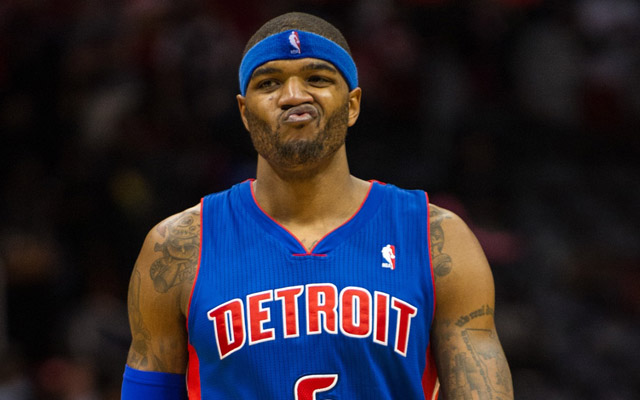
Smith is a talent, but a frustrating and expensive one at that (CBSSports)
The following article was contributed by Robert Simms:

There is a team in Detroit that is unhappy with one of their big men. That team of course is the Pistons, and that big man in question is forward Josh Smith, a stretch power forward who refuses to accept that he is not a wing player. Smith is an incredible athlete who could flourish in the right system, if last season serves as any indication of the future then Detroit is not the right system.

It was almost a year ago to the day that the Pistons signed Smith to a large near-max contract by Detroit's then-GM Joe Dumars. The organization almost immediately regretted the deal, a four-year, $56 million dollar gamble in a player who had never made an All-Star team. The vision Dumars had in mind when he signed Smith was to play bully-ball in a league infatuated with going small. He believed the triumvirate of Smith, Andre Drummond, and Greg Monroe would pound teams down low and dominate the glass. What he failed to account for, however, was the utter lack of spacing that would exist when the three bigs played together.

The entire league knows that Josh Smith can’t shoot. The only person who doesn’t know that is Josh Smith. After improving his shot selection his last few years in Atlanta, Smith regressed to his old habits his first year in Detroit, taking over a fifth of his shots from beyond three point range while making only 26.4% of them. That is atrociously inefficient basketball. In the past five seasons, there is only one player who has shot more than 250 threes in a season while making less than 27% of them, and that player was Josh Smith this past year. Ew. When Smith plays small forward alongside Drummond and Monroe, his defender consistently sinks off him towards the paint, crowding the airspace of Drummond and Monroe.  

In other words, when Smith plays on the perimeter with two traditional, non-shooting big men, he is a liability. Smith spent most of this season in Detroit as a perimeter player and finished with an Offensive Win Shares rating of -1.4. That means that Smith’s offense took away 1.4 wins from his team. I mean, any time you can pay a guy $13.5 million to make your team worse, you have to do it right? When the three big men were on the court together, the Pistons’ offense sputtered and their defense was even worse. It should come as no surprise that Joe Dumars is no longer with the Pistons.

Though he is a terrible outside shooter, when Smith plays close to the rim he performs at near elite levels. Smith shot 71% from within three feet of the hoop last year, a rate up near LeBron James territory. However, in order to get Smith down low he needs to be playing power forward. Smith doesn’t have the body of a traditional 4, but his athleticism gives him mismatches against the larger, slower nominal power forwards who guard him. Smith has the size and strength to battle with most big men (Zach Randolph types are the exception) while also possessing the quickness and agility to score around them. This athleticism is largely wasted at small forward though, since it is hard to blow by a defender slacked six feet away. For Smith to be effective, he can’t be on the wing. He absolutely needs to play power forward.

Unfortunately for him, that is something the Pistons do not need right now. Detroit’s new head coach, Stan Van Gundy, has publicly stated that he thinks Drummond and Monroe are an “ideal pairing” and is seeking to give the two more minutes together. Van Gundy also stated that Smith would be playing primarily power forward this coming season in order to maximize his strong inside game. If Drummond and Monroe play the same number of minutes as they did last year, Smith is left with less than 30 at power forward after accounting for the minutes Detroit’s other bigs will play. Smith is far too proud (and talented) to play less than 30 minutes a night, considering he hasn’t averaged less than 32 minutes per contest since his rookie year. 

This leaves the Pistons with a few choices. They could bite the bullet and play Smith at small forward, but that is a doomed strategy they know doesn’t work. They could increase Smith’s minutes at power forward at the expense of Monroe and Drummond’s playing time but the organization is committed to developing them and would be reluctant to cut their minutes. A third option (and in my opinion the smartest) would be to trade Smith. 

One year after signing with Detroit, Smith appears to be odd man out (RantSports)
The Pistons have been open about their desire to deal Smith, but so far no trades have happened. ESPN’s Marc Stein reported that the Pistons were in talks with Sacramento regarding the Kings sending a package including Derrick Williams and Jason Thompson in exchange for Smith. Thankfully for the Kings, these talks have died down. Pairing the volatile Smith with consistently grumpy DeMarcus Cousins would ruin any chemistry the Kings built last season. Not to mention, a starting front court of Rudy Gay, Smith, and Cousins would have spacing nearly as bad as Detroit’s.

The Pistons are allegedly not asking for much in exchange for Smith, but teams around the league are loath to take on his gargantuan contract. A team that might consider doing so would be the Love-less Boston Celtics. After failing to trade for the Timberwolves’ Kevin Love, the rebuilding Celtics find themselves with a ton of assets but no real talent and appear to be headed for another sub-par season. During the season, NBC Sports’ Dan Feldman floated the idea of the Celtics sending Gerald Wallace and Jeff Green in exchange for Smith. Though that deal seemed reasonable at the time, I think the Celtics could get Smith for cheaper than that, especially since Smith would definitely cause a stink were he to be brought off the bench behind Drummond and Monroe, a strategy Van Gundy would likely employ.

If Boston offers Detroit a trade package of Gerald Wallace, Jared Sullinger, and Jared Sullinger’s ass, who says no? Detroit would be out from underneath Smith’s albatross of a contract and the Celtics would receive a top ten power forward to unite with star point guard Rajon Rondo. Wallace’s contract is almost as undesirable as Smith’s, but it becomes an expiring contract after this season and the Celtics would certainly have to include it in the trade in order to accommodate Smith’s deal and remain under the cap. Sullinger is young and Boston likes him, but he is nowhere near the athlete Smith is and never will be. This deal could happen tomorrow and both teams would be improved.

It also helps that Smith and Rondo have expressed a strong desire to play together. The two were teammates in high school at Oak Hill Academy in Virginia and have remained close friends. Though both players have proven troublesome to coaches in the past, the pair’s friendship might keep them both grounded. A starting five of Rondo, Avery Bradley, Jeff Green, Smith, and Kelly Olynyk might be enough for the Celtics to compete for a playoff spot in the decrepit East.

This deal won’t happen of course, and that is because Celtics’ GM Danny Ainge –along with most other GMs in the league-- understands that Josh Smith is a broken player. Smith can’t shoot but for some reason refuses to stop. Were a coach to hypnotize Smith into finally believing he is a post player, he would be great. But $13.5 million a year is far too expensive a price tag for someone who might only be great under hypnosis. Ainge is too smart for that. Fortunately for Detroit, there are dumber GM’s out there but in all likelihood, Detroit will end up stuck with Smith.

This will lead them to consider dealing a different one of their three bigs: Monroe. He has much more appeal around the league and is signed to a much more reasonable deal. Monroe is in the last year of a deal that will pay him around $5.4 million this year, a number that is well worth it for a quality center. Monroe has stated that he wants the max but Detroit doesn’t have the resources to retain him on a big deal, especially since they are expected to give Drummond a huge contract extension soon. There has been a consensus around that league that Monroe is not worth the full max either. I would bet he ends up getting something in the neighborhood of 5 years, $70 million, a deal that would pay him slightly more than the Wizards just agreed to pay Marcin Gortat.

There are many teams around the league in need of a quality center like Monroe, but GMs are wary of taking on a player in the last year of a contract for fear he might bolt at the end of the season. A solution here for both sides could be executing a sign-and-trade. Detroit could sign Monroe to a deal and then promptly swap him to one of his many potential suitors. In exchange, the Pistons would probably expect quality wing help and maybe a pick or two. Atlanta, Orlando, and Portland are the three teams that have expressed the strongest interest in acquiring Monroe, again according to ESPN’s Marc Stein. 

Orlando makes sense. The Magic could use a reliable big man to pair with Nikola Vucevic and they have assets they could send to Detroit. Portland and Atlanta are a bit trickier to understand. Both teams already have solid centers that fit well within their systems in Robin Lopez and Al Horford. Adding a guy like Monroe to the mix would leave them with too many cooks in their proverbial kitchens, but sending one of their current centers back to Detroit would leave the Pistons in the same predicament they are already in.

The Pistons were not very good last year, and unless they sort out their frontcourt issues they are not going to be very good this year either. Van Gundy is a sharp basketball mind, but he won’t solve Detroit's issues on his own. He’ll need help from around the league because if Smith and Monroe both stay put this season, the Pistons will be hard pressed to improve. But Van Gundy's a smart man, and I'd wager a bet that he has something up his sleeve.

Saturday, June 14, 2014

Verlander Losing His Touch

Verlander's been a mess for over a full calendar year now (DynastySportsEmpire)
As much as it pains me to say this, I think we've seen the best of Justin Verlander.

It's hard to believe how far he's fallen since the beginning of last year, when he was still widely regarded as the best pitcher on the planet. After two straight incredible seasons, the first six weeks of 2013 were business as usual for the 2011 American League MVP and Cy Young recipient. Through May 10th he had a 1.55 ERA and 50/13 K/BB ratio through 46-and-one-third innings. Opponents were batting just .222/.276/.287 with one home run against him. He was as unhittable as ever.

In the 13 months since, he's been thoroughly mediocre. He was average at best over the remainder of 2013, with an ERA just a hair below four, and has been brutal this year. Not including the postseason, over his last 41 starts he's compiled a 4.51 ERA, more than a run above his career mark. His WHIP has been 1.42 after staying below one in 2011 and 2012 combined, and his K/BB rate, which cleared four in 2011 and '12 combined, has fallen to 2.32.

All metrics--traditional, advanced, and velocity--indicate Verlander is a pitcher in decline. He's less accurate and slower, and at 31 will probably never be the same.

With both his walks and hits on the rise, it's easy to see why Verlander's struggled so much. His walk rate has climbed steadily from 2 BB/9 in 2011 to 2.3 in 2012, 3.1 last year and 3.8 so far this year, which would be his worst since 2008, when his ERA was almost five. His command hasn't just slipped, it's gotten terrible. His walk rate has nearly doubled in the span of three years.

He's also become more hittable. Since allowing just 6.2 H/9 in 2011, the best mark in baseball that year, his hit rate has risen to 7.3 in 2012, 8.7 the year after that and 9.7 this year. He's been battered for more than one hit per inning during his 41-start malaise.

I'm sure there's some bad luck in there, as his BABiP has been the third-highest in baseball dating back to the start of last season, likely a combination of bad luck and Detroit's iffy infield defense. His ERA exceeded his FIP last year (3.46 to 3.28) and this year (4.61 to 3.98), which also suggests bad fortune. His left-on-base percentage is well below the league average this year as well.

Still, there's no getting around the fact that Verlander simply isn't the dominant hurler he used to be. What's most troubling about his poor start to this season is that his strikeout rate has fallen off a cliff. After holding steady around one batter per inning in each of the last three years, it's nosedived to 6.6 K/9 this year. It hasn't been below 8.8 since 2008, his worst full year in the majors. This decline is most readily explained by his diminishing fastball velocity, which has slipped every year since 2009 and is now the lowest it's ever been. Verlander simply can't reach back for the heat to blow hitters away like he used to, which probably has something to do with the fact that he's thrown more innings than any pitcher in baseball since the start of the 2006 season (Verlander's rookie year).

It' clear a change in the way Verlander attacks hitters is needed, and until he adapts he's going to continue to struggle like he has recently. The six-time All-Star has been brutal lately, allowing at least five earned runs in five of his last six starts and 35 runs (31 earned) over his past 37 and two-thirds innings. He's surrendered six home runs and walked 18 while striking out only 24. Once an ace and Detroit's most reliable starter, he's nothing more than an average hurler at best. In those 41 starts I mentioned, the Tigers have gone 18-23. Yep, they've been a sub-.500 team with Verlander on the mound for more than a year now.

Here are some more startling stats: since the start of last year, Verlander has a worse ERA than Ubaldo Jimenez, Jason Vargas, Jorge De La Rosa, and Travis Wood. His FIP is worse than Bartolo Colon's and barely better than Jose Quintana's and Justin Masterson's. His K/BB ratio has been bested by 53 qualified pitchers, including A.J. Griffin, Eric Stults, Dillon Gee, Lance Lynn, and A.J. Burnett.

Once the best pitcher on the face of the earth, Verlander has been the worst starting pitcher on his own team this year. His sudden fall from grace is a stark reminder that even the best pitcher can practically lose it overnight. Look what happened to CC Sabathia, Johan Santana, and Roy Halladay. One second they're on top of the world, and the next they're just another pitcher. I didn't think I'd be saying this for a few more years, but it seems that Verlander is precisely that: just another pitcher.

The Tigers, who owe him $28 million per season over the next five years and will probably be on the hook for another $22 million in 2020, better hope that's not the case. Otherwise the former MVP and Cy Young winner will have a new title for the rest of the decade: the most expensive innings-eater in baseball history.