Showing posts with label Centerfielders. Show all posts

Tuesday, June 17, 2014

Gone Grady Gone

Sizemore had a nice spring, but struggled mightily once the season got underway
The Boston Red Sox designated Grady Sizemore for assignment today, bringing an end to their attempt to salvage his career. Sizemore's comeback attempt, one of the baseball seasons more positive stories during spring training, stalled shortly after the season began when it became apparent that his once elite skills were no longer intact. Sizemore was not even a capable fourth outfielder, much less the 30/30 All-Star he used to be.

The time had come to pull the plug on Sizemore, who had the sixth-lowest OPS among players with at least 200 plate appearances this season. A shell of his former self, Sizemore was hitting a paltry .216/.288/.324 after going 0-for-4 in Sunday's extra-inning loss to Cleveland. The combination of power, speed, and defense that made him one of the game's best all-around players five years ago was nowhere to be seen, a distant memory.

Quite frankly, the Red Sox should have cut bait weeks ago, when both Sizemore and the team were slumping. There was no sense in wasting at-bats on Sizemore, a thirtysomething has-been, when Boston's farm system is quite literally overflowing with talent. The Red Sox have elected to fill his roster spot by recalling 23 year-old Garin Cecchini, who debuted on June 1st and appears to be the new third baseman of the future (your days are numbered, Will Middlebrooks).

So while Cecchin's major league career is just taking off, Sizemore's is likely finished. Over his past 156 games spanning parts of three seasons, the soon-to-be 32 year-old is a .219/.283/.361 hitter with 161 strikeouts worth -0.3 bWAR. Teams don't have room for an outfielder who can't hit and doesn't offer much defensively or on the bases, especially one with the extensive injury history of Sizemore.

If this is indeed the end of the line for Sizemore, you have to feel disappointed about how quickly he crashed and burned. A career that began with so much promise, seemingly destined to land him in Cooperstown, only to be ravaged by injuries right when he should have been coming into his prime. He was robbed of what were supposed to be the best years of his career, and baseball fans that missed his early years in Cleveland were deprived of watching him perform at an elite level. Few superstars have ever been so unlucky in the injury department so young, and consequently his career is ending much too soon.

You have to give Sizemore credit for trying to come back, for giving it one more shot and defying the odds after missing two full seasons. It's just a shame it didn't work out.

Saturday, June 14, 2014

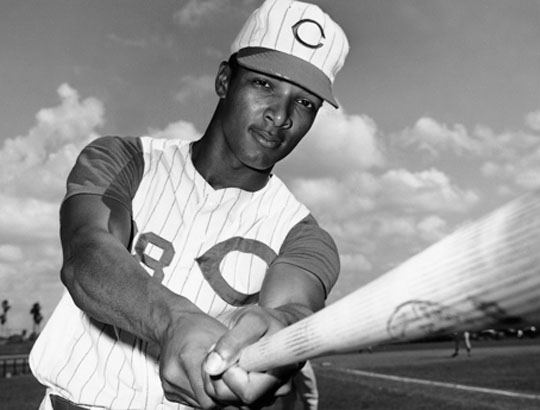
Put Pinson in Cooperstown?

A classic borderline Hall of Famer, does Pinson make the cut?
At the conclusion of the 1967 baseball season, it must have seemed almost certain that Vada Pinson was destined for Cooperstown. The 29 year-old centerfielder was coming off a run of nine seasons in which he led baseball in games, plate appearances, hits, doubles, and triples. In addition to batting a combined .300/.343/.478 over that span, he'd also swatted 180 home runs, stolen 202 bases, and scored 898 runs. To that point, his most similar batter was Al Kaline, a first ballot Hall of Famer.

No one could have known it at the time, but Pinson's days as one of baseball's best all-around players, a 20/20 centerfielder who batted close to .300, were over. He'd have one more good year in 1971 with the Cleveland Indians, the only season of his final eight in which he slugged better than .385, hit more than 11 home runs, or posted an OPS above .700. Pinson played eight more years and over 1,000 more games, but would be worth a mere 7.7 bWAR, meaning he was essentially replacement level during that time.

That he was so ordinary in the second half of his career, especially during seasons that could still be considered peak years, is hard to reconcile given how good Pinson was at such a young age. Few players have ever been as good as Pinson was at 20, when he batted .316 with 205 hits, 20 long balls, 21 steals, and led the major leagues with 131 runs and 47 doubles (he is one of only 13 players to total at least five fWAR in their age 20 season). Few have been as good as he was at 22, when he batted .343--still the highest average by a 22 year-old since World War II-- paced the majors with 208 hits and was worth 7.5 wins above replacement. He also won his only Gold Glove and had his highest finish in the MVP voting (third, behind teammate Frank Robinson and Orlando Cepeda) that year.

Those represent Pinson's greatest seasons, but he remained a great player through most of his 20s. From ages 20 through 28 he maintained a 120 OPS+ and almost never missed a game, which combined with his solid performance in center and on the bases made him worth 46.3 bWAR. He averaged 100 runs, 191 hits, 34 doubles, 10 triples, 20 homers, 84 RBI, 22 steals, 305 total bases, and 5.1 bWAR per year. With such a fast start, Pinson should have been a lock for 3,000 hits, close to 300 homers and 300 steals, and a spot in the Hall of Fame.

Pinson's decline began in 1968, the Year of the Pitcher, and Pinson's numbers declined along with everyone else's. He also missed time with injuries, which may have contributed to his down season as well. After the season he was traded to St. Louis for Wayne Granger and Bobby Tolan. After spending his first 11 seasons in a Reds uniform, Pinson became something of a journeyman, never sticking anywhere for more than two years after leaving the Reds. He lasted just one season in St. Louis, as he missed more time and his numbers continued to decline. 1969 saw him post then-career lows in many categories, making him the weakest link in a phenomenal outfield that included Curt Flood and Lou Brock.

Following a five-player trade to the Indians he rebounded in 1970, smashing a career-high 24 home runs in his American League debut. But his numbers declined again in 1971 and he was traded to the Angels for a minor leaguer (Barry Raziano) and cash. He was solid in 1972 but mediocre in '73, so he was traded one final time; to the Kansas City Royals. Decent in 1974, Pinson was miserable in 1975 and was flat-out released that winter. He signed on with the Milwaukee Brewers a month later, but failed to stick with the big league club and was released in April, ending his major league career at the age of 37. He would coach for nearly 20 years afterwards before passing away much too soon at 57 in 1995.

Are Pinson's accomplishments Hall of Fame worthy? One could certainly make the case. He had a fantastic peak, worth 40 wins above replacement and 22.1 wins above average from 1959 through 1965, when he was the seventh most valuable player in baseball and led both leagues in hits, doubles, and triples. During this period he scored more runs than everyone except Hank Aaron and Willie Mays, stole more bases than everyone except Maury Wills and Luis Aparicio, and batted .303/.349/.487--24 percent better than average per OPS+. If one expands the timeframe to 1969, a span of 11 season, Pinson still rates as the eighth-best position player in the National League, barely behind Frank Robinson at number seven. If you want to make a compelling case for Pinson, noting that he was one of the NL's ten-best non-pitchers for more than a decade, during a time when the sport was overflowing with talent, is a great place to start.

Pinson also had longevity. Pinson played 18 seasons (only one of which he failed to play 100 games) and nearly 2,500 baseball games. His durability helped him accumulate almost 10,500 plate appearances, in which he compiled 2,757 hits, close to 500 doubles, and more than 250 home runs and 300 steals. He ranks inside the top-100 all-time in runs, hits, total bases, doubles, triples, and extra base hits. His counting numbers are very good, and if those aren't Hall of Fame numbers, they're very close.

It's also important to remember that like all great offensive stars of the 1960s, Pinson was undoubtedly hurt by the era in which he played. Neutralizing his offensive numbers lifts his career OPS by 18 points and makes his counting numbers more Hall of Fame worthy: 1,457 runs, nearly 2,900 hits, and more than 500 doubles.

Pinson played like a Hall of Famer at his best, and with such a fast start should have been a Hall of Famer. He certainly played like one for many years.

So why is Pinson not in the Hall of Fame? He was unfortunate to have his peak overlap with two of the greatest center fielders of all-time, Willie Mays and Mickey Mantle, to whom he could not compare (then again, Duke Snider showed there's no shame in finishing third to those two). The National League also enjoyed an abundance of talent in the 1960s, which explains why Pinson was an All-Star in only two of his 18 seasons and fared poorly in MVP voting, finishing better than tenth only once. Even on his own team he was overshadowed, playing Robin to Frank Robinson's Batman. He's also hurt by the fact that in his lone postseason appearance, the Reds fell in five games to the mighty Yankees led by Mantle, Roger Maris, and Whitey Ford. Pinson failed to distinguish himself, batting below .100 with no runs or RBI in his only Fall Classic.

One of the great all-around players who has been tragically underrated, Pinson did everything well but nothing spectacularly well. He had good power, topping 20 home runs seven times and reaching double digits in 12 seasons, but never hit even 25 home runs in any season. In the year that Maris shattered Babe Ruth's single season home run mark, for instance, Pinson's 16 dingers paled in comparison. Pinson was fast and stole lots of bases, but topped 30 only once and never stood out the way Maury Wills and Lou Brock did. He was a fine defender in his early years but only won one Gold Glove (the same can be said for Mantle). He hit .299 through the first ten years of his career but only once seriously competed for a batting title.

If Pinson was unappreciated during his day, he is even less appreciated by today's sabermetric-oriented community. Pinson rarely walked, barely eclipsing 500 unintentional walks for his career, and so his .327 career OBP is poor by Cooperstown standards (but still better than Andre Dawson's!). His .442 career slugging mark ranks 487th all-time, just a hair better than Mark Grace's. His 111 OPS+ is nothing special, ranking 632nd all-time and tied with the likes of Carney Lansford, Carlos Guillen, Julio Franco, and Jermaine Dye.

He wasn't good enough defensively or on the bases to compensate for a bat that was only 11 percent better than average.With 54.1 career bWAR, Pinson's still a few solid seasons short of the Hall. Had he just had one or two more monster years like his 1959/1961/1963, or merely even maintained his 1966-67 production through '68 and '69, he'd have a much stronger case. Had he been able to hang around a few more years, he probably could have reached 3,000 hits or come close enough to punch his ticket to Cooperstown.

As it is, according to most available metrics, Pinson is not a Hall of Famer. WAR says he was one of his league's ten-best players only twice--in 1959 (ninth) and 1961 (fifth). He was the best player on his team once, in 1963. His Black Ink and Gray Ink scores both fall short, as does his Hall of Fame monitor score. He comes up short by Hall of Fame standards, JAWs, and the Hall of Stats Hall Rating as well. For a long-time he had the most hits of any player outside the Hall of Fame, but someone has to hold that title. It's also telling that Pinson never came close to election, polling under five percent his first four years on the ballot and peaking at 15.7 percent in 1988. He was on the ballot for 15 years, and the writers never seriously considered him.

Furthermore, only two of his ten most similar batters are enshrined, and only one in the top seven. That would be Roberto Clemente, Pinson's most similar batter from ages 32 throug 35. The other is Zack Wheat, who was inducted by the Veteran's Committee, which is now Pinson's only chance. Pinson's closest comps--Steve Finley, Johnny Damon, Clemente, Al Oliver, and Willie Davis, were all great players but only Clemente was Cooperstown-worthy. The rest must merely settle for the Hall of Very Good.

JAWS rates him as the 17th best centerfielder of all-time, sandwiched between non Hall-of-Famers Jim Wynn and Cesar Cedeno. Though Pinson rates better than 9 of the 18 centerfielders already enshrined at the position, almost all of whom had short careers (Kirby Puckett, Earl Averill, Larry Doby, Hack Wilson). His JAWS score is considerably below the established standard at the position, behind Carlos Beltran, Andruw Jones, and Kenny Lofton and barely better than those of Chet Lemon, Fred Lynn, and Dale Murphy, and Bernie Williams. His triple slash stats and home run/stolen base totals are essentially Mike Cameron's.

So in the end, as much as I want to believe that Pinson was Hall of Fame worthy, I think he falls just short. He either needed a few more good seasons or needed to be more dominant during his prime, with 30/30 seasons rather than 20/20 and an MVP award or two. And without Reggie Jackson-esque postseason heroics or a distinguished managerial career, he's just too similar to Murphy, Steve Garvey, Dave Parker, and a lot of other guys who didn't quite make it to Cooperstown's doorstep. I think the case against Pinson is stronger than the case for him, and that's why I'm saying no.

Wednesday, June 11, 2014

Forecasting Flood's Future

Flood isn't in Cooperstown even though he had Hall of Fame talent (SportsCouchPotato)
Had Curt Flood not sacrificed the second half of his career to challenge baseball's reserve clause, what would his career numbers have looked like, and would he have made the Hall of Fame?

Throughout the 1960s, Flood played at a Hall of Fame level. From 1961 through 1969, when pitching reigned supreme, he batted .302 while averaging 177 hits and 4.3 bWAR per season in addition to playing a terrific center field. At the end of 1969, Flood's age 31 season, he had compiled 1,854 hits, 42.1 bWAR, and won seven straight Gold Gloves. With his skills and speed intact, he was still a solid hitter, plus defender and, above all, a good player worth between three and four wins above replacement.

At that point in Flood's career his most similar player was Willie Davis. Davis aged gracefully and remained a solid regular through age 36, so using his career as a guide it's reasonable to think Flood had around five more decent/good years left in him. After age 31 Davis added about 820 hits, 16 bWAR and two Gold Gloves to his ledger. Doing the same for Flood gives him nearly 2,700 hits, 58 bWAR and nine Gold Gloves, plus probably another All-Star appearance or two.

Would that have been enough for Cooperstown? I say probably, especially if he could have reached double digits in Gold Gloves, which at the time had only been done by Roberto Clemente, Willie Mays and Al Kaline among outfielders. That would have put him in some pretty impressive company. All those Gold Gloves, combined with his large hit total and role on the 1960s Cardinals dynasty teams, probably would have resulted in a Hall of Fame nod (though definitely not on the first ballot and perhaps not even the writer's ballot, but I suspect the Veteran's Committee would have opened the door for him).

Even if we forget White and assume a natural aging curve for Flood in which he declined by 0.5 bWAR per season, he would have posted 3.3 in 1970, 2.8 in 1971, and so on until flatlining at 0.3 in 1976, by which point he would have been 38 and likely too old to play center field. It's well known that Flood, like many players of the time (Mickey Mantle chief among them) lived hard and had a drinking problem, so I doubt he would have lasted to 40 anyways.

That gives him a career bWAR total of 54.6, still a few solid seasons short of the Hall. This is the likely outcome if he had begun to decline significantly around 33 or 34, as many players do, especially back then. In this scenario Flood is not a worthy Hall of Famer, but perhaps makes it in anyways.

A third, and admittedly more crude, way to look at it would be to expect that Flood would have produced roughly half the numbers he'd already compiled. Doing that gives him credit for approximately 425 more runs, 925 more hits, 135 doubles, 20 triples, 40 homers, 300 RBI, 45 steals, and 1200 total bases in about 875 extra games (around seven more years at 125 games per year), good for 21 more bWAR. Though a bit generous, I think that's fair.

So by that measurement, Flood would have ended up with around 1,300 runs, 2,800 hits, 400 doubles, 60 triples, 125 homers/steals, 1,000 RBI, and 3,700 total bases. At 63 bWAR he would have retired as one of the ten best center fielders ever and probably would have been inducted as a result.

I'm inclined to think that because of his hardware, World Series appearances and gaudy hit totals, Flood would have eventually made the Hall of Fame had his career not been curtailed by outside circumstance. Then again, maybe not. His career was obscured by the abundance of great National Leaguers that defined his era; Mays, Hank AaronWillie McCovey, Ernie Banks, Billy Williams, Frank Robinson, Vada Pinson, the list goes on. Flood was never viewed as the best player in the league and was often overshadowed on his own team by Bob Gibson, Ken Boyer, Lou Brock, Bill White, and Orlando Cepeda, which explains why he finished in the top-ten of MVP voting only once. His power numbers were weak for an outfielder, and he didn't provide the elite speed or on-base skills needed to compensate for that deficiency. It's quite possible that Flood would have been overlooked and underrated, much like Dwight Evans and the aforementioned Davis.

Obviously we'll never know if Flood had the finishing kick needed to beef up his Hall of Fame case, especially given his knack for late-night carousing. He wasn't dominant enough at his peak to get in with a short career, and thus needed longevity to compile big counting numbers. Had he remained a great player through the first half of the 70s, he would have approached 3,000 hits and would almost assuredly be in the Hall of Fame today. But if he'd tailed off in the early 70s and retired around 1974-75, then he would have fallen short.

At the very least we can appreciate Flood for what he did do, which was win seven consecutive Gold Gloves, make three All-Star teams, play for three pennant winners and two World Series champions, and compile more hits than all but five players in the 1960s (and more than Mays, Robinson, Banks, Brock, Kaline, Ron Santo, and Carl Yastrzemski). He was one of the best defensive center fielders of all-time and turned out to be a pretty decent hitter, batting better than .300 six times.

So while Flood's career isn't Hall of Fame worthy, it definitely could have been, and I think it would have been had he reported to the Phillies in the spring of 1970.

Thursday, January 23, 2014

Sox Sign Sizemore

Once a star, Sizemore hopes to catch on with the Red Sox (Boston Herald)
Since Jacoby Ellsbury vacated their center field spot in early December, the Boston Red Sox seemed content to roll the dice on Jackie Bradley Jr. and hope the soon-to-be 24 year-old was ready to hold down the job. There was no talk of moving Shane Victorino, a natural center fielder, over from right field. Ben Cherington didn't trade for Matt Kemp or sign a new outfielder. It looked like Bradley had the gig all to himself. 

The situation just became a little more complicated yesterday, when Boston signed Grady Sizemore to a one-year, $750,000 deal that could pay up to $6 million with incentives. Though Sizemore has not played a major league game since September 22nd, 2011, he says he's healthy and eager to get back on the field. 

It's been a long time since Sizemore was healthy, much less able to stay that way for any appreciable length of time. One of the baseball's best and brightest young players five years ago, Sizemore watched what should have been the prime of his career go up in flames. Injuries kept him off the field in 2012 and 2013, and he hasn't played anything close to a full season since 2008. It's probably going to take awhile for him to get his timing back, especially now that he's 31 years old, but the Red Sox are hoping he recover some of the ability that made him a three-time All-Star and perennial 30/30 threat with the Indians.

I don't think he'll ever again be anything close to the six-win player/fringe MVP candidate that he used to be, but at his price all he has to do is contribute on some level to qualify as a major bargain. Competent center fielders don't grow on trees, you know.

Worst case, Sizemore doesn't pan out and the Sox are on the hook for less than $1 million, which is just a drop in their $160 million bucket. At the very least, he'll provide a healthy dose of competition for the center field job, which hopefully inspires Bradley to work and play harder. There's something to be said about making young players prove themselves and earn their jobs rather than just handing it to them on a silver platter. Better than anyone, the Red Sox know how dangerous entitled athletes can be (see: 2011 and 2012). Perhaps Sizemore's mere presence at Spring Training can help bring out the best in Bradley.

Call me crazy, but I have this sneaky feeling that Sizemore still has something left in the tank. Not enough to play everyday, mind you (not on two surgically repaired knees), but maybe enough to be a quality fourth or fifth outfielder type. He could be this year's Mike Carp. Maybe that doesn't sound like much for someone who's most similar player through age 26 was Barry Bonds, but at least it's something. 

Wednesday, August 14, 2013

Baseball Brothers: The DiMaggios

Joe DiMaggio, Dom DiMaggio, and Vince DiMaggio were three of baseball's best centerfielders spanning the years from the Dust Bowl through the Korean War. The sons of Italian immigrants, they were born in California and grew up playing baseball. All three cut their teeth playing for the San Francisco Seals, a local minor league team (Double-A) in the Pacific Coast League, where their talents caught the eye of major league scouts. And so rather than becoming fishermen, as their father hoped, the brothers made their living playing America's national pastime instead.

Here's a brief look at their careers:

Joe (1936-1951)
The Yankee Clipper crammed a lot into his 13-year career. An All-Star every year, Joltin' Joe was inducted into baseball's Hall of Fame in 1955. His other achievements include nine World Series championships, three MVP awards, two batting titles, and one incredibly long hitting streak. With a resume like that, it's no wonder he was introduced as baseball's greatest living player until his death in 1999, long after it stopped being true.

Dom (1940-1953)
"The Little Professor" was every bit the centerfielder that Joltin' Joe was, earning comparisons to Tris Speaker for his ability to play shallow and still get back on deep fly balls. The youngest DiMaggio was also the ideal leadoff hitter, using his great speed and on-base ability to ignite the powerhouse Red Sox lineups of the late '40s and early '50s. Ted Williams always insisted his bespectacled teammate was Hall-worthy, and had DiMaggio not lost three prime seasons to World War II he'd have a plaque hanging in Cooperstown, too.

Vince (1937-1946)
The eldest and least talked about of the DiMaggio trio was said to be the fastest. He was also the least polished. His claim to fame is a dubious one: setting the NL record for strikeouts with 134 in 1938, one of six times he led the league in that department (weird considering that his two brothers rarely struck out). Not surprisingly, DiMaggio batted just .249 for his career, well below the league average of .267 during his playing days. Even so, the two-time All-Star was by no means a poor baseball player. In fact, he was a pretty good one, rating above average as a power-hitter, fielder, and baserunner. More importantly, he blazed the trail for his two younger brothers. It was Vince who convinced the Seals manager to give Joe a spot on the team (at shortstop), thereby launching Joe's professional career. Dom followed in their footsteps, breaking in with the Seals in 1937 after Joe and Vince reached the big leagues.