Showing posts with label Los Angeles. Show all posts

Sunday, April 19, 2015

Gonzalez Going Bananas, Miggy Mashing

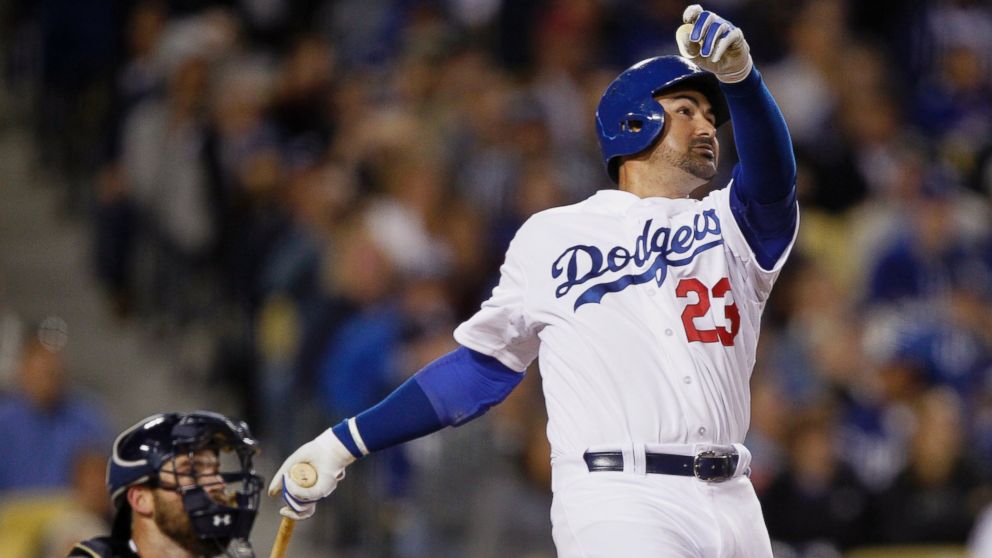
Gonzalez's great start has helped the Dodgers to an 8-3 record (ABC News)
Adrian Gonzalez came up to bat with the bases loaded twice in yesterday's Rockies-Dodgers game. The first time was in the bottom of the third, with the score tied 1-1 and only one out. With nowhere to put Gonzalez, Jordan Lyles had no choice but to pitch to the man from Mildon, who entered the game batting a scintillating .550/.609/1.125.

To his credit, Lyles got Gonzalez to ground into what should have been an inning-ending double play. Gonzalez rolled a tailor-made rally killer to Troy Tulowitzki, who quickly flipped to DJ LeMahieu at second. Though he had plenty of time to get the slow-footed Gonzalez, LeMahieu rushed his throw to first and buried it in the dirt. Justin Morneau was unable to field the hop at first, allowing Gonzalez to reach and the go-ahead run to score.

But that's just how hot Gonzalez is these days. The fielders are just as afraid of him as the pitchers are, and even his outs hurt opposing teams.

In the bottom of the fifth with the score still 2-1, Gonzalez came up in another bases loaded situation. Once again, Lyles was forced to pitch to him, and once again Gonzalez made him wish he hadn't. Gonzalez laced a long, looping drive that one-hopped the center field wall, landing just beyond the reach of a diving Charlie Blackmon. Joc Pederson and Jimmy Rollins scored, giving Los Angeles a 4-1 lead and boosting Gonzalez's RBI total to 14 on the young season. Gonzalez's single would prove to be the game-winning hit, as LA went on to win 6-3.

Gonzalez, who has hit safely in every game thus far and leads the majors in just about every conceivable batting metric, has been unstoppable since starting the season on fire against San Diego. Gonzalez had an opening series for the ages, going 10-for-13 with five home runs, two doubles, seven RBI, and seven runs scored as the Dodgers took two out of three from the Padres. After falling a triple shy of the cycle in each of the first two games, Gonzalez capped his monster series with his first career three-homer game.

Gonzalez has yet to go hard since, but he hasn't stopped hitting in the meantime. For starters, his .523/.580/1.625 line represents season lows in all three categories. Yeah. His plate discipline stats also reflect how locked in he is right now. He's made contact on nearly 90 percent of his swings, getting wood on almost 98 percent of the pitches he's swung at inside the strike zone. His swinging strike percentage, currently below five percent, is half his career rate. He's done his best Victor Martinez impression by striking out only three times.

Gonzalez's hot streak shows that even as his 33rd birthday rapidly approaches, he's still a great player. The quiet, steady first baseman usually doesn't generate many headlines, but right now he's the star of the show. Los Angeles is first in the NL West, but if he was having a Mark Teixeira-type start they wouldn't be. He's either scored or driven in 22 of the team's 56 runs thus far--a whopping 39.3 percent--and is responsible for over a quarter of their total bases.

With Matt Kemp gone and Yasiel Puig struggling to find consistency at the major league level, Gonzalez is clearly the best hitter on his team. If the last two weeks have taught us anything, it's that.
Cabrera can still crank, too (Tigers Sout)
Gonzalez isn't the only 30-something first baseman off to a torrid start. Over in the American League, in a mysterious land called Michigan, Miguel Cabrera has continued to remind everyone why he was considered the best hitter on the planet before last year.

Cabrera, who turned 32 yesterday, has been almost as impossible to get out as Gonzalez. Although his numbers pale in comparison to the latter's gaudy figures, they're still video game worthy. Through 11 games, Cabrera's hitting .442/.510/.674 with an AL-leading 19 hits. He's also driven in 10 runs so far, tied with J.D. Martinez for most on the Tigers.

Like Los Angeles, Detroit is also off to a strong start, having won nine of ten before getting blown up by Chicago yesterday. The Tigers, who many thought might fall apart this year, have resumed their usual perch atop the AL Central, Cabrera once again a big reason why.

While the two-time AL MVP hasn't been as consistent as Gonzalez (he's already gone hitless three times), he did have a series where the other team had no answer for him. In Cleveland last weekend for Detroit's first road series of the season, Cabrera laid waste to Tribe pitching. He went 3-for-5 in the opener and 4-for-5 the next day, but that was just a teaser for the grand finale: a 4-for-4 day with two long balls and a double as Detroit won 8-5 to complete the sweep.

Like Gonzalez, Cabrera hasn't cleared the fences since his mega-game but has continued to rake. He's reached base in every game since Opening Day and currently leads the American League in on-base percentage. The ankle injury that plagued him last year and required offseason surgery appears not to be an issue, and if it is he's hiding it very well. This is an encouraging sign for the Tigers, who won't see Cabrera's eight-year, $248 million contract extension begin until next year.

Before the year, everyone was quick to hand Mike Trout the MVP award (myself included). However, it looks like Cabrera's going to make it an interesting race...

Thursday, January 1, 2015

Garvey Good Enough for Hall?

Garvey almost never took a day off (RantSports)
Steve Garvey accomplished a lot during a productive career that spanned almost two decades. He made 10 All-Star teams, won four Gold Gloves, and set the National League record for most consecutive games played (1,207). He won an MVP award and finished runner-up one other time, won a World Series and played in four others. He was durable, hit for high averages, and starred in several postseasons (.910 OPS in 55 playoff games). He hit for power, he drove in runs, and he was a smooth first baseman, all while maintaining a squeaky-clean image on the field and off.

No wonder they called him Captain America.

But despite all the accolades, all the awards and big hits and West Coast glamor, despite his immense popularity and movie-star looks and middle-of-the-order presence, despite his many Midsummer Classic and Fall Classic appearances, Steve Garvey is not in the Hall of Fame, nor should he be. 15 times he was on the writer's ballot, and 15 times the BBWAA said no.

In 2013 he was given another chance at induction via the Expansion Era Committee, and once again he did not receive the necessary votes. When I reviewed his case then, I concluded he was not Hall of Fame worthy, something I stand by today.

A good place to start is his career WAR total, which Baseball-Reference and FanGraphs both place at just under 38. That's way below the 60 usually needed to even be in the conversation for Cooperstown, and very weak considering he played in 2,337 games and compiled nearly 9,500 plate appearances. It's less than fellow first basemen Mark Grace, Dolph Camilli, and Bill White, all players who clearly fall short of the Hall's standards. Ditto Fernando Valenzuela and Carl Furillo, the two Dodgers he falls between for career bWAR. As far as I can tell, the only first basemen to be elected with fewer WAR are Jim Bottomley and High Pockets Kelly, both flawed Veteran's Committee selections. WAR also says Garvey was never the best player on his team.

Even if WAR's not your cup of tea (it's not, nor should it be, the end-all be-all method of player evaluation), Garvey still falls short by other metrics. His Black Ink score, which measures how frequently he led the league in something, is 12, well below the established HOF score of 27. His Gray Ink, which scores how often a player appears in the top 10, is closer but still falls short. And by Hall of Fame standards, which sets the bar at 50 for an average Hall of Famer, Garvey is well-shy at 32. He does pass the Hall of Fame monitor (which assesses the likelihood a player makes the Hall, not his worthiness), with his 130 score indicative of a "virtual cinch," but one out of four (six including JAWS and Hall of Stats) ain't too good.

Don't like those metrics? Okay then, but know that Garvey never slugged .500 in any of his 19 seasons, and never had an OBP above .365. He never led the league in home runs, RBI, total bases, OPS, or any meaningful statistic besides hits (twice), games played (seven times), double plays grounded into (twice), and sacrifice flies (once). He never scored 100 runs, clubbed 40 doubles, legged out 10 triples, smacked 35 home runs, or stole 20 bases in any season.

Sure, Garvey got loads of hits--2,599 of them, in fact--but hardly ever walked. Only once did he work even 50 walks in a season, and it was 50 on the nose. He only had one other season with as many as 40, and again it was 40 on the nose. His career walk rate barely cracked five percent (the league average is around 8.5), and when you subtract out his 113 intentional walks (which account for nearly one-quarter of his 479 career walks) that rate plummets below four percent. So really, Garvey wasn't even half as good as the average played at working a walk.

As such, Garvey's career on-base percentage is shockingly bad for someone who almost batted .300 for his career. At .329 it's better than average, but not by much.

Garvey also didn't hit for much power. He only had the one season with more than 30 home runs and managed just 272 for his career, or one every 32.5 at-bats. He hit a good number of doubles, but overall his pop barely stood above league average; his .152 ISO isn't much better than usual league average of .140.

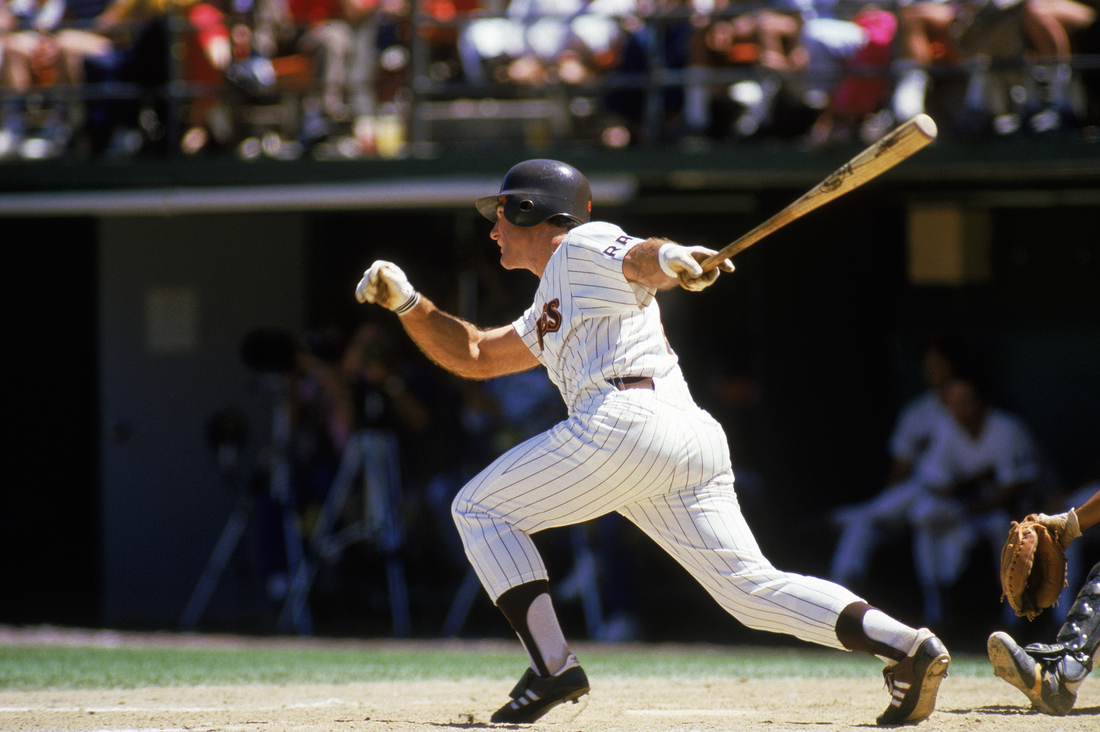
Garvey pictured here with the Padres, with whom he finished his career (SBNation)
Consider that from 1974-1980, when Garvey was at his absolute best, he wasn't even one of the 20 most valuable position players in baseball. He was never one of the NL's five most valuable position players, and only twice cracked the top 10. He did not deserve that 1974 MVP, an award that should have gone to Mike Schmidt or Joe Morgan or Johnny Bench.

By overrated, flawed statistics, Garvey does well. He has lots of hits, RBI, and a high batting average. But in the statistics that really matter--WAR, OPS, runs created--he fares poorly.

Still, it crossed my mind that the voters may have actually undervalued Garvey. He was a righthanded hitter who spent his entire career in pitcher's parks, at a time when the game very much favored pitchers and speed. But his time on the BBWAA ballot coincided with the crazy offensive environment of the Steroid Era, which no doubt made his numbers seem less impressive. It's weird that he debuted with 41.6 percent of the vote and then stalled out, gradually losing support over the years and finishing up with a mere 21.1 percent of the vote in his last year of eligibility. The proliferation of advanced metrics in the early 2000s couldn't have helped his case either.

Sure enough, Garvey's neutralized numbers look much better. His career batting line rises to .306/.343/.463, giving him a 31 point boost in OPS. He has more than 2,800 hits and 1,300 runs, nearly 500 doubles, 300 long balls, and 1,500 RBI. If those were Garvey's actual numbers, I think he might have made it in. Then again, those are Dave Parker numbers, so maybe not.

I'm still saying no to Garvey, though. A first baseman needs great offensive statistics to be Hall of Fame-worthy, and Garvey's resemble more of a really good shortstop's like Derek Jeter or Alan Trammell. Garvey was a nicely packaged ballplayer with good longevity and a solid peak, but didn't do enough of anything to stand out. He didn't hit for enough power, get on base frequently enough, run well enough, or play good enough defense to earn a trip to Cooperstown. He was a lot like Gil Hodges--another classic borderline case and superb all-around first baseman for the Dodgers--only Hodges was better.

Hodges has waited over 50 years for Cooperstown to call his name, and at this point I'm starting to think it never will. Garvey, who never polled as high as Hodges, is an even greater longshot. His place in the Hall of Very Good is secure, but I'll be shocked if he ever sees his day in Cooperstown.

Thursday, December 11, 2014

Dodgers Deal Kemp

The Dodgers were smart to unload Kemp and his giant contract (FoxSports)
The Los Angeles Dodgers finally found someone willing to take Matt Kemp off their hands, and surprisingly it was the San Diego Padres, who have never been known for their willingness to acquire big name talent. Thus ends the endless speculation about Kemp being traded (for now).

The punchless Padres desperately need offense and star power, and Kemp provides a healthy dose of both. Had he played for San Diego last year, he easily would have been their best hitter as well as their highest paid player. A two-time All-Star and Gold Glover, the Padres haven't had a position player as gifted as Kemp since Adrian Gonzalez (excluding Chase Headley's monster 2012).

Problem is, Kemp's not a superstar anymore, even though he's still being paid like one. He's been worth just four bWAR in the past three seasons combined, two of which were cut short by injury. He's still a great hitter (140 OPS+ last year), but can't run like he used to and can't field like he used to. At 30 years old, he might already be on his way down, despite having five years and $107 million remaining on his contract. Playing half his games at Petco only figures to accelerate that decline.

The Dodgers haven't spent their money wisely lately, but kudos to them for getting out from under Kemp's contract, which was doomed to become a Vernon Wells-esque albatross. The $32 million they still have to pay isn't even a third of what would've been required to keep him around, and is well worth the added roster and payroll flexibility. For instance, moving Kemp clears up their surplus of high-priced outfielders, allowing them to go forward with Carl Crawford, Yasiel Puig, and Andre Ethier. It also frees up some funds should they choose to pursue a big ticket starting pitcher like Max Scherzer or James Shields.

This trade comes on the heels of another trade for the Dodgers, the one that brought Jimmy Rollins over from Philadelphia. Rollins remained effective at age 35 last year, worth 3.9 bWAR with 17 home runs, 28 steals in 34 attempts, and decent defense at short. So long as he doesn't fall off a cliff, he should be a solid replacement for the recently departed Hanley Ramirez.

Thursday, November 13, 2014

LA: City of MVPs

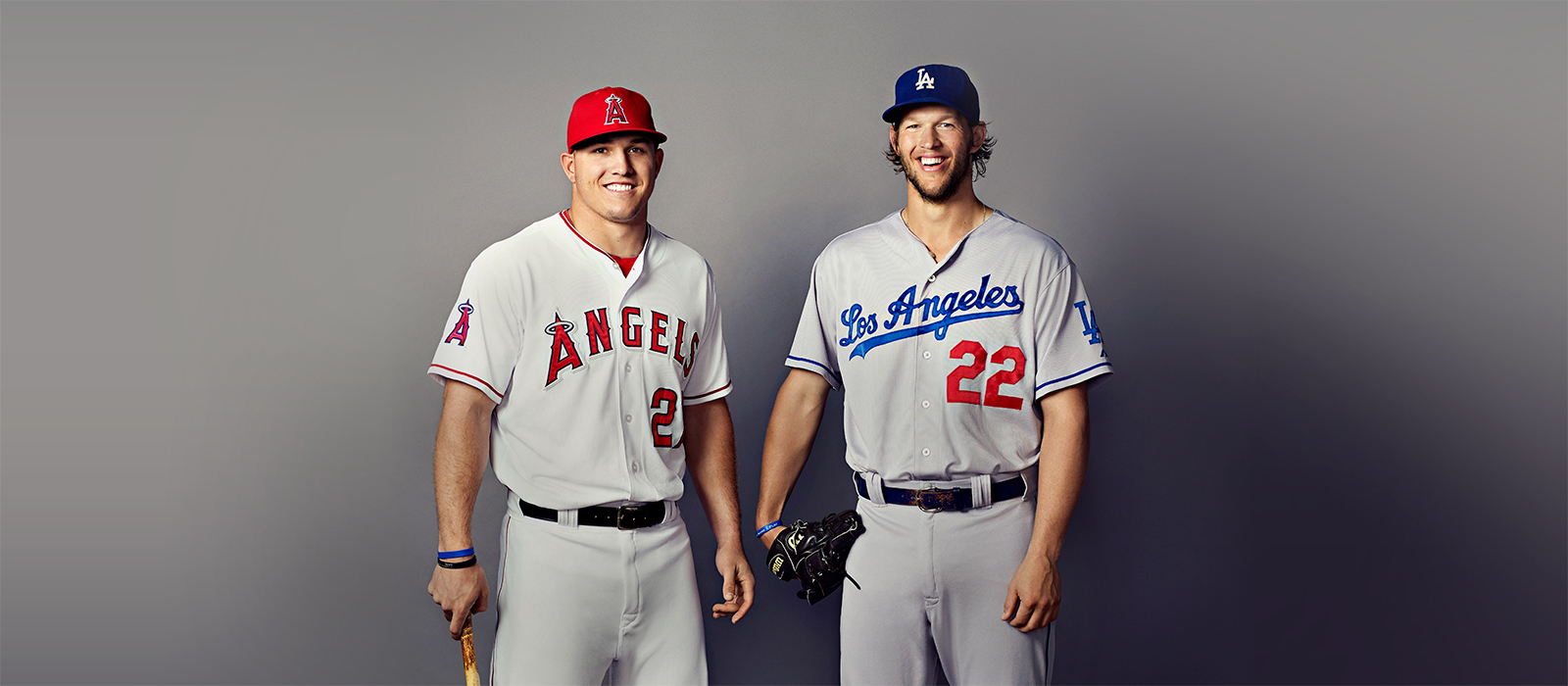
As expected, Trout (left) and Kershaw walked away with league MVP honors (ESPN)
All hail Clayton Kershaw, king of the mound, the City of Angels, and the National League.

Already the best pitcher on the planet, Kershaw raised his game to new heights in 2014. Already earning comparisons to Sandy Koufax, another great Dodger lefty, Kershaw delivered a historic campaign that looks like it was lifted straight out of Koufax's prime. Already a three-time Cy Young recipient, Kershaw added a new piece of hardware to his trophy collection: the National League MVP, something no starting pitcher had won since Bob Gibson in 1968.

Despite missing more than a month early in the season, Kershaw was so dominant in his 27 starts that he still managed to lead all players in the Baseball-Reference version of WAR with 8.0. Though he fell just shy of 200 innings, he still topped the majors in wins (21) and complete games (6) while ranking seventh with 239 strikeouts.

And while Kershaw's counting stats were excellent, his rate stats were off the charts. His 1.77 ERA secured his record fourth straight ML-ERA crown and was the lowest by a pitcher since Pedro Martinez's 1.74 in 2000. His 1.81 FIP and 0.86 WHIP, both best in the bigs, were the fourth and seventh-best marks of the live ball era. His 10.8 K/9 ratio, 197 adjusted ERA+, and .875 winning percentage were all tops in baseball. His 7.71 K/BB ratio was the highest in the Senior Circuit, too.

That's why voters were willing to overlook the fact that he only started 27 games--the fewest ever by an MVP starting pitcher--and spent 41 consecutive days on the Disabled List (between his first start and his second)--also a record for an MVP.

While Kershaw was leading the Dodgers to the NL West division title, Mike Trout was doing the same for the city's American League team. Though he had a down season by his standards, Trout was the unanimous choice in the American League after helping the Angels to 98 wins and the best record in baseball. All Trout did was lead the majors in runs (115), total bases (338), and extra base hits (84), plus runs created (137) and oWAR (8.7) while patrolling center field for the Halos. He also paced the AL with 111 RBI, smashed 36 home runs, and stole 16 bases in 18 attempts. Altogether he was worth 7.9 bWAR this year, most in the American League.

This should be Trout's third straight award, but he had to settle for second the previous two years because of the voting bloc's affinity for Miguel Cabrera's shiny Triple Crown stats. But with Cabrera having an off year by his standards as well, the door was wide open for Trout to run away with the trophy, and that's exactly what he did. He was the clear favorite for most of the season, and was so good in the first half (1.012 OPS through July 20th) that he still won easily despite a poor second half (.249/.333/.485 and 84 strikeouts thereafter, not including his miserable postseason).

Just 23 years old, Trout became the youngest unanimous winner in baseball history and fifth-youngest overall. He is the first American League player to win unanimously since Ken Griffey Jr. in 1997. Trout joins Don Baylor (1979) and Vladimir Guerrero (2004) as the only Angels to win the award in team history, which dates back to 1961.

And if Trout keeps playing the way he has, he'll win at least a few more before he's through.

Monday, October 13, 2014

Bye Bye Beckett

Beckett had Hall of Fame talent but couldn't stay healthy (WashingtonTimes)
Josh Beckett, one of the best big game pitchers of his generation, has thrown his last pitch in the big leagues.

Beckett is retiring after an effective but injury-plagued 2014. He made 20 starts and two trips to the Disabled List before being shut down for the season in early August because of a (career-ending) torn labrum in his left hip. One of those starts was a no-hitter against the Philadelphia Phillies on May 25th, the first and only no-no of his career.

And what a career it was! It could be said that Beckett didn't quite live up to the early promise that made him the second overall pick of the 1999 draft (behind some guy named Josh Hamilton) and World Series MVP at age 23. A lot of that can be chalked up to health, as Beckett topped 200 innings in a season just three times in his 14-year career. He barely made it to 2,000 career innings despite being a frontline starter for the better part of a decade and a half.

But when he was healthy enough to take the mound, Beckett was usually pretty good. FanGraphs estimates he was worth 39 wins above replacement over the course of his career with an ERA that was 11 percent better than average after adjustments for league and park. His 3.02 K/BB ratio ain't bad, either. He made three All-Star teams and was the 2007 AL Cy Young runner-up to CC Sabathia despite leading the majors in wins (with 20) and AL in FIP (3.08).

As good as Beckett was during the regular season, he was even better during the postseason, positively Bob Gibson-esque. He dominated the first two playoff runs of his career, leading his teams to World Series championships each time. His initial claim to fame came was shutting out the Yankees in the decisive game of the 2003 World Series as a member of the Florida Marlins, holding the Bombers to five hits and two walks while striking out nine.

Four years later he was lights-out in October again, this time for the Boston Red Sox. By then an established star, Beckett's reputation preceded him, but did not preclude him from pitching the best baseball of his life. He won all four of his starts that month, allowing only four earned runs in 30 masterful innings (1.20 ERA) while posting an absurd 35/2 K/BB ratio. He was named ALCS MVP after pitching Boston back from the brink of defeat with a key Game 5 victory in that series.

That sparkling playoff performance capped the best season of his career. He was only 27, still at the peak of his powers, but after that his career began to go downhill. He slipped in 2008, rebounded in 2009, and suffered a lost year in 2010. In 2011 he returned to form, only to pitch terribly down the stretch and go down in infamy as one of the beer and chicken guzzling 2011 Boston Red Sox. The following year he struggled and became reviled in Boston, drawing the ire of both fans and media before he was shipped out of town along with Adrian Gonzalez, Carl Crawford and Nick Punto. The Red Sox won the World Series without him in 2013, with Beckett making just eight starts for his new team, the Los Angeles Dodgers.

While I'm sure 2014 was a frustrating season for Beckett, especially towards the end (he failed to pitch beyond the fifth inning in any of his final five starts), he has to be happy with his performance. Most starting pitchers don't get to go out with a 2.88 ERA and 1.17 WHIP. It was classic Beckett, showing us how good he could be, but not healthy enough to do it for very long.

Saturday, September 27, 2014

Kemp's Comeback

Finally healthy, Kemp has returned to his previous offensive levels (BlackSportsOnline)
With Yasiel Puig on the up-and-up, Clayton Kershaw headed for a Cy Young/MVP combo meal, and Adrian Gonzalez driving in runs like it's his job, Matt Kemp might not be the star of the Dodgers any more. But you know what? He's still a pretty darn good baseball player.

It was easy to lose sight of that the last two years, when Kemp was constantly hurt and his performance suffered. That was especially true last year, when he missed more than half the season and batted an empty .270/.328/.395. There was legitimate concern that he would never again resemble the two-time All-Star, Silver Slugger, Gold Glove recipient and one-time MVP runner-up. Though he was only 29 coming into the season, his best days appeared to be behind him.

This year Kemp has bounced back in a big way, staying healthy enough to play in all but a dozen games to date and re-asserting himself as one of the best-hitting outfielders in the National League. In that group he ranks sixth in wOBA and wRC+, fifth in home runs and fourth in RBI. Even after factoring in his iffy baserunning, he still rates as one of the Senior Circuit's 10 best offensive outfielders, better than Justin Upton and Ryan Braun, among others.

The bulk of that production has come in the second half. Kemp was horrible in the early going, hitting a paltry .238/.291/.398 through June 5th. He really looked done and was even benched. But then his bat got hot as the weather warmed, and since then he's looked like the Kemp of old. Starting on June 6th he's batted .307/.369/.549 with 23 doubles, 19 homers and 71 RBI in 97 games. Projected over the course of 162 games, those numbers work out to be roughly 30 homers, 40 doubles and 120 RBI. That early season rough patch is now a thing of the past, as most of Kemp's numbers are back up to his 2012 levels--a rebound deserving of the NL Comeback Player of the Year award.

Of course, any analysis of Kemp's performance must also include his defense, which has been abysmal in every sense of the word. A lot of the value he accrued at the plate has been lost to his brutal fielding, so much so that Baseball-Reference estimates him as being worth a mere one win above replacement level this year. FanGraphs is a bit more generous at 1.7, but it's pretty clear that Kemp has regressed as an outfielder. Remember how bad he was in 2010? He's been at least as bad this year, maybe worse. It goes without saying that he will not be winning his third career Gold Glove in 2014.

Kemp is also not the factor he once was on the bases. Since stealing 40 bases in 2011, he's failed to top nine since. Granted, Don Mattingly doesn't need to give him the green light as much now that he has Dee Gordon and Carl Crawford at his disposal, but it's clear that Kemp's hamstring woes have cost him a good chunk of his speed. Kemp's an old-30 and three years into an eight-year, $160 million contract that doesn't look like it's going to work out too well.

At least Kemp can still hit, and that resurgence at the plate was a big key to the Dodgers' winning the NL West again this year. He's second on the team in doubles, home runs, RBI, total bases, and tops in slugging for anyone who's played at least 100 games. He makes their lineup significantly more dangerous and has teamed with Gonzalez, Puig, and Hanley Ramirez to form a pretty intimidating heart of the order most nights. I think it's fair to say that without Kemp, the NL West would probably still be up for grabs.

The Dodgers can only hope that his monster second half doesn't end when October begins.

Friday, September 26, 2014

Kershaw Clinches Division, MVP

Kershaw helped get the Dodgers over the hump this year (www.la.com)
The race for the National League West is over, and with it the race for NL MVP.

The second coming of Sandy Koufax was in top form in his final start of the season last night, hurling eight innings of one-run ball as the Dodgers beat up on the Giants. LA's bats picked him up after falling into an early 1-0 hole against Tim Hudson, scoring four runs in the sixth and four more in the eighth to fuel the Dodgers' 91st victory of the season.

With LA's second straight division title secure, champagne flowed in home locker room of Dodger Stadium after the win. Of all the celebratory Dodgers, none did more to help the team get there than Kershaw.

All the reigning Cy Young award winner did was turn in one of the most dominant seasons any pitcher has ever had. While he likely won't win the Triple Crown (his 239 strikeouts will probably be surpassed by Johnny Cueto and Stephen Strasburg, both at 235 with one start remaining), he's statistically head and shoulders above the crowd. Look no further than his 197 ERA+, which is based off his 1.77 raw ERA--the lowest by a pitcher since Pedro Martinez's 1.74 mark in 2000 and good enough for his record fourth straight major league ERA crown.

Just wait--there's more. His 1.80 FIP is the fourth-lowest mark of the live ball era, and his 0.86 WHIP rates seventh. His 10.8 K/9 was the best in baseball this year, and his 7.71 K/BB ratio paced the National League. Though injuries prevented him from reaching 200 innings (he'll fall five outs short), nobody has more complete games (six)--a testament to the fact that he averaged more than 7 and 1/3 innings per turn.

And as much as I hate wins, his 21 are tops in the bigs (and tie his career high). They're also the most-ever for anyone with as few starts as him (27) since 1880. In other words: a very long time. He only suffered three losses, which over the course of 27 starts is just ridiculous, and so his .875 W-L percentage is extraordinary as well.

Kershaw currently leads both leagues in bWAR, barely ahead of Mike Trout, and is first in the NL per fWAR. There's no doubt in my mind now. Clayton Kershaw is the National League MVP. 

Until recently, I wasn't ready to hand him the trophy just yet because of all the time he missed at the beginning of the season (41 days between his first start and second thought), my thought being that he absolutely had to finish strong in order to make up for that.

And boy, did Kershaw finish strong.  Including last night he won his last seven decisions, going eight innings in all but one of those starts--a 14-5 rout of the Cubs last Friday. He struck out eight or more in each start--65 in 53 innings of work against just 12 walks--and was untouchable, holding opponents to a .195/.245/.258 line over that span. During crunch time, with the Dodgers vying for a division title and guaranteed playoff spot, Kershaw was at his finest. 

That sealed it for me. Kershaw will be the first National League pitcher to win the MVP award since Bob Gibson in 1968. That was a special season, one of the all-time greats. Something tells me someday we'll look back on Kershaw's 2014 in a similar light. 

Wednesday, August 6, 2014

2013 Puig vs 2014 Puig


Last year as a 22 year-old rookie, Yasiel Puig played 104 games. This year as a 23 year-old sophomore he's played 104 games so far, and the results have been...almost identical. Still the same awesome numbers, electrifying throws, and jaw-dropping bat flips. Still the same shaky defense, baserunning errors and Robinson Cano-esque lapses in focus that lead to boneheaded mistakes like this one.

But when you're a superstar rookie, as Puig was, then staying the same is hardly a bad thing. Certainly not when you put up numbers like these:

First 104 games: 432 PA 122 H 19 HR 42 RBI 11 SB .319/.391/.534 159 OPS+ 4.9 bWAR
Last 104 games: 447 PA 123 H 13 HR 55 RBI 7 SB .313/.400/.540 165 OPS+ 4.0 bWAR

Puig's done well to improve as a hitter by boosting his walk rate and cutting down his strikeouts. Now if he could just make similar strides in his baserunning and fielding, he'd be the National League's answer to Mike Trout.

Wednesday, June 11, 2014

Puig's Performance 162 Games In

Puig's been dominant in his first full major league season (ESPN)
We have officialy seen a full season from Yasiel Puig, and the results have been spectacular.

After his eye-popping debut last year and torrid start to this season, Puig's posted some incredible statistics through his first full big league season. In fact, Puig's numbers through his first 162 games look an awfully lot like the ones Mike Trout compiled through his first 162 games, and in some respects are even better. See for yourself:

Trout: 192 H 30 2B 6 3B 32 HR 93 RBI 62 BB 148 K.309/.374/.531 10.9 bWAR
Puig:   195 H 37 2B 5 3B 30 HR 82 RBI 67 BB 145 K .324/.405/.552 7.7 bWAR

Puig's career numbers eerily similar to Trout's figures from his monster 2012 season, when he batted .326/.399/.564 with 30 homers, 83 RBI and 67 BB en route to winning the AL Rookie of the Year Award and placing second to Miguel Cabrera in a hotly contested MVP race.

Though Puig is a year-and-a-half older than Trout (who's still the superior player because of his better defense and speed), it doesn't diminish the fact that he's off to one of the best starts in big league history. Love him or hate him, you have to admit that he's a special, one-of-a-kind player who will wind up in the Hall of Fame if he keeps doing what he's doing.

Saturday, March 29, 2014

Trout's Team-Friendly Extension

Trout scored a massive payday that will pay him like the superstar he is (CBS)
Five months after inspiring heated MVP debate and discussion, Miguel Cabrera and Mike Trout are in the news again, this time for the record-breaking contract extensions they signed on the same day.

Cabrera, of course, just signed an eight-year, $248 million deal to follow the two years and $48 million still remaining on his current contract. All told, the $292 million (not including the additional $60 million he could earn in vesting options) lump sum is the most ever committed to one player.

Coming on the heels of that, Trout's six-year, $144.5 million extension not only pales in comparison, but also looks like a veritable bargain. Whereas Cabrera's instantly regrettable contract is a perfect example of the kind of deal teams should never, ever make under any circumstance, Trout's extension is the polar opposite. If a team is going to spend hundreds of millions of dollars on a baseball player, it should at least get the player's prime years in return instead of his entire decline phase. The deals made with Ryan Howard, Albert Pujols, Alex Rodriguez, Robinson Cano, and Josh Hamilton are all albatrosses because they drastically overpay said players for the back end of their careers. These megadeals are much more likely to work out when given to the Mike Trouts and Bryce Harpers of the world, young and supremely talented all-around players still years away from reaching their peaks.

Nobody is more deserving of such a deal than Trout, the best young player in baseball history. Since he already signed for a million dollars this year, his new extension kicks in next year and runs through 2020, when he'll be 29--still in his prime and young enough to command a ten year deal of his own that will likely be the largest sports contract ever seen. For now, Trout will have to settle for the most money ever given to a player with just two years of service time.

And it's still not enough--not even close. FanGraphs valued Trout's performance at almost $100 million in the last two seasons alone (when he made about $1 million in player salaries), which means he could be half the player he was in 2012 and 2013 and still be worth every cent. And if he gets better, as most players in their early 20s tend to do, or just keeps playing like the modern-day Willie Mays, then his contract will look even better.

So while I'm sure the Angels regret their most recent nine-figure commitments (to Pujols and Hamilton), they won't regret this one. Trout will be worth the money and then some.

Saturday, March 22, 2014

Kershaw King of Opening Day

Kershaw was masterful in his first start of the 2014 season (NESN)
Clayton Kershaw asserted his dominance throughout yesterday's season opener in Australia. Kershaw, the reigning NL Cy Young winner and now the most expensive pitcher in baseball history, stymied the Arizona Diamondbacks with six and two-thirds innings of one-run. The lefty was in top form, surrendering just five hits--only one of which went for extra bases (a Paul Goldschmidt double)--and one walk while fanning seven. It didn't hurt that LA put three runs on the board for him relatively early, thanks to Andre Ethier's RBI groundout and Scott Van Slyke's two-run bomb (both of which scored Adrian Gonzalez).

Wade Miley, while repsectable in his own right (three runs and eight K's in five innings), was no match for baseball's top hurler. Arizona's bullpen kept Los Angeles at bay over the final four frames, but the D-Backs were unable to mount a comeback. Chris Perez, new setup man Brian Wilson and killer closer Kenley Jensen allowed no hits in relief of Kershaw, thereby suffocating any hopes for an Arizona rally.

The home team's lone run came in the bottom of the sixth, when Goldschmidt led off with a double and advanced to third on a wild pitch during Martin Prado's at-bat. Mark Trumbo, in his Diamondbacks debut, plated Goldschmidt by grounding out to second baseman Justin Turner.

But it was too little, too late for Arizona--held hitless in the final three innings. They'll look to get the bats going tonight against Hyun-jin Ryu, who's making the first start of his sophomore season. The D-Backs hope to get their first win of 2014 behind Trevor Cahill, who needs to put a rough spring training behind him.

Thursday, February 27, 2014

Trout Gets Much-Deserved Raise

If you just got your salary doubled and became a millionaire, you'd be smiling too
Mike Trout will make twice as much money as he made last year, and he'll still be the best bargain in baseball by a mile.

Consider that over the past two seasons, Trout has scored more runs and stolen more bases than anybody in baseball. He's been worth 20.4 fWAR. Nobody else has more than 15 (Andrew McCutchen). He's totaled more fWAR by himself than all the position players on the Mariners, Marlins, and Astros. In fact, he has more fWAR than all the Miami and Houston position players put together. That's absolutely nuts.

Last year alone, Trout was worth as many wins above replacement as all the New York Yankees position players put together (which is really impressive, or sad, considering Robinson Cano was worth six wins by himself). The Angels got more from Mike Trout than six other teams got from all their position players. He had more fWAR than the Marlins, Astros, White Sox, and Mariners combined.

Teams spent hundreds of millions of dollars to get what Mike Trout has provided for just $1 million over the last two years (and somehow LA missed the playoffs both years, despite allocating $250 million to other players during that time). He'll cost the Angels $1 million this year, which will be the most any team has ever paid for a one-year deal from a player who was not yet arbitration-eligible. Ryan Howard and his current teammate Albert Pujols held the previous record of $900,000.

Interestingly enough, all three were voted Rookie of the Year. Here's what else they'd accomplished at the time of signing:

Pujols:   1,351 PA  71 HR  .321/.399/.586  154 OPS+ 12.7 fWAR, MVP runner-up
Howard: 1,094 PA  82 HR  .304/.399/.624  155 OPS+ 8.2 fWAR, 2006 NL MVP
Trout:   1,490 PA  62 HR  .314//404/.544  166 OPS+ 21.1 fWAR, 2 MVP runner-ups

Trout's clearly the best of the bunch in terms of context-adjusted hitting and overall value. Both his predecessors went on to land monster contracts, so the way Trout's career is shaping up it's only a matter of time before he scores a mega-payday of his own.

But for now, he'll have to settle for $1 million.

Tuesday, January 21, 2014

The Dodgers' Pricey Outfield

I read something that blew my mind today. The Los Angeles Dodgers have upwards of $57 million committed to three outfielders this year: Matt Kemp, Carl Crawford, and Andre Ethier. In other words, the Dodgers are giving those three guys close to what the Chicago Cubs and Minnesota Twins paid their entire teams last year, not to mention more than the Astros and Marlins combined.

That wasn't what surprised me though. The Dodgers are the richest team in baseball by far and will spend around $250 million this season. They seem to have infinite money; with a roster that includes four players earning over $20 million apiece and another six set to earn more than 10, they were still able to dig deep and give Clayton Kershaw a $215 million contract extension, then make Masahiro Tanaka an offer. Theirs is a team built around expensive talent

No, what shocked me was that the Dodgers have so much money tied up in those three--about $300 million in future salary commitments if Ethier's vesting option kicks in--and none of them are very good anymore. Or at least they weren't last year, when they were worth about five bWAR put together. A few years ago, that outfield would have been a superb collection of talent. All have Gold Gloves, Silver Sluggers, All-Star appearances, and serious MVP consideration on their resumes. They all brought something different to the table: Crawford had ridiculous speed, Kemp blended speed with power, and Ethier got on base and hit for power.

Unfortunately for the Dodgers, it's not 2010 anymore. Their star-studded outfield has deteriorated to the point that somebody will need to accept a reduced role so Yasiel Puig can play everyday. If LA had succeeded in trading Kemp, then this wouldn't be an issue, but nobody was too interested in potentially damaged goods who's still due $130 mil over the next six seasons.

So who's it going to be? Puig saw action at all three outfield positions last year but spent the lion's share of his time in right, which would seem to push former Gold Glover Andre Ethier out. But Ethier proved he could play a halfway decent center field while Kemp was on the mend and had the best offensive season of the three. Kemp, a two-time Gold Glove winner in center, will need to prove himself by showing he can stay healthy. Crawford's been a left fielder all his life, spending 1,429 of his 1,468 career games there and winning a Gold Glove in 2010, but his offense is no longer worthy of a corner outfield spot.

Let's take a closer look at each one to try to figure this out:

The youngest, most talented and most expensive of the group is Kemp, who's set to make $21 million this year. That salary comes from the eight-year, $160 million deal he signed after his monster 2011, when he showed just how awesome he could be. Kemp put it all together that year, finishing runner-up to Ryan Braun in the MVP race after falling one home run shy of 40/40 and piling up 8.1 bWAR.

But injuries have ravaged his career since then, limiting him to 106 games in 2012 and just 73 last year, during which his power was non-existent. Health is a big question mark for Kemp going forward, and it remains to be seen if he can recapture the form that made him one of the game's best all-around players before last season. He's too young to write off and has the most bounce back potential of the three.

Then there's Crawford, who's going to cost LA $20 million and some change. Crawford, you might recall, signed his seven-year, $142 million contract with the Red Sox prior to their infamous 2011 disaster. Crawford struggled mightily that year and was hurt the next, causing Boston to dump him (along with Josh Beckett, Adrian Gonzalez and Nick Punto) on the Dodgers in late August. He got off to a hot start last year, only to miss five weeks with a hamstring injury and bat an uninspiring .270/.307/.361 after returning in early July.

Since landing his huge payday, Crawford has not proven himself to be anywhere near the excellent player he was with Tampa Bay. Various injuries have knocked him out of the lineup too often, causing him to miss an average of 70 games per season over the past three. To make matters worse, he hasn't been very productive when he does play, as his 97 OPS+ and 2.3 bWAR in that time can attest. He can still run a bit and hit a little--skills that play well in Dodger Stadium--but doesn't do nearly enough of either to justify his massive salary. That doesn't figure to change much as he prepares to turn 33 this summer. He sucked against southpaws last year, managing a meager .551 OPS against them, and could be the odd man out if he doesn't show signs of rebounding.

Last but not least we have Andre Ethier, who just completed the first year of his ill-advised five-year, $85 million contract extension and will collect $15.5 million this season. Ethier was the most valuable of the trio last year by sheer virtue of staying healthy enough to play 142 games. That looks like far too many for a player who can't hit lefties to save his life (.613 OPS against them last year, .644 for his career) and doesn't offer much power (averaging 14 homers and 68 RBI over his last three seasons).

That said, Ethier is still a comfortably above average offensive player even if his traditional numbers leave something to be desired. He gets on base at a good clip--.360 OBP last year, .362 for his career--and hits lots of doubles, much like Nick Markakis. His bat, which produced a 122 OPS+ last year, was worth close to three wins by itself. So even though Ethier doesn't offer much in the way of speed or defense, he still hits enough to merit a spot in the everyday lineup (with off days coming against lefthanders, of course). He'll be 32 in April, so some decline should be expected.

So to sum it up, Crawford should be the one to sit at first. If I were Don Mattingly I'd keep Puig in right, Kemp in center, and shift Ethier to left. If Kemp breaks down again, let Ethier cover for him (or maybe even give Puig a shot at the glory position) and slide Crawford back to left. It hurts to spend more than $20 million on a fourth outfielder, but that's what teams have been doing with Vernon Wells for years. And besides, if any team can afford to eat that kind of money, it's the Dodgers.

Thursday, January 16, 2014

Dodgers Break Bank for Kershaw

Last winter LA made Zack Greinke very rich, but Kershaw's even richer
The way the Los Angeles Yankees Dodgers have been throwing around money lately, it was only a matter of time before they made their ace Clayton Kershaw an offer he couldn't refuse.

Yesterday both parties agreed to a seven-year extension that will pay Kershaw $215 million, making him the highest paid pitcher in history by a comfortable margin. With an average annual value of $30.714 million, it will also make him the most expensive player at any position (exceeding CC Sabathia). Kerhshaw has one more season to go before the contract kicks in and he can opt-out after five years, which he's likely to do seeing as how he'll be 31 at that time and could easily score another giant payday (barring serious injury or decline).

Of course, if there's any pitcher on the planet worth that kind of money, it's Kershaw, who's only 25 but has already proven himself to be on par with the likes of Sandy Koufax, Johan SantanaPedro Martinez. He's won two of the past three NL Cy Young awards and probably deserved to win in 2012 as well, when he was runner-up to R.A. Dickey. He's posted the sport's best ERA in each of the past three seasons, something only Koufax, Greg Maddux and Lefty Grove have accomplished during the live ball era.

All metrics, advanced and traditional, agree that Kershaw has been one of baseball's best pitchers over the past three years. Since the start of the 2011 season he ranks first in ERA, ERA-. FIP, WHIP, strikeouts, and opponent batting average. On top of that, he rates second in shutouts and complete games, third in wins, innings pitched, and xFIP, and fourth in K/BB ratio. Only Charlie Morton does a better job at keeping the ball in the park, and FanGraphs estimates that only Justin Verlander has been more valuable per fWAR.

So while investing lots of years and dollars in pitchers is always risky, Kershaw is about as safe as they come. He's young, dominant, and durable (not to mention left-handed), presumably with many more great years in front of him. At his age, two of his three most similar pitchers are Tom Seaver and Jim Palmer (the other is Gary Nolan, who was on the Cooperstown track before injuries ended his career before his 30th birthday). He's a Hall-of-Famer in the making, and the Dodgers were wise to lock him up for at least the rest of the decade before he could reach free agency.

Thursday, November 14, 2013

Cy Youngs Follow Script

Scherzer was baseball's most winning-est pitcher in 2013 
To nobody's surprise, Max Scherzer and Clayton Kershaw were named Cy Young winners yesterday.

Scherzer, who had never received any Cy Young consideration in any of his previous five seasons, steamrolled to the trophy on the strength of his 21-3 record and league-best 0.97 WHIP. Removing his stellar record from the equation still leaves him with impressive credentials: 240 strikeouts, a 2.90 ERA and 6.7 pitching WAR. Though he got off to a rocky start, he emerged as the favorite over the summer as his win total mounted (he won his first 13 decisions), the strikeouts piled up (he had eight starts with at least ten) and his ERA dropped with each passing month. He started the All-Star Game and delivered a scoreless inning, striking out Joey Votto and contributing to the American League's 3-0 shutout of the Senior Circuit.

Unlike many pitchers who put together excellent first halves, only to fall off after the All-S-Star Break (Ubaldo Jimenez in 2010, R.A. Dickey to some extent last year), Scherzer did not let up. After winning his 19th game on August 24th, though, it took him four weeks and six starts for him to earn win number 20 (on September 20th, fittingly enough). Though wins and losses are a terrible way to gauge pitchers, his record was a good indication of how well the Tigers played when he was on the mound. They were 25-7 (.781) when he started. That's the definition of an ace.

(For those who care about such things, Scherzer's winning percentage has gone up every year he's been in the big leagues, from his winless 2008 up to his ML-best .875 mark in 2013. I think it's safe to say that trend won't continue next year.)

What was odd about the American League voting was how the remaining pair of first place votes were split by Anibal Sanchez and Chris Sale, both of whom finished outside the top three (fourth and fifth, respectively). Whiff-machine and preseason award favorite Yu Darvish was runner-up largely because of his gigantic strikeout total (277 in 209 and two-thirds innings pitched, which translates to 11.9 K/9). Hisashi Iwakuma was third, posting excellent numbers across the board and leading all AL hurlers in pitching WAR. Other players receiving votes were Bartolo Colon, Koji Uehara, Felix Hernandez, Greg Holland, Matt Moore, and James Shields.
Kershaw's dominance is reminiscent of Sandy Koufax's run in the mid-1960s
Kershaw handily won his second Cy in three years (and probably should have won last year, too) with all but one first place votes going his way. Kershaw was an easy choice after leading the major leagues with a sparkling 1.83 ERA and 0.92 WHIP. He also led the National League in strikeouts, shutouts, and pitching WAR. It seems safe to say that he's inherited the title of Best Pitcher on the Planet from Justin Verlander, who had a down season by his lofty standards and may not be the same now that he's on the wrong side of 30. That should help him in his quest to become baseball's first $200 million pitcher as he pursues a contract extension this winter.

The one dissenting first place vote went to runner-up Adam Wainwright, who topped both leagues in starts, innings pitched, and complete games but with an ERA (2.94) more than one full run higher than Kershaw's. Wainwright, who also won an NL-best 19 games, has managed three top-three finishes in his past four seasons but has yet to capture the award. NL Rookie of the Year Jose Fernandez finished third. Matt Harvey and Craig Kimbrel tied for fourth, which means Cliff Lee's quietly outstanding season was not deemed worthy of a top five finish in the eyes of the voters. Jordan Zimmerman, Zack Greinke, Madison Bumgarner and Francisco Liriano (he's back!) rounded out the voting.

Friday, October 18, 2013

One Game Away

The Boston Red Sox pulled to within one win of the World Series with their 4-3 win over the Detroit Tigers last night.

Mike Napoli, whose home run off Justin Verlander was the only run in Game 3, got the Sox on the board with an absolute bomb to dead center that traveled 445 feet. Well-placed hits combined with Detroit's shaky defense led to Boston scoring two more runs in the inning. Napoli, who went 3-for-4 in the game, scampered home on a wild pitch in the third to make Boston's lead four runs.

That was the extent of Boston's scoring in this one, and it turned out to be just enough to withstand the Tigers' gradual comeback (three runs--one in the fifth, sixth, and seventh). Jon Lester left the game with one out in the sixth after putting runners on first and second. Junichi Tazawa allowed one run to come in on Bryan Pena's RBI single before getting Austin Jackson to ground into an inning-ending double play.

Tazawa got another crucial double play the next inning after Jose Iglesias and Torii Hunter singled to put runners on the corners with nobody out. In what was probably the biggest moment of the game, Tazawa traded a run for two outs when Miguel Cabrera bounced into a rally-killing DP. That made the score 4-3, and that's the way it stayed thanks to Craig Breslow and Koji Uehara. The dynamic duo recorded the final seven outs without permitting a Tiger to reach base.

The Red Sox nearly added some much-needed insurance in the top of the ninth after getting two men into scoring position with only one out, but both Shane Victorino and Dustin Pedroia failed to deliver the big hit against Al Albuerquerque (probably the second-most fun baseball name to say--behind Jarrod Saltalamacchia, of course). Instead of giving Uehara some breathing room it went down as another missed opportunity by the Bosox, who've stranded a small army on the basepaths going back to the last two games of the Tampa Bay series. It's been incredibly frustrating to watch the best offense in baseball doing such a poor job of getting hits with RISP, but luckily they've been scoring just enough runs to win (all three W's in this series have been of the one-run variety). Obviously a win counts the same whether the score is 1-0 or 10-0, but I'd really like to see Boston's bats do more damage.

After an off-day today, the series will resume at Fenway Park tomorrow with Clay Buchholz and likely AL Cy Young winner Max Scherzer squaring off.

Over in the National League, the St. Louis Cardinals have a chance to polish off the Los Angeles Dodgers at home tonight. But in order to do that, they'll have to overcome Clayton Kershaw, only the best pitcher on the planet in the year 2013. The Redbirds will counter with Michael Wacha, their 22 year-old rookie phenom. Wacha may not be a household name yet, but don't underestimate him. He surrendered one run in his first two postseason starts combined after posting a 2.78 ERA during the regular season. Clearly LA has the edge here, but Wacha's not as overmatched as one might think and could surprise us all by outdueling Kershaw.