Wednesday, June 3, 2015

Boston's Summer Swoon

1978 is the standard against which all other Red Sox collapses are measured (Boston.com)
It's been a rough summer for Red Sox fans, and doesn't figure to get any better unless this team figures out how to hit with runners in scoring position and string together quality outings on the mound.

Regardless of what happens over the next four months, no summer will ever be as bad as the one where Boston had its division sewn up in late July, only to miss the playoffs on the season's final day.

Red Sox Nation has endured its fair share of epic collapses, both in the regular season and postseason. There was Johnny Pesky "holding the ball" as Enos Slaughter raced around to score in 1946, lost pennants on the final days of the 1948 and 1949 seasons, Bill Buckner letting an easy grounder skip through his legs, and Grady Little leaving in Pedro Martinez too long.

Until 2011 came along, however, Boston's 1978 tank-job was always in a league of its own. Mention the year 1978 in New England, and memories will immediately recall two things; the historic blizzard that dumped record amounts of snowfall across the region, and the Olde Towne Team’s equally historic meltdown that summer.

For a while, it looked as though the ‘78 Red Sox would go down as one of the great ballclubs in history given how dominant they were in the first half. By July 20th,  Boston had built up a nine-game lead over its division—including a 14 game cushion over the slumping Yankees—and was on pace to win 112 games. From that point forward the Yankees were the best team in baseball, going 52-21 to close out the season, while the Bosox barely broke .500 at 37-36.

Boston’s swoon started in late July, when the Sox suddenly lost nine of ten and saw their division lead cut in half. It was around this time that a maelstrom of injuries devastated the starting lineup. Leadoff man and shortstop Rick Burleson missed 16 games in July with a strained ankle ligament. A sprained wrist cost Captain Carl Yastrzemski 10 games in August. All-Star second baseman Jerry Remy suffered a chipped bone on a steal play at second, forcing him from the starting lineup for two weeks in late August/early September. Dizziness resulting from a beaning beset Dwight Evans, who had an .815 OPS before September 1st but only a .545 OPS after. Meanwhile, catcher Carlton Fisk was playing through a cracked rib and Butch Hobson battled floating bone chips in his throwing elbow, which he would re-arrange between pitches to the horror of his teammates.

With two-thirds of their starting lineup hampered by injury, the Red Sox were running on fumes as the calendar flipped to September. Their already weak bench was stretched too thin, forcing Don Zimmer to replace his All-Stars with the likes of Bob Bailey, Jack Brohamer, and Frank Duffy. Zimmer also did himself no favors by limiting Bill Lee, a notorious Yankee-killer and Boston’s only left-handed starting pitcher, to just 24 starts even though Lee was perfectly healthy. Lee did not make a single start after August 19th and was used only three times—all in relief—as Boston’s seemingly insurmountable lead slipped away.

Entering September, the Red Sox still held a seven game lead over the rest of their division. With injuries mounting, however, they simply hit a wall. Boston lost 14 of 17, going from seven games up on the division to three and a half out of first with two weeks to go. In the middle of that horrid stretch was the Boston Massacre, a nightmare four-game sweep at the hands of the surging Yankees. New York bludgeoned Boston 42-9 in the pivotal series, erasing the home team’s four-game lead in the standings and seemingly delivering the knockout punch.

Boston, however, was far from finished. With their backs to the wall, they rallied to win 12 of their last 14, including eight in a row to close out the regular season and force a tie of first, setting up a tie-breaker game at Fenway Park against the Yankees.

On what was a beautiful fall day in New England, Boston got to New York’s ace and eventual AL Cy Young winner Ron Guidry first, tagging him for one run in the second and another in the sixth. With former Yankee Mike Torrez cruising, the Red Sox appeared to have the game well in hand as they took a 2-0 lead into the top of the seventh. Just seven outs from advancing to the American League Championship Series, Boston had an 82 percent chance of winning the game when Bucky Dent, New York’s number nine hitter, stepped in to face his former teammate with two outs and runners on first and second.

At that moment, one would have been hard-pressed to find a batter less-threatening than Dent. The light-hitting shortstop was mired in a horrendous slump, having collected just seven hits and two RBI in his previous 58 at-bats. His batting average had plunged to a lowly .241, with his slugging percentage not much better at .308. With only four home runs on the season he was not a threat to go yard, especially since his last home run had come on August 16th.
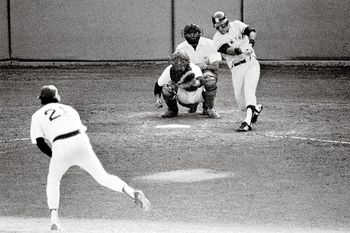
"Deep to left! Yastrzemski will not get it...it's a home run!" 
So when Dent lifted a pop fly towards the left field wall nobody, not even Dent, thought it was going out. He started digging for a double. Many believed Dent had just flied out to end the inning.

“When Bucky hit the ball, I said, ‘That's an out.’” Don Zimmer remembered.

“It was a ball that everyone thought was going to be caught,” author Leigh Montville recalled, “a nothing kind of hit.”

Only that nothing hit somehow found its way into the netting atop the Green Monster for a go-ahead three-run homer, silencing the crowd of 33,000. Left fielder Carl Yastrzemski, who appeared to have a play on the ball when it first left Dent’s bat, crumpled just in front of the wall as he watched the ball soar over it.

“I still can’t believe it went in the net,” Yastrzemski would say years later.

Dent’s unlikely long ball did not win the game for New York, as many have come to believe, but it did turn the tide. Torrez walked the next batter, Mickey Rivers, and was pulled from the game, unable to get the final out of the inning. Bob Stanley trotted in and allowed Thurman Munson to double, which scored Rivers easily from second (he had stolen). The winning run wouldn’t score until the top of the eighth, when Reggie Jackson led off with a solo shot to center that gave New York a 5-2 lead and drove Stanley from the game.

Boston rallied for two runs in the bottom of the eighth and had a chance to win the game in the bottom of the ninth. The tying and winning runs were on base for Jim Rice, that year’s American League MVP, and Yastrzemski. Rice flew out and Yaz popped out, stranding the tying run on third base.

The Red Sox had come as close as humanly possible to tying the game. Boston had won 99 regular season games, and in the end it was not enough. The downtrodden Sox went home for the winter with nothing to show for it except the bitter taste of defeat in their mouths.

Game 163, fittingly enough, was a microcosm of Boston’s rollercoaster season. The Sox jumped out to an early lead, blew it, clawed back, but ultimately fell just short. It would be eight more years before they reached the postseason, which would end even more tragically than their ill-fated 1978 campaign.

Tuesday, June 2, 2015

2015 MLB May Awards

That funky stance produced one of the best months any player has ever had (MLB Reports)
May is over, which means it's time to hand out some hardware.

American League

Player of the Month--Jason Kipnis
Kipnis made history last month, becoming the first player in 90 years to notch at least 30 runs and 50 hits (51, actually) in the month of May. The last to do it? Al Simmons, and the only other to ever do it was the one and only Ty Cobb. In addition to batting a scalding .429/.511/.706, Kipnis clubbed 22 extra base hits (15 doubles), led the major leagues in weighted runs created (38) and was worth 3.1 fWAR, becoming the first player in a decade to finish a month with more than three. Cleveland's leadoff man also recorded two or more hits in 16 of 29 games last month, hitting safely in all but four. Kipnis currently leads all American League position players in bWAR

Pitcher of the Month--Sonny Gray
The Oakland A's may be tanking, but that's hardly Gray's fault. The early season Cy Young candidate compiled a nifty 1.67 ERA and 1.06 WHIP across six May starts, of which Oakland only won three. The 25 year-old flamethrower also averaged over a strikeout per inning while limiting the 151 batters he faced to a .191/.272/.265 slash line. The A's have gone 6-5 in Gray's starts, but are just 14-28 in the games he hasn't pitched.

Rookie of the Month--Steven Souza
Souza's been a big source of offense for the Rays this year, leading Tampa Bay in home runs and ranking second in total bases and runs scored. The 26 year-old rightfielder slammed six home runs last month, scored 16 runs, and slugged .512. Fun fact: he currently has twice as many long balls as anyone else on his team.

Team of the Month--Minnesota Twins
The Twins finished May in a most unlikely place--at the top of the AL Central. This was a common occurrence for Minnesota last decade but hasn't been lately, as the Twins have endured four consecutive 90-loss seasons. The Twins, who went 20-7 in May, lost consecutive games only once last month while stringing together six separate winning streaks. Their offense clicked, averaging 5.15 runs per game, and the pitching shined, allowing only 3.85 runs per game. You know you've had a good month when Ricky Nolasco--one of the most erratic hurlers in baseball--wins five consecutive starts.
Scherzer's settled in as the best pitcher in the game this year (Grantland)
National League

Player of the Month--Bryce Harper
I've talked at length about Harper's incredible month, which saw the 22 year-old smash 13 home runs, drive in 28 runs, walk 22 times, and bat .360/.495/.884. Harper's May ranks as one of the best-ever, and nobody did more damage with a bat in his hands last month (except maybe Kipnis).

Pitcher of the Month--Max Scherzer
Scherzer and Harper have almost single-handedly carried Washington to the top of the NL East. Scherzer won five of his six starts in May, and in his lone loss allowed just five hits and one run in seven innings while striking out 10. He completed at least seven frames in all six turns, pitching 43 innings in all while maintaining a 1.67 ERA and 0.91 WHIP. Meanwhile, he notched double digit strikeouts in four of those starts, finishing the month with an absurd 56/6 K/BB ratio. He limited opponents (167 batters faced) to a .208/.241/.321 batting line and his average GameScore was 70. My preseason choice for the NL Cy Young winner has established himself as the early frontrunner.

Rookie of the Month--Kris Bryant
Close call here between Bryant and Joc Pederson, but I'll take the guy who hit his first major league home run, then belted six more over the following two weeks (that would be Bryant). I ultimately favored Bryant, whose counting stats and rate stats were a bit better and because he more than doubled Pederson's WPA. I'd expect Bryant to win this award at least once more before the season is through.

Team of the Month--San Francisco Giants
The defending World Series champs rounded into form following a tough (9-13) April. The Giants went 21-9, vaulting themselves from last place in the NL West at the beginning of the month to just a half game out of first by the end of it. They swept the reigning AL West champs to kick off May with a five-game win streak, but San Fran didn't really hit its stride until the second half of the month. The Giants won eight in a row from May 15-23, lost two straight in Colorado before promptly winning five more, briefly climbing into first place before dropping a pair against Atlanta to close out the month. San Francisco was buoyed by an offense that averaged nearly five runs a game, aided by Brandon Belt's smoldering bat, the return of Hunter Pence, and the quiet consistency of Buster Posey. The pitching, meanwhile, allowed only 3.6 runs per game, largely thanks to the revival of Tim Lincecum and a surprisingly good month from Ryan Vogelsong. The Giants probably don't have what it takes to hang with the Dodgers all summer, but at least they've made it a race.

Monday, June 1, 2015

May's Monster Hitters

Goldschmidt exploded last month and is having an MVP-type season (Rant Sports)
With May officially in the books, I present to you the 11 position players who posted the most impressive batting numbers last month (in my humble opinion, as always).

Paul Goldschmidt
Goldschmidt was already off to a great start, having posted a 1.030 OPS and driving in 20 runs in April, but in May he was even better. The Diamondbacks first baseman, who ended April on fire with three consecutive three-hit games, continued his torrid pace by hitting .365/.476/.750. His counting numbers were equally impressive, as he socked 10 dingers and eight doubles, knocked in 23 runs amd scored 21, and worked 22 walks. He also reached base in all but three games last month and was intentionally walked nine times, including three times in yesterday's 17-inning marathon against the Brewers. With nine hits--six for extra bases--in his last three games, Goldschmidt's hotter than the Arizona desert as the calendar flips to June.

Bryce Harper
Harper started May slow, with just one single in his first 17 at-bats, but immediately went from ice-cold to blisteringly-hot. The major league leader in bWAR just enjoyed an unbelievable three-week stretch from May 6-27 in which he slugged 13 home runs, piled up 28 RBI, scored 23 runs, and batted an insane .460/.570/1.175. Also of note is that he struck out a lot less in May; just 17 times in 109 plate appearances compared to 30 times in 100 trips to the plate in April. His OPS on the season is now just a shade below 1.200.

Josh Donaldson
The American League leader in RBI and major league leader in runs scored went bananas last month, clubbing 10 home runs, posting a 1.022 OPS, and coming around to score 25 times. He was especially hot in the month's final week, blasting six home runs and totaling 11 runs, hits, and RBI in six games last week. Incredibly, White Sox and Twins pitchers did not intentionally walk him once during that stretch. Donaldson now has as many bWAR as Mike Trout.

Prince Fielder
Fielder found his power stroke after managing just one long ball during April. The former home run champion went yard nine times in May, knocking in 28 runs as he batted a robust .377/.430/.656. The AL hits leader also registered 46 base knocks during the month, 16 of which went for extra bases. His resurgence is a big reason why the Rangers went 19-11 in May, and he should continue hitting with Shin-Soo Choo and Josh Hamilton returning to form.

Jason Kipnis
Kipnis rebounded from a brutal April with a torrid May. To give you an idea of just how great his May was, consider that he finished April batting .218/.263/.287, and ended May up at .340/.411/.529 with the second-most bWAR in the American League. All he did was bat .429, reach base in over half his plate appearances, and slug .706 by virtue of 22 extra base hits. Cleveland's leadoff man led the way with an astounding 51 hits and 30 runs scored last month. Following a down year in 2014 and a sluggish start to this year, it appears the 2013 All-Star version of Kipnis has returned.

Brandon Belt
After showing intermittent flashes of promise throughout his five-year career, the 27 year-old finally appears to be putting it all together. Belt put an ugly April (.613 OPS, no home runs) behind him to rake in May, pounding out 21 extra base hits and triple-slashing .339/.405/.670. Seven of those extra base hits left the yard, all since May 15th. The Giants are currently just a half game out of first in the NL West, and Belt's bat is a big reason why.

Todd Frazier
An All-Star for the first time last year as a reserve, Frazier is making a strong case to be the NL's starting third baseman at this year's midsummer classic, which also happens to be hosted by his home team's city. With 16 long balls, 9 of which came in May, he's already more than halfway to last year's total of 29--a career high. In addition to posting lofty power totals such as his .683 slugging, he was also an on-base machine, reaching safely in 24 of 27 games at almost a 40 percent clip. He also batted .327--an 89 point improvement over his April average. Frazier has been especially hot over the last week, tagging four home runs and four doubles over his past six games.

Justin Upton
The re-tooled Padres haven't lived up to expectations, but Upton's not the reason why. The younger and better Upton brother was huge during the month of May, batting .343/.418/.546 with six home runs, 23 RBI, and nine stolen bases in nine attempts. It's been years since Upton ran like that, literally; he swiped more bags last month than he did in each of the last two seasons. His defense, however, still leaves a lot to be desired.

Ryan Braun
Braun's back, baby! Well, sort of. His numbers still aren't anywhere near prime-level Braun, but they're much better than they were the last two years. The Hebrew Hammer hit eight home runs with 28 RBI, 22 runs, and five steals in May, impressive counting stats for a twice-busted 31 year-old PED offender. That was mean.

Andrew McCutchen
Kudos to McCutchen for turning around a truly awful start to the season. He was batting below .200 through May 6th, but has looked more like himself over the past three weeks as he recovers from knee soreness. 'Cutch batted a McCutchen-esque .330/.419/.566--right in line with his numbers from last year--to make his batting line respectable. He also smacked 10 doubles, five home runs, and walked nearly as often (14 times) as he struck out (15 times).

Nelson Cruz
Last but not least we have Cruz, the major league home run leader who added eight bombs to his ledger in May. He did a lot more than just leave the yard though, batting .346/.407/.607 on the month.
Last year's ML home run king is at it again (MLB)

Sunday, May 31, 2015

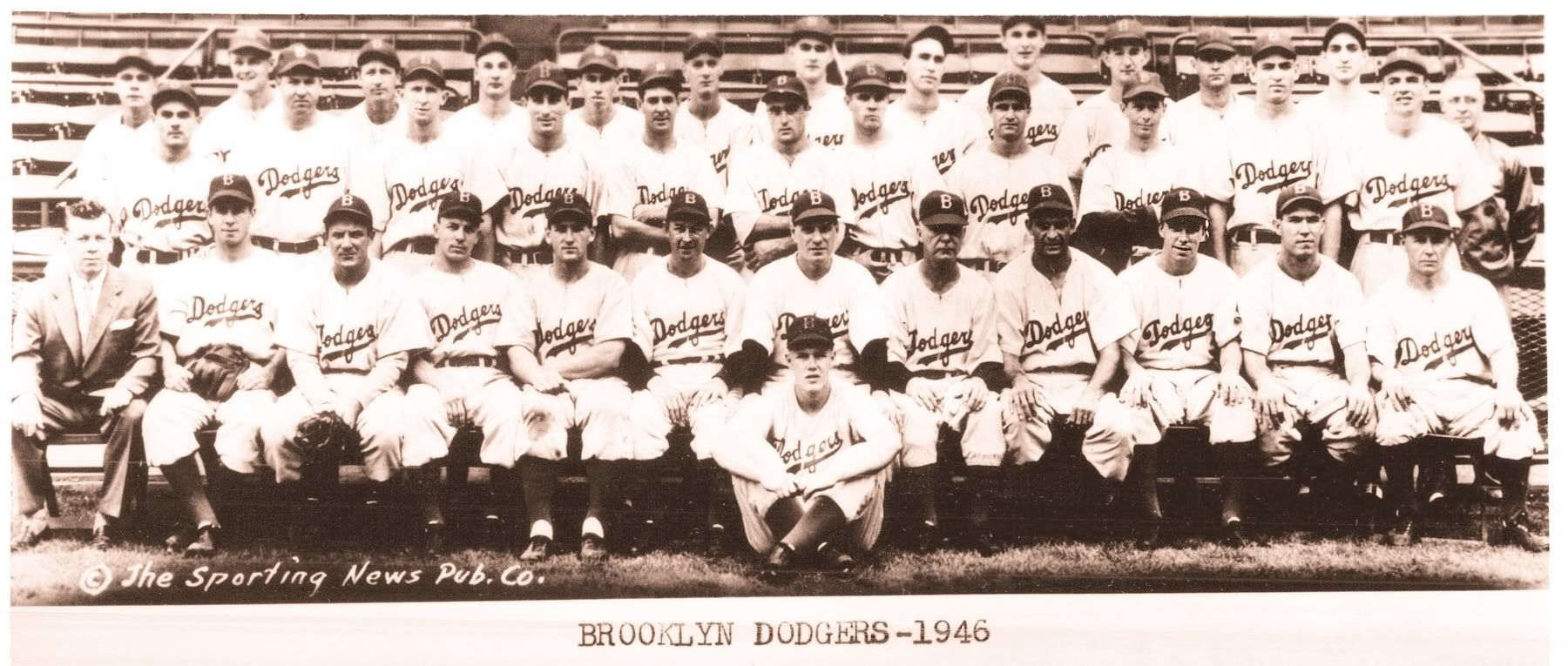
Remembering the 1946 Brooklyn Dodgers

Brooklyn's last non-integrated team went 96-60 (Baseball Fever)
In honor of June--the unofficial start of summer--and this being the 60th anniversary of when the Bums finally won it all, I'm going to recall and ultimately rank the fabled "Boys of Summer" teams that captivated the borough of Brooklyn in the dozen seasons immediately following World War II, before the Dodgers moved to Los Angeles after the 1957 season.

'Dem Bums emerged as a powerhouse immediately before the war, eclipsing 100 wins in the 1941 and 1942 seasons before star players departed to join the war effort. Brooklyn remained competitive during the war years, albeit not nearly as dominant as they'd been beforehand. The Dodgers fielded winning records in 1943 and 1945, finishing 20 games over .500 in '45.

The 1946 edition, Brooklyn's last all-white team, was unlike the hitting-heavy clubs that proceeded it in that it was buoyed by outstanding pitching. The Bums compiled a 3.05 ERA, which was good for second best in the majors, while pacing the National League in strikeouts, saves, and fewest hits allowed. The rotation was led by the trio of rookie Joe Hatten, All-Star Kirby Higbe, and sophomore Vic Lombardi, all of whom were versatile enough to make at least 25 starts and 10 relief appearances each. In all, six of the seven hurlers who started 10 games or more posted an above average adjusted ERA, with starters combining for a 3.04 ERA. The bullpen, led by reliable fireman Hugh Casey, was nearly as effective, leading the league in saves and compiling a 3.07 ERA.

Brooklyn's lineup was less impressive, with 35 year-old All-Star Dixie Walker being the only regular to bat over .285, knock in more than 75 runs, and top an .800 OPS. Only two players reached double digit homers, with Pete Reiser's 11 leading the team, and nobody registered 30 doubles. Even with their astounding lack of power, the Dodgers still finished second in the NL in runs scored and OPS, largely because they led the loop in OBP, walks, steals, and triples. Brooklyn's punchless lineup expertly manufactured runs like a finely tuned machine, much like last year's Royals.

After falling 5-3 to the Braves, then of Boston, on Opening Day, Leo Durocher's Dodgers ripped off eight straight wins to vault into first place. They remained there for much of the summer, spending just one day out of first between May 22nd and August 25th. Brooklyn fell behind the hard-charging St. Louis Cardinals at the end of August and played catch-up for most of September despite going 21-8 that month. The Dodgers finally tied the Cardinals for first on September 28th--the regular season's penultimate day--but incredibly both teams lost home games the next day against clearly inferior teams to finish the season at 96-58, forcing the first-ever pennant tiebreaker.

Brooklyn won the coin-toss to determine home field advantage for the best-of-three series and opted to play the first game in St. Louis, which meant games two and three would be played at Ebbets Field. The Dodgers clearly did not think this through, as that entailed traveling from New York to St. Louis by train, then immediately turning around and heading back to New York. The Cardinals, who were already in St, Louis, did not need to go anywhere for the first game and were thus well-rested when the weary Dodgers arrived.

Not surprisingly, the Cardinals took game one 4-2 behind a complete game from Howie Pollet. Meanwhile, visiting starter Ralph Branca--a name that would become infamous five years later--failed to make it out of the third inning. The Dodgers doubled their scoring output in the second game, but so did the Cardinals and that was that. St. Louis headed back to the World Series, their fourth in five seasons, where they would upset the Boston Red Sox in seven games. The Dodgers went home empty-handed, left to wonder how they would have fared against Ted Williams and co. Who knows how the series would have played out had it begun in Brooklyn, forcing St. Louis to make the nearly 1,000 mile journey before Game 1.

One also has to wonder how Brooklyn would have fared with Jackie Robinson, Don Newcombe, and Roy Campanella--all cutting their teeth in its farm system that year--on the major league roster. Newcombe, who turned 20 that summer and didn't debut until 1949, probably wouldn't have made the team, but Campanella (24) and Robinson (27) likely would have been starters, especially since the Dodgers relied on a rookie catcher, 22 year-old Bruce Edwards, and 21 year-old first baseman Ed Stevens, neither of whom could hold a candle to the Hall of Fame talents of their eventual successors. Given their more advanced age and how well they played upon arriving in the big leagues, it seems safe to say that Campy and Jackie would have helped Brooklyn win at least one more regular season game and thus avoid the playoff series altogether.

It's just a shame they didn't get the chance.

Saturday, May 30, 2015

Belated MLB Postseason Predictions

AL East--Red Sox
Boston's going to take a weak AL East behind the best offense in baseball (once they start hitting with runners in scoring position, that is).

AL Central--Tigers
The Tigers are still top dogs until someone (likely the Indians) unseats them.

AL West--Mariners
Seattle added some bats this winter, Nelson Cruz chief among them, to complement what projects to be an outstanding rotation.

AL WC1--Indians
With so much in their prime talent, something has to go terribly wrong for Cleveland to miss out on the postseason.

AL WC2--Blue Jays
This is finally the year Toronto snaps its playoff drought, which stretches back to 1993.

WC: Indians win Wild Card Game when Corey Kluber shuts down the Blue Jays 3-0
ALDS: Tigers over Indians in 5
ALDS: Red Sox over Mariners in 5
ALCS: Red Sox over Tigers in 6

NL East--Nationals
Washington's going to trample the NL East as they gun for 100 wins.

NL Central--Cardinals
The most balanced team in baseball.

NL West--Dodgers
Like the Yankees of last decade, they have too much money and star power to not win their division.

NL WC1--Cubs
The addition of veteran talent (Jon Lester, Miguel Montero, Dexter Fowler) to an up-and-coming team will get them back to the playoffs.

NL WC2--Padres
The offseason additions of Justin Upton, Matt Kemp, James Shields, and Derek Norris are going to take them from sub-.500 to October.

WC: Cubs over Padres 7-3
NLDS: Nationals over Cubs in 4
NLDS: Dodgers over Cardinals in 5
NLCS: Nationals over Dodgers in 7

WS: Nationals over Red Sox in 5