Showing posts with label Willie Mays. Show all posts

Monday, October 26, 2015

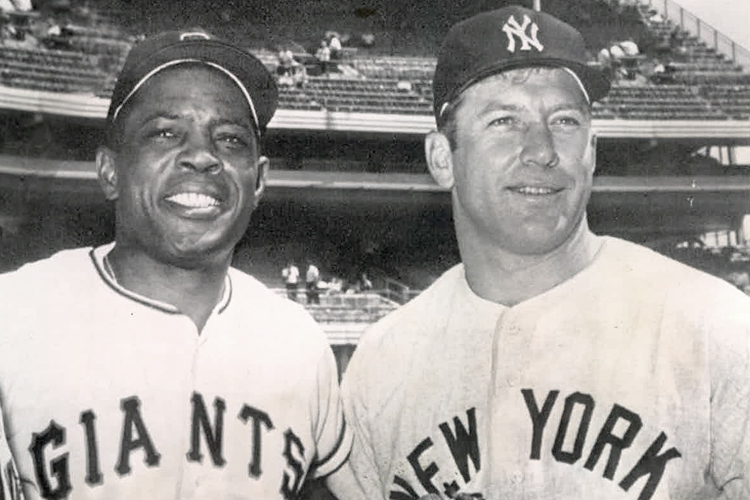
Mantle vs. Mays

Mays was better, but for a while it was too close to call (Salon.com)
For many years during the 1950s and well into the 1960s, Willie Mays and Mickey Mantle were the best center fielders in their respective leagues, if not the two best players in baseball. Throughout the first halves of their careers, before Mays' Giants moved to San Francisco, they were frequently compared with Duke Snider, the talented center fielder of the Brooklyn Dodgers. Snider and Mays both departed New York after the 1957 season, and while Snider was never again the superstar he'd been in Brooklyn, Mays flourished on the West Coast. He and Mantle were widely regarded as the best all-around players in baseball, and upon retiring found themselves on the short list of not just the best center fielders of all time (along with Tris Speaker and Mantle's one-time teammate Joe DiMaggio), but the best players period.

There's no question as to which one was better. That would clearly be Mays, who many consider the best ballplayer not named Babe Ruth. He was just as good as if not better than Mantle in his prime and lasted longer, which explains his advantage of nearly 50 bWAR.

But for a long time, Mantle hung in there. Despite the injuries, his offensive numbers were on par with Mays's and because Mantle walked more, he was a significantly better hitter. Mays was a much better baserunner and fielder, but as a total package Mantle was very nearly his equal.

Here are their stats from 1951 through 1964:
Mays:    8,002 PA 1,379 R 453 HR 1,290 RBI .313/.388/.589 161 OPS+ 109 bWAR 78.8 WAA
Mantle: 7,979 PA 1,472 R 454 HR 1,298 RBI .309/.429/.582 177 OPS+ 97.8 bWAR 73.5 WAA

After 1964, however, Mantle could no longer keep up. The Mick faded fast, becoming a .250 hitter with 20-homer power over his final four seasons. Mays remained a superstar for several more years, copping his second MVP with 52 dingers in 1965 and putting together a nine-win season in '66. He continued to be a solidly above average player into the early '70s, several years after Mantle retired, before hanging up his spikes after the 1973 campaign.

Many, myself included, maintain that Mantle was actually a hair better than Mays before he broke down. Are they right? Let's take a closer look, going year-by-year to determine which one was better.

1951 Mays
Both had massive expectations place on them from the start and, as 19 year-olds usually do, hit rough patches early on in their rookie campaigns. Mays famously went 1-for-his-first-26 (albeit with a home run off Warren Spahn) and became so discouraged that Leo Durocher promised Mays would remain the starting center fielder for the rest of the season to revive his confidence. Mantle was demoted in mid-July to New York's minor league affiliate in Kansas City, where he remained for six weeks and nearly quit before his father talked some sense into him.

Both rebounded from their early slumps. Mays caught fire in June (1.041 OPS) and July (10 home runs) en route to winning the NL Rookie of the Year award and helping the Giants overtake the Dodgers in a wild pennant race. Mantle rejoined the Yankees in late August in time for the stretch run and hit well enough to reclaim his spot at the top of the order. As fate would have it, the dynamic duo met up in the World Series. The Bombers, in the midst of claiming five straight titles, prevailed despite a gruesome knee injury suffered by Mantle when he caught his spikes in an outfield drainage ditch trying to make a play on a fly ball, a fly ball hit by none other than Willie Mays.

Statistically, Mays outproduced Mantle in almost every offensive category. Granted, part of that was because Mays played 25 more games, but even so he outslashed Mantle in average, OBP, and slugging, producing an OPS 36 points higher than Mickey's .792 mark. Combined with his plus defense in center field (Mantle played the less challenging position of right field with DiMaggio still patrolling center), Willie was worth almost four wins above replacement, more than double Mantle's 1.5.
Mantle and Mays faced each other in two World Series. Mantle's Yankees won both (Bama Media)
1954 Mays
Following a two-year hiatus in the Army, Mays returned to baseball a full-blown superstar. He more than doubled his home run output from his rookie year, improved his OPS by 250 points and scored more than twice as many runs. Mays made his first All-Star team and was voted league MVP after leading the majors in batting (.345), slugging (.667), and bWAR (10.6) while also pacing the NL in triples, OPS, and OPS+. To top it all off, he led the Giants to a World Series victory over the heavily-favored Cleveland Indians, winners of 111 games during the regular season.

Mantle, who'd developed into a great player while Mays was gone, continued to improve in his fourth season. In addition to batting .300 for the second time and exceeding a .400 OBP and 100 RBI for the first, he set career highs in nearly every category and scored an ML-best 129 runs.  The Mick was tremendous, worth almost seven wins, but Mays was playing in a different stratosphere that year.

1955 Mays
Very, very close this time around. Both B-R and FanGraphs give Mantle the slight edge in WAR, rating him closer to 10 while pegging Mays at nine exactly, but frankly I can't see how. Mays was arguably better in his MVP encore, leading the majors with 13 triples, 51 homers, 382 total bases, a .659 slugging, and a 1.059 OPS. Mantle was outstanding in his own right, emerging as a true superstar by leading the AL in triples, big flies, OBP, slugging, and OPS, as well as both leagues in OPS+ and bWAR.

Mays definitely had the bigger offensive season, however, compensating for Mantle's 31 point advantage in OBP with 14 additional home runs, 28 more RBI and a slugging percentage some 48 points higher. Mays also stole three times as many bases as Mantle and was already regarded as the best center fielder in the game after making "The Catch" the previous October. Advantage: Mays.

1956 Mantle
'56 was Mantle's signature season, a gem of a campaign that saw him win the major league triple crown and pile up 11.3 bWAR in addition to leading baseball in runs, runs created, total bases, slugging percentage, OPS, OPS+, WAR, extra base hits, and times on base. When the dust settled, he'd led the Yankees to another World Series championship, won his first MVP award (unanimously), and endeared himself to a new generation of Yankee fans with a season comparable to the best of Babe Ruth, Lou Gehrig, and Joe DiMaggio. Mays, with 36 home runs, a major league leading 40 steals, and 7.6 bWAR, was also terrific, but Mantle was legendary.

1957 Mantle
In his final season in New York (before returning as a Met 15 years later), Mays won his first of 12 straight Gold Gloves. He also treated the fans to some impressive offensive statistics, slugging 35 home runs and a ML-leading 20 triples to go along with his 38 steals (also tops in the bigs) and a 1.033 OPS, good for the best OPS+ (173) in the National League. 

But Mantle, in some respects, had an even better year than his Triple Crown campaign. Not only did he bat a career-best .365 with a .512 OBP (fueled by 146 walks--most in the majors), but he also posted the highest OPS (1.177) and OPS+ (221) of his career. WAR says Mantle's '57 was every bit as valuable as the season that preceded it, and the voters agreed, giving him his second straight MVP trophy despite an otherworldly season by Ted Williams (.388/.526/.731 with 38 homers).
So with a three-bWAR edge over Mays, Mantle wins easily.

1958 Mantle
The Say Hey Kid's first season out west was a good one, as he batted .347/.419/.583 for a league-best 1.002 OPS and 165 OPS+. While his 29 homers were his fewest since his rookie season, he made up for it with personal bests in batting average and hits (208) as well as leading the majors in stolen bases again (with 31). His second season worth at least 10 bWAR was only good enough for second in the NL MVP race, however, as voters elected Ernie Banks (9.4 bWAR) and his prodigious power totals at shortstop.

Mantle fell back to earth a bit after his insane 1956 and 1957 seasons, but still clobbered a league-high 42 home runs, batted over .300, and worked more walks/scored more runs than anybody else in baseball. Despite batting 43 points lower than Mays, he still held significant advantages in OBP (24 points) and slugging (nine points), not to mention the best OPS+ in baseball at 188. That's why I'm giving the edge to him even though bWAR estimates Mays was worth about 1.5 more wins to his team. With Mantle clearly the better hitter and almost Mays' equal on the bases (he was a very efficient 18 for 21 in stolen base attempts), I'm not going to be swayed by unreliable defensive metrics.

1959 Mays
1959 was a major disappointment for Mantle and the Yankees, who finished only four games above .500 and failed to win the pennant for only the second time since Casey Stengel took over. The Mick suffered his worst season since 1953, hitting "only" 31 home runs with "only" 75 RBI. Those numbers would have been more palatable to Yankee fans had he not led the major leagues in whiffs with 126 (a career-high) and batted .285--his worst mark since his rookie season.
While '59 was a down year for Mickey, it was business as usual for Mays, who won another Gold Glove, slugged 34 home runs, drove in 104, and stole a league-high 27 bases in 31 attempts. Add it all up and Mays was worth over a full win more than Mantle, even though their offensive output was almost dead-even (Mays had a 156 OPS+ to Mantle's AL-best 151).
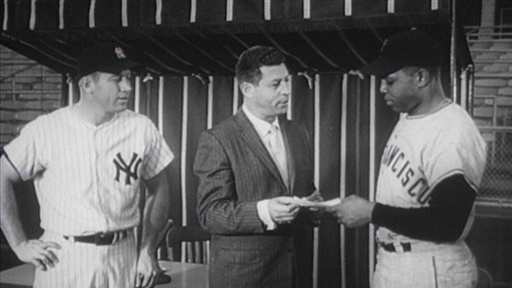
Mantle and Mays squared off in the first ever home run derby. Mantle won
1960 Mays
Offensively, Mays and Mantle were about dead-even in the first year of the '60s, with perhaps the slight edge going to Mantle. By this point, however, Mays was the much better fielder and baserunner, which means on the whole he was more valuable. This is bored out by bWAR, which puts Mays at 9.5--a full three wins better than Mantle's 6.3. Both players endured "down" years by their lofty standards, with Mays failing to reach 30 home runs for the second time in three years and Mantle batting .275 with a league-high 125 strikeouts. I'm nitpicking, of course, but I'm sure both players would tell you that 1960 wasn't their best.

1961 Mantle
Mays boosted his power numbers considerably in his second year at the 'Stick, generating his most home runs (40) and RBI (123) since his monster 1955 campaign and raising his slugging percentage nearly 30 points.

Even with the power spike, he still fell well short of Mantle, who along with teammate Roger Maris challenged Babe Ruth's hallowed single-season home run record. Mantle fell short at 54, but still led the majors in walks (126), slugging (.687) and bWAR (10.5). So feared was the Mick that Maris, despite launching 61 homers himself, did not receive a single intentional walk in 1961, for he spent most of the season batting in front of Mantle.

1962 Mays
Mantle may have won his third MVP but Mays eclipsed him in almost every category. Mantle had the superior rate stats, batting an obscene .321/.486/.605 (195 OPS+), but he also missed roughly a quarter of the season, which limited his value to about six wins. Mays, on the other hand, played 162 of a possible 165 regular season games, racking up personal bests in runs (130), RBI (141), and total bases (382) as well as 49 home runs--most in the majors. Mays was worth an incredible 10.5 bWAR that year, and yet somehow did not win MVP (voters gave it to Maury Wills, who shattered Ty Cobb's single season stolen base record that year).

Mantle got the best of Mays in that year's Fall Classic, which featured the Yankees and Giants in a rematch of the 1951 Series. New York won in seven despite Mantle's mediocre .120/.241/.160 performance. Perhaps the Giants would have won--they lost Game 7 by one run, had Mays done more than bat .250/.276/.321 with zero home runs and one RBI.

1963 Mays
Mantle seriously injured himself, missing almost 100 games after breaking his foot in a nasty collision with a chain-link fence. He was terrific when he did play, replicating his 1962 production, but Mays stayed healthy so there was no discussion.

1964 Mays
'64 was Mantle's last great season, yielding 35 homer runs and 111 RBI as well as the best OBP (.423), OPS (1.015) and adjusted OPS (177) in baseball. But Mays was right there with him, knocking in the same number of runs, socking 12 more home runs, leading the major leagues in slugging percentage at .607 and posting the NL's best raw (.990) and adjusted (172) OPS. Mays was much better in the field and on the bases at this point as well, with 19 steals to Mantle's six and Gold Glove defense in center compared to Mantle's abysmal defense. All said, Mays was worth more than twice as many bWAR (11.1) as Mantle (4.8), making him the obvious choice here.

After 1964, Mays vs. Mantle was no longer a debate. Age, injuries, and alcohol pushed Mantle over the cliff, as he batted just .254 over his final four seasons while averaging just 20 home runs and 53 RBI per season. Mays took much better care of himself, and thus aged more gracefully, winning his second MVP in 1965 and compiling almost 31 bWAR from 1964-1968. Their teams endured similar fates, as the Yankees plummeted to the second division while the Giants remained one of the best teams in baseball.

One can only wonder how Mantle's closing act would have played out had he stayed healthy and avoided the bottle. Based on how close the above comparisons are, I can't imagine it would have been much different from Mays.

Saturday, April 25, 2015

Baseball's Elite Eight

PED use aside, Bonds (left) and A-Rod are two of the greatest living ballplayers (NYPost)
So MLB.com is letting fans determine the four greatest living players in baseball history (a title Joe DiMaggio proudly but wrongly held from 1969 until his death in 1999). Only not really, because voters are selecting from a ballot of eight candidates, several of whom shouldn't be there. Several writers, Joe Posnanski chief among them, have already pointed out the lunacy of Sandy Koufax's inclusion, and by extension Pedro Martinez (who was a lot like Koufax, only with better developmental seasons and a handful of years tacked on at the end of his career). Johnny Bench seems to be an odd choice as well, and I probably wouldn't have given Tom Seaver much thought.

If I were in charge of creating the ballot, these are the eight guys I'd put on there:

Barry Bonds
Nobody had a career anything close to the one that Bobby Bonds's son did, which is why the most similar batter to him has a similarity score of only 761 (fun fact: it's his godfather). He leads the world in home runs and walks, has more MVPs than anybody, stole 514 bases, and was the best (or nearly so) defensive left fielder of all-time. 2000-2004 Bonds was the closest anyone has come to dominating the game like Babe Ruth since, well, Babe Ruth.

Roger Clemens
The pitching equivalent of Bonds is, in all likelihood, the best pitcher to ever grace this earth (check back with us in 15 years, Clayton Kershaw).  The crazy thing about Clemens is how he was so good for so long. He won his first Cy Young award and was named MVP in 1986 at age 23; He won his seventh and final Cy Young in 2004 at 41, was the major league ERA champion the next year, and had a 2.30 ERA (194 ERA+) the year after that.

Hank Aaron
Aaron may have ceded his title as the Home Run King to Bonds, but he's still number one all-time in RBI, total bases, and extra base hits. What blows my mind about Aaron is that he was so good for so long, drawing MVP votes every year from 1955 through 1973, but came away with only one MVP award. He finished third six times, but for some reason I'm just really surprised by that, especially since he kept raking even as offense disappeared in the 1960s.

Willie Mays
At his best, Mays was the best all-around ballplayer there ever was. He had 50-homer power, 40-steal speed, was a threat to win a batting title, and played center field better than anyone not named Andruw Jones. It's scary to think what he could have accomplished had he not lost two full seasons to military service and played in one of the worst possible offensive environments (Candlestick Park in the '60s) imaginable.

Randy Johnson
The Big Unit also had a Koufax-esque run for the ages in the late '90s/early '00s, earning four straight Cys and five in all. The nine-time strikeout champion punched up more K's than everyone besides Nolan Ryan, won over 300 games, and staked his claim as the best southpaw to ever take the bump (apologies to Koufax, Kershaw, and Lefty Grove).

Greg Maddux
Mad Dog matched the peak of Koufax (four consecutive Cys, 2.15 ERA over a seven-year stretch) while remaining healthy and durable enough to complete more than 5,000 innings. Think about it--that's averaging 250 innings per year for 20 years. Nobody today, not even of Mark Buehrle, is capable of that.

Rickey Henderson
Henderson may not have the as great as he thought/proclaimed he was, but he was still pretty damn good. Man of Steal stole more bases and scored more runs than anybody in baseball history, reached base over 5,200 times, swatted nearly 300 home runs, and swiped 100 bags or more in a season three times. Henderson, who maintained a .401 OBP over 25 seasons and 13,346 plate appearances, was also exceptional into old age, leading the league in walks and steals at 39 and batting .315/.423/.466 at 40.

Alex Rodriguez
If nothing else, Rodriguez is reminding us this year of the incredibly gifted player once considered the best all-around talent in baseball. From his Mike Trout-esque beginnings in Seattle to his towering seasons in Texas to his continued dominance in New York, Rodriguez has been a force in major league baseball for two decades now. He's done some incredible things along the way, like win five home run crowns and three MVP awards while playing top-shelf defense and stealing hundreds of bases. The sad thing is that he probably still could have done all those things without PEDs.

Of these eight, I'd vote for Bonds, Aaron, Mays, and Clemens. If the ballot could have stretched to 10 I would have included Mike Schmidt and probably Seaver, with Frank Robinson just missing the cut.

Friday, May 30, 2014

A-Rod: A Modern Willie Mays

A-Rod was the second coming of the amazing Mays (Examiner)
Willie Mays and Alex Rodriguez both rate as each other's second best comp according to Baseball-Reference. B-R says Ken Griffey Jr. was most similar to A-Rod and that Frank Robinson was the Say Hey Kid's closest match. Frankly, I don't see how two players could be any more similar. For starters, many of their career numbers are almost inseparable:

Doubles: Mays 523, A-Rod 519
Home runs: Mays 660, A-Rod 654
RBI: Mays 1,903, A-Rod 1,969
Steals: Mays 338, A-Rod 322
OPS: Mays .941, A-Rod .942
Iso: Mays .256, A-Rod .259
wOBA Mays .409, A-Rod .400
GIDP: Mays 251, A-Rod 240
SH: Mays 13, A-Rod 16
SF: Mays 91, A-Rod 101
BSR: Mays 32.9, A-Rod 33.3

The similarities don't end there, of course. Their careers shared many parallels despite playing out nearly half a century apart.
  • They both batted from the right side
  • They both played in New York and won one World Series playing there. They played for many great teams surrounded by numerous Hall of Fame-caliber players (Willie McCovey, Orlando Cepeda, Monte Irvin, and Juan Marichal for Mays, Griffey, Randy Johnson, Derek Jeter, Mariano Rivera for Rodriguez)
  • Were stellar in their first full seasons/broke out at age 20--Mays won the 1951 NL Rookie of the Year and Rodriguez finished second in the AL MVP race to Juan Gonzalez
  • Emerged as elite players in their third seasons--1954 for Mays (MVP) and '96 for A-Rod (MVP runner-up)--and won their one and only batting crowns
  • Their career batting lines are almost identical: Mays batted .302/.384/.557 and Rodriguez hit .299/.384/.558
  • Rodriguez won five home run titles and four slugging titles. Mays won four home run titles and five slugging titles
  • Both had five full seasons with an OBP better than .400
  • Both led the league in hits once and won a batting title (but not in the same season)
  • Each had one season with at least 100 walks
  • Mays topped 300 total bases for 13 straight seasons, from 1954 through 1966. Rodriguez exceeded 290 13 consecutive years; 1996 through 2008
  • Both had 13 straight seasons with at least 99 runs scored
  • Both won multiple MVPs (but deserved more) and were runner-up twice. Mays won his first and last MVP 12 years apart, something A-Rod would have accomplished if the voters in 1996 had an ounce of sense in their heads
  • Both had multiple seasons with at least 50 home runs, and each won their last MVP with a 50 home run season (Mays with 52 in 1965 and Rodriguez with 54 in 2007)
  • Each switched teams but never leagues, and called three separate cities home
  • Both supplemented their elite power with great speed, and were excellent baserunners/basestealers. Mays stole 338 bases and was caught 103 times (76.6 percent success rate), while Rodriguez swiped 322 and was nabbed 76 (80.9 percent). Reached 40 steals in a season one time each
  • Were regarded as outstanding defensive players and won multiple Gold Gloves, Rodriguez was a slick-fielding shortstop and third baseman while Mays is regarded as perhaps the best defensive center fielder of all-time (along with Tris Speaker)
  • Both had their shares of highs and lows in the postseason
  • Were the highest paid players in baseball for a time
  • Both had their last great season the year they turned 35 (1966 for Mays and 2010 for Rodriguez)
If Rodriguez's career is indeed over (only time will tell), he deserves to be remembered not for all his off-the-field transgressions, but for the greatness he displayed on the diamond. He was as close to Willie Mays as any player possibly can be, and that's pretty special.
A-Rod is fifth on the career home run list, six behind Mays

Tuesday, January 7, 2014

Ranking Righthanded Hitters

More than 75 years after his last at-bat, Hornsby is still the best righty
With another incredible season under his belt, American League MVP Miguel Cabrera is making a case as one of the best righthanded hitters of all time. But there have been many great players that batted from the right side, so as of now he doesn't even crack the top 10. In my opinion, these are the best righthanded hitters to debut after 1900. That disqualifies Honus Wagner and Nap Lajoie right off the bat, though frankly I'm not sure they would have made the final cut anyways.

For statistical comparisons I used Adjusted OPS,  scaled Runs per Plate Appearance, True Average and weighted On-Base Average to help account for parks and different scoring levels.

1. Rogers Hornsby 175 OPS+ 173 wRC+ .459 wOBA 860 Rbat
Rajah won six consecutive sabermetric Triple Crowns (seven overall), two traditional Triple Crowns, two MVP awards, and led the league in OPS+ a dozen times. The .358 career hitter also eclipsed a .400 batting average three times and batted .382/.460/.637 during the Roaring Twenties.

2. Hank Aaron 155 OPS+ 153 WRC+ .335 TAv .403 wOBA 870 Rbat
The all-time leader in RBI (2,297), total bases (6,856) and extra base hits (1,477), Hammerin' Hank is best remembered for breaking Babe Ruth's career home run record in 1974. Though Barry Bonds has since passed him, Aaron's 755 career dingers are still the most ever by a righty. His combination of consistency and longevity--20 straight seasons with at least 20 homers and and OPS+ over 100 in all but one of his 23 seasons--is unmatched for a power hitter.

3. Jimmie Foxx 163 OPS+ 158 wRC+ .460 wOBA 758 Rbat
One of the most feared hitters of all-time, Foxx led the American League in walks seven times. From 1929-1940, Foxx reached 30 home runs and 100 RBI each year while batting an aggregate .334/.440/.644. He also won three MVPs and a Triple Crown in a career with 534 home runs.

4. Willie Mays 156 OPS+ 154 wRC+ .339 TAv .409 wOBA 805 Rbat
Probably the best all-around player to ever grace the diamond, Mays slammed 660 homers in a career that spanned 22 seasons. He also won five league OPS titles, five slugging titles and four home run championships.

5. Albert Pujols 165 OPS+ 161 wRC+ .337 TAv .420 wOBA 663 Rbat
Through his first ten seasons, Pujols cemented his reputation as one of the best hitters in baseball history by winning three MVP awards (would have been more if not for Barry Bonds) and averaging 41 homers, 123 RBI, 43 doubles and 119 runs scored per season. His career OPS after the 2010 season was 1.050. Though his career appears to be in a state of decline, he's already done more than enough to bank a first-ballot Hall of Fame induction.

6. Frank Thomas 156 OPS+ 154 wRC+ .331 TAv .416 wOBA 688 Rbat
Few players have started their careers better than Thomas, who batted .330/.452/.600 through his first eight seasons and won back-to-back MVP awards, becoming the league's first righthanded hitter to do so in over 60 years. The Big Hurt finished his career with rate stats nearly identical to Mickey Mantle's and 521 home runs, same as Ted Williams and Willie McCovey.

7. Manny Ramirez 154 OPS+ 153 wRC+ .326 TAv .418 wOBA 649 Rbat
Ramirez loafed on defense and never ran out anything, which explains how he never won an MVP award (or even finish second), but his intense focus in the batter's box was unquestioned. For his career he batted .312/.411/.585 with 555 home runs and 547 doubles. ManRam was also an RBI machine, topping the century mark 12 times and driving in as many as 165 in 1999.

8. Frank Robinson 154 OPS+ 153 wRC+ .332 TAv .404 wOBA 726 Rbat
Another candidate for most feared hitter to ever step up to the plate, Robinson led the majors in intentional walks four straight years. He is the only player to win an MVP award in both leagues, winning in 1961 with the Reds and 1966 with the Orioles after winning both the conventional and sabermetric Triple Crowns.

9. Mark McGwire 163 OPS+ 157 wRC+ .333 TAv .415 wOBA 544 Rbat
Big Mac was a feast or famine type hitter, especially early on his career (.250 career average through age 30), but walked a ton and so his career OBP of .394 is actually very good. More importantly, he cranked 583 home runs and owns the best AB/HR ratio of all-time.

10. Tie Hank Greenberg 158 OPS+ 154 wRC+ .453 wOBA 433 Rbat and Joe DiMaggio 155 OPS+ 152 wRC+ .439 wOBA 529 Rbat
Due to injuries, World War II and somewhat early retirements (both called it quits after their age 36 seasons), their careers lasted just 13 seasons. But both men accomplished a great deal in that short time and were overwhelmingly dominant when they did play. Greenberg batted .313/.412/.605 for his career, winning four home run championships, four RBI titles and two MVP awards in the process. He narrowly missed breaking Lou Gehrig's league RBI record and Babe Ruth's single season home run record in successive seasons. DiMaggio's numbers were hurt by Yankee Stadium, but Death Valley didn't stop him from winning back-to-back batting titles and three MVP awards, or from making the All-Star team every year. It also didn't stop him from getting a hit in 56 consecutive games in 1941.

Honorable Mention (in no particular order)
Dick Allen 156 OPS+ 155 wRC+ .330 TAv .400 wOBA
Harry Heilmann 148 OPS+ 144 wRC+ .427 wOBA
Mike Schmidt 147 OPS+ 147 wRC+ .317 TAv .395 wOBA
Gary Sheffield 140 OPS+ 141 wRC+ .314 TAv .391 wOBA
Edgar Martinez 147 OPS+ 147 wRC+ .320 TAv .405 wOBA
Alex Rodriguez 143 OPS+ 143 wRC+ .314 TAv .400 wOBA
Harmon Killebrew 143 OPS+ 142 wRC+ .318 TAv .389 wOBA
Jeff Bagwell 149 OPS+ 149 wRC+ .321 TAv .405 wOBA
Mike Piazza 143 OPS+ 140 wRC+ .314 TAv.390 wOBA
Albert Belle 144 OPS+ 139 wRC+ .310 TAv .396 wOBA
Frank Howard 142 OPS+ 140 wRC+ .313 TAv .374 wOBA
Ralph Kiner 149 OPS+ 147 WRC+ .427 wOBA
Hack Wilson 144 OPS+ 143 wRC+ .421 wOBA
Vladimir Guerrero 140 OPS+ 136 wRC+ .309 TAv .390 wOBA

Maybe someday...
Miguel Cabrera 154 OPS+ 152 wRC+ .324 TAv .407 wOBA
Ryan Braun 146 OPS+ 148 wRC+ .315 TAv 400 wOBA
Mike Trout 166 OPS+ 163 wRC+ .350 TAv .405 wOBA


Monday, August 12, 2013

Mantle at Full Strength

Injuries and alcoholism prevented Mantle from realizing his potential
Last night I was thumbing through Jane Leavy's "The Last Boy" (great read by the way). In it, Leavy recounts several conversations she had with Mickey Mantle--the biography's subject. When Leavy asked Mantle who was better--Willie Mays or himself--Mantle conceded that Mays had the superior career, but with the caveat that Mantle felt he played most of his games at 80 percent.

That got me thinking: what would his career totals look like if he was 100 percent? After crunching the numbers, I found that his adjusted figures look almost identical to those of the player he is most often compared to:

2,095 runs--would rank 7th all-time (Mays had 2,062)
3,019 hits--would rank 26th all-time (Mays had 3,283)
670 home runs--would rank 4th all-time (Mays had 660)
1,886 RBI--would rank 12th all-time (Mays had 1,903
5,639 total bases--would rank 8th all-time (Mays had 6,066)
2,166 walks--would rank 3rd all-time (Mays had 1,464)

The world will never know what a fully healthy Mantle could've accomplished. Perhaps he would've shattered Babe Ruth's home run record before Hank Aaron did. As it stands, Mantle is probably one of the 10 or 12 best non-pitchers in baseball history. Had he been able to stay healthy and avoid the bottle, maybe we would look back on his career as the best that any player ever had.