Showing posts with label Mickey Mantle. Show all posts

Wednesday, May 31, 2017

Trout Was Having Mantle-esque Season

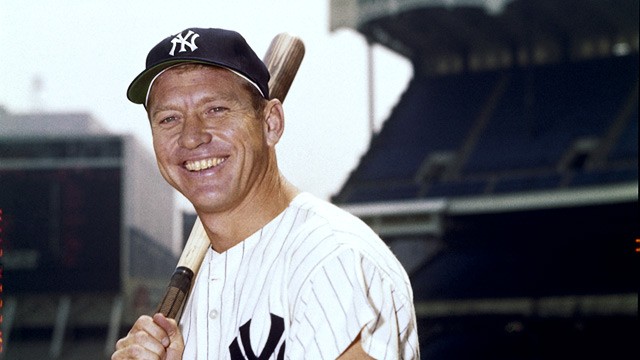
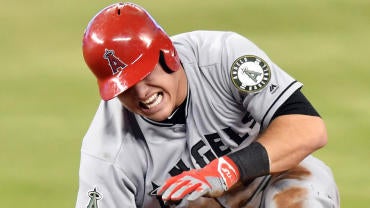
Prior to his injury, Trout was giving Mantle a run for his money (CBS Sports)
We've been comparing Mike Trout to Mickey Mantle so often for so long that we might as well start calling him Mikey Mantle. Seriously though, the comparisons have always been justified, which you can't say about most players who've had their names mentioned in the same breath as Mantle's over the past half-century.

Here are their numbers through their age-24 seasons:

Trout: 811 G  168 HR  .306/.405/.557  168 wRC+  47.7 fWAR
Mantle: 808 G  173 HR  .308/.412/.560  164 wRC+  41.1 fWAR

Throw in the fact that they're both soft-spoken, crew-cut boys from working class families who grew into speedy, powerful center fielders for big-market American League teams, and you'd be justified in thinking Trout was Mantle reincarnated (it's impossible, however, because Trout had just celebrated his fourth birthday when Mantle passed away in August, 1995).

While Trout's edges in fielding and baserunning made him more valuable than Mantle through the first phase of their careers, he has yet to have a season that rivaled Mantle at his best. Peak Mantle won a Triple Crown at 24, batted .365 with a .512 OBP at 25, and nearly broke Babe Ruth's single-season home run record during that charmed summer of 1961. As incredible as Trout's been, he has yet to reach Mantle's prodigious heights. He hasn't belted 50 homers or slugged .700 in a season and has never won a batting title, much less topped .350 in consecutive years like Mantle. That's why Mantle has a pair of 11-WAR seasons on his resume (according to FanGraphs), while Trout has zero.

This year, it looked like that was going to change. At age 25 and in his seventh big league campaign, Trout had done the unthinkable. He found another gear, inflicting maximum damage with his swings by ambushing pitchers earlier in the count. Since 2012, we've been wondering what it would look like if Trout followed a normal aging curve and improved during his 20s like players are supposed to. Everything written or said about him came with the caveat that he wasn't technically in his prime yet, even though it was plain for all to see that he was already at or near his zenith.

But with every pitcher, catcher, and manager making it their life mission to exploit holes in Trout's swing, the best he could do was keep up. He was able to maintain, but not improve, although that's no knock against him. Producing at an elite level year-after-year is the hardest thing you can do in sports. Every player has a down year at some point, even Ted Williams.

Not Trout, whose consistency has been most often described as metronomic. Each year, however, he's taken a slightly different path to success. His traditional numbers have fluctuated quite a bit, but his WAR values have remained constant.

Trout's managed to sustain his excellence by constantly and rapidly adjusting. At various points, pitchers have tried to neutralize him with breaking stuff away, hard stuff in, and fastballs up in the zone. Each time, he made the necessary adjustments to handle these pitches. Unable to penetrate his airtight plate coverage, pitchers tried to use his discipline against him, attacking him earlier in the count to get ahead of him since he rarely swung at the first pitch. Trout quickly caught on, forcing them to go offspeed early in hopes of disrupting his timing and sneaking strike one by him.

Well, that hasn't worked either, and it seems that pitchers have, for the time being at least, run out of ways to fool Trout. Let the record show that during the first two months of the 2017 season, he was simply unstoppable. Through his first 47 games, he was sporting an absurd 1.203 OPS with 16 homers and 3.5 fWAR. He was on pace for close to 50 homers and well over 100 RBIs. In essence, he was duplicating Mantle's Triple Crown year:

Trout 2017: .337/.461/.742  (217 OPS+) 11.1 fWAR in 150 games (projected)
Mantle 1956: .353/.464/.705  (210 OPS+)  11.5 fWAR in 150 games (actual)

Then, Trout did what Mantle used to do all too frequently: He got hurt. It happened while Trout was stealing his 10th base in 11 tries this year, giving him double-digit thefts in six straight seasons and putting him on track for a fourth season of at least 30. Only Trout dove head-first, one of the stupidest things you can do on a baseball field besides turn your back on the pitcher or run out to play defense without your glove.

It ended poorly for Trout, who tore a ligament in his thumb and will miss the next 6-8 weeks after undergoing surgery. As it turns out, the only thing capable of slowing Trout down in 2017 was Trout himself.

And so, after losing its top pitcher (Clayton Kershaw) for most of last summer, baseball will be -- for the first time since 2011 -- without its best player for much of this one. He'll be sidelined for all of June and possibly July, though he'll likely be back around the All-Star break. Trout strikes me as the type of guy who will return on the early side of his recovery timetable, and maybe even before it. The Angels can't compete without him, and you can bet he'll do everything in his power to get back in the lineup as soon as possible.

Let's hope he does, so he can get back to doing what he does best; playing baseball better than anyone who's ever lived.

Monday, October 26, 2015

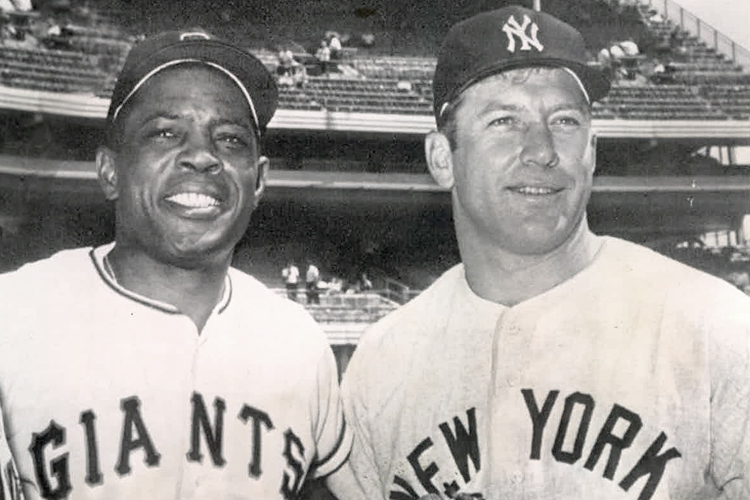
Mantle vs. Mays

Mays was better, but for a while it was too close to call (Salon.com)
For many years during the 1950s and well into the 1960s, Willie Mays and Mickey Mantle were the best center fielders in their respective leagues, if not the two best players in baseball. Throughout the first halves of their careers, before Mays' Giants moved to San Francisco, they were frequently compared with Duke Snider, the talented center fielder of the Brooklyn Dodgers. Snider and Mays both departed New York after the 1957 season, and while Snider was never again the superstar he'd been in Brooklyn, Mays flourished on the West Coast. He and Mantle were widely regarded as the best all-around players in baseball, and upon retiring found themselves on the short list of not just the best center fielders of all time (along with Tris Speaker and Mantle's one-time teammate Joe DiMaggio), but the best players period.

There's no question as to which one was better. That would clearly be Mays, who many consider the best ballplayer not named Babe Ruth. He was just as good as if not better than Mantle in his prime and lasted longer, which explains his advantage of nearly 50 bWAR.

But for a long time, Mantle hung in there. Despite the injuries, his offensive numbers were on par with Mays's and because Mantle walked more, he was a significantly better hitter. Mays was a much better baserunner and fielder, but as a total package Mantle was very nearly his equal.

Here are their stats from 1951 through 1964:
Mays:    8,002 PA 1,379 R 453 HR 1,290 RBI .313/.388/.589 161 OPS+ 109 bWAR 78.8 WAA
Mantle: 7,979 PA 1,472 R 454 HR 1,298 RBI .309/.429/.582 177 OPS+ 97.8 bWAR 73.5 WAA

After 1964, however, Mantle could no longer keep up. The Mick faded fast, becoming a .250 hitter with 20-homer power over his final four seasons. Mays remained a superstar for several more years, copping his second MVP with 52 dingers in 1965 and putting together a nine-win season in '66. He continued to be a solidly above average player into the early '70s, several years after Mantle retired, before hanging up his spikes after the 1973 campaign.

Many, myself included, maintain that Mantle was actually a hair better than Mays before he broke down. Are they right? Let's take a closer look, going year-by-year to determine which one was better.

1951 Mays
Both had massive expectations place on them from the start and, as 19 year-olds usually do, hit rough patches early on in their rookie campaigns. Mays famously went 1-for-his-first-26 (albeit with a home run off Warren Spahn) and became so discouraged that Leo Durocher promised Mays would remain the starting center fielder for the rest of the season to revive his confidence. Mantle was demoted in mid-July to New York's minor league affiliate in Kansas City, where he remained for six weeks and nearly quit before his father talked some sense into him.

Both rebounded from their early slumps. Mays caught fire in June (1.041 OPS) and July (10 home runs) en route to winning the NL Rookie of the Year award and helping the Giants overtake the Dodgers in a wild pennant race. Mantle rejoined the Yankees in late August in time for the stretch run and hit well enough to reclaim his spot at the top of the order. As fate would have it, the dynamic duo met up in the World Series. The Bombers, in the midst of claiming five straight titles, prevailed despite a gruesome knee injury suffered by Mantle when he caught his spikes in an outfield drainage ditch trying to make a play on a fly ball, a fly ball hit by none other than Willie Mays.

Statistically, Mays outproduced Mantle in almost every offensive category. Granted, part of that was because Mays played 25 more games, but even so he outslashed Mantle in average, OBP, and slugging, producing an OPS 36 points higher than Mickey's .792 mark. Combined with his plus defense in center field (Mantle played the less challenging position of right field with DiMaggio still patrolling center), Willie was worth almost four wins above replacement, more than double Mantle's 1.5.
Mantle and Mays faced each other in two World Series. Mantle's Yankees won both (Bama Media)
1954 Mays
Following a two-year hiatus in the Army, Mays returned to baseball a full-blown superstar. He more than doubled his home run output from his rookie year, improved his OPS by 250 points and scored more than twice as many runs. Mays made his first All-Star team and was voted league MVP after leading the majors in batting (.345), slugging (.667), and bWAR (10.6) while also pacing the NL in triples, OPS, and OPS+. To top it all off, he led the Giants to a World Series victory over the heavily-favored Cleveland Indians, winners of 111 games during the regular season.

Mantle, who'd developed into a great player while Mays was gone, continued to improve in his fourth season. In addition to batting .300 for the second time and exceeding a .400 OBP and 100 RBI for the first, he set career highs in nearly every category and scored an ML-best 129 runs.  The Mick was tremendous, worth almost seven wins, but Mays was playing in a different stratosphere that year.

1955 Mays
Very, very close this time around. Both B-R and FanGraphs give Mantle the slight edge in WAR, rating him closer to 10 while pegging Mays at nine exactly, but frankly I can't see how. Mays was arguably better in his MVP encore, leading the majors with 13 triples, 51 homers, 382 total bases, a .659 slugging, and a 1.059 OPS. Mantle was outstanding in his own right, emerging as a true superstar by leading the AL in triples, big flies, OBP, slugging, and OPS, as well as both leagues in OPS+ and bWAR.

Mays definitely had the bigger offensive season, however, compensating for Mantle's 31 point advantage in OBP with 14 additional home runs, 28 more RBI and a slugging percentage some 48 points higher. Mays also stole three times as many bases as Mantle and was already regarded as the best center fielder in the game after making "The Catch" the previous October. Advantage: Mays.

1956 Mantle
'56 was Mantle's signature season, a gem of a campaign that saw him win the major league triple crown and pile up 11.3 bWAR in addition to leading baseball in runs, runs created, total bases, slugging percentage, OPS, OPS+, WAR, extra base hits, and times on base. When the dust settled, he'd led the Yankees to another World Series championship, won his first MVP award (unanimously), and endeared himself to a new generation of Yankee fans with a season comparable to the best of Babe Ruth, Lou Gehrig, and Joe DiMaggio. Mays, with 36 home runs, a major league leading 40 steals, and 7.6 bWAR, was also terrific, but Mantle was legendary.

1957 Mantle
In his final season in New York (before returning as a Met 15 years later), Mays won his first of 12 straight Gold Gloves. He also treated the fans to some impressive offensive statistics, slugging 35 home runs and a ML-leading 20 triples to go along with his 38 steals (also tops in the bigs) and a 1.033 OPS, good for the best OPS+ (173) in the National League. 

But Mantle, in some respects, had an even better year than his Triple Crown campaign. Not only did he bat a career-best .365 with a .512 OBP (fueled by 146 walks--most in the majors), but he also posted the highest OPS (1.177) and OPS+ (221) of his career. WAR says Mantle's '57 was every bit as valuable as the season that preceded it, and the voters agreed, giving him his second straight MVP trophy despite an otherworldly season by Ted Williams (.388/.526/.731 with 38 homers).
So with a three-bWAR edge over Mays, Mantle wins easily.

1958 Mantle
The Say Hey Kid's first season out west was a good one, as he batted .347/.419/.583 for a league-best 1.002 OPS and 165 OPS+. While his 29 homers were his fewest since his rookie season, he made up for it with personal bests in batting average and hits (208) as well as leading the majors in stolen bases again (with 31). His second season worth at least 10 bWAR was only good enough for second in the NL MVP race, however, as voters elected Ernie Banks (9.4 bWAR) and his prodigious power totals at shortstop.

Mantle fell back to earth a bit after his insane 1956 and 1957 seasons, but still clobbered a league-high 42 home runs, batted over .300, and worked more walks/scored more runs than anybody else in baseball. Despite batting 43 points lower than Mays, he still held significant advantages in OBP (24 points) and slugging (nine points), not to mention the best OPS+ in baseball at 188. That's why I'm giving the edge to him even though bWAR estimates Mays was worth about 1.5 more wins to his team. With Mantle clearly the better hitter and almost Mays' equal on the bases (he was a very efficient 18 for 21 in stolen base attempts), I'm not going to be swayed by unreliable defensive metrics.

1959 Mays
1959 was a major disappointment for Mantle and the Yankees, who finished only four games above .500 and failed to win the pennant for only the second time since Casey Stengel took over. The Mick suffered his worst season since 1953, hitting "only" 31 home runs with "only" 75 RBI. Those numbers would have been more palatable to Yankee fans had he not led the major leagues in whiffs with 126 (a career-high) and batted .285--his worst mark since his rookie season.
While '59 was a down year for Mickey, it was business as usual for Mays, who won another Gold Glove, slugged 34 home runs, drove in 104, and stole a league-high 27 bases in 31 attempts. Add it all up and Mays was worth over a full win more than Mantle, even though their offensive output was almost dead-even (Mays had a 156 OPS+ to Mantle's AL-best 151).
Mantle and Mays squared off in the first ever home run derby. Mantle won
1960 Mays
Offensively, Mays and Mantle were about dead-even in the first year of the '60s, with perhaps the slight edge going to Mantle. By this point, however, Mays was the much better fielder and baserunner, which means on the whole he was more valuable. This is bored out by bWAR, which puts Mays at 9.5--a full three wins better than Mantle's 6.3. Both players endured "down" years by their lofty standards, with Mays failing to reach 30 home runs for the second time in three years and Mantle batting .275 with a league-high 125 strikeouts. I'm nitpicking, of course, but I'm sure both players would tell you that 1960 wasn't their best.

1961 Mantle
Mays boosted his power numbers considerably in his second year at the 'Stick, generating his most home runs (40) and RBI (123) since his monster 1955 campaign and raising his slugging percentage nearly 30 points.

Even with the power spike, he still fell well short of Mantle, who along with teammate Roger Maris challenged Babe Ruth's hallowed single-season home run record. Mantle fell short at 54, but still led the majors in walks (126), slugging (.687) and bWAR (10.5). So feared was the Mick that Maris, despite launching 61 homers himself, did not receive a single intentional walk in 1961, for he spent most of the season batting in front of Mantle.

1962 Mays
Mantle may have won his third MVP but Mays eclipsed him in almost every category. Mantle had the superior rate stats, batting an obscene .321/.486/.605 (195 OPS+), but he also missed roughly a quarter of the season, which limited his value to about six wins. Mays, on the other hand, played 162 of a possible 165 regular season games, racking up personal bests in runs (130), RBI (141), and total bases (382) as well as 49 home runs--most in the majors. Mays was worth an incredible 10.5 bWAR that year, and yet somehow did not win MVP (voters gave it to Maury Wills, who shattered Ty Cobb's single season stolen base record that year).

Mantle got the best of Mays in that year's Fall Classic, which featured the Yankees and Giants in a rematch of the 1951 Series. New York won in seven despite Mantle's mediocre .120/.241/.160 performance. Perhaps the Giants would have won--they lost Game 7 by one run, had Mays done more than bat .250/.276/.321 with zero home runs and one RBI.

1963 Mays
Mantle seriously injured himself, missing almost 100 games after breaking his foot in a nasty collision with a chain-link fence. He was terrific when he did play, replicating his 1962 production, but Mays stayed healthy so there was no discussion.

1964 Mays
'64 was Mantle's last great season, yielding 35 homer runs and 111 RBI as well as the best OBP (.423), OPS (1.015) and adjusted OPS (177) in baseball. But Mays was right there with him, knocking in the same number of runs, socking 12 more home runs, leading the major leagues in slugging percentage at .607 and posting the NL's best raw (.990) and adjusted (172) OPS. Mays was much better in the field and on the bases at this point as well, with 19 steals to Mantle's six and Gold Glove defense in center compared to Mantle's abysmal defense. All said, Mays was worth more than twice as many bWAR (11.1) as Mantle (4.8), making him the obvious choice here.

After 1964, Mays vs. Mantle was no longer a debate. Age, injuries, and alcohol pushed Mantle over the cliff, as he batted just .254 over his final four seasons while averaging just 20 home runs and 53 RBI per season. Mays took much better care of himself, and thus aged more gracefully, winning his second MVP in 1965 and compiling almost 31 bWAR from 1964-1968. Their teams endured similar fates, as the Yankees plummeted to the second division while the Giants remained one of the best teams in baseball.

One can only wonder how Mantle's closing act would have played out had he stayed healthy and avoided the bottle. Based on how close the above comparisons are, I can't imagine it would have been much different from Mays.

Wednesday, October 22, 2014

Mantle's Miserable Closing Act

All great things, especially great athletic careers, must end (LIFE)
With the 50th anniversary of the 1964 World Series just having passed, I've been thinking a lot about the players on those teams, but I keep circling back to one in particular: Mickey Mantle.

Everybody remembers the 1964 Fall Classic as Mantle's last hurrah. It was the last World Series he ever played in, and statistically it was also one of his greatest. He slugged three home runs, including a walk-off blast in Game 3 that broke Babe Ruth's record for Series homers. He also knocked in and scored eight runs apiece while batting .333/.467/.792. Mantle was a beast and, had the Yankees prevailed over Bob Gibson in Game 7, likely would have copped World Series MVP honors.

After that great series, at the end of Mantle's last great season, it was all downhill for the Mick and his Yankees. His final four years, 1965-1968, are generally regarded as an exercise in futility. An old 33, worn down by his many injuries and years of hard living, Mantle declined sharply after the 1964 season. His last four seasons produced a meager .254 batting average, dragging his lifetime mark down from .309 to .298. To make matters worse, the Yankees were horrible during this time, losing 41 more games than they won and never sniffing a pennant. Mantle's misery was compounded by the failures of his team, and vice versa.

Theoretically, one could pinpoint the beginning of Mantle's decline midway through the 1964 campaign, Mantle's last truly great season. Through July 15th he was hitting .335/.453/.631, right in line with what he'd done the previous two seasons. Had he stayed on that pace, he probably would have secured his fourth MVP. As it were, he tailed off a bit and batted .271/.393/.550 the rest of the way. Still great numbers, but bringing his seasonal stats down enough for Brooks Robinson to steal the award out from under him.

What's often forgotten is that Mantle came roaring out of the gates in 1965, with four home runs in his first 11 games and seven through his first 24. Halfway through May he was hitting .275/.451/.623--in line with his second half performance from 1964. Then Mantle went into an extended slump, scuffling through the next three months, with just five home runs in June and July combined. After gracing magazine covers for 15 years, he found himself on the front page of Life in late July beside a gloomy caption: Mantle's Misery.

He rebounded in August to hit .325/.404/.519, but went out with a whimper in September. After homering in his first two September games, Mantle went into a major funk, collecting just four hits in his final 34 at-bats, with no homers and no RBI. In those final three weeks he lost more than 40 points off his OPS, as his batting line fell from a respectable .269/.392/.480 to a more pedestrian .255/.379/.452 (still good for a 137 OPS+). Believing Mantle's retirement to be imminent, the Yankees hosted Mickey Mantle Day for their beloved legend at Yankee Stadium on September 18th.

Mantle had missed 40 games and struggled when he did play, posting the lowest batting average of his career to that point. It hadn't helped that the Yankees slipped to sixth in the standings, their worst finish since 1925. Embarrassed by his poor performance, Mantle very nearly retired following the 1965 season. Ailed by his battered legs and a shoulder injury that hampered his swing and throwing ability, Mantle made up his mind to quit. But when he went to New York to inform the Yankees, Ralph Houk talked him out of it. He said Mantle shouldn't retire on a bad note, and that he'd still be valuable even if he was only able to play half a season.
By the late '60s Mantle was no longer the physical specimen he had once been
1966 was better for Mantle, but not at first. It took him 21 games to launch his first home run. For most of the first half his numbers were in line with the previous season's until he enjoyed the last great power binge of his career. From June 23rd through July 19th, a span of 28 games, Mantle mashed 15 home runs. For one glorious month, he was the Mantle of old. His revival sparked the moribund Yankees to a brief spurt, helping them climb from ninth place at the All-Star Break to sixth place after play ended on July 29th. New York's hot streak ignited talk of a possible second half surge, but such speculation quickly dissipated as the Bombers bombed in August and stumbled towards a last place finish.

Mantle reverted to his old self, too, parking only two more dingers the rest of the way. With 21 in late July, he should have been able to bank one last 30 homer season, but managed only two in August and none in September. He had a real shot at batting .300 one last time and topping a .400 OBP as well, but did neither, falling short at .288 and .389. Mantle was not an All-Star for the first time since his rookie season even though he compiled a .927 OPS (170 OPS+).

1967 marked the true beginning of the end. Mantle was moved from the outfield to first base to preserve his body (which worked, as Mantle played 144 games that year and the next) as well as limit the harm he could incur on defense, which had been terrible for five years by that point. Once again it took awhile for Mantle to get going, as he went without an extra base hit in his first 10 games of the season and managed but one RBI. He caught fire after that though, homering in consecutive games and launching 11 in all over the next month, including the 500th of his career on May 14th, Mother's Day. Mantle celebrated by hobbling around the bases on a dreary day at the Stadium.

Mantle's numbers remained strong through late July, with his OPS just a shade under .900. But like most old players, Mantle crashed and burned during the dog days of summer. From July 26th through the end of August, Mantle managed just one home run and six RBI while slugging .308.  By September Mantle was clearly out of gas, and once again his numbers were dragged down by a terrible finish. Hitting .259/.403/.462 midway through September, he recorded just three hits in his final 12 games and lost nearly 40 points off his OPS, which fell from .864 to .825 over the season's final two weeks. He failed to go yard in his last 22 games of the season as well, ending up with 22 taters on the year when he easily could have had 25+.

Looking back, it's puzzling as to why Mantle did not hang it up after that miserable '67 campaign, which had been even worse than his 1965 season. The Yankees were still terrible, having lost 90 games and finishing 9th in 1967. Whitey Ford, his good friend, drinking buddy and last remaining link to the team's heyday of the 1950s, had retired, giving Mantle the perfect opportunity to go out side-by-side with one of the few pals still left from his glory days, With 518 home runs and a .302 batting average, Mantle should have been satisfied. He should have called it a career. He should have walked away.

But Mantle did not quit. He still hoped to play several more years and ascend towards 600 homers, but that dream quickly died as 1968 proved to be even worse than '67. "This is my last year," Mantle told a teammate after striking out for the fourth time one game. "I missed about five pitches I should have hit."
Late-career Mantle made home run trots look painful (Yanks Go Yard)
Mantle just stopped hitting. He had one multi-hit game in June and went six weeks without a homer during the summer. He entered September stuck on 534 career home runs, having gone homerless since tying Jimmie Foxx on August 22nd. It would take him awhile to eclipse Foxx, and only because Denny McLain gifted him several pitches in a meaningless late season game against the World Series-bound Tigers. The following day Mantle ripped his 536th and final home run, taking reigning AL Cy Young winner Jim Lonborg deep at the Stadium. It was Mantle's last highlight as a big leaguer, for he managed just one hit--a measly single--and three walks over his final 21 plate appearances as his batting line tumbled to .237/.385/.398.

Mantle played his last game on September 28 at Fenway Park, popping up against Lonborg in his lone plate appearance. Andy Kosco replaced him at first base in the bottom half of the inning, sending Mantle off the field for the final time. The 25,534 Red Sox fans on hand acknowledged him with a standing ovation, realizing that they were potentially saying good-bye to one of baseball's biggest heroes.

"I knew I had reached the end of the line," Mantle would later write in his biography. He didn't even stay for the rest of the inning. After watching Kosco warm up he slunk down the runway, peeled off his uniform in the clubhouse, and went home.

*****

Mantle dragged himself to Spring Training in 1969, but quickly realized he couldn't go on. The Yankees tried in vain to convince him to stay, but Mantle refused. "I can't do it anymore," he told them. "My body doesn't respond." Houk promised he would take care of Mantle and not let him embarrass himself, but still Mantle said no.

On March 1st, 1969, he announced his retirement. “I was going to try to play but I didn’t think I could,” he said. “I’ve had three or four bad years in a row and, as a result, found myself dreading another season.

“I had a wonderful time playing ball,” he continued. “But I should have quit sooner. If I kept playing, I would only keep lowering my average. That’s what happened the last few years. I have known for two years that I couldn’t hit anymore but I kept trying."

By 1969, the pain was simply too great. It was time to stop trying.

Looking back, Mantle should have sailed off into the sunset after 1965. Joe DiMaggio retired after his lone bad season. So did Hank Greenberg and, for all intents and purposes, Derek Jeter. Ted Williams almost did the same before going out on his terms with one last monster season. It would have been better for everyone. Mantle could have spared himself and his fans three more years of watching him flail away for terrible Yankee teams. All that pain and misery could have been avoided. Plus, had he done that, Mantle would have retired with a .306/.426/.576 line and a career 1.002 OPS. He would have been one of only eight players to finish their careers with a four-point OPS (the others being Ruth, Williams, Foxx, Greenberg, Barry Bonds, Lou Gehrig, and Rogers Hornsby).

So yeah, Mantle hung on too long, but most great athletes do. Even Willie Mays did. Mantle knew he was washed up, too, but just kept hoping against hope that
Sunday, June 29, 2014

M&M Boys: Mantle and Mathews

Mathews, Mantle and Aaron pose for a picture in spring training
Throughout the 1950s and into the 60s, Eddie Mathews was essentially a poor man's Mickey Mantle. By this I mean no disrespect to Mathews, easily one of the five greatest third baseman of all-time and a most-deserving Hall of Famer. If you're going to be a poor man's version of somebody, after all, you couldn't do much better than The Mick.

It's fascinating how much their personal lives and baseball careers overlapped. They were born one week apart in October, 1931 in the rural Midwest, with Mathews hailing from Texas and Mantle a progeny of Oklahoma. Both signed as amateur free agents in 1949 and played their first full season in 1952 with similar results; Mantle had 23 home runs in 142 games, Mathews slugged 25 in 145, and both drew MVP votes despite leading their respective leagues in strikeouts.

Thus marked the beginning of two outstanding careers that lasted until 1968, when both posted the worst batting averages of their careers and promptly retired, clearly done. But not before they hit milestone homers in that Year of the Pitcher, with Mantle taking Denny McLain deep to pass Jimmie Foxx and Mathews, by then a teammate of McLain's eclipsing Mel Ott with the last home run he'd ever it.

In between they didn't see a whole lot of each other, as they played in different leagues during a time when AL and NL players met twice a year; in the Midsummer Classic and the Fall Classic. They were All-Stars in the same year nine times and crossed paths in two World Series--in 1957 and again the following year. Milwaukee won their first meeting but New York took the rematch, with both series going the full seven. Mathews played better in the first one, Mantle fared better in the second.

In the end, Mantle was clearly the better player and enjoyed the superior career, but some of their numbers look remarkably similar:

Mantle: 2,401 G 2,415 H 344 2B 72 3B 536 HR 1,509 RBI 4,511 TB 109.7 bWAR
Mathews: 2,391 G 2,315 H 354 2B 72 3B 512 HR 1,453 RBI 4,349 TB 96.4 bWAR

They were both patient power hitters who drew their fare share of walks and weren't afraid to strike out. They both established themselves as great young players and peaked early on, but by the same token crashed and burned rather prematurely in their mid-thirties. They ended up as one of the five best to play their respective positions, even if their walk-drawing and run-scoring skills wouldn't get the credit they deserved for many years. Mantle wasn't fully appreciated until Roger Maris arrived midway through his career and took most of the heat off him, and Mathews remains criminally underrated to this day.

Off the field, they both led difficult lives and drank too much, which may have led to their somewhat early demise as players and as men (neither one played past 36 or lived to 70).They were ultimately tragic figures then, exceptional players but flawed human beings with a whiff of unfulfilled potential. The Commerce Comet was frequently criticized for not living up to his great Yankee predecessors of Babe Ruth, Lou Gehrig, and Joe DiMaggio, while it was Mathews' fate to be overshadowed by teammate Henry Aaron.

Not surprisingly, Mathews is rated as Mantle's closest comp on Baseball-Reference. Mantle is the fourth-best match for Mathews, following Mike Schmidt, Ernie Banks, and Willie McCovey. Pretty good company.

With so many similarities, it's easy to see why:
  • Both had four seasons with at least 40 home runs (Mantle topped 50 twice) and 14 with at least 20. Mathews had 10 seasons with more than 30 bombs, one more than Mantle's nine. 
  • Because they walked so much, neither one knocked in as many runs as one would expect given their huge power totals. Mantle exceeded 100 RBI four times, while Mathews did so five times. Each managed five additional seasons in which they plated more than 90 (but less than 100). Additionally, Mathews' career high of 135 barely exceed's Mantle's personal best of 130.
  • Because they walked so much, both scored tons of runs. Mantle had 11 straight seasons with at least 90 runs, including nine with over 100. Mathews had 10 consecutive seasons with 90 or more runs, including eight with at least 100. 
  • Both struck out a lot. Mantle led the league in the dubious K statistic five times, something Mathews did in 1952, when both led their respective leagues, with Mathews' 115 edging Mantle's 111 for the ML-lead. 
  • Both finished their careers with near 1:1 strikeout to walk ratios. Mantle walked 23 more times than he whiffed for a 1.01 BB/K ratio, while Mathews fanned 43 more times than he walked and thus had a 0.97 BB/K ratio.
  • Neither one hit a lot of doubles. Each had only one season with more than 30.
  • Mantle was caught stealing 38 times, one fewer than Mathews.
  • Mathews bounced into 123 doubles plays, Mantle 113. Both had more than 10 in a season only three times, and never bounced into more than 11.
  • Mathews had six seasons with at least 300 total bases, one more than Mantle's five.
  • Mantle was intentionally walked 126 times, but Mathews wasn't far behind at 107. Both were clearly feared by opposing pitchers and managers.
  • They were both All-Stars in 1953, then every year from 1955 through 1962

Thursday, January 30, 2014

Ranking the Best Switch-Hitters

Mantle is the gold standard for switch-hitters (SI)
Reviewing Lance Berkman's career got me thinking about the best switch-hitters in baseball history. Here's what I came up with:

1. Mickey Mantle 172 OPS+ 170 wRC+ .354 TAv .428 wOBA 802 Rbat
An obvious choice. Though the Mick was devastating from the left side, injuries hampered his southpaw swing later in his career and he would have been better off never having learned to switch-hit at all. He batted .330/.416/.575 from the right side compared to .281/.419/.546 from the left.

2. Chipper Jones 141 OPS+ 141 wRC+ .319 TAv .397 wOBA 557 Rbat
His favorite player was Mickey Mantle, which is interesting given that he was born four years after Mantle's final season. Jones is the only switch-hitter with a career .300 average and at least 400 home runs, something Mantle would have accomplished as well had he retired before 1968.

3. Eddie Murray 129 OPS+ 127 wRC+ .299 TAv .365 wOBA 389 Rbat
Steady Eddie leads all switch-hitters in RBI and ranks second in home runs to Mantle. He is one of only four players to eclipse 500 home runs and 3,000 hits, the others being Hank Aaron, Willie Mays and Rafael Palmeiro.

4. Pete Rose 118 OPS+ 121 wRC+ .289 TAv .354 wOBA 368 Rbat
The Hit King.

5. Lance Berkman 144 OPS+ 144 wRC+ .318 TAv .400 wOBA 420 Rbat
His OPS was better than .900 in 10 of his 15 seasons and his .943 OPS ranks 26th all-time. He holds the National League record for most home runs (45--tied with Jones) and RBI (136) by a switch-hitter in a single season (2006).

6. Tim Raines 123 OPS+ 125 wRC+ .294 TAv .365 wOBA 290 Rbat
Even after removing all of Raines' steals from the equation (for they have nothing to do with hitting), his offensive resume is still an impressive one. The Rock batted .294 for his career and was the 1986 NL batting champion. He also led the league in OBP that year, one of 11 times he reached base more than 39 percent of the time.

7. Reggie Smith 137 OPS+ 137 wRC+ .306 TAv .379 wOBA 309 Rbat
One of the most underrated ballplayers in baseball history, Smith was a phenomenal talent who's numbers were depressed by the era in which he played as well as Dodger Stadium. His neutralized career batting line of .296/.377/.505 is quite good.

8. Mark Teixeira 130 OPS+ 131 wRC+ .298 TAv .381 wOBA 245 Rbat
Teixeira has been ridiculed so much during his time in New York that it's easy to forget just how great he was before joining the Yankees. He had eight straight seasons with at least 30 home runs and 100 RBI from 2004 through 2011 and set the major league record for most single-season RBI by a switch-hitter with 144 in 2005. His future is in doubt after wrist problems limited him to just 15 games last year, and it's possible that his power may never return. That would be a shame considering nobody has homered from both sides of the plate in the same game as often as Teixeira, who's done so 13 times to date.

9. Bernie Williams 125 OPS+ 126 wRC+ .292 TAv .373 wOBA 295 Rbat
Williams was a Yankees legend who played in 25 postseason series across 12 Octobers, during which time he compiled the most RBI in playoff history. He also ranks second in hits, doubles, home runs, total bases, and runs scored. Williams was no slouch during the regular season either, batting above .300 every year from 1995 through 2002 and winning the batting title in 1998 on his way to a .297 career average.

10. Carlos Beltran 122 OPS+ 122 wRC+ .296 TAv .365 wOBA 249 Rbat
The only switch-hitter with more than 300 home runs and stolen bases. He's also the best postseason hitter for all-time, for what it's worth.

11. Roberto Alomar 116 OPS+ 118 wRC+ .284 TAv .359 wOBA 240 Rbat
A career .300 hitter, Alomar had good power for a second baseman with over 500 doubles and 200 home runs.

12. Frankie Frisch 110 OPS+ 112 wRC+ .370 wOBA 158 Rbat
His .316 career batting average is still the highest ever for a switch-hitter, so it should come as no surprise that he and Chipper Jones are the only switch-hitters to bat above .300 from both sides of the plate (min. 5,000 plate appearances).

Honorable Mention: Ted Simmons, Jorge Posada, Chili Davis

Monday, August 12, 2013

Mantle at Full Strength

Injuries and alcoholism prevented Mantle from realizing his potential
Last night I was thumbing through Jane Leavy's "The Last Boy" (great read by the way). In it, Leavy recounts several conversations she had with Mickey Mantle--the biography's subject. When Leavy asked Mantle who was better--Willie Mays or himself--Mantle conceded that Mays had the superior career, but with the caveat that Mantle felt he played most of his games at 80 percent.

That got me thinking: what would his career totals look like if he was 100 percent? After crunching the numbers, I found that his adjusted figures look almost identical to those of the player he is most often compared to:

2,095 runs--would rank 7th all-time (Mays had 2,062)
3,019 hits--would rank 26th all-time (Mays had 3,283)
670 home runs--would rank 4th all-time (Mays had 660)
1,886 RBI--would rank 12th all-time (Mays had 1,903
5,639 total bases--would rank 8th all-time (Mays had 6,066)
2,166 walks--would rank 3rd all-time (Mays had 1,464)

The world will never know what a fully healthy Mantle could've accomplished. Perhaps he would've shattered Babe Ruth's home run record before Hank Aaron did. As it stands, Mantle is probably one of the 10 or 12 best non-pitchers in baseball history. Had he been able to stay healthy and avoid the bottle, maybe we would look back on his career as the best that any player ever had.

Sunday, March 18, 2012

Best Offensive Baseball Season of the 1950s

Like Barry Bonds in the 2000s edition of this series, there was no debate over who the player would be.  Instead, the only question was which year, and even that wasn't a difficult choice.

1956 Mickey Mantle (12.9 bWAR)

Mantle was already a household name and a top player by '56, the year his production finally satisfied the lofty expectations that had burdened him since his rookie season five years earlier.  His career had been following a smooth upward trajectory, bearing an eery resemblance to Ken Griffey Jr.'s early seasons.  Even though he put up big numbers in '55, there was a gnawing suspicion that Yankee fans still hadn't seen the best of this kid, the one who was supposed to be on par with Babe Ruth, Lou Gehrig, and his predecessor in center, Joe DiMaggio.   Although he was only 24 years old, he was a very accomplished player; he had already played in four World Series (three of them against Snider's Dodgers), winning three of them, had made four straight All-Star squads, and earned a pair of top-five MVP finishes (getting robbed the previous year, when voters inexplicbly preferred teammate Yogi Berra over Mantle's 9.5 bWAR).

At the time he was locked in a three-way battle with Willie Mays and Duke Snider for the title of best centerfielder in the city, but in '56 he was able to separate himself from the pack. After doubling his salary from the year before, Muscles sprinted out of the gate by blasting a pair of home runs on Opening Day, putting up enormous numbers in May and holding his average above .400 into early June. He was keeping up with Ruth's record-setting home run pace for much of the season, entering September with 47 home runs.  Unfortunately Mickey slumped down the stretch; the season's final month was his worst by far and he managed to clear the fences just five more times.  Five years later he would challenge the Babe once again, teaming up with Roger Maris in a mesmerizing home run chase that wouldn't be replicated until the Mark McGwire/Sammy Sosa race at the end of the century.  The Mick would finish with 54 four-baggers (a career high) after a hip infection knocked him out of the race late in the season, leaving Maris to ultimately rewrite the record books.

Mantle won the major league triple crown after his "favorite summer," leading the Show with 52 home runs, 130 RBI and a .353 batting average (nobody in the Junior Circuit came within 20 of his home run total, but he didn't shake Ted Williams in batting average until the final week of the season and Al Kaline finished with just two fewer RBI). His 132 runs, .705 slugging percentage, 1.169 OPS, 210 OPS+ and 376 total bases also ranked first among all big leaguers.  The Commerce Comet set career highs in almost every category and helped lead the Bombers to 97 wins and another World Series flag.  He slugged three home runs against their crosstown rivals, the Brooklyn Dodgers, in a rematch of the previous year's Fall Classic (when the Boys of Summer finally got the best of their American League nemesis).  In the offseason he captured his first MVP award, and did so unanimously by receiving all 24 first place votes. He also received the Hickok Belt as the top professional athlete of the year, was recognized as Associated Press Male Athlete of the Year  and was named ML Player of the Year by Sporting News. On the strength of this monster year, Mantle nearly doubled his salary for the 1957 season.

Some more stats from Mantle's banner year:

-Also led the American League in bWAR, extra base hits, runs created, adjusted batting runs, adjusted batting wins, times on base, and offensive win percentage
-The switch hitter batted .342/.459/.737 from the left side, .375/.474/.642 from his natural right side
-He didn't ground into any double plays in May and June, and bounced into just four all year long (one in each month except for May and June), a match of his 1955 total.  He did not hit into any twin-killings at home that season.
-Batted an otherworldly .444/.582/.861 with runners in scoring position.  With runners in scoring position and two outs, his batting average was an even .500.  It was no surprise, then, that all six of his intentional walks came with men in scoring position
-His BABiP (.353) matched his batting average
-Stole ten bases, marking the first time in his career he cracked double digits.  He was caught stealing just one time, and went on to swipe at least a dozen bases in each of the following five seasons
-Inflicted the majority of his damage in May and August, when he socked a combined 29 home runs and piled up 88 of his 188 hits.

Tuesday, July 26, 2011

50 Years Later; Revisiting the Summer of 1961

Last night, Yankee first baseman Mark Teixeira belted a two-run home run to left field off Jason Vargas in the first inning of what would ultimately become a 10-3 drubbing of the hapless Seattle Mariners.  It was Tex's 27th blast of the season, tying him with center fielder Curtis Granderson for team lead.  Given their lineup protection, favorable ballpark and productive second halves in 2010, both have an outside shot at 50 long balls (they're currently on pace for 44).  That would mark the first time in half a century (and just the second time ever) that two teammates joined forces to clobber 50 baseballs out of the park apiece, and it would be an especially impressive accomplishment in a season dominated by pitching.

But even if they both get red hot and launch 23 more home runs apiece over the season's final two months, their achievement still can't stack up to the magical summer of fifty years ago when JFK had just been inaugurated, freedom riders challenged Jim Crow and baseballs were flying out of Yankee Stadium. Just to give you an idea of the kind of season these guys were having, on this day in 1961, Maris had already crushed 40 homers and Mantle would blast his 39th that afternoon at the Stadium against the White Sox.

1961 marked a time of change in baseball.  The American League had just expanded, adding the Los Angeles Angels and Washington Senators (your current Texas Rangers) while tacking on eight games to the regular season schedule in order to accommodate them.  With the pitching now diluted by the addition of two replacement level staffs, offense was expected to receive a boost and did, with runs per game spiking from 4.39 to 4.53.  The M & M Boys feasted off these weaker teams; Mantle socked 16 home runs and Maris drilled 13 against the Angels and Senators.   The other Yankees joined the party, too, as the team slammed 240 home runs, a new record that quickly became a footnote to history when Maris shattered a much more significant record; Babe Ruth's hallowed mark of 60 home runs in a single season that had stood for 34 years since it was set in 1927.  It had been seriously challenged by Jimmie Foxx and Hank Greenberg, who both whacked 58 home runs during the offense-friendly Great Depression years, and before the season several pundits believed the record could be threatened again. 

Mantle himself had been the latest to put 60 in jeopardy when he cranked 52 moon shots just five years earlier, but the Yankees did not concern themselves with such bold predictions, for they came to spring training with a singular goal; winning the 1961 World Series.

New York entered the '61 season a hungry bunch, eager for another crack at the title after losing in heartbreaking fashion on light-hitting Bill Mazeroski's (career .367 slugging percetage) walk-off homer in Game 7 of the 1960 Fall Classic, a series in which they outscored the underdog Pittsburgh Pirates 55 to 27 but came home empty handed.  They returned with their roster virtually intact and were favored to run away with the league again, although the talented Detroit Tigers were expected to put up a fight.  The fiery Ralph Houk, a former Yankee scrub known as "Major," took over the managerial reigns from 70 year-old Casey Stengel and provided more stability than his inconsistent predecessor.

Roger Maris, a 26 year-old soft spoken farm boy from North Dakota, had been traded from the Kansas City Athletics after the 1959 season and took his game to another level in his first season in the Big Apple.  Using a compact swing to pull the bull into short porch in right, Maris enjoyed a torrid start to his Yankee career and finished 1960 with 39 home runs, 112 RBI and a .581 slugging percentage, the latter two figures enough to lead the league and earn him AL MVP honors over Mickey Mantle by the slimmest of margins (a three point difference--talk about a photo finish).  A complete ballplayer with a strong arm, Maris firmly established himself as one of the best all-around players in the league without requiring a season to acclimate himself to the pressure and attention that comes with playing in New York.  Baseball fans agreed 1960 seemed to be a career year for Maris and wanted to see what he could do for an encore. 

Mantle, the reigning AL home run champ fresh off his third 40 homer season in five years, enjoyed a hot beginning to his season.  Locked in as the team's cleanup hitter and perhaps trying to prove that he was still the best player in the league, the Commerce Comet jacked seven homers in the season's first two weeks and picked up the slack when Maris slumped.  Opposing pitchers began to pitch around him, though, and as a result his pace slowed to eight taters over 38 more spring games.  Once Maris started swinging a hot bat in the beginning of the summer, though, the power became contagious and Muscles ripped two dozen home runs, drove in 53 runs and triple slashed a scorching .373/.505/.880 over his next 46 games through July 26th, today's date.  The team took off and by then the boo-birds who had jeered him through his first ten seasons, five World Series championships, two MVP awards and 1956 Triple Crown season, the ones who called him "draft-dodger," "coward," and "hick" were silenced by his prodigious display of might.  Even better, he had turned his enemies in the stands and press box into full-fledged supporters by joining Maris in the thrilling home run chase.  The Yankees were on a roll, too, having won 49 of their last 72 games and on the brink of sweeping the North Siders.

Although he stumbled in the middle of August when he cracked just one home run in a two and a half week period, Mantle entered September needing eleven home runs to tie the Sultan of Swat.  He had already hit eleven in June and fourteen in July, so Mickey still had a reasonable chance of breaking the record.  After a September 10th doubleheader, a recent hot streak had Mantle sitting on a career high 53 home runs with three weeks left in the season and his chances seemed even better.  Unfortunately Mantle came down with the flu and he received a shot in his hip to try to play through it, but his hip abscessed and became infected.  After gutting it out for two weeks and falling out of the race by clearing the fences only one more time, he shut it down for the season, leaving Maris behind without his lineup protection to pursue history alone.

Maris, on the other hand, got off to a slow start and seemed to be pressing, perhaps trying to live up to his MVP status.  Yankee skipper Ralph Houk tried dropping him from fifth to seventh in the lineup to take some pressure off his struggling star, but Rajah still wasn't hitting.  After going 0-4 on May 16th, his average sat at .208 and with just three home runs, he wasn't hitting for power either.  Houk cemented him as the number three hitter (where he had been batting sporadically throughout May) ahead of Mickey, and Maris responded by swatting dingers in four consecutive games, the beginning of a ten week tear during which he launched 37 home runs, drove in 84 and slugged .784.  He even hit .305 over that 68 game stretch to pull his average up to a more respectable .279.  Naturally, he cooled off and only managed to hit one over the fences during the next two weeks, but then made up for lost time with seven in his next six games. 

By then it was the middle of August, and Roger was only a dozen short of the Babe's record while Mantle was hot on his tail in the race that had gone back and forth all summer. Fans and reporters made it clear they wanted Mickey, now suddenly deemed a "true yankee" after playing in DiMaggio's shadow throughout the 1950s, to break the record, and some even went so far as to boo Maris in his home park.  Rogers Hornsby, arguably the greatest right-handed hitter of all-time and proud owner of a .358 career lifetime batting average (second only to Ty Cobb), told the press it would be a real shame if a .270 hitter like Maris broke the Bambino's record.  Roger lacked Mantle's charisma and struggled with the scribes that surrounded his locker after every game, and before long he grew to disdain them.  The pressure mounted, the press swarmed him like flies, his hair started falling out in clumps, and his body began to wear down towards the end of a long season.  He would only hit .218 the rest of the way, but the homers kept coming; Maris hit three more in August and nine in September to tie Ruth. 

And so it came down to the final game of the season.  The Yankees, with 108 wins, had long since wrapped up the pennant race and only 23,000 fans showed up at the Stadium for a relatively meaningless afternoon game against a mediocre Boston Red Sox squad featuring 22 year old rookie Carl Yastrzemski in left field.  Yaz gloved a Maris liner, a shot that would have been an easy triple or potential inside the park home run, in  Death Valley during the first inning.  But Maris had hit the ball on the screws, and the crowd was buzzing when he dug in with one out and the bases empty in the fourth inning of a scoreless game.  24 year old Tracy Stallard, making just his fourteenth career start, threw a fastball.  Maris swung, connected, and the rest, as they say, is history.  Roger's record-breaking shot proved to be the difference, as the Yanks won 1-0 to earn their 109th victory of the season.

The Bronx Bombers would go on to pulverize the Cincinatti Reds in five games without much help from their pair of sluggers.  Mantle's hip wound opened up and blood soaked through his pinstripes in Game 2, forcing him out of the series after only six at-bats.  Maris, without the Mick's lineup protection once more, recorded just two hits (double and home run) in 23 plate appearances.  He earned his first World Series ring, though, and would bring home another MVP trophy even though Mantle had a much better all-around season; he outhit Maris by 48 points, posted an OBP 76 points higher, outslugged him by 67 points and was worth 4.7 more wins above replacement!  Yet Maris won; the voters must have been swayed by his more impressive home run and RBI totals.  The most telling statistic was that Roger Maris did not receive a single intentional walk in the season he hit 61 homers and knocked in 142 runs; pitchers and managers would rather take their chances with him than face Mantle with a man on first.  That just goes to show which bomber was more feared.

Some more food for thought; Mantle was a switch hitter, while Maris was a left-handed slugger.  Teixeira is a switch hitter, and Granderson bats lefty.  Granderson, like Maris was in '61, is in his second season in pinstripes after coming coming over from a midwestern team (Detroit Tigers in Granderson's case).

In all likelihood, neither Tex nor Grandy hits 50 this season and if anyone does, it's going to be that Jose Bautista guy again.  Both strike out a lot and can be really streaky (to be fair, the same was said about Mantle and Maris), but the return of Alex Rodriguez in two weeks should help and I think they'll both clear 40 if they stay healthy.  It will be interesting to see how they fare in the MVP race as well, since they've managed to keep New York and its shaky rotation in the division race for much of the year, although at this point Adrian Gonzalez is still the favorite and I can't imagine the award going to someone who doesn't play for the Red Sox.

I just hope they keep it up, because I have both of them (plus 40 HR candidate Mike Stanton and the aforementioned Joey Bats-talk about a loaded lineup) on my fantasy team.