Showing posts with label 1950s. Show all posts

Monday, October 26, 2015

Mantle vs. Mays

Mays was better, but for a while it was too close to call (Salon.com)
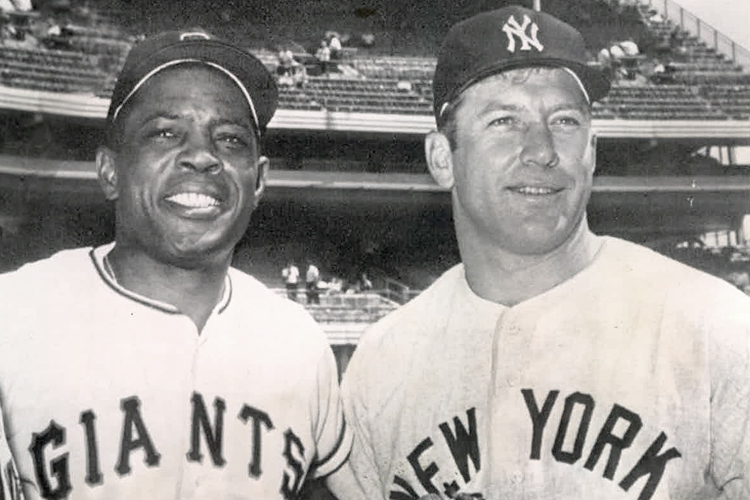
For many years during the 1950s and well into the 1960s, Willie Mays and Mickey Mantle were the best center fielders in their respective leagues, if not the two best players in baseball. Throughout the first halves of their careers, before Mays' Giants moved to San Francisco, they were frequently compared with Duke Snider, the talented center fielder of the Brooklyn Dodgers. Snider and Mays both departed New York after the 1957 season, and while Snider was never again the superstar he'd been in Brooklyn, Mays flourished on the West Coast. He and Mantle were widely regarded as the best all-around players in baseball, and upon retiring found themselves on the short list of not just the best center fielders of all time (along with Tris Speaker and Mantle's one-time teammate Joe DiMaggio), but the best players period.

There's no question as to which one was better. That would clearly be Mays, who many consider the best ballplayer not named Babe Ruth. He was just as good as if not better than Mantle in his prime and lasted longer, which explains his advantage of nearly 50 bWAR.

But for a long time, Mantle hung in there. Despite the injuries, his offensive numbers were on par with Mays's and because Mantle walked more, he was a significantly better hitter. Mays was a much better baserunner and fielder, but as a total package Mantle was very nearly his equal.

Here are their stats from 1951 through 1964:
Mays:    8,002 PA 1,379 R 453 HR 1,290 RBI .313/.388/.589 161 OPS+ 109 bWAR 78.8 WAA
Mantle: 7,979 PA 1,472 R 454 HR 1,298 RBI .309/.429/.582 177 OPS+ 97.8 bWAR 73.5 WAA

After 1964, however, Mantle could no longer keep up. The Mick faded fast, becoming a .250 hitter with 20-homer power over his final four seasons. Mays remained a superstar for several more years, copping his second MVP with 52 dingers in 1965 and putting together a nine-win season in '66. He continued to be a solidly above average player into the early '70s, several years after Mantle retired, before hanging up his spikes after the 1973 campaign.

Many, myself included, maintain that Mantle was actually a hair better than Mays before he broke down. Are they right? Let's take a closer look, going year-by-year to determine which one was better.

1951 Mays
Both had massive expectations place on them from the start and, as 19 year-olds usually do, hit rough patches early on in their rookie campaigns. Mays famously went 1-for-his-first-26 (albeit with a home run off Warren Spahn) and became so discouraged that Leo Durocher promised Mays would remain the starting center fielder for the rest of the season to revive his confidence. Mantle was demoted in mid-July to New York's minor league affiliate in Kansas City, where he remained for six weeks and nearly quit before his father talked some sense into him.

Both rebounded from their early slumps. Mays caught fire in June (1.041 OPS) and July (10 home runs) en route to winning the NL Rookie of the Year award and helping the Giants overtake the Dodgers in a wild pennant race. Mantle rejoined the Yankees in late August in time for the stretch run and hit well enough to reclaim his spot at the top of the order. As fate would have it, the dynamic duo met up in the World Series. The Bombers, in the midst of claiming five straight titles, prevailed despite a gruesome knee injury suffered by Mantle when he caught his spikes in an outfield drainage ditch trying to make a play on a fly ball, a fly ball hit by none other than Willie Mays.

Statistically, Mays outproduced Mantle in almost every offensive category. Granted, part of that was because Mays played 25 more games, but even so he outslashed Mantle in average, OBP, and slugging, producing an OPS 36 points higher than Mickey's .792 mark. Combined with his plus defense in center field (Mantle played the less challenging position of right field with DiMaggio still patrolling center), Willie was worth almost four wins above replacement, more than double Mantle's 1.5.
Mantle and Mays faced each other in two World Series. Mantle's Yankees won both (Bama Media)
1954 Mays
Following a two-year hiatus in the Army, Mays returned to baseball a full-blown superstar. He more than doubled his home run output from his rookie year, improved his OPS by 250 points and scored more than twice as many runs. Mays made his first All-Star team and was voted league MVP after leading the majors in batting (.345), slugging (.667), and bWAR (10.6) while also pacing the NL in triples, OPS, and OPS+. To top it all off, he led the Giants to a World Series victory over the heavily-favored Cleveland Indians, winners of 111 games during the regular season.

Mantle, who'd developed into a great player while Mays was gone, continued to improve in his fourth season. In addition to batting .300 for the second time and exceeding a .400 OBP and 100 RBI for the first, he set career highs in nearly every category and scored an ML-best 129 runs.  The Mick was tremendous, worth almost seven wins, but Mays was playing in a different stratosphere that year.

1955 Mays
Very, very close this time around. Both B-R and FanGraphs give Mantle the slight edge in WAR, rating him closer to 10 while pegging Mays at nine exactly, but frankly I can't see how. Mays was arguably better in his MVP encore, leading the majors with 13 triples, 51 homers, 382 total bases, a .659 slugging, and a 1.059 OPS. Mantle was outstanding in his own right, emerging as a true superstar by leading the AL in triples, big flies, OBP, slugging, and OPS, as well as both leagues in OPS+ and bWAR.

Mays definitely had the bigger offensive season, however, compensating for Mantle's 31 point advantage in OBP with 14 additional home runs, 28 more RBI and a slugging percentage some 48 points higher. Mays also stole three times as many bases as Mantle and was already regarded as the best center fielder in the game after making "The Catch" the previous October. Advantage: Mays.

1956 Mantle
'56 was Mantle's signature season, a gem of a campaign that saw him win the major league triple crown and pile up 11.3 bWAR in addition to leading baseball in runs, runs created, total bases, slugging percentage, OPS, OPS+, WAR, extra base hits, and times on base. When the dust settled, he'd led the Yankees to another World Series championship, won his first MVP award (unanimously), and endeared himself to a new generation of Yankee fans with a season comparable to the best of Babe Ruth, Lou Gehrig, and Joe DiMaggio. Mays, with 36 home runs, a major league leading 40 steals, and 7.6 bWAR, was also terrific, but Mantle was legendary.

1957 Mantle
In his final season in New York (before returning as a Met 15 years later), Mays won his first of 12 straight Gold Gloves. He also treated the fans to some impressive offensive statistics, slugging 35 home runs and a ML-leading 20 triples to go along with his 38 steals (also tops in the bigs) and a 1.033 OPS, good for the best OPS+ (173) in the National League. 

But Mantle, in some respects, had an even better year than his Triple Crown campaign. Not only did he bat a career-best .365 with a .512 OBP (fueled by 146 walks--most in the majors), but he also posted the highest OPS (1.177) and OPS+ (221) of his career. WAR says Mantle's '57 was every bit as valuable as the season that preceded it, and the voters agreed, giving him his second straight MVP trophy despite an otherworldly season by Ted Williams (.388/.526/.731 with 38 homers).
So with a three-bWAR edge over Mays, Mantle wins easily.

1958 Mantle
The Say Hey Kid's first season out west was a good one, as he batted .347/.419/.583 for a league-best 1.002 OPS and 165 OPS+. While his 29 homers were his fewest since his rookie season, he made up for it with personal bests in batting average and hits (208) as well as leading the majors in stolen bases again (with 31). His second season worth at least 10 bWAR was only good enough for second in the NL MVP race, however, as voters elected Ernie Banks (9.4 bWAR) and his prodigious power totals at shortstop.

Mantle fell back to earth a bit after his insane 1956 and 1957 seasons, but still clobbered a league-high 42 home runs, batted over .300, and worked more walks/scored more runs than anybody else in baseball. Despite batting 43 points lower than Mays, he still held significant advantages in OBP (24 points) and slugging (nine points), not to mention the best OPS+ in baseball at 188. That's why I'm giving the edge to him even though bWAR estimates Mays was worth about 1.5 more wins to his team. With Mantle clearly the better hitter and almost Mays' equal on the bases (he was a very efficient 18 for 21 in stolen base attempts), I'm not going to be swayed by unreliable defensive metrics.

1959 Mays
1959 was a major disappointment for Mantle and the Yankees, who finished only four games above .500 and failed to win the pennant for only the second time since Casey Stengel took over. The Mick suffered his worst season since 1953, hitting "only" 31 home runs with "only" 75 RBI. Those numbers would have been more palatable to Yankee fans had he not led the major leagues in whiffs with 126 (a career-high) and batted .285--his worst mark since his rookie season.
While '59 was a down year for Mickey, it was business as usual for Mays, who won another Gold Glove, slugged 34 home runs, drove in 104, and stole a league-high 27 bases in 31 attempts. Add it all up and Mays was worth over a full win more than Mantle, even though their offensive output was almost dead-even (Mays had a 156 OPS+ to Mantle's AL-best 151).
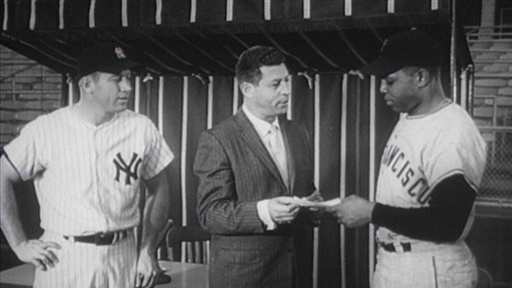
Mantle and Mays squared off in the first ever home run derby. Mantle won
1960 Mays
Offensively, Mays and Mantle were about dead-even in the first year of the '60s, with perhaps the slight edge going to Mantle. By this point, however, Mays was the much better fielder and baserunner, which means on the whole he was more valuable. This is bored out by bWAR, which puts Mays at 9.5--a full three wins better than Mantle's 6.3. Both players endured "down" years by their lofty standards, with Mays failing to reach 30 home runs for the second time in three years and Mantle batting .275 with a league-high 125 strikeouts. I'm nitpicking, of course, but I'm sure both players would tell you that 1960 wasn't their best.

1961 Mantle
Mays boosted his power numbers considerably in his second year at the 'Stick, generating his most home runs (40) and RBI (123) since his monster 1955 campaign and raising his slugging percentage nearly 30 points.

Even with the power spike, he still fell well short of Mantle, who along with teammate Roger Maris challenged Babe Ruth's hallowed single-season home run record. Mantle fell short at 54, but still led the majors in walks (126), slugging (.687) and bWAR (10.5). So feared was the Mick that Maris, despite launching 61 homers himself, did not receive a single intentional walk in 1961, for he spent most of the season batting in front of Mantle.

1962 Mays
Mantle may have won his third MVP but Mays eclipsed him in almost every category. Mantle had the superior rate stats, batting an obscene .321/.486/.605 (195 OPS+), but he also missed roughly a quarter of the season, which limited his value to about six wins. Mays, on the other hand, played 162 of a possible 165 regular season games, racking up personal bests in runs (130), RBI (141), and total bases (382) as well as 49 home runs--most in the majors. Mays was worth an incredible 10.5 bWAR that year, and yet somehow did not win MVP (voters gave it to Maury Wills, who shattered Ty Cobb's single season stolen base record that year).

Mantle got the best of Mays in that year's Fall Classic, which featured the Yankees and Giants in a rematch of the 1951 Series. New York won in seven despite Mantle's mediocre .120/.241/.160 performance. Perhaps the Giants would have won--they lost Game 7 by one run, had Mays done more than bat .250/.276/.321 with zero home runs and one RBI.

1963 Mays
Mantle seriously injured himself, missing almost 100 games after breaking his foot in a nasty collision with a chain-link fence. He was terrific when he did play, replicating his 1962 production, but Mays stayed healthy so there was no discussion.

1964 Mays
'64 was Mantle's last great season, yielding 35 homer runs and 111 RBI as well as the best OBP (.423), OPS (1.015) and adjusted OPS (177) in baseball. But Mays was right there with him, knocking in the same number of runs, socking 12 more home runs, leading the major leagues in slugging percentage at .607 and posting the NL's best raw (.990) and adjusted (172) OPS. Mays was much better in the field and on the bases at this point as well, with 19 steals to Mantle's six and Gold Glove defense in center compared to Mantle's abysmal defense. All said, Mays was worth more than twice as many bWAR (11.1) as Mantle (4.8), making him the obvious choice here.

After 1964, Mays vs. Mantle was no longer a debate. Age, injuries, and alcohol pushed Mantle over the cliff, as he batted just .254 over his final four seasons while averaging just 20 home runs and 53 RBI per season. Mays took much better care of himself, and thus aged more gracefully, winning his second MVP in 1965 and compiling almost 31 bWAR from 1964-1968. Their teams endured similar fates, as the Yankees plummeted to the second division while the Giants remained one of the best teams in baseball.

One can only wonder how Mantle's closing act would have played out had he stayed healthy and avoided the bottle. Based on how close the above comparisons are, I can't imagine it would have been much different from Mays.

Saturday, January 3, 2015

Questionable Rookies of the Year: 1950s

Minoso was always tragically underrated (Grab Some Bench)
1951 AL Gil McDougald over Minnie Minoso
McDougald had an outstanding season for the Bronx Bombers, helping them win their third straight championship by hitting .306/.396/.488 with 14 homers, 14 steals, and 4.6 bWAR. Minoso was even better, however, batting .326/.422/.500 with 112 runs and 5.5 bWAR. Minoso also led the majors in triples with 14 and the American League in steals with 31. The BBWAA correctly recognized Minoso as the more valuable player, for he finished fourth in the MVP voting to McDougald's ninth, so I'm not sure what happened with the ROY vote. Most likely, McDougald benefited from Yankee bias (Minoso was traded from Cleveland to Chicago) and perhaps even racism (Minoso was a black Latin-American star).

1953 NL Jim Gilliam over Harvey Haddix
Big screw-up here, as Gilliam wasn't even worth four bWAR whereas Haddix had over seven. Make no mistake, Gilliam had a phenomenal season in which he scored 125 runs, drew 100 walks, and led the major leagues in triples all while playing second base, but Haddix had the superior season. Aside from winning 20 games, the St. Louis southpaw maintained a 3.06 ERA (139 ERA+) and 1.14 WHIP over 253 innings. He also paced the National League in shutouts with six. Again, the BBWAA identified Haddix as the more valuable player by giving him MVP consideration (Gilliam got none, but probably deserved some) but screwed up in the Rookie of the Year vote. Gilliam undoubtedly benefited from his role on a thoroughly dominant 105-win Dodgers team, whereas Haddix toiled for a more mediocre 83-win Cardinals outfit.

1956 AL Luis Aparicio over Rocky Colavito
Colavito's OPS was 250 points higher than Aparicio's, and he hit seven times as many home runs. While it's true that Aparicio was an everyday shortstop (and a good one at that) who led the league in steals, Colavito was still the more valuable player per bWAR despite playing 49 fewer games and manning right field. My guess is that Aparicio made an impression on voters with his flashy defense and speed--a rarity in the largely white 1950s American League.

1957 AL Tony Kubek over Frank Malzone
Another example of Yankee bias as Kubek beat out a more-deserving Red Sox player. Kubek was a good utilityman who played five different positions and delivered league-average offense, but Malzone played a sterling third base (winning his first of three straight Gold Gloves) while posting much better batting statistics. Malzone's OPS was 35 points higher, for instance, even though he had 203 more official at-bats. Sure enough, Malzone made a serious dent in MVP voting, finishing seventh, while Kubek hardly get any support and finished a distant 26th.

1958 AL Albie Pearson over everyone else
Pearson had a pretty pedestrian season for an outfielder, hitting .275/.354/.358 with little power (three home runs) and speed (seven steals). He did walk more than twice as often as he struck out, but that's really the only good thing one can say about Pearson's rookie campaign (which resulted in 0.9 bWAR). Third-place Gary Bell (2.9 bWAR) had a much stronger season, delivering a 3.31 ERA (112 ERA+) and 1.18 WHIP over 182 rock solid innings. Pearson was barely an average outfielder whereas Bell was clearly an above average starting pitcher, and I don't see how the voters missed that.

Sunday, June 29, 2014

M&M Boys: Mantle and Mathews

Mathews, Mantle and Aaron pose for a picture in spring training
Throughout the 1950s and into the 60s, Eddie Mathews was essentially a poor man's Mickey Mantle. By this I mean no disrespect to Mathews, easily one of the five greatest third baseman of all-time and a most-deserving Hall of Famer. If you're going to be a poor man's version of somebody, after all, you couldn't do much better than The Mick.

It's fascinating how much their personal lives and baseball careers overlapped. They were born one week apart in October, 1931 in the rural Midwest, with Mathews hailing from Texas and Mantle a progeny of Oklahoma. Both signed as amateur free agents in 1949 and played their first full season in 1952 with similar results; Mantle had 23 home runs in 142 games, Mathews slugged 25 in 145, and both drew MVP votes despite leading their respective leagues in strikeouts.

Thus marked the beginning of two outstanding careers that lasted until 1968, when both posted the worst batting averages of their careers and promptly retired, clearly done. But not before they hit milestone homers in that Year of the Pitcher, with Mantle taking Denny McLain deep to pass Jimmie Foxx and Mathews, by then a teammate of McLain's eclipsing Mel Ott with the last home run he'd ever it.

In between they didn't see a whole lot of each other, as they played in different leagues during a time when AL and NL players met twice a year; in the Midsummer Classic and the Fall Classic. They were All-Stars in the same year nine times and crossed paths in two World Series--in 1957 and again the following year. Milwaukee won their first meeting but New York took the rematch, with both series going the full seven. Mathews played better in the first one, Mantle fared better in the second.

In the end, Mantle was clearly the better player and enjoyed the superior career, but some of their numbers look remarkably similar:

Mantle: 2,401 G 2,415 H 344 2B 72 3B 536 HR 1,509 RBI 4,511 TB 109.7 bWAR
Mathews: 2,391 G 2,315 H 354 2B 72 3B 512 HR 1,453 RBI 4,349 TB 96.4 bWAR

They were both patient power hitters who drew their fare share of walks and weren't afraid to strike out. They both established themselves as great young players and peaked early on, but by the same token crashed and burned rather prematurely in their mid-thirties. They ended up as one of the five best to play their respective positions, even if their walk-drawing and run-scoring skills wouldn't get the credit they deserved for many years. Mantle wasn't fully appreciated until Roger Maris arrived midway through his career and took most of the heat off him, and Mathews remains criminally underrated to this day.

Off the field, they both led difficult lives and drank too much, which may have led to their somewhat early demise as players and as men (neither one played past 36 or lived to 70).They were ultimately tragic figures then, exceptional players but flawed human beings with a whiff of unfulfilled potential. The Commerce Comet was frequently criticized for not living up to his great Yankee predecessors of Babe Ruth, Lou Gehrig, and Joe DiMaggio, while it was Mathews' fate to be overshadowed by teammate Henry Aaron.

Not surprisingly, Mathews is rated as Mantle's closest comp on Baseball-Reference. Mantle is the fourth-best match for Mathews, following Mike Schmidt, Ernie Banks, and Willie McCovey. Pretty good company.

With so many similarities, it's easy to see why:
  • Both had four seasons with at least 40 home runs (Mantle topped 50 twice) and 14 with at least 20. Mathews had 10 seasons with more than 30 bombs, one more than Mantle's nine. 
  • Because they walked so much, neither one knocked in as many runs as one would expect given their huge power totals. Mantle exceeded 100 RBI four times, while Mathews did so five times. Each managed five additional seasons in which they plated more than 90 (but less than 100). Additionally, Mathews' career high of 135 barely exceed's Mantle's personal best of 130.
  • Because they walked so much, both scored tons of runs. Mantle had 11 straight seasons with at least 90 runs, including nine with over 100. Mathews had 10 consecutive seasons with 90 or more runs, including eight with at least 100. 
  • Both struck out a lot. Mantle led the league in the dubious K statistic five times, something Mathews did in 1952, when both led their respective leagues, with Mathews' 115 edging Mantle's 111 for the ML-lead. 
  • Both finished their careers with near 1:1 strikeout to walk ratios. Mantle walked 23 more times than he whiffed for a 1.01 BB/K ratio, while Mathews fanned 43 more times than he walked and thus had a 0.97 BB/K ratio.
  • Neither one hit a lot of doubles. Each had only one season with more than 30.
  • Mantle was caught stealing 38 times, one fewer than Mathews.
  • Mathews bounced into 123 doubles plays, Mantle 113. Both had more than 10 in a season only three times, and never bounced into more than 11.
  • Mathews had six seasons with at least 300 total bases, one more than Mantle's five.
  • Mantle was intentionally walked 126 times, but Mathews wasn't far behind at 107. Both were clearly feared by opposing pitchers and managers.
  • They were both All-Stars in 1953, then every year from 1955 through 1962

Thursday, February 6, 2014

RIP Ralph Kiner

Even in a brief career, Kiner was one of the best power hitters of all-time
Ralph Kiner, the Hall of Fame slugger and longtime broadcaster, died today. He was 91.

Though Kiner's playing career spanned only ten seasons (1946-1955) because military service delayed its start and a bad back cut it short, he left his mark as one of the greatest sluggers the game has ever seen. During that time he was the fifth most valuable player in baseball behind Stan Musial, Ted Williams, Jackie Robinson, and Pee Wee Reese--all Hall of Famers. Kiner was the top home run hitter during that period, outhomering the next closest guy (Musial) by 80. Kiner was also third in runs scored and third in RBI despite playing on poor teams for much of his career (only twice was he on a winning ballclub). In that time-frame only Ted Williams walked more.

Hell, Kiner averaged 37 home runs, 101 RBI, 97 runs and 101 walks per season for his career. Not many players can say that.

Kiner's prodigious power was evident from the start. He smacked 23 home runs as a 23 year-old rookie in 1946, enough to lead the National League and start a record streak of seven straight home run titles. He also led the league in AB/HR ratio, something he would do seven times in a row as well.

But Kiner was not a finished product when he arrived in the Show. He showed good plate discipline by walking 74 times, but like most rookies he had trouble making consistent contact, an issue reflected in his low batting average (.247, almost 20 points below the league average of .266) and high strikeout total. In fact, his 109 whiffs were far and away the most in the Senior Circuit that year--nobody else had more than 86. Kiner was blessed with raw power, but he needed to polish his skills to become not just a slugger, but a hitter.

Under the tutelage of teammate and future Hall of Famer Hank Greenberg, Kiner honed his craft and emerged as one of baseball's most dominant offensive forces in 1947. He walked 17 more times (98) than he struck out (81) and his batting line jumped to .313/.417/.639, giving him the highest slugging percentage in baseball as well as the league's best OPS (1.055) and OPS+ (173).

But what made Kiner special was the long ball. Learning from Greenberg, a four-time home run champion who hit as many as 58 in a single season, helped Kiner reach his full power potential. He cleared the fences 51 times in 1947 to share the major league lead with Johnny Mize and rack up 361 total bases--most in the bigs. Kiner crushed 28 of those home runs at home--Forbes Field--where he was aided by a short left field porch. Originally dubbed "Greenberg Gardens" by the press, it was quickly renamed "Kiner's Korner" after Greenberg retired following his one year stint with the Pirates. Two decades later, Kiner's postgame show would be named that as well.

With the help of Forbes Field's friendly confines, Kiner was baseball's top home run hitter in each of the next five seasons:

1948: 40 HR, 31/9 Home/Road
1949: 54 HR, 29/25 Home/Road
1950: 47 HR, 27/20 Home/Road
1951: 42 HR, 26/16 Home/Road
1952: 37 HR, 22/15 Home/Road

His string of six straight major league home run crowns is a record, even if he did share a tie in three of those years (with Mize in the first two and Hank Sauer in the last). His five consecutive seasons with at least 40 home runs, equaled by Duke Snider from 1953-1957, stood as a National League record until 2003, when Sammy Sosa reached 40 homers for the sixth straight season.

In 1953 Kiner got off to a slow start, and on June 4th he was traded along with three other players to the Chicago Cubs for six players and $150,000 ($1.3 million in today's money). Pittsburgh's GM at the time, Branch Rickey, reportedly told Kiner that the Pirates, who had lost 112 games and finished last the year before, would have no problem finishing last without him.

That seemed to light a fire under Kiner. He socked 28 home runs over the season's final four months and reached his usual benchmarks--100 walks, 100 runs, and 116 RBI, all for the last time. He was also named to the All-Star team for the sixth and final time. But for the first time since World War II the National League had a new home run king. It was Eddie Mathews of the Milwaukee Braves, who bashed 47 home runs in his sophomore season at the tender age of 21. Six players (including Mathews) outdid Kiner's total of 35 that year, marking the end of his home run reign. He swatted just 22 the next year and tailed off to 18 with Cleveland in an injury-plagued 1955.

Though he was just 32 years old at season's end, Kiner called it quits. His home run totals had declined every year since 1949 and he'd played a career-low 113 games in '55, easily the worst season of his career. When Kiner retired, his 369 home runs ranked sixth all-time. His 14.1 AB/HR ratio was second only to Babe Ruth. Even now, it's still the sixth best mark of all-time, trailing only Mark McGwire, Ruth, Barry Bonds, Jim Thome, and Ryan Howard.

Because Kiner's brilliance was short-lived, it took him a while to get elected into the Hall of Fame. He wasn't inducted until his final year of eligibility in 1975, 20 years after his final game. Kiner barely made it in too, receiving just one more vote than he needed to clear the 75 percent threshold. Writers were probably reluctant to vote him in right away because of his low counting numbers, unimpressive batting average (.279) and zero MVP awards and World Series appearances. His poor defense in left field and lackluster baserunning didn't help his case much, either, but in the end his magnificent peak was deemed spectacular enough to merit a plaque in Cooperstown.

After his playing days were over, Kiner became a broadcaster for the Chicago White Sox in 1961. Chicago wasn't half bad that year: they won 86 games with a roster that featured notables such as Luis Aparicio, Nellie Fox, Minnie Minoso, Roy Sievers, and Al Smith, plus Billy Pierce and Early Wynn in the rotation. But the White Sox finished a staggering 23 games behind the New York Yankees, who of course had Roger Maris and Mickey Mantle chasing Babe Ruth's home run record that summer, plus a stellar supporting cast of Elston Howard, Yogi Berra, and Whitey Ford.

The following season Kiner, along with Lindsey Nelson and Bob Murphy, began broadcasting games for the New York Mets, then in their inaugural season. The Mets were terrible in their early years, losing 120 in their MLB debut and exceeding 100 losses four times in the five years after that. That's what made their 100-win season and World Series championship in 1969 so unexpected, so miraculous. Just the year before, they'd dropped 89 games and finished second to last in the National League. Kiner helped call the '69 Fall Classic, which saw the Mets upset a powerhouse Baltimore Orioles team in five games.

Kiner continued calling Mets games for the rest of his life* even as Bell's palsy affected his speech. He was inducted into the organization's Hall of Fame in 1984 for his work behind the microphone and was honored with Ralph Kiner Night at Shea Stadium in 2007. In 2013, his final season, he was the oldest active announcer in the major leagues, and only Vin Scully and Jaime Jarrin were more tenured.

*Fittingly enough, the Mets were horrible at the beginning of his announcing career and bad at the end. They've endured five straight losing seasons and haven't won a World Series since 1986, which only happened because Calvin Schiraldi couldn't put them away in Game 6.

Kiner spent 53 years in the booth in all, captivating fans with his trademark home run call and by occasionally mispronouncing people's names. But his signature quote came from his playing days, when he declared that "home run hitters drive Cadillacs and singles hitters drive Fords."

Based on Kiner's track record, I'd say he was born to drive Cadillacs.

Thursday, January 2, 2014

Questionable Cy Youngs: 1956-1959

The first Cy Young award wasn't presented until 1956, and even then there was only one awarded for both leagues. Here I argue who should have been the lone winner, and pick who should (would?) have won in the other league as well:

1956 Don Newcombe over Herb Score
In an MVP-winning performance, Newcombe also took home baseball's first-ever Cy Young award on the strength of his 27-7 record, which gave him the most wins and best winning percentage in baseball. But the real Cy Young pitched in the American League, and didn't even make the ballot. Young Herb Score, just 23 and coming off his sensational rookie campaign, led all of baseball in strikeouts, adjusted ERA, H/9 and K/9. Score also led the league in shutouts and ranked second in wins (20), winning percentage, raw ERA (2.53, more than half a run better than Newk's 3.06), and pitching WAR with 7.3. He pitched nearly 250 innings, almost as many as Newcombe's 268, so there's really no viable argument for Newcombe over Score. Unfortunately, Score was struck by a line drive off the bat of Gil McDougald the following spring and was never the same.

NL-Newcombe
AL-Score

1957 Warren Spahn--no argument
NL-Spahn
AL-Jim Bunning

1958 Bob Turley over everyone else
Turley wasn't even the best pitcher on his own team, let alone all of baseball. Rotationmate Whitey Ford was the major league ERA champion with his microscopic 2.01 mark, which translated to baseball's best ERA+ (177) as well. He also led the majors in shutouts (7) and WHIP (1.08), but somehow failed to even crack the ballot. He was probably hurt by the fact that Casey Stengel only started him 29 times, which limited Slick to "just" 219.1 innings. Warren Spahn, Lew Burdette, and Bob Friend, the three men who finished behind Turley, all threw at least 274. Even so, bWAR rates Ford more valuable than all of them.

NL-Sam Jones
AL-Ford

1959 Early Wynn over Sam Jones
Wynn won an ML-best 22 games and pitched the most innings in the American League (255.2) with a 3.17 ERA, but somehow that wasn't even worth three wins above replacement. Teammate Bob Shaw, who pitched 25 fewer innings but did so with a 2.69 ERA, was worth nearly five bWAR but finished third, even though he had a better case. Not as good as San Francisco's Sam Jones, the runner-up, who led the Senior Circuit with 21 wins, a 2.83 ERA and four shutouts. He also threw 270.2 innings, fourth most in baseball, and struck out 209 batters, second only to Don Drysdale.

NL-Sam Jones
AL-Hoyt Wilhelm

Sunday, February 10, 2013

Best Pitching Season of the 1950s

Robin Roberts 1953 (9.4 bWAR)

To this day, Roberts remains one of the most underrated and underappreciated pitchers in baseball history. He wasn't a first-ballot Hall of Famer and he wasn't selected to baseball's All-Century Team. His name rarely comes up in the discussion of greatest hurlers, even when that list is narrowed down to men who pitched exclusively after Jackie Robinson busted through the color barrier in 1947.

So why doesn't Roberts, who won 20 games in six (almost seven) straight years, made seven consecutive All-Star teams and started five of them, get the credit he deserves? I have a few theories:
  1. Roberts never won a World Series, mainly because the Philadelphia Phillies were a second division team for most of his time there (through no fault of his own). Good players on bad teams are always doomed to be underrated. When the Phils beat the Brooklyn Dodgers on the final day of the 1950 season to clinch their first NL pennant in 35 years, the Whiz Kids were swept by the Bronx Bombers of Joe DiMaggio, Yogi Berra, and Whitey Ford.
  2. He failed to win 300 games, but came awfully close. Tommy John and Bert Blyleven are the only pitchers to eclipse his 286 career wins without reaching 300. If Roberts played for better teams, or had even just one more good season, he would have passed the threshold with ease.
  3. Roberts was not a big strikeout pitcher the way Bob Feller, Sandy Koufax, and Nolan Ryan were. Despite twice leading the majors in punchouts, he did not blow hitters away. In fact, he struck out one batter for every two innings he pitched. Roberts was more of a control pitcher who succeeded by keeping the ball in the strike zone/limiting his walks, as evidenced by his career 1.7 BB/9 ratio.
  4. Roberts never threw a no-hitter, much less a perfect game, though he did toss a one-hitter on May 13th, 1954 against the Cincinnati Reds.
  5. His massive workloads caught up with him and led to premature decline. Over the final ten years of his career, Roberts lost more games than he won and compiled a 102 ERA+. When the 1960s rolled around he was washed up, reduced to mere afterthought as the sport became dominated by elite pitchers such as Koufax, Bob Gibson, Don Drysdale and Juan Marichal.
  6. Roberts never won an MVP despite accumulating 1.93 award shares and never won a Cy Young, though he probably could have taken one or two if the award had been invented five years earlier.
  7. Despite playing in an era that produced gems such as "The Say Hey Kid" (Willie Mays), "The Commerce Comet" (Mickey Mantle) and "The Duke of Flatbush" (Duke Snider), Roberts never received a nickname from the Philadelphia faithful.
  8. Roberts did his best work 60 years ago, long before many baseball fans were even born. Most Baby Boomers were still in diapers when he was at his peak.
  9. Roberts did not have much of a personality. He wasn't quotable like Berra, arrogant like Ted Williams or a scrappy fighter like Billy Martin. Instead, he was quiet and more reserved like Musial and DiMaggio. He lets his performance speak for itself.
None of that changes the fact that Roberts was quite possibly the best pitcher of the 1950s, especially during the first half of the decade when he was at the top of his game.

Fresh off a dominant 1952 in which he won 28 games and finished runner-up to Hank Sauer in that year's headscratching MVP results, Roberts was even better in '53. The 26 year-old won two legs of the pitching Triple Crown by leading the majors with 23 wins and 198 strikeouts, but settled for second in ERA with his 2.75 mark. He also posted the lowest walk rate and highest K/BB ratio in the bigs.  More impressively, Roberts completed 33 of his 41 starts (both ML-leading totals) on his way to totaling 346 and two-thirds innings pitched, 60 more than any other major league pitcher (Bob Lemon).

Roberts finished sixth in the MVP race but did receive one first-place vote, which was more than either Stan Musial or Jackie Robinson could say that year. Had there been a Cy Young award that year he probably would have won it. Then again, he may have lost out to Warren Spahn, who won 23 games as well but with the best ERA (2.10) and WHIP (1.06) in baseball.

  • Opponents batted .244/.278/.348 against Roberts but tagged him for 30 home runs that year, starting a streak of eight straight seasons in which he served up at least that many gopher balls
  • Was much better facing righties than lefties. Southpaws posted a .783 OPS against him, nearly 200 points higher than the .584 righthanded batters managed against him
  • Was also much better at home, where his 2.18 ERA was over a full run better than it was everywhere else 
  • Average GameScore was 61
  • The Phillies were 26-17 (.605) when Roberts pitched, 57-54 (.514) when he didn't 
  • Roberts completed his first 20 starts of the season, going 13-6-1 with the one tie coming in a rain-shortened game against Stan Musial's St. Louis Cardinals. In the final game of the streak, he fired ten shutout innings against the hapless Pittsburgh Pirates
  • Started the Midsummer Classic and blanked the Junior Circuit in three innings, holding them to just one hit (a Gus Zernial single) while fanning two (Hank Bauer and Billy Pierce)
  • Saved two nine-inning games in the span of five days in August. Nowadays, it's unheard of for starting pitchers to come out of the bullpen unless the game goes deep into extra innings. Can you imagine Jim Leyland calling on Justin Verlander to close out a ballgame twice in the same week?
  • Pitch totals for this season are incomplete, but records show he threw 159 pitches at Ebbetts Field in a 7-6 loss on May 9th. Two months later, in another start in Brooklyn, he ran the pitch count up to 151 in an extra-inning loss. The Dodgers won 105 games that year on the back of the major league's most prolific offense, a run-scoring machine that featured NL MVP Roy Campanella, Snider, Robinson, Gil Hodges, Pee Wee Reese, NL Rookie of the Year Jim Gilliam, and NL batting champ Carl Furillo
  • Roberts was a model of consistency for most of the season but faltered at the finish line when he endured a September swoon. Check out his monthly ERA splits and guess which one does not belong
        April--2.63 ERA
        May--2.35 ERA
        June--2.40 ERA
        July--2.41 ERA
        August--2.45 ERA
        September--4.56 ERA
  • Last but not least, here's his earned run breakdown
        0 runs--5 starts
        1 run--11 starts
        2 runs--7 starts
        3 runs--4 starts
        4 runs--5 starts
        5+ runs--12 starts


Best offensive season of the 1950s--Mickey Mantle (1956)

Tuesday, January 22, 2013

The Man

Stan "The Man" Musial was one of the ten best baseball players of all time, the National League's answer to Ted Williams during the 1940s and '50s. While Musial falls short of Williams as a hitter (everyone does), he was unquestionably a superior outfielder and baserunner, not to mention much kinder to St. Lo's fans and press.

Even so, Musial's career lacked the flair of his peers. He didn't make dazzling catches like Willie Mays or hit tape-measure home runs like Mickey Mantle or steal home like Jackie Robinson. He consistently hit for high averages, but never batted .400 like Williams. He swatted 475 home runs, but never topped 40 in any season or led the league in that department. He piled up 3,630 base hits, but couldn't challenge Joe DiMaggio's magical 56-game run.  His teams won three World Series, but he did not shine in the postseason the way October legends Mantle and Reggie Jackson did. Musial batted just .256/.347/.395 with one home run in his 23 Series games. He didn't have a cool nickname like "Joltin' Joe," the "Say Hey Kid" or the "Splendid Splinter."

He was simply "The Man."

It stuck because it fit; his body of work was defined by quiet, sustained excellence. As Joe Posnanski points out, he led the league in something pretty much every year. He showed up to work everyday, played hard, and gave opposing pitchers fits. He aged well, remaining productive to the very end even though his last five seasons represented a considerable drop-off from the 17 eye-popping years that preceded them.

But whereas most players remembered for their consistency (Eddie Murray, Hank Aaron, Fred McGriff) never put together that signature, standout year that jumps off the page, Musial's 1948 remains one of the greatest offensive performances a player ever had. His 10.8 bWAR led the majors that year, as did his 230 base hits, 46 doubles, 18 triples, .376 batting average, .702 slugging percentage, 1.152 OPS, 200 OPS+, 103 extra base hits, and 429 total bases (!), still the record for the integrated era. Musial received a midseason pay-raise for his outstanding performance, something that was virtually unheard of in an era when most players fought tooth and nail for every cent they earned. He recorded his 1,000th career hit in April. He crushed a two-run homer in the All-Star Game. He had five hits in a game on four separate occasions.

He was, in a word, unstoppable.

Musial breezed to his third MVP award, becoming the first National Leaguer to collect a trio of said trophies (Roy Campanella, Mike Schmidt, Barry Bonds, and Albert Pujols later joined him). Somehow, he did not win the award unanimously. Johnny Sain received five first place votes for helping lead the Boston Braves to the NL pennant and Sain's teammate, Al Dark, snagged one for his Rookie of the Year campaign.

Musial fell one home run shy of winning the Triple Crown that year. His 39 dingers placed third behind Johnny Mize and Ralph Kiner, who tied for the league lead with 40. Musial would have made it a three-way tie were it not for a rainout erasing one longball from his ledger.

Here are some more fascinating figures:
  • Made 24 consecutive All-Star teams. 
  • Of Musial's 3,630 hits, he pounded out 1,815 at home and 1,815 on the road
  • Musial claimed seven batting titles and finished in the top five ten other times. Only Ty Cobb, Tony Gwynn, and Honus Wagner won more batting crowns
  • The Man was not made of Iron like Cal Ripken Jr. and Lou Gehrig, but he was extremely durable nevertheless. He averaged 153 games played from 1943-to-1956 and led the league in the category five times
  • The writers loved Musial. He received three MVP awards and totaled 6.96 award shares. Barry Bonds (9.30) was the only player to garner more MVP consideration, though Albert Pujols (6.90) is poised to pass Musial soon
  • One truly remarkable stat is that of Musial's 12,717 plate appearances, only 696 ended with strike three. He didn't exceed 40 strike outs in any season prior to his forties
  • Ranks second all-time in total bases and MVP shares, third in doubles, runs created, and extra base hits, and fourth in hits
  • Was fortunate that he only lost one season to World War II. Hank Greenberg and Bob Feller missed nearly four full years.
  • Never won the traditional Triple Crown, but won a pair of sabermetric Triple Crowns by leading the league in the triple slash stats in 1943 and 1948
  • Upon retirement in 1963, Musial held or shared 17 major league records, 29 National League records and 9 All-Star Game records. He was the first player to appear in 1,000 games at two different positions, recording 1,896 in the outfield and 1,016 at first base
  • Made it into the Hall of fame on the first ballot in 1969 (Roy Campanella was also inducted that year) with 93.3 percent of the vote. 23 members of the BBWAA did not believe his career was Cooperstown worthy
  • My personal favorite: Stan Musial was never ejected from a game. Earl Weaver, who I just wrote about, was given the hook at least 91 times

Saturday, April 21, 2012

MLB All Decade Team 1950s

C Yogi Berra Much more consistent than Roy Campanella, who was an every other year player to the extreme
1B Gil Hodges You could make a case for Ted Kluszewski as well
2B Nellie Fox I hate to leave out Jackie Robinson, but he was done after '54
3B Eddie Mathews
SS Ernie Banks
OF Willie Mays
OF Mickey Mantle
OF Duke Snider Hate leaving out Ted Williams
U Stan Musial Stan the Man was an outfielder during the first half of the decade, then moved over to first base full time
RHP Robin Roberts Edges out Early Wynn
LHP Warren Spahn Over Whitey Ford

Sunday, March 18, 2012

Best Offensive Baseball Season of the 1950s

Like Barry Bonds in the 2000s edition of this series, there was no debate over who the player would be.  Instead, the only question was which year, and even that wasn't a difficult choice.

1956 Mickey Mantle (12.9 bWAR)

Mantle was already a household name and a top player by '56, the year his production finally satisfied the lofty expectations that had burdened him since his rookie season five years earlier.  His career had been following a smooth upward trajectory, bearing an eery resemblance to Ken Griffey Jr.'s early seasons.  Even though he put up big numbers in '55, there was a gnawing suspicion that Yankee fans still hadn't seen the best of this kid, the one who was supposed to be on par with Babe Ruth, Lou Gehrig, and his predecessor in center, Joe DiMaggio.   Although he was only 24 years old, he was a very accomplished player; he had already played in four World Series (three of them against Snider's Dodgers), winning three of them, had made four straight All-Star squads, and earned a pair of top-five MVP finishes (getting robbed the previous year, when voters inexplicbly preferred teammate Yogi Berra over Mantle's 9.5 bWAR).

At the time he was locked in a three-way battle with Willie Mays and Duke Snider for the title of best centerfielder in the city, but in '56 he was able to separate himself from the pack. After doubling his salary from the year before, Muscles sprinted out of the gate by blasting a pair of home runs on Opening Day, putting up enormous numbers in May and holding his average above .400 into early June. He was keeping up with Ruth's record-setting home run pace for much of the season, entering September with 47 home runs.  Unfortunately Mickey slumped down the stretch; the season's final month was his worst by far and he managed to clear the fences just five more times.  Five years later he would challenge the Babe once again, teaming up with Roger Maris in a mesmerizing home run chase that wouldn't be replicated until the Mark McGwire/Sammy Sosa race at the end of the century.  The Mick would finish with 54 four-baggers (a career high) after a hip infection knocked him out of the race late in the season, leaving Maris to ultimately rewrite the record books.

Mantle won the major league triple crown after his "favorite summer," leading the Show with 52 home runs, 130 RBI and a .353 batting average (nobody in the Junior Circuit came within 20 of his home run total, but he didn't shake Ted Williams in batting average until the final week of the season and Al Kaline finished with just two fewer RBI). His 132 runs, .705 slugging percentage, 1.169 OPS, 210 OPS+ and 376 total bases also ranked first among all big leaguers.  The Commerce Comet set career highs in almost every category and helped lead the Bombers to 97 wins and another World Series flag.  He slugged three home runs against their crosstown rivals, the Brooklyn Dodgers, in a rematch of the previous year's Fall Classic (when the Boys of Summer finally got the best of their American League nemesis).  In the offseason he captured his first MVP award, and did so unanimously by receiving all 24 first place votes. He also received the Hickok Belt as the top professional athlete of the year, was recognized as Associated Press Male Athlete of the Year  and was named ML Player of the Year by Sporting News. On the strength of this monster year, Mantle nearly doubled his salary for the 1957 season.

Some more stats from Mantle's banner year:

-Also led the American League in bWAR, extra base hits, runs created, adjusted batting runs, adjusted batting wins, times on base, and offensive win percentage
-The switch hitter batted .342/.459/.737 from the left side, .375/.474/.642 from his natural right side
-He didn't ground into any double plays in May and June, and bounced into just four all year long (one in each month except for May and June), a match of his 1955 total.  He did not hit into any twin-killings at home that season.
-Batted an otherworldly .444/.582/.861 with runners in scoring position.  With runners in scoring position and two outs, his batting average was an even .500.  It was no surprise, then, that all six of his intentional walks came with men in scoring position
-His BABiP (.353) matched his batting average
-Stole ten bases, marking the first time in his career he cracked double digits.  He was caught stealing just one time, and went on to swipe at least a dozen bases in each of the following five seasons
-Inflicted the majority of his damage in May and August, when he socked a combined 29 home runs and piled up 88 of his 188 hits.