Thursday, December 31, 2015

16 to Watch in 2016

All eyes will be on Big Papi next year (Monstah Mash)
With 2016 just around the corner, here are 16 players you should be watching next year:

In his final season and still one of the best hitters in baseball, Big Papi should give us a victory lap to remember.

How will the 34 year-old Cardinals ace hold up after missing most of last season with an Achilles injury? He only pitched out of the bullpen after coming back late last year, but St. Louis is counting on him to be a frontline starter.

Rodriguez returned from a year-long suspension to post one of his best seasons in years, He dropped off sharply in the second half, batting just .191/.300/.377 after August 1st, causing doubt as to whether he can repeat that performance at age 40. Health permitting, however, he should become the fourth player to surpass 700 long balls.

Can't wait to see what the A-Rod clone (Mariners version) does in his first full season. He's only 21.

Will Wrigley Field help him realize his power potential? Probably not, but perhaps a second 20-homer season (and his first since 2012) is in the cards.

One of the game's premier talents with Milwaukee the last few years, Gomez was an absolute disaster after getting traded to Houston last summer. 2016 is a contract year for the 30 year-old, so expect him to right the ship.

We know he can play a mean center field, but we still don't know if he can hit major league pitching. JBJ is entering his fourth season and turns 26 in April, so he's running out of chances to prove himself.

How will going from from one of baseball's pitching-friendliest venues to one of its hitting-friendliest affect the 32 year-old? Let's just say I don't see any more Cy Youngs in his future.

As great as Bryant was last year, he didn't come close to touching his 40-homer ceiling. We'll see what adjustments he makes as a sophomore, or if his strikeout problem (199 K's last year--most in the NL) drags him down some.

Pederson had a terrific first half but fell apart after the All-Star break. Did the league figure him out, or was it merely pitchers adjusting to the talented rookie? The Dodgers are hoping for more consistency from their 24 year-old center fielder in 2016.

Still waiting to see what the former AL Rookie of the Year can do in a full schedule, as he has averaged just 78 games per year over his first three. Now 25, he should be entering his prime.

You're not not going to watch Bryce Harper.

Just a few years ago he looked like the next Mike Trout, but his injury-married 2015 marked a huge step back for him. His Hanley Ramirez-esque attitude problems are a huge issue, but that can be overlooked if he finally puts it all together.

Can he come close to replicating last year's power outburst? As long as he plays half his games in Coors Field, he has a chance.

Boston played considerably better after cancer forced Farrell from the dugout, leaving one to wonder whether he's contributing to the team's consecutive last place finishes. Farrell's under contract through 2017, but should the Sox sputter again he'll likely be out of a job by season's end.

16. The Yankees Bullpen
With Dellin Betances, Andrew Miller, and now Aroldis Chapman waiting for teams at the end of games, will the Yankees lose any games they're leading after the sixth inning? New York is still a flawed team, but its relief corps should be the best in baseball.

The Death of Baseball's Iron Man

Rizzo got hit by more pitches and played more games than any other National Leaguer (SOE)
Anthony Rizzo is good at a lot of things. He's good at hitting for power, as evidenced by his career .206 ISO. He has a knack for hitting in the clutch, for he led all of baseball in Win Probability Added last year. He boasts a great batting eye, which is reflected in his 10.9 percent career walk rate.

Unlike most first basemen, Rizzo's skills extend beyond the batter's box. He's smooth around the bag, ranking in the top three for Total Zone Runs and in the top five for Range Factor among NL first-sackers in each of the past three years. He's even a good baserunner, quick enough to steal 17 bases last year--second only to Paul Goldschmidt at the position.

Rizzo has one other skill, a skill that tends to get underrated when evaluating ballplayers; durability. Over the past three years, Rizzo has played 460 of a possible 486 games. Only 16 men have played more. His only significant injury was a mild back strain that cost him three weeks in 2014, from which he returned to bat .395/.521/.684 the rest of the way (had Chicago not been out of contention, he might have come back sooner).

I bring this up because last year, Rizzo played more games--160--than anyone in the Senior Circuit. He played Chicago's first 79 games before sitting out, then didn't take another day off until the season's final week. With the Cubs fighting for home field advantage in the wild card game, he couldn't exactly afford many rest days, but his attendance is still impressive nevertheless.

What I found interesting was that Rizzo was able to lead the league in games played despite getting plunked 30 times, most in the majors*. On the one hand, getting hit by so many pitches is rather unfortunate (though Rizzo is mostly to blame for standing so close to the plate), but on the other hand he was incredibly fortunate to avoid injury, as one misplaced fastball is enough to end a player's season, or even his life. Cubs fans should thank their lucky stars one of those beanballs didn't shatter Rizzo's wrist or smash his cover-boy face.

*Leading one's league in hit by pitches and games played is not as rare as I originally thought. Recent examples include Prince Fielder in 2012, Carlos Delgado in 2000, and Craig Biggio in 1997. 

What I found even more interesting than Rizzo's strange feat was that he paced his circuit in games played despite missing multiple contests. The last time that happened in the National League, as far as I can tell, was never (in the modern era, at least).

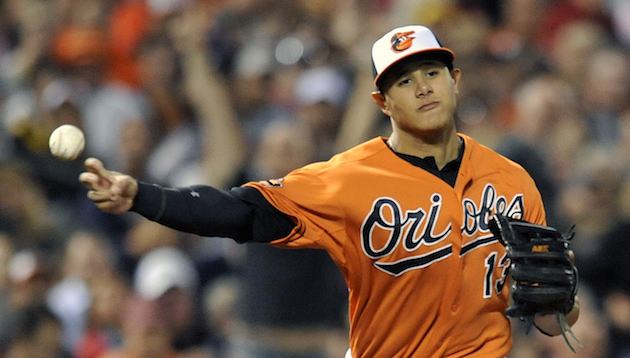
It's amazing how much the games played leaderboards have changed in just the last few years. In 2005, for instance, 10 players played every game. This year, there was only one--22 year-old Manny Machado*--even though there's more young talent proliferating the sport than ever before (young players, theoretically, should be more able to play full slates).

*I would have thought this impossible after the gruesome knee injury he suffered in 2013. Professional ballplayers are just different animals, I guess...
Machado was the only player to appear in every game last year (CBS Sports)
It appears the days of Iron Men like Cal Ripken, Jr., Miguel Tejada, and Steve Garvey are over. I'm sure some of that has to do with the decrease of performance enhancing drugs in the game; players simply can't maintain the stamina needed to survive a 162 game season. They can't train as hard in the offseason, so they wear down faster during the regular season. Training regimens have also shifted, stressing weightlifting more than endurance-boosting cardio, which makes players less flexible and more prone to muscle tears.

I think the real reason for this change, though, is that managers are smarter about how to manage their players. Gone are the days of slave-drive skippers who held little regard for their players' well-being, penciling the same names into their lineup cards everyday as long as they could stand. The new, more understanding breed--the proverbial "player's manager"--is keen on providing "maintenance" days throughout the year to keep his club fresh for the stretch drive. Roster expansion allows them, heck, encourages them to employ scrub-heavy lineups over the season's final month. And those rare times when doubleheaders occur, it's even rarer to see someone play both ends of it.

Some of that, I'm sure, has to do with how much players are paid these days. Teams invest too much in their stars--the guys you'd want playing everyday--to risk them getting hurt overexerting themselves (injuries are more likely to occur when you're over-fatigued, as that's when mechanics break down). They don't want their best players on the field everyday because they have the long-term interests of the players in mind, whereas before they weren't as concerned with protecting their assets. Players aren't disposable when they're signed to nine-figure contracts. You want to take care of that new Lamborghini in the garage, not run it into the ground.

Money has also changed how players view the game. They see it as a career more than just a temporary profession, and they'll do everything in their power to extend their playing careers, and thus their earning potential, as long as possible. They don't want to play 162 games if they don't have to, as every additional game carries the risk of a career-altering injury. And don't forget, they get paid the same for playing 162 as they do for playing 62. There's no incentive for playing every game, so why do it? Taking a few days off here and there versus playing through an injury could mean the difference of millions of dollars, so how can you blame someone for erring on the side of caution?

Lastly, I get the sense that players don't have the same amount of pride their predecessors got from playing every game. Playing all 162 used to be a badge of honor, a sign of strength. It takes a tough SOB to endure 162 ballgames. Perfect attendance was an achievement to be proud of, like batting .300 or driving in 100 runs. Remember, before free agency jacked salaries through the roof, players didn't play major league baseball solely for money; they played because they loved the game. Of course they wanted to play everyday (thinking of you, Ernie Banks).

It's not that players aren't capable of playing full seasons anymore, it's just that there aren't any good reasons to. That, and nobody's forcing them to..

Wednesday, December 30, 2015

Sox Lose Another Legend

Malzone passed away yesterday. He was 85 (Boston Herald)
It's been a rough week for Red Sox legends. On Sunday, Dave Henderson died. Yesterday, Frank Malzone joined him in the great big diamond in the sky.

Whereas Henderson was remembered mostly for one swing, Malzone never had a career-defining moment. He was just a steady third base man for the better part of the decade, one of the best Red Sox during their dark days of the late '50s and early '60s. A slick-fielding, solid-hitting third baseman, Malzone was a Mike Lowell-type destined to be overshadowed by superstar teammates Ted Williams and Carl Yastrzemski.

Despite not doing much to distinguish himself off the field, Malzone did plenty to earn recognition in between the lines. After spending seven seasons in the minors and two years in the military during the Korean War, Malzone debuted with a flourish in 1957, batting .292 with 15 homers and a career high 103 RBI. The first time All-Star and finished second to Tony Kubek in the Rookie of the Year race--an award Malzone deserved to win--but placed seventh in the MVP vote.

Malzone also won his first Gold Glove--the first ever awarded to an American League third baseman. He won the next two as well before Brooks Robinson came along and won 16 straight from 1960-1975 (Who knows how many Malzone might have won had Robinson played in the National League?). Only six men--Robinson, Buddy Bell, Gary Gaetti, Robin Ventura, Eric Chavez, and Adrian Beltre--won more while manning the hot corner for an AL team.

Malzone was more than just a terrific gloveman, however; he was also a pretty decent hitter (thanks to Fenway Park, where he batted .298/.339/.442 for his career). Most years he was good for a .280-ish average, 15 or so homers, and around 80 RBI. You could also count on him to be in the lineup everyday; from 1957-1964, no American Leaguer played more games. It was that kind of solid production and consistency that made him a six-time All-Star during this span, though it helped that the top third basemen at the time (Eddie Mathews, Ken Boyer, Ron Santo) played in the National League.

After dropping off sharply in 1965, the 35 year-old Malzone was released on the last day of November (he didn't remain a free agent for long, however, as the California Angels signed him the same day). After an even worse season with the Angels in 1966, Malzone hung up his spikes for good.

In 1995, 30 years after his last game with the Red Sox, Malzone was one of 14 players inducted into the franchise's inaugural Hall of Fame class, along with former teammates Williams, Yastrzemski, and Tony Conigliaro. Maybe someday the Sox will retire his 11, which he wore from 1956 to 1965. Clay Buchholz is currently wearing it, but should he leave after next season Boston would do well to add it to their line of numbers along Fenway's right field roof.

MLB's Top 15 for 2015

We'll remember 2015 as the year Harper rose to the top of his profession (Washington Post)
Another year has come and gone, which means it's time to reflect on another great baseball season gone by. Here are the 15 best players who made the 2015 campaign one to remember.

We all knew this day was coming; we just weren't sure it would come so soon. Harper became the best player (and youngest unanimous MVP) in baseball at 22, having the best season for a player his age since Ted Williams' 1941. All Harper did was hit .330/.460/.659 (195 OPS+) with 42 home runs and 9.9 bWAR--the most by a National Leaguer since Barry Bonds circa 2004.

For the first time since 2011, Trout was not the best player in baseball. Still, there's no shame in second place, as the three-time MVP runner-up knows all too well. 2015 was another marvelous year for his generation's Mickey Mantle; all he did was lead the AL in WAR, slugging, OPS, OPS+, runs created, and times on base while playing an above average center field.

After back-to-back MVP-caliber years in Oakland, Donaldson finally took home the award in his first season with Toronto. The slick-fielding third baseman posted monster numbers, leading the majors in runs and AL in RBI as he helped the Blue Jays snap their 22-year playoff drought.

Kershaw was once again the best pitcher in baseball, topping both leagues with his 8.6 fWAR, 1.99 FIP, 232 and 2/3 innings, and 301 strikeouts--the most by a pitcher since Randy Johnson in 2002. He was denied another Cy Young, however, by the man behind him on this list.

It's been a swift rise to dominance for Arrieta, who had a 5.46 career ERA when the Orioles traded him midway through the 2013 season and had never completed 160 innings in a season before this one. 2015 saw him build on a stellar 2014 (2.53 ERA) with the best second half in major league history, resulting his first Cy Young award.

Greinke picked a great time to have a career year, compiling baseball's lowest ERA (1.66) in 20 years just before he was eligible to opt out of the six-year, $147 million deal he signed with the Dodgers after the 2012 season. He exercised that option to become the richest baseball player ever in terms of annual salary.

After a fractured hand cost him the final two months of 2014, Goldschmidt roared back to form in his age-27 season by raking at a .321/.435/.570 (170 OPS+) clip. More than just a masher, Goldy won his second Gold Glove and notched 21 steals in 26 tries.

At 31, Votto bounced back from an injury-marred 2014 to post his typically gaudy numbers, including 7.6 bWAR and a .314/.459/.541 (174 OPS+) slash line. In a normal year he would have been an easy choice for MVP, especially after his epic second half, but against Harper he never stood a chance.

Machado showed no ill-effects from the ugly knee injury that cost him half of 2014, coming back strong to play every game, steal 20 bases, and earn his second Gold Glove. The 22 year-old third-sacker also erupted at the plate, crushing 35 home runs and batting .286/.359/.502 (131 OPS+). With Chris Davis likely playing elsewhere next year and Adam Jones now in his 30s, Machado is poised to become Baltimore's franchise cornerstone for the foreseeable future.

'Cutch rallied from his injury-hampered slow start to finish with his usually excellent numbers, leading the Pirates to 98 wins on the strength of his 23 homers, 96 RBI, and .292/.401/.488 (145 OPS+) slash line.

The deserving AL Cy Young winner helped Houston make the playoffs by leading the loop in innings, WHIP, ERA+, and pitcher bWAR.

Like Greinke, Price leveraged his career year to score a massive payday. The AL ERA leader (2.45) came up big down the stretch for Toronto, going 9-1 in 11 starts after arriving via trade on July 30th.

The author of two no-nos and a one-hitter last year, Scherzer was a bloop single, a throwing error, and an oversized elbow pad away from spinning three perfect games. Now that would have been something. Scherzer was largely forgotten about after the Nats pooped the bed in the second half (he played a part in that as well), but his 2.79 ERA, 0.92 WHIP, 276 strikeouts and major league-leading 8.12 K/BB ratio would have made him a popular Cy Young pick most years.

A popular MVP choice in the sabermetric community, Rizzo led all of baseball in Win Probability Added. He compiled impressive traditional stats too, slamming 31 home runs, amassing 300 total bases, and slashing .278/.387/.512 (144 OPS+). In addition to anchoring the Cubs lineup (no National Leaguer played more games or had more plate appearances), Rizzo provided unusual baserunning value for a first baseman with 17 steals.

Colorado's 24 year-old third baseman continued improving his power in his third season, busting out to lead the majors in RBI, total bases, and extra base hits. He also won his third straight Gold Glove for his defensive excellence at the hot corner, making him one of the best two-way players in the game.

Sunday, December 27, 2015

Henderson's Homer Remembered

Red Sox legend Dave Henderson passed away today at age 57 (NESN)
One strike away.

Two weeks before coming within one strike of winning the World Series, the 1986 Boston Red Sox were one strike away from getting booted out of the ALCS. Little-used outfielder Dave Henderson, a defensive replacement for the slugging Tony Armas, was at the plate. Donnie Moore, ace reliever of the California Angels, was on the mound. There were two outs, two balls, and two strikes--deuces were wild, as Don Orsillo likes to say.


Henderson was fated to be in that situation. He had switched teams for the first time that summer when Seattle, the team that drafted him a decade prior, sent him and Spike Owens to Boston in a late August trade. Though Hendu had been an everyday player with the Mariners, he was relegated to a bench role with the Sox. He played sparingly as Boston cruised to the AL East title, then continued to ride the pine as they went down 3-1 to California in the ALCS.

With the Red Sox trailing 5-2 in the top of the ninth, it looked as though Henderson's first postseason series would end without him making much of an impact. Then Boston rallied, closing the gap to one on Don Baylor's two-run homer off Mike Witt.

Witt got the second out of the inning, inducing Dwight Evans to pop up. But now, after 122 pitches and with Rich Gedman (3-for-3 on the day versus Witt) coming up, Witt was removed from the game. Gene Mauch, a chronic over-manager, substituted Gary Lucas, a southpaw, to neutralize Boston's lefty-hitting catcher once more (Lucas had fanned Gedman the night before).

Lucas, who had not hit a batter in over four years, promptly plunked Gedman with his first pitch. That prompted Mauch to bring in his closer, Moore, to take care of Henderson. Hendu wasn't much of a power-hitter, but Moore had a bit of a home run problem, having surrendered 19 of them over the previous two seasons.

It had all come down to Henderson, seeking redemption after Bobby Grich's fly ball bounced off his glove and over the wall for a two-run homer earlier in the game. The odds were against him, however, as Boston's chances of winning stood at just eight percent.

Moore's first pitch narrowly missed for a ball, but his second pitch zipped in for strike one. Henderson swung and missed badly on Moore's next offering, bringing the Red Sox to their last strike.

After missing wide to even the count at 2-2, Moore came back with a breaking ball, which Henderson tapped foul to stay alive. After a brief delay, Moore reared back and fired a heater, trying to blow Hendu away. He nearly succeeded, but Henderson caught a piece, fouling it straight back to the screen.

While the count was even, Moore was clearly winning the pitcher-hitter duel based on the quality of Henderson's swings. His next pitch caught too much of the plate, and Henderson swatted it into the left field bleachers. Channeling Carlton Fisk, Henderson leapt for joy as soon as the ball cleared the fence. He had turned Boston's one-run deficit into a one-run lead, shifting the momentum of the series in Boston's favor. The resurgent Red Sox went on to win on Henderson's sacrifice fly in the 11th, then routed the Angels in Games 6 and 7 back at Fenway.

Henderson had rescued Boston from the dead, willing them to the World Series the way David Ortiz would 18 years later. He nearly willed them to their first championship in 68 years, too, torching the Mets for 10 hits in 25 at-bats, including two homers and five RBI. His second dinger gave Boston the lead in the 11th inning of Game 6, bringing them to the cusp of breaking the Curse of the Bambino.

One strike away, the Red Sox were.