Showing posts with label Angels. Show all posts

Sunday, December 27, 2015

Henderson's Homer Remembered

Red Sox legend Dave Henderson passed away today at age 57 (NESN)
One strike away.

Two weeks before coming within one strike of winning the World Series, the 1986 Boston Red Sox were one strike away from getting booted out of the ALCS. Little-used outfielder Dave Henderson, a defensive replacement for the slugging Tony Armas, was at the plate. Donnie Moore, ace reliever of the California Angels, was on the mound. There were two outs, two balls, and two strikes--deuces were wild, as Don Orsillo likes to say.


Henderson was fated to be in that situation. He had switched teams for the first time that summer when Seattle, the team that drafted him a decade prior, sent him and Spike Owens to Boston in a late August trade. Though Hendu had been an everyday player with the Mariners, he was relegated to a bench role with the Sox. He played sparingly as Boston cruised to the AL East title, then continued to ride the pine as they went down 3-1 to California in the ALCS.

With the Red Sox trailing 5-2 in the top of the ninth, it looked as though Henderson's first postseason series would end without him making much of an impact. Then Boston rallied, closing the gap to one on Don Baylor's two-run homer off Mike Witt.

Witt got the second out of the inning, inducing Dwight Evans to pop up. But now, after 122 pitches and with Rich Gedman (3-for-3 on the day versus Witt) coming up, Witt was removed from the game. Gene Mauch, a chronic over-manager, substituted Gary Lucas, a southpaw, to neutralize Boston's lefty-hitting catcher once more (Lucas had fanned Gedman the night before).

Lucas, who had not hit a batter in over four years, promptly plunked Gedman with his first pitch. That prompted Mauch to bring in his closer, Moore, to take care of Henderson. Hendu wasn't much of a power-hitter, but Moore had a bit of a home run problem, having surrendered 19 of them over the previous two seasons.

It had all come down to Henderson, seeking redemption after Bobby Grich's fly ball bounced off his glove and over the wall for a two-run homer earlier in the game. The odds were against him, however, as Boston's chances of winning stood at just eight percent.

Moore's first pitch narrowly missed for a ball, but his second pitch zipped in for strike one. Henderson swung and missed badly on Moore's next offering, bringing the Red Sox to their last strike.

After missing wide to even the count at 2-2, Moore came back with a breaking ball, which Henderson tapped foul to stay alive. After a brief delay, Moore reared back and fired a heater, trying to blow Hendu away. He nearly succeeded, but Henderson caught a piece, fouling it straight back to the screen.

While the count was even, Moore was clearly winning the pitcher-hitter duel based on the quality of Henderson's swings. His next pitch caught too much of the plate, and Henderson swatted it into the left field bleachers. Channeling Carlton Fisk, Henderson leapt for joy as soon as the ball cleared the fence. He had turned Boston's one-run deficit into a one-run lead, shifting the momentum of the series in Boston's favor. The resurgent Red Sox went on to win on Henderson's sacrifice fly in the 11th, then routed the Angels in Games 6 and 7 back at Fenway.

Henderson had rescued Boston from the dead, willing them to the World Series the way David Ortiz would 18 years later. He nearly willed them to their first championship in 68 years, too, torching the Mets for 10 hits in 25 at-bats, including two homers and five RBI. His second dinger gave Boston the lead in the 11th inning of Game 6, bringing them to the cusp of breaking the Curse of the Bambino.

One strike away, the Red Sox were.

Saturday, March 29, 2014

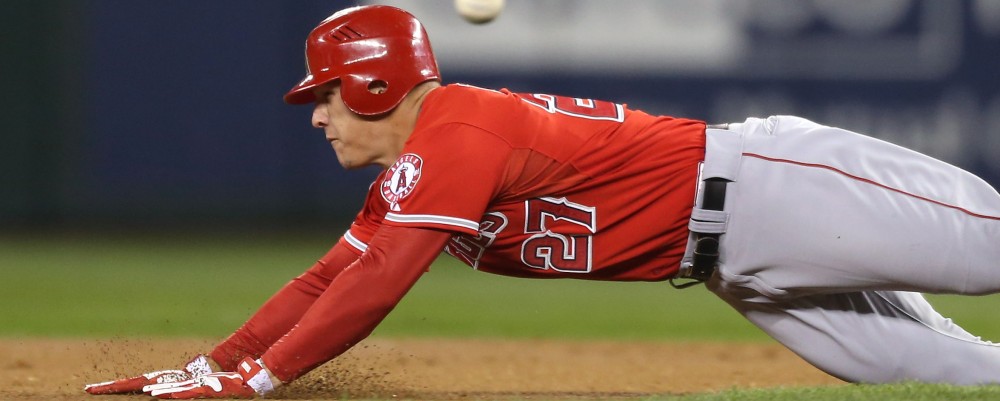
Trout's Team-Friendly Extension

Trout scored a massive payday that will pay him like the superstar he is (CBS)
Five months after inspiring heated MVP debate and discussion, Miguel Cabrera and Mike Trout are in the news again, this time for the record-breaking contract extensions they signed on the same day.

Cabrera, of course, just signed an eight-year, $248 million deal to follow the two years and $48 million still remaining on his current contract. All told, the $292 million (not including the additional $60 million he could earn in vesting options) lump sum is the most ever committed to one player.

Coming on the heels of that, Trout's six-year, $144.5 million extension not only pales in comparison, but also looks like a veritable bargain. Whereas Cabrera's instantly regrettable contract is a perfect example of the kind of deal teams should never, ever make under any circumstance, Trout's extension is the polar opposite. If a team is going to spend hundreds of millions of dollars on a baseball player, it should at least get the player's prime years in return instead of his entire decline phase. The deals made with Ryan Howard, Albert Pujols, Alex Rodriguez, Robinson Cano, and Josh Hamilton are all albatrosses because they drastically overpay said players for the back end of their careers. These megadeals are much more likely to work out when given to the Mike Trouts and Bryce Harpers of the world, young and supremely talented all-around players still years away from reaching their peaks.

Nobody is more deserving of such a deal than Trout, the best young player in baseball history. Since he already signed for a million dollars this year, his new extension kicks in next year and runs through 2020, when he'll be 29--still in his prime and young enough to command a ten year deal of his own that will likely be the largest sports contract ever seen. For now, Trout will have to settle for the most money ever given to a player with just two years of service time.

And it's still not enough--not even close. FanGraphs valued Trout's performance at almost $100 million in the last two seasons alone (when he made about $1 million in player salaries), which means he could be half the player he was in 2012 and 2013 and still be worth every cent. And if he gets better, as most players in their early 20s tend to do, or just keeps playing like the modern-day Willie Mays, then his contract will look even better.

So while I'm sure the Angels regret their most recent nine-figure commitments (to Pujols and Hamilton), they won't regret this one. Trout will be worth the money and then some.

Thursday, February 27, 2014

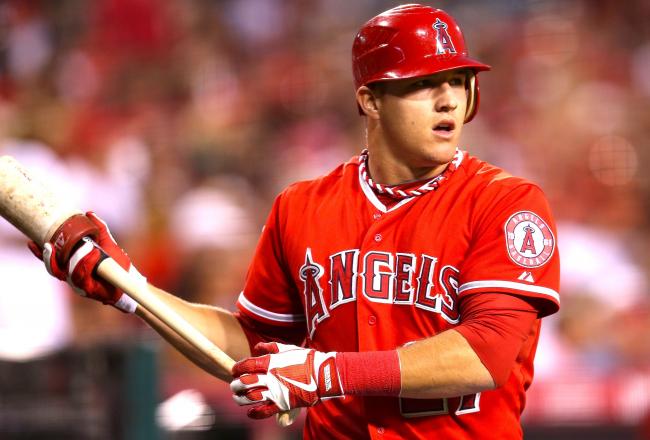
Trout Gets Much-Deserved Raise

If you just got your salary doubled and became a millionaire, you'd be smiling too
Mike Trout will make twice as much money as he made last year, and he'll still be the best bargain in baseball by a mile.

Consider that over the past two seasons, Trout has scored more runs and stolen more bases than anybody in baseball. He's been worth 20.4 fWAR. Nobody else has more than 15 (Andrew McCutchen). He's totaled more fWAR by himself than all the position players on the Mariners, Marlins, and Astros. In fact, he has more fWAR than all the Miami and Houston position players put together. That's absolutely nuts.

Last year alone, Trout was worth as many wins above replacement as all the New York Yankees position players put together (which is really impressive, or sad, considering Robinson Cano was worth six wins by himself). The Angels got more from Mike Trout than six other teams got from all their position players. He had more fWAR than the Marlins, Astros, White Sox, and Mariners combined.

Teams spent hundreds of millions of dollars to get what Mike Trout has provided for just $1 million over the last two years (and somehow LA missed the playoffs both years, despite allocating $250 million to other players during that time). He'll cost the Angels $1 million this year, which will be the most any team has ever paid for a one-year deal from a player who was not yet arbitration-eligible. Ryan Howard and his current teammate Albert Pujols held the previous record of $900,000.

Interestingly enough, all three were voted Rookie of the Year. Here's what else they'd accomplished at the time of signing:

Pujols:   1,351 PA  71 HR  .321/.399/.586  154 OPS+ 12.7 fWAR, MVP runner-up
Howard: 1,094 PA  82 HR  .304/.399/.624  155 OPS+ 8.2 fWAR, 2006 NL MVP
Trout:   1,490 PA  62 HR  .314//404/.544  166 OPS+ 21.1 fWAR, 2 MVP runner-ups

Trout's clearly the best of the bunch in terms of context-adjusted hitting and overall value. Both his predecessors went on to land monster contracts, so the way Trout's career is shaping up it's only a matter of time before he scores a mega-payday of his own.

But for now, he'll have to settle for $1 million.

Wednesday, September 18, 2013

Trout the Terrific

Mike Trout is not going to win the MVP this year. If he couldn't win it last year, when he was worth 10.9 bWAR and led the majors in runs and steals, all while playing superlative defense in center field, then he's not going to win it this year. Not with Miguel Cabrera and Chris Davis standing in his way. Trout will be lucky to get a first place vote.

It's sad, really, to see Trout not get the kind of recognition his special season deserves. He's been every bit as good as he was last year, and in some respects a bit better. He's leading the league in runs, walks, and wins above replacement. He has a four-digit OPS. He's already surpassed 10 WAR again (according to FanGraphs), which makes him the first player with back-to-back ten win seasons since a pumped up Barry Bonds did it during his second prime.

What makes Trouts success even more impressive is his age. He celebrated his 22nd birthday just last month. Nobody's ever been this good, this young before.

Nobody in the game today can match his combination of elite speed, defense, and offensive ability, either. It's not his fault the Angels stink. He couldn't control Josh Hamilton sucking and Albert Pujols getting hurt and the pitching staff falling apart. Trout can do a lot of special things on the diamond, but he can't cover the entire outfield or toe the rubber. He's just one man on a team of 25 guys, and no matter how well he plays, he can only elevate them so much.

He can do it all, but he can't literally do it all.

Once again, Mike Trout is the most valuable player in baseball. But once again, he won't have an MVP trophy to prove it.

Sunday, June 23, 2013

Pujols Putting Slow Start Behind Him

Albert Pujols is no stranger to sluggish starts.

Statistically speaking, April and May are the two worst months of his career by OPS. He's not quite Mark Teixeira, but in recent seasons he's looked like a shadow of himself during the spring. For the third year in a row, he slumped so badly out of the gate that many questioned whether we've seen the end of Albert Pujols as we know him--an elite offensive force and one of the best hitters of all time.

Once again, Pujols has proved such talk to be premature. Since June 4th he's belted five home runs, driven home 15 runs, and batted a Pujolsian .338/.400/.631 in 16 games.

He's back, which is hardly surprising. We've seen this movie before, so we know how it ends:

2011
Pujols slumped at the beginning of his walk year after his contract negotiations with the St. Louis Cardinals fell through. The slugger went a month between home runs (April 23rd to May 23rd). Through May 29th was batting just .257/.326/.395 and had already grounded into 16 double plays

Rest of the way .322/.388/.623

2012
Many players struggle immediately after signing a big contract (Carl Crawford, Josh Hamilton, Adrian Beltre), and Pujols was no exception. After signing the third largest deal in baseball history behind Alex Rodriguez's two megadeals, he didn't make a good impression with his new team. Pujols went homerless in April and didn't launch his first big fly of the season until May 6th. Through May 14th he was batting just .197/.235/.275, reminiscent of the brutal cold spells endured by David Ortiz in 2009 and '10.

Rest of the way .312/.374/.589

2013
After hitting well--albeit without much power--in the first few weeks of April, Pujols went into an extended funk that saw his batting line plummet to .243/.315/.408 through June 3rd. There's no denying that age and injuries have diminished the three-time MVP, but he's raked since then, and will probably continue to rake throughout the rest of the summer. His rate stats aren't going to climb back up to his career marks, but he's a good bet to reach 30 home runs (something he's done every season) and 100 RBI (every year except 2011).

Tuesday, March 26, 2013

AL West Preview

1st Place--Los Angeles Angels
2012 Record: 89-73
2012 Pythagorean: 88-74
2013 Projected: 92-70
After starting last year 7-15 with Mike Trout toiling in the minors and Albert Pujols mired in the worst slump of his career, the Halos dug themselves out of an early hole and produced the best record in baseball from that point forward. Though their wretched April cost them a playoff berth in 2012, the Angels are poised to make the postseason after inking Josh Hamilton--the most coveted position player on the free agent market--to a five-year, $125 million deal. Though the former MVP is on the wrong side of 30 and will likely regress and/or get hurt following a career year in 2012, he'll provide a heavy dose of lefthanded power LA so desperately craves. That said, don't be surprised if Hamilton goes bust and Torii Hunter, now with the Tigers, produces more value in 2013. Mike Scoscia will have the pleasure of filling out a lineup card that features baseball's best all-around player (Trout), baseball's most exciting player (Hamilton) and one of the best hitters of all-time in Pujols. Trout figures to slide a bit following his historic season, but at least his talent won't be wasted in the minor leagues. Pujols shrugged off a slow start to bat .312/.374/.589 from May 15th onward, proving talk about his decline to be premature. Expect similar numbers in year two of his gargantuan contract. Slugger Mark Trumbo has been a mess since the end of July, but I think he reverts to his mashing ways in his age-27 season. I could also see Peter Bourjos breaking out. Jered Weaver, the only American League pitcher to finish in the top five of the Cy Young voting in each of the past three years, is a bona fide ace even though his strikeout rate has plunged from 9.3 K/9 in 2010 to 6.8 K/9 last year. C.J Wilson will improve upon his first season with the Angels when he takes advantage of the run support boost and friendly home ballpark. Jason Vargas and Tommy Hanson are intriguing additions to the starting rotation, though I'm guessing most Angels fans would rather have seen their team keep Dan Haren and Zack Greinke. However, I don't think they'll miss Ervin Santana and Vernon Wells too much. The bullpen should get a nice boost from Ryan Madson, but it remains to be seen how effective he'll be after sitting out all of last year recovering from Tommy John surgery. Given how much worse the Rangers got over the winter, the AL West is theirs for the taking.

2nd Place--Texas Rangers
2012 Record: 93-69
2012 Pythagorean: 91-71
2013 Projected: 88-74
As if blowing their division lead on the regular season’s final day wasn’t miserable enough, the Texas Rangers followed up their late-season collapse with a lean winter. They waved goodbye when sluggers Josh Hamilton and Mike Napoli signed with new teams. They parted ways with veteran leader and fan favorite Michael Young. They winced when Nelson Cruz‘s name surfaced in the latest PED scandal. They whiffed on Justin Upton. Talk about a rough offseason. Faced with limited options and suddenly short on offense, the Rangers turned to Lance Berkman out of desperation. Five years ago that would have been a great get for them, but Big Puma is 37 and doesn't appear to have much left in the tank after needing four separate DL stints last year. He's just one of many Rangers at risk for disappointing seasons. Texas paced the American League in runs and hits last year, and while their lineup is still formidable there's no way that happens again this year. Adrian Beltre is their best hitter, and he'll be 34 two weeks from now. Ian Kinsler is on the wrong side of 30, too, and second basemen age horribly. Cruz will turn 33 and his best days are probably behind him. At 36, A.J. Pierzynski can't possibly repeat his career year and will probably wear down over the course of a long Texas summer. The offense will probably be fine, but there's a lot of downside risk here and not much upside. Yu Darvish made adjustments toward the end of last year and is going to have a big sophomore season (like Daisuke Matsuzaka did). He needs to cut down on his walks, but could win 20 games and the Cy Young award even though the Ballpark in Arlington will likely suppress his numbers. He anchors a strong rotation that also features Matt Harrison, Derek Holland, and Alexi Ogando. Joe Nathan proved he's still an elite closer in his Texas debut last year, making the All-Star team and saving 37 games. Joakim Soria, a former All-Star closer with the Kansas City Royals, will set him up. The Rangers certainly have enough talent to win 90+ games again and challenge the top spot in the division, but I see them taking a small step back in 2013.


3rd Place--Oakland A's
2012 Record: 94-68
2012 Pythagorean: 92-70
2013 Projected: 83-79
I still can't believe these guys won the AL West last year, especially since they ended May seven games below .500. Maybe that's why I can't shake the feeling that they just got red-hot for four months and will probably fall back to earth in 2013 (not quite like the Orioles, but similar). The A's are woefully short on offense without Chris Carter, Stephen Drew, and Jonny Gomes, though the middle of the order has some potential. Yoenis Cespedes is a Vladimir Guerrero-type who can hit the ball out of a canyon and is an MVP-candidate-in-the-making, but I'm not totally sold on Josh Reddick as an All-Star caliber player just yet. Chris Young brings a nice power/speed combo, but it's worth noting that he's a .224/.311/.409 hitter away from Chase Field. Jemile Weeks is almost guaranteed to bounce back from a miserable year in which his BABiP cratered at .256. The bottom half of their lineup is a disaster, so runs will be in short supply. That means Oakland will have to rely on its elite pitching staff, which ranked second in ERA last year. With Jarrod Parker, Tommy Milone, A.J. Griffin, and Dan Straily all poised to build off successful 2012s, the young rotation is brimming with upside. Brandon McCarthy will be missed, but Oakland is hoping Brett Anderson can finally stay healthy after averaging just 13 starts per year over the past three. He's demonstrated the ability to pitch like an ace, so a full season from him would go a long way towards boosting his team's playoff chances (but I wouldn't count on it). The bullpen looks stellar on paper, and the defense is solid, too. The A's could be a great team again if the starting pitching improves and Cespedes makes the leap to superstardom, but I see them settling into the 80-85 win range and missing the postseason.

4th Place--Seattle Mariners
2012 Record: 75-87
2012 Pythagorean: 77-85
2013 Projected: 73-89
The Mariners have lacked adequate firepower for quite some time now--you'd have to go back to the end of the Bush administration to find the last time Seattle didn't finish last among AL teams in runs scored. That's going to change this year after taking on veteran hitters Michael Morse, Kendrys Morales, Raul Ibanez, and Jason Bay. Ibanez and Bay are bench players at this stage in their careers, but Morales and Morse add much-needed pop to the middle of the order. As the cornerstone of Seattle's lineup, Jesus Montero must (and will) improve upon his disappointing 2012 (.685 OPS, -0.2 bWAR). He's just 23 and still has room to grow, as do Kyle Seager, Dustin Ackley and Justin Smoak. Moving in Safeco's fences will help these young hitters, but not enough to make much of a difference. The Mariners have one of the best pitchers around in Felix Hernandez, but he seems to be at risk for a down year after receiving a mammoth contract extension and throwing more innings than any other hurler since 2009. Seattle's rotation is a mess with him and would be downright unwatchable without him. M's are stocked with young pitching talent that could arrive in the Show later this year, but by the time they're ready to contribute it will too late to improve Seattle's non-existent playoff chances. They're still rebuilding and at least another year or two away from making a serious run at one of the wild card spots.

5th Place--Houston Astros
2012 Record: 55-107
2012 Pythagorean: 59-103
2013 Record: 58-104
Welcome to the American League, boys. It's going to eat you alive.

Tuesday, March 5, 2013

The Plight of Mike Trout

Mike Trout's salary for the 2013 season is $510,000. That's 20 grand above the league minimum, considerably less than what Alex Rodriguez, Vernon Wells, Alfonso Soriano, and a bunch of other players will take in this year.

Thing is, Trout was more valuable than all of them last year. He may not have the American League MVP award to prove it, but he has the numbers. In baseball, numbers are everything (well, almost everything).

Here's one: 10.7--that's how many wins above replacement Trout was last year, most in the major leagues by a wide margin.

Here's another: 0--that's how many players scored at least 125 runs, swatted 30 homers and stole more than 45 bases in the same season before Trout came along.

Here's one more: 21--that, of course, is Mike Trout's age in human years.

In a fair, just world, Trout is rewarded handsomely after committing his historic season to memory. His income skyrockets into the same stratosphere as A-Rod, Albert Pujols, and Josh Hamilton. The Angels hand him a blank check, build a statue of him outside their stadium, and give him the moon while they're at it.

Unfortunately, the world we live in is neither a fair one nor a just one. The 2012 AL Rookie of the Year doesn't yet have enough service time under his belt to command more money via arbitration. He has the ability to do anything he wants on the baseball diamond, but when it comes to contract negotiations he is powerless. Hamstrung by his youth and inexperience, Trout has no leverage at the bargaining table.

He is at the mercy of his team, a team that went 6-14 while Trout languished in Triple-A last spring but posted the best record in baseball after promoting him to the Show.

But the Angels have already committed more than $147 million to this year's roster, of which Trout's cut accounts for less than half a percent--a drop in the bucket. Trout deserves a bigger slice of the pie, and he is mad. So is his agent, Craig Landis. More importantly, they want us to be mad, too.

I am not. Trout is getting shafted, yes, but that's just a function of how baseball contracts are structured. Players are vastly underpaid during their early years but eventually become drastically overpaid in the second half of their careers. In the end, everything evens out.

Trout can't complain. While most kids his age are surviving college on a shoestring budget, he'll make more than half a million dollars playing major league baseball this year and is only going to get richer. He'll have to settle for being baseball's best bargain today, but he can sleep easy knowing that he's in line for a windfall tomorrow. Barring an unforeseen career-ending injury, he's slated to become a free agent at 26 and could score the biggest sports contract in history if he keeps playing like he did last year.

Sorry I'm not sorry that you got screwed over, Mike Trout. Just be patient--your day will come.

Tuesday, December 25, 2012

Hamilton to Hollywood

Hamilton is happy to be an Angel
Last December the Los Angeles Angels dominated the Hot Stove headlines by committing more than $300 million to Albert Pujols and C.J. Wilson. Over the summer they landed Zack Greinke, the most prized trade deadline target, to form a super-rotation with Wilson, Dan Haren, Jered Weaver, and Ervin Santana.

But for all their wheeling and dealing, the Halos finished third in a four-team division. The Los Angeles Dodgers missed the playoffs, too, despite bringing in Hanley Ramirez, Shane Victorino, Adrian Gonzalez, Josh Beckett, Joe Blanton and Carl Crawford to fortify a roster that already boasted the league's top position player (Matt Kemp) and pitcher (Clayton Kershaw).

The Dodgers added more star power by shelling out $147.5 million for Greinke, the best pitcher on the market. The Angels countered by stealing Josh Hamilton, the best available hitter, from their division rivals with a five-year, $125 million deal. Hamilton provides a lefthanded power bat his new team sorely needed. He joins a lineup that has baseball's version of the Big Three, featuring the best all-around player in the game, the best hitter of his generation and the sport's most exciting, dynamic talent. It would be like pairing Ted Williams with Mickey Mantle and Willie Mays.

But don't go handing them the AL West title just yet. Pujols will be 33 next year and his OPS has declined each season since 2008, falling from a superlative 1.114 to a merely good .859 in his Califorinia debut. Trout can't possibly get any better and will likely regress in 2013. Hamilton is the biggest wild card of all, an every-other year player on the wrong side of 30 who also seems like a good bet to regress after moving away from a hitter's haven in Texas to a pitcher's paradise in Anaheim. The former MVP and batting champ is also likely to miss a good chunk of time; he's topped 150 games played just once throughout his career and isn't getting any younger.

No one knows what to make of Hamilton after his rollercoaster 2012 campaign that highlighted the mountainous peaks and cavernous valleys that have defined his six major league seasons. After a magical first two months to the season highlighted by a historic night in Baltimore that saw him blast four home runs, the MVP frontrunner fell into a prolonged slump and everyone soured on him. Nolan Ryan called him out. Rangers fans booed him. He was criticized for giving away at-bats with his hyper-aggressive batting approach, lack of plate discipline, and Vladimir Guerrero-esque tendency to hack at any pitch in the general vicinity of the strike zone.

The numbers speak for themselves. From June 1st until the end of the season, the enigmatic outfielder batted an uninspiring .245 with 123 strikeouts. The five-time All-Star also seemed to let his struggles at the dish follow him out onto the field, where his typically solid defense deteriorated sharply during the second half of the season.

But even with his summer slide, Hamilton still finished his contract year with gaudy power numbers. His 43 home runs, 128 RBI, and .577 SLG all ranked second in the Junior Circuit, surpassed only by Triple Crown winner and league MVP Miguel Cabrera, while his HR/AB ratio was bested only by Edwin Encarnacion. Hamilton also placed top five in OPS, runs, intentional walks, total bases, and extra base hits. Not too shabby.

I doubt he'll compile similar statistics next year, though, or possibly ever again given his combination of age, injury history, personal baggage and move to a pitcher-friendly environment. I project him to replicate Pujols' .285-30-105 production from last year, but can't see Hamilton repeating his past performances. His numbers were inflated by the Ballpark in Arlington, where he owns a .315./373/.592 batting line, as well as his great supporting cast of Ian Kinsler, Adrian Beltre, Michael Young, Elvis Andrus, Nelson Cruz, and Mike Napoli that made Texas a run-scoring machine.

Hamilton is still a great hitter and tremendous talent regardless of where he plays, but I'm willing to bet we've already seen the best of him. He inked the same contract as Ryan Howard at the same age--32--and after the first year of Howard's deal it's already looking like a massive mistake. Same goes for Pujols. And I don't have to tell you about Alex Rodriguez, the only player with a larger annual salary than Hamilton.

The deal he got was fair, but I doubt he'll be worth the money. Then again, few players with nine-figure contracts (Alfonso Soriano, Vernon Wells and Barry Zito come to mind) are.

Merry Christmas!

Sunday, December 9, 2012

Dodgers Get Greinke

Four months ago the Los Angeles Angels won the Zack Greinke sweepstakes. This time around, the other baseball team in Hollywood got him.

On July 27th the Angels traded for Zack Greinke, adding the former Cy Young winner to a stacked starting rotation that already included Jered Weaver, Dan Haren, C.J. Wilson and Ervin Santana. At the time, the Halos were four games behind Texas in the AL West and still trying to dig themselves out of the hole created by their 7-15 start. But the Rangers were fading, Albert Pujols was the masher he'd been paid to be and Mike Trout was playing so well that the BBWAA might as well have just handed him the AL MVP trophy right then and there. Surely Greinke would push LA over the top and help get the Angels back to the playoffs for the first time since 2009.

It didn't happen. Los Angeles endured another 7-15 tailspan immediately following the Greinke trade, and they ended the year in third place despite a torrid finish to their season. Greinke initially struggled in his new digs but, to his credit, pitched well down the stretch.

A similar scenario played out across town as the Dodgers, formerly of Brooklyn, made a furious charge for their first postseason appearance in three years.  The playoff hungry Bums went all-out to bulk up their roster, trading for Hanley Ramirez and Shane Victorino just before the July 32st deadline, then taking Carl Crawford, Josh Beckett and Adrian Gonzalez off Boston's hands in late August. This new blood kept the Dodgers afloat for a few more weeks--they were in first place as late as August 19th--before they plummeted out of the race by dropping 20 of their next 32 games. By the time LA righted the ship it was too late; they had fallen ten games behind the Giants in the standings and missed out on October.

With the bitter taste of disappointment in their mouths, both clubs entered the offseason eyeing Greinke, unquestionably the top starting pitcher on the market. He was going to cost a pretty penny, something close to the $161 million CC Sabathia received from the New York Yankees four years ago. The Rangers were also in the mix, but in the end it was the Dodgers who made Greinke one of the richest pitchers in baseball history by opening up their wallets and giving him a six-year, $147 million deal, the largest contract ever signed by a right-handed pitcher. His annual salary of $24.5 million is the highest ever for a pitcher, falling just short of what Alex Rodriguez and Albert Pujols bank every year.

No, Greinke didn't quite get Sabathia money, but he came close and will have to settle for Cole Hamels money. That sounds about right considering that Hamels is a good comp for Greinke; they're two months apart in age, have 91 career wins and can be dominant pitchers at their best but aren't what I consider to be elite hurlers.

With the exception of his masterful 2009 when he channeled Justin Verlander and Pedro Martinez, Greinke's been more of a really good number two starter. In the three seasons since, he's got a 3.83 ERA, 1.22 WHIP and a 106 ERA+. Good numbers, but not great. Those looking to nitpick Greinke and/or claim he's not worth the money have no shortage of ammunition. He's a one-time All-Star (got snubbed last summer, but still), has never won more than 16 games in any season and got bombed in his only postseason. He has just three shutouts to his name (all in '09) and hasn't gone the full nine innings since June 13th, 2010. Perhaps the most startling statistic of all is that Baseball-Reference credits him with only 6.7 bWAR since 2010. A player with a nine figure contract should be able to provide that much value in one season, not three.

But Greinke's stellar peripheral numbers suggest that he has pitched better than his ERA indicates. During his time in Kansas City and Milwaukee he was victimized by poor defense, shaky bullpens and plain bad luck. That explains the substantial discrepancy between his FIP, xFIP and ERA in recent years. It goes without saying that the 29 year-old should post better numbers next year in the weaker National League by making half his starts in pitcher-friendly Dodger Stadium, especially when you account for LA's lights-out bullpen and solid D.

It's interesting that LA was willing to go above and beyond for Greinke because pitching was not one of their weaknesses in 2012. In fact, it was one of their strengths. The staff's 3.41 ERA last year ranked third in the majors. Kershaw turned in another Cy Young worthy performance while Aaron Harang, Chad Billingsley, Ted Lilly and Chris Capuano all produced above average results. But in baseball, you can never have too much pitching. Greinke will be a formidable number two/sidekick to Kershaw, who over the past few years has looked like a Sandy Koufax-in-the-making. I guess that makes Greinke the equivalent of Don Drysdale in that analogy.

However, adding Greinke hikes LA's already bloated payroll up to $210 million, meaning the Dodgers are the most expensive team in baseball, at least for now. The Dodgers have signaled that they're all in, willing win at all costs and do whatever to takes to make the playoffs. No expense will be spared. They're the New Yankees, gobbling up stars and ugly contracts left and right. Heck, if they hadn't just handed Andre Ethier a five-year, $85 million extension, they probably would have shelled out for Josh Hamilton, too. Imagine Hamilton sharing the same outfield with Matt Kemp.

Hey, with the way the Dodgers are spending money lately, it might not be as far-fetched as you think.

Tuesday, August 28, 2012

Santanas Struggling

2012 has not been kind to the three (unrelated) Santanas playing in the major leagues this season.

Johan Santana (6-9, 4.85 ERA)
Through the season's first half, the two-time Cy Young winner was building a compelling for NL Comeback Player of the Year honors.  After missing all of 2011 he was pitching like an ace again; through the end of June he had a 2.76 ERA, 93 Ks in 98 innings and limited opponents to a meager .207 batting average.  But then fatigue caught up with him and his once promising season took a turn for the worse.  In his five starts--all losses--since the calendar flipped to July, he allowed at least six earned runs each time out and failed to pitch beyond the fifth inning.  Over that span the southpaw allowed 33 earned runs in just 19 innings pitched (15.63 ERA).  If you go back even further, looking at the ten starts he's made since hurling the first no-hitter in Mets franchise history on June 1st, he has been battered to the tune of .327/.377/.587 while serving up 13 home runs.

Santana started the season strong, but wilted during
the summer months and will not pitch again in 2012
His struggles can be partially explained by simple regression to the mean; .259 BABiP in those first eleven starts, .357 since (despite almost no change in batted ball data) as more hits started falling in.  He's also been a bit unlucky with a 68.8 LOB% (league average is around 72) and 11.7% HR/FB rate, his worst mark since his final season with the Twins five years ago.  His 4.08 FIP, 4.02 xFIP and 3.86 SIERA are all significantly lower than his ugly 4.85 ERA.  Health has been an issue for the 33 year-old as well.  The four time All-Star spent three weeks on the DL in late July/early August with a right ankle sprain/shoulder weakness.  Made just two starts when he returned, getting hammered each time out.  He clearly wasn't right, and last week the Mets shut him down for the season with lower back inflammation.  On the bright side, his two shutouts still lead the National League, though he's tied with Clayton Kershaw, Matt Cain, Cole Hamels, Adam Wainwright, and teammate R.A. Dickey.  In order to preserve his arm for next season Santana will delay his throwing program six weeks this winter. 

Carlos Santana (.241/.361/.399)
Big things were expected of Cleveland's 26 year-old backstop after he slugged 27 home runs, drew 97 walks and posted a .218 ISO in his first full season last year.  Some even believed that with continued growth the switch-hitter had the potential to be the best offensive catcher this year, better than Joe Mauer, Mike Napoli, Brian McCann, Matt Wieters, Miguel Montero, Buster Posey, and all the rest.  Instead, he seems to have taken a step back in the power department and has been a major disappointment, especially in the first half. Look no further than June, when he failed to go yard and drove in just five runs over 20 games.  In fact, he he didn't hit a single bomb from May 16th through July 17th, a power outage that lasted one-third of the season.  He hit rock bottom in early July, but has picked it up in the second half.  His power has returned with 17 extra base hits and he's driving in runs. He has also posted a stellar .906 OPS and 27/22 BB/K ratio since the All-Star Break.  Overall he's walking more, striking out less, and hitting more line drives than he did a year ago, all signs of a maturing hitter.  I believe a big season in 2013, his age 27 season, is looming on the horizon.  Projecting a 30 home run season seems overly optimistic given that he likely won't even reach 20 this year (currently has 13), but I wouldn't say it's out of the question.
Santana's power is down, but his plate discipline remains excellent
Ervin Santana (7-11, 5.45 ERA)
2012 has been rough on Big Erv, who lost his first six starts of the year and hasn't really recovered.   I detailed his struggles when the Angels landed Zack Greinke nearly a month ago, but it looks as through he's starting to turn it around a bit.  Since bottoming out on July 21st after Texas tagged him for eight hits and six earned runs in one and two-thirds innings, he skipped a turn in the rotation when Dan Haren returned from the DL and has pitched much better lately.  Santana managed to lower his ERA in each of the six starts since and has limited opponents to a paltry .199 batting average over that stretch.  Still, one month-long stretch of success can't wipe away an entire season's worth of struggles (unless that month happens to be October, of course).  He's been wildly inconsistent all year--just look at his monthly splits:

Santana's rollercoaster season fits perfectly with his
up and down career
April-6.16 ERA 1.50 WHIP 5.6 K/9, allowed a dozen home runs in his first four starts

May--3.69 ERA 1.21 WHIP 7.6 K/9, ten strikeouts on 5/4, one on 5/9 and nine on 5/15

June--5.85 ERA 1.24 WHIP 5.8 K/9, tossed a shutout after getting bombed for seven earned runs in each of his previous two starts

July--12.21 ERA 2.29 WHIP 3.2 K/9, failed to make it out of the second inning in two starts and had more walks (six) than strikeouts (five)

August-3.58 ERA 0.98 WHIP 6.1 K/9, best month yet!


It's not hard to see why Santana is having the worst season of his career based on ERA+ (69) and bWAR (-1.6). His career worst 6.1 K/9 is down nearly a full batter from last season, he's tenth in the league in walks and he's already served up 31 gopher balls this year (only Baltimore's Tommy Hunter, with 32, has allowed more, and Santana has yet to go more than two starts in a row without surrendering a four-bagger).  That, combined with a career worst 1.89 K/BB ratio and a less than fortunate 67.5 strand rate, is not exactly a recipe for success. No wonder he ranks third among AL hurlers in most earned runs allowed (behind Ricky Romero and Ubaldo Jimenez) or tied for third in losses (behind Jimenez and Luke Hochevar).  Still, his 1.33 WHIP isn't horrendous, and his 4.60 xFIP indicates he's been a little unlucky.  His next start is September 1st against the light-hitting Seattle Mariners, so his recent hot streak should continue.

But how will he pitch in September?  Your guess is as good as mine.

Saturday, July 28, 2012

Angels Win Greinke Sweepstakes

When the Los Angeles Angels signed C.J Wilson last December, adding him to a rotation that already featured a formidable big three in Jered Weaver, Dan Haren, and Ervin Santana, I firmly believed LA had the best starting pitching in the Amiercan League, if not the majors.  The Yankees would challenge that title when they surrounded C.C. Sabathia with Hiroki Kuroda and Michael Pineda, and you won't have any trouble making a case for Philadelphia and its exceptional trio of Roy Halladay, Cliff Lee and Cole Hamels

But now with 2009 AL Cy Young winner Zack Greinke on board, it's not even close.  The Halos have used trades, free agent signings and homegrown talent to construct the deepest, most talented starting fives in recent memory.  Maybe ever.  I can't remember a rotation as loaded as this one.  Top to bottom, it's stacked.  Each member is a current or former All-Star with a resume that includes postseason experience, Cy Young consideration, and multiple seasons of above average performance. To provide a snapshot of the caliber of talent that's been assembled here, just look at what these guys did last year:

Weaver: 18-8, 2.41 ERA, 1.01 WHIP, 235.2 IP, 198 Ks, 158 ERA+, 6.7 bWAR, All-Star, Cy Young runner-up
Wilson: 16-7, 2.94 ERA, 1.19 WHIP, 223.1 IP, 206 Ks, 150 ERA+, 4.4 bWAR, All-Star, 6th place Cy
Haren: 16-10, 3.17 ERA, 1.02 WHIP, 238.1 IP, 192 Ks, 120 ERA+, 4.0 bWAR, 7th place Cy
Santana: 11-12, 3.38 ERA, 1.22 WHIP, 228.2 IP, 178 Ks, 112 ERA+, 2.7 bWAR
Greinke: 16-6, 3.83 ERA, 1.20 WHIP, 171.2 IP, 201 Ks, 103 ERA+, 1.4 bWAR

By my calculations, that adds up to 77 wins, 1,097.2 innings pitched, 975 punchouts and 19.2 bWAR.  Good luck finding a team, real-life or fantasy, that ever got those kinds of numbers from their five hurlers.  It's mind-blowing.  They always say you can never have enough pitching, but it's hard to imagine having more than the Angels do at the moment.

Give credit to Angels General Manager Jerry Dipoto for taking a good thing and making it even better, like adding crispy bacon strips on top of a mouth-watering cheeseburger.  The pitching-rich Angels were already playoff bound, but he wasn't satisfied with merely making the postseason.  He had his eye on that shiny World Series trophy. He believes 2012 is his team's year, and he's all-in.  Dipoto didn't have to sell the farm to secure Greinke, but he did have to get rid of some of his more promising livestock.  The package he sent to the Brewers includes rookie shortstop Jean Segura as well as a pair of righthanded double A starting pitchers, Ariel Pena and Johnny Hellweg. Segura is a 22 year-old speedy, slick-fielding shortstop who has the ceiling of a Jimmy Rollins/Jose Reyes kind of player.  Baseball America ranked him as the Angels' fourth best prospect and rated him #55 among all prospects coming into the season.  Pena, rated the ninth best prospect in the Angels system, is 23 and pitched well in AA with the second most strikeouts in the Texas League. He could be ace material.  Hellweg, a 23 year-old towering bean pole, stands 6'9 tall but weighs just 210 pounds.  His record is an uimpressive 5-10, but he has a solid 3.38 ERA.  Best case scenario, he develops into a capable back-end of the rotation starter.

It happens all the time, but I've never understood the logic behind dealing established major league talent for unproven prospects.  Greinke has built a track record of success, proving he's one of the top hurlers in the game.  We know what he is and what he can do, but have no idea if the prospects will even make the majors, let alone succeed there.  So many prospects never pan out.  It's a total crapshoot, which is why these kinds of trades usually involve multiple prospects--to increase the odds that at least one can achieve at the big league level.  The Brewers were in an enviable position as one of the few teams selling in a market crowded with buyers (the second Wild Card has made so many more teams contenders).  They committed to trading him early on and dangled his name in trade rumors for much of the summer.  With Greinke just months away from free agency and likely to command north of $100 million on the open market, it made sense for the Brewers to squeeze some young talent out of a contender looking to make a splash at the deadline.  Once Cole Hamels signed that massive contract extension with the Phillies, Greinke's value soared even higher.  He was so coveted that GM Doug Melvin could have asked for the moon, and some desperate team woud have found a way to make it happen.   The Rangers were also in the hunt for Greinke, but backed off when they thought Melvin's asking price was too steep.  Now he's working in the same division, pitching against them.  Oh, the irony.  We'll have to wait and see if this mistake comes back to bite them in September and October with playoff games on the line.

I believe the Angels had already surpassed Texas as the best team in the AL West before the trade, even though they're still four games behind the Rangers in the standings. LA is 55-45 entering play today, which doesn't scream "best team ever," but since dropping 15 of their first 22 games/calling up MVP candidate Mike Trout they've gone 48-30 (.615 winning percentage). Maintain that pace for an entire season, and you win 100 games.  Meanwhile, Texas has lost steam and faltered in July, going 8-11 with a minus-17 run differential.  Josh Hamilton hasn't hit in two months, Michael Young and Nelson Cruz are underperforming, and Roy Oswalt has been a profound disappointment.  No wonder Nolan Ryan has been getting antsy.  The Rangers are still a great team, but maybe just not as good as they seemed before the All-Star Break.  Their flaws--mainly streaky hitting and a shaky back of the rotation--have been exposed.

But no team is perfect, and even the best have to slog through a rough patch every now and then. In  my mind these are the two best teams in baseball, and I'd be shocked if one of them doesn't make it to the World Series.  Their relationship is starting to resemble the Red Sox-Yankees power struggle that dominated the baseball landscape for much of the new milennium.  I'd love to see them square off in the ALCS with the Fall Classic at stake.  Texas has the better offense, but you'd have to give the edge to the Angels (in seven) on account of their superior pitching.  My gut feeling is that LA will go all the way, but I could just as easily see the Rangers making a third consecutive trip to the Series.  Stay tuned.
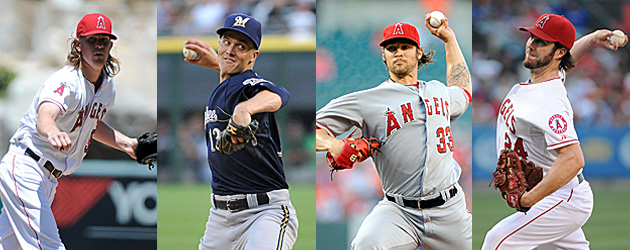
Now the Angels have four aces, and pitching to spare
But I want to talk a little more about that awesome Angels rotation.  For all intents and purposes, they have four number-one starters!  Let's take a deeper look.

Jered Weaver (13-1, 2.26 ERA)
Simply put, he's one of the best pitchers in the game.  The younger Weaver brother is the main threat to Justin Verlander's quest to take home another AL Cy Young trophy  Since the calendar flipped to May, LA has gone 12-1 in Weaver's starts.  If that's not an ace, I don't know what is.

C.J. Wilson (9-6, 2.89 ERA)
The California native has thrived in his Angels debut.  Was especially dominant over a six week period from May 22nd through July 1st, when the Angels won all eight of his starts.  Wilson allowed one earned run or fewer in seven of those outings, maintaining a sparkling 1.35 ERA while limiting opponents to .197/.282/.251 and yielding just one home run in 53.1 masterful innings of work.  Made the All-Star team and his 0.5 HR/9 rate leads the American League. Takes the mound against the Rays today in search of his first win in more than a month.

Dan Haren (8-8, 4.59 ERA)
Since the Cardinals traded him as the centerpiece of a three player package to Oakland in exchange for Mark Mulder following the 2004 season, he's been one of the most consistent and durable arms in the game.  He's made at least 33 starts and completed no less than 216 innings every year, averaging 195 strikeouts per season and 4.3 whiffs for every walk.  His velocity is down a bit this year and he's struggled at times, but his numbers look bad because he tried to pitch through a lower back strain in June before landing on the Disabled List. If you remove that abysmal one month stretch from June 9th through July 3rd his ERA falls to 3.35.  Since returning from the DL he's beaten a pair of tough opponents in the Texas Rangers and Tampa Bay Rays. Haren is poised for a strong second half and should finish the year with numbers similar to his 2010 statistics. 

Ervin Santana (4-10, 6.00 ERA)
The Greinke deal means Big Erv becomes the number five starter, but on most teams he's be a number three.  When you talk about good pitchers having disastrous seasons--Tim Lincecum, Jon Lester, and  Ricky Romero come to mind--Santana belongs in the discussion. Prolonged struggles are nothing new for Santana, who's been plagued by inconsistency throughout his career.  He's suffering from a servere case of gopheritis this year, as he's already been taken deep 23 times and is allowing nearly two homers per nine innings pitched.  Nearly one in every five fly balls he allows leaves the yard even though he's keeping the ball on the ground more than ever before and has a career best 1.51 GB/FB ratio.  Nothing has gone right for him this year; his walks are up, his strikeouts are down and his strand rate is an ugly 65.5%.  He hasn't shown any signs of righting the ship, either, as he's failed to make it out of the second inning in two of his past three starts.  The Angels mercifully skipped his turn in the rotation when Haren returned from the DL, and when Santana makes his next start there will be a 15 out restriction in effect. That way he won't have to pace himself as much; he can just go out there and throw for five innings. This has been a lost year for him, but hopefully he can rediscover the form that helped him completed more than 220 innings and keep his ERA under four in each of the past two seasons. His velocity and command hasn't changed, and his usage rate of different pitches indicates that he' not attacking hitters any differently. I'm surprised the Brewers didn't take a flier on him and see if he could take advantage of the National League boost.  Hey, if A.J. Burnett can do it, anyone can.  Except maybe John Lackey.
 
Zack Greinke (9-3, 3.44 ERA)
After a brief hiatus in the Senior Circuit, the one-time Kansas City Royal returns to the American League.  In Milwaukee he was victimized by the brutal Brewers defense, which is why his ERA there doesn't reflect how well he pitched (hence the All-Star snub).  In California he'll benefit from Gold Glovers Albert Pujols and DL-bound Erick Aybar backing him in the infield along with defensive wizards Trout, Peter Bourjos and Torii Hunter patrolling the outfield.  Just as long as he keeps the ball away from Mark Trumbo, he should be fine.