 |
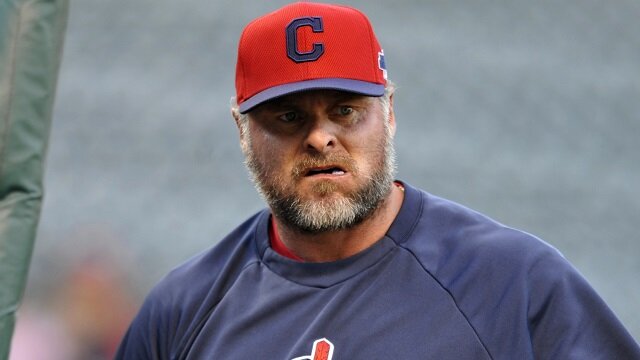
| Yep, that guy played major league baseball last year (Rant Sports) |
I say finally because it seemed like Giambi retired years ago. He became a part-time player after leaving the Yankees via free agency in 2009 and, save for a brief resurgence with Colorado in 2011, was never again the impact hitter that he was during his days in Oakland and New York. Giambi played so sparingly over the past five seasons that it was just easy to forget about him unless you were a die-hard Rockies or Indians fan. Every now and then I'd see his name in the box score and think What? That guy's still playing?
Giambi hung around long past his expiration date, but he was hardly the first to do so. I'm just surprised a bat-first/only guy on the wrong side of 40 who couldn't hit, run, or field kept finding work.
And while those final years didn't add much to his counting stats, they did help him achieve several milestones. Giambi notched his 2,000th career hit on September 8th, 2013 against the New York mets. Leading off the bottom of the ninth, Giambi represented the tying run and was promptly removed for a pinch-runner. He cracked his 400th double the same year. There were also moments like these.
That's how the last act of Giambi's career played out; a lot of pinch-hitting and DH-ing and even more time spent on the bench. But during his heyday during the late 1990s and early 2000s, at the height of the steroid era, Giambi was an absolute terror. He had a beastly four-year peak from 1999-2002 when he batted .326/.452/.612 (177 OPS+) with a .448 wOBA. He was in the top-eight of the MVP voting every year, winning outright in 2000 and finishing runner-up to Ichiro Suzuki the following year. There were only two position players more valuable than Giambi during this time (according to fWAR): Barry Bonds and Alex Rodriguez.
Like Frank Thomas, another burly slugging first base/DH type, Giambi remained effective throughout his 30s but slipped as his body began to break down (probably a result of his admitted steroid use). Perhaps seduced by Yankee Stadium's short right field porch, he became more of a three-true outcomes kind of guy, especially once teams began employing defensive shifts against him. His BABiP, which had been above .310 every year from 1996-2002, fell below .295 in every one of his last dozen seasons, during which time Giambi batted a mere .238. Pretty shocking considering he nearly beat out Ichiro for the batting title in 2001.*.
*The same thing has more or less happened with Mark Teixeira, a first baseman who, like Giambi, signed a big long-term deal with New York, only to follow up a monster first season with several very good years before injuries, shifts, and a pull-happy approach wrecked him.
Giambi's time in New York overlapped with the seven years where they failed to win the World Series. He signed on with them six weeks after Mariano Rivera's Game 7 meltdown in Arizona, only to depart the winter before New York hoisted its 27th championship banner. Giambi played 20 years, all in the wild card era, without ever winning a title, albeit through no fault of his own. He hit well in the postseason, flashing a .290/.425/.486 line with seven homers and 19 RBI in 45 games.
Interestingly, Giambi retires as the active leader in walks and hit by pitches. Few players had a better batting eye than the five-time All-Star, who led the league in free passes four times and posted a 15.3 BB% for his career. He also knew how to take one for the team, which he did 180 times throughout his career. In fact, only 10 players have ever been hit by more pitches.
Giambi, of course, was also a phenomenal power hitter and run producer. He topped 40 homers three times, 30 eight times, and 20 11 times. He went yard 440 times in all, good for 41st on the all-time list. He also came close to knocking in 1,500 runs, settling at 1,441 with seven seasons over the century mark (and another at 96). That's why Steinbrenner and Cashman paid him the big bucks.
Giambi's star may have faded away, but he had a damn good career, on par with David Ortiz, Carlos Delgado, and Jim Rice in terms of overall value. Had he been able to remain productive throughout his late 30s like Ortiz or if his peak had extended a few more years in either direction, we'd be talking about a legitimate Hall of Fame candidate. Instead, Giambi must settle for the Hall of Very Good, but that's still a pretty great place to be.


