Showing posts with label Cleveland Indians. Show all posts

Monday, February 16, 2015

Giambi Goes Out With Whimper

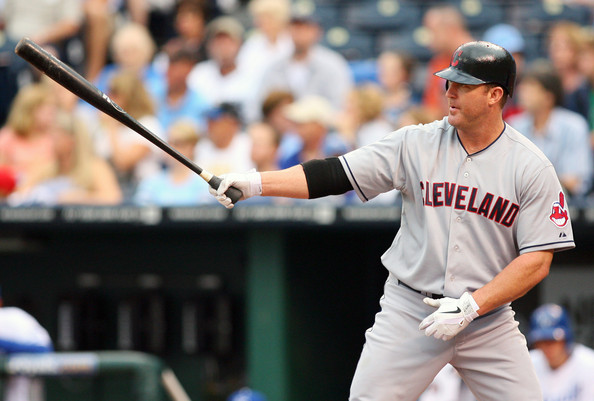
Yep, that guy played major league baseball last year (Rant Sports)
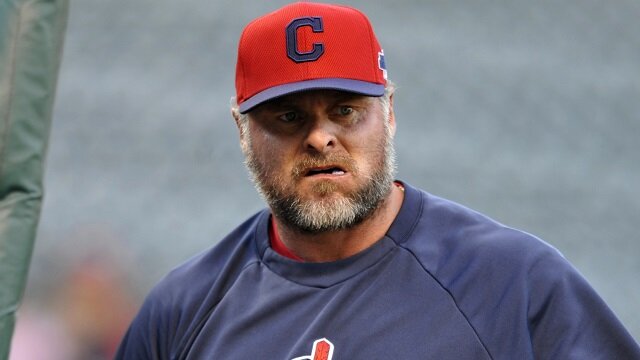
Jason Giambi finally announced his retirement today at the age of 44.

I say finally because it seemed like Giambi retired years ago. He became a part-time player after leaving the Yankees via free agency in 2009 and, save for a brief resurgence with Colorado in 2011, was never again the impact hitter that he was during his days in Oakland and New York. Giambi played so sparingly over the past five seasons that it was just easy to forget about him unless you were a die-hard Rockies or Indians fan. Every now and then I'd see his name in the box score and think What? That guy's still playing?

Giambi hung around long past his expiration date, but he was hardly the first to do so. I'm just surprised a bat-first/only guy on the wrong side of 40 who couldn't hit, run, or field kept finding work.

And while those final years didn't add much to his counting stats, they did help him achieve several milestones. Giambi notched his 2,000th career hit on September 8th, 2013 against the New York mets. Leading off the bottom of the ninth, Giambi represented the tying run and was promptly removed for a pinch-runner. He cracked his 400th double the same year. There were also moments like these.

That's how the last act of Giambi's career played out; a lot of pinch-hitting and DH-ing and even more time spent on the bench. But during his heyday during the late 1990s and early 2000s, at the height of the steroid era, Giambi was an absolute terror. He had a beastly four-year peak from 1999-2002 when he batted .326/.452/.612 (177 OPS+) with a .448 wOBA. He was in the top-eight of the MVP voting every year, winning outright in 2000 and finishing runner-up to Ichiro Suzuki the following year. There were only two position players more valuable than Giambi during this time (according to fWAR): Barry Bonds and Alex Rodriguez.

Like Frank Thomas, another burly slugging first base/DH type, Giambi remained effective throughout his 30s but slipped as his body began to break down (probably a result of his admitted steroid use). Perhaps seduced by Yankee Stadium's short right field porch, he became more of a three-true outcomes kind of guy, especially once teams began employing defensive shifts against him. His BABiP, which had been above .310 every year from 1996-2002, fell below .295 in every one of his last dozen seasons, during which time Giambi batted a mere .238. Pretty shocking considering he nearly beat out Ichiro for the batting title in 2001.*.

*The same thing has more or less happened with Mark Teixeira, a first baseman who, like Giambi, signed a big long-term deal with New York, only to follow up a monster first season with several very good years before injuries, shifts, and a pull-happy approach wrecked him. 

Giambi's time in New York overlapped with the seven years where they failed to win the World Series. He signed on with them six weeks after Mariano Rivera's Game 7 meltdown in Arizona, only to depart the winter before New York hoisted its 27th championship banner. Giambi played 20 years, all in the wild card era, without ever winning a title, albeit through no fault of his own. He hit well in the postseason, flashing a .290/.425/.486 line with seven homers and 19 RBI in 45 games.

Interestingly, Giambi retires as the active leader in walks and hit by pitches. Few players had a better batting eye than the five-time All-Star, who led the league in free passes four times and posted a 15.3 BB% for his career. He also knew how to take one for the team, which he did 180 times throughout his career. In fact, only 10 players have ever been hit by more pitches.

Giambi, of course, was also a phenomenal power hitter and run producer. He topped 40 homers three times, 30 eight times, and 20 11 times. He went yard 440 times in all, good for 41st on the all-time list. He also came close to knocking in 1,500 runs, settling at 1,441 with seven seasons over the century mark (and another at 96). That's why Steinbrenner and Cashman paid him the big bucks.

Giambi's star may have faded away, but he had a damn good career, on par with David Ortiz, Carlos Delgado, and Jim Rice in terms of overall value. Had he been able to remain productive throughout his late 30s like Ortiz or if his peak had extended a few more years in either direction, we'd be talking about a legitimate Hall of Fame candidate. Instead, Giambi must settle for the Hall of Very Good, but that's still a pretty great place to be.

Wednesday, November 12, 2014

Kluber Robs King Felix

Hernandez deserved to win his second Cy Young, but didn't (RotoScout)
The races for the American League and National League Cy Young couldn't have been any different.

In the National League, Clayton Kershaw was the heavy favorite and won easily, securing his third Cy Young in four years (and, let's be honest, he deserved the 2012 award over R.A. Dickey too). It was Kershaw and everyone else, meaning a vote for Johnny Cueto or Adam Wainwright, while defensible, was clearly misguided.

The American League's top two candidates were virtually inseparable. They both had dominant seasons and compelling reasons, but in the end it came down to splitting hairs. In what was destined to be a photo finish, Corey Kluber beat out Felix Hernandez. Kluber nabbed 17 of the 30 first place votes and 169 points, edging out the 13 and 159 compiled by King Felix. Chris Sale finished a distant third with 78 points.

Looking at Hernandez's stats, it's hard to see how he didn't win. He had the league's lowest ERA, WHIP, and hit rate while placing second in pitcher bWAR (to Kluber), innings pitched (to David Price), ERA+ (to Sale), and FIP (to Kluber). He also led in most of the advanced stats like adjusted pitching runs and wins, base-out runs and wins saved, and situational wins saved. Opponents batted just .200/.243/.303 (.244 wOBA) against him, and his average GameScore was 65. For most of the summer, he was the clear favorite as he strung together an MLB-record 16 straight starts with at least seven innings pitched and two earned runs allowed or fewer.

But he slipped just a bit over the final six weeks (2.75 ERA), opening the door for Kluber, who came on like a freight train down the stretch. His first half was hardly Cy-worthy (3.01 ERA), but after the All-Star Break he had a 1.73 ERA over his final 104 innings to lower his final ERA to 2.44. He also struck out 39 batters over his final three starts to give him a whopping 269 K's on the season, second only to Price and 21 more than Hernandez. He also finished in a three-way tie for the league lead in wins with 18 (same as Max Scherzer and Jered Weaver) while pacing the circuit in pitching bWAR (7.4), and FIP (2.35).

While Kluber had an outstanding season, I believe the hardware belongs to King Felix. For one, Kluber wasn't even Cy Young-caliber for most of the first half, while Hernandez was Cy Young worthy from start to finish. Kluber had that great finishing kick, but I think Hernandez deserves credit for being more consistent. Additionally Kluber's average GameScore (63) was a hair lower than Hernandez's, revealing that he was slightly less dominant on a per-start basis. Batters also had more success against him, hitting .233/.279/.345 (.277 wOBA) when he was on the bump--a 78 point difference between him and Hernandez. That's pretty sizable, especially considering Kluber faced slightly weaker hitting talent.

It's true that Hernandez did pitch in a more favorable environment with a better defense behind him, but the park is accounted for in Adjusted ERA+, which has him considerably ahead of Kluber 170 to 152. Furthermore, Safeco doesn't help Hernandez as much as other pitchers because of his ability to induce ground balls. As for the defense, well, it's not like Hernandez was pitching to contact. He still struck out 248 batter's, for heaven's sake! Tony Blengino over at FanGraphs took all these factors into account and calculated Hernandez's true ERA to be 2.29, a touch better than Kluber's 2.45.

All in all, I like Hernandez's case a little better than Kluber's. I'm not sure what swayed the voters over to the latter's side: I hope it was the FIP and gaudy strikeout rates but I suspect the monster second half and shinier win total played a role as well. The voters had to make a really tough choice, so I'm not surprised they got it wrong (look no further than their inability to elect Mike Trout MVP before this year). Kluber was great, but Hernandez was a tad better and deserved to win by the slimmest of margins.

Tuesday, August 5, 2014

What's Behind Brantley's Breakout?

An All-Star for the first time this year, Brantley's having an MVP caliber season
Is Michael Brantley baseball’s best kept secret? If he played on a better team in a bigger market, wouldn't we be talking about him the way we talk about Mike Trout, Andrew McCutchen, Adam Jones, and Yasiel Puig?

I think so. Don't believe me? Go ahead. Check the numbers. They're closer than you think. Seriously, see for yourself. I'll wait. 

Over the first five years of his career, Brantley was pretty much the definition of an average everyday outfielder. With an OPS+ of 100, his bat was perfectly pedestrian. He hit for a little bit of power and flashed a little bit of speed, got on base at a solid rate and played decent defense, too. He didn’t really have any holes in his game, but at the same time failed to stand out. He was productive, capable, solid, but boring. Nothing special.

Not this year. Brantley, a beast all season long and first-time All-Star, is playing like an MVP. That's been even more true lately, as he's recorded five straight multi-hit games and seven in his past nine. With his batting line now up to .324/.383/.515 on the season, Brantley can say there's nobody in the American league who beats him in all three triple slash categories. In fact, there's only one player in baseball who can beg to differ, and it's Troy Tulowitzki. Only three players have provided more offensive value than Brantley, and their names are Trout, McCutchen, and Puig, all serious MVP candidates. Brantley deserves to be, too.

Because in his age-27 season, Brantley's taken a quantum leap from average hitter to one of the best in baseball, enjoying an unexpected breakout in the same vein as Melky Cabrera and Daniel Nava. His 154 wRC+ ties him with Jose Bautista for tenth-highest in baseball, better than Miguel Cabrera, Robinson Cano, and Ryan Braun. With roughly one-third of the season still to go, B-R has already valued Brantley's performance at almost five wins above replacement. Per FanGraphs, Brantley has been baseball's ninth-most valuable position player this year, including the third-best outfielder in the American League to only Trout and Alex Gordon (and most of Gordon’s value comes from his defense, at which Brantley is merely okay).

So what’s fueling Brantley’s big, out-of-nowhere season? Surprisingly not BABiP, which at .325 is almost dead even with his actual average of .324. Considering Brantley’s career BABiP is .308, one can't merely chalk his success up to good luck. What's driving his robust batting average is the highest line drive rate of his career at nearly 27 percent. When more than one in four of your batted balls are frozen ropes, chances are you're doing something right.

As for the power surge, well, that's easy to explain. Brantley's boasting the highest HR/FB rate of his career by far. At 14.7 percent, it’s more than double last year’s 6.8 percent and his 6.7 percent career rate. That explains why he already has 16 home runs--on pace for 24--after never hitting more than 10 in a season before. In turn his ISO, which hovered in the .110-.120 range the past three years, has jumped up close to .200. 

He’s also being pitched to a little differently. Whether that's because of his newfound success or vice-versa is up for debate, but this isn't: after struggling mightily against fastballs last year, Brantley's been well above average against the heater this year (two and four-seamers). On a similar note he’s also enjoyed much more success against the cutter, a pitch that tends to give lefty hitters such as Brantley trouble by exploding in on their hands when thrown from a righthander. Pitchers appear to be taking notice, as they’ve given him fewer fastballs this year and more changeups, perhaps trying to catch Brantley off guard or get him out in front. But Brantley’s always been a good hitter against changeups, and that has remained true this year. 

On top of all that, Brantley's been much better on the basepaths as well. With 13 stolen bases in 14 attempts, he's been almost impossible to throw out. That represents a big step up over just two years ago, when he was nabbed nearly as many times (9) as he was successful (12). FanGraphs estimates he's provided more baserunning value than all but 14 major leaguers this year. Among players who have been less valuable than Brantley on the bases; Carlos Gomez, Jacoby Ellsbury, Brett Gardner, and Trout.

Offensively, Brantley's playing at his absolute best right now. His walks are up from last year and his strikeouts are down, so much so that the rates are almost dead even. He's hitting for power and getting on base a ton, and when he does get on base he makes a positive difference with his legs.  The only area in which he hasn't improved is defense, where he's average at best and subpar at worst. At this point in his career Brantley's probably never going to be a great defensive outfielder, as he already plays a corner spot and can be expected to cover less ground with each passing year. 

But as long as he keeps hitting the way he is,  then that's something the Indians can live with. 

Sunday, August 3, 2014

Thome Retires with Tribe


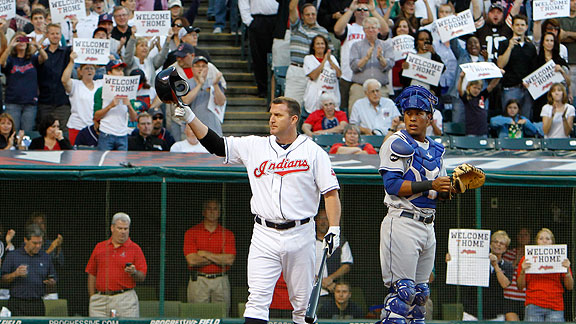
Jim Thome, the most recent member of baseball's 600 home run club and eighth to join, announced his retirement yesterday after signing a one-day contract with the Cleveland Indians, marking the end of his incredible 25 year baseball journey.

Thome, who last played in 2012, came full circle by going out with Cleveland, the team that drafted him in the 13th round of the 1989 amateur draft. Two years later he was in the big leagues for a cup of coffee, a September call-up who on October 4th launched the first of his 612 career home runs, taking Steve Farr of the Yankees deep at the Stadium.

It didn't take long for Thome's trademark power and batting eye to emerge, and by 1994 he was the club's everyday third baseman. Despite the player's strike he still managed to pop 20 homers, something he would do in every season but one through 2010. A key member of the great Indians squads of the 1990s, Thome won his first and only Silver Slugger at the hot corner in 1996 before moving across the diamond the following year to accomodate Matt Williams. Thome responded with his first 40-homer season and All-Star appearance, the first of six and five, respectively.

While more than half of Thome's regular season home runs would come in an Indians uniform (his 337 with Cleveland are a franchise record, nearly 100 more than second place Albert Belle's 242), all of his postseason long balls benefitted Cleveland. A dynasty that never was, the Tribe made the playoffs six times from 1995 through 2001, reaching the World Series twice but losing both times. A driving force behind those great teams, Thome compiled some impressive playoff statistics along the way. The 6'4, 250 pound behemoth cranked 17 home runs (tied with David Ortiz for seventh all-time) and knocked in 36 over the course of 11 different postseason series with Cleveland, showcasing his monster power on the game's biggest stage. Unfortunately for him and through no fault of his own, the Indians were unable to win the big one. Thome would go on to play in four postseasons after leaving Cleveland, but never again would he come to bat in the World Series or go yard in a playoff game.

Thome left Cleveland after the 2002 season--the best of his career--in which he batted .304/.445/.677 with 52 homers, 118 RBI and 122 walks, good for 7.4 bWAR, a league-high 197 OPS+ and a seventh place finish in the AL MVP voting. Thome capitalized, parlaying those monster numbers into a six-year, $85 million deal with the Phillies. He continued to produce huge power numbers in Philly, tying Alex Rodriguez for the major league lead in home runs with 47 in 2003 and belting 42 more the year after that. In 2005 he had his first off year, starting slow out of the gates and then getting hurt before he was shut down for the season in August. His replacement, a young but equally large slugger named Ryan Howard, came up and smashed 22 big flies in roughly half a season, enough to win NL Rookie of the Year honors and convince Phillies management he was the first baseman of the future.


Thome was traded to the White Sox, where he won AL Comeback Player of the Year and made his last All-Star appearance in 2006, reaping the benefits of the homer-friendly U.S. Cellular Field. Late in the 2009 season he was traded to the Dodgers, who were seeking a big bat for the stretch run. He did nothing with LA, bounced back to have one last big season in 2010 with Minnesota (25 home runs, 1.039 OPS), and after that was basically a spare part. He played his last game as a member of the Baltimore Orioles, with whom he crushed his 612th and final career home run on September 26th, 2012 at the age of 42. Though Thome was limited to part-time duty in his final few seasons, he remained an effective hitter to the end because of his power and on-base ability. After his disastrous 2005 season, Thome's OPS+ never dipped below 112.

After spending his first dozen seasons with Cleveland Thome bounced around a lot, changing teams seven times in the second half of his career and even returning to the Rock and Roll Capital of the World briefly in 2011. Nevertheless, he left a tremendous legacy with his original team, where he's tops in home runs and walks and top-five in most offensive categories.

But Thome is more than one of the greatest Indians of all-time: he's one of the best sluggers in baseball history. An offensive force for two decades (think Harmon Killebrew with longevity), Thome is absolutely a first-ballot Hall of Famer. There are the 612 home runs, of course (not including the 17 he hit in the postseason), a record for first basemen and seventh-most all-time. He knocked in nearly 1,700 runs and scored almost 1,600 others. He reached base 4,144 times, more than Jimmie Foxx, Rod Carew, and Reggie Jackson. His .956 career OPS is the 18th-highest mark in baseball history. He ranks 24th all-time in slugging percentage and RBI, 23rd in runs created, and 20th in extra base hits. His 13.8 AB/HR ratio has been bettered by three men; Mark McGwire, Babe Ruth, and Barry Bonds.

Still not convinced? He had eight seasons with at least 30 dingers and 100 runs, walks, and RBI, two more than Albert Pujols and Stan Musial combined. From 1994, Thome's first full season, through 2012, he outhomered everyone not named Alex Rodriguez (an admitted steroid user) and walked more often than anyone besides Barry Bonds (also juiced). Only Rodriguez and Manny Ramirez, both busted PED offenders, piled up more RBI. A-Rod, Derek Jeter, Johnny Damon, and Chipper Jones were the only ones to score more runs. Per JAWs, Thome's one of the ten-best first basemen of all-time, with virtually the same number of bWAR that Frank Thomas accumulated in his career. The Big Hurt, who actually spent more time as a DH, just sailed into the Hall on his first try with over 90 percent of the vote.

Thomas is actually a very good comparison for Thome and comes up as his second-best comp after Sammy Sosa. Their careers overlapped for many years and they both reached the 500 home run milestone in 2007, each without a whisper of PED use despite their huge power numbers in the heart of the steroid era. Thome had better luck with injuries and so he lasted a little longer, but as you can see their numbers are very similar:

Thomas 1990-'08: 10,075 PA 521 HR 1,704 RBI 1,667 BB .301/.419/.555 156 OPS+ 73.7 bWAR
Thome 1991-'12: 10,313 PA 612 HR 1,699 RBI 1,747 BB .276/.402/.554 147 OPS+ 72.9 bWAR

Thomas was better than Thome, but only by the slimmest of margins. In Fact, JAWs has Thomas as the ninth-best first baseman of all-time and Thome barely behind him at tenth. So if Thomas truly is a deserving first ballot Hall of Famer (which he is), then Thome has to be, too. He's just as worthy of that honor as he is of the new eight-foot bronze statue at Progressive Field.

Monday, July 28, 2014

Santana Smoking Hot

Santana's swinging a hot bat after slumping through April and May (WahoosOnFirst)
The Cleveland Indians are deservedly off today after 11 straight road games to open the second half. And while I'm sure every Indian's thankful for the reprieve, especially with Cleveland having lost six of its last eight, something tells me Carlos Santana wouldn't mind another game tonight.

The former-catcher-turned-corner-infielder has been unconscious over the past week, hitting safely in seven straight games and launching six home runs during that span. His hitting streak, modest as it is, has also produced three doubles and six singles. That makes 15 base knocks in 27 at-bats, a .556 clip that's hiked his season average from a Mario Mendoza-esque .204 to a still-lowly-but-more-respectable .232.

But it's the home runs--five of 'em in the past three days and 14 since the start of June--that have people talking. Santana's slugging percentage rose from .380 after last Sunday to .456, just a tick below his 2014 high-water mark of .462 four games into the season. The 28 year-old Dominican kicked off his monster weekend with a pair of long balls off the young Yordano Ventura Friday night, a performance made even more impressive by the fact that Santana had played 14 innings--a game and a half--the day before.

But despite his big day at the plate, the Indians lost that game and the next one, too, blowing a five run lead on Saturday that Santana started with a solo shot off Jeremy Guthrie. He walked later in the inning and doubled his next time up, but Zach McAllister couldn't keep the Royals at bay and the Tribe fell, 7-5.

After losing the first three games of their series in Kansas City and falling behind early in the fourth, Cleveland salvaged the series and road trip with a 10-3 rout yesterday. The switch-hitting Santana led the way, smashing a two-run homer off Bruce Chen and another off Aaron Crow. The pair of bombs gave him eight on the month and upped his season total to 20, equaling his figure from last year but in 59 fewer games. They also raised his OPS to .827, 101 points higher than where it stood one week ago.

With Cleveland one game below .500 but only 3.5 out of the second wild card spot, Santana's hot streak couldn't have come at a better time for Terry Francona's scuffling club. They need him to keep producing big power numbers out of the cleanup spot if they're going to stay in the hunt for a second straight postseason berth. Thankfully for them he appears to have put his miserable start (.572 OPS through May 21st) behind him. After going through a recent rough stretch where he struck out 14 times in the seven games leading up to the All-Star Break, Santana seems to be seeing the ball more clearly and has had much more success making contact lately, with nine walks against four whiffs in his first 51 plate appearances of the second half.

Santana has always been a patient hitter who's at his very best when he waits for his pitch, putting himself in a position where he can lay back and drive the ball, taking advantage of the natural power that's cranked out 85 homers over the past three and a half seasons. This year's major league leader in walks has definitely been doing that a lot lately, and he'll try to stay hot tomorrow night against Seattle's Hisashi Iwakuma.

Sunday, July 6, 2014

Giambi Got Screwed

Love him or hate him, Giambi's been ruthlessly victimized by defensive shifts
The widespread implementation of defensive shifts in recent years has taken God knows how many hits away from lefty pull hitters such as David Ortiz, Mark Teixeira, Adam Dunn, Ryan Howard, and Jason Giambi. How frustrating is it to watch hitters smash ground balls and line drives into short right field, only to see a re-arranged defender waiting there to gobble it up and throw them out by 20 feet at first base. Once reserved for Ted Williams and few others, shifts nowadays pose an obstacle for many players with ground ball pull tendencies, even those who bat from the right side like Edwin Encarnacion.

Giambi, now a 43 year-old role player for the Cleveland Indians, estimates he's lost 200 hits to shifts over the course of his 20 year career, which is a huge deal. Imagine if all those hits went through for base knocks; what would Giambi's numbers look like then?

If one gives him credit for 200 additional hits, his career batting average soars from .277 to .304. People today don't think of Giambi as a .300 hitter because he's batted over .260 only once since 2003, but he hit as high as .342 in 2000 and owned a .309 career average through the 2002 season. Surely we'd have a much different impression of him if he had a higher career batting average than Willie Mays and just a smidge below Hank Aaron's. Similarly, his OBP would jump from .399 to .422, which would rank 17th all-time and second only to Barry Bonds for players that debuted after Jackie Robinson broke the color barrier.

Even if we assume all those hits would have been singles (and some surely would have been some doubles), giving Giambi 200 extra total bases raises his career slugging percentage from .517 to .545, which would rank just outside the top-30. His career OPS would be at least 50 points higher than it is now, and at .966 would rank as the 15th highest mark of all-time. If Giambi's estimates are correct, he would be one of the select few players to exceed a .300 batting average, .400 on-base percentage and .500 slugging percentage for his career.

Steroids aside, Giambi didn't dominate long enough to merit serious Hall of Fame consideration. Without the shift, however, he'd be a slam dunk for Cooperstown with career slash stats in the same neighborhood as Manny Ramirez, Frank Thomas, and Mickey Mantle. So that's something to think about the next time your favorite player rips a rocket into the hole and heads back to the dugout with nothing to show for it. Shifts aren't just costing him hits: they could be costing him a Hall of Fame plaque as well.

Friday, June 13, 2014

Boston's Bats Break Out, Batter Cleveland

Boston's bats have been unusually quiet this season, but that was not the case tonight at Fenway Park, where the Olde Towne Team crushed the Cleveland Indians by a score of 10-3.

It was surprising to see the Red Sox score so many runs in one game given the way they've struggled at the plate this year, and especially lately. Earlier in the week they managed only one run in a three-game series in Baltimore against one of the worst pitching staffs in the American League, making mediocre hurlers such as Bud Norris, Chris Tillman and Wei-Yin Chen look like Cy Young candidates. They were shutout for the fifth and sixth times this season, unable to take advantage of soft competition in a hitter's park.

Thus ended a horrible road trip in which the Sox dropped seven out of nine, falling to seven games below .500 and nine out of first place in the process. Even the two wins were lucky, for the first required David Ortiz's ninth inning go-ahead home run off Joba Chamberlain, and the second saw Boston score one measly run. If Ortiz doesn't take Chamberlain deep and Brandon Workman doesn't blank the O's two days later, then the Sox return home with a nine game losing streak and their tails between their legs.

Thankfully, that didn't happen.

The Red Sox played uncharacteristically poor baseball at home during the season's first two months, going 10-17 and being swept three times. Red Sox teams are known for dominating at Fenway, but through Memorial Day enjoyed no home field advantage whatsoever.

That's changed lately however, practically on a dime. After tonight's pasting of the Indians, the Sox have now won seven straight at the Fens. Tonight's win was special, though, for it marked the first time this season that Boston scored 10 runs in a game, finally breaking the double digit barrier 67 games into what has been an immensely frustrating and uneven season.

John Lackey and the Sox fell behind early on a two-run shot by Carlos Santana in the second, only to return the favor with three of their own in the bottom of the frame as A.J. Pierzynski plated two with a double and Jackie Bradley, Jr. tripled him home.

Cleveland quickly responded with back-to-back doubles from Asdrubal Cabrera and Michael Brantley to open the third and seemed to have Lackey on the ropes. But the 35 year-old veteran settled down, bouncing back to whiff Jason Kipnis and Lonnie Chisenhall before retiring David Murphy on a ground out to Dustin Pedroia.

After that it was smooth sailing for Lackey, who cruised into the seventh inning before Cabrera's two-out double forced John Farrell to go to his bullpen. Andrew Miller came in and Lackey left after 110 pitches, leading 5-3 and in line for his eighth win of the season. Miller kept it that way by retiring Brantley, the potential tying-run, on a grounder to Mike Napoli at first.

Napoli helped Boston tack on some insurance runs after the seventh inning stretch, plating Pedroia after Bryan Shaw intentionally walked Ortiz. Daniel Nava followed suit by spanking a double down the left field line that scored Ortiz and put Boston up 9-3, capping their four-run seventh inning. The Sox added one more in the bottom of the eighth on a Xander Bogaerts solo shot that caromed off the light tower, a breathtaking blast that reminded everyone watching why Bogaerts is regarded as one of the game's top young talents.

Miller took care of Cleveland in the eighth, setting them down 1-2-3, and Burke Badenhop silenced them in the ninth by fanning George Kottaras, Santana, and Ryan Raburn to close out the win. Hopefully Boston keeps swinging hot bats tomorrow versus Cleveland's T.J. House. With Jake Peavy (6.69 ERA in his last six starts) on the mound, they're gonna have to.

Friday, April 4, 2014

Cleveland Keeps Kipnis

Cleveland locked up its second baseman at a very reasonable price
The Cleveland Indians announced today that they extended second baseman Jason Kipnis for the next six years (including this one) at a cost of "only" $52.5 million. The extension--nearly identical to the one Matt Carpenter signed with the Cardinals last month--also includes a team option for 2020, when Kipnis will be 33.

For the Indians, that's a terrific deal. Kipnis, who turned 27 on Thursday, ranked as one of the league's ten best position players last year and was rewarded with his first All-Star nod and an 11th place MVP finish. Among American League second basemen, only Robinson Cano and Dustin Pedroia were more valuable per bWAR, and both of them just netted long-term nine figure deals. By comparison, Kipnis is a veritable bargain.

Kipnis doesn't excel at one thing, but like Pedroia and Ben Zobrist he does almost everything well, which has made one of the game's five best second basemen since the start of the 2012 season. He hits for power, gets on base, steals bags, and scores/drives in runs. His defense isn't great, but it's not terrible either. He can hold his own in the field, and while that's not going to win him any Gold Gloves, it also means he's not a liability like Dan Uggla.

Bottom line: you can never go wrong by signing an in-his-prime second baseman for about $8.5 million per year.

Tuesday, November 12, 2013

Francona, Hurdle Top Managers

Terry Francona and Clint Hurdle were named Managers of the Year today after leading their respective teams to impressive turnarounds and postseason berths.

Following a one-year hiatus in the broadcast booth, Francona returned to the dugout and guided Cleveland to 92 wins and the American League's top Wild Card spot. Few expected the Indians to contend in the wake of a miserable 2012 that saw them lose 94 games, but Francona's touch (as well as key additions like Nick Swisher, Michael Bourn and Scott Kazmir) helped Cleveland reach the playoffs for the first time since 2007. Francona's 2011 Red Sox famously choked away their all-but-guaranteed playoff spot by going 7-20 in September, but this year he flipped the script. Cleveland went 21-6 in September, winning ten in a row to close out the regular season and nearly catch Detroit in the AL Central. They were unable to carry that momentum into their Wild Card playoff game, however, falling to Tampa Bay 4-0.

This selection was a bit of an upset, as many predicted John Farrell would win the award after taking Boston from worst to first. Farrell did a commendable job in the aftermath of the Bobby Valentine fiasco, but he also inherited a much more talented roster than Francona did. Boston's payroll was roughly twice that of Cleveland, meaning Francona had to make do with far less. Both teams drastically exceeded expectations, but the Indians overachieved more so than the re-tooled Red Sox, who made significant upgrades over the winter (Mike Napoli, Shane Victorino) and enjoyed a good deal of positive regression to the mean (such as healthy years from David Ortiz, Jacoby Ellsbury, and John Lackey). Cleveland finished one game behind the Tigers. Who could have seen that coming?

The National League selection was much easier. Clint Hurdle helmed the Pittsburgh Pirates, a team that had not experienced a winning season since 1992, to 94 wins and the NL's top Wild Card slot. Hurdle oversaw the two most recent of those losing years, both of which were heartbreaking disasters that saw Pittsburgh contend for much of the summer, only to fall flat on its face in August and September.

This time around, Hurdle helped them get over the hump. There was no late-season collapse, no slipping on the banana peel just before the finish line. They battled St. Louis for the division crown all summer long and were in first place as late as September 16th, but settled for the Wild Card when they were unable to hold off the Cardinals. The same thing happened in the NLDS when Pittsburgh took a 2-1 series lead, only to let St. Louis storm back and win the series behind the stellar pitching of Michael Wacha and Adam Wainwright.

Oh well. There's always next year.

Tuesday, October 1, 2013

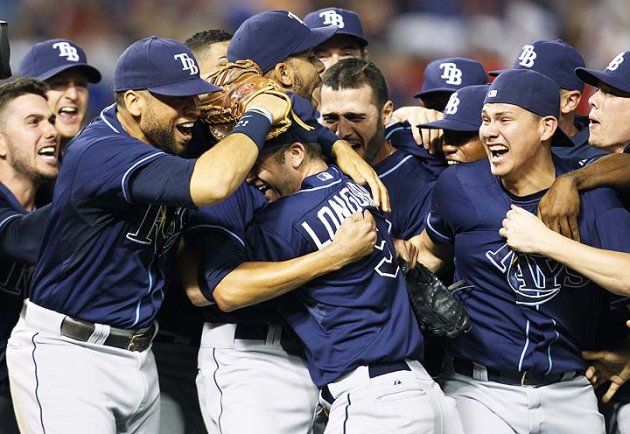
Rays Win Game 163

After their 5-2 win last night the Rays live to play another day (Yahoo Sports)
Last night the Tampa Bay Rays and Texas Rangers, both of whom finished the regular season with identical 91-71 records, squared off in Arlington last night to determine the American League's second Wild Card team.

This game--Game 163--wouldn't have happened two years ago. Instead, both teams would be lamenting how they finished one game behind the Cleveland Indians--the true Wild Card winners. But the times, and rules, have changed, so both teams were given a second shot at October baseball.

The Rangers were red-hot, having won seven straight games to close out the year. That sprint to the finish left Ron Washington unable to start Yu Darvish or Derek Holland. He went with 22 year-old rookie Martin Perez, who acquitted himself well this year but wouldn't have been anyone's first choice to start a game of this magnitude.

That's what made the Rays clear favorites to win. In this do-or-die, win-or-go-home cage-match,Tampa Bay turned to its ace and reigning AL Cy Young winner David Price. Putting his postseason struggles against Texas aside, the three-time All-Star is widely considered to be one of baseball's best pitchers and his availability seemed likely to swing the game in Tampa Bay's favor.

Sure enough, it did. Price pitched the Rays into the playoffs by going the distance, scattering seven hits and allowing just two runs. Tampa Bay staked him to an early lead, drawing first blood on Delmon Young's sac fly in the top of the first. The Rays led from that point forward, and with Price pitching their lead was never seriously threatened.

Perez didn't pitch poorly, but simply wasn't good enough to outduel Price. He departed in the sixth after striking out Ben Zobrist to open the frame, giving way to Alexi Ogando. Texas was losing 3-1 at the time, but doubles from Evan Longoria and David DeJesus made that deficit 4-1 before Ogando could close out the inning.

The Rangers responded with a run in their half of the inning on an RBI double from Alex Rios, but Price shut them out for the rest of the night. Tampa added an insurance run in the top of the ninth to make the score 5-2. Rather than tap into his bullpen, Joe Maddon let Price, who had thrown 108 pitches through eight, come back out to finish what he started. He finished strong, setting down Adrian Beltre, A.J. Pierzynski and Nelson Cruz in order.

(Speaking of Cruz, all the hoopla surrounding his return from a 50 game suspension turned out to be much ado about nothing. Cruz was a non-factor, going 0-for-4 with a strikeout).

Price put the team on his back, but so did Evan Longoria, who continued his run of monster games on the final day of the season. Longo went 3-for-4 with a single, double, and two-run homer. The long ball was his seventh career blast on the final day of the season, breaking a tie with Stan Musial. Longoria clearly understands the importance of saving his best for last.

So for the second year in a row, the Rangers are headed home after narrowly missing the postseason and Washington will likely be fired as a result. The Rays travel to Cleveland, where they will take on Terry Francona's Indians tomorrow night in another sudden-death affair--the Wild Card (aka coin toss) playoff game. Tampa Bay will pin its playoff hopes on Alex Cobb, while Cleveland will ride rookie Danny Salazar, who has just ten big league starts under his belt.

Obviously this game could go either way, but my gut tells me the Rays will come out on top. I say Tampa Bay 4, Cleveland 3.

Sunday, March 24, 2013

AL Central Preview

1st Place--Detroit Tigers
2012 Record: 88-74
2012 Pythagorean: 87-75
2013 Projected: 92-70
The reigning American League champs should have no trouble winning their third straight division title in 2013. On paper, they're clearly the best team in the division and only got better over the offseason. Victor Martinez returns from a lost 2012 to join Motown mashers Miguel Cabrera and Prince Fielder in the heart of the order. Letting Delmon Young walk is addition by subtraction, whereas signing Torii Hunter is simply pure addition (unless the 37 year-old falls off a cliff). Austin Jackson quietly blossomed into one of the sport's top center fielders after adopting a more patient approach at the plate and could have an Andrew McCutchen-kind-of-year. I think Alex Avila bounces back after hitting .243 with nine home runs last year, but don't see him returning to 2011 form (neither will Jhonny Peralta). The Tigers have the best pitcher on the planet in Justin Verlander and a strong rotation to back him up. Max Scherzer got off to a rocky start last year but still posted the best strikeout rate in the majors last year. What's more, he compiled a sparkling 2.53 ERA after June 13th, better than Verlander's 2.61 mark over the same stretch. I say it every spring, but this might be the year he finally takes the leap. Detroit re-upped with Anibal Sanchez for five years and $88 million, which is a bit pricey for a number three but not bad considering he's pitched about as well as Zack Greinke (who got much more than that) over the past three seasons. Don't worry about Doug Fister's spring training woes--he'll be fine. Overall, the Tigers are deeper and more balanced than last year, so I'd be shocked if anyone else wins the AL Central.

2nd Place--Chicago White Sox
2012 Record: 85-77
2012 Pythagorean: 88-74
2013 Projected: 83-79
Robin Ventura's White Sox spent most of the season in first place, only to falter at the finish line and cough up the division in the season's final week. Chicago had a quiet offseason, letting Kevin Youkilis and A.J. Pierzynski walk but keeping the rest of their roster intact. Youk will be missed at the hot corner, esepcially since his replacement (Jeff Keppinger) offers little power and average defense at best. Pierzynski's departure opens the door for Tyler Flowers to play behind the plate everyday and infuse some youth into a veteran lineup. 37 year-old Paul Konerko has shown no signs of slowing down and should continue to be a force in the heart of Chicago's order along with Alex Rios and Adam Dunn, both of whom rebounded from miserable 2011s. In the outfield, Dayan Viciedo has 30-homer potential and Alejandro de Aza is a rock solid leadoff hitter/center fielder. The rotation is headed by two aces--2012 breakout Chris Sale and former Cy Young winner Jake Peavy--both of whom must sustain their success if Chicago is going to have any chance at keeping up with the Tigers this year. The oft-injured Peavy, 31, is hardly a sure thing given that he averaged just 17 starts per year from 2009-2011. Sale, soon to be 24, is a Verducci effect candidate after approaching 200 innings in his first full season as a starter. John Danks, Gavin Floyd, and Jose Quintana round out the rest of the rotation with Hector Santiago ready to step in if needed. The bullpen looks good for the most part, but Addison Reed needs to be more consistent if he wants to hang on to his closer's gig.

3rd Place--Cleveland Indians
2012 Record: 68-94
2012 Pythagorean: 64-98
2013 Projected: 80-82
Everything that could go wrong did go wrong for the Tribe last year, but they enter 2013 with significantly more talent. They upgraded their outfield outfield by signing Nick Swisher and Michael Bourn, signing slugging corner infielder Mark Reynolds to a cheap one-year deal and trading for Trevor Bauer, who projects to be a future ace. Cleveland is stacked up the middle: catcher Carlos Santana is primed for a breakout in his age 27 season, Jason Kipnis and Asdrubal Cabrera are a great double-play tandem, and Bourn is the best defensive center fielder in baseball not named Mike Trout. All four could be All-Stars this year, and it seems safe to say the Indians won't finish second-to-last in runs scored like they did last year. Of course,  it doesn't really matter how many more times they cross home plate if Cleveland finishes dead last in ERA again. I can't say I love their rotation, which lacks a true number one and two, but the good news is that Justin Masterson, Ubaldo Jimenez and Josh Tomlin have nowhere to go but up. If they can at least pitched as well as they did in 2011, then Cleveland will be in much better shape. Zach McAllister showed some promise as a rookie last year and could be a nice boon if he continues to develop. With veteran skipper Terry Francona at the helm, Cleveland now has one of the best managers of the past decade at the reins. The Indians aren't talented enough to surpass the Detroit Tigers in the AL Central but have the pieces to move above .500 for the first time since 2007.

4th Place--Kansas City Royals
2012 Record: 72-90
2012 Pythagorean: 74-88
2013 Projected: 77-85
Kansas City is loaded with young talent but made a critical blunder in trading future superstar Wil Myers for James Shields, a number two pitcher with a career 4.67 ERA pitching outside of a dome. He's not going to be the difference-maker GM Dayton Moore is expecting, so KC will have to rely on continued growth and maturity from its young core of position players. Lorenzo Cain, Mike Moustakas, Alcides Escobar, Salvador Perez, and Eric Hosmer in particular all need to be better than they were last year (so does Jeff Francoeur, who followed up his strong Royals debut by reminding everyone just how bad he really is). Billy Butler and Alex Gordon just have to keep doing their thing. Whereas the Royals' starting lineup is teeming with potential and upside, their starting rotation is staffed by so-so veterans like Bruce Chen, Ervin Santana, and Jeremy Guthrie. Shields is a lock to provide 220 quality innings, but I see him taking a substantial step back after moving out of the pitcher's haven known as Tropicana Field. Kansas City boasts a bullpen full of live arms, none of whom seem capable of developing into usable starting pitchers. The Royals could have a winning season if everything goes their way, but that's not going to be enough to snap their 27-year playoff drought.

5th Place--Minnesota Twins
2012 Record: 66-96
2012 Pythagorean: 68-94
2013 Projected: 67-95
The Twins were the Junior Circuit's worst team in 2011 and 2012, but lucky for them the Houston Astros switched leagues and will spare them from claiming that dubious distinction for a third straight season. Thanks to a  Harmon Killebrew-type year from slugger Josh Willingham and rebounds from Joe Mauer, Justin Morneau, and Ryan Doumit, the Twins fielded a decent lineup last year. Speedy outfielders Denard Span and Ben Revere will be missed, especially on defense. The Twins are never going to put up big offensive numbers so long as their playing half their games at Target Field. They need to be built around strong starting pitching, an asset that was in short supply last year. Breakout Scott Diamond was the only hurler to make more than 20 starts or complete more than 110 innings. Ron Gardenhire is counting on Diamond to be the ace of the staff, but Diamond is a mid-rotation starter at best. Furthermore, his complete and utter inability to miss bats (4.7 K/9 last year) makes him a likely bust candidate. Unlike last year, he figures to have some help in the rotation. GM Terry Ryan acquired Vance Worley, Mike Pelfrey, and Kevin Correia to fill out the staff, and while none of those names are exciting at least they are all capable big league pitchers. That's not saying much, but it represents a clear upgrade over last year's soft-tossing crew of Nick Blackburn, Brian Duensing, and Carl Pavano. Minnesota fans might as well start thinking about football season, because their baseball team isn't going anywhere anytime soon.

Wednesday, February 20, 2013

13 Bold Predictions for 2013

1. The Boston Red Sox make the playoffs
Why this is bold: The Red Sox lost 93 games last year and haven't won a postseason game since 2008. They improved during the offseason but failed to land the kind of high-impact player capable of adding six or seven wins to a roster by himself.

2. The New York Yankees miss the playoffs
Why this is bold: The Bronx bombers are October mainstays, having reached the postseason 17 times in the past 18 years. They won 95 games last year and enter 2013 with the highest payroll in the American League, a deep starting rotation and a veteran lineup loaded with All-Stars at almost every position.

3. B.J. Upton goes 30/30
Why this is bold: Upton's combination of power and speed is tantalizing, but he's yet to put together a 30/30 season. His power is trending upward but the fact remains that he's averaged just 18 home runs per season over the last five. Furthermore, his stolen base totals have decreased in each of the last two years, falling from 42 in 2010 to 36 in 2011 and 31 in 2012. I'm probably picking the wrong Upton.

4. Mariano Rivera leads the American League in saves
Why this is bold: The greatest closer of all time spent most of 2012 recovering from knee surgery after shredding his ACL while shagging fly balls during batting practice. Signed a one-year deal worth $10 million to return in 2013, but he's 43 years-old and Father Time is going to catch up to him at some point.

5. The Seattle Mariners and Cleveland Indians both have winning records
Why this is bold: Neither team had a winning record last year (or in 2011, or 2010, for that matter). The Mariners face stiff competition in the AL West, arguably the toughest division in baseball with LA, Oakland, and Texas all capable of winning 90+ ballgames. Furthermore, the two clubs haven't enjoyed winning seasons in the same year since 2007.

6. Dan Haren wins 20 games
Why this is bold: Haren's career high for wins is 16. Also, he's 32 years-old and coming off his worst full season as a pro.

7. Nick Swisher hits fewer than 20 home runs
Why this is bold: Since becoming an everyday player in 2005, Swish has never failed to smack less than 21 home runs in a season (averaging 26 per year). He's one of just six players who can claim that; the others are  Albert Pujols, Miguel Cabrera, Alfonso Soriano, Mark Teixeira, and David Ortiz.

8. Michael Young bats over .300
Why this is bold: Young is 36 and coming off his worst season in over a decade after batting just .277/.312/.370. He's batted below .285 in two of the past three years and seems to have entered the decline phase of his career. It certainly doesn't help that he's leaving the Ballpark in Arlington, where he batted .320 as opposed to .283 everywhere else.

9 Zack Greinke wins the NL Cy Young award
Why this is bold: Since winning the 2009 AL Cy Young in a landslide, Greinke's compiled a 3.83 ERA and has failed to receive a single vote for the award. Plus, he has formidable competition in his own rotation in the form of Clayton Kershaw.

10. Jim Johnson and Fernando Rodney combined have fewer saves than the AL saves leader
Why this is bold: Johnson led the major leagues with 51 saves last year, and Rodney was right behind him with 48.

11. Bryce Harper is better than Mike Trout
Why this is bold: The AL Rookie of the Year outproduced the NL Rookie of the Year in almost every conceivable metric last year.

12. Derek Jeter plays in fewer than 100 games
Why this is bold: Jeter may not be Cal Ripken Jr., but he's borderline indestructible. The Yankee legend has averaged 151 games played per year since winning the AL Rookie of the Year award in 1996, playing at least 148 games every year except for two (2003 and 2011).

13. The Toronto Blue Jays won't win the World Series
Why this is bold: Everyone's picking the bolstered Blue Jays to win the Fall Classic after a busy offseason in which Toronto added R.A. Dickey, Josh Johnson, Jose Reyes, Mark Buehrle, and Melky Cabrera without giving up any of their established talent.