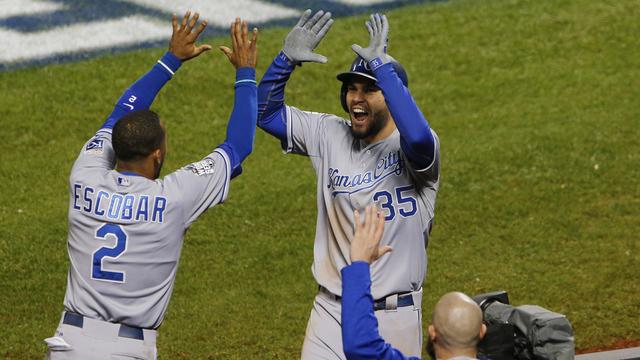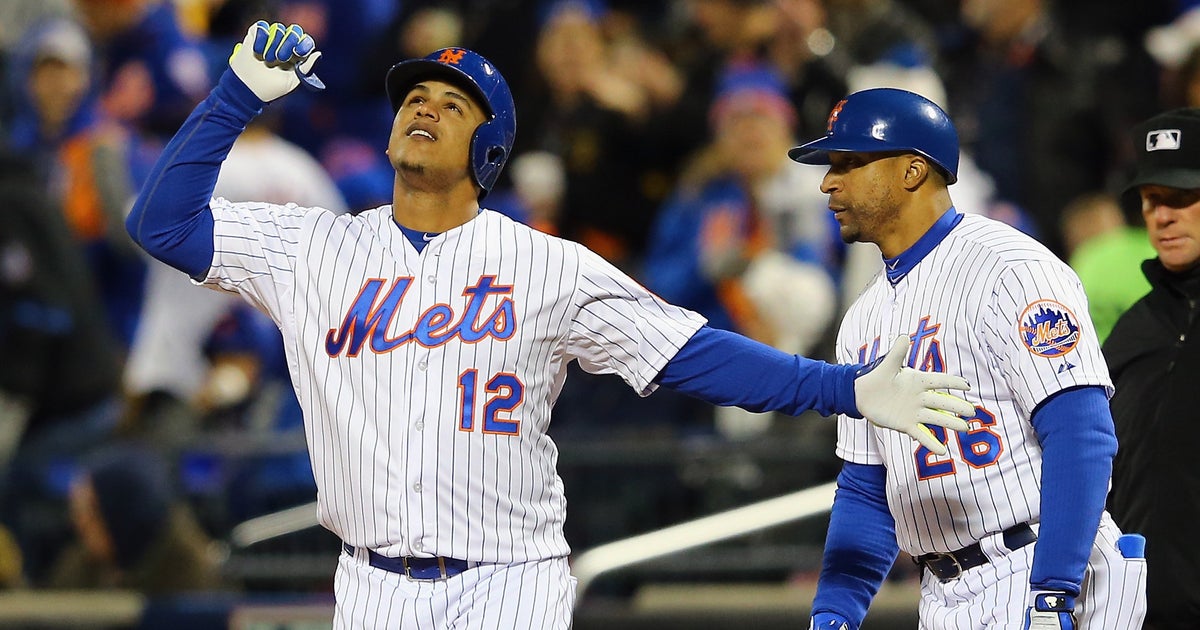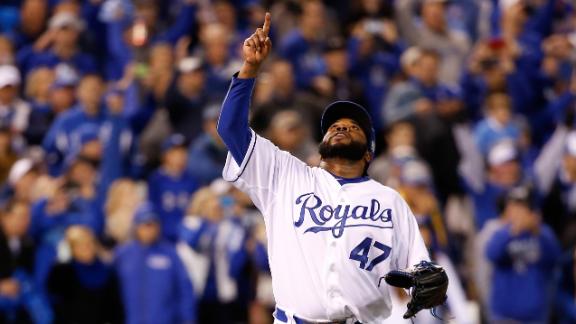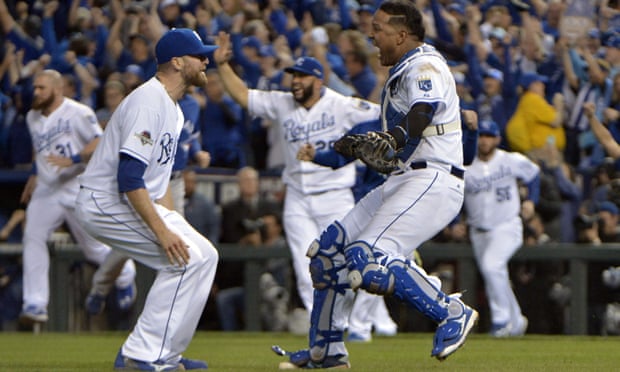
Showing posts with label Kansas City Royals. Show all posts

Monday, November 2, 2015

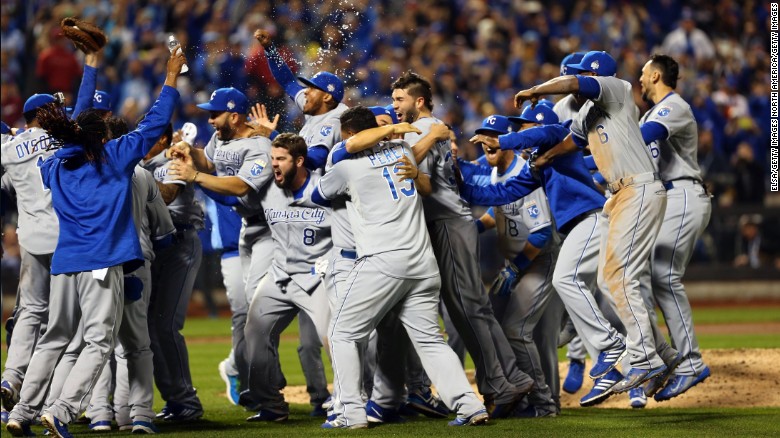
Royals Rally to Win Championship

Three of Kansas City's four wins in this series were come-from-behind (CNN)
It is easy to envision a scenario in which the New York Mets, and not the Kansas City Royals, were the ones celebrating their first championship in three decades yesterday.

In Game 1, the Mets took a 4-3 lead into the bottom of the ninth. After Jeurys Familia, who had been lights-out all year, got Salvador Perez to ground out, New York's chances of winning stood at 89 percent. The Mets were two outs--two stinking outs--away. They should have won this game. Alex Gordon homered, however, and the Royals ultimately prevailed in 14 innings.

In Game 4, the Mets looking to even the series at two games apiece after winning Game 3. They led 3-2 through seven. After Alcides Escobar grounded out to lead off the eighth, New York's odds of victory improved to 82 percent. Then Tyler Clippard (a mess all playoffs) issued two consecutive walks, bringing Familia into the game, and since Familia was clearly cursed this week of course things went south from there.

Familia got Eric Hosmer, the other hero of Game 1, to tap a slow-roller towards Daniel Murphy at second. Murphy came charging in, reached down to scoop it with his glove...and came up with nothing but air. Ben Zobrist scored, a sure out had been lost, and the game was tied. Back-to-back singles followed, giving Kansas City a 5-3 lead. The Royals, in case you hadn't noticed, don't blow 5-3 leads in the eighth inning or later. Like, ever. And they didn't.

As painful as those two losses were, both paled in comparison to the gut-wrenching defeat New York suffered in Game 5. With the Mets one loss away from elimination and Edinson Volquez throwing gas, they needed a gem from Matt Harvey. They got one, as he fired eight shutout innings, allowing just four hits and one walk while striking out nine. In the biggest game of his life, a game his team absolutely had to win, he'd been almost perfect.

Harvey walked off the mound after needing just nine pitches to get through a 1-2-3 top of the eighth. Citi Field's roaring applause followed him to the dugout, where he exchanged handshakes and high-fives with his teammates and coaches before collapsing onto the bench. Though the temperature had dropped into the 50s by that point, his face was covered in sweat.

While the Mets were batting in the bottom of the eighth, pitching coach Dan Warthen came over to inform Harvey that he was coming out of the game.

"No way," Harvey said. "No way, no way, no way."

Warthen was still talking, trying to tell the pitcher what a great job he did, but Harvey wasn't listening.

"No way," he repeated. "No way." In this moment, Harvey's vocabulary had been reduced to two words. He wouldn't take no for an answer.

Warthen hadn't finished talking yet when Harvey walked away, down the bench in search of Terry Collins. When he found him, he repeated what he'd said to Warthen.

"No way," Harvey said again. "No way am I coming out of this game."
Collins lets Harvey convince him to remain in the game (NY Post)
When Murphy struck out to conclude the eighth, Harvey hopped out of the dugout and strolled back to the pitcher's mound, much to the crowd's surprise. This was his game to win, or lose. He had gotten the Mets 89 percent of the way there, recording 24 of 27 outs. He only needed to get three more.

Players will say the last three outs of a ballgame are the toughest to get. History says otherwise, but against the Royals that is 100 percent accurate. For whatever reason, Kansas City has a knack for late game heroics. Just when it looks like you're about to finish them off, they jump back from the ropes and deliver a haymaker to the temple. Or, more appropriately, straight to the stomach.

It also helped that this time, Terry Collins was having a Grady Little moment. He'd sent a tired ace back out after throwing 102 pressure-packed pitches, not to mention 216 innings--postseason included--in his first year back from Tommy John surgery (the recommended limit is 160-180). The situation called for Collins to bring in his closer to finish out he game, which entailed facing Kansas City's 3-4-5 hitters, but Collins let Harvey have his way. Maybe he was spooked by Familia's meltdowns in Game 1 and Game 4. Maybe he was as mesmerized by Harvey as the Royals had been. Maybe he was swayed by Harvey's passionate plea to let him stay in. All we know is in that moment, he did not make the move he would have made in any of the 175 games that preceded this.

In all likelihood, it wouldn't have mattered. These Royals were a team of destiny, and they would have rallied no matter who Collins chose to pitch the ninth. But their odds were greatly improved by the presence of a gassed Harvey as opposed to a fresh reliever out of the 'pen. While their odds of winning were technically only six percent, they suddenly seemed much greater.

Any Red Sox fan could tell you what happened next. Harvey lost Lorenzo Cain on a full count and walked him, driving his pitch count up to 109. On pitch number 110, Cain stole second. On pitch 111, Hosmer launched a double down the left field line, scoring Cain and cutting New York's lead in half.

Collins had seen enough, and did what he should have done two batters beforehand. He took the ball out of Harvey's hands and summoned Familia.

The decision to let Harvey stay in looked even worse when Familia got three consecutive groundouts, the second of which scored a run only because there had been a man on second when he entered the game. Had he been allowed to start the inning, obviously, that would not have been the case.

And so the last game of the World Series, like the first one, went to extra innings. Not surprisingly Kansas City, with its superior bullpen, came out on top again. For the third time in a week, the Royals had come back to win a World Series game where they'd trailed in the eighth inning or later. For the third time in a week, the Mets had blown a game they had at least an 80 percent chance of winning.

And that is how we'll remember the 2015 World Series. The Mets faltering late in games, committing costly errors and not getting the big outs when they needed to, and the Royals, once again, proving they are impossible to kill.

Unless you have Madison Bumgarner.

Sunday, November 1, 2015

New York Needs a Miracle

Kansas City came back to win Game 4 (CBS Sports)
After yet another comeback win, the Kansas City Royals are one victory away from winning the World Series. The New York Mets, on the other hand, need to win three more times--in a row, including twice on the road--to capture the flag. Simple math would seem to favor the Royals.

But while the Mets are down, you can't say they're out. Not when they have Matt Harvey pitching tonight, Jacob deGrom going on Tuesday, and Noah Syndergaard starting Game 7 if needed. Those three rank among the best, hardest-throwing pitchers in baseball. When you have them lined up like that, you have a fighting chance against anybody.

It's just weird that the Mets find themselves in this position. After never trailing in the NLCS, New York has been playing catch-up this whole series, or at least since they lost Game 1. I felt at the time that their inability to hold onto that ninth inning lead would come back to haunt them, and sure enough, it has completely altered the Fall Classic's dynamic. If Alex Gordon flies out to the track there, or even hits it off the wall, the Series would be tied at two rather than 3-1 Royals. But in a best-of-seven, you can't afford to make those mistakes. Teams wins 95 percent of games they lead going into the ninth inning. During the most important games of the year, you better not have one of those 5 percent games, but the Mets have basically had two in five days.

Tonight's game will be a rematch between Game 1 starters Edinson Volquez and Matt Harvey, who compiled nearly identical stat lines in the Series opener. Volquez has been tough since suddenly finding an extra foot on his fastball, but Harvey's still the superior pitcher. He's had one very good start sandwiched between two decent turns this postseason, but he'll have to be at his absolute best tonight. When your team is one loss away from being eliminated, there's no margin for error.

Saturday, October 31, 2015

Mets Make Comeback, Win Game 3

The Mets emerged victorious in Game 3 (Huffington Post)
There's a comedian--Brian Regan--who does a funny bit about the dumb questions sports reporters ask. One of his examples; "is this a must-win game for you?", to which players always say things like "of course" or "definitely." As Regan points out, though, unless it's an elimination game, it never is a must-win. Obviously, as a competitor, you want to win every game, but very rarely do you actually have to win.

But after losing games 1 and 2 of the World Series in Kansas City, the New York Mets absolutely had to win Game 3. Sure, they could lose the third game and still win it all, but despite what the 2004 Red Sox and a handful of hockey teams have shown us, going down 3-0 in a best of seven series is a death sentence. It's just too hard to win four in a row against an elite team, especially when half those games are on the road.

Having already thrown their two aces (Matt Harvey and Jacob deGrom), the Mets pinned their hopes on Noah Syndergaard, their hard-throwing, lion-haired rookie. A kid who began the season in the minors and turned 23 two months ago--not exactly the grizzled, battle-hardened Jon Lester-type you'd want starting a game like that.

Nobody knew what to expect from Syndergaard last night, but it's safe to say nobody thought he'd open the biggest game of his life by buzzing Kansas City's leadoff batter on the very first pitch. Besides nearly inciting a riot in the Royals' dugout with that high and tight fastball aimed at Alcides Escobar's noggin, he also made a very loud, very clear statement; I'm the one in control here. We might be down in this series, but I'm not afraid of you. You're the ones who should be afraid of me.

His purpose pitch did, however, have the unintended side effect of lighting a fire under the Royals, who clearly don't take kindly to 98 mile-per-hour heaters headed for their helmets. They didn't wait around to exact revenge, knocking Syndergaard around for six hits and three runs through the first two innings. With Syndergaard struggling, it looked like it was going to be a long night for New York's bullpen, not to mention another victory for Kansas City.

Then, all of the sudden, Syndergaard became unhittable, He retired 12 Royals in a row, keeping Kansas City at bay while his teammates tied the game in the third, then took the lead in the fourth.

That is, until he ran into trouble again in the sixth. After fanning Lorenzo Cain and Eric Hosmer, he allowed Mike Moustakas to reach on an infield single. It was the kind of cheap hit that drives pitchers crazy, especially when  they come with two outs. That forced Syndergaard back to pitching out of the stretch for the first time in awhile, which seemed to disrupt his rhythm. He walked Salvador Perez--who probably would have taken a hack at that pitch that almost decapitated Escobar--on five pitches before losing Gordon on a full count.

With Syndergaard closing in on 100 pitches and New York's 5-3 lead very much in danger, the crowd at Citi Field began howling for a pitching change. One more hit would even the score and force Syndergaard out, turning the game into a battle of bullpens. Since that would obviously favor Kansas City, New York could not afford to lose its lead.

So it was curious, then, that Mets manager Terry Collins stayed put, sticking with Syndergaard as Alex Rios came up to bat. It was the most important at-bat of the game, and Collins had to choose between his tiring starter and a fresh reliever, albeit one from his shaky middle relief corps. He went with the former, hoping for one more out from the rookie. On his 100th pitch of the night, Syndergaard got it, suffocating Kansas City's rally and preserving New York's lead at two.

The lead would grow to six by the end of the inning, as the Mets erupted for four runs in their half of the frame. New York's bullpen took it from there, doing their best impression of the Royals' relief corps by shutting down Kansas City over the final three innings. So dominant were the Mets relievers that the Royals didn't manage so much as a single baserunner. And with that, it was a series again.

The Mets will send another rookie, Steven Matz, to the mound tonight as they look to even the Series at two-all. A native New Yorker, Matz understands the pressure riding on this game. It's the most important one of the series, as there's a huge difference between being tied at two games apiece versus being one loss shy of elimination. It's his job to ensure the former.

On the other side, the Royals will try to get back on track behind Chris Young. who surprised everyone by emerging as their best pitcher this year. A full 12 years older than Matz, he has a solid decade of major league experience on his kid opponent. And thanks to his relief appearance in Game 1, he has more World Series experience under his belt, too. Young was the winning pitcher in that crazy marathon, firing three hitless innings out of the 'pen as he put the sleepy Mets to bed. We'll see if he can do the same against their refreshed lineup tonight.

Thursday, October 29, 2015

Game 2: Royals Roll

Cueto came up big last night for Kansas City (ABC News)
Six weeks ago, mired in perhaps the worst cold spell of his career, Johnny Cueto looked totally lost. After being one of the best pitchers in baseball during the first half, he'd come over to Kansas City in late July and promptly lost his mojo. He couldn't strike anybody out, and he was getting torched every time he took the mound. Over a four-week stretch his ERA approached 10. His transition to the American League was not going well, to say the least.

As his struggles persisted into mid-September, they raised alarm over whether Kansas City could rely on him come playoff time. The whole reason they'd got him was to bolster their middling rotation, which lacked a clear-cut number one without James Shields, and they believed that in order to win the World Series they needed an ace. When they acquired him, Cueto certainly qualified as such. Just one month later, however, he seemed completely broken.

That is, until pitching coach Dave Eiland fixed him. Eiland noticed Cueto's left shoulder flying open during his delivery, causing his pitches to flatten out. His cutter in particular had become straight as an arrow. He called Cueto in to have a look at the tape, and together they saw why the star pitcher was getting creamed.

Cueto was fine the rest of way, allowing three earned runs or fewer in each of his last starts. But Royals fans still had reason to be concerned. The final few weeks of the regular season amounted to garbage time for Kansas City, who'd locked up the AL Central before Cueto even arrived. How would he hold up during the most pressure-packed games of the season, especially after suffering an apparent "crisis of confidence" so late in the season?

Those doubts still lingered before last night's game, as Cueto had been shelled in his most recent outing against Toronto. The Blue Jays battered him for eight runs in two innings, teeing off on him like it was batting practice. It was by far his worst start of the season, worse than any of his late-summer beatings. His ERA since joining the Royals, postseason included, was now 5.27. With an unbeaten (in the postseason) Jacob deGrom lined up to face Cueto, Game 2 seemed likely to go New York's way.

Then the game started, and all of the sudden Cueto could do no wrong.
Cueto and the Royals celebrate their 7-1 victory over the Mets (Click2Houston)
Last night was a perfect example of why Dayton Moore traded for Cueto back in July, even with the playoffs all but assured by that point. When he's on, he's one of the best pitchers in the game.
Cueto delivered his best start since early August, spinning a complete game two-hitter as Kansas City trounced New York, 7-1. By GameScore, it was his best start since he shut out Detroit on August 10th. It was also the best postseason start of his career.

Kansas City's dreadlocked ace was dominant from the start, zipping through the first three innings while facing the minimum nine batters. He hit a snag his second time through the order, walking two and letting in the game's first run on a flare single by Lucas Duda with two outs in the fourth. Beyond that, though, Cueto was unstoppable. He retired the next 15 in a row, allowing just one baserunner (a Daniel Murphy walk) the rest of the way.

With Cueto starting opposite deGrom, Game 2 was billed as the best pitching matchup of the series. For the first half of the game, it certainly was. Both stumbled in the fourth, however, with Cueto surrendering the first run of the game and deGrom getting out of a bases loaded jam. But whereas Cueto settled down after his minor hiccup, deGrom disintegrated the very next inning.
The trouble started when Alex Gordon, the hero of Game 1, led off with a full-count walk.

Alex Rios, the Royals' most regrettable offseaon pickup, followed with a single to move Gordon up to second. That brought Alcides Escobar, who got the scoring started the previous night with his mad dash around the bases, to the plate. Once again, he delivered Kansas City's first run of the game, slapping a single up the middle that plated Gordon and tied the game.

After Ben Zobrist grounded out and Lorenzo Cain lined out, it looked like deGrom would escape the inning without further damage. Until Eric Hosmer, another Game 1 hero, struck again, poking a single up the middle that scored both Rios and Escobar. According to win probability added, it was the biggest play of the game, increasing Kansas City's chances of winning the game from 58 percent to 80 percent. Successive singles by Kendrys Morales and Mike Moustakas added another run to KC's ledger, improving their odds of victory to 87 percent by the end of the frame.

After that it was all Kansas City. Cueto cruised the rest of the way while New York's bullpen, summoned back into action after a taxing effort in Game 1, allowed three additional runs in the eighth to put the game out of reach. That also gave Cueto plenty of leeway with which to finish his start and saving Ned Yost the trouble of warming anyone up in case Cueto faltered. With a maximum of one more start this season (plus a possible Madison Bumgarner-esque relief effort if the series goes seven), the free agent-to-be was permitted to come back out for the ninth even though he'd already thrown 106 pitches. He finished the game having thrown 122.

Cueto did what deGrom could not--he saved the bullpen after an exhausting Game 1.
More importantly, he gave his team a commanding 2-0 series lead, bringing Kansas City to within two wins of its first World Series championship in 30 years.

Now, the Mets' championship hopes ride on a rookie starting pitcher who turned 23 two months ago. Make no mistake, Noah Syndergaard will be up to the challenge based on how he's performed up to this point, but you just never know how he'll handle this kind of pressure-cooker. He has to pitch knowing that if he loses, his team is in an 0-3 hole and their season is effectively over. That's a ton of pressure on a kid making his first World Series start.

The pitcher he's going up against, Yordano Ventura, isn't much older at 24. Ventura does have World Series experience, however, so he's been there before. His team is in the driver's seat, so he can pitch relatively worry-free.

While Game 2 was supposed to be a pitcher's duel, Game 3 has similar potential. Syndergaard and Ventura are two of the hardest throwers in the game today, which makes their matchup especially intriguing. Syndergaard's been the superior pitcher this year (in both the regular season and postseason), but Ventura does have that World Series experience to draw on. New York would seem to have the advantage, being at home with the better pitcher on the mound, but either hurtler is certainly capable of the kind of virtuoso performance Cueto enjoyed last night.

The Mets just better hope that their guy's better, because if not then they're finished.

Wednesday, October 28, 2015

Game 1: Royals Rally as Mets Melt Down

The Royals celebrate their walk-off win in Game 1 (ABC News)
Well, the World Series is certainly off to a great start.
 
I have to admit, I wasn't too excited about this year's Fall Classic. I didn't read the standard previews or carefully compare the two rosters. I simultaneously want both teams to win while not caring deeply about who ultimately prevails. I just don't have a dog in this fight.
 
But after last night, I think I might be getting sucked in. I was in New York yesterday on business, and I could feel the electricity in the air as I traversed downtown Manhattan. I passed throngs of New Yorkers donning blue Mets caps, wrapped in Mets jackets, and walking a little taller knowing their team is possibly championship-bound. I also noticed the kind of nervous faces and hurried walks that only manifest themselves when your team is on the eve of its biggest game of the season.
 
I'm sure the Mets and Royals were in a similar state as Game 1 approached. After spending all day watching rain fall on Kaufmann Stadium, they had no idea if they'd get to play. Thankfully they did, as the Mets and Royals proceeded to play one of the most thrilling World Series games of my lifetime.
 
Seriously, it was some game. An instant classic from the start.
 
We should have known we were in for a special night four batters into the game. Leading off the bottom of the first, Alcides Escobar launched Matt Harvey's first pitch of the evening into the left-center field gap. Yoenis Cespedes--a corner outfielder moonlighting in center--caught up to the ball but did not catch it. Left fielder Michael Conforto was converging on the play as well, creating some confusion as to whose ball it was. Neither called for it so Cespedes didn't get his glove up until it was too late, allowing the ball to land at his feet.
 
Still running full speed towards the wall, he compounded his mistake by kicking the ball, which bounced off the fence and skidded away from both Mets outfielders. By the time Conforto caught up to it in left field, Escobar was already rounding third and heading for home. He made it in standing up, without a throw, and when he crossed home plate he'd completed the 12th inside the park home run in World Series history--the first since 1929.
 
If you're the Mets, that's the worst possible way to start the World Series. After not trailing once in the NLCS, you find yourself down after one pitch and a play that should have been made. Plus you're on the road, and now 40,000 Royals fans are up and cheering before they've even had time to settle into their seats.
 
But New York didn't panic, didn't unravel after committing such a costly mistake to start the game. Harvey settled down, keeping Kansas City off the board until the sixth, by which point the Mets had gone ahead 3-1.
 
After five, New York appeared to be cruising. Not only were they winning, but Harvey had thrown just 62 pitches. He was on a roll, having retired the last 11 Royals in a row, and appeared to have a few more innings in him. In the Mets dugout, Terry Collins was hopeful he wouldn't have to call upon his shaky middle relievers in this one.
Escobar flies around the bases on his historic homer (NBC Sports)
That dream quickly came to an end, however, as Harvey immediately got himself into trouble. Ben Zobrist drilled his first pitch of the inning for a double, and Lorenzo Cain followed with a single that put runners on the corners. Hosmer hit an 0-2 pitch deep to center, and while it stayed in the yard it was still plenty deep enough to plate Zobrist.
 
Then, on what might have been the biggest play of the game, Cain stole second to put himself in scoring position. That proved huge when, after Kendrys Morales grounded out to Harvey, Mike Moustakas roped a single back up the middle to score Cain and tie the game.
 
It didn't look like it would matter when the Mets re-took the lead in the top of the eighth, pulling ahead 4-3 on Eric Hosmer's untimely error. That set the stage for a dramatic ninth inning, another showcase for Kanas City's incredible resilience.
 
The indomitable Jeurys Familia had already recorded two outs, needing just two more to nail down the victory for New York.  The Royals' chances of winning the game had been reduced to 11 percent.
 
These numbers apparently mean nothing to Kansas City, however, because the less likely they are to win the better they play. No matter how dire the situation gets, they always find a way to come back from the dead.
 
Fortunately for the Royals, they had their best player up in this critical moment--Alex Gordon. But Gordon is not really a slugger--he had just 13 home runs this year and 19 last year--and the Royals hadn't cleared the fences all night. They seemed unlikely to do so now, against a pitcher who had not allowed a run this postseason after posting a 1.85 ERA during the regular season.
 
But nobody's impenetrable come playoff time, not even Mariano Rivera. Gordon put a good swing on Familia's third offering of the at-bat and drove it out to center field, the deepest part of the ballpark. At first it looked like defensive replacement Juan Lagares might have a play, but the ball kept carrying, and carrying, until it carried right over the wall. Just like that, it was a brand new ballgame. Kansas City was still alive.
 
The game went into extra innings, and both teams began emptying out their bullpens. The 10th inning passed without any score, and so did the 11th. Nobody scored in the 12th, either. The 13th came and went, and still the score was knotted at 4-4.
 
By the middle of the 14th, both teams appeared to be dragging. The game was nearing the five hour mark, which meant both teams had exhausted their adrenaline supplies long ago. They'd spent their top relievers, too; Bartolo Colon was in the game now, ready to pitch until sunrise if he had to. It was after one in the morning, far too late (early?) to be playing baseball.
 
So the Royals ended it, right then and there. They got an assist from David Wright, whose throwing error allowed Escobar to reach safely with nobody out. Zobrist knocked a single--his third hit of the game--into right field, sending Escobar to third. Colon intentionally walked Cain to load the bases, setting up a force play at any base.
 
That brought up Hosmer, who'd helped key Kansas City's sixth inning rally but also made the miscue that nearly cost them the game. Now he had the chance to be the hero, the guy who finally ended this thing once and for all.
 
Thankfully he did, lifting a fly ball to right that scored Escobar easily. Curtis Granderson, with his noodle arm, never had a chance. Had it been Cespedes out there (Collins had moved him to left), there would have been a bang-bang play at the plate. Both teams might still be playing.
 
Based on the box score's symmetry, they probably would be. They scored the same amount of runs through 13 innings and wound up with equal numbers of hits and errors. Both teams hit one out-of-the-park home run. Matt Harvey and Edinson Volquez produced nearly identical pitching lines. Both bullpens performed admirably, but in the end Kansas City's superior relievers won out.
 
Going into this series the two contestants seemed evenly matched, and that's even more true today. The Mets will look to even the Series behind Jacob deGrom tonight, while the Royals will try to take a 2-0 lead to New York with Johnny Cueto on the hill. In a matchup of aces, we should be in for another nailbiter, but it will be tough to top last night's game.
 
I can tell you one thing; I'll be watching to find out.
 

Sunday, October 25, 2015

Royals Return to Series

They're baaaaack (image courtesy of the Guardian)
The Kansas City Royals came within one game of winning it all last year. Now they're back to finish the job.

I still can't believe Kansas City is in the World Series--again. Last year seemed like such a fluke, from their crazy comeback against Oakland in the wild card game to stunning sweeps in the ALDS and ALCS. Were it not for Madison Bumgarner, they would've beaten the Giants, too. They'd overachieved by leaps and bounds, especially considering they'd only outscored opponents by 27 runs during the regular season.

That's why this year, I didn't see the Royals going .500 and certainly not getting back to the World Series. They hadn't been very good to start with and seemed due for serious regression, especially after losing James Shields and Billy Butler to free agency and spending what little money they had on guys who weren't very good (Alex Rios? Edinson Volquez? Kendrys Morales?). Compared to other teams, they were dangerously low on star power. Furthermore, Kansas City's strengths--speed, bullpen, and defense--are highly volatile, making its success more difficult to sustain.

Once again, however, everything fell into place for the Royals. Their new pickups (minus Rios) played well, and their bullpen was even stingier than it was last year. Lorenzo Cain emerged as an MVP candidate, while Eric Hosmer and Mike Moustakas finally started living up to their potential. They were aided by trade deadline reinforcements in Johnny Cueto and Ben Zobrist. Their defense remained airtight.

It also helped that the rest of their division cleared a path for them. The Tigers finally broke down, the Indians failed to take the next step, and the Twins and White Sox both fizzled out. That enabled the Royals to not only win AL Central handily, by a dozen games, but also helped them secure the best record in the American League and homefield advantage throughout the playoffs. That's been huge for Kansas City, who have won five straight at home since dropping Game 1 of the ALDS to Houston.

Now, for the second time in as many years, Kansas City will host the World Series. Once again, the Royals will have to go through some tough pitching, though this time there will be no Bumgarner standing in their way. Instead, they'll need to overcome Matt Harvey, Jacob deGrom, and Noah Syndergaard, three fireballers who will put their contact skills to the test. They'll also have to find a way to neutralize Daniel Murphy, something nobody's been able to do thus far.

I think the Mets have more talent and are more dangerous, especially because their starting pitching is so superior. Their offense has also been ridiculously hot over the past three months, which if it continues will force Kansas City's starters early from the game and take their relievers out of play. That being said, I do think the Royals have a more balanced team and deeper lineup, so it won't be a cakewalk for New York. Mets in six.


Saturday, October 17, 2015

ALCS a Heavyweight Showdown

The reigning AL champs are itching to get back to the Series (Bleeding Royal Blue)
Because of baseball's division format, added wild card games, and the sheer randomness that ensues in a best-of-five series, it's become exceedingly rare that the two best teams (record-wise) meet up in the league championship series. This is only the fourth such time in the American League since the wild card era began in 1995.

But in a year where all but three American League teams finished within seven games of .500 (how's that for parity?), the Toronto Blue Jays and Kansas City Royals were head and shoulders above everyone else. The Royals had the league's best record (95-67), and the Blue Jays its top run-differential (+221). They were the only AL teams to top 90 wins this year.

How they got here is quite interesting. The defending AL champs appeared to take a step back over the winter, losing ace James Shields to free agency and making a host of questionable free agent signings. Experts thought they'd be lucky to crack .500, let alone return to the postseason. But Kansas City got off to a hot start and never looked back, spending just 19 days out of first and never a day below second. They took over first place for good on June 8th, running away with a middling AL Central. Two months later they'd built up a double-digit lead and maintained it the rest of the way, winning their division by a whopping 12 games.

But whereas Kansas City cruised through the regular season, Toronto spent most of the year playing catch-up. After an active offseason in which they traded for Josh Donaldson and signed Russell Martin, the Jays were a popular pick to make the playoffs, if not win the division.

So it was surprising when Toronto started slow, playing losing baseball for the first two months. They'd slipped to last in the AL East by Memorial Day and were still seven games below .500 one week later. They begin digging themselves out with a sizzling June, only to flounder again in July. Toronto limped into the break with a losing record, having dropped 10 of 14 leading up to the Midsummer Classic. Their struggles continued throughout the rest of July, only coming to an end when the team acquired David Price and Troy Tulowitzki just before the trade deadline.

When Troy Tulowitzki came over on July 28th, the Jays were still one game below .500. Supplemented by David Price two days later, they won 14 of their next 15 and began steamrolling the American League. The Blue Jays became the hottest team in baseball, winning 43 of their final 61 games, good for a ridiculous .705 winning percentage--this from a team that hadn't managed to win even half its games for four solid months.

Toronto wasn't the only team to land a pair of big names at the deadline, though. Kansas City also made waves, fetching an ace in Johnny Cueto and bolstering its lineup with Ben Zobrist.
Both teams instantly took on the look of World Series contenders, so it's only fitting that they're playing each other for the rights to be in the Fall Classic.

The Royals, of course, were just there last year, and would have won were it not for a herculean effort by Madison Bumgarner. After coming oh so close, Kansas City is determined not just to get back to the Series, but to win it.

So are the Blue Jays, who just snapped the longest active postseason drought in American professional sports. With Price a free agent at season's end and many of their best players about to join him soon, the time to win is now. This could be their last, best chance for awhile.
Toronto's power makes them a formidable opponent (Betting Talk)
A few days ago, it didn't look like either one would survive the ALDS. Both were on the cusp of losing to inferior teams, just one game away from elimination. Toronto went down 0-2, dropping the first two games to Texas at home. When the Jays lost Game 2, blowing an eighth-inning lead and losing in extra innings, it felt like Toronto's fans had just seen the last game at the Rogers Centre this year. The Blue Jays' season was about to end in disappointment.

But Texas, who recently failed to win a World Series despite being one strike away twice, was once again unable to finish the job. Toronto battled back, winning both games in Arlington to force Game 5 and return the series north of the border. Having burned through Price in Game 4 and facing Cole Hamels, however, the Jays appeared to be at a major disadvantage, especially after the Rangers grabbed an early lead and still led after the seventh-inning stretch. Once again, it looked like Toronto's season would end in tragedy.

Until the Rangers imploded, committing three straight errors and choking away the game in one of the craziest innings I've ever seen.

The Royals were in similarly dire straits, losing two of three to begin the series and staring down a four-run deficit in Game 4. With just six outs left in their season, the odds of them living to play another day were three percent.

But for the second year in a row, the Royals rallied from down four runs in a must-win elimination game, snatching victory from the jaws of defeat. They stunned Houston with a five-run frame, then tacked on two more in the ninth for good measure. Back in Kansas City, they won Game 5 two days later, overcoming another early deficit to send the Astros packing.

So now that they're here, who's the better team? The Royals were the American League's best team wire-to-wire, but the Blue Jays were the best team in baseball after the All-Star Break. We know momentum doesn't matter heading into a playoff series, but both teams have to be feeling pretty good about themselves after cheating death in the ALDS.

The Blue Jays were actually a much better regular season team than the Royals despite winning fewer games. They played in a tougher division and outscored Kansas City by 167 runs--more than one per game. Their run prevention was nearly as good, too, allowing only 29 more runs than Kansas City. According to Bill James's pythagorean model, which estimates how many games a team should have won based on its run differential, Toronto should have won 102 games this year--or nine more than they actually won. The Royals--winners of 95--would have been expected to win 90.

The gulf in talent becomes obvious after a quick comparison between the two rosters. Toronto boasts an All-Star lineup with Donaldson, Martin, Tulo, Jose Bautista, and Edwin Encarnacion. They also have the AL's best pitcher at the moment in Price, who might, as Bumgarner showed last year, win the series all by himself.

Which is why even though Kansas City sports the superior regular season record (and thus home field advantage), I sense that Toronto is the better team. This series won't prove that, of course, and the Royals are obviously good enough to win. I just think the Jays have more talent. I was originally going to say Toronto in six, but after Kansas City's Game 1 win I'm revising it to Toronto in seven.

Friday, July 31, 2015

Royals Reel in Big Fish

Cueto can help Kansas City win it all (Kansas City Star)
It was surprising--nay, shocking--that the Royals were the first team to make a major splash leading up to the deadline, landing Johnny Cueto on an otherwise sleepy Sunday. Not just because they already had the best record in the American League and were favored to win the World Series, but because it was totally out of character for an organization known for its restraint whenever superstars become available.

They Royals, because they are a small-market team with an average payroll, rarely generate shockwaves of this magnitude. Their last was the intensely-ridiculed Wil Myers for James Shield swap, which happened nearly three years ago. That the trade actually ended up working out better for Kansas City than it did for Tampa Bay, who promptly dumped Myers on San Diego two years after the fact, is besides the point. The point is that the Royals rarely come up whenever big name players are discussed, largely because they can't afford them. Giving somebody a lengthy nine-figure contract is simply out of the question.

But while that's the case for many teams, most can afford a superstar's final months before he reaches free agency, even the Royals. The issue is no longer salary, then, but the prospects one must give up to net such a big fish. When you're in the playoff hunt and every win counts, it can be worth it to sacrifice tomorrow for today. But for Kansas City, an organization that builds and develops from within, mortgaging the future for a few months of an elite rental was never in their best interest, especially because they were never in contention. Two months of a star player doesn't make a difference when you're in last place.

Well, the Royals are no longer also-rans: they are legitimate contenders, and when you're a contender you have to try to separate yourself from the other contenders. You have to plug your leaks as best you can, whether that means shoring up the bullpen, adding a frontline starter, or bringing in another bat. Stand still, and you run the risk of getting passed.

It's been awhile since the Royals were buyers at the trade deadline--usually they're at the other end of the table--and it felt like a ravenous tiger being let of its cage. They pounced, coming away with Johnny Cueto and Ben Zobrist to kick off a busy week across baseball. They might not be done--they could still use another arm--but they have to be satisfied with impressive haul.

The cost for Cueto was steep--three young lefthanded pitchers--but should also pay big dividends in the short-term. In Cueto, the Royals finally have a legitimate ace to replace James Shields, who departed over the winter via free agency. He's somebody you want to hand the ball when a championship's on the line, because he's someone who's capable of doing what Madison Bumgarner did last October. We're talking about a guy who's had an ERA in the twos each of the past five seasons, who led his league in strikeouts and innings pitched last year, and who won 20 games last year while finishing second to Clay Kershaw in the NL Cy Young vote last year.

That's a stud.
Zobrist was brought in to help replace Alex Gordon's production (Grantland)
Most teams would have been happy to add Cueto and called it a day, but Kansas City didn't stop there. Two days later, in what was only the third-biggest deal of a wild day that saw Troy Tulowitzki (more on him later) and Jonathan Papelbon change hands, the Royals reeled in Ben Zobrist from the flatlining A's.

Even at 34, Zobrist is still one of the most impactful players in the game today. Like Cueto, he's been criminally underrated despite ranking third among position players in fWAR since 2009, behind a couple of guys named Miguel Cabrera and Andrew McCutchen. Also like Cueto, he's going to be a free agent at year's end, meaning he'll likely be playing elsewhere next year.

Even so, two months (hopefully three) of Zobrist and Cueto beats no months of them. Because of Oakland's poor play and a knee injury that limited him to just 14 games through May 25th, Zobrist has flown under the radar even more than usual this year. When healthy, however, he's been his usual self, flashing strong on-base numbers, medium power, and the ability to man multiple positions. A jack of all trades who can hit--think Brock Holt--has real value, not just in the depth charts but on the field everyday. He can fill the void left by Alex Gordon in left field until Gordon returns--possibly by early September--then play wherever Ned Yost needs him.

Royals GM Dayton Moore has made numerous miscalculations during his underwhelming tenure, several of which occurred just this past winter, but it's safe to say trading for Cueto and Zorbist won't join them. On the contrary, this week has to be considered his finest hour. Although his team has the best record in the American League and a cushy lead over a mediocre AL Central, he wasn't content with cruising into the postseason. He knew that his team, as well as they've played, was not going to win the World Series without help, so he went out and got it.

Moore could have just as easily done nothing because hey, if it ain't broke, why fix it? But he looked at his team, saw an aceless rotation and a gaping hole in the lineup, and made the necessary moves to quickly address them. That's his job, sure, but for him to score two huge victories during the busiest week of the baseball year--when everyone and their mother is trying to do something--well, that deserves applause.

I wonder how much of his aggression, if any, can be traced back to Kansas City's Game 7 loss in last year's World Series. To come so close to winning it all and lose, with the tying run on third base, isn't just heartbreaking--it's soul-crushing. How much did that that inspire them to double down, like the Red Sox did after losing Game 7 of the 2003 ALCS, in order to get over the hump? The Royals hadn't made the playoffs since 1985 before last year, so they know how rare these opportunities are. They've waited long enough. Their time is now, and they know there's a weak American League out there for the taking. They already had a clear path to the postseason, but now they're better positioned to get back to the World Series, where they'll have another crack at winning their first championship in 30 years.

As seen by this year's All-Star "voting," interest in the Royals has never been higher. Kudos to Moore for trying to capitalize on that by dramatically strengthening his team for the stretch run. Last year won the fans back, and this year's going to keep them there. Sometimes even when you're at the top, you have to reach just a little bit higher.

Monday, June 22, 2015

Red Sox Rout Royals

Ramirez kicked off the scoring with his second inning solo shot (Boston Herald)
In the midst of a season where everything that could go wrong has gone wrong, the last-place Red Sox enjoyed a day where everything went right.

Boston authored its most dominant victory of the season yesterday, bludgeoning the Kansas City Royals 13-2. The 13 runs marked a season high for the Sox, who lost the only other time they scored in double digits this season. It was also the team's largest margin of victory this year, surpassing their 8-0 pasting of the moribund Philadelphia Phillies back on Opening Day.

A season that began with so much hope and promise has quickly deteriorated into a nightmare. In between those two routs the Red Sox were abysmal, going 29-40 and getting outscored by 64 runs. There is no quick fix, as their pitching, hitting, baserunning, and defense have all been horrendous. Frustration seems to be setting in, first manifesting itself in the form of Wade Miley's outburst in Baltimore, then again on Saturday with David Ortiz's ejection.

But on Father's Day, at least, all was right in Red Sox Nation. Boston didn't just beat the best team in the American League (on the road, no less); they clobbered them. The bats, mysteriously quiet for much of the spring, came alive on the first day of summer to pound out 16 hits, all but three of which went for extra bases. Miley continued to redeem himself in the aftermath of his blow-up with six shutout innings, lowering his ERA to 4.50 after his second straight strong outing.

It has to be a great feeling as the Red Sox return home for a three-game set with the O's, having just won their first series in two weeks. Mookie Betts, back in the leadoff spot, scored three times and was a single shy of the cycle in extending his hitting streak to nine games. Brock Holt, who cycled on Tuesday, bolstered his line with a triple and two doubles. Dustin Pedroia also had a trio of hits including two doubles, shaking off the knee soreness that caused him two miss two games earlier in the week and snapping a stretch of 12 hitless at-bats.

Ortiz, still smoldering from Saturday's ejection, belted a towering home run over the right field bullpen. The blast--Papi's fourth in the past 11 days--was also the 476th of his career, breaking a tie with Stan Musial and Willie Stargell for 30th on the all-time list. Hanley Ramirez hit a monster home run of his own, crushing his team-leading 15th of the year over the left field bullpen for the game's first run. Xander Bogaerts continued to impress at the plate with three doubles and a game-high three RBI.

Miley, meanwhile, allowed eight Royals to reach base in his six innings but none to score--impressive given that he notched just two strikeouts. It helped that the Boston defense behind him did not commit any errors.

This is exactly the kind of game Ben Cherington must have envisioned when he brought in Ramirez and Pablo Sandoval over the winter, assembling what at the time was widely thought to be the best offense in baseball. The Red Sox were supposedly returning to the formula that helped them win it all in 2013, building a deep lineup that could blow teams out of the water on any given night. It hasn't panned out that way, but perhaps with the weather warming and several Sox hitters coming around, the team's frustrated fans may finally get to see what Boston's bats are capable of.