Showing posts with label Craig Kimbrel. Show all posts

Wednesday, July 12, 2017

Breaking Down Boston's All-Stars

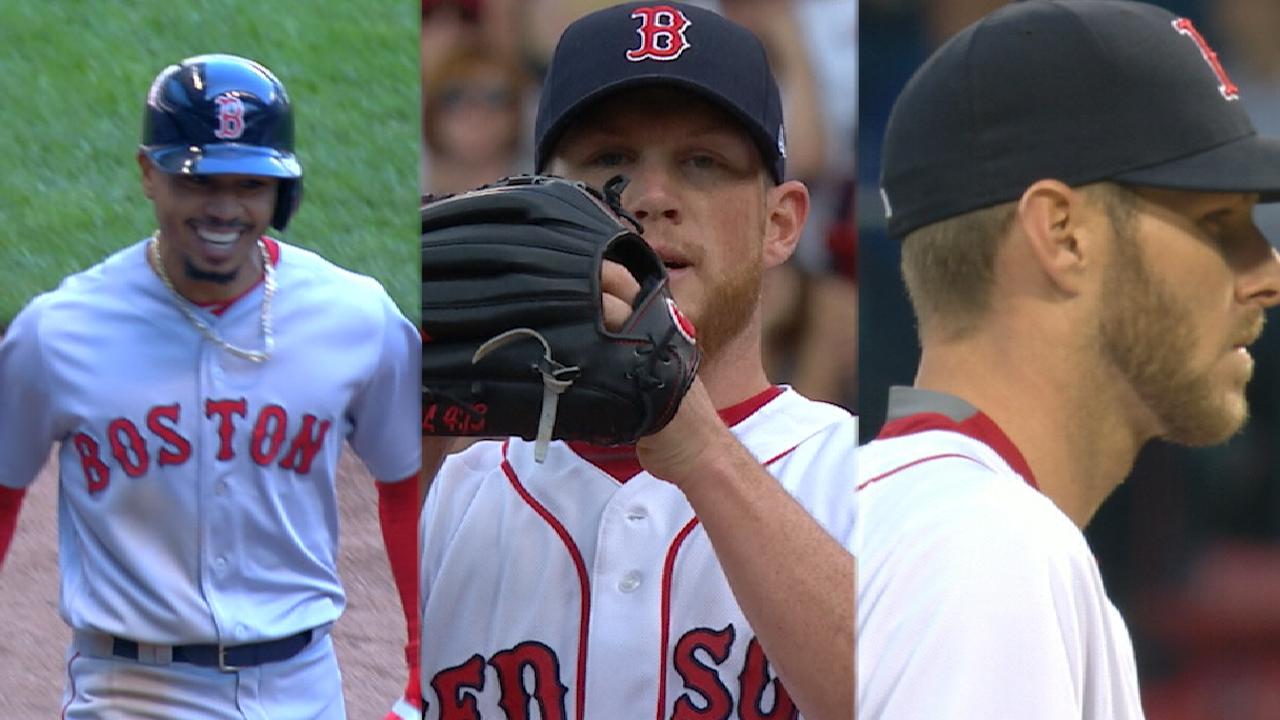
Betts, Kimbrel, and Sale are in the midst of terrific seasons (MLB.com)
The Red Sox sent three players to the All-Star Game in Miami last night, and all three played a role in the American League's 2-1 victory. Chris Sale started and tossed two scoreless innings, Craig Kimbrel earned the win in relief, and Mookie Betts made a pretty good throw. They were at their best against the National League's best, and I'm sure the American Leaguers were happy to have them on their side.

So are the Red Sox, given how well the trio has performed this year:

Chris Sale (3.9 bWAR)
Sale has been the best pitcher in the American League this year and arguably the best pitcher in baseball. He's gone at least seven innings while allowing three or fewer runs in 12 of his 18 starts and has a dozen starts with double-digit strikeouts, including eight in a row at one point that tied his own (and Pedro Martinez's) record. These strong showings have been reflected in his awesome GameScores, which have exceeded 70 nine times and have averaged 67 (he only has one lower than 54). He's currently leading the Majors in strikeouts (178), FIP (2.09) and K/9 rate (12.5) while also pacing the AL in innings (127 2/3), WHIP (0.90) and K/BB ratio (8.1). Assuming his arm doesn't fall off in the second half, he looks like a lock for his first Cy Young award.

Mookie Betts (4.3 bWAR)
Offensively, the Red Sox have gotten the 2015 version of Betts rather than last year's version who finished second to Mike Trout in the MVP race, but he's compensated by taking his defense to new heights. After winning his first Gold Glove last year with an incredible 32 fielding runs per Baseball-Reference, Betts is on pace to surpass that number with 20 under his belt already. With a glove like that, anything he provides on offense should be considered a plus, except that his bat was nearly as valuable as his leather last year (30 batting runs). He's slipped a bit offensively due to another slow start, but he's still leading the Majors in doubles (29) and has a shot at 30 homers and 30 steals. Betts has also shown flashes of breaking out recently, suggesting he might have another big second half in store. Even if he doesn't, he's still one of the league's 10, if not 5, most valuable players.

Craig Kimbrel (2.3 bWAR)
Kimbrel's numbers had been trending in the wrong direction before he was traded to Boston, and his first season with the Red Sox was a disappointment. He got hurt, struggled with his command (5.1 BB/9) and posted a career-worst 3.40 ERA. Heading into 2017, there was talk that Kimbrel might be a problem rather than a solution in the bullpen. Well, that hasn't been the case this year, as the flamethrowing righty has silenced the critics by reclaiming his status as one of the game's premier closers. You need a microscope to see his 0.50 WHIP, as he's stopped walking people (five of the 134 batters he's faced) and is more unhittable than ever, striking out nearly two batters per inning and limiting opponents to a .110/.157/.181 batting line. He's been lights-out when he gets the call -- converting 23 of his 25 save opportunities -- and he hasn't suffered a loss yet after dropping a career-worst six decisions last year. If he keeps it up, Sale won't be the only Boston pitcher on Cy Young ballots.

So yeah, they've all been pretty good. Any game that Sale starts and/or Kimbrel finishes is as good as a win, and with Betts always a threat to have a monster day at the plate, he's capable of winning ballgames all by himself, too.

Monday, August 15, 2016

Red Sox Rundown

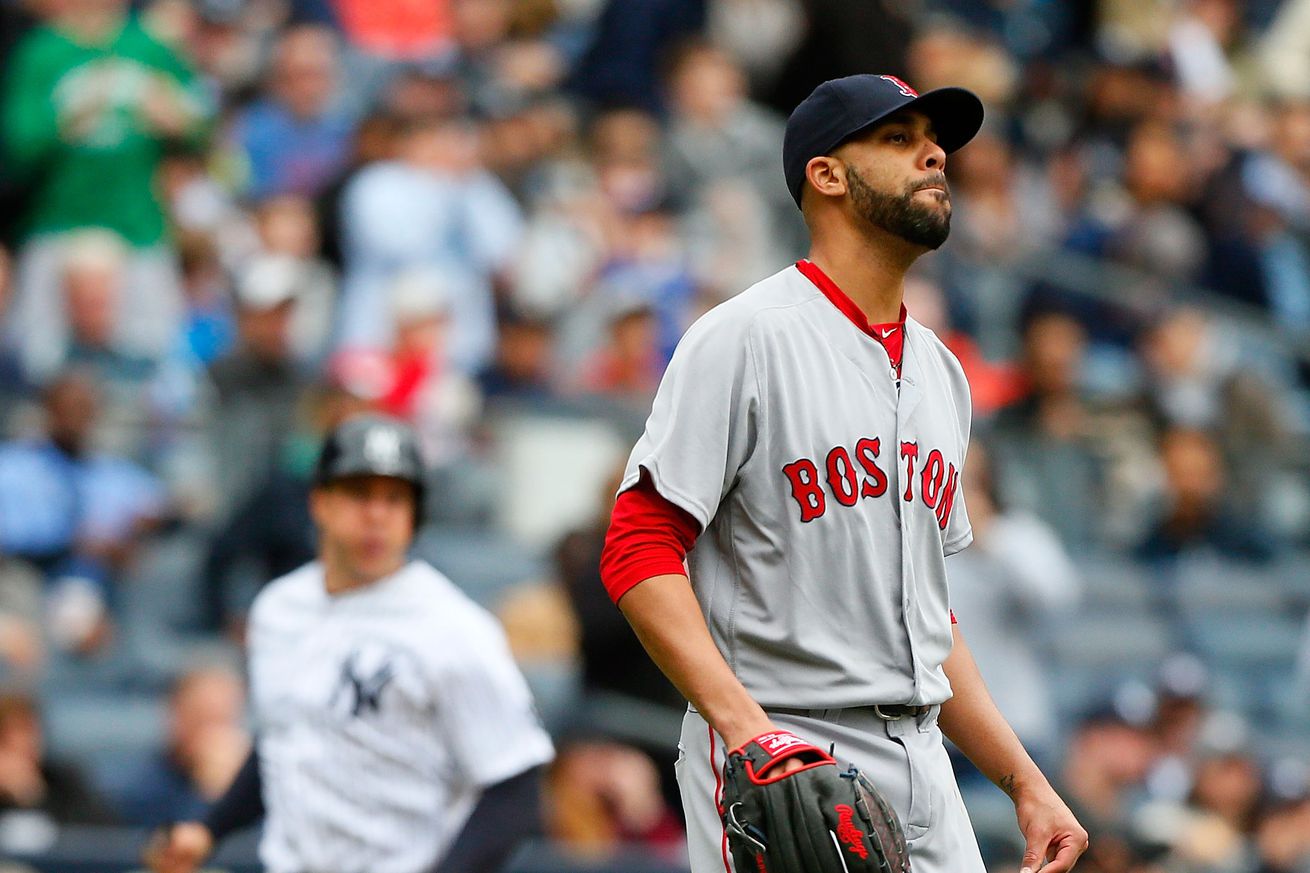
Boston's ace has not lived up to his new contract so far (Over The Monster)
Got to answer a few questions about the Sox last month from fellow Baseball Blogger Alliance member Peter Schiller over at baseballreflections.com. Thanks for the shout-out Pete!

Q: How are the Red Sox’s offseason acquisitions working out so far? Any concerns?

A: Alright. Their four main acquisitions were David Price, Craig Kimbrel, Carson Smith, and Chris Young. Price has been up-and-down, but overall he’s made the rotation better. Kimbrel has been shaky at times, but for the most part has been about as good as advertised. Smith has been hurt all year, so he hasn’t made any impact. Young has been solid in left field, but John Farrell’s had to over-rely on him with alternatives Brock Holt and Blake Swihart out for extended periods of time.  Price hasn’t been himself, which is definitely a concern when you’ve got him signed to the most expensive contract ever for a pitcher, and Smith underwent Tommy John which is never a positive.

Q: Who has been the most disappointing player so far this season? Will they improve as the season goes on?

A: Gotta be Price. The Sox are paying him close to $1 million per start and roughly half of his starts have been duds. He’s running the highest ERA of his career and has struggled against weak offenses like Tampa Bay and New York. He’ll have innings where he just loses it and completely melts down, which you typically don’t see from your ace. That said, he should improve as his peripherals are excellent (he leads the league in strikeouts) and he’s gotten unlucky with balls in play and strand rate. He was a monster for Toronto in the second half last year, and if he can do that again his rough first half will be forgotten.

Q: Who has been the most surprising player so far this season? Can they sustain this pace?

A: It’s a toss-up between Jackie Bradley Jr., who’s been the team’s MVP after not being able to hit at all during first three seasons (save for one month last year), and Steven Wright, who’s emerged as a Cy Young candidate and could potentially start the All-Star Game. I guess you’d have to say Wright is more surprising given his age (31) and the fact that he almost didn’t make Boston’s rotation this year. Bradley had shown flashes of brilliance before -- so we knew he had it in him -- and he’s 26, which is a normal breakout age.  Bradley has a decent shot of keeping this up based on his minor league track record, but Wright is a knuckleballer which makes his dominance unlikely to continue.

Q: What top prospects might we see before the All Star break (What type of player are they: 5 tool player, speedster, defensive, power hitter, etc.)? What will be their impact on the team?

A: Andrew Benintendi may get some run in left field with the injuries to Holt, Swihart and Young.  He’s a 5 tool player who could help Boston down the stretch, allowing Holt and Swihart to slide back to their natural positions and allowing Farrell to use Young strictly against lefties. If the Sox don’t promote him this summer, he’ll probably get called up for a cup of coffee when rosters expand in September.
The Red Sox have arguably baseball's top prospect in Moncada (Fox Sports)
Q: What top prospects are currently being blocked by current players on the big club? Will this make them trade bait, will they switch positions or will the vet eventually be traded?

A: Yoan Moncada is Boston’s best prospect and most untouchable asset, but he’s currently blocked at second base by Dustin Pedroia. Moncada seems unlikely to be traded (unless it’s for an ace-level starter in return) and Pedroia’s not going anywhere, which means he’s going to have to change positions at some point. He could convert to an outfielder, like Mookie Betts did, or possibly play third. He can play pretty much anywhere with his athleticism, so the Sox shouldn’t have any problem finding a place for him.

Q: What is the team lacking that either wasn’t addressed in the offseason or the offseason acquisition isn’t cutting it?

A: Quality starting pitching beyond Price, who hasn’t been nearly as good as expected. They have three good starters with him, Wright, and Rick Porcello, but the back of the rotation has been a dumpster fire. It’s clear the team will need to trade for another starter or two as the deadline rolls around, which will probably require sacrificing one of their prized prospects.

Q: Are they better or worse off now than they were at the end of last season?

A: There’s no question that they’re better, although it’s important to remember that they were one of baseball’s better teams in the second half last year. Adding Price gives them the ace they’ve lacked since trading Jon Lester, while Kimbrel gives the bullpen a much-needed power arm. Losing Pablo Sandoval for the year is addition by subtraction, especially since it allows Travis Shaw to play everyday. Hanley Ramirez has proven to be a competent first baseman, which is a huge upgrade over his terrible defense in left field last year.

Q: What is your predicted outcome for the team this season? Why?

A: I expect they’ll win 88-90 games and one of the two wild cards. They’re really strong up the middle and have arguably the league’s best starting pitcher and closer, but lack of depth in the rotation will ultimately prevent them from winning 95 games and the division.

Q: What players need to go (traded, released, etc.) & why?

A: Sandoval needs to go, but there’s no way to get rid of him. His trade value’s at an all-time low, and releasing him would mean eating the next three years of his contract. The Red Sox should also part ways with catcher Ryan Hanigan, as they have two great young catchers in Swihart and Christian Vazquez. They should also try to find a way to get rid of Clay Buchholz, since he’s no longer a reliable starter and doesn’t make much sense as a bullpen option.

Monday, November 16, 2015

Breaking Down Boston's Big Trade

Kimbrel helps the Red Sox, but did they give up too much to get him? (Sports on Earth)
Dave Dombrowski got the ball rolling on what figures to be a busy offseason for the Boston Red Sox, trading four prospects to the San Diego Padres for All-Star closer Craig Kimbrel.

As a Red Sox fan, I feel very conflicted about this deal. When the trade was first announced Friday I was vehemently against it (four prospects for a closer? What were they thinking??), but after giving it some thought this weekend I don't hate it. I definitely don't love it, though, which is why I want to examine both sides of the coin.

Why it's a good trade for Boston:

So much of the blame for Boston's last place finish fell on their starting rotation that it was easy to overlook how terrible their bullpen was last year. It wasn't just bad; it was one of the worst. Red Sox relievers ranked last in FIP and fifth from the bottom in ERA last year.  One might think they struggled because they were overworked, that they had to pitch more frequently because Sox starters got shelled so often, but that wasn't the case. In fact, Boston's bullpen pitched fewer innings than average.

The reason Red Sox relievers stunk was because they couldn't miss bats. Boston had the majors' fifth-lowest K/9 rate, which reflected the dearth of power arms on their roster. The strikeout is an essential weapon for any reliever, as it's the best way of getting out of jams and avoiding late-inning meltdowns. This is especially true in Fenway Park, where any ball hit in play can spell trouble.

In Kimbrel, the Sox are getting one of the nastiest flamethrowers in the game. He's been the best reliever in baseball since debuting in 2010, leading all firemen in saves, FIP, and xFIP during that time. He also has the second-best strikeout rate in baseball over that span, trailing only Aroldis Chapman (who was linked to the Red Sox last week).

Kimbrel will also solidify the back of Boston's bullpen. Current closer Koji Uehara, while still dominant, will be 41 in April. Compounding his age is his Clay Buchholz-like tendency to get injured, as he did last year when he suffered a season-ending wrist fracture in early August.

What's more, Uehara will be a free agent at season's end, whereas Kimbrel is under team control for three more years. Given his age, it's unlikely that Uehara will still be pitching by the time Kimbrel hits the market, making the latter more of a long-term solution. More importantly, Kimbrel is 13 years younger than Uehara and has never spent a day on the Disabled List. If they both stay healthy, Boston's going to have one of the best bullpen duos in baseball next year.

And for those worried about how Kimbrel will adjust to the American League, fear not. Kimbrel has had great success against the Junior Circuit throughout his career, posting a 1.44 ERA against AL teams, which is actually better than his 1.65 mark versus NL competition.

Lastly, none of the four prospects Boston gave up appeared to have much of a future with the team. The best players sent to San Diego in the deal--center fielder Manuel Margot and shortstop Javier Guerra--were both blocked by Mookie Betts and Xander Bogaerts, who figure to be franchise cornerstones for years to come (unless Dombrowski decides to trade them, too). Carlos Asuaje struggled at Double-A last year, batting just .251/.334/.378, and is also blocked at second base by Dustin Pedroia, who's signed through 2021. Last but not least is Logan Allen, who just graduated high school. Scouts like him and he pitched well across his eight minor league starts this year, but it's much too soon to predict his future. In any case, all were unlikely to crack the major league roster next year.

Boston needs to be aggressive after back-to-back last place finishes, and this move signals they're serious about contending again in 2016. Fans would have rather seen them address their starting pitching first, but it doesn't matter when you fix your issues so long as they all get fixed. This move is only the first of many, and it's one the Red Sox wouldn't have made if they weren't going to add more pieces later.

As for the prospects, well, I'm not crying over any of them. Boston boasts the best farm system in baseball, so they certainly have trade chips to spare. Dombrowski's predecessors seemed over-protective of their minor leaguers at times (can you imagine Ben Cherington making this deal?), but I'll never argue against exchanging kids for proven talent. Boston could afford to pony up the prospects and can afford to pay Kimbrel, so what's the problem? He's as good as it gets, and he makes the Sox better in the short run without harming their long-term plans.
Kimbrel might never be as good as he was with the Braves (Fox Sports)
Why it's a bad trade for Boston:

For whatever reason, managers and front offices are seduced by star closers and their ability to rack up saves. Like saves, the men who compile them are overrated. They pitch roughly 60 innings per year--usually one inning a few times a week--and the majority of those innings come when their team's already leading in the ninth inning. Teams convert 95 percent of ninth-inning leads anyways, meaning they pitch only when victory is all but assured. As such, the advantage of having a quote-unquote shutdown closer is marginal at best, meaning closers are not worth the lavish contracts they command

The Red Sox are paying a steep price for Kimbrel, both in terms of dollars and who they sacrificed to get him. He'll earn $11.25 million next year and $13.25 million the year after that, more than Wade Miley and nearly as much as  Pedroia. Kimbrel won't be nearly as valuable as either of those guys, meaning he'll be responsible for a disproportionate percent of the team's payroll. You could get a decent starting pitcher or a solid regular for that price.

And if that weren't bad enough, Boston also surrendered four prospects to San Diego in the trade. While the Red Sox farm system is deep, four prospects is a lot no matter how you slice it. Definitely too many for a guy who throws 60 innings a year. Dombrowski should have used those prospects to land a starter, something the Red Sox desperately need. Dombrowski says they'll attempt to do so via free agency, but that almost guarantees they'll be stuck with a massive contract they'll regret someday. Better to trade for a starter and pay for relievers, who can often be had on the cheap.

Another reason for concern is that Kimbrel's coming off the worst year of his career. Granted, it was still a terrific season by any standard, but it's still discouraging that he pitched significantly worse despite moving to the best pitcher's park in baseball. Pitchers peak early, meaning we may have already seen Kimbrel's best. Though he'll only be 28 next year, his decline phase could be well underway. His ERA and FIP have both increased in three consecutive seasons, while his strikeout totals have fallen every year since 2011.

And while Kimbrel's proven he can handle American League opponents, who knows how he'll fare in Fenway Park--a much better place for hitters than his previous homes in Atlanta and San Diego. Just because he's pitched well in the National League doesn't mean he'll replicate his success in the American League, either. The Red Sox have whiffed badly on the last few big-name NL relievers they've acquired, from Mark Melancon to Joel Hanrahan to Edward Mujica. You can add Andrew Bailey, Bobby Jenks, and Dan Wheeler to the list as well, even though they came from American League teams.

On the opposite end of the spectrum, this looks like a great trade for the Padres, who traded five players and took on B.J. (excuse me, Melvin) Upton's albatross contract to acquire Kimbrel last April (now that was a terrible trade). Pricey closers are expensive luxuries rebuilding teams don't need (just ask the Phillies), making Kimbrel expendable. More importantly, the swap helps replenish San Diego's farm system, which A.J. Preller gutted to acquire all those big names last winter. Netting two top-100 prospects and a couple of lottery tickets is a fantastic haul, not to mention a big first step towards recovery.

So who won? San Diego doesn't lose anything by giving up Kimbrel, so you can't really say they lost even if none of their new prospects pan out (at least they saved themselves some money). But for this trade to work in Boston, the Red Sox have to be good. Kimbrel's only useful if they have late-inning leads for him to protect. If they don't, well, it won't be long before Kimbrel finds himself on the trading block again.