Showing posts with label Chris Sale. Show all posts

Wednesday, July 12, 2017

Breaking Down Boston's All-Stars

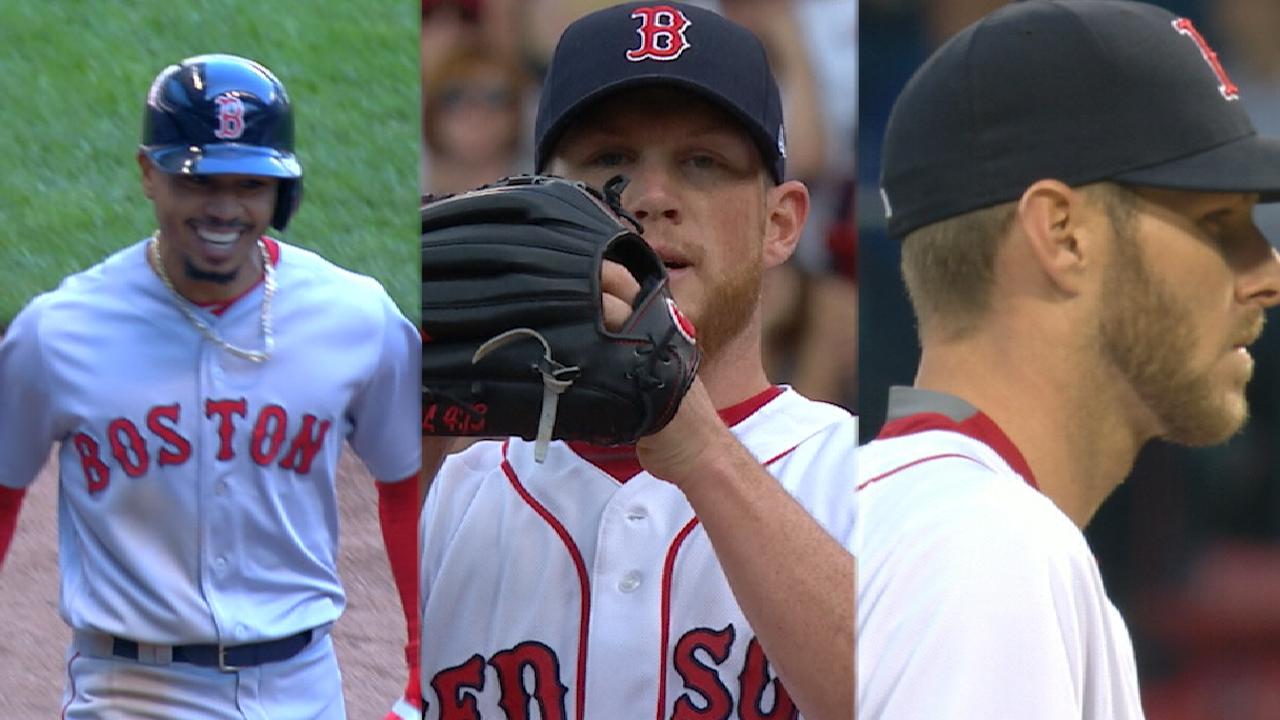
Betts, Kimbrel, and Sale are in the midst of terrific seasons (MLB.com)
The Red Sox sent three players to the All-Star Game in Miami last night, and all three played a role in the American League's 2-1 victory. Chris Sale started and tossed two scoreless innings, Craig Kimbrel earned the win in relief, and Mookie Betts made a pretty good throw. They were at their best against the National League's best, and I'm sure the American Leaguers were happy to have them on their side.

So are the Red Sox, given how well the trio has performed this year:

Chris Sale (3.9 bWAR)
Sale has been the best pitcher in the American League this year and arguably the best pitcher in baseball. He's gone at least seven innings while allowing three or fewer runs in 12 of his 18 starts and has a dozen starts with double-digit strikeouts, including eight in a row at one point that tied his own (and Pedro Martinez's) record. These strong showings have been reflected in his awesome GameScores, which have exceeded 70 nine times and have averaged 67 (he only has one lower than 54). He's currently leading the Majors in strikeouts (178), FIP (2.09) and K/9 rate (12.5) while also pacing the AL in innings (127 2/3), WHIP (0.90) and K/BB ratio (8.1). Assuming his arm doesn't fall off in the second half, he looks like a lock for his first Cy Young award.

Mookie Betts (4.3 bWAR)
Offensively, the Red Sox have gotten the 2015 version of Betts rather than last year's version who finished second to Mike Trout in the MVP race, but he's compensated by taking his defense to new heights. After winning his first Gold Glove last year with an incredible 32 fielding runs per Baseball-Reference, Betts is on pace to surpass that number with 20 under his belt already. With a glove like that, anything he provides on offense should be considered a plus, except that his bat was nearly as valuable as his leather last year (30 batting runs). He's slipped a bit offensively due to another slow start, but he's still leading the Majors in doubles (29) and has a shot at 30 homers and 30 steals. Betts has also shown flashes of breaking out recently, suggesting he might have another big second half in store. Even if he doesn't, he's still one of the league's 10, if not 5, most valuable players.

Craig Kimbrel (2.3 bWAR)
Kimbrel's numbers had been trending in the wrong direction before he was traded to Boston, and his first season with the Red Sox was a disappointment. He got hurt, struggled with his command (5.1 BB/9) and posted a career-worst 3.40 ERA. Heading into 2017, there was talk that Kimbrel might be a problem rather than a solution in the bullpen. Well, that hasn't been the case this year, as the flamethrowing righty has silenced the critics by reclaiming his status as one of the game's premier closers. You need a microscope to see his 0.50 WHIP, as he's stopped walking people (five of the 134 batters he's faced) and is more unhittable than ever, striking out nearly two batters per inning and limiting opponents to a .110/.157/.181 batting line. He's been lights-out when he gets the call -- converting 23 of his 25 save opportunities -- and he hasn't suffered a loss yet after dropping a career-worst six decisions last year. If he keeps it up, Sale won't be the only Boston pitcher on Cy Young ballots.

So yeah, they've all been pretty good. Any game that Sale starts and/or Kimbrel finishes is as good as a win, and with Betts always a threat to have a monster day at the plate, he's capable of winning ballgames all by himself, too.

Sunday, March 12, 2017

Sale Already a Savior

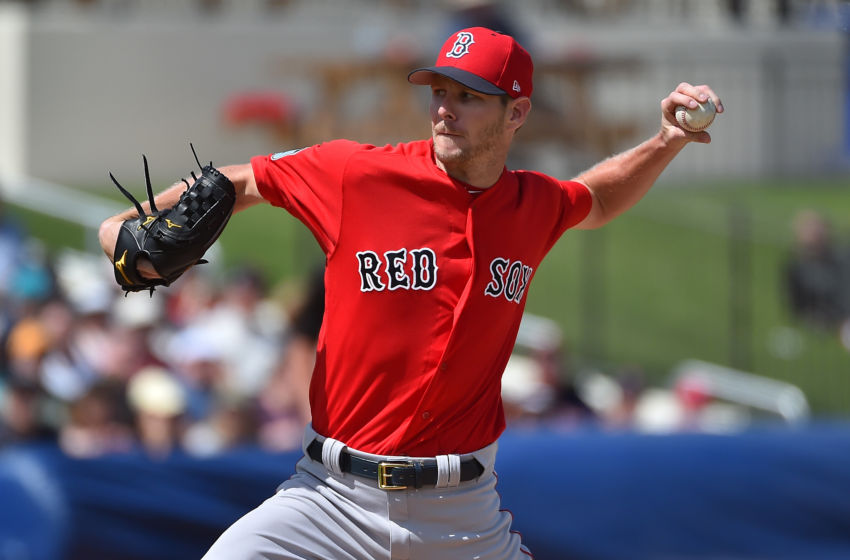
Sale was solid in Monday's Spring Training debut (Chowder and Champions)
It's been a little more than three months since the Red Sox rocked the sports world by trading for Chris Sale, and I'm still having trouble eating solid food. That's because my jaw is still unhinged from when I first heard the news of baseball's biggest offseason maneuver, a stunning blockbuster that altered the courses of both franchises for years to come. Four months after courting Sale at the trade deadline, Boston finally got its man -- at an exorbitant price.

Only now is it starting to sink in. Sale made his first appearance with his new team in Spring Training this week, and it went reasonably well. He didn't dominate, but he "felt strong," which is all anyone cares about this time of year. The rust will dissipate, the command will come.

Of course, any other news would have been worrisome. It was Sale's first start -- he should feel strong. But with the aftershocks from last week's David Price scare still reverberating throughout New England, a positive update on his co-ace was highly encouraging for Red Sox Nation. At least one of Boston's elite arms is healthy.

Most teams don't even have a pitcher like Price to begin with, and the ones that do could hardly afford to lose him. The Red Sox can, however, because they are in a unique position. They have a younger, better version of Price in Sale -- a poor man's Clayton Kershaw. If the whitecoats pronounced Price out for the season tomorrow, Boston could still be reasonably expected to win 90 games and the AL East. That speaks to how good the rest of their roster is, as well as Sale's ability to carry a staff.

That's what the Red Sox envisioned when they mortgaged their future for him. Boston failed to land Sale at the deadline, settling for Drew Pomeranz instead, but upped the ante when Chicago made him available again during baseball's winter meetings. Once Dave Dombrowski fixates on a player, he'll do whatever it takes to acquire him, whether that's shell out over $200 million for Prince Fielder (and Price) or strip his franchise of its most coveted prospects.

Given that Boston already runs one of the highest payrolls in professional sports, Dombrowski's resorted to cannibalizing its once-bright farm system in a series of trades for Pomeranz, Craig Kimbrel, Tyler Thornburg, and now Sale. No team had ever traded the number one prospect before, until Dealin' Dave flipped Yoan Moncada to the White Sox along with Michael Kopech -- a flamethrower who's been clocked at 105 -- and a pair of decent throw-ins (Victor Diaz and Luis Alexander Basabe, both of whom have big league potential). Boston boasted the sport's best farm system when Dombrowski took over in August, 2015. Eighteen months later, they have one of the worst.

The transformation at the Major League level has been equally swift, however, as Dombrowski's wheeling and dealing paid immediate dividends. A last place team when Dombrowski arrived on the scene, the Red Sox won the division in their first full year under his watch and enter 2017 as favorites to make the World Series. Not since 2011 have the Sox been so star-studded.

Their loaded roster is a byproduct of Dombrowski's eternal commitment to winning now, future be damned. Whereas his predecessor, Ben Cherington, was a conservative prospect-hugger who preferred to open his checkbook for players he wanted, Dombrowski never met a prospect he wouldn't trade (not even Andrew Benintendi, baseball's new number one prospect and already a fan favorite, was safe). Their wildly different approaches manifested in the players they pursued; Cherington sought mid-tier, impact veterans such as Shane Victorino, Hanley Ramirez, and Pablo Sandoval, whereas Dombrowski reaches for the stars. Cherington didn't acquire a true superstar during his four years at the helm, while Dombrowski has already acquired two future Hall of Fame starters and the decade's best closer in half the time. Cherington's 2015 club didn't have an ace; Dombrowski obtained two in the span of 12 months.

There's a new sheriff in town, and a trigger-happy gunslinger at that.
Price has struggled with his health and performance in Boston (CBS Boston)
It was this sweeping shift in philosophy that made the Sale swap possible, because Cherington never would have had the stomach for it. To get a lot you need to give a lot in return, and Dombrowski was willing to pony up. Boston got another ace to pair with Price, giving them their best 1-2 pitching punch since Curt Schilling joined Pedro Martinez in 2004. Chicago netted a budding superstar and a potential ace in return, accelerating its rebuild with what Dave Cameron hailed as the winter's best transaction.

Indeed, the future is bright for both sides. The Red Sox are the prohibitive favorites in the AL East and a top-five team despite losing David Ortiz -- the best hitter in baseball last year -- to retirement. The White Sox now have the foundation for a winning team and should emerge as contenders by decade's end. On paper, the trade was a classic win-win.

And yet, I was admittedly lukewarm about the Sale acquisition when it was announced back in December. I felt then, and still feel now, that Boston overpaid for Sale's services. They gave up six years of Moncada for three years of Sale, plus whatever Kopech and co. provide (which could be substantial, given how hard Kopech and Diaz throw and the tools Basabe displayed as a teenager). If Moncada and Kopech realize their potential, this trade is a clear win for Chicago. If all four do, it will be disgustingly lopsided.

What bothered me most about the trade, however, was that the Red Sox didn't need Sale. They already had an ace and one of the best rotations in baseball, finishing top-10 in ERA and fWAR last year. Their stable featured two Cy Young winners (Price and Rick Porcello) at the top, two 2016 All-Stars (Steven Wright and Drew Pomeranz), and a likely future All-Star in Eduardo Rodriguez. They still had Clay Buchholz at the time too, another former All-Star and occasional Cy Young contender when healthy, but quickly dumped him on Philadelphia after Sale made him expendable.

For all of Buchholz's struggles last year, he was a meaningful contributor in a variety of roles and was a dominant starter as recently as 2015. He still provided value last year despite posting the
second-worst ERA (4.78) and highest FIP (5.06) of his career, and almost certainly would have pitched better this year, especially if used exclusively in relief. He could have given this year's outfit something if not depth, but obviously Dombrowski felt differently. Gaining Sale meant losing Buchholz along with the aforementioned prospects -- too much, in my estimation.

And so I did not feel the ecstasy that baseball fans are supposed to feel when their team scores an ace, the way I felt when the Sox got Schilling and Josh Beckett and Daisuke Matsuzaka. Too much had been sacrificed to fill a void that did not exist, to make an already great team marginally better. It did nothing to address the gaping hole in the middle of Boston's lineup, which most agreed was the team's most pressing issue entering the offseason and one that could have been readily filled by any number of inexpensive right-handed sluggers (Mike Napoli, Chris Carter, Mark Trumbo, et. all) who would have fit perfectly in Fenway. If Dombrowski wanted to make a splash, he could have wooed Edwin Encarnacion or Jose Bautista a moderate sum. Instead, he paid a king's ransom for Sale and signed Mitch Moreland to man first.

Circumstances have changed since December, however, and now Sale appears even more valuable. With Price's 31-year-old elbow in question and his future uncertain, it's comforting to know that Boston still has someone to lead the rotation. Were it not for Sale that would have been Porcello, who's had one great year in his eight-year career and is more of a number two at best. The pressure on him would have been enormous, and we all remember how well (or rather, how poorly) he performed the last time he faced sustained pressure after signing his huge contract extension early in 2015. His postseason numbers (0-3, 5.66 ERA) tell a similar story.

Sale has never pitched in October, but he has fronted a staff for the past half-decade. All he's done during that time is make five straight All-Star teams and finish in the top six of Cy Young voting every year. Last year he focused on pitching deeper into games and recorded a career-high 226 2/3 innings -- just 10 outs shy of Price's ML-leading 230 -- and won 17 games for a losing team. He could easily win 20 on the Sox and possibly the Cy which has eluded him. Sale can be counted on for over 200 quality innings, a similar number of strikeouts and an ERA around three -- the same steady production for which Boston made Price the highest-paid pitcher in history. If both stay healthy, the Red Sox should have one of the best rotations in baseball and will be difficult to beat come playoff time.

Dombrowski drew a fair amount of criticism for going all-in on Sale. After investing nearly a quarter-billion dollars in Price the previous winter, it was hard for him to justify doubling down on another ace. Sale was a luxury Boston didn't need. But when you splurge on a sports car the warranty becomes an afterthought, and whether they knew it or not the Red Sox were essentially getting an insurance policy on Price in Sale. And like all insurance policies, you never truly appreciate it until you need it.
Sunday, December 14, 2014

Here Comes Chicago

With Lester aboard, the Cubs have the pitching to complement their hitting (NESN)
Despite finishing last year with identical 73-89 records, the remade Chicago Cubs and White Sox are teams to be feared in 2015.

The long-suffering Cubs are coming off their fifth consecutive fifth-place finish and 106th straight season without a World Series championship (but who's counting). Even so, 2014 was an encouraging year for the beleaguered Cubbies. Franchise centerpieces Anthony Rizzo and Starlin Castro enjoyed bounce back years, Jorge Soler and Kyle Hendricks made promising debuts, and Jake Arrieta was one of the National League's best pitchers on a per-inning basis. Chicago ranked second in the Senior Circuit in long balls, and Kris Bryant hasn't even arrived yet. Imagine how many bombs they'll hit when he does and with Soler and Javier Baez playing every day.

Entering the fourth year of Theo Epstein and Jed Hoyer's rebuilding project, Chicago appears on the brink of contention. The major league roster finally has the talent ready to compete. Aided by Soler and Hendriks, the Cubs were actually a much better team in the second half last year despite trading away their two best pitchers (Jeff Samardzija and Jason Hammel) in early July. Chicago went 31-28 after July 27th, winning one more game than the eventual World Series champion San Francisco Giants during that span.

It's no secret that Chicago has an abundance of young hitting talent, so the next logical step was to add quality arms this winter. The Cubs did so by re-signing Jason Hammel, who had a 2.98 ERA in 17 starts with them last year before being traded to Oakland, and swaying Jon Lester away from the Red Sox with a jaw-dropping six-year, $155 million offer that sent shockwaves throughout baseball. Chicago's new ace immediately improves a rotation that had the seventh-highest ERA in baseball last year. A vaunted big game pitcher and two-time World Series champion with Boston, Lester brings a furnished postseason track record to the Windy City as well.

Chicago also acquired arguably the game's best manager in Joe Maddon. Maddon, a two-time AL Manager of the year (2008 and 2011), helmed the Rays to five 90-win seasons between 2008 and 2013 (and 84 wins in 2009, the lone non-90 win season in that timeframe). More importantly, he has postseason experience, having managed four playoff teams in Tampa Bay including the 2008 American League champions. Unlike most of the Cubs, he's been to the World Series.

And while the Cubs didn't get the market's top catcher (Russell Martin, who went to the Blue Jays instead), they still got a good one by trading for Miguel Montero. A two-time All-Star, Montero was a four-win player in 2011 and 2012 and should remain productive at age 31. In addition to swinging a pretty solid stick, he also provides veteran leadership and experience behind the plate.

A busy offseason has prepared the Cubs for a competitive 2015 that could very well result in a playoff berth. Chicago will have its hands full with the St. Louis Cardinals, favorites to win the division for the third year in a row,  but the rest of the division looks less than formidable. The Reds are rebuilding, the Pirates keep losing talent (i.e. Martin), and the Brewers haven't improved. The Cubs could easily finish second and ride a wild card berth all the way to World Series glory.
Jose Abreu (pictured) and Chris Sale have help (GalleryHip)
The White Sox, who last made the playoffs in 2008, were essentially a .500 team last year into August (54-56 on the morning of August 2nd) before fading down the stretch. They were second in their division through the first week in June, but ultimately their thin rotation and aging lineup caught up to them.

Don't expect the same issues to derail Chicago this year. The White Sox won't have the MLB's sixth-worst rotation ERA again after trading for Jeff Samardzija, one of the game's premier power pitchers. Paired with Chris Sale, Samardizja gives the Sox an outstanding left-right punch atop their rotation. Chicago also signed David Robertson, a shutdown closer and one of baseball's best relievers over the past four years. He solidifies the back end of a leaky bullpen that finished 2014 with the third-worst ERA in the majors.

The White Sox upgraded their offense as well, inking Melky Cabrera and Adam LaRoche to bolster a lineup that was heavily dependent on Jose Abreu in 2014. LaRoche, a lock for 20 to 25 home runs when healthy, offsets the loss of Adam Dunn as the team's primary lefthanded power source. A former Gold Glove winner, LaRoche will also allow Abreu to DH a few times per week.

Cabrera figures to slide in behind leadoff man Adam Eaton, giving the team two quality table-setters for Abreu and LaRoche. With an OPS above .800 in three of the past four seasons, he's the kind of impact bat Chicago needs, and like LaRoche his power should play well at U.S. Cellular Field. Cabrera's also a switch-hitter, which helps keep Chicago's lineup balanced.

Like the Cubs, the White Sox seem to have an insurmountable foe in their division vis a vis the Detroit Tigers, winners of four straight AL Central crowns. They also must contend with the reigning AL pennant winners (though Kansas City will surely suffer from losing James Shields), and a solid Indians team. Even the Twins have improved. Accordingly, Chicago will be hard-pressed to make the playoffs coming out of such a competitive division, but I'd expect them to at least go .500. They're still a bit top-heavy (they're doomed if Abreu and/or Sale are lost for extended periods of time), but if their stars are healthy and perform then they'll have enough talent to make some noise.

Regardless of which side they stand on, Chicago baseball fans have plenty to be excited about. Both teams are much-improved and will be right in the thick of things, which hasn't been the case very often. Neither club has made the playoffs since 2008, but it wouldn't surprise me to see both playing next October.

An all-Chicago World Series might be a longshot, but at least there's a chance.

Wednesday, November 12, 2014

Kluber Robs King Felix

Hernandez deserved to win his second Cy Young, but didn't (RotoScout)
The races for the American League and National League Cy Young couldn't have been any different.

In the National League, Clayton Kershaw was the heavy favorite and won easily, securing his third Cy Young in four years (and, let's be honest, he deserved the 2012 award over R.A. Dickey too). It was Kershaw and everyone else, meaning a vote for Johnny Cueto or Adam Wainwright, while defensible, was clearly misguided.

The American League's top two candidates were virtually inseparable. They both had dominant seasons and compelling reasons, but in the end it came down to splitting hairs. In what was destined to be a photo finish, Corey Kluber beat out Felix Hernandez. Kluber nabbed 17 of the 30 first place votes and 169 points, edging out the 13 and 159 compiled by King Felix. Chris Sale finished a distant third with 78 points.

Looking at Hernandez's stats, it's hard to see how he didn't win. He had the league's lowest ERA, WHIP, and hit rate while placing second in pitcher bWAR (to Kluber), innings pitched (to David Price), ERA+ (to Sale), and FIP (to Kluber). He also led in most of the advanced stats like adjusted pitching runs and wins, base-out runs and wins saved, and situational wins saved. Opponents batted just .200/.243/.303 (.244 wOBA) against him, and his average GameScore was 65. For most of the summer, he was the clear favorite as he strung together an MLB-record 16 straight starts with at least seven innings pitched and two earned runs allowed or fewer.

But he slipped just a bit over the final six weeks (2.75 ERA), opening the door for Kluber, who came on like a freight train down the stretch. His first half was hardly Cy-worthy (3.01 ERA), but after the All-Star Break he had a 1.73 ERA over his final 104 innings to lower his final ERA to 2.44. He also struck out 39 batters over his final three starts to give him a whopping 269 K's on the season, second only to Price and 21 more than Hernandez. He also finished in a three-way tie for the league lead in wins with 18 (same as Max Scherzer and Jered Weaver) while pacing the circuit in pitching bWAR (7.4), and FIP (2.35).

While Kluber had an outstanding season, I believe the hardware belongs to King Felix. For one, Kluber wasn't even Cy Young-caliber for most of the first half, while Hernandez was Cy Young worthy from start to finish. Kluber had that great finishing kick, but I think Hernandez deserves credit for being more consistent. Additionally Kluber's average GameScore (63) was a hair lower than Hernandez's, revealing that he was slightly less dominant on a per-start basis. Batters also had more success against him, hitting .233/.279/.345 (.277 wOBA) when he was on the bump--a 78 point difference between him and Hernandez. That's pretty sizable, especially considering Kluber faced slightly weaker hitting talent.

It's true that Hernandez did pitch in a more favorable environment with a better defense behind him, but the park is accounted for in Adjusted ERA+, which has him considerably ahead of Kluber 170 to 152. Furthermore, Safeco doesn't help Hernandez as much as other pitchers because of his ability to induce ground balls. As for the defense, well, it's not like Hernandez was pitching to contact. He still struck out 248 batter's, for heaven's sake! Tony Blengino over at FanGraphs took all these factors into account and calculated Hernandez's true ERA to be 2.29, a touch better than Kluber's 2.45.

All in all, I like Hernandez's case a little better than Kluber's. I'm not sure what swayed the voters over to the latter's side: I hope it was the FIP and gaudy strikeout rates but I suspect the monster second half and shinier win total played a role as well. The voters had to make a really tough choice, so I'm not surprised they got it wrong (look no further than their inability to elect Mike Trout MVP before this year). Kluber was great, but Hernandez was a tad better and deserved to win by the slimmest of margins.