Showing posts with label Mark Teixeira. Show all posts

Saturday, August 15, 2015

Pujols, Teixeira Turning Back the Clock

Teixeira takes another pitcher deep (NY Times)
One of the best sluggers in the American League this year is 35 year-old first baseman who has been hobbled by injuries in recent seasons, injuries that have cut into his into playing time, hampered his power, and left many to wonder just how effective he could be going forward. Recently his giant contract has been deemed among the worst in baseball, but this year he's been worth every penny. He's re-asserted himself as a middle of the order force on a contending team, socking home runs and driving in runs with regularity. Last month he was an All-Star for the first time in years, and now he's adding to his MVP case as the stretch run looms.

I'm talking about Mark Teixeira. I am also talking about Albert Pujols.

Both players, you see, are enjoying unexpected resurgences at the plate. What's funny is that they're going about it different ways. Pujols is being more aggressive than ever before, continuing a trend of declining walk rates since 2009. This is common in older hitters, who start their swing earlier to counteract their diminishing bat speed. He's also tinkered with his batting stance, adjusting his leg kick and load position. His is a classic case of an older player taking on the role of mad scientist, feverishly trying anything and everything in the hopes of recapturing his old glory.

Teixeira, on the other hand, wanted to get back to doing what he's always done: take walks and hit the ball a long way. Rather than experiment with a new approach, he simply sought to return to his old one. His only change was what he put on his plate, which no longer includes sugar and gluten (how somebody can swear off one, let alone both, is incomprehensible to me). Contrary to Pujols, Tex became even more patient. Granted, he's always been a disciplined hitter, but it's noteworthy that his walk rate hasn't been this high since 2010. Given how far the league walk rate has fallen since then, that's really quite impressive.

Once among the best pure hitters in the game, they're essentially all-or-nothing sluggers at this point. Their averages, which used to top .300 with regularity, have settled into the .250s. Pujols is striking out more than at any point since his rookie season, and Teixeira's taken plenty of whiffs, too.

It's the return of their power, however, that's made them elite offensive performers again. Both are sitting on 30 home runs, a benchmark neither has surpassed since 2011 (Pujols hit 30 on the nose in 2012--his first year with the Angels). They're tied for fifth-most in the American League, four behind ML-leader Nelson Cruz. Pujols is sporting his best Isolated Power since 2010, while Teixeira is putting up the best ISO of his career. Pujols is in the league's top-10 for total bases, whereas Tex is in the top-10 for slugging percentage and extra base hits.
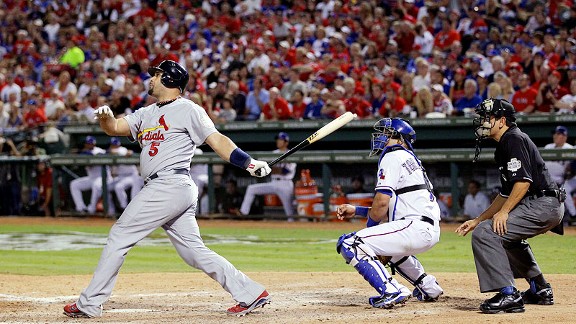
Pujols hasn't hit this well since his Cardinals days (ESPN)
Their coinciding comebacks is just the latest parallel in their exceptional careers, which have mirrored each other at every turn. Both were born in 1980, came up in the early 2000s, and raked from the start. They were extremely durable. They hit for good power and high averages. They became multi-Gold Glove winning first basemen.

Both were absolute monsters through around 2009 or so, then they signed huge contracts with new teams and almost immediately began going downhill. Part of it was age, part of it was injuries, and part of it was the league-wide decline in offense that's been happening since these guys turned 30. They both had some years where they got off to absolutely terrible starts, and as you get older those slumps last longer and it becomes harder and harder to come back from them.

They both bottomed out in 2013, when injuries limited Pujols to 99 games and Teixeira to all of 15. They bounced back some in 2014, but nowhere near their pre-injury levels. As they crept into their mid-30s and injuries kept piling up, their careers seemed to be heading south.

Then, just when everyone had written them off, they came roaring back. Fully healthy for the first time in years, they've been able to inflict some serious damage on AL pitching this summer. It was a sight to see both at the Midsummer Classic, something neither had been a part of in half a decade. They looked like dinosaurs alongside National League representatives Paul Goldschmidt and Anthony Rizzo, both of whom are nearly a decade younger.

But every All-Star Game is like that, a bizarre juxtaposition of fading stars and bright up-and-comers. Pujols and Teixeira might not have looked like they belonged, but their numbers said otherwise.

Thursday, May 1, 2014

Teixeira Trying To Get Back On Track

Teixeira's trying to put a pair of disappointing seasons behind him (CBS)
The 2012 season had been a tough one for Mark Teixeira even before a calf strain sent him to the Disabled List in late August, causing him to miss all but one game in September and 30 of his team's final 34 games. Besides dealing with his customary slow start (.686 April OPS), Tex also battled severe bronchial congestion and wrist inflammation throughout the season. Though he returned in time for New York's postseason run he wasn't the same, managing just one extra base hit and one RBI as the Yankees bowed out in the League Championship Series.

Not surprisingly, the then 32-year old Teixeira had his worst season since his rookie year, and his worst since becoming a member of the Yankees. Tex finished the season having played 123 games, the fewest of his career. His 24 home runs and 84 RBI set career lows in addition to snapping his string of eight consecutive seasons with 30 home runs and 100 RBI. He received his fifth Gold Glove award for strong defense at first base, but it was little consolation for his otherwise disappointing season. Yankee fans and Teixeira were hopeful he would bounce back in 2013.

Alas, it was not to be. 2013 turned out to be a lost season for Teixeira (and the Yankees, who missed the playoffs for only the second time in 20 years). Tex strained his wrist in early March and didn't make it back until May 31st. His return was short-lived, though, as he re-aggravated the injury two weeks later and went back on the Disabled List. He opted for wrist surgery and was shut down for the season, one of many Yankee stars along with Curtis Granderson, Alex Rodriguez, Kevin Youkilis, and Derek Jeter to barely see the field in 2013.

Teixeira's outlook for 2014 was decidedly less optimistic. Few expected the 34 year-old to return to form, especially given the severe decline he experienced before injuries began ravaging his career. Wrist injuries in particular are tricky and can permanently alter a player's swing, leading some to fear that he would never be the same. He was, at the very least, a very big question mark in an infield full of question marks.

Those fears were exacerbated by Teixeira's abysmal spring training performance (.403 OPS) in which he looked utterly over-matched at the plate. Then, only four games into the regular season, Teixeira found himself on the DL again--this time with a strained hamstring. Another setback on the road to recovery. His entire body, it seemed, was failing him.

Thankfully, Teixeira made a speedy recovery and spent the minimum time on the DL. His power and batting eye appear to have returned, as he has three home runs and seven walks in his eight games back. As long as he anchors New York's lineup by tallying plenty of both, nobody's going to complain about the two-time All-Star's $22.5 million salary.

Like Albert Pujols, another talented, extremely well-paid 34 year-old first baseman who was written off after consecutive down years, Teixeira is going about the business of resuming his Hall of Fame career. He still has a long season ahead of him, but so far, at least, the early returns are promising.

Thursday, January 30, 2014

Ranking the Best Switch-Hitters

Mantle is the gold standard for switch-hitters (SI)
Reviewing Lance Berkman's career got me thinking about the best switch-hitters in baseball history. Here's what I came up with:

1. Mickey Mantle 172 OPS+ 170 wRC+ .354 TAv .428 wOBA 802 Rbat
An obvious choice. Though the Mick was devastating from the left side, injuries hampered his southpaw swing later in his career and he would have been better off never having learned to switch-hit at all. He batted .330/.416/.575 from the right side compared to .281/.419/.546 from the left.

2. Chipper Jones 141 OPS+ 141 wRC+ .319 TAv .397 wOBA 557 Rbat
His favorite player was Mickey Mantle, which is interesting given that he was born four years after Mantle's final season. Jones is the only switch-hitter with a career .300 average and at least 400 home runs, something Mantle would have accomplished as well had he retired before 1968.

3. Eddie Murray 129 OPS+ 127 wRC+ .299 TAv .365 wOBA 389 Rbat
Steady Eddie leads all switch-hitters in RBI and ranks second in home runs to Mantle. He is one of only four players to eclipse 500 home runs and 3,000 hits, the others being Hank Aaron, Willie Mays and Rafael Palmeiro.

4. Pete Rose 118 OPS+ 121 wRC+ .289 TAv .354 wOBA 368 Rbat
The Hit King.

5. Lance Berkman 144 OPS+ 144 wRC+ .318 TAv .400 wOBA 420 Rbat
His OPS was better than .900 in 10 of his 15 seasons and his .943 OPS ranks 26th all-time. He holds the National League record for most home runs (45--tied with Jones) and RBI (136) by a switch-hitter in a single season (2006).

6. Tim Raines 123 OPS+ 125 wRC+ .294 TAv .365 wOBA 290 Rbat
Even after removing all of Raines' steals from the equation (for they have nothing to do with hitting), his offensive resume is still an impressive one. The Rock batted .294 for his career and was the 1986 NL batting champion. He also led the league in OBP that year, one of 11 times he reached base more than 39 percent of the time.

7. Reggie Smith 137 OPS+ 137 wRC+ .306 TAv .379 wOBA 309 Rbat
One of the most underrated ballplayers in baseball history, Smith was a phenomenal talent who's numbers were depressed by the era in which he played as well as Dodger Stadium. His neutralized career batting line of .296/.377/.505 is quite good.

8. Mark Teixeira 130 OPS+ 131 wRC+ .298 TAv .381 wOBA 245 Rbat
Teixeira has been ridiculed so much during his time in New York that it's easy to forget just how great he was before joining the Yankees. He had eight straight seasons with at least 30 home runs and 100 RBI from 2004 through 2011 and set the major league record for most single-season RBI by a switch-hitter with 144 in 2005. His future is in doubt after wrist problems limited him to just 15 games last year, and it's possible that his power may never return. That would be a shame considering nobody has homered from both sides of the plate in the same game as often as Teixeira, who's done so 13 times to date.

9. Bernie Williams 125 OPS+ 126 wRC+ .292 TAv .373 wOBA 295 Rbat
Williams was a Yankees legend who played in 25 postseason series across 12 Octobers, during which time he compiled the most RBI in playoff history. He also ranks second in hits, doubles, home runs, total bases, and runs scored. Williams was no slouch during the regular season either, batting above .300 every year from 1995 through 2002 and winning the batting title in 1998 on his way to a .297 career average.

10. Carlos Beltran 122 OPS+ 122 wRC+ .296 TAv .365 wOBA 249 Rbat
The only switch-hitter with more than 300 home runs and stolen bases. He's also the best postseason hitter for all-time, for what it's worth.

11. Roberto Alomar 116 OPS+ 118 wRC+ .284 TAv .359 wOBA 240 Rbat
A career .300 hitter, Alomar had good power for a second baseman with over 500 doubles and 200 home runs.

12. Frankie Frisch 110 OPS+ 112 wRC+ .370 wOBA 158 Rbat
His .316 career batting average is still the highest ever for a switch-hitter, so it should come as no surprise that he and Chipper Jones are the only switch-hitters to bat above .300 from both sides of the plate (min. 5,000 plate appearances).

Honorable Mention: Ted Simmons, Jorge Posada, Chili Davis

Friday, June 7, 2013

Teixeira Teeing Off

Teixeira watches his grand slam off Justin Masterson leave the park
Since returning from the 60-day disabled list on May 31st, New York Yankees first baseman Mark Teixeira has been able to avoid the kind of slow start that's plagued him throughout his major league career. Showing no ill affects from the strained wrist tendon that caused him to miss 53 games, Tex has jacked three home runs and compiled eight RBI in his past four games--all Yankees victories--to help New York keep pace with the Boston Red Sox in the American League East.

That kind of offensive production couldn't have come at a better time for the Yanks, who had lost five in a row before Teixeira came back. Despite unexpected heroics from the likes of Lyle Overbay, Vernon Wells, Travis Hafner, New York's offense has been a far cry from the powerful run scoring machine that slugged 245 long balls last season. The Bronx Bombers have been stretched thin due to injuries to Texeira, Derek Jeter, Alex Rodriguez, Curtis Granderson, and Kevin Youkilis, forcing Joe Girardi to rely on an aging cast of journeymen and washed-up veterans to plug the leaks.

But with Teixeira back in the fold, Girardi can pencil another big bat into his lineup to complement Robinson Cano. Even though the 33 year-old is clearly in decline, he still brings plenty of power, patience and plus defense to the table everyday. He's overpaid, but at least he's on the field helping the team win, which is more than Jeter and A-Rod can say.

I don't think you'll hear any complaints from Girardi, Brian Cashman or the Steinbrenners. At this point, they'll take any help they can get.

Tuesday, October 23, 2012

The Tigers Win the Pennant

That was easy.

After taking four straight games from the New York Yankees, the Detroit Tigers are World Series bound and look to capture their first title since 1984. They will take on the San Francisco Giants, who rebounded from a 3-1 deficit in the NLCS and are gunning for their second championship in three years.

Detroit won on the strength of exceptional performances from their starting pitchers Justin Verlander, Max Scherzer, Doug Fister and Anibal Sanchez, who combined to allow two earned runs in 27 and a third innings (a 0.66 ERA!). The bullpen was shaky, but aside from its Game 1 meltdown pitched quite well. ALCS MVP Delmon Young paced the offense, but hardly alone. Miguel Cabrera, Austin Jackson, Jhonny Peralta and Avisail Garcia swung hot bats, too.

The Yankees, who posted the best record in the American League this year, never even held a lead, for Steinbrenner's sake. They failed to show up. It was like Invasion of the Body Snatchers, except the aliens only stole the New York Yankees. The oldest roster in baseball looked like it had run out of gas.

The Yankees hadn't been skunked in a best-of-7 series since 1976, when the Big Red Machine cruised to their second consecutive championship by dominating Billy Martin's Yankee squad, a humiliation that prompted George Steinbrenner to dig into his pockets and sign Reggie Jackson. New York also rolled a donut in the 1963 Fall Classic against the Dodgers, when they scored four runs total off Sandy Koufax, Don Drysdale and co. Before that, you'd have to go all the way back to 1922, back when the original Yankee Stadium was still under construction, forcing the Giants and their little brothers to share the Polo Grounds.

The mighty Yankees scored all of six runs in the series, four of which were generated during their extra-inning Game 1 defeat. The bats went into hibernation mode, bearing no resemblance to the high-powered offense that set a franchise record with 245 home runs during the regular season and paced the American League in long balls, OBP, SLG, and total bases. Tigers pitching neutralized the Bronx Bombers, holding them scoreless in 33 of 36 innings and limiting their hitters to .157/.224/.264 triple slash stats.

The entire Yankee offense, sans Raul Ibanez and Ichiro Suzuki, went AWOL. Check these series numbers and try not to cringe:

Robinson Cano: 1-for-18 with no walks
Eric Chavez: 0-for-8 with four strikeouts
Brett Gardner: 0-for-8
Curtis Granderson: 0-for-11 with seven strikeouts
Russell Martin: 2-for-14 with no walks
Alex Rodriguez: 1-for-9 no walks
Nick Swisher: 3-for-12 with five strikeouts
Mark Teixeira: 3-for-15 with no RBI

Not even a healthy Derek Jeter could have turned that team around.

Culminating with an 8-1 drubbing in Game 4. New York managed just two hits, a Swisher double and Eduardo Nunez triple, as Max Scherzer silenced their bats. Detroit hammered CC Sabathia for eleven hits and six runs (five earned) , handing him the second loss of his otherwise stellar postseason track record with the Bombers. By the time Joe Girardi replaced him with Cody Eppley in the fourth inning, the game was already over.  In all, Detroit pounded out 16 hits, four of which cleared the fences,

Detroit has had New York's number in the postseason lately, ending the Yankees' season in three of the past seven playoffs. The Tigers whipped them in the 2006 ALDS, outlasted them in the division series last year and dominated them this season. But while everyone focuses on how poorly the Yankees played, what seems to be forgotten is that Detroit has a roster loaded with top shelf talent. They have the best pitcher (Justin Verlander) and hitter (Miguel Cabrera) in baseball. They have Prince Fielder, one of the game's top sluggers, and Austin Jackson, perhaps the most underrated player today. Top to bottom, the lineup can inflict damage, and the rotation is surprisingly deep.

I like their chances against San Francisco in the World Series, which starts tomorrow night with a rested Verlander on the bump.


Tuesday, July 26, 2011

50 Years Later; Revisiting the Summer of 1961

Last night, Yankee first baseman Mark Teixeira belted a two-run home run to left field off Jason Vargas in the first inning of what would ultimately become a 10-3 drubbing of the hapless Seattle Mariners.  It was Tex's 27th blast of the season, tying him with center fielder Curtis Granderson for team lead.  Given their lineup protection, favorable ballpark and productive second halves in 2010, both have an outside shot at 50 long balls (they're currently on pace for 44).  That would mark the first time in half a century (and just the second time ever) that two teammates joined forces to clobber 50 baseballs out of the park apiece, and it would be an especially impressive accomplishment in a season dominated by pitching.

But even if they both get red hot and launch 23 more home runs apiece over the season's final two months, their achievement still can't stack up to the magical summer of fifty years ago when JFK had just been inaugurated, freedom riders challenged Jim Crow and baseballs were flying out of Yankee Stadium. Just to give you an idea of the kind of season these guys were having, on this day in 1961, Maris had already crushed 40 homers and Mantle would blast his 39th that afternoon at the Stadium against the White Sox.

1961 marked a time of change in baseball.  The American League had just expanded, adding the Los Angeles Angels and Washington Senators (your current Texas Rangers) while tacking on eight games to the regular season schedule in order to accommodate them.  With the pitching now diluted by the addition of two replacement level staffs, offense was expected to receive a boost and did, with runs per game spiking from 4.39 to 4.53.  The M & M Boys feasted off these weaker teams; Mantle socked 16 home runs and Maris drilled 13 against the Angels and Senators.   The other Yankees joined the party, too, as the team slammed 240 home runs, a new record that quickly became a footnote to history when Maris shattered a much more significant record; Babe Ruth's hallowed mark of 60 home runs in a single season that had stood for 34 years since it was set in 1927.  It had been seriously challenged by Jimmie Foxx and Hank Greenberg, who both whacked 58 home runs during the offense-friendly Great Depression years, and before the season several pundits believed the record could be threatened again. 

Mantle himself had been the latest to put 60 in jeopardy when he cranked 52 moon shots just five years earlier, but the Yankees did not concern themselves with such bold predictions, for they came to spring training with a singular goal; winning the 1961 World Series.

New York entered the '61 season a hungry bunch, eager for another crack at the title after losing in heartbreaking fashion on light-hitting Bill Mazeroski's (career .367 slugging percetage) walk-off homer in Game 7 of the 1960 Fall Classic, a series in which they outscored the underdog Pittsburgh Pirates 55 to 27 but came home empty handed.  They returned with their roster virtually intact and were favored to run away with the league again, although the talented Detroit Tigers were expected to put up a fight.  The fiery Ralph Houk, a former Yankee scrub known as "Major," took over the managerial reigns from 70 year-old Casey Stengel and provided more stability than his inconsistent predecessor.

Roger Maris, a 26 year-old soft spoken farm boy from North Dakota, had been traded from the Kansas City Athletics after the 1959 season and took his game to another level in his first season in the Big Apple.  Using a compact swing to pull the bull into short porch in right, Maris enjoyed a torrid start to his Yankee career and finished 1960 with 39 home runs, 112 RBI and a .581 slugging percentage, the latter two figures enough to lead the league and earn him AL MVP honors over Mickey Mantle by the slimmest of margins (a three point difference--talk about a photo finish).  A complete ballplayer with a strong arm, Maris firmly established himself as one of the best all-around players in the league without requiring a season to acclimate himself to the pressure and attention that comes with playing in New York.  Baseball fans agreed 1960 seemed to be a career year for Maris and wanted to see what he could do for an encore. 

Mantle, the reigning AL home run champ fresh off his third 40 homer season in five years, enjoyed a hot beginning to his season.  Locked in as the team's cleanup hitter and perhaps trying to prove that he was still the best player in the league, the Commerce Comet jacked seven homers in the season's first two weeks and picked up the slack when Maris slumped.  Opposing pitchers began to pitch around him, though, and as a result his pace slowed to eight taters over 38 more spring games.  Once Maris started swinging a hot bat in the beginning of the summer, though, the power became contagious and Muscles ripped two dozen home runs, drove in 53 runs and triple slashed a scorching .373/.505/.880 over his next 46 games through July 26th, today's date.  The team took off and by then the boo-birds who had jeered him through his first ten seasons, five World Series championships, two MVP awards and 1956 Triple Crown season, the ones who called him "draft-dodger," "coward," and "hick" were silenced by his prodigious display of might.  Even better, he had turned his enemies in the stands and press box into full-fledged supporters by joining Maris in the thrilling home run chase.  The Yankees were on a roll, too, having won 49 of their last 72 games and on the brink of sweeping the North Siders.

Although he stumbled in the middle of August when he cracked just one home run in a two and a half week period, Mantle entered September needing eleven home runs to tie the Sultan of Swat.  He had already hit eleven in June and fourteen in July, so Mickey still had a reasonable chance of breaking the record.  After a September 10th doubleheader, a recent hot streak had Mantle sitting on a career high 53 home runs with three weeks left in the season and his chances seemed even better.  Unfortunately Mantle came down with the flu and he received a shot in his hip to try to play through it, but his hip abscessed and became infected.  After gutting it out for two weeks and falling out of the race by clearing the fences only one more time, he shut it down for the season, leaving Maris behind without his lineup protection to pursue history alone.

Maris, on the other hand, got off to a slow start and seemed to be pressing, perhaps trying to live up to his MVP status.  Yankee skipper Ralph Houk tried dropping him from fifth to seventh in the lineup to take some pressure off his struggling star, but Rajah still wasn't hitting.  After going 0-4 on May 16th, his average sat at .208 and with just three home runs, he wasn't hitting for power either.  Houk cemented him as the number three hitter (where he had been batting sporadically throughout May) ahead of Mickey, and Maris responded by swatting dingers in four consecutive games, the beginning of a ten week tear during which he launched 37 home runs, drove in 84 and slugged .784.  He even hit .305 over that 68 game stretch to pull his average up to a more respectable .279.  Naturally, he cooled off and only managed to hit one over the fences during the next two weeks, but then made up for lost time with seven in his next six games. 

By then it was the middle of August, and Roger was only a dozen short of the Babe's record while Mantle was hot on his tail in the race that had gone back and forth all summer. Fans and reporters made it clear they wanted Mickey, now suddenly deemed a "true yankee" after playing in DiMaggio's shadow throughout the 1950s, to break the record, and some even went so far as to boo Maris in his home park.  Rogers Hornsby, arguably the greatest right-handed hitter of all-time and proud owner of a .358 career lifetime batting average (second only to Ty Cobb), told the press it would be a real shame if a .270 hitter like Maris broke the Bambino's record.  Roger lacked Mantle's charisma and struggled with the scribes that surrounded his locker after every game, and before long he grew to disdain them.  The pressure mounted, the press swarmed him like flies, his hair started falling out in clumps, and his body began to wear down towards the end of a long season.  He would only hit .218 the rest of the way, but the homers kept coming; Maris hit three more in August and nine in September to tie Ruth. 

And so it came down to the final game of the season.  The Yankees, with 108 wins, had long since wrapped up the pennant race and only 23,000 fans showed up at the Stadium for a relatively meaningless afternoon game against a mediocre Boston Red Sox squad featuring 22 year old rookie Carl Yastrzemski in left field.  Yaz gloved a Maris liner, a shot that would have been an easy triple or potential inside the park home run, in  Death Valley during the first inning.  But Maris had hit the ball on the screws, and the crowd was buzzing when he dug in with one out and the bases empty in the fourth inning of a scoreless game.  24 year old Tracy Stallard, making just his fourteenth career start, threw a fastball.  Maris swung, connected, and the rest, as they say, is history.  Roger's record-breaking shot proved to be the difference, as the Yanks won 1-0 to earn their 109th victory of the season.

The Bronx Bombers would go on to pulverize the Cincinatti Reds in five games without much help from their pair of sluggers.  Mantle's hip wound opened up and blood soaked through his pinstripes in Game 2, forcing him out of the series after only six at-bats.  Maris, without the Mick's lineup protection once more, recorded just two hits (double and home run) in 23 plate appearances.  He earned his first World Series ring, though, and would bring home another MVP trophy even though Mantle had a much better all-around season; he outhit Maris by 48 points, posted an OBP 76 points higher, outslugged him by 67 points and was worth 4.7 more wins above replacement!  Yet Maris won; the voters must have been swayed by his more impressive home run and RBI totals.  The most telling statistic was that Roger Maris did not receive a single intentional walk in the season he hit 61 homers and knocked in 142 runs; pitchers and managers would rather take their chances with him than face Mantle with a man on first.  That just goes to show which bomber was more feared.

Some more food for thought; Mantle was a switch hitter, while Maris was a left-handed slugger.  Teixeira is a switch hitter, and Granderson bats lefty.  Granderson, like Maris was in '61, is in his second season in pinstripes after coming coming over from a midwestern team (Detroit Tigers in Granderson's case).

In all likelihood, neither Tex nor Grandy hits 50 this season and if anyone does, it's going to be that Jose Bautista guy again.  Both strike out a lot and can be really streaky (to be fair, the same was said about Mantle and Maris), but the return of Alex Rodriguez in two weeks should help and I think they'll both clear 40 if they stay healthy.  It will be interesting to see how they fare in the MVP race as well, since they've managed to keep New York and its shaky rotation in the division race for much of the year, although at this point Adrian Gonzalez is still the favorite and I can't imagine the award going to someone who doesn't play for the Red Sox.

I just hope they keep it up, because I have both of them (plus 40 HR candidate Mike Stanton and the aforementioned Joey Bats-talk about a loaded lineup) on my fantasy team.