Showing posts with label Miguel Cabrera. Show all posts

Friday, May 22, 2015

Beltre vs. Cabrera

Beltre belts the 400th long ball of his career (Fox Sports)
Adrian Beltre launched the 400th home run of his career last Friday night, slamming a 3-0 pitch his first time up against Bruce Chen into Globe Life's grassy knoll. With the solo shot, Beltre became just the fifth third baseman to surpass 400 career homers, joining Hall of Famers Mike Schmidt and Eddie Mathews, future Hall of Famer Chipper Jones, and Hall of Very Good member Darrell Evans.

The Rangers third baseman is off to a slow start this year, batting just .259/.296/.416 with five home runs and 15 RBI. It's too soon to tell whether this is merely an early season slump or the beginnings of decline for the 36 year-old, who is owed $16 million this year and $18 million next year. It's hard to believe he simply lost it overnight after averaging an .899 OPS (139 OPS+) with 29 home runs and 96 RBI over the past five years, but he is at an age where that happens to hitters. Bad luck seems to have played a part (his BABiP is .260), but his hard-hit percentage and HR/FB rate are down for the third straight year, which suggests his bat speed is in decline.

If this is indeed the beginning of the end for Beltre, he's had one helluva run. The 400 homers barely scratch the the surface for the 2004 NL MVP runner-up, who's amassed over 2,600 hits, 500 doubles, and 100 stolen bases. His next RBI will be the 1,400th of his career. The four-time Gold Glove winner has also been one of the best defensive third basemen in recent memory, which combined with his excellent production at the plate has helped him accumulate nearly 80 career bWAR. If he retired today he'd be a deserving Hall of Famer.

The same could be said for Miguel Cabrera, who also joined the 400 home run club last week. Cabrera became the 53rd player in baseball history with at least 400 career big flies the day after Beltre became the 52nd. Like Beltre's, Cabrera's was a first-inning solo shot to dead center that made landfall in a grassy batter's eye (at Comerica Park). Interestingly, neither has homered since.

Unlike Beltre, however, Cabrera has shown no signs of slowing down. Miggy's off to a rip-roaring start with 10 home runs, 31 RBI and a scorching .336/.440/.592 line thus far. To be fair, he is a full four years younger than Cabrera, which can be the difference between a player's prime and twilight when he's on the wrong side of 30. Cabrera has also benefited from spending the bulk of his career at first base, a much less demanding position than third, although he did man the hot corner for awhile in his younger days and again when he and Prince Fielder were briefly teammates.
Cabrera rounds the bases after his rain-soaked milestone blast (SB Nation)
Though their 400th home runs took nearly identical trajectories, the career paths of Beltre and Cabrera could not be more different. Both debuted at young ages (Beltre was 19, Cabrera 20) and put up similar numbers in their age-20 seasons, but after that their careers diverged. Cabrera immediately developed into a star, stringing together 11 straight seasons of 25 or more home runs and at least 100 RBI--numbers which he's on pace to surpass for the 12th consecutive season in 2015. He peaked as a hitter in his late 20s, as most ballplayers do, when he became the first man in 45 years to win the Triple Crown and copped back-to-back MVP awards.

It took Beltre much longer to reach that elite level. His progress stalled in his early 20s, throughout which he was an average hitter outside his fluky monster 2004, when he belted an ML-leading 48 home runs and put up a 1.017 OPS. His numbers were stifled by brutal home parks (Dodger Stadium and Safeco), and through age 30 his career line stood at .270/.325/.453--hardly Cooperstown worthy. In light of his monster contract, most viewed him as a disappointment.

Over the past six years, however, he's benefited from two of the best hitter's parks in baseball (Fenway and Arlington), which have helped him enjoy the sustained stretch of dominance most Hall of Fame voters look for in a career. At ages when most players slip offensively, Beltre became one of the best hitters in the game. We've seen this happen with "late bloomers" like Jose Bautista and Raul Ibanez as well, but the difference is that Beltre accomplished enough during his 20s to compile Cooperstown-caliber statistics.

Although their overall numbers are similar, their playing styles are as different as night and day. Cabrera is the prototypical plodding slugger, a slow first base/DH type with impressive power totals and a patient plate approach. At 6'4 and 240 pounds, he looks the part and has a smooth swing to boot. Cabrera also plays the game with a smile and boyish enthusiasm reminiscent of Ernie Banks.

Beltre, on the other hand, plays the game with a Ty Cobb level of ferocity unrivaled in today's game. He scowls far more often than he smiles, and his swing could best be described as vicious. The slick-fielding third baseman is also much more athletic than Cabrera, probably a byproduct of his compact but powerful 5'11, 220 pound frame.

It's funny, then, that both played third base. Beltre was one of the best to ever play the position, while Cabrera was one of the worst. Cabrera was a much better hitter than Beltre, however, and so they'll likely wind up even in terms of career value. In both cases, though, they will have more than enough to make the Hall of Fame.

Sunday, April 19, 2015

Gonzalez Going Bananas, Miggy Mashing

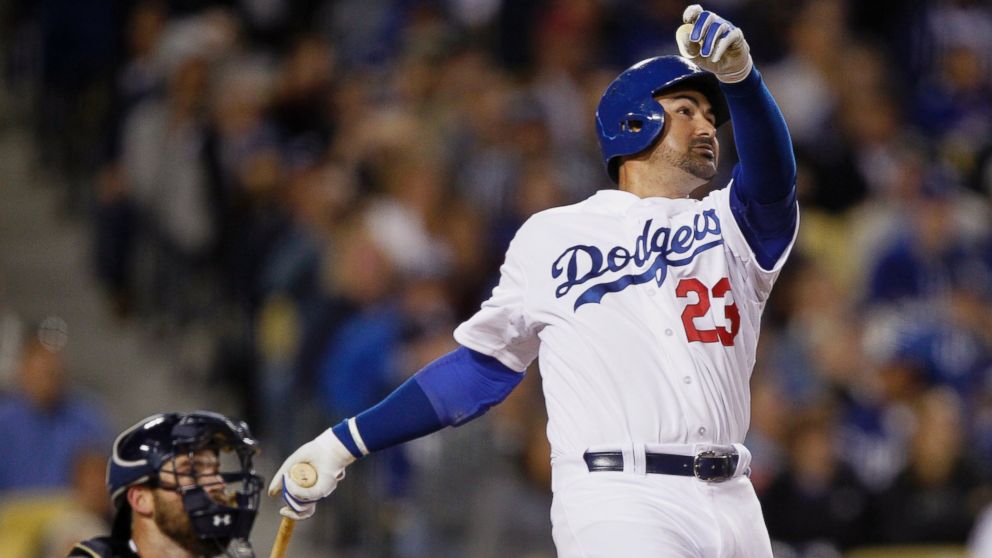
Gonzalez's great start has helped the Dodgers to an 8-3 record (ABC News)
Adrian Gonzalez came up to bat with the bases loaded twice in yesterday's Rockies-Dodgers game. The first time was in the bottom of the third, with the score tied 1-1 and only one out. With nowhere to put Gonzalez, Jordan Lyles had no choice but to pitch to the man from Mildon, who entered the game batting a scintillating .550/.609/1.125.

To his credit, Lyles got Gonzalez to ground into what should have been an inning-ending double play. Gonzalez rolled a tailor-made rally killer to Troy Tulowitzki, who quickly flipped to DJ LeMahieu at second. Though he had plenty of time to get the slow-footed Gonzalez, LeMahieu rushed his throw to first and buried it in the dirt. Justin Morneau was unable to field the hop at first, allowing Gonzalez to reach and the go-ahead run to score.

But that's just how hot Gonzalez is these days. The fielders are just as afraid of him as the pitchers are, and even his outs hurt opposing teams.

In the bottom of the fifth with the score still 2-1, Gonzalez came up in another bases loaded situation. Once again, Lyles was forced to pitch to him, and once again Gonzalez made him wish he hadn't. Gonzalez laced a long, looping drive that one-hopped the center field wall, landing just beyond the reach of a diving Charlie Blackmon. Joc Pederson and Jimmy Rollins scored, giving Los Angeles a 4-1 lead and boosting Gonzalez's RBI total to 14 on the young season. Gonzalez's single would prove to be the game-winning hit, as LA went on to win 6-3.

Gonzalez, who has hit safely in every game thus far and leads the majors in just about every conceivable batting metric, has been unstoppable since starting the season on fire against San Diego. Gonzalez had an opening series for the ages, going 10-for-13 with five home runs, two doubles, seven RBI, and seven runs scored as the Dodgers took two out of three from the Padres. After falling a triple shy of the cycle in each of the first two games, Gonzalez capped his monster series with his first career three-homer game.

Gonzalez has yet to go hard since, but he hasn't stopped hitting in the meantime. For starters, his .523/.580/1.625 line represents season lows in all three categories. Yeah. His plate discipline stats also reflect how locked in he is right now. He's made contact on nearly 90 percent of his swings, getting wood on almost 98 percent of the pitches he's swung at inside the strike zone. His swinging strike percentage, currently below five percent, is half his career rate. He's done his best Victor Martinez impression by striking out only three times.

Gonzalez's hot streak shows that even as his 33rd birthday rapidly approaches, he's still a great player. The quiet, steady first baseman usually doesn't generate many headlines, but right now he's the star of the show. Los Angeles is first in the NL West, but if he was having a Mark Teixeira-type start they wouldn't be. He's either scored or driven in 22 of the team's 56 runs thus far--a whopping 39.3 percent--and is responsible for over a quarter of their total bases.

With Matt Kemp gone and Yasiel Puig struggling to find consistency at the major league level, Gonzalez is clearly the best hitter on his team. If the last two weeks have taught us anything, it's that.
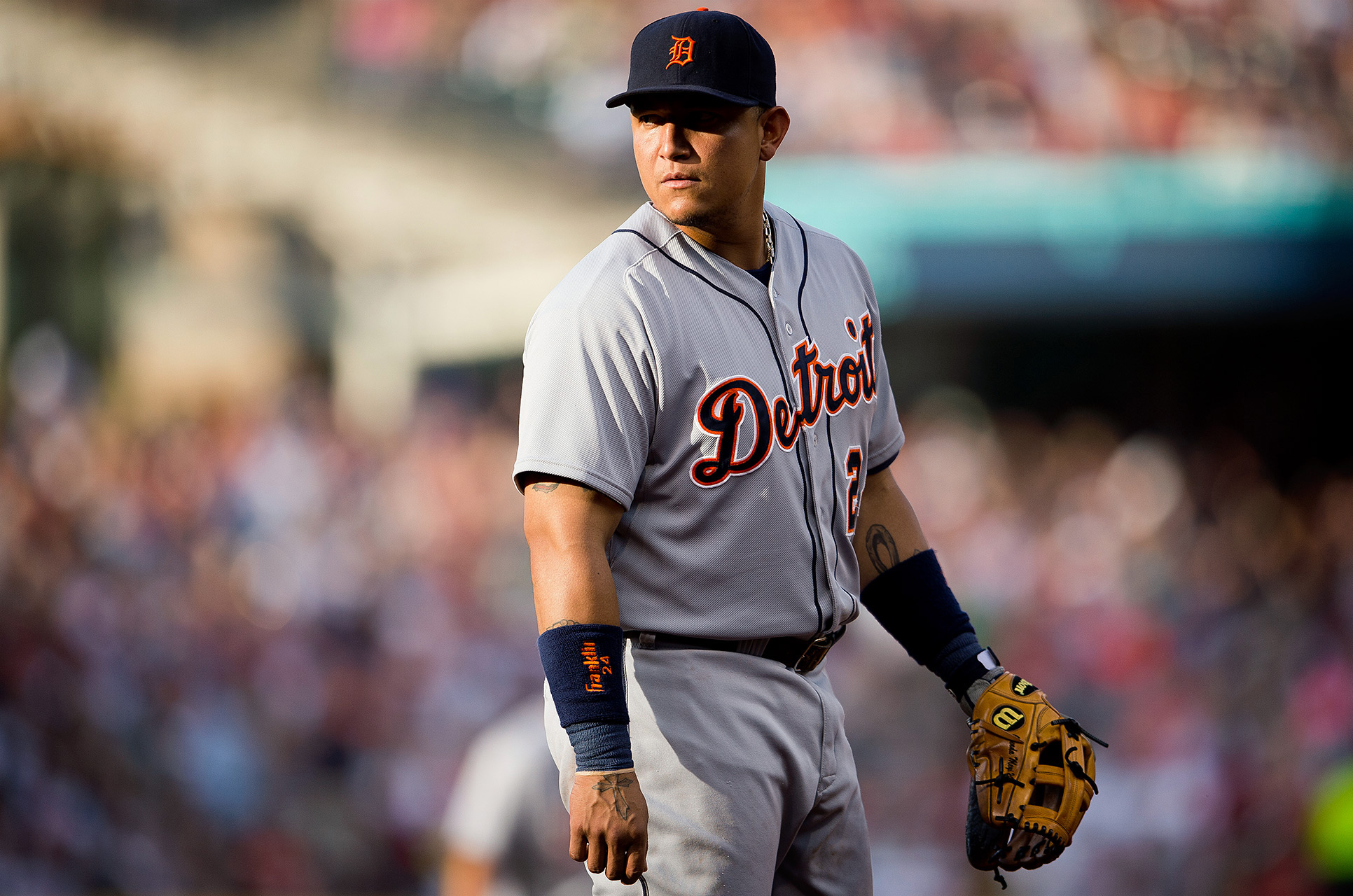
Cabrera can still crank, too (Tigers Sout)
Gonzalez isn't the only 30-something first baseman off to a torrid start. Over in the American League, in a mysterious land called Michigan, Miguel Cabrera has continued to remind everyone why he was considered the best hitter on the planet before last year.

Cabrera, who turned 32 yesterday, has been almost as impossible to get out as Gonzalez. Although his numbers pale in comparison to the latter's gaudy figures, they're still video game worthy. Through 11 games, Cabrera's hitting .442/.510/.674 with an AL-leading 19 hits. He's also driven in 10 runs so far, tied with J.D. Martinez for most on the Tigers.

Like Los Angeles, Detroit is also off to a strong start, having won nine of ten before getting blown up by Chicago yesterday. The Tigers, who many thought might fall apart this year, have resumed their usual perch atop the AL Central, Cabrera once again a big reason why.

While the two-time AL MVP hasn't been as consistent as Gonzalez (he's already gone hitless three times), he did have a series where the other team had no answer for him. In Cleveland last weekend for Detroit's first road series of the season, Cabrera laid waste to Tribe pitching. He went 3-for-5 in the opener and 4-for-5 the next day, but that was just a teaser for the grand finale: a 4-for-4 day with two long balls and a double as Detroit won 8-5 to complete the sweep.

Like Gonzalez, Cabrera hasn't cleared the fences since his mega-game but has continued to rake. He's reached base in every game since Opening Day and currently leads the American League in on-base percentage. The ankle injury that plagued him last year and required offseason surgery appears not to be an issue, and if it is he's hiding it very well. This is an encouraging sign for the Tigers, who won't see Cabrera's eight-year, $248 million contract extension begin until next year.

Before the year, everyone was quick to hand Mike Trout the MVP award (myself included). However, it looks like Cabrera's going to make it an interesting race...

Thursday, October 2, 2014

Inconsistent Cabrera

Though his numbers were excellent, Cabrera had an uneven season (FantasySmackTalk)
I was looking at Miguel Cabrera's game log today, trying to figure out how his great season went so unnoticed, and I think I figured it out. The two-time defending AL MVP got off  to a slow start (.728 OPS through May 2nd), which always makes it easier to forget about a player because his numbers are depressed for a good chunk of the season (see: Matt Holliday). But his numbers weren't depressed very long, as he went bananas in May to quickly get his stats back up to his career norms.

Then, over the next three months, he basically became Alex Gordon, minus the exceptional defense and baserunning. In 81 games--that's half a season--he managed just seven home runs and a very unCabrera-esque .278/.355/.431 slash line. His prolonged slump cause his batting line to steadily decline throughout the summer, falling from its peak of .332/.377/.569 at the dawn of June to .299/.363/.486 by the end of August. With "only" 17 home runs and 91 RBI, Cabrera was having an Adrian Gonzalez type of season. Good numbers, to be sure, but also not what we've come to expect from Cabrera after his past few seasons.

So by that point, he'd had four average to below average months and one monster month. No wonder nobody was saying much about him. September turned out be like May, as Cabrera batted .379/.409/.709 (right in line with May's .380/.423/.704) and slugged eight home runs (same as May). That finishing kick enabled Cabrera to hike his OPS 45 points in the season's final month, raising it from .850 to .895 in four weeks.

I suspect Cabrera wasn't appreciated this year because he was mediocre for such a long stretch there, reminiscent of Alex Rodriguez's roller-coaster 2006 campaign, which followed the same pattern of bookending three tough summer months with a huge May and September. Like Rodriguez that year, Cabrera provided the bulk of his production in two months, one of which was May (not exactly the most exciting time in baseball). In those two amazing months combined he mashed 21 doubles, 16 homers, knocked in 52 runs and batted roughly .380/.415/.706. For a third of the season, he was otherworldly. But for the other two-thirds he was merely pedestrian.

An old baseball idiom is that sluggers typically do 50 percent of their damage in a quarter of the season. That was absolutely the case with Cabrera this year. It's funny he was so streaky this year because he's made a reputation out of being machine-like for more than a decade. But that's just what happens as players age--their slumps last longer and their hot streaks become less frequent.

And at 31 with a dozen big league seasons under his belt, Cabrera ain't getting any younger.

Tuesday, September 30, 2014

Cabrera's Forgotten Season

Cabrera was curiously ignored this season despite his impressive numbers (ESPN)
Maybe I wasn't paying close enough attention, but I felt like we just went through an entire baseball season without talking about Miguel Cabrera.

Not only did his Tigers capture their fourth straight division title, but they did so with Cabrera once again posting monster numbers in the middle of their lineup. While his production sagged below his career norms--especially compared to the last four years--it was still outstanding. He batted .313/.371/.524, good for a 147 wRC+ and .384 wOBA (both seventh in the American League). His counting stats were exceptional as well; 25 home runs, 109 RBI, 101 runs, 320 total bases and a league-leading 52 doubles. With 5.4 fWAR he was one of the ten most valuable position players in the American League, but nobody seems to be seriously campaigning for him to win his third straight award.

I just don't get it. The guy puts up huge numbers, his team wins the division, and we forget about him? Like all of the sudden he doesn't exist anymore? What makes this lack of recognition even more strange is that Cabrera was a constant presence, playing all but three games this year. It's not like he got hurt for a few weeks and fell off the face of the earth for a little while. He was out there everyday. How do you think he reached 25 home runs, 100 RBI and 300 total bases for the 11th straight year?

Cabrera's consistency went unnoticed, as a lot of other Tigers got more ink this year. Justin Verlander and Joe Nathan fell apart, and their demise attracted a lot of negative attention. Victor Martinez had a remarkable, MVP-caliber season batting behind Cabrera. Ian Kinsler was phenomenal in his Detroit debut, making everyone forget about Prince Fielder. Torii Hunter somehow warded off age for another year. J.D. Martinez came out of nowhere and emerged as one of the best hitters in baseball. Brad Ausmus replacing Jim Leyland. Detroit trading for David Price at the deadline and still almost not winning the division. Just on the Tigers alone, there were lots of other storylines besides Cabrera this year. He was overshadowed.

Part of me thinks it was a response to Cabrera became a little overrated over the last couple of years. He won the Triple Crown in 2012, something nobody had done in 45 years, but Mike Trout was clearly better. Last year was more of the same. Cabrera once again had awesome statistics, even better than the year he won the Triple Crown, but again Trout was better. Cabrera won the MVP both years even though he was the league's fourth-most valuable player each time. It was like Juan Gonzalez beating out A-Rod, Nomar Garciaparra, and Derek Jeter for MVPs in the late '90s.

Then Cabrera signed that ridiculous contract, the eight-year, $248 million extension that doesn't even kick in until after next year, and for the first time in over a decade baseball's highest paid player wasn't Alex Rodriguez. The love for Cabrera, one of the game's more underrated players for the first ten years or so of his career, had swung too far in the other direction. He'd gone from under-appreciated to horribly overrated.

So, when he had a merely great season this year, nobody seemed to notice. He very clearly declined, but not so much that people started asking "what's wrong with Cabrera?" or began calling him out for being an overpaid bum. He was not extraordinary enough to fawn over like Trout or Giancarlo Stanton or Clayton Kershaw, but he was still productive enough to skirt any criticism that might come his way.

Of course, the Tigers should be worried about Cabrera. Despite moving back to first base, his OPS still fell nearly 200 points compared to last year. He just had the second-worst ISO and third-worst walk rate of his career. After walking more than he whiffed in 2011 and maintaining an almost-even ratio last year, he fanned more than twice as often as he walked this year, something he hasn't done since 2008. He's going to be 32 next April. Alarm bells should be going off. It's Albert Pujols all over again.

But for now Cabrera continues to fly under the radar. That will probably change over the next couple weeks if he comes up with a few big hits or strikes out in key situations. The Tigers are still trying to win their first World Series in 30 years, after all, and if Cabrera helps them do that then he'll be back in the spotlight where he belongs.

Maybe he's not the best hitter on the planet anymore, but he's still among the best, and that's worth talking about.

Friday, March 28, 2014

Criticizing Cabrera's Contract

Cabrera just became the most expensive player in baseball history
For over 13 years Alex Rodriguez held the title of highest paid player in baseball. Now, for the first time since the year 2000, someone has surpassed him.

Not surprisingly it is Miguel Cabrera, the best hitter in baseball.

With Detroit unable to reach an agreement with last year's AL Cy Young winner Max Scherzer earlier this week, the Tigers turned around and inked Cabrera to a new ten-year deal that will pay him $292 million--$17 million more than Rodriguez was guaranteed when he signed his megadeal with the Yankees six years ago. The deal also includes vesting options for the two years after the contract expires, options that would pay him an additional $30 million per season and hike the contract's total value up to $352 million (!).

A quick aside: the Tigers better pray that Cabrera retires or gets traded before those vesting options kick in, as they cover Cabrera's age 41 and 42 seasons. If he lasts into his early 40s he'll probably be pursuing some major milestones such as Barry Bonds's home run record or Hank Aaron's RBI record, but there's just no way he'd have enough on-field value to justify earning $30 million per year (even after accounting for inflation and rising salaries). Owing $30 million per year to a former star on the wrong side of 40 is the kind of dumb decision that cripples a budget and ties a team's hands, especially if that team isn't the Yankees or Dodgers.

As for the contract itself, well, I think Detroit was incredibly dumb to lock him up when he was still two years away from free agency. Just as the Red Sox should have held off on extending David Ortiz, the Tigers could and should have waited until next year to begin serious contract discussion talks. They were fools to make this move now, especially with Cabrera coming off back-to-back MVP seasons that maxed out his earnings potential. Had they just waited another year or two, they probably could have bought out the rest of Cabrera's career for significantly less.

The Tigers are betting that Cabrera can sustain his current level of play for at least a few more years and remain an effective hitter throughout his 30s. But they have to be prepared for the possibility that his days as a superstar are already behind him or are about to come to an end. A lot can happen in two years, especially during a player's early 30s when he typically begins to show signs of decline. Sure, Cabrera looks great and healthy now, just a few weeks shy of his 31st birthday, but in the past we've seen many start to go downhill around that age as their skills diminish and they have trouble staying healthy. Alex Rodriguez was otherworldly at 31, but his OPS has gone down every season since. Albert Pujols, the player with whom Cabrera is most frequently compared, saw his OPS drop more than 100 points between his age 30 and 31 season and hasn't been an elite hitter since. Frank Thomas, another great comp for Cabrera, was a beast up through age 32, then struggled to stay healthy and consistent after that.

It's discouraging, then, that Cabrera struggled with injuries and slumped during the second half last year. His descent appears imminent.

In a lot of ways this deal reminds me of the ill-fated contract extension Philadelphia gave Ryan Howard prior to the 2010 season. The Phillies gave him a five-year, $125 million deal that didn't kick in until 2012. Howard was a monster at the time, having totaled no less than 45 home runs and 136 RBI in each of the previous four seasons, but his performance dropped off dramatically during the two intervening years, and by the time his contract kicked in it was already regarded as an albatross. Howard has only gotten worse as age, injuries, and an ability to hit southpaws have made him a very expensive shell of his former self.

Philadelphia's blunder has since become a cautionary tale: don't give a contract extension to a slugging baseman in his 30s, because chances are you're going to regret it. I thought the Tigers had learned a similar lesson from their failed Prince Fielder experiment. Apparently not.

Now Cabrera is a much, much better hitter than either of them, but the same logic still applies. Like Howard and Fielder, Cabrera is a big, slow, first base/DH type with the kind of body that typically doesn't age well and is ripe for regression. All of his value is tied up in his bat, so he won't be able to help Detroit with his legs or glove. If the Tigers are smart (which, based on their head-scratching moves this offseason, they don't appear to be) they'll turn him into a full-time designated hitter as soon as they part ways with Victor Martinez, who's contract is up at the end of the season, and hope Cabrera ages as well as Ortiz and Edgar Martinez.

Because if he doesn't, the Tigers are going to get burned.

Thursday, February 27, 2014

Trout or Cabrera?

Cabrera and Trout battle for fantasy's top spot (ESPN)
Imagine your fantasy baseball draft day has finally arrived and you scored the first pick. You're sitting pretty. The only question is: who do you take?

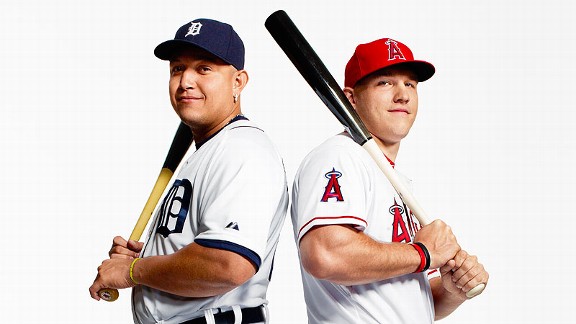
Even though any player in the MLB universe can be yours, you only have to consider two options. One is Miguel Cabrera, back-to-back MVP, three-time batting champion, and the most dangerous hitter in the game. The other is Mike Trout, baseball's best player.

So who do you choose? ESPN, MLB and Yahoo all have Trout at number one and Cabrera at number two. I thought it'd be helpful to compare their 5x5 totals from the last two years, with their major league ranks in parentheses:

Cabrera:  212 R (2nd)  88 HR (1st)  276 RBI (1st)  .338 AVG (1st)  7 SB (82nd)
Trout: 238 R (1st)  57 HR (14th)  180 RBI (22nd)  .324 AVG (2nd)  82 SB (1st)

The numbers favor Cabrera who has a huge edge in home runs and RBI. He's a good bet to provide more runs, RBI, home runs, and a higher batting average than anyone else, though the run total will probably go down a bit now that Victor Martinez is batting directly behind him instead of Prince Fielder. He's not going to provide many steals, but you're not drafting him for his speed.

But Cabrera has reached his peak. He's not going to get any better than this (can he?). Trout, on the other hand, is only 22. He still has room to grow. 40/40 is a very real possibility for him. So is winning a batting title, scoring 130 runs and driving in more than 100.

Even if you don't think Trout can get much better, you have to ask yourself if Trout's huge advantage in steals and sizable edge in runs compensate for Cabrera's superiority in the other three categories. Last year they weren't quite enough, as Cabrera was the most valuable player in fantasy baseball, scoring a 15.04 on ESPN's Player Rater. Trout was a not-too distant second at 14.57. It's worth noting that in 2012 Trout came out on top, and Cabrera was third with Ryan Braun sandwiched between them (Braun, coming off an injury-plagued and PED-ruined season, is too big of a question mark to take first this year).

Cabrera loses a bit of value by moving back across the diamond from third base to first, but manning first should help keep him on the field. He's about to be 31 though--the same age Albert Pujols began to decline--and was slowed by injuries in the second half. Cabrera's 2013 games played total was his lowest since his rookie season, which should be taken into account. He carries a bit more age/injury-regression risk than Trout.

It all comes down to a matter of personal taste, I suppose. Trout's game is more rounded and still has room for improvement. If you like to draft upside and/or power-speed guys, then Trout's your man. But if you love mashers you can plug in on Opening Day and never worry about again (of which there are very few), then Cabrera's a no-brainer.

I'd probably pick Trout because I like well-rounded players who can give me a bit of everything, but you can't go wrong with either of them. So if you're on the clock and become overwhelmed with indecision, don't hesitate to flip a coin.

Friday, November 15, 2013

MVP?

For the second year in a row, Miguel Cabrera has won a Most Valuable Player award that he did not deserve. For the second year in a row Mike Trout, who was far and away baseball's most valuable player (this year and last), will go home empty-handed.

For all of his gaudy offensive numbers--his .348/.442/.634 batting line, his 1.078 OPS, his 187 OPS+ (all of which led the major leagues, by the way)--Miguel Cabrera was not the American League's most valuable player this year. He wasn't last year, either. According to WAR, Miguel Cabrera has never been his league's most valuable player, or even its second most valuable player. He's never been the league's most valuable position player, either. He was third once (this year), fourth once (last year) and fifth once (2011). And yet he has not one, but two MVP awards.

Last year he won the Triple Crown, something nobody had done since 1967, and I'm sure the writers felt some pressure to honor that achievement with an MVP award. How would they be able to justify not giving him the award? So they played up his team's postseason status and his willingness to change positions to accommodate Prince Fielder and his countless big hits down the stretch, conveniently ignoring the indisputable fact that Trout was baseball's best player by a huge margin.

This year the reasoning was very similar. Detroit made the playoffs, the Angels didn't. Cabrera hit even better than he did in 2012. He didn't win the Triple Crown again, but was in the running for much of the season before injuries slowed him down in September, allowing Chris Davis to capture both the home run and RBI crowns.

That Cabrera is the sport's best hitter is unquestioned. Joey Votto has his supporters and David Ortiz was impossible to get out in the World Series, but Cabrera's clearly the best. But baseball is more than hitting. Trout, who's a really really good hitter but just a notch below Cabrera, makes up that ground (quite literally) with his legs.  When it comes to speed Trout blows away Cabrera, who's a bad baserunner and an even worse defender at a key position. Trout is so much better at the other aspects of the game that he's worth multiple more wins to his team per season than Cabrera is.

But baseball writers, people who are paid to watch and write about baseball, don't see this. I guess they're missing something. (Side note, the person who voted Trout seventh on their ballot should have their voting privileges revoked. To not have Trout in your top three, let alone your top five, is indefensible).

In a much less infuriating vote, Andrew McCutchen was named the NL's Most Valuable Player, becoming the first Pittsburgh Pirate to take home the trophy since Barry Bonds did so in 1990. Funny thing was, McCutchen won despite dropping off considerably from last year, when he finished third behind Buster Posey and Ryan Braun. Despite playing the same number of games and recording one additional plate appearance this year, 'Cutch hit ten fewer home runs, knocked in 12 fewer runs, scored ten fewer runs, and compiled 32 fewer total bases. He lost ten points on his batting average, 45 points on his slugging percentage and 42 points off his OPS. He grounded into more double plays.

It just goes to show you can't control how the other players in your league perform. Sometimes you have a great year and you're not the most valuable player, but even if you slip a bit you can still be MVP the next year. I think of Alex Rodriguez, whose lone MVP from his three magnificent seasons with Texas came after what was clearly the worst of the three.

And yet, because McCutchen played better defense and ran the bases better (sound familiar?) than he did in 2012, he was actually a more valuable baseball player this year, worth 8.2 bWAR this season compared to 7.2 in 2012. With all due respect to Votto, Clayton Kershaw, and Matt Carpenter, McCutchen was the true MVP this year, especially when you factor in his role of helping Pittsburgh snap its string of 20 consecutive losing seasons. There's no way the Pirates sniff the playoffs without him.

Here's what really bugs me though. The NL race was almost identical to the American League race, with McCutchen and Paul Goldschmidt standing in for lesser versions of Trout and Cabrera. Goldschmidt was the Senior Circuit's top hitter, leading the league in home runs, RBI, slugging, OPS, OPS+, total bases, and extra base hits. McCutchen's numbers were less impressive, but because he's the complete package he out-WARed Arizona's slugging first-baseman.

So if Trout and Cabrera are McCutchen and Goldschmidt on steroids (figuratively speaking), then why didn't Trout win? The only thing I can think of is that McCutchen was part of a much more compelling narrative. He was the best player on a team that made the playoffs, which nobody saw coming. Trout was the best player on a team that massively underachieved and was an afterthought for much of the season. Too much attention was paid to what went wrong with the Angels (Josh Hamilton and Albert Pujols sucking, no pitching) than the amazing feats Trout was performing on the diamond everyday.

I guess my point is that the MVP award has a lot to do with context. Context has not been kind to Mike Trout these past few years, but context is ever-changing. Conventional wisdom says he's still young, and thus has plenty of time to win multiple MVP awards. I hope he does. I hope someday he gets recognized for what he is: the best player in baseball.

Wednesday, September 18, 2013

Trout the Terrific

Mike Trout is not going to win the MVP this year. If he couldn't win it last year, when he was worth 10.9 bWAR and led the majors in runs and steals, all while playing superlative defense in center field, then he's not going to win it this year. Not with Miguel Cabrera and Chris Davis standing in his way. Trout will be lucky to get a first place vote.

It's sad, really, to see Trout not get the kind of recognition his special season deserves. He's been every bit as good as he was last year, and in some respects a bit better. He's leading the league in runs, walks, and wins above replacement. He has a four-digit OPS. He's already surpassed 10 WAR again (according to FanGraphs), which makes him the first player with back-to-back ten win seasons since a pumped up Barry Bonds did it during his second prime.

What makes Trouts success even more impressive is his age. He celebrated his 22nd birthday just last month. Nobody's ever been this good, this young before.

Nobody in the game today can match his combination of elite speed, defense, and offensive ability, either. It's not his fault the Angels stink. He couldn't control Josh Hamilton sucking and Albert Pujols getting hurt and the pitching staff falling apart. Trout can do a lot of special things on the diamond, but he can't cover the entire outfield or toe the rubber. He's just one man on a team of 25 guys, and no matter how well he plays, he can only elevate them so much.

He can do it all, but he can't literally do it all.

Once again, Mike Trout is the most valuable player in baseball. But once again, he won't have an MVP trophy to prove it.

Saturday, June 1, 2013

May MVPs

1. Miguel Cabrera (.379/.455/.767)
Cabrera is at it again after becoming the first Triple Crown winner in 45 years last season. The major league hits leader recorded at last one base knock in 26 of the 28 games he played in May, totaling 44 hits for the month and enjoying 13 multi-hit games. He also reached base in every game of the month save one--May 13th against the Houston Astros. What's more, Cabrera cranked out 12 home runs during the month, including three in one game against the Texas Rangers on May 19th, while knocking  in 33 runs. The reigning AL MVP, a one-man wrecking crew with the bat in his hands, can't be stopped.

2. Chris Davis (.364/.442/.768)
Davis followed up his monster opening month with an even better performance in May. After a slow start to the month in which he went 2-for-18, Davis caught fire and hasn't looked back. Crush supplied plenty of power for Baltimore's prolific offense last month, ripping 10 home runs and 10 doubles to hike his season slugging percentage up to .749--easily the best mark in both leagues--and maintain his long ball lead over Cabrera. He also supplied 22 runs and 22 RBI. At the moment, Davis appears to be the only obstacle standing in the way of Cabrera's bid for another Triple Crown and MVP award.

3. Domonic Brown (.303/.303/.688)
On the heels of an underwhelming April in which he batted .233/.309/.372 with three home runs, the Philadelphia left fielder broke through with a torrid May. Brown became hyper-aggressive at the plate, refusing to draw so much as a single walk in the entire month. That lack of patience didn't stop him from belting a dozen big flies, seven of which came during the month's final week, to surge past a cooling Justin Upton for the National League lead in home runs. The 25 year-old's power binge produced 25 RBI. He now sports a .272/.306/.549 batting line and is one of the few bright spots on an aging, underachieving Phillies ballclub. Brown's batting approach is not a recipe for success in the long run, but in the meantime it's helped him eclipse Ryan Howard, Jimmy Rollins, and Chase Utley as the team's top position player.

4. Mike Trout (.327/.409/.664)
2012's AL Rookie of the Year shrugged off a mediocre April and put up the kind of numbers that made him the deserving MVP one year ago. Trout scored 27 runs in May, a feat that undoubtedly had something to do with the fact that he reached base in all but two games last month. He also plated 21 runs and smacked 17 extra base hits. The 21 year-old was just as dominant on the basepaths, stealing eight bases in ten attempts. His recent hot streak sparked the scuffling Los Angeles Angels to an eight-game winning streak that helped the Halos make up some ground in the AL West.

5. Manny Machado (.355/.380/.556)
Machado emerged as a legitimate superstar during the month of May, earning comparisons to fellow phenoms Trout and Bryce Harper. The 20 year-old piled up 44 hits during the month on the back of 14 multi-hit efforts. 14 of those base knocks were doubles, giving him an ML-best 25 two-baggers on the season. That puts him on pace to break Earl Webb's single season record of 67, set all the way back in 1931. The talented third baseman is making quite a name for himself.

Wednesday, May 22, 2013

Cabrera At It Again

Once again, Miguel Cabrera is far and away the best hitter in baseball
Last year, Miguel Cabrera became the first man in 45 years to lead his league in home runs, RBI, and batting average. This year, he could become the first player ever to win the Triple Crown in consecutive seasons.

Only two men have ever won multiple Triple Crowns, and their names are Ted Williams and Rogers Hornsby. Williams accomplished the feat five years apart, in 1942 and 1947, but might have won in 1943 had he not been serving his country during World War II. He nearly won in 1941, when his .406 batting average and 37 home runs paced the major leagues, but his 120 RBI fell five short of Joe DiMaggio's league-leading total.

Hornsby also came tantalizingly close to becoming a repeat Triple Crown winner. He won his first in 1922 but came within an eyelash of winning the year before. Rajah won the batting crown (.397) and RBI title (126) in 1921 but his 21 long balls were bested by High Pockets Kelly's 23. Hornsby won his second Triple Crown in 1925.

While it's still way too early to be talking about a serious Triple Crown run, the reigning MVP's hot start has put him on track to make history. Cabrera currently leads the major leagues in both batting average  (.384) and RBI (49) while ranking third in home runs (12), tied with Edwin Encarnacion and Mark Reynolds but just one behind league-leaders Chris Davis and Robinson Cano.

Cabrera is raking right now, and while his batting average is guaranteed to drop off he's still a good bet to win his third straight batting title. As for his power, it's possible the best is yet to come given how well he finished last season--36 home runs and 105 RBI from this date forward. While it's going to be almost impossible for him to sustain his current level of run production (he's on pace for 185 RBI thanks to his absurd .509/.586/.912 batting line with runners in scoring position), he could benefit from even more RBI opportunities once Austin Jackson returns from his hamstring injury early next week.

Until then, look for him to do some serious damage when the last-place Minnesota Twins come to the Motor City for a four-game set this weekend.

Monday, February 25, 2013

Who's Number One?

Mike Trout, Ryan Braun, and Miguel Cabrera (in that order) were the top three fantasy baseball players in 2012 according to ESPN's Player Rater. Which one deserves to be the first name off the board in your fantasy draft?

The Case for Braun
  • A true five category stud, Braun's average season yields 102 runs scored, 34 home runs, 107 RBI, 21 steals, and a .313 batting average
  • Braun's batted over .300 in five of his six big league seasons and owns a .313 career average
  • Few can match his combination of power and speed: Braun was the only player to go 30/30 in both 2011 and 2012
  • Milwaukee's offense paced the National League in runs scored last year, meaning Braun should have plenty of opportunities to score and drive in runs.
  • Fantasy owners need not worry about injury risk. Braun's averaged 154 games per season over the past five and is one of the safest investments in fantasy
Reasons to think twice
  • Braun's name has been linked to baseball's latest PED scandal and he once again finds himself embroiled in controversy. While it's highly unlikely Braun gets suspended, his performance will once again endure intense scrutiny from fans and media alike
  • After trimming his strikeout rate every year from 2008-2011, in 2012 Braun posted the worst whiff rate since his sophomore season
  • The spike in strikeouts may have something to do with the fact that he offered at 36.8 percent of pitches outside the strike zone, easily the highest mark of his career
My Projections: 104 runs, 36 home runs, 110 RBI, 31 steals, .318 batting average

The Case for Cabrera
  • Whereas outfield is the deepest position in fantasy for hitters, third base tends to be more volatile. It's not as thin as in years past, but many players (Pablo Sandoval, Kevin Youkilis, Chase Headley) have question marks
  • Starting in 2004, Cabrera's average season has produced 102 runs scored, 34 home runs, 118 RBI, 4 steals and a .321 batting average
  • A career .318 hitter and two-time batting champ, Cabrera has batted below .320 just once in his past eight seasons
  • He has Prince Fielder and Victor Martinez, two of baseball's top RBI men, protecting him in Detroit's lineup
  • Surprisingly durable for his size, Cabrera has appeared in at least 157 games each year since 2004. He's one of those players you pencil in on Opening Day and don't touch for the rest of the season
Reasons to think twice
  • Cabrera turns 30 in April, and his weight has been an issue throughout his career. Let's just say he won't be posing shirtless on magazine covers anytime soon
  • His OPS has declined in consecutive seasons
  • His walk rate plummeted from a career-best 15.7 percent in 2011 to 9.5 percent last year, probably because he adopted a more aggressive approach with Fielder batting behind him
  • With just 33 stolen bases to his name, Cabrera is a not a five category monster like Trout and Braun. Owners seeking speed will have to look elsewhere
My Projections: 112 runs, 37 home runs, 124 RBI, 2 steals, .333 batting average

The Case for Trout
  • At the tender age of 20, Trout delivered one of the greatest all-around seasons in baseball history. Assuming he follows a normal aging curve, he should only get better 
  • Despite spending the season's first 20 games in Triple-A, he went on to lead the major leagues with 129 runs, 49 stolen bases, and 10.7 bWAR last year. In addition, the Millville Meteor slugged 30 home runs, finished runner-up to Cabrera for the batting title and posted the AL's highest OPS+
  • If Mike Scoscia continues to bat him leadoff, he's going to score a truckload of runs setting the table for Albert Pujols, Josh Hamilton, and Mark Trumbo.
Reasons to think twice
  • Trout cooled off considerably in the season's final third. From August 1st forward, he batted .287/.383/.500 while striking out in a quarter of his plate appearances. Perhaps pitchers adjusted. Maybe he wore down over the course of his first full major league campaign. Perhaps it was simple regression to the mean. Most likely, all three factors played a role in his late-season slide.
  • Batting leadoff limits a batter's RBI opportunities, so Trout is going to be hard-pressed to reach the century mark in ribbies no matter how successful he is with men on base
  • Trout lacks the distinguished track records of Braun and Cabrera. The sample size is too small to make confident predictions about how he's going to perform in 2013 and beyond...
  • His .383 BABiP ranked third behind Dexter Fowler and Torii Hunter last year. Trout's fast, but he'll probably bat closer to .300 than the .326 mark he posted last year
  • Is the power legit? After all, we are talking about a guy who managed just 23 home runs in more than 1,300 minor league plate appearances
  • Could he possibly be any better than he was last year? Can he avoid the dreaded "sophomore slump" that plagues many of the sport's best young talents? Eric Hosmer, Brett Lawrie and Jason Heyward, all billed as superstars-in-the-making, struggled mightily in their second seasons. While they weren't anywhere close to Trout's level, they displayed how growing pains are part of the game. He won't fall off a cliff, but will probably dip a bit the same way Alex Rodriguez, Ted Williams and Pujols (already Cooperstown caliber players at Trout's age) did
My Projections: 123 runs, 24 home runs, 79 RBI, 52 steals, .306 batting average

The bottom line: if you score one of the first three picks in your draft, you're sitting pretty. Don't agonize over the decision too much, because you can't go wrong. Cabrera and Braun are money in the bank. Taking Trout is more of a calculated risk, albeit one that could also reap the biggest rewards. If the 21 year-old wunderkind somehow improves upon his historic rookie year, watch out.

I prefer to play it safe, so I'd put Braun at number one, Cabrera second and Trout third. How about you?

Tuesday, December 25, 2012

Hamilton to Hollywood

Hamilton is happy to be an Angel
Last December the Los Angeles Angels dominated the Hot Stove headlines by committing more than $300 million to Albert Pujols and C.J. Wilson. Over the summer they landed Zack Greinke, the most prized trade deadline target, to form a super-rotation with Wilson, Dan Haren, Jered Weaver, and Ervin Santana.

But for all their wheeling and dealing, the Halos finished third in a four-team division. The Los Angeles Dodgers missed the playoffs, too, despite bringing in Hanley Ramirez, Shane Victorino, Adrian Gonzalez, Josh Beckett, Joe Blanton and Carl Crawford to fortify a roster that already boasted the league's top position player (Matt Kemp) and pitcher (Clayton Kershaw).

The Dodgers added more star power by shelling out $147.5 million for Greinke, the best pitcher on the market. The Angels countered by stealing Josh Hamilton, the best available hitter, from their division rivals with a five-year, $125 million deal. Hamilton provides a lefthanded power bat his new team sorely needed. He joins a lineup that has baseball's version of the Big Three, featuring the best all-around player in the game, the best hitter of his generation and the sport's most exciting, dynamic talent. It would be like pairing Ted Williams with Mickey Mantle and Willie Mays.

But don't go handing them the AL West title just yet. Pujols will be 33 next year and his OPS has declined each season since 2008, falling from a superlative 1.114 to a merely good .859 in his Califorinia debut. Trout can't possibly get any better and will likely regress in 2013. Hamilton is the biggest wild card of all, an every-other year player on the wrong side of 30 who also seems like a good bet to regress after moving away from a hitter's haven in Texas to a pitcher's paradise in Anaheim. The former MVP and batting champ is also likely to miss a good chunk of time; he's topped 150 games played just once throughout his career and isn't getting any younger.

No one knows what to make of Hamilton after his rollercoaster 2012 campaign that highlighted the mountainous peaks and cavernous valleys that have defined his six major league seasons. After a magical first two months to the season highlighted by a historic night in Baltimore that saw him blast four home runs, the MVP frontrunner fell into a prolonged slump and everyone soured on him. Nolan Ryan called him out. Rangers fans booed him. He was criticized for giving away at-bats with his hyper-aggressive batting approach, lack of plate discipline, and Vladimir Guerrero-esque tendency to hack at any pitch in the general vicinity of the strike zone.

The numbers speak for themselves. From June 1st until the end of the season, the enigmatic outfielder batted an uninspiring .245 with 123 strikeouts. The five-time All-Star also seemed to let his struggles at the dish follow him out onto the field, where his typically solid defense deteriorated sharply during the second half of the season.

But even with his summer slide, Hamilton still finished his contract year with gaudy power numbers. His 43 home runs, 128 RBI, and .577 SLG all ranked second in the Junior Circuit, surpassed only by Triple Crown winner and league MVP Miguel Cabrera, while his HR/AB ratio was bested only by Edwin Encarnacion. Hamilton also placed top five in OPS, runs, intentional walks, total bases, and extra base hits. Not too shabby.

I doubt he'll compile similar statistics next year, though, or possibly ever again given his combination of age, injury history, personal baggage and move to a pitcher-friendly environment. I project him to replicate Pujols' .285-30-105 production from last year, but can't see Hamilton repeating his past performances. His numbers were inflated by the Ballpark in Arlington, where he owns a .315./373/.592 batting line, as well as his great supporting cast of Ian Kinsler, Adrian Beltre, Michael Young, Elvis Andrus, Nelson Cruz, and Mike Napoli that made Texas a run-scoring machine.

Hamilton is still a great hitter and tremendous talent regardless of where he plays, but I'm willing to bet we've already seen the best of him. He inked the same contract as Ryan Howard at the same age--32--and after the first year of Howard's deal it's already looking like a massive mistake. Same goes for Pujols. And I don't have to tell you about Alex Rodriguez, the only player with a larger annual salary than Hamilton.

The deal he got was fair, but I doubt he'll be worth the money. Then again, few players with nine-figure contracts (Alfonso Soriano, Vernon Wells and Barry Zito come to mind) are.

Merry Christmas!

Monday, November 19, 2012

MVP Reaction

The debate between Mike Trout and Miguel Cabrera has been raging for months, and by this point it's been analyzed to death. I don't want to beat a dead horse, so I'm just going to say this. Mike Trout deserved to win the American League Most Valuable Player award. So did Miguel Cabrera. Trout deserved it more. He should have been the third player to win both Rookie of the Year honors and the MVP award in the same season (Fred Lynn and Ichiro Suzuki are the others).

I don't mean to bash Cabrera here, because he had a monster season. He really did. Besides leading the league with his .330-44-139 produciton, he also led the majors with his .999 OPS and 377 total bases. Hands down the best hitter in baseball this year. No disrespect to Cabrera, but his numbers weren't that special (they look like your typical Manny Ramirez year, or something out of Jim Rice's prime). Trout had one of the greatest seasons of all time. There is no compelling argument for why Miggy should have won over Trout, especially by such a huge margin;

-Cabrera won the Triple Crown, which is cool. Nobody had done it since Carl Yastrzemski's magical 1967 season. But Trout became the first player ever to score at least 125 runs, hit 30 homers and steal 45 bases.

-Cabrera hit better down the stretch (August and September), but Trout was better in May, June, and July. Last time I checked, a win in May counts just as much in the standings as it does in September.

-Sure, the Tigers made the playoffs and the Angels didn't, but LA actually won one more game in Detroit despite playing in a much tougher division. While Detroit got to beat up on the Twins, Royals, and Indians, LA had to duke it out with Oakland and Texas all summer long. The Halos missed the playoffs because Pujols had the worst April of his career, Mark Trumbo disappeared after the All-Star Break, Ervin Santana fell apart and Dan Haren had the worst full season of his career. How is any of that Trout's fault? If the team hadn't kept him buried in the minors for most of April it probably would have reached the postseason. And I'm sick of the notion that the MVP has to come from a playoff team (it cost Matt Kemp the award last year). The best player deserves to win. Period.

-Trout had the best season by a 20 year-old has ever had. Better than Alex Rodriguez's 1996, Ted Williams' 1939 and Ty Cobb's 1907. Cabrera didn't even have the best season of his career (his last two years were better).

-Trout was the best defensive centerfielder (forget Adam Jones winning the Gold Glove, Trout won the Fielding Bible Award) and the best baserunner in baseball. Cabrera "sacrificed" by moving back to third base to make room for Prince Fielder, but he is average at the hot corner and average on the basepaths.

-Cabrera hit better with runners on base, but he also had 138 more men on base than Trout did over the course of the season and also grounded into two dozen more double plays. Besides, WPA (the best statistic for measuring "clutch") shows that Trout was superior in high leverage situations.

-Forget the batting title. Every baseball fan worth his salt knows OBP is more important, and Trout's .399 mark tops Cabrera's .393.

-Last but not least, Trout was worth 10.7 bWAR, the most any position player has had since Barry Bonds ten years ago. Cabrera was worth 6.9, becoming the first Triple Crown winner not to lead his league in in WAR. You tell me who was more valuable.

As for the National League, it was a foregone conclusion that Buster Posey would win the award after his monster second half helped San Francisco reclaim the NL West. Even though his counting numbers paled in comparison to Ryan Braun's, Posey's 7.2 bWAR led the league. The Giants backstop posted the best batting average and OPS+ in the majors. He cut down more would-be basestealers than any catcher in baseball. Put it all together and Posey became the first NL catcher to win the award since Johnny Bench took home the trophy in 1972 (looking at Mike Piazza's player page it's a wonder he never won.)

I was happy to see Braun get the credit he deserved for another phenomenal season. The 2011 NL MVP paced the Senior Circuit in runs, homers, OPS, total bases, and extra base hits while finishing second in hits, slugging, RBI. He was the only player in the league to go 30/30, something he did last year as well.  He was undoubtedly the top hitter in th NL this year, and had the Brewers made the playoffs the vote would have been much closer. As it is, he finished a distant second but still received ten first place votes. I thought the BBWAA would punish him for his testosterone red flag last October, but they gave him a fair shake. Andrew McCutchen (third) and Yadier Molina (fourth) took the remaining pair of first place votes, while NL RBI leader Chase Headley rounded out the top five.

Other notes of interest:
The AL  truly was a two-horse race. Cabrera and Trout received all 28 first place votes. I'm a little surprised that Robinson Cano or Josh Hamilton didn't get any.

Justin Verlander, the Cy Young runner-up, finished four spots higher than David Price, who won the award.

Albert Pujols wound up 17th, the first time in his career he missed the top ten. Before this season he'd made the top five every year from 2001-2011 except 2007, when he finished ninth.

Nobody on the Boston Red Sox received MVP consideration, and rightfully so. Can't remember the last time that happened.

Hunter Pence made his way onto the ballot despite skidding to the finish line with a .253/.319/.425 batting line and 0.8 bWAR. I'm guessing someone was impressed with his 24 home runs and 104 RBI.

Chipper Jones received consideration for the 13th and final time in his career.

And who in God's name voted for Raul Ibanez? (probably the same guy who threw David Robertson a vote last season; the man needs to be stopped). Ibanez batted .240/.308/.453 and was worth a paltry 0.3 bWAR. I can think of many players more deserving of that vote; Curtis Granderson, David Ortiz, Chris Davis, Billy Butler, Alex Gordon, and the biggest snub; Austin Jackson. A-Jax led the league in triples, maintained a .377 OBP and scored 103 runs setting the table for Prince Fielder and the MVP.