Showing posts with label Mike Trout. Show all posts

Friday, June 30, 2017

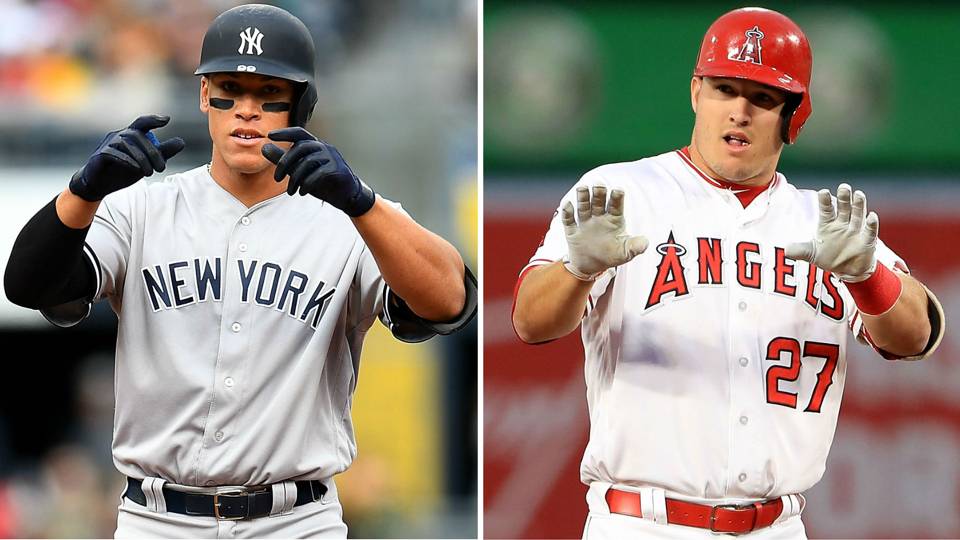
Aaron Judge is the New Mike Trout

With Trout sidelined, Judge has been dominating baseball (The Current)
It's been over a month since Mike Trout landed on the disabled list with a torn ligament in his left thumb, thereby opening the door for someone else to claim the title of Best Player in Baseball, if only for a while. Even if Trout hadn't gotten hurt, however, there's a good chance he would have relinquished his crown anyways, because Aaron Judge has been every bit as good.

When Trout went down, he was slashing an absurd .337/.461/.742 -- good for a 208 wRC+ and a .475 wOBA. Through yesterday, Judge was batting .331/.451/.699, which translates to a 200 wRC+ and a .470 wOBA. Not only are those numbers nearly identical to Trout's, but they've been sustained over an additional 28 games and 122 plate appearances. Excluding Freddie Freeman, who's also hurt and hasn't played in six weeks, no one else is even close to those numbers.

Judge isn't merely a one-dimensional slugger, either. He's stolen six bases in eight attempts, and isn't the liability on the bases like most elite power hitters. He doesn't have the game-changing speed of a Trout or Billy Hamilton, but he runs well for a man his size, which has helped him score an MLB-high 70 runs this year. FanGraphs and Baseball-Reference only credit Trout for contributing 1-2 more runs than Judge on the bases -- a fraction of a win in the grand scheme of things.

And while Judge isn't going to win a Gold Glove for his work in right field, he holds his own on defense. He has a strong throwing arm and decent range, while his wingspan and length allow him to reach balls that smaller players might miss. For all of Trout's home run robberies and jaw-dropping catches, it's important to remember that he has never won a Gold Glove, either, and that side from his rookie season, he has never rated as a great defender. Both B-R and FG have Judge as the superior outfielder this season by roughly 0.2 wins, which cancels out Trout's advantage on the bases.

So with mirroring batting lines and equal contributions outside the batter's box, Trout and Judge have been essentially the same player this year. If Judge keeps it up, he'll finish the season with over 10 WAR (both versions), which is something that only Trout has done since 2004. He's pretty much a lock to win Rookie of the Year at this point, and he'll probably win MVP, too, which not even Trout was able to accomplish as a freshman.

The similarities don't end there, either. They've both dominated in their first full season after struggling during brief cups of coffee, emerging as fully-formed baseball gods. They're both 25 and play for big-market teams but aren't quite comfortable in the spotlight, projecting the aw-shucks personality that made Mickey Mantle (whom both have been compared to) so endearing. They wow fans and teammates with their superhuman feats on the ball field, but off the field they appear to be regular guys. They're clean cut, avoid controversy and stay away from drugs, alcohol, or any other vice that would compromise their tremendous skills. They're more Roger Maris than Mantle in that sense, and they're nothing like fellow prodigy Bryce Harper. They're living proof that you don't need to grow wild hair or fight pitchers to make baseball fun again; all they have to do is play the game to the best of their ability.

Wednesday, May 31, 2017

Trout Was Having Mantle-esque Season

Prior to his injury, Trout was giving Mantle a run for his money (CBS Sports)
We've been comparing Mike Trout to Mickey Mantle so often for so long that we might as well start calling him Mikey Mantle. Seriously though, the comparisons have always been justified, which you can't say about most players who've had their names mentioned in the same breath as Mantle's over the past half-century.

Here are their numbers through their age-24 seasons:

Trout: 811 G  168 HR  .306/.405/.557  168 wRC+  47.7 fWAR
Mantle: 808 G  173 HR  .308/.412/.560  164 wRC+  41.1 fWAR

Throw in the fact that they're both soft-spoken, crew-cut boys from working class families who grew into speedy, powerful center fielders for big-market American League teams, and you'd be justified in thinking Trout was Mantle reincarnated (it's impossible, however, because Trout had just celebrated his fourth birthday when Mantle passed away in August, 1995).

While Trout's edges in fielding and baserunning made him more valuable than Mantle through the first phase of their careers, he has yet to have a season that rivaled Mantle at his best. Peak Mantle won a Triple Crown at 24, batted .365 with a .512 OBP at 25, and nearly broke Babe Ruth's single-season home run record during that charmed summer of 1961. As incredible as Trout's been, he has yet to reach Mantle's prodigious heights. He hasn't belted 50 homers or slugged .700 in a season and has never won a batting title, much less topped .350 in consecutive years like Mantle. That's why Mantle has a pair of 11-WAR seasons on his resume (according to FanGraphs), while Trout has zero.

This year, it looked like that was going to change. At age 25 and in his seventh big league campaign, Trout had done the unthinkable. He found another gear, inflicting maximum damage with his swings by ambushing pitchers earlier in the count. Since 2012, we've been wondering what it would look like if Trout followed a normal aging curve and improved during his 20s like players are supposed to. Everything written or said about him came with the caveat that he wasn't technically in his prime yet, even though it was plain for all to see that he was already at or near his zenith.

But with every pitcher, catcher, and manager making it their life mission to exploit holes in Trout's swing, the best he could do was keep up. He was able to maintain, but not improve, although that's no knock against him. Producing at an elite level year-after-year is the hardest thing you can do in sports. Every player has a down year at some point, even Ted Williams.

Not Trout, whose consistency has been most often described as metronomic. Each year, however, he's taken a slightly different path to success. His traditional numbers have fluctuated quite a bit, but his WAR values have remained constant.

Trout's managed to sustain his excellence by constantly and rapidly adjusting. At various points, pitchers have tried to neutralize him with breaking stuff away, hard stuff in, and fastballs up in the zone. Each time, he made the necessary adjustments to handle these pitches. Unable to penetrate his airtight plate coverage, pitchers tried to use his discipline against him, attacking him earlier in the count to get ahead of him since he rarely swung at the first pitch. Trout quickly caught on, forcing them to go offspeed early in hopes of disrupting his timing and sneaking strike one by him.

Well, that hasn't worked either, and it seems that pitchers have, for the time being at least, run out of ways to fool Trout. Let the record show that during the first two months of the 2017 season, he was simply unstoppable. Through his first 47 games, he was sporting an absurd 1.203 OPS with 16 homers and 3.5 fWAR. He was on pace for close to 50 homers and well over 100 RBIs. In essence, he was duplicating Mantle's Triple Crown year:

Trout 2017: .337/.461/.742  (217 OPS+) 11.1 fWAR in 150 games (projected)
Mantle 1956: .353/.464/.705  (210 OPS+)  11.5 fWAR in 150 games (actual)

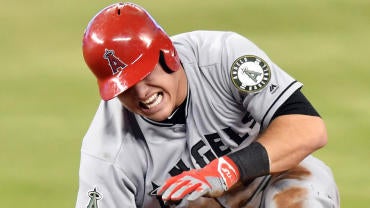
Then, Trout did what Mantle used to do all too frequently: He got hurt. It happened while Trout was stealing his 10th base in 11 tries this year, giving him double-digit thefts in six straight seasons and putting him on track for a fourth season of at least 30. Only Trout dove head-first, one of the stupidest things you can do on a baseball field besides turn your back on the pitcher or run out to play defense without your glove.

It ended poorly for Trout, who tore a ligament in his thumb and will miss the next 6-8 weeks after undergoing surgery. As it turns out, the only thing capable of slowing Trout down in 2017 was Trout himself.

And so, after losing its top pitcher (Clayton Kershaw) for most of last summer, baseball will be -- for the first time since 2011 -- without its best player for much of this one. He'll be sidelined for all of June and possibly July, though he'll likely be back around the All-Star break. Trout strikes me as the type of guy who will return on the early side of his recovery timetable, and maybe even before it. The Angels can't compete without him, and you can bet he'll do everything in his power to get back in the lineup as soon as possible.

Let's hope he does, so he can get back to doing what he does best; playing baseball better than anyone who's ever lived.

Thursday, September 1, 2016

Trout's Team Costing Him Another MVP Award

Trout's team is the only thing stopping him from winning MVP (MLB.com)
The regular season ends one month from tomorrow, and we still have no idea who the American League's Most Valuable Player is going to be. Will it be Josh Donaldson again? Maybe! Could Jose Altuve become the shortest MVP in baseball history? Possibly! Does Mookie Betts have a chance? Absolutely!

Mike Trout, unfortunately, has no chance. He'll get plenty of votes, of course, perhaps even enough to finish second again (something he's accomplished three times already). But because the Angels have been so bad, and the rest of the competition is so good, voters are going to give the award to someone else. Again.

Trout's annual MVP snubs are getting ridiculous. Everyone knows he's the best player in baseball, the way you know the sky is blue and the earth is round, and the stats back it up. But when the recipient is named in November, it won't be Trout. It will be Donaldson, who edged him last year, or Altuve, or maybe even Betts. Heck, David Ortiz probably has a better chance than Trout at his point. Ironically, the player with the best statistical case appears least likely to win.

Trout still has a month to build his case, but it won't matter how well he plays down the stretch. Last year he had a 1.078 OPS in September--his highest of any month--while nearly leading Los Angeles into the playoffs, and it still wasn't enough. He can hit .400 with 12 home runs over the next five weeks, and it's not going to make an ounce of difference because the Angels have been out of contention for months.

And so Trout will finish his fifth full season with one MVP award, even though he should have five. He deserved to win over Miguel Cabrera in 2012 and 2013, and he deserved to win over Donaldson last year. Ironically, the year he did win--2014--was probably his worst year, but LA ran away with the division so Trout won in a landslide (unanimously, actually).

His career is starting to look an awful lot like that of Willie Mays, who won his first MVP at 22--the same age Trout won his--but then didn't win another one until he was 33. Like Trout, Mays led the league in WAR pretty much every year and was widely believed to be the best player in baseball, but the Giants were generally mediocre and he suffered at the polls as a result. Sixty years later, the same thing is happening to Trout.

But people really need to stop penalizing Trout for the lack of talent around him, especially since playing for a winning team is not part of the award criteria. It's not his fault the Angels have failed to surround him with adequate talent, or that they've been hamstrung by overpaying the likes of Albert Pujols, Josh Hamilton, and C.J. Wilson. As bad as they've been with him, just imagine how much worse they'd be without him. It's possible they'd have the worst record in baseball were it not for Trout, which, in a world where the Braves exist, is a scary thought.

So while Trout isn't leading his team to the playoffs this year, at least he's keeping them out of last place (not even peak Alex Rodriguez-on-steroids was able to do that in Texas). Trout has the talent to transform a .500 team into a contender all by himself, but the problem is that he's not on a .500 team. He's still making a huge difference in the standings, just not one that many people care about.

Friday, November 20, 2015

Harper Wins Handily, Donaldson Defeats Trout

For the third time in four years, Trout was denied an MVP he deserved to win (LA Times)
This year's MVP race featured a pretty easy call in the National League and a brutally tough call in the American League. As usual, the BBWAA knocked the meatball out of the park but froze on the outside curve at the knees.

To be fair, that tough call was borderline impossible. Mike Trout's stats and Josh Donaldson's stats were virtually identical, and when that happens you tend to see voters falling back on wonky criteria to make their decisions, i.e. whose team made the playoffs, who had the better second half, who was part of a better story, etc. I'm sure some also felt less compelled to vote for Trout since he won last year, whereas Donaldson had never won.

Still, the fact remains that in tight races, the BBWAA seems to get the calls wrong more often than not. I'm thinking back to all those years Ted Williams lost out to his Yankee rivals (usually Joe DiMaggio), when Roger Maris edged out Mickey Mantle twice, how Sammy Sosa sneaked off with Mark McGwire's trophy, and the recent Trout and Miguel Cabrera debates. I could go on and on--Albert Pujols vs. Ryan Howard, Matt Kemp vs. Ryan Braun, any shortstop vs. Juan Gonzalez. Maybe I'm just not remembering the times voters have gotten the close ones right, but I can think of many more examples where the opposite was true.

I'm really starting to feel bad for Trout. The dude should have four MVPs by now, and instead he just has one and three second-place finishes. While that's still an impressive accomplishment, there's no trophy for second place. He could/should have been the first player in baseball history to be a four-time MVP before his 25th birthday, not to mention the only player not named Barry Bonds with more than three. Instead, he's still searching for his second.

Trout's starting to suffer from the Willie Mays effect, which is that even though everyone acknowledges him as the best all-around player in baseball, they still find ways to give the MVP to someone else. His seasons are all so great that none of them feel special anymore; it's just business as usual, another ho-hum nine-win season from Trout. People don't appreciate just how ridiculously good he has been--the best ever in baseball history at his age up to this point.

It's probably no coincidence, either, that despite leading American League position players in bWAR four years in a row, the only year he won MVP was the year his team made the playoffs--and that was his worst season individually! The other three times, he lost out to an inferior player on a postseason team. Voters are still failing to isolate the player from the team.

People didn't have that problem with Harper, who was far and away the best player in baseball this year even though he played for one of the most disappointing clubs in recent memory. The failures of his teammates not named Max Scherzer didn't stop him from winning unanimously, becoming the youngest player to do so (Trout had been the previous record-holder after winning unanimously last year).

It also helped that Harper had the trophy locked up by Memorial Day, surviving historic second halves from Joey Votto and Jake Arrieta. Of course, the MVP at the end of May isn't always the MVP come October, as we saw with Josh Hamilton in 2012 and Troy Tulowitzki in 2014, but Harper hit plenty over the season's final four months to protect his lead. When the dust settled, he had the highest WAR, OBP, slugging, OPS, and OPS+ in the majors, not to mention the most runs and long balls in the National League. Not even a surprise strangling by Jonathan Papelbon could knock him off. 

Harper is very much a modern MVP winner in that he won because he had the best numbers.  Even though he came from a crappy team, failed to drive in 100 runs, didn't play a premium position, and was not well-liked throughout the game--reasons voters might opt for someone else--he still won unanimously. His numbers were simply too overwhelming.*

*Which is funny, because he had the kind of season Ted Williams used to have every year, only Williams was usually dismissed for all the reasons I just mentioned
Unlike the AL award, the NL MVP was never in doubt (ABC6)
So while the NL race was effectively over by June, the American League remained an epic back-and-forth struggle between Trout and Donaldson throughout the summer. Whenever one seemed to take the lead, the other would get hot and pull even again.

The stretch that sealed it for Donaldson was the six weeks between the end of July and middle of September. Toronto took off during that time, rising from a game under .500 to first place in the AL East, leapfrogging three teams to get there. Donaldson went out of his mind during his team's ascension to the top of the standings, batting a sizzling .364/.433/.755 with 14 homers and 49 RBI over 39 games from July 29th through September 11th. With the Blue Jays firmly in control of first, no one seemed to notice how much he tailed off over the season's final three weeks, losing 31 points from his OPS.

While Toronto and Donaldson were kicking it into high gear for the stretch drive, Trout and the Angels were falling apart. Fourteen games over .500 and leading the AL West on July 23rd, Los Angeles plummeted to a game below .500 and 7.5 out of first by the end of August. Not surprisingly, LA's slide coincided with Trout's worst month as a professional. From August 1st through August 29th he batted .194/.336/.290 with just six extra base hits and six RBI.

Both rebounded in September, but were unable to make up the ground they lost in their late summer swoon. The Angels missed out on the second wild card by one game, and Trout was unable to overtake Donaldson in the MVP vote.

He should have. Trout was the best hitter in the American League--his raw OPS was 52 points better than Donaldson's in a much tougher hitting environment--while playing center field, a more demanding position than third base (Donaldson's position). Donaldson had better counting numbers, but that was largely because he had better hitters around him and walked less, so he ended up with 45 more at-bats even though Trout played one more game. Besides, we know stats like runs and RBI are team-dependent and thus should not hold much weight in these discussions.

So how did Donaldson win? Trout won last year, which probably hurt him, but I think the real reason was that that Donaldson had narrative on his side. He comes over in a blockbuster trade and then immediately leads his team to the postseason--their first playoff berth in 22 years, mind you--his very first year there. He had plenty of help from Jose Bautista, Edwin Encarnacion, Russell Martin, and David Price, but people seem to think Donaldson, like Maris coming to the Yankees in 1960 or Bonds going to San Fran in '93, made the difference.

I don't think so. I think Toronto still makes the playoffs with Brett Lawrie at third, all else being equal but they probably don't win the division. Los Angeles, on the other hand, wouldn't have even sniffed the second wild card were it not for Trout. They had a negative run differential with their superstar center fielder, so they surely would have had a losing season without him. Trout single-handedly turned a mediocre team into a contender, whereas Donaldson made a contender the best team in the American League.

I'm more impressed by what Trout did for LA than what Donaldson did for Toronto. Then again, I'd still vote for Trout even if the Angels had lost 100 games. Because the best player is the most valuable, and once again Trout was the best.

Friday, September 4, 2015

MLB September Storylines

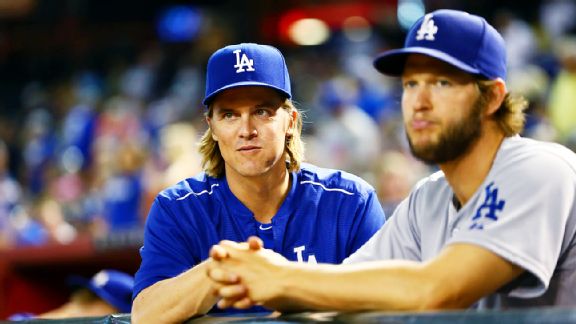
Dodger aces Greinke (L) and Kershaw are players to follow in September (ESPN)
Labor Day weekend is upon us (seriously, how did that happen?), which means there's but one month left of the regular season. Even with most of the divisions and playoff races already decided, several exciting stories have yet to be played out. Will the Blue Jays win their division, thus ending the longest postseason drought in American professional sports? Can Houston hang on in the AL West? And just who is going to put themselves over the top in various award races?

Even if your team is toast and you can't wait for football to start, there's still enough going on to keep fans engaged into October. Here's a sample:

1. David Ortiz's march to 500 home runs
It's been another tough year for the Red Sox but another great one for Ortiz, who's closing in on his 500th career long ball. He has five to go which, given his feverish home run pace (23 taters in his last 70 games), shouldn't take too long.

2. Clayton Kershaw's quest for 300 strikeouts
As Jeff Sullivan noted yesterday, Kershaw's up to 251 K's on the year after fanning 15 Giants in Wednesday night's masterpiece. With five or six starts remaining, he has a chance to become the first pitcher since 2002 to eclipse 300 punchouts. If he does that, a third straight Cy Young award may be in the cards.

3. AL East showdown
As always, the AL East has become a dogfight between its top two teams, one being the Yankees of course. For once, however, the other combatant isn't Boston. It's the Blue Jays, currently clinging to a 1.5 game lead over the Bombers. Toronto will get every opportunity to widen the gap down the stretch with the rest of its games coming against sub-.500 teams and New York.  The Yankees have a similarly easy slate, however, so it wouldn't be surprising to see first place change hands several times over the next month.

4. How will the West be Won?
The fate of the AL West is still up in the air, for it's the only division where the third place team isn't more than 10 games out. It has been turned completely upside down this year, with Houston and Texas (both losers of 90+ games last year) rising to the top while Oakland and Seattle (winners of 88 and 87, respectively) sinking to the bottom. In between are last year's division champs--the Angels--still trying to find their way. LA's coming off a terrible August but could catch up if they play like they did in July. Houston's had control of first place for most of the year, but now find themselves holding on for dear life with a two game edge over the surging Rangers. So hold your breath, Astros fans, and don't exhale until this time next month.

5. Who will snag the second AL wild card?
The Pirates and Cubs have both NL wild card spots wrapped up, and whoever loses the Yankees-Blue Jays duel is guaranteed the first wild card in the AL. The second wild card berth, however, is very much up for grabs. Texas currently leads by one game over Minnesota, with Los Angeles and Tampa Bay looming not far behind. The Twins and Angels are fading fast, while the Rangers have rolled since trading for Cole Hamels. Fingers crossed for a tie, which would mean a play-in game for the play-in game!

6. Will Washington pull it together?
It's now or never for the Nats, who've hovered around .500 all summer and allowed the Mets to break away. They're still close enough (six games) that Washington could steal the division out from under them with a huge September, but time is dwindling. Which team will the Nationals be this month: the one that everyone predicted to win 100 games or the one that might wind up with a losing record? I say they finish strong but still miss the playoffs.

7. St. Louis shoots for 100
Improved parity has made 100-win teams increasingly rare--there were none in each of the past three seasons. Only one team has a legitimate shot to do it this year, and it's not the preseason favorites. The best team in baseball this year has been the St. Louis Cardinals, currently 86-47 and steaming towards their third straight division title. With 29 games remaining on their schedule, the Redbirds need only go .500 to reach the century mark.

8. Does anyone get to 50 homers?
There have been just two instances of a player surpassing 50 home runs during the past seven seasons, but it's possible we'll see two or more players crack that many this year. Nelson Cruz--last year's long ball champion and the current major league leader--needs 11 to get there while Chris Davis--the last to break the 50 barrier--is a dozen away. Look for Carlos Gonzalez, who's cranked 31 over the last three months, to make a run as well.

9. Award races
The AL MVP was seemingly Mike Trout's to lose until about a month ago, at which point he and his Angels went in the toilet while Josh Donaldson and the Blue Jays took off. Now Donaldson appears to have the upper hand, but that could change in an instant if Trout gets back to being himself and leads LA to the playoffs. The NL MVP belongs to Bryce Harper no matter how often Joey Votto reaches base, but Zack Greinke could become the second straight Dodger pitcher to win it if he continues to be lights-out in September.

Speaking of Greinke, he and Kershaw will duke it out for the NL Cy Young award. Wonder which Dodger (and former Cy) voters prefer; Greinke with his sparkling ERA or Kershaw and his gaudy strikeout totals and only slightly less-sparkling ERA? The AL trophy is probably going to Dallas Keuchel (who saw that one coming?), but don't count Chris Sale out just yet.

The AL Rookie of the Year race is a tight one too, with Carlos Correa, Miguel Sano, and Andrew Heaney all having strong cases. The NL field is a two-horse race between Joc Pederson and Kris Bryant, though Noah Syndergaard deserves consideration as well.

10. September call-ups
No matter where your team falls in the standings, it's worth checking in on them throughout September as their future stars get a first taste of the big leagues. For instance, Corey Seager made his major league debut last night.
Monday, May 18, 2015

Analyzing Harper's Hot Start

Harper's having a tremendous start to the season (Zimbio)
Bryce Harper was at it again yesterday, going 3-for-4 with a triple and home run in Washington's 10-5 rout of the San Diego Padres.  The blast, Harper's NL-leading 14th of the year, was also his ninth in the past dozen days. And while he fell a double short of the cycle, the big day raised his batting line to a Ruthian .338/.476/.729 (221 OPS+).

Granted, we're not even a quarter of the way through the season yet, but it's impossible not to marvel at what Harper's done thus far. He's put the Nationals' slumping lineup on his back, accounting for one-third of the team's home runs and driving in a major-league leading 37 runs. Opponents have pitched around him, intentionally walking him five times already and 36 overall (both lead the majors), but that hasn't stopped him from inflicting major damage on the few strikes he does see.

Harper went yard on Opening Day and hasn't stopped hitting since. Following a strong April in which he posted a .985 OPS, he's been even better thus far in May with nine home runs, 22 RBI, and 14 walks with two weeks to go before the calendar flips to June. His OPS for the month currently stands at an astronomical 1.511.

Harper's been the best hitter in baseball over the first six weeks, and thus appears to have become the superstar he was always destined to be. After three years of coming up short in comparisons to Mike Trout, baseball's other wunderkind, Harper has finally ascended to Trout's level. Right now it's Harper, not Trout, who currently leads all of baseball in refWAR.

There's a lot of interesting trends going on with Harper's hellacious start. The first is his walk rate, which has ballooned to over 21 percent--more than double his career 10.4 percent mark coming into the year. A lot of that has to do with how poorly the Nationals not named Harper and Denard Span have hit, but at the same time Harper's also exhibited improved patience and strike zone knowledge in his fourth big league campaign. His overall swing rate is the lowest of his career, as he's been much more selective on pitches both in and out of the zone.

His batted ball data also reveals major shifts from his first three seasons, starting with his spray charts. Harper's pulled over half the balls he's put in play this year, after never having done so on even 40 percent of his batted balls in any prior season. He's using center field about the same, meaning he's going the other way a lot less often. This shift helps explains Harper's massive power surge, as players rarely hit to the opposite field with power and tend to pull the majority of their home runs.

Harper has also become a different hitter in terms of how he elevates the ball. He's become much more of a fly ball hitter, hitting more fly balls than grounders for the first time in his career. That would also explain why his power numbers are through the roof, and should help them stay up even as his 34.1 percent HR/FB inevitably falls back to earth. Impressively, he's managed to loft the ball much more frequently without increasing his pop-out rate, which is just a tick below his career rate.

Harper's also hitting more line drives than ever before, which helps explain how he's been able to bat .383 on balls in play despite lifting almost half those balls into the air. With FanGraphs classifying nearly one-quarter of his batted balls as line drives, it's no wonder that he's flashing the highest hard-hit percentage of his career, either, with two-fifths of his batted balls qualifying as such.

So what does all of this mean? Harper, the age of a typical college graduate, is still improving. He's walking more (a lot more), striking out less, and hitting the ball with authority. Luck has absolutely played a part in his hot start--that home run rate and BABiP are bound to fall--but Harper has proven himself to be a demonstrably better hitter. His increased patience is indicative of a maturing player, while his superior results on swings suggest he's honing in on pitches he can crush. It's plain for all to see that Harper is locked in, which is always a sight to behold when a player with his unlimited ability develops the right approach to complement it.

The last few years there was no doubt about who the best player in baseball was. Now it's very much up for debate.


Friday, January 16, 2015

2015 MVP Predictions


AL MVP: Mike Trout

It’s a well-known fact that Mike Trout is the best all-around player in baseball. His combination of elite power, speed, and defense at a premium position is unmatched in the game today. 

Trout is the total package. Over the past three years he has been the sport's best hitter on a league and park-adjusted basis, leading all of baseball with a 170 wRC+ (meaning he created 70 percent more runs than a league average hitter would have in the same number of plate appearances) while also ranking first inbaserunning value. Not surprisingly, he has produced more offensive value in the last three years than anyone else, all while playing a solid, if sometimes spectacular, center field. 

As such, Baseball-Reference and FanGraphs ranked Trout as baseball’s most valuable player in each of thepast three seasons based on wins above replacement (WAR). This trio of standout seasons has resulted in three straight All-Star nods and impressive MVP results for Trout, who was runner-up to Miguel Cabrera in 2012 and 2013 before winningunanimously last season, becoming the youngest player ever to do so. 

While Trout is clearly a superstar according to these advanced metrics, his excellence is also apparent in the traditional stats that voters love. Since the start of the 2012 season he ranks first in runs scored, second in slugging percentage, third in on-base percentage, fifth in RBI (a favorite stat of MVP voters), seventh in home runs, and eighth in steals and batting average.   

Playing time is an important factor in MVP voting as well, and Trout is no slouch in this regard. Athletic, durable, and built like a tank, he’s never spent a day on the Disabled List and played in 157 of a possible 162 games in each of the last two years. Trout has a clean bill of health and should have no problems staying on the field this year. 

It also helps that Trout plays for a great team in a big market: the Los Angeles Angels. The Angels had the best record in baseball last year, winning 98 games and cruising to the AL West title by a 10 game margin over the Oakland A’s. With their two most serious challengers, the A’s and Seattle Mariners, failing to considerably improve so far this offseason, LA has to be considered favorites to repeat as division champs. And with star teammates Albert Pujols and Josh Hamilton indecline, Trout is obviously the best and most indispensable player on the Halos, and thus will continue to fare well in MVP voting.  

Lastly, since Trout is just 23 years old, he’s still at an age where he should be getting better, not worse. He’s still a few years away from what are traditionally considered to be a player’s prime years (ages 25-29). Health permitting, Trout is poised to be a force in MVP voting for another decade.
NL MVP: Andrew McCutchen 

Andrew McCutchen is the National League’s answer to Mike Trout; a supremely gifted all-around center fielder at the top of his game. Per the FanGraphs version of WAR, McCutchen has been the second-most valuable position player since the start of the 2012 season, trailing only the aforementioned Angels superstar. Like Trout, ‘Cutch has won an MVP in a landslide and came close two other times. So long as he’s healthy, McCutchen figures to be a strong candidate again in 2015. 

Though McCutchen’s offensive statistics are not always overwhelming—he has just one 30-homer season on his resume and has never knocked in 100 runs—he’s produced far more offensive value than any other National Leaguer over the past three years. He owns the league’s highest batting average, on-base percentage, and wRC+ during that span, as well as its third-highest slugging percentage and weighted on-base average (wOBA).  In fact, McCutchen is the only major leaguer to exceed a .300 batting average, .400 OBP, and .500 SLG in all three of those seasons. Like Trout, he received three Silver Sluggers for those same seasons as well. 

McCutchen is also a very good baserunner, having stolen no less than 18 bases in all six of his big league seasons and averaging 24 per year at a 74 percent success rate. His defense, while not highly rated by advanced metrics, passes the “eye test” (meaning he looks like a good fielder to the casual observer) and was rewarded with a Gold Glove in 2012. 

Last season’s short DL-stint notwithstanding, McCutchen has also been exceptionally durable throughout his career. He played at least 154 games every year from 2010 to 2013. After spending the minimum 15 days on the Disabled List with a rib injury last August, he suffered no drop-off in his performance after returning and helped lead Pittsburgh back to the postseason by posting a1.042 OPS in September. And at 28 years old, McCutchen is squarely in his prime coming off four consecutive All-Star seasons, so one would not expect his performance to fall drastically this year. 

Although the Pirates do not play in a big market, they are a relevant team due to their recent success. They’ve finished second in the NL Central each of the last two seasons, making the playoffs both years after going 20 seasons (1993-2012) without a postseason berth. Their division will be more crowded this year with the emergence of the Cubs and a likely rebound from the Reds, but Pittsburgh boasts a young, quality team that should be in the mix for several more years at least. And because the Pirates are built around depth more so than star power, McCutchen is far and away the best player on his team, which guarantees MVP consideration if they do well. 

McCutchen might not be as much of a sure thing as Trout, especially if Giancarlo Stanton has another monster season or Bryce Harper puts it all together, but he’s pretty much guaranteed to be in the running for the next few years. If he doesn't win in 2015, he'll at least come close.

Thursday, November 13, 2014

LA: City of MVPs

As expected, Trout (left) and Kershaw walked away with league MVP honors (ESPN)
All hail Clayton Kershaw, king of the mound, the City of Angels, and the National League.

Already the best pitcher on the planet, Kershaw raised his game to new heights in 2014. Already earning comparisons to Sandy Koufax, another great Dodger lefty, Kershaw delivered a historic campaign that looks like it was lifted straight out of Koufax's prime. Already a three-time Cy Young recipient, Kershaw added a new piece of hardware to his trophy collection: the National League MVP, something no starting pitcher had won since Bob Gibson in 1968.

Despite missing more than a month early in the season, Kershaw was so dominant in his 27 starts that he still managed to lead all players in the Baseball-Reference version of WAR with 8.0. Though he fell just shy of 200 innings, he still topped the majors in wins (21) and complete games (6) while ranking seventh with 239 strikeouts.

And while Kershaw's counting stats were excellent, his rate stats were off the charts. His 1.77 ERA secured his record fourth straight ML-ERA crown and was the lowest by a pitcher since Pedro Martinez's 1.74 in 2000. His 1.81 FIP and 0.86 WHIP, both best in the bigs, were the fourth and seventh-best marks of the live ball era. His 10.8 K/9 ratio, 197 adjusted ERA+, and .875 winning percentage were all tops in baseball. His 7.71 K/BB ratio was the highest in the Senior Circuit, too.

That's why voters were willing to overlook the fact that he only started 27 games--the fewest ever by an MVP starting pitcher--and spent 41 consecutive days on the Disabled List (between his first start and his second)--also a record for an MVP.

While Kershaw was leading the Dodgers to the NL West division title, Mike Trout was doing the same for the city's American League team. Though he had a down season by his standards, Trout was the unanimous choice in the American League after helping the Angels to 98 wins and the best record in baseball. All Trout did was lead the majors in runs (115), total bases (338), and extra base hits (84), plus runs created (137) and oWAR (8.7) while patrolling center field for the Halos. He also paced the AL with 111 RBI, smashed 36 home runs, and stole 16 bases in 18 attempts. Altogether he was worth 7.9 bWAR this year, most in the American League.

This should be Trout's third straight award, but he had to settle for second the previous two years because of the voting bloc's affinity for Miguel Cabrera's shiny Triple Crown stats. But with Cabrera having an off year by his standards as well, the door was wide open for Trout to run away with the trophy, and that's exactly what he did. He was the clear favorite for most of the season, and was so good in the first half (1.012 OPS through July 20th) that he still won easily despite a poor second half (.249/.333/.485 and 84 strikeouts thereafter, not including his miserable postseason).

Just 23 years old, Trout became the youngest unanimous winner in baseball history and fifth-youngest overall. He is the first American League player to win unanimously since Ken Griffey Jr. in 1997. Trout joins Don Baylor (1979) and Vladimir Guerrero (2004) as the only Angels to win the award in team history, which dates back to 1961.

And if Trout keeps playing the way he has, he'll win at least a few more before he's through.

Monday, October 27, 2014

Stanton, Trout Deserved Hank Aaron Award

Trout (left) and Stanton earned some much-deserved hardware (SportsPyder)
While MLB awards season is not quite yet underway, there was some notable hardware handed out the other day. Before Game 4 of the World Series, Mike Trout and Giancarlo Stanton were named the 2014 winners of the Hank Aaron Award, presented by none other than Hammerin' Hank himself. Aaron votes for the award, as do the fans and a panel of Hall of Famers comprised of Roberto Alomar, Johnny Bench, Paul Molitor, Eddie Murray, Frank Thomas, and Robin Yount.

The award, which serves to recognize the best offensive performer in each league, was an easy call in the Junior Circuit. Trout was once again the most valuable position player in baseball, leading the sport in WAR and oWAR for the third straight year. His 137 runs created and 8.7 oWAR led both leagues, as did his 115 runs, 338 total bases, and 84 extra base hits. In addition to his American League-leading 111 RBI, he also swatted 36 home runs and 39 doubles to go along with his .939 OPS, good for a 167 OPS+. He unseated two-time defending champion Miguel Cabrera and should do the same in the MVP award as well.

Stanton was not quite as dominant as Trout but still had a phenomenal season in his own right, posting the fourth-highest OBP, SLG, and OPS in baseball. His 37 home runs, .555 slugging percentage and 299 total bases were tops in the National League, as were his 14.6 AB/HR ratio, 69 extra base hits, and 24 intentional walks. Per Baseball-Reference, only Andrew McCutchen--Stanton's closest competition for the award--had a higher Adjusted OPS+, more runs created, and a higher oWAR total than Stanton among National Leaguers. Had he not been beaned in the face with 17 games still remaining on the schedule, Stanton would have likely finished the season with around 40 home runs, 120 RBI, 100 runs and walks, and well over 300 total bases--gaudy totals that reflect just how dominant a year Stanton was having at the time of his injury.

One could certainly make the case that McCutchen was slightly more deserving in the Senior Circuit, but the numbers say they're a virtual toss up. Both FanGraphs and Baseball-Reference rate McCutchen as the slightly more valuable offensive player, and since he played just one more game than Stanton it's not like that difference can be chalked up to Stanton's injury. And while McCutchen only led Stanton by two points in OPS, the former's OPS was significantly more valuable after adjustments for league and park (eight point difference in OPS+, nine in wRC+) and when OBP and SLG are properly weighted (with 'Cutch ahead in wOBA .412 to .403). In terms of baserunning they come out about even, so that doesn't move the needle either way.

All things considered, McCutchen was probably more deserving by the slimmest of margins, but he and Stanton are so close that I can't blame the voters for being seduced by the latter's titanic big flies and monster power figures. Those kinds of numbers, especially in today's offense-challenged climate, are impossible to ignore. Stanton's season definitely felt more dominant, and with the benefit of a healthy September I think he beats McCutchen by a nose.

Just to wrap things up quickly here, Stanton and Trout are first-time winners but are likely to repeat given their age. Stanton is not yet 25 and Trout is just 23. Two of the most exciting talents in the game, both appear to have many fine seasons ahead of them.

Sunday, September 28, 2014

Mike Trout: "Average" MVP

Trout will win AL MVP even though his batting average isn't exceptional 
While the debate's been raging over who deserves to be the National League MVP this year (clearly Clayton Kershaw), the American League's outcome has been a foregone conclusion for months. This is the year Mike Trout wins his first (should be third) MVP award.

What's interesting about that is that he batted "only" .287, well above the league average but also considerably below historical standards established by previous MVPs. I know batting average is not a great statistic, but I couldn't remember the last time someone won with a sub-.300 average. So after doing some research on Baseball-Reference, I found that there hasn't been an MVP with such a low average since 1987, when Andrew Dawson walked away with the NL trophy after leading the majors with 49 home runs and 137 RBI. In retrospect Dawson was a poor choice (Tony Gwynn, Jack Clark, Will Clark, and Darryl Strawberry had better cases), but here Trout is very clearly the right choice.

In fact, the last time anybody won MVP without hitting .300 was Jimmy Rollins in 2007 (another poor choice). It hasn't happened in the American League since 2003, when Alex Rodriguez finally won his first (like Trout, A-Rod's was long overdue).

I think it's telling that the best player in baseball isn't even a .300 hitter. It says a lot about how far we've come in terms of valuing players. It also speaks to league-wide declining averages due to rising strikeouts, more emphasis on defense, and more frequent shifts. It blows my mind that Trout, a phenomenal hitter with great speed, didn't even crack .290. Not that it matters, of course.

Wednesday, June 11, 2014

Puig's Performance 162 Games In

Puig's been dominant in his first full major league season (ESPN)
We have officialy seen a full season from Yasiel Puig, and the results have been spectacular.

After his eye-popping debut last year and torrid start to this season, Puig's posted some incredible statistics through his first full big league season. In fact, Puig's numbers through his first 162 games look an awfully lot like the ones Mike Trout compiled through his first 162 games, and in some respects are even better. See for yourself:

Trout: 192 H 30 2B 6 3B 32 HR 93 RBI 62 BB 148 K.309/.374/.531 10.9 bWAR
Puig:   195 H 37 2B 5 3B 30 HR 82 RBI 67 BB 145 K .324/.405/.552 7.7 bWAR

Puig's career numbers eerily similar to Trout's figures from his monster 2012 season, when he batted .326/.399/.564 with 30 homers, 83 RBI and 67 BB en route to winning the AL Rookie of the Year Award and placing second to Miguel Cabrera in a hotly contested MVP race.

Though Puig is a year-and-a-half older than Trout (who's still the superior player because of his better defense and speed), it doesn't diminish the fact that he's off to one of the best starts in big league history. Love him or hate him, you have to admit that he's a special, one-of-a-kind player who will wind up in the Hall of Fame if he keeps doing what he's doing.

Saturday, March 29, 2014

Trout's Team-Friendly Extension

Trout scored a massive payday that will pay him like the superstar he is (CBS)
Five months after inspiring heated MVP debate and discussion, Miguel Cabrera and Mike Trout are in the news again, this time for the record-breaking contract extensions they signed on the same day.

Cabrera, of course, just signed an eight-year, $248 million deal to follow the two years and $48 million still remaining on his current contract. All told, the $292 million (not including the additional $60 million he could earn in vesting options) lump sum is the most ever committed to one player.

Coming on the heels of that, Trout's six-year, $144.5 million extension not only pales in comparison, but also looks like a veritable bargain. Whereas Cabrera's instantly regrettable contract is a perfect example of the kind of deal teams should never, ever make under any circumstance, Trout's extension is the polar opposite. If a team is going to spend hundreds of millions of dollars on a baseball player, it should at least get the player's prime years in return instead of his entire decline phase. The deals made with Ryan Howard, Albert Pujols, Alex Rodriguez, Robinson Cano, and Josh Hamilton are all albatrosses because they drastically overpay said players for the back end of their careers. These megadeals are much more likely to work out when given to the Mike Trouts and Bryce Harpers of the world, young and supremely talented all-around players still years away from reaching their peaks.

Nobody is more deserving of such a deal than Trout, the best young player in baseball history. Since he already signed for a million dollars this year, his new extension kicks in next year and runs through 2020, when he'll be 29--still in his prime and young enough to command a ten year deal of his own that will likely be the largest sports contract ever seen. For now, Trout will have to settle for the most money ever given to a player with just two years of service time.

And it's still not enough--not even close. FanGraphs valued Trout's performance at almost $100 million in the last two seasons alone (when he made about $1 million in player salaries), which means he could be half the player he was in 2012 and 2013 and still be worth every cent. And if he gets better, as most players in their early 20s tend to do, or just keeps playing like the modern-day Willie Mays, then his contract will look even better.

So while I'm sure the Angels regret their most recent nine-figure commitments (to Pujols and Hamilton), they won't regret this one. Trout will be worth the money and then some.

Thursday, February 27, 2014

Trout Gets Much-Deserved Raise

If you just got your salary doubled and became a millionaire, you'd be smiling too
Mike Trout will make twice as much money as he made last year, and he'll still be the best bargain in baseball by a mile.

Consider that over the past two seasons, Trout has scored more runs and stolen more bases than anybody in baseball. He's been worth 20.4 fWAR. Nobody else has more than 15 (Andrew McCutchen). He's totaled more fWAR by himself than all the position players on the Mariners, Marlins, and Astros. In fact, he has more fWAR than all the Miami and Houston position players put together. That's absolutely nuts.

Last year alone, Trout was worth as many wins above replacement as all the New York Yankees position players put together (which is really impressive, or sad, considering Robinson Cano was worth six wins by himself). The Angels got more from Mike Trout than six other teams got from all their position players. He had more fWAR than the Marlins, Astros, White Sox, and Mariners combined.

Teams spent hundreds of millions of dollars to get what Mike Trout has provided for just $1 million over the last two years (and somehow LA missed the playoffs both years, despite allocating $250 million to other players during that time). He'll cost the Angels $1 million this year, which will be the most any team has ever paid for a one-year deal from a player who was not yet arbitration-eligible. Ryan Howard and his current teammate Albert Pujols held the previous record of $900,000.

Interestingly enough, all three were voted Rookie of the Year. Here's what else they'd accomplished at the time of signing:

Pujols:   1,351 PA  71 HR  .321/.399/.586  154 OPS+ 12.7 fWAR, MVP runner-up
Howard: 1,094 PA  82 HR  .304/.399/.624  155 OPS+ 8.2 fWAR, 2006 NL MVP
Trout:   1,490 PA  62 HR  .314//404/.544  166 OPS+ 21.1 fWAR, 2 MVP runner-ups

Trout's clearly the best of the bunch in terms of context-adjusted hitting and overall value. Both his predecessors went on to land monster contracts, so the way Trout's career is shaping up it's only a matter of time before he scores a mega-payday of his own.

But for now, he'll have to settle for $1 million.

Trout or Cabrera?

Cabrera and Trout battle for fantasy's top spot (ESPN)
Imagine your fantasy baseball draft day has finally arrived and you scored the first pick. You're sitting pretty. The only question is: who do you take?

Even though any player in the MLB universe can be yours, you only have to consider two options. One is Miguel Cabrera, back-to-back MVP, three-time batting champion, and the most dangerous hitter in the game. The other is Mike Trout, baseball's best player.

So who do you choose? ESPN, MLB and Yahoo all have Trout at number one and Cabrera at number two. I thought it'd be helpful to compare their 5x5 totals from the last two years, with their major league ranks in parentheses:

Cabrera:  212 R (2nd)  88 HR (1st)  276 RBI (1st)  .338 AVG (1st)  7 SB (82nd)
Trout: 238 R (1st)  57 HR (14th)  180 RBI (22nd)  .324 AVG (2nd)  82 SB (1st)

The numbers favor Cabrera who has a huge edge in home runs and RBI. He's a good bet to provide more runs, RBI, home runs, and a higher batting average than anyone else, though the run total will probably go down a bit now that Victor Martinez is batting directly behind him instead of Prince Fielder. He's not going to provide many steals, but you're not drafting him for his speed.

But Cabrera has reached his peak. He's not going to get any better than this (can he?). Trout, on the other hand, is only 22. He still has room to grow. 40/40 is a very real possibility for him. So is winning a batting title, scoring 130 runs and driving in more than 100.

Even if you don't think Trout can get much better, you have to ask yourself if Trout's huge advantage in steals and sizable edge in runs compensate for Cabrera's superiority in the other three categories. Last year they weren't quite enough, as Cabrera was the most valuable player in fantasy baseball, scoring a 15.04 on ESPN's Player Rater. Trout was a not-too distant second at 14.57. It's worth noting that in 2012 Trout came out on top, and Cabrera was third with Ryan Braun sandwiched between them (Braun, coming off an injury-plagued and PED-ruined season, is too big of a question mark to take first this year).

Cabrera loses a bit of value by moving back across the diamond from third base to first, but manning first should help keep him on the field. He's about to be 31 though--the same age Albert Pujols began to decline--and was slowed by injuries in the second half. Cabrera's 2013 games played total was his lowest since his rookie season, which should be taken into account. He carries a bit more age/injury-regression risk than Trout.

It all comes down to a matter of personal taste, I suppose. Trout's game is more rounded and still has room for improvement. If you like to draft upside and/or power-speed guys, then Trout's your man. But if you love mashers you can plug in on Opening Day and never worry about again (of which there are very few), then Cabrera's a no-brainer.

I'd probably pick Trout because I like well-rounded players who can give me a bit of everything, but you can't go wrong with either of them. So if you're on the clock and become overwhelmed with indecision, don't hesitate to flip a coin.