Showing posts with label Los Angeles Angels. Show all posts

Thursday, September 1, 2016

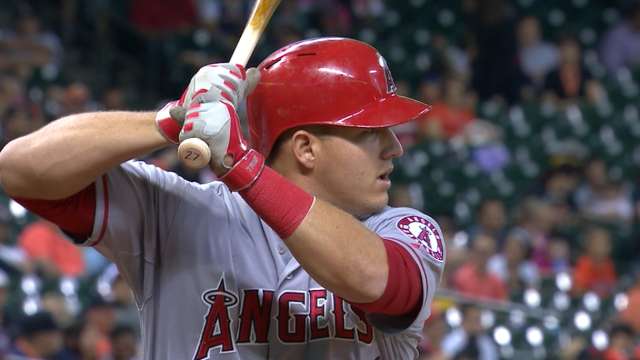
Trout's Team Costing Him Another MVP Award

Trout's team is the only thing stopping him from winning MVP (MLB.com)
The regular season ends one month from tomorrow, and we still have no idea who the American League's Most Valuable Player is going to be. Will it be Josh Donaldson again? Maybe! Could Jose Altuve become the shortest MVP in baseball history? Possibly! Does Mookie Betts have a chance? Absolutely!

Mike Trout, unfortunately, has no chance. He'll get plenty of votes, of course, perhaps even enough to finish second again (something he's accomplished three times already). But because the Angels have been so bad, and the rest of the competition is so good, voters are going to give the award to someone else. Again.

Trout's annual MVP snubs are getting ridiculous. Everyone knows he's the best player in baseball, the way you know the sky is blue and the earth is round, and the stats back it up. But when the recipient is named in November, it won't be Trout. It will be Donaldson, who edged him last year, or Altuve, or maybe even Betts. Heck, David Ortiz probably has a better chance than Trout at his point. Ironically, the player with the best statistical case appears least likely to win.

Trout still has a month to build his case, but it won't matter how well he plays down the stretch. Last year he had a 1.078 OPS in September--his highest of any month--while nearly leading Los Angeles into the playoffs, and it still wasn't enough. He can hit .400 with 12 home runs over the next five weeks, and it's not going to make an ounce of difference because the Angels have been out of contention for months.

And so Trout will finish his fifth full season with one MVP award, even though he should have five. He deserved to win over Miguel Cabrera in 2012 and 2013, and he deserved to win over Donaldson last year. Ironically, the year he did win--2014--was probably his worst year, but LA ran away with the division so Trout won in a landslide (unanimously, actually).

His career is starting to look an awful lot like that of Willie Mays, who won his first MVP at 22--the same age Trout won his--but then didn't win another one until he was 33. Like Trout, Mays led the league in WAR pretty much every year and was widely believed to be the best player in baseball, but the Giants were generally mediocre and he suffered at the polls as a result. Sixty years later, the same thing is happening to Trout.

But people really need to stop penalizing Trout for the lack of talent around him, especially since playing for a winning team is not part of the award criteria. It's not his fault the Angels have failed to surround him with adequate talent, or that they've been hamstrung by overpaying the likes of Albert Pujols, Josh Hamilton, and C.J. Wilson. As bad as they've been with him, just imagine how much worse they'd be without him. It's possible they'd have the worst record in baseball were it not for Trout, which, in a world where the Braves exist, is a scary thought.

So while Trout isn't leading his team to the playoffs this year, at least he's keeping them out of last place (not even peak Alex Rodriguez-on-steroids was able to do that in Texas). Trout has the talent to transform a .500 team into a contender all by himself, but the problem is that he's not on a .500 team. He's still making a huge difference in the standings, just not one that many people care about.

Friday, November 13, 2015

Aybar for Andrelton

In Simmons, the Angels acquired one of the best shortstops in the game (Sports On Earth)
Who would you rather have; A 31 year-old shortstop (32 next year) who batted .270/.301/.338 and is an okay defender? Or a 26 year-old shortstop who hit .265/.321/.338 and plays superlative defense? Furthermore, the former is entering his walk year, whereas the younger is under contract for a reasonable $10.6 million per year over the next five years.

Um, I'll take the world-class defender who's half a decade younger. Apparently the Atlanta Braves would rather have the other guy.

In a bizarre trade that makes absolutely no sense to me, the rebuilding Atlanta Braves traded Andrelton Simmons to the Los Angeles Angels for Erick Aybar. In this swap of shortstops, the Angels are clearly getting the better one. They get an in-his-prime, two-time Gold Glove winner who'll be around for the rest of the decade. The Braves get a placeholder for a year and a pair of pitching prospects. The two starters are highly regarded, but when it comes to prospects--pitchers in particular--you just never know.

Especially wild ones like Sean Newcomb and Chris Ellis, who placed eighth and 47th last year in walk rate among the 578 pitchers who threw at least 100 innings (thanks to Jeff Sullivan at FanGraphs for the info). Obviously wildness can be tamed--see Sandy Koufax and Randy Johnson-- and the Braves are known for developing great pitchers, but there's a real chance neither of them ever pan out. They're risks.

In Simmons, they had a sure thing; an elite gloveman who wasn't a total liability with the bat, a guy who's been worth roughly 17 wins through his first 500 games. Since debuting in 2012, Simmons has been baseball's fifth-most valuable shortstop despite playing just 49 games in his abbreviated rookie season.

Number six, interestingly enough, is Aybar. But Aybar, as mentioned, is going to be 32 next year. His defense has slipped noticeably the last couple years, and he just posted his lowest OPS since 2010. He still has a little bit of speed, but not enough to compensate for his eroding skills at the plate and in the field. He'll be an average major league shortstop at best in 2016, with the very real possibility that he drops below replacement level.

That's not going to happen to Simmons for some time, simply because he's such an outstanding defender. He could be a black hole on offense and still save enough runs with his glove to be an everyday shortstop. He'd be much more valuable, of course, if he could combine last year's decent OBP (.321) with the 17 homers he hit in 2013, but there's nothing wrong with being a slicker-fielding Elvis Andrus type who doesn't run.

I'm just baffled as to why Atlanta would give up on Simmons so soon after locking him in to a team-friendly contract. He has not progressed with the stick as hoped, so maybe they feel his value will never be higher than it is right now, before his defense declines and drags down his worth. 2,000 plate appearances into his major league career, Simmons has failed to show he can be even an average major league hitter, so the Braves might be on to something there.

Still, quality shortstops don't just grow on trees, and it's hard to be much better than Simmons has over the past few years. That's why the Red Sox didn't move Xander Bogaerts when he was struggling last year; because young, controllable shortstops are worth their weight in gold. The Halos were wise to swap out Aybar for Simmons, especially with no viable replacement on the horizon. Rather than overpay to keep Aybar or go through a revolving door of shortstops a la Boston circa 2004-2013, they ensured stability at the position for the foreseeable future. (They also get a catching prospect to boot, though it doesn't look like he'll amount to much after posting a sub-.500 OPS last year).

I'm sure finances played a role in this exchange as well. Aybar's only under contract for one more year and will cost Atlanta a modest $6 million, as LA is picking up $2.5 million of the price tag to split the difference between his and Simmons' salaries. Simmons, on the other hand, is owed $53 million over the next five years. Maybe the Braves felt that was a contract they needed to get out from under, even though they had no problem ponying up $44 million for Nick Markakis last winter. In reality, though, Simmons is an absolute steal at that price. He only needs to be worth seven or eight wins over the next five years to earn his keep, which should be a breeze as long as he stays healthy (he was worth seven wins in 2013 alone).

As with all trades, we won't be able to judge this one for a while. The Angels addressed their short-term needs and got the best player in the deal (as of now), whereas the Braves saved some money and stocked their farm system. For now both teams are winners, though my gut's telling me history will favor Los Angeles on this one.

Wednesday, October 28, 2015

Hunter Hangs 'Em Up

Hunter is retiring after a nice final season with the Twins (MLive)
After a stellar and tremendously consistent 19-year career, Torii Hunter is calling it quits.

Hunter had returned to the Minnesota Twins--who drafted him out of high school and watched him develop into one of the best center fielders of his generation--on a one-year deal for 2015. While he didn't explicitly say so, it was assumed he intended to retire as a member of the Twins, whom he played for from 1997-2007. He was going to be 40 in July, and while he'd been productive the last couple years one get the sense that his career was winding down. Why else would he want to come home?

Especially since the Twins have been terrible the last few years. When guys get to be Hunter's age and haven't won a ring yet, they usually want to go where they'll have a chance to do so. A popular, respected player with some juice left in his bat like Hunter could have latched on almost anywhere, had he been willing to take a discount. In need of a bat and veteran leadership for its up-and-coming team, Minnesota paid him above market value to come back.

It seemed like a sentimental move more than anything else. Hunter had been replacement level in 2014 and figured to be worse in 2015. That's nobody's idea of a $10 million player. But if anyone could afford to give a former star one last victory lap, the Twins could. With so much young talent to break in, Minnesota wasn't ready to contend.

As it turned out, the team and Hunter were both much better than expected. The Twins surprised everyone by finishing second in the AL Central, pursuing a wild card berth until the season's final week. Hunter hit 22 home runs--his most in a season since 2011--and played 139 games.

It was a fitting farewell for Hunter, one of the best and most popular Twins of all-time. Drafted by Minnesota in 1993, he made the big club in 1997 alongside David Ortiz, who like Hunter kept hitting throughout his entire 30s.

Also like Ortiz, it took Hunter a few years to get going. He didn't break out until he was 25, by which point he was in his fifth season--but once he did he never looked back. He hit 27 home runs and won his first of nine straight Gold Gloves that year (2001), made his first All-Star team and finished sixth in the MVP vote the following year, and had his first 100 RBI season the year after that. Nicknamed "Spiderman" for his amazing catches, he was quietly one of the best players of the 2000s, racking up eight Gold Gloves and topping 20 homers eight times (11 in all).

By the end of the decade he was an Angel, having moved on after a big walk year in 2007. When Vladimir Guerrero departed he moved over to right, which no doubt extended his career. He'd shown signs of slowing down in his last season as an everyday center fielder, batting .262 with his worst slugging percentage in over a decade.

But before long LA's outfield became too crowded for him, with Mike Trout taking over in center and Josh Hamilton signing on. Hunter found a home in Detroit, where he had two near-identical offensive campaings in 2013 and 2014.

It was towards the end of his first year with the Tigers that he was involved in what may be the most memorable play of his career. It was Game 2 of the ALCS and Boston, and Detroit led 5-1 in the bottom of the eighth. The bases were loaded and David Ortiz, Hunter's old teammate, stood at the plate, facing fresh reliever (Joaquin Benoit) summoned to extinguish the flames.

Ortiz turned on Benoit's first pitch and belted it deep into the night. 37,000 cold, tired fans leapt from their seats as the ball rocketed towards the right field bullpen. Hunter raced back to the wall and leapt, his glove hand stretched as high as it could go. Hunter had robbed many a would-be home run before, and it looked like he might do so again. He timed his leap perfectly, but without time to set his feet  he slammed into the wall, then flipped over it as his momentum carried him out of play. The ball followed him into the bullpen, having just cleared his outstretched mitt.

The game was tied, and within a matter of hours, so was the series. The Red Sox went on to win in six, then proceeded to beat the Cardinals in the World Series. Had Hunter made the catch, Detroit would have won the game and probably the series. It could have been them celebrating after defeating St. Louis. And Hunter, of course, would have been the hero for robbing a would-be game-tying grand slam.

Instead, he retires with the best play of his career occurring in an All-Star Game. It was a superb play, to be sure, but I guarantee Hunter would trade it in a heartbeat for the ALCS grab, especially since he nearly killed himself trying to make it.

But not even that could slow him down. Nothing ever did.

Oh sure, he lost range over time as all mortals do. His defense inevitably slipped, forcing him over to right field and eventually DH. But even as he became a non-factor on the bases and a liability in the field, he remained a threat in the batter's box.

It's rare that centerfielders age as well as Hunter did. I think of Mickey Mantle, Dale Murphy, and Ken Griffey Jr., all of whom broke down in their 30s. Same goes for Andruw Jones, Vada Pinson, Fred Lynn, and Cesar Cedeno. Jim Edmonds couldn't stay healthy. All that running and crashing into walls usually catches up to you.

Not Hunter. He had pretty much the same season every year for 15 years. He'd bat around .280 with 20 homers, 20 steals, and 90 or so RBI. Like clockwork. There were a couple years where he got hurt--in 2005 he was limited to 98 games and in 2009 played only 119--but for the most part he was in the lineup everyday.

You know whose career Hunter's reminds me a lot of? Johnny Damon's. They were never really great, All-Star caliber players, let alone serious MVP candidates, but they were really good for a long time and held up surprisingly well. They played on some terrific teams and were usually in the postseason. They were pretty indestructible, too.

Hunter wasn't quite as good as Damon, but he had a better career than most people realize. His counting numbers are actually very similar to Jim Rice's. He surpassed 350 homers and fell just short of some other big round numbers like 2,500 hits, 500 doubles, 200 stolen bases, 1,400 RBI, and 1,300 runs. Not quite Hall of Fame numbers, but Hall of Very Good for sure.

Most impressively, Hunter went out on his own terms, not because of injury or as some washed up bum on a team he didn't care about. He got to retire as a healthy contributor for his original team after a year in which they almost made the postseason. It's not the perfect final chapter, but it's still a happy ending.

Tuesday, April 28, 2015

Hamilton Headed Back to Texas

Hamilton's brief but costly tenure with the Angels is over (Rant Sports)
On December 15th, 2012, the Los Angeles Angels signed Josh Hamilton to a five-year, $125 million deal. Two and a half years later, they traded him away for essentially nothing--either a player to be named later or a fraction of the $80 million he's still owed.

There have been a lot of ugly contracts handed out in recent years, but Hamilton's might trump them all. Depending on how much the Rangers pay, which is believed to be anywhere from $6-8 million to $15 million, the Angels are on the hook for at least $110 million for a season and a half of mediocre production. Baseball-Reference and FanGraphs agree Hamilton produced about three wins above replacement in 2013-2014 combined, meaning he cost the Angels around $35 million per win--five to six times what a win is supposed to cost on the open market.

The Angels bought high on Hamilton, who was coming off five straight All-Star appearances and a big 43-homer season. His first year in LA was a massive disappointment, as his OPS fell nearly 200 points and he hit half as many home runs in the same number of plate appearances. The Angels also flopped, going 78-84 after winning 89 games the year before.

Hamilton's second go-round with the Angels wasn't much better, as he played all of eight games before landing on the disabled list with a thumb injury, which he sustained while doing what everyone knows is one of the riskiest and least rewarding plays in baseball--diving headfirst into first base. The daring play cost him two months and much of his power, for he slugged just .386 after returning to action in early June. He missed most of September with shoulder soreness and was a bust in the playoffs, going hitless in 13 at-bats as the Angels were swept in the ALDS.

Hurt again, Hamilton is currently recovering from shoulder surgery. He also relapsed recently, which proved to be the straw that broke the camel's (more specifically, Arte Moreno's) back. The Angels owner had had enough of Hamilton, who was costing him truckloads of money and giving him next to nothing in return.

That Hamilton's career soured so quickly was hardly surprising, though it was something of a worst-case scenario. He has been undone by all the flaws that made this pact so risky in the first place. His high strikeout rate in 2012 proved to be the new normal, as he followed up that year's 25.5 percent whiff rate with a 24.8 percent mark in 2013 and 28.3 percent mark last year. His injury woes followed him, limiting him to just 89 games last year and shelving him for the start of 2015.

He was also hurt by the move away from Texas, putting up a .690 home OPS in 2013 and a .616 home OPS in 2014. Age has certainly been a factor as well, as Hamilton's decline is on par with what most athletes experience in  their early 30s. Lastly, he was unable to shake the personal issues that have plagued him his entire career, ultimately preventing him from realizing his full potential.

In light of all this, one can understand why the Angels were so eager to cut bait and move on. They realized Hamilton was a sunk cost and not worth the headaches. Obviously they feel they will be better off without him, even if that means paying most of his contract for him to go away.

As for the Rangers, they can't be any worse with him. They are currently last in the AL West and are getting nothing offensively from their outfielders. Hamilton had his best years in Texas, so it's worth finding out if he can recapture some of his former glory with his old team. Hopefully he does Alex Rodriguez-style, because when he's right he's one of the most electrifying talents in the game. If he doesn't, the cost to the Rangers is entirely inconsequential. They can't lose.

The Angels, meanwhile, will continue to lose money on Hamilton for three more years. All they can do is hope he doesn't return to form with their division rivals and take advantage of all those opportunities he'll get to punish the team still signing his checks.

Thursday, November 13, 2014

LA: City of MVPs

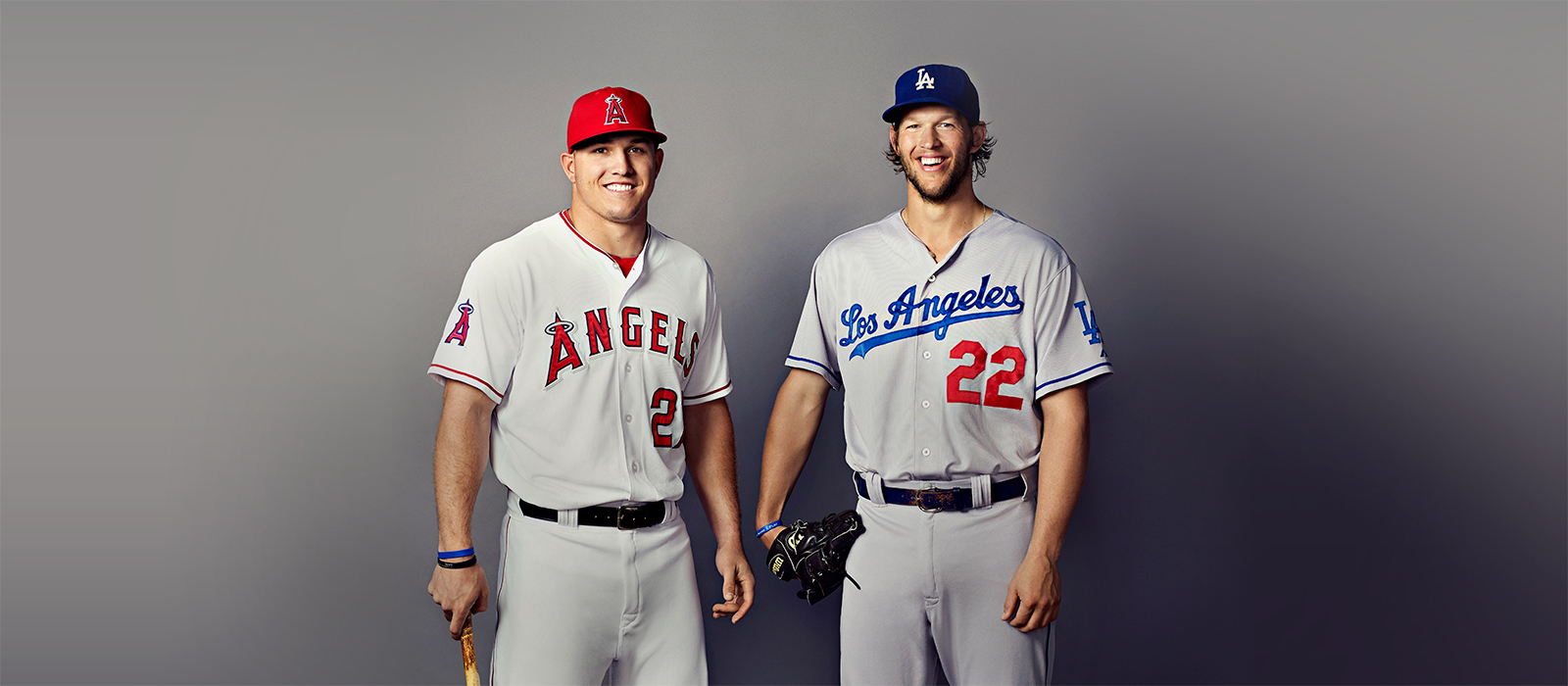
As expected, Trout (left) and Kershaw walked away with league MVP honors (ESPN)
All hail Clayton Kershaw, king of the mound, the City of Angels, and the National League.

Already the best pitcher on the planet, Kershaw raised his game to new heights in 2014. Already earning comparisons to Sandy Koufax, another great Dodger lefty, Kershaw delivered a historic campaign that looks like it was lifted straight out of Koufax's prime. Already a three-time Cy Young recipient, Kershaw added a new piece of hardware to his trophy collection: the National League MVP, something no starting pitcher had won since Bob Gibson in 1968.

Despite missing more than a month early in the season, Kershaw was so dominant in his 27 starts that he still managed to lead all players in the Baseball-Reference version of WAR with 8.0. Though he fell just shy of 200 innings, he still topped the majors in wins (21) and complete games (6) while ranking seventh with 239 strikeouts.

And while Kershaw's counting stats were excellent, his rate stats were off the charts. His 1.77 ERA secured his record fourth straight ML-ERA crown and was the lowest by a pitcher since Pedro Martinez's 1.74 in 2000. His 1.81 FIP and 0.86 WHIP, both best in the bigs, were the fourth and seventh-best marks of the live ball era. His 10.8 K/9 ratio, 197 adjusted ERA+, and .875 winning percentage were all tops in baseball. His 7.71 K/BB ratio was the highest in the Senior Circuit, too.

That's why voters were willing to overlook the fact that he only started 27 games--the fewest ever by an MVP starting pitcher--and spent 41 consecutive days on the Disabled List (between his first start and his second)--also a record for an MVP.

While Kershaw was leading the Dodgers to the NL West division title, Mike Trout was doing the same for the city's American League team. Though he had a down season by his standards, Trout was the unanimous choice in the American League after helping the Angels to 98 wins and the best record in baseball. All Trout did was lead the majors in runs (115), total bases (338), and extra base hits (84), plus runs created (137) and oWAR (8.7) while patrolling center field for the Halos. He also paced the AL with 111 RBI, smashed 36 home runs, and stole 16 bases in 18 attempts. Altogether he was worth 7.9 bWAR this year, most in the American League.

This should be Trout's third straight award, but he had to settle for second the previous two years because of the voting bloc's affinity for Miguel Cabrera's shiny Triple Crown stats. But with Cabrera having an off year by his standards as well, the door was wide open for Trout to run away with the trophy, and that's exactly what he did. He was the clear favorite for most of the season, and was so good in the first half (1.012 OPS through July 20th) that he still won easily despite a poor second half (.249/.333/.485 and 84 strikeouts thereafter, not including his miserable postseason).

Just 23 years old, Trout became the youngest unanimous winner in baseball history and fifth-youngest overall. He is the first American League player to win unanimously since Ken Griffey Jr. in 1997. Trout joins Don Baylor (1979) and Vladimir Guerrero (2004) as the only Angels to win the award in team history, which dates back to 1961.

And if Trout keeps playing the way he has, he'll win at least a few more before he's through.

Monday, October 27, 2014

Stanton, Trout Deserved Hank Aaron Award

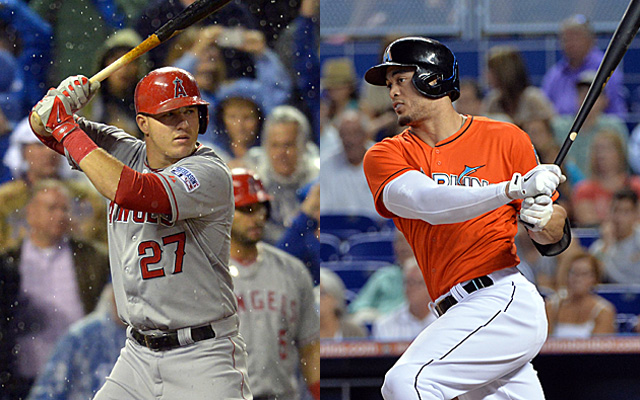
Trout (left) and Stanton earned some much-deserved hardware (SportsPyder)
While MLB awards season is not quite yet underway, there was some notable hardware handed out the other day. Before Game 4 of the World Series, Mike Trout and Giancarlo Stanton were named the 2014 winners of the Hank Aaron Award, presented by none other than Hammerin' Hank himself. Aaron votes for the award, as do the fans and a panel of Hall of Famers comprised of Roberto Alomar, Johnny Bench, Paul Molitor, Eddie Murray, Frank Thomas, and Robin Yount.

The award, which serves to recognize the best offensive performer in each league, was an easy call in the Junior Circuit. Trout was once again the most valuable position player in baseball, leading the sport in WAR and oWAR for the third straight year. His 137 runs created and 8.7 oWAR led both leagues, as did his 115 runs, 338 total bases, and 84 extra base hits. In addition to his American League-leading 111 RBI, he also swatted 36 home runs and 39 doubles to go along with his .939 OPS, good for a 167 OPS+. He unseated two-time defending champion Miguel Cabrera and should do the same in the MVP award as well.

Stanton was not quite as dominant as Trout but still had a phenomenal season in his own right, posting the fourth-highest OBP, SLG, and OPS in baseball. His 37 home runs, .555 slugging percentage and 299 total bases were tops in the National League, as were his 14.6 AB/HR ratio, 69 extra base hits, and 24 intentional walks. Per Baseball-Reference, only Andrew McCutchen--Stanton's closest competition for the award--had a higher Adjusted OPS+, more runs created, and a higher oWAR total than Stanton among National Leaguers. Had he not been beaned in the face with 17 games still remaining on the schedule, Stanton would have likely finished the season with around 40 home runs, 120 RBI, 100 runs and walks, and well over 300 total bases--gaudy totals that reflect just how dominant a year Stanton was having at the time of his injury.

One could certainly make the case that McCutchen was slightly more deserving in the Senior Circuit, but the numbers say they're a virtual toss up. Both FanGraphs and Baseball-Reference rate McCutchen as the slightly more valuable offensive player, and since he played just one more game than Stanton it's not like that difference can be chalked up to Stanton's injury. And while McCutchen only led Stanton by two points in OPS, the former's OPS was significantly more valuable after adjustments for league and park (eight point difference in OPS+, nine in wRC+) and when OBP and SLG are properly weighted (with 'Cutch ahead in wOBA .412 to .403). In terms of baserunning they come out about even, so that doesn't move the needle either way.

All things considered, McCutchen was probably more deserving by the slimmest of margins, but he and Stanton are so close that I can't blame the voters for being seduced by the latter's titanic big flies and monster power figures. Those kinds of numbers, especially in today's offense-challenged climate, are impossible to ignore. Stanton's season definitely felt more dominant, and with the benefit of a healthy September I think he beats McCutchen by a nose.

Just to wrap things up quickly here, Stanton and Trout are first-time winners but are likely to repeat given their age. Stanton is not yet 25 and Trout is just 23. Two of the most exciting talents in the game, both appear to have many fine seasons ahead of them.

Sunday, September 28, 2014

Mike Trout: "Average" MVP

Trout will win AL MVP even though his batting average isn't exceptional 
While the debate's been raging over who deserves to be the National League MVP this year (clearly Clayton Kershaw), the American League's outcome has been a foregone conclusion for months. This is the year Mike Trout wins his first (should be third) MVP award.

What's interesting about that is that he batted "only" .287, well above the league average but also considerably below historical standards established by previous MVPs. I know batting average is not a great statistic, but I couldn't remember the last time someone won with a sub-.300 average. So after doing some research on Baseball-Reference, I found that there hasn't been an MVP with such a low average since 1987, when Andrew Dawson walked away with the NL trophy after leading the majors with 49 home runs and 137 RBI. In retrospect Dawson was a poor choice (Tony Gwynn, Jack Clark, Will Clark, and Darryl Strawberry had better cases), but here Trout is very clearly the right choice.

In fact, the last time anybody won MVP without hitting .300 was Jimmy Rollins in 2007 (another poor choice). It hasn't happened in the American League since 2003, when Alex Rodriguez finally won his first (like Trout, A-Rod's was long overdue).

I think it's telling that the best player in baseball isn't even a .300 hitter. It says a lot about how far we've come in terms of valuing players. It also speaks to league-wide declining averages due to rising strikeouts, more emphasis on defense, and more frequent shifts. It blows my mind that Trout, a phenomenal hitter with great speed, didn't even crack .290. Not that it matters, of course.

Friday, April 11, 2014

Pujols Not Done Yet

Pujols just passed Lou Gehrig and Fred McGriff on the all-time home run list
I know it's early, but I'm starting to get the feeling that Albert Pujols is back. Yeah, I think the baseball world gave up on him too soon.

Everybody seems to think that Pujols has been a disaster since signing his mammoth contract with the Angels, and that's simply not true. He hasn't been as good as he was before he signed the contract, but we had no reason to expect him to be. Pujols was already past his prime at 32 when he inked his contract and was already on his way down, having suffered declining performance in each of the previous two years. Moving to Angels Stadium, a notoriously tough park for hitters, and a division with pitching friendly venues in Seattle and Oakland, wasn't going to help. Throw in the pressure of signing the third-largest deal in baseball history at the time (behind only the two signed by Alex Rodriguez) and it was pretty much guaranteed that we had already seen the best of Pujols.

It didn't help that Pujols made a bad first impression with his new team. He went homerless in April 2012, knocking in only four runs and batting just .217/.265/.304--easily the worst month of his career up to that point. With Pujols sputtering (and Mike Trout still in the minor leagues) the Angels struggled, going 8-15 and effectively dooming their postseason chances. It goes without saying that had Pujols hit like Pujols and Trout was on the team from the start, the 2012 Angels would have made the playoffs and maybe won the World Series, and if that had happened then people would surely have a much different perception of Pujols's Angels tenure.

Alas, we will never know. Pujols did not break out of his funk until he swatted his first home run of the year on May 16th. But from that point forward, he hit like the Pujols of old, batting .308/.371/.588 the rest of the way.

Though his .285/.343/.516 final line represented career lows in all three triple slash categories, it was still good for a robust 138 OPS+. He reached 30 homers for the 12th consecutive season, topped 100 RBI for the 11th time and had exactly the same number of hits (173) and total bases (313) as the year before. He also cranked 50 doubles--his most since 2004 and one shy of league leader Alex Gordon--and was worth nearly five wins above replacement according to Baseball-Reference.

If anything, Pujols was underrated that year. Though he was one of the league's ten most valuable position players, he did not make the All-Star team and finished a distant 17th in the MVP voting (after never having finished lower than fifth before that) behind the likes of Derek Jeter (2.2 bWAR), Fernando Rodney (3.8 bWAR) and Jim Johnson (2.5 bWAR). All-in-all, it was a pretty good year, though certainly a bit below expectations.

Then came 2013, the year that essentially destroyed Pujols's reputation as one of the game's elite. All because for the first time in his career, Pujols was unable to stay healthy. After averaging 155 games played per year from 2001 through 2012, Pujols played just 99 games in 2013 before he was shut down for the season in late July. Hampered by plantar fascitiis and various lower body ailments, Pujols played in pain the entire season, and it showed in his numbers. He batted a lowly .258/.330/.437, struggled in the field and was a nonfactor on the bases. Hobbled by injuries, Pujols clearly wasn't the same player, and given his age it was fair to wonder whether he would be ever again.

And so people counted Pujols out. They said he was old and washed up. They doubted his abilities. Everyone called his contract an albatross, a horrible mistake. They said he was done. All at once, everyone seemed to lose faith in the greatest hitter of his generation. Once money in the bank, he was viewed as one giant question mark or worse--damaged goods.

The more I think about it, the more I think we all overreacted. Pujols had one bad season, which wasn't even that bad. It was poor by his lofty standards, but really not so terrible otherwise. His OPS, when adjusted for league and park, was still 16 percent better than average. He was on pace for around 25 home runs and 100 RBI before he was shut down. And yet everyone grabbed their pitchforks and treated him like the next Jason Bay, or the next Vernon Wells. So it goes when you're locked into a ten-year, $240 million deal that expects you to earn the bulk of that money in the first few years of your contract.

All the talk about his decline seems premature and exaggerated. Pujols is 34, still young enough that he should have several more good years in him. He's not going to be the monster who won three MVP awards in five years, who like Miguel Cabrera was a threat to win the Triple Crown every year, but he still has the skills to be a very good hitter. He still has power, as he showcased the last couple nights, and he still has that perfect, balanced swing. He doesn't strike out very much. He remains a dangerous hitter, arguably more dangerous now that he has something to prove--that he can still rake.

Pujols still has something left in the tank. Not enough to catch Barry Bonds, but enough to keep climbing up the career leaderboards and cement his status as one of the greatest to ever play the game.

Tuesday, April 1, 2014

Guerrero Calls it a Career

Vlad was a flashy player and lethal hitter throughout his 16 year career
More than two years after his last game, Vladimir Guerrero officially retired yesterday at the age of 39.

Guerrero, who last played for the Baltimore Orioles in 2011 (not counting his 2012 minor league tryout with Toronto), signed a one-day contract so he could retire as a member of the Angels. Fittingly, he threw out their ceremonial first pitch yesterday to new Angels hitting coach Don Baylor, who broke his right leg while receiving the toss and had to be carried off the field (that can't be a good sign if you're an Angels fan).

That moment, bizarre and unfortunate as it was, doesn't look so out of place with the rest of Guerrero's career, which was generally beyond explanation and on many occasions seemed to defy belief.

A notorious bad-ball hitter, Guerrero never saw a pitch he didn't like. For mere mortals, that kind of swing-at-everything approach would lead to a lot of weak contact and ugly strikeouts. Not Guerrero who had an uncanny ability to make consistent, quality contact and hit the ball with authority. His off-the-charts hand-eye coordination allowed him to reach pitches most men could never dream of hitting, and his natural strength allowed him drive those pitches into the gaps and over the fence. His swing was vicious, but it was also a thing of beauty. It was controlled aggression.

Guerrero was like Roberto Clemente with power. He batted .318/.379/.553 in his 16 year career, blending power (449 home runs) with speed (181 stolen bases). He hit above .300 every year from 1997 through 2008 and never hit below .290, save for his nine game cameo at the end of the 1996 season. It shocks me that Guerrero never won a batting title despite batting over .320 seven times and hitting as high as .345 one year).

He always seemed to get the bat on the ball. Guerrero never struck out 100 times in any season and topped 90 only once--in 1998, his first full season. After 2001, he never even struck out 80 times in a single season. Vlad came to the plate more than 9,000 times and fanned fewer than 1,000, an exceptional ratio for a slugger.

Vlad the Impaler won eight Silver Slugger awards and was one of the most feared hitters of his era, a modern day Jim Rice. He led the league in intentional walks five times and his career total of 250 ranks fifth all-time, behind only Barry Bonds, Hank Aaron, Albert Pujols, Willie McCovey. Pitchers couldn't pitch around him because he could expand the strike zone and still do damage. They didn't know what to do with him.

As a baserunner and outfielder Guerrero can best be described as erratic. He had good speed in his early years, twice going 30/30 and falling one home run shy of a 40/40 season in 2002, but he was successful in less than 66 percent of his stolen base attempts. He was caught 20 times in 2002--most in the majors--and didn't steal much after that as age and wisdom forced him to be less aggressive on the basepaths.

He was a poor, error prone outfielder despite his Clemente-esque cannon for an arm. Though he led the league in right field assists three times and racked up 126 in his career, he gave up just as many outs with his mistakes. He led the league in errors by a right fielder nine times and his career total of 125 is fifth-most. He made daring throws and often overthrew his intended targets.

In spite of his flaws, Guerrero is still Hall of Fame worthy. He maintained a .980 OPS (151 OPS+) and averaged 35 home runs and 114 RBI per season from 1998 through 2007 when he was one of the ten best position players in baseball. He drew MVP votes in 12 different seasons, winning the award in 2004 and finishing third twice. His 2,590 hits are the most of any Dominican player, and he was one of the game's most popular players throughout his career. To my knowledge he has never been linked to PEDs.

JAWs estimates Guerrero's career value was about the same as Ichiro Suzuki's (a slam dunk, probable first ballot Hall of Famer) and just a hair below Dave Winfield's (a first ballot inductee). His most similar batter is Jeff Bagwell, who should have been elected already but is being kept out because of unfounded steroid suspicions. Like Bagwell, Guerrero won't get in on the first try, but both deserve to get in and will be inducted eventually.