Showing posts with label Second Base. Show all posts

Saturday, January 10, 2015

Best Second Basemen

Hornsby has to be considered the best second baseman of all-time (I70Baseball)
Craig Biggio's overdue election to the Hall of Fame got me thinking about where he ranks among the best second basemen of all-time. Here's the list I came up with.

1. Rogers Hornsby (127 bWAR, 130.3 fWAR, 97.5 WAA)
While Babe Ruth was dominating the American League during the Roaring Twenties, Hornsby was doing the same to the National League. The best righthanded hitter the game has ever known batted over .400 three times, establishing the modern record of .424 in 1924, and averaged .382 from 1920 through 1929, winning seven batting titles. Rajah also had exceptional power for a second baseman, winning two Triple Crowns and nine slugging titles on his way to blasting 301 home runs and 541 doubles. Oh, and I'm just realizing this now, but he has a 1.010 career OPS (175 OPS+). Not a misprint. He may have been mediocre in the field and on the bases, but when you hit like that (.358/.434/.577) it makes up for a multitude of sins.

2. Eddie Collins (123.9 bWAR, 120.5 fWAR, 78.8 WAA)
Collins compiled some astonishing statistics in a Hall of Fame career that spanned 25 years. A .333 career batter, he stroked 3,315 hits, scored 1,821 runs, drove in another 1,300, stole 741 bases, and worked 1,499 walks. He ranks 10th all-time in WAR by position players (13th overall), 11th in oWAR and hits, 12th in OBP (at .424) and triples, and eighth in steals. He also had a winning reputation, starring on four World Series champs and six pennant winners.

3. Nap Lajoie (107.4 bWAR, 102.2 fWAR, 68 WAA)
Lajoie was a slightly better hitter than Collins because of his superior power, but Collins had more speed and was the better all-around player. He was also better for longer, which gave him the slight edge. Lajoie's final numbers are actually very similar to Collins's, as he batted .338 for his career with 3,243 hits. Until Ty Cobb came along, he was the best hitter in the American League, winning five batting crowns and batting as high as .426 in 1901, when he won the sabermetric Triple Crown. His 657 doubles are seventh-most all-time.

4. Joe Morgan (100.3 bWAR, 98.8 fWAR, 63.2 WAA)
At his peak in the mid-70s, Little Joe was one of the most complete ballplayers there ever was. The back-to-back MVP contended for batting titles, walked a ton, hit for power, drove in and scored loads of runs, stole 60+ bases, and provided Gold Glove defense. fWAR has him as the best position player of the 1970s, and I agree. Still, as good as Morgan's numbers were, it's important to remember how depressed they were by playing his entire career during a pitcher's era and spending the first nine years of it in Houston. His neutralized batting line of .285/.408/.447 adds 36 points to his actual OPS. He also would have come close to 300 home runs, surpassed 2,000 walks and added an extra 200 runs and hits. Morgan's the best second baseman of the integrated era, for sure.

5. Charlie Gehringer (80.6 bWAR, 78.6 fWAR, 45.4 WAA)
Whereas Morgan was hurt by the era in which he played, Gehringer definitely received a boost from his. Not only did his peak coincide with the high-scoring 1930s, but he also reaped the benefits of playing half his games at Tiger Stadium. When neutralized, his OPS falls nearly 60 points as his .320/.404/.480 batting line becomes .298/.379/.448. Still phenomenal for a second baseman, but not as gaudy as his raw totals suggest. Nicknamed the Mechanical Man, he was machine-like in that he was a lock to score 100 runs, bang out 200 hits, and bat well over .300 every year. He was one of the five best position players during the Depression years, a notch below Jimmie Foxx, Lou Gehrig, and Mel Ott but better than just about everyone else.

Sandberg was the NL's best second basman in the '80s and early '90s (MyCubsToday)
6. Ryne Sandberg (67.5 bWAR, 60.9 fWAR, 38.1 WAA)
A Cubs icon, Sandberg was an outstanding two-way second baseman for much of his 16-year career. He won an MVP, made 10 straight All-Star trips, received nine consecutive Gold Gloves, and earned seven Silver Sluggers. Offensively, he was a great blend of power and speed with 282 home runs, 344 steals, and three 20/20 seasons. He hit as many as 40 home runs in a season--leading the league in 1990--and topped 25 on five other occasions. Remember that he accomplished all this mostly during the 1980s and early 90s, when offense wasn't so easy to come by. For 11 years, from 1982 to 1992, he ranked as one of the five-best position players in baseball. He was also dynamite in the postseason, batting a scorching .385/.457/.641 in 47 October plate appearances. While it's true that the Cubs haven't won a World Series, it's hardly Sandberg's fault.

7. Roberto Alomar (66.8 bWAR, 63.9 fWAR, 32.3 WAA)
The ideal second baseman, Alomar could do it all. He was great in the field (10 Gold Gloves), on the bases (474 steals at 80.6 percent success rate), and at the dish (career .300/.371/.443 hitter). He was the top second baseman when he played (1988-2004), earning 12 straight All-Star nods, four Silver Sluggers, and five top-six finishes in the MVP vote. Fell just eight votes shy of being a first-ballot Hall of Famer only because of a regrettable spitting incident with umpire John Hirschbeck in 1996. Spitting didn't keep Ted Williams out of the Hall of Fame. He's very close to Sandberg, but just a tick below because Sandberg was a better fielder and had more power despite playing in a offense-depressed era.

8. Craig Biggio (65.1 bWAR, 65.1 fWAR, 28.7 WAA)
Biggio was a bit of a compiler--hanging on at the end to get his 3,000th hit--but he was still a very good player for most of his 20-year career. He was tremendous at his peak in the mid-to-late '90s; a doubles machine who walked a lot, stole bases, scored runs by the truckload, and played Gold Glove defense. He was like a better version of Dustin Pedroia for two decades, and as a result his career numbers are absolutely staggering; 1,844 runs, 3,060 hits, 668 doubles, 291 homers, 414 steals, 1,160 walks, and 4,711 total bases. He's also took one for the team more than anyone else, getting plunked 285 times (ouch!). He was easy to overlook when lumbering sluggers like Mark McGwire, Sammy Sosa, Barry Bonds, and Frank Thomas took over the game, but there were few players as well-rounded as Biggio.

9. Bobby Grich (70.9 bWAR, 69.1 fWAR, 43.4 WAA)
Grich was the best second baseman in the American League when he played (1970-1986) and was second only to Joe Morgan, and there's hardly any shame in that. A four-time Gold Glove recipient and six-time All-Star, Grich combined good power (224 home runs) with patience (.371 OBP) and strong defense. He also added a dash of speed, stealing 104 bases throughout his 17 year career. His era and home parks severely dampened his numbers, which in turn led to him failing to get past the first round of Hall of Fame voting. Even so, he's clearly one of the 10 best to ever play the position.

10. Lou Whitaker (74.9 bWAR, 68.1 fWAR, 42.5 WAA)
Whitaker was excellent from start to finish, winning AL Rookie of the Year honors in 1978 and retiring after a career-high .890 OPS in his final season. Whitaker was the American League's top second baseman during the 1980s, when he made five straight All-Star teams, four Silver Sluggers, and three Gold Gloves. He was also remarkably steady, routinely posting high on-base percentages and solid power totals while providing great defense up the middle. The lifelong Tiger teamed with Alan Trammell to form the best double-play combination in baseball history. Last but not least, Whitaker was one of the 10 most valuable position players over the course of his career, nestled between George Brett and Ozzie Smith.

Grich and Whitaker are virtually inseparable value-wise, but I ultimately decided Grich was a hair better because his numbers were severely depressed by the parks he played in while Whitaker was helped by Tiger Stadium. After neutralizing their numbers, Grich's OPS jumps 43 points, from .794 to .837. Whitaker's, on the other hand, rises just 15 points, from .789 to .804. Grich was also better at his peak and relative to his peers. While Trammell was one of the 10 best players of his day, Grich was among the top five.

Note: I didn't include Rod Carew (81 bWAR, 72.3 fWAR, 46 WAA) because he actually spent more time at first base than second.

Honorable Mention: Jeff Kent, Willie Randolph, Joe Gordon, Frankie Frisch

Wednesday, August 27, 2014

What Happened to Cano's Power?

Cano's having another excellent season despite middling power numbers
Robinson Cano went yard in Seattle's 5-0 win over the Texas Rangers last night, crushing a solo homer off Rangers starter Nick Martinez in his first at-bat of the game. The long ball, Cano's only hit of the game, was just his 12th of the year. That puts him on pace to finish the season with 15, his fewest since 2008 and a far cry from the 28 he averaged over his last five seasons in New York. His .143 ISo would be the second-lowest of his career, ahead of only 2008's .139 mark.

Obviously the Mariners were hoping for a bit more pop when they signed him to that crazy 10-year, $240 million contract last winter. Cano has shown some lately with five home runs since the start of August, but it's too little, too late for someone who managed only two through his team's first 64 games of the season.

So what's going on with Cano? The natural inclination is to blame his power drop-off on the switch from Yankee Stadium, a park perfectly suited for his pull-power stroke, to the offense-depressing wasteland known as Safeco Field. But Cano actually has more dingers at home (7) than he does on the road (5), so that's not it.

Rather, what appears to have happened is that Cano altered his swing, focusing on hitting to all fields as opposed to hammering everything to right field. This shift is evident in his splits, which reveal that Cano has become a phenomenal opposite-field hitter this year, but at the expense of success on balls he hits to other parts of the park.

2013 Pull .385/.385/.754
2014 Pull .313/.313/.646

2013 Middle .351/.347/.554
2014 Middle .360/.357/.434

2013 Oppo .387/.379/.548
2014 Oppo .459/.453/.682

So as you can see, what Cano's essentially done is reverse his strengths. In 2013, playing half his games at a park that rewarded lefthanded fly ball hitters, he was lethal when he used right field. Now, playing in a park with fences that are extremely difficult to clear, he's become more of a line drive spray-hitter. Rather than try to make his strengths work in his new digs, he's adjusted to his surroundings and become a different, albeit still great, hitter.

This modification is reflected in Cano's batted ball distribution, which shows a career-low fly ball rate and his highest ground ball rate since 2007. For the first time in his career he's hitting more than twice as many ground balls as fly balls, and when you do that it's very difficult to hit home runs.

The trade-off has resulted in more base hits for Cano, who's sporting his lowest strikeout rate in five years and batting .326, which if he sustains it will be his highest average since he hit .342 in 2006. Those extra hits, combined with his solid walk rate, are fueling his .394 OBP--a career-best and the third-best mark in the American League.

So while Cano's days of threatening 30 homers appear to be over, he's still every bit as effective at the dish as he was in 2012 and 2013--when he slugged 33 and 27 home runs--after adjustments for league and park. His 147 OPS+ this year is almost identical to the 148 mark he posted in both those seasons. He's still the best second baseman in baseball, an elite hitter, obvious All-Star, and intriguing MVP candidate.

Considering Cano hit only one home run each in April, May, and July, that's pretty freaking impressive.

Wednesday, June 18, 2014

Beckham Back on Track?

After four straight subpar years, has Beckham finally figured it out?
I don't want to speak too soon here, but is it possible that Gordon Beckham is finally enjoying the breakout season that's long been expected of him?

Now 27, the White Sox second baseman burst on the scene in 2009 by hitting .270/.347/.460 as a 22 year-old rookie. He basically had the season that Wil Myers had last year, when Myers was a 22 year-old rookie.

Beckham '09-378 AB 58 R 102 H 28 2B 14 HR 63 RBI 174 TB 7 SB .270/.347/.460  2.1 bWAR
Myers 2013--335 AB 50 R  98 H 23 2B 13 HR 53 RBI 160 TB 5 SB .293/.354/.478  1.9 bWAR

Naturally, people expected big things from Beckham. He looked like a future All-Star, a middle infielder with good patience, 40 doubles/20 homer upside and a dash of speed (sounds like Ben Zobrist or Dustin Pedroia, doesn't it? He was going to be a franchise centerpiece for years to come.

It didn't happen. Over the next four years Beckham became an annual disappointment, batting a combined .244/.306/.364 while averaging just 10 home runs and 44 RBI per season. During the time when he was supposed to make strides as a ballplayer, he took major steps back instead. His batting average tumbled, never even matching the .270 mark from his rookie year. His OBP fell with it, plummeting below .300 in 2010 and 2011. His slugging has been below .380 every year since. His walk rate nosedived, his whiff rate went up, and his power was seldom seen. Beckham never came close to matching his wonderful rookie season, much less surpassing it. He was barely above replacement replacement, and with each passing year the glow of his rookie season receded further into the past.

Until this year. Left for dead after playing only 103 games last year--his fewest total since his rookie year (also 103)--and sitting out the first three weeks, Beckham's been better this year. Still not as good as he was in 2009, but significantly better than he's been during the interim. His .283 average and 108 OPS+ would both be career highs if he can sustain them, and he's already compiled 1.3 bWAR, more than any season save his rookie year. He's shown some pop as well by already matching last season's home run total of five in half as many games.

Beckham's resurgence, along with Jose Abreu's dominance, Alexei Ramirez's huge start, and Chris Sale's near--perfection on the mound, is one of the many reasons why Chicago stands only four and a half games out of first place in the AL Central. As Beckham's improved this year, so have the White Sox.

When digging deeper to see if Beckham's breakthrough is legit, I couldn't come to a definitive conclusion. His BABiP is up to .325: not just the highest it's ever been, but 40 points above his career average. He's hitting a lot more ground balls and a good number of line drives, so it stands to reason that his BABiP would improve. However, he's also walking less than ever before and striking out more frequently than he did the last two years. Normally that would be cause for concern, but his plate discipline numbers show that he's exhibited more restraint in laying off pitches outside the strike zone. As for the power, his HR/FB rate is the highest it's been since his rookie year, but he does play half his games in a homer-friendly park, so good fortune in that department is to be expected.

I can't make heads nor tails of Beckham this year. But then again, how does one explain his career? Perhaps Beckham was thrust into a starting role too soon. Maybe moving from third to second base after his rookie year made him uncomfortable. Or it could very well be that his rookie season was nothing more than a fluke, and the four horrible years that followed represented his true talent level.

Whatever the reason, it's clear that Beckham's playing better this year and has probably saved his career in the process (at least for now). At this point it's doubtful that he'll ever develop into the All-Star caliber player he seemed poised to become after finishing fifth in the 2009 AL Rookie of the Year voting. But if he can just play somewhere near that level again, I'm sure the White Sox would take it in a heartbeat.

Saturday, June 7, 2014

Pedroia on Path to Cooperstown

Pedroia's numbers are slipping, but he's still headed for the Hall of Fame
A couple days ago I was listening to WEEI on the morning commute, and one of the talk show hosts said that Dustin Pedroia, because of his diminishing power, is not going to wind up as a Hall of Famer. While I certainly don't dispute the fact that Pedroia's pop has declined significantly over the past few years (one need only to look at his dwindling home run numbers), I disagreed with the notion that Pedroia is not a Hall of Famer.

Now, to be clear, Pedroia is not yet a Hall of Famer. That is to say if he retired tomorrow, his credentials wouldn't merit enshrinement into Cooperstown. I think he'd be regarded in the same light as Thurman Munson--a great hitter and winner at a key defensive position, but not dominant enough during his prime to compensate for his brief career the way Ralph Kiner, Sandy Koufax, and Hank Greenberg were.

(The Munson comparison is also fitting because they both won Rookie of the Year, an MVP award, made multiple All-Star teams, won multiple Gold Gloves, and had a career OPS+ of 116)

But Munson was on the Hall of Fame path before his career was tragically cut short at 32, when he still had plenty of baseball left in front of him. Pedroia is on that same path, but like Munson will be remembered as one of the best to play his position during his era, but not the best. Munson was ultimately overshadowed by Carlton Fisk and Johnny Bench, as Pedroia is and will be by Robinson Cano and Chase Utley.

And yet, Pedroia is the only American League second baseman to win MVP in the last 55 years, since Nellie Fox in 1959 (Munson was the only Junior Circuit backstop to be named MVP between Elston Howard in 1963 and Ivan Rodriguez in 1999). He's only the third to win Rookie of the Year and MVP in cosecutive seasons too, joining Cal Ripken Jr. and Ryan Howard. In this millennium he's the only second baseman to win multiple World Series with the same team. He's one of only two Red Sox player, Carl Yastrzemski being the other, to exceed 100 home runs and stolen bases, and is already the second-greatest second baseman in franchise history behind Hall of Famer Bobby Doerr. Pedroia's career is only half over, and he's already done some special things.

Besides, the diminutive second baseman was never going to make it into the Hall of Fame on his power numbers alone. He just hit his 100th home run last month off Oakland's Ryan Cook, but is on pace for only five or six after hitting just nine last year. If he's truly a single-digit home run guy going forward, then he probably wont make it to 200. He's never slugged .500 and, barring a major power resurgence, never will. As a table-setter he's never been a big RBI guy, either. He's too small to hit home runs like Ryne Sandberg or drive in runs like Jeff Kent, and not fast enough to steal bases like Joe Morgan.

No, Pedroia's going to the Hall of Fame because, like a poor man's Jackie Robinson, he does everything well. He gets lots of hits, especially doubles, has a great batting eye, hits for good averages, steals bases, and plays fantastic defense (if he didn't play for the Red Sox and wasn't pint-sized, he'd probably be like Alex Gordon or Ben Zobrist, by which I mean one of the most underrated players in baseball). As long as he stays healthy, Pedroia should have no problem reaching 2,000 hits, 500 doubles, and at least 60 bWAR (a good starting point for Hall of Fame-worthy players). And with at least seven more years in Boston after this one thanks to the contract extension he signed last summer, it wouldn't surprise anyone if he added another World Series ring or two to his collection and retire as his generation's Derek Jeter--a great team leader and a winner with good offensive numbers from a demanding defensive position.

Pedroia isn't the power hitter he used to be, but that's normal. He's going to be 31 in two months. He's still on track for 40-45 doubles, 90 or so runs, and more than five wins above replacement. Pedroia's still a great player, nearly All-Star caliber, and as long as he follows a normal aging curve he's going to the Hall of Fame.

That's no sure thing, especially given the all-out way Pedroia plays the game and the way second basemen have been known to fall apart without warning, but I feel pretty confident saying that when it's all said and done, he'll have a plaque hanging in Cooperstown.

Sunday, May 25, 2014

Where Does Cano Rank Among Yankee Second Baseman?

Now that Cano's tenure with the Yankees is over, is he their best 2B ever? 
I'm still getting used to the idea that Robinson Cano is a Seattle Mariner. But now that he is one and his days in Pinstripes are most likely over, I wondered where he rates among the Yankees' best second basemen in franchise history. Here's my top-five list:

5. Gil McDougald (.276/.356/.410, 111 OPS+, 40.7 bWAR
Though the native Californian actually played more games at other positions (shortstop and third) than he did at second, of the positions he did play he logged the most time at the keystone. The 1951 AL Rookie of the Year (an honor Minnie Minoso deserved) was the first Yankee to win the award and first rookie to hit a grand slam in the World Series, though he's probably best remembered for how he altered the career of another Rookie of the Year, Cleveland flamethrower Herb Score, with a line drive that struck Score in the right eye and effectively finished his career at age 23. History seems to have forgotten that McDougald was exceptionally consistent throughout his ten-year career, worth at least 2.5 bWAR every year as he helped Casey Stengel's Yankees capture eight pennants and five World Series. A five-time All-Star with a trio of top-ten MVP finishes, McDougald could be counted on for between 10-14 home runs per year (something he achieved in all but his two final seasons) and a good OBP, usually around .360. The versatile teammate of Mickey Mantle, Yogi Berra and Whitey Ford could bat almost anywhere in the lineup and play three difficult infield positions well, making him a valuable asset during the New York dynasty days of the 1950s.

4. Willie Randolph (.275/.374/.357, 104 OPS+, 53.7 bWAR)
The Pirates traded him (along with Dock Ellis and George Brett's older brother Ken Brett) to New York for pitcher Doc Medich when Randolph was just 21, with only 70 major league plate appearances to his name. While Medich lasted only one season in Pittsburgh Randolph went on to make a name for himself in the Big Apple, manning the keystone position for the next 13 seasons and playing more games at second base than any Yankee who has ever lived. Batting first or second for many of the great Yankee teams of the late 1970s and early '80s, Randolph was an on-base machine (.373 career OBP while walking nearly twice as often as he struck out) with a good deal of speed, swiping at least ten bases in all but his final season in pinstripes and topping 30 four times. The sparkplug second baseman made five All-Star teams with the Bombers and though he never won a Gold Glove award, he was a great defensive second baseman on par with contemporaries Frank White, Lou Whitaker and Ryne Sandberg. Randolph was as steady as they come and could be counted on to hit around .280 with a very good OBP, usually around .370, and great glovework every year. With more than 60 career WAR according to both Baseball-Reference and FanGraphs, Randolph has a compelling case for the Hall of Fame.

3. Tony Lazzeri (.293/.379/.467, 120 OPS+,  48.3 bWAR)
"Poosh 'Em Up Tony" was the first great Yankees second baseman and a key contributor for Babe Ruth and Lou Gehrig's great Yankee squads, playing on six pennant winners. A mainstay at the keystone position for a dozen years from 1926 through 1937, Lazzeri held the record for most games played by a Yankees second baseman for nearly 50 years, until Randolph passed him late in the 1986 season. Lazzeri's numbers were never spectacular but consistently great. He hit between eight and 18 home runs every year, had ten seasons with at least 80 RBI, and registered an OPS+ below 100 only once, in his final year with the Yankees. He also played decent defense and could run a bit as well, exceeding ten stolen bases eight times and nabbing as many as 22 in 1927. Lazzeri was elected to the Hall of Fame by the Veteran's Committe in 1991, 45 years after his death.

The top two: Robinson Cano and Joe Gordon

This is a very tough comparison for many reasons. Gordon debuted nearly 70 years before Cano did and the game played today is very different from the one played during the Great Depression. Gordon was also a righthanaded hitter who had to contend with the Old Yankee Stadium's Death Valley, whereas Cano was able to take advantage of the short porch in right. Gordon also missed two prime years to war. Who knows what would have happened during those years? (I have to think he would have continued to play well, and consequently would have been inducted into Cooperstown much earlier than 2009).

The best way to compare them, then, is to see how well they played compared to their peers while simultaneously comparing them to each other. Here goes:

Hitting
Cano was clearly the better hitter, but not by much. Though Cano's batting average and slugging percentage were nearly 40 points higher than Gordon's, Gordon walked much more actually got on base at a slightly better clip, and because he played in a much more difficult ballpark their Adjusted OPS figures are almost identical. Their power numbers are also very close, as Gordon averaged 22 home runs and 88 RBI per season while Cano averaged 23 and 91. That said, Cano produced almost twice as many runs with the bat as Gordon did (180 to 97) during their respective Yankee careers, so I feel pretty comfortable saying Cano was a better hitter.

Fielding
Cano's a good defensive second baseman, but Gordon was great and one of the best to ever play the position. Cano saved 23 runs with his glove in his nine seasons with New York, winning two Gold Gloves, but Gordon saved 103 in seven years and probably would have won the Gold Glove every year had the award existed back then. To put Gordon's greatness in perspective, he saved 21 runs defensively in one season--1939.

Baserunning
Both players were slightly below average baserunners. Cano was a touch better, but not enough to swing the argument. Any advantage you give Cano for baserunning, however small, would just be canceled out by Gordon's superiority in the postseason anyways.

Cano was a better hitter, but Gordon was nearly as good and more than made up for the difference with his glove. Gordon was the more valuable player on a per season basis. The numbers bear this out, as Cano averaged five bWAR per season with New York, while Gordon averaged 5.4. Gordon was also the only Yankee second baseman to ever win an MVP award, though Cano (and Bobby Richardson) came close. Thus, the choice is clear. Joe Gordon is the best second baseman the Yankees have ever had, but there's certainly an argument to be made for Cano, especially if you're skeptical of defensive metrics and/or give more weight to hitting.

2. Robinson Cano (.309/.355/.504, 125 OPS+, 45.1 bWAR)
Cano's Yankee career can essentially be split into two halves. For the first four years of his career, Cano was a good-not-great hitter (109 OPS+) who hardly ever walked and was still searching for his home run power. He showed flashes of brilliance, nearly beating out Joe Mauer for the batting title as a sophomore, but went through growing pains and had trouble remaining conistent under Joe Torre. His defense was also erratic, characterized by smooth glovework and lapses in focus. In the second half, Cano matured into a superstar under Joe Girardi. With his Ken Griffey Jr.-sweet swing, Cano blossomed from a frustrating, but clearly talented young player into a perennial All-Star and MVP candidate. After exceeding 15 home runs just once in his first four seasons, Cano hit no less than 25 in each of his next five seasons in addition to clubbing at least 41 doubles and batting well over .300 every year, ranking as baseball's fourth-most valuable player during that span (tied with Joe Votto behind Miguel Cabrera, Evan Longoria and Ben Zobrist). He exhibited more patience and became the biggest bat on teams that included greats such as Alex Rodriguez, Derek Jeter, and Mark Teixeira. He also emerged as one of the best defensive second baseman in the game. Had he stayed with New York, he surely would have retired as the best 2B in franchise history. But that would have meant turning down a contract that will pay him nearly one quarter of a billion dollars over the next decade, and who in their right mind would do that?

1. Joe Gordon (.271/.358/.467, 120 OPS+, 37.5 bWAR)
Like Lazzeri, Gordon shined bright but not for very long, and as a result he was not inducted into Cooperstown until decades after his death. A 23 year-old rookie in 1938, Gordon succeeded Lazzeri as New York's everyday second baseman and immediately proved himself to be just as good as his predecessor. His 25 home runs broke Charlie Gehringer's record for a rookie second baseman, a record that stood until Dan Uggla parked 27 in 2006. With his marriage of elite power and terrific defense, Gordon was named to the All-Star team in each of his next nine seasons, taking MVP honors in 1942 over Triple Crown winner Ted Williams (not to mention teammate Joe DiMaggio) and finishing in the top-ten four other times. Gordon lost two prime seasons, 1944 and 1945, to World War II and was not the same when he returned, as a combination of rustiness and injuries caused him to endure the worst season of his career in 1946. That fall, Larry MacPhail dealt him to the Cleveland Indians for Allie Reynolds, a swap that worked out wonderfully for both sides. Gordon revived his career in Cleveland, helping the Tribe win the pennant in 1948 with arguably his finest season, while Reynolds helped pitch New York to six World Series titles, including five straight from 1949-'53. Gordon finished his Yankee career with exactly 1,000 games played and 1,000 hits, the only player in history to do so.

Honorable Mentions: Alfonso Soriano, Bobby Richardson, Horace Clarke

Monday, April 14, 2014

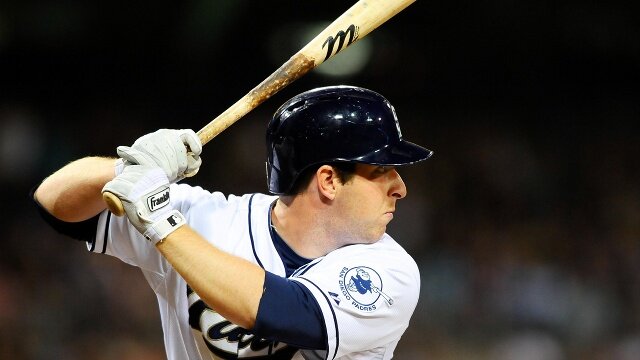
Gyorko Gets Extension

Gyorko's elite power compensates for his deficiencies in other areas of the game (RantSports)
Padres second baseman Jedd Gyorko received a six-year, $35 million contract extension today that will take effect immediately. The deal, which makes Gyorko a cornerstone of San Diego's lineup through the rest of the decade, is the third-largest for a player with just one year of service time after Andrelton Simmons and Ryan Braun. It buys out his first year of free agency and also includes a club option for the seventh year/his second free agent year (2020--his age 31 season) priced at $13 million.

The Padres were quick to extend Gyorko, who made his big league debut last Opening Day. Though he's off to a slow start this year with a .531 OPS through his first 12 games, the 25 year-old appears to have a bright future after his strong 2013 campaign. His 23 home runs led the team and ranked second among MLB second baseman (behind Robinson Cano's 27) and was the third-most in big league history by a rookie second baseman, trailing Dan Uggla's 27 with the Marlins in 2006 and Joe Gordon's 25 for the Yankees in 1938.

That power outburst (he also socked 26 doubles), made even more impressive by the facct that Gyorko plays half his games at the power-sapping Petco Park, helped him finish sixth in the NL Rookie of the Year voting, ahead of Nolan Arenado and Evan Gattis but behind the quintet of Jose Fernandez, Yasiel Puig, Shelby Miller, Hyun-jin Ryu and Julio Teheran. Had he not missed 30 games to a groin injury, he may have reached 30 home runs and finished higher in the voting. As it is, he still managed to lead all rookies in home runs, OBP, and SLG. He also became the first rookie second baseman in baseball history to lead his team in RBI (with 63).

Gyorko's power is obvious but he is far from a finished product, or a complete ballplayer, for that matter. For starters, he doesn't contribute much defensively or on the basepaths (just one steal). His .249/.301/.444 batting line was not particularly impressive, though it still produced an OPS that was 13 percent better than average when adjusted for league and park. His plate discipline is also an issue as he whiffed 123 times while drawing just 32 unintentional walks last year, a nearly 4:1 ratio that has carried over into this season (16/4 K/BB) and is reminiscent of the figures Will Middlebrooks posted in his rookie season (which was followed by a brutal sophomore slump). Gyorko proved to be a streaky hitter last year, with 15 of his home runs coming after August 1st, and will likely remain one if he doesn't adopt a more patient plate approach. But seeing as how Gyorko's already in his prime at 25, he doesn't figure to get much better, but it's reasonable to expect he might become more disciplined as he gains more experience.

Regardless, 30-homer potential at the keystone position is almost unheard of and makes Gyorko pretty valuable. FanGraphs estimates he was worth 2.5 fWAR last year in approximately three-quarters of a season (125 games), so it's certainly possible that he'll be a 3-4 win player if he manages to play a whole season. Even if he holds steady at around two wins per season, that's still more than enough to justify his $6 million AAV. Gyorko will provide great value and offense for the Padres, an organization that craves both.

Perhaps more importantly, Gyorko also acts as an insurance policy for Chase Headley, who's in his walk year and may leave as a free agent following this season. Gyorko manned the hot corner in the minors and would have no problem shifting over to third should Headley leave (I have a feeling he will).

In the meantime, Gyorko will continue to provide big-time pop from a premium position, and that's plenty valuable enough.