Showing posts with label Seattle Mariners. Show all posts

Tuesday, December 8, 2015

Sox Move Miley

Miley was 11-11 with a 4.46 ERA in his lone year with Boston (Boston Herald)
Less than a year after trading for Wade Miley, the Boston Red Sox are trading him away.

Miley was sent to Seattle yesterday, the latest casualty (along with reliever Jonathan Aro) of Dave Dombrowski's new quest to build a super-bullpen. He'd been acquired by the Sox last winter in a three-for-one swap with Arizona, replenishing a Boston rotation that had been depleted by trades the previous summer. They promptly locked up his arbitration years, making Miley an apparent fixture in Boston for seasons to come.

Ten months later, he's already gone. Not because he pitched poorly--his numbers last year were comparable to his final one in Arizona--but because Boston's new GM is hell-bent on assembling a shutdown relief unit (though I do wonder how much Miley's meltdown last summer contributed to the decision to trade him, as John Farrell is coming back and the Red Sox don't have much patience for internal feuds).

The David Price signing also made Boston's rotation too lefty-heavy, as he joins fellow southpaws Eduardo Rodriguez and Henry Owens. It's generally not a good idea to have 80 percent of your starters throw from the left side when the left field wall in your home park is a mere 315 feet away. Fenway has chewed up and spit out many a lefty, and may well do the same to the aforementioned trio (as well as newcomer Roenis Elias--more on him in a minute).

But as I wrote in my analysis of last month's Craig Kimbrel trade, Boston's bullpen needed help. Red Sox relievers were among the worst in baseball last year, and adding 60 innings of Kimbrel was only a start. Getting another 70 from Carson Smith, Seattle's setup man last year, should help. Like Kimbrel, he's exactly the sort of young power arm Boston needs. Having him, Kimbrel, and a healthy Koji Uehara gives the Sox one of the best late-game relief corps in the majors.

Dombrowski appears to be trying to emulate Kansas City, who have ridden their stellar bullpen to consecutive AL pennants and a championship. Or he could be trying to avoid ending up like the Mets, who were undone in this year's Fall Classic by shaky relief work.

If this had been a one-for-one trade--Miley for Smith straight-up (which is how the press is spinning it)--then I'd be calling for Dombrowski's head. Miley's nothing special, but he's a durable league-average starter who soaks up innings, and that's more valuable than a setup man. But the Red Sox are basically getting Miley back in Elias, a lefthander who posted similar numbers last year. And seeing as how Elias is two years younger and won't be arbitration-eligible until 2018, he's the superior commodity. It's possible the third-year starting pitcher, whose next start will be his 50th, still elevates his game to another level. After four full seasons, the 29 year-old Miley is what he is at this point. Elias could wind up being better.

So Elias is more preferable to Miley, and Smith is probably better than Aro, who has yet to prove himself at the major league level. I'd say that makes this trade a win for Boston.

Wednesday, November 25, 2015

Cano Can Still Rake

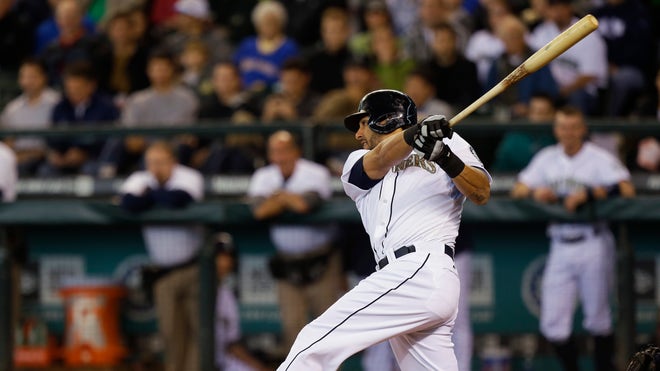
Cano collapsed in the first half last year (Fox Sports)
Apparently, Robinson Cano isn't happy in Seattle. Good thing he only has eight years to go on his current contract, which he signed prior to the 2014 season. Last time I checked, the Mariners were giving him 240 million reasons to be very, very happy.

Maybe it's because they haven't made the playoffs since he got there (they recently fired their GM, so there's a lot of uncertainty around the team right now, too). Maybe the weather's getting him down. Maybe he hates Starbucks.

I don't know. All I know is, happy or not, he's continued to produce. Even when he has one of the worst first halves I've ever seen.

Somehow, he still ended up with tremendous numbers. Somehow, he righted the ship after taking on water for three months. Cano has always been a better second-half hitter, but he'd never had a first half as ugly as this.

It all began innocently enough, with a tough opening week for the All-Star second baseman. Seeing as how plenty of players start slow--they're still getting their timing back and adjusting to better quality pitching than they faced in spring training--nobody noticed. They certainly couldn't have known it was the start of a three-month malaise.

That bad first week quickly snowballed into a bad first month, which saw Cano hit just .253/.292/.374 with one home run and six RBI in April. It was his worst April since 2008--his worst season--so that should have been a sign that his struggles were far from over.

At the time, though, it seemed to be nothing more than a slow start. Cano had been so consistently good for so long, enjoying a decade of uninterrupted brilliance (excluding '08), that his poor April barely registered. Anyone can have a bad month--it just so happened that Cano's was the first one, when there are no other stats to mask it. Besides, his month wasn't even that bad. Sandwiched in between a pair of sluggish weeks was an 11-game hit streak, over which he batted .409. He'd be fine. Did I mention that Cano usually starts slow?

His May was even worse. After starting to pull out of his funk in early May, Cano went ice-cold, batting his weight with just two extra base hits over the month's final three weeks. When the calendar flipped to June, Cano's slash stats were even worse than when May began. A third of the season had passed, and he had two home runs and 16 RBI to show for it.

By this point the fans and media were growing restless. "What was wrong with Cano?" they asked. "Where had his power gone?" "Am I crazy to drop him like a hot potato from my fantasy team?"

Historically, April and May have been the worst months of Cano's career, so there was hope that he'd get back to his old self in June, especially as the weather warmed. At the very least, positive regression to the mean would give him a boost. He couldn't possibly be any worse.

Except that he was. Cano had almost as many hitless games (11) as games with hits (14), which dragged his average down below .240. He struck out 22 times against a mere four walks. And his once prodigious power? Nowhere to be found.

It was incomprehensible that a perfectly healthy Cano could enter July hitting just .238/.277/.344 with four home runs and 24 RBI. Alarm bells were going off everywhere. His power had evaporated, he was striking out more than ever before, and his walks were down. This wasn't just a slump--this was a 32 year-old second baseman falling off a cliff. Dave Cameron said as much when he wrote Cano had the lowest trade value in baseball.
Cano flipped a switch in July and was fine the rest of the way (NY Post)
Yet, even in the midst of that deep-freeze, there were still signs that Cano would turn it around. Grantland's Jonah Keri noted that Cano was flashing one of the 20 best exit velocities in baseball. He was still hitting the ball as hard as ever--those rockets just weren't translating into hits. His BABiP was .277, nearly 50 points below his career average and almost 60 points off his 2014 mark. As long as Cano kept smoking line drives, it was only a matter of time before they began to fall.

And fall they did. Cano kicked off July with a 4-for-5 day--his first four-hit effort of the season--which included a double and a homer. Two days later, he rapped out three more hits, lifting his average up to .250. With nine hits in the week leading up to the All-Star Game, including three of the the extra base variety, he'd suddenly caught fire.

Without a Midsummer Classic or home run derby to compete in, Cano was able to get some much-needed rest and clear his head for a few days. It seemed to do him some good, for when the second half began he looked like the Cano of old. After swatting two home runs his second game back, against his former team in his old home park, he was off and running. He clubbed three more dingers before the month was out. When July ended, his OPS was 100 points higher than when it began.

Cano was just getting warmed up. After batting .337/.398/.622 in July, he raked at a .351/.403/.491 clip in August. He hit safely in 22 of 28 games that month, compiling a dozen multi-hit performances along the way. One of those was a five-hit day at Fenway Park; another was a four-knock night in Chicago. His OPS rose another 40 points in August as his batting line swelled to a respectable .283/.330/.416.

With Seattle playing out the string in September, Cano continued to mash. Saving his best for last, he recorded at least one hit in all but four of his final 42 games, blazing to the finish line on a 16-game hit streak. He also kicked his power up a notch, blasting seven home runs over the season's final month.

When the dust settled, Cano had batted .330/.383/.536 over his final 82 games, with 17 homers and 55 RBI. With even a normal first half, he would have finished with MVP-caliber numbers instead of the very good ones (.287/.334/.446--21--79) he wound up with.

Cano's remarkable turnaround was largely fueled by a bounce back in BABiP, which was .351 from July 1st onward. It's also possible that he benefited from a lineup change. After batting Cano third and occasionally second throughout the first half, Lloyd McClendon started hitting him cleanup after the All-Star Break and left him there. Cano had been hitting .252/.291/.384 before the switch but immediately went on an eight-game hitting streak, batting .333/.389/.528 the rest of the way.

So when baseball resumes in a few months, the Mariners would be wise to bat their best player fourth. He's far from done, and he's still worth every penny.

Saturday, August 15, 2015

Reeling Red Sox Rout Mariners

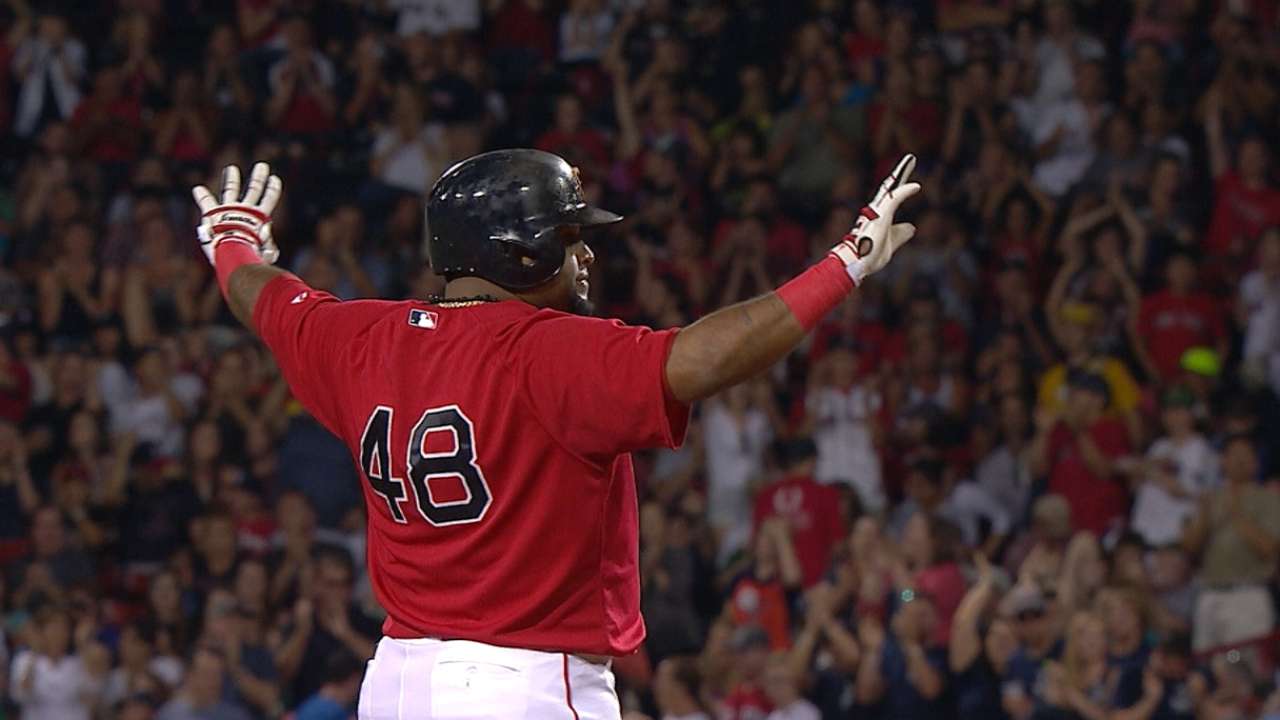
Pablo Sandoval paced the assault with three hits and three RBI (MLB.com)
John Farrell never lets himself be the story. In his three tumultuous seasons as manager of the Boston Red Sox, he has never said anything even remotely controversial. He stays out of his own way, keeps his opinions to himself and his foot out of his mouth. In that sense he is the ideal manager, especially in a baseball-crazed town like Boston. No matter how stormy the seas get, he doesn't rock the boat.

Farrell is nothing like his predecessor, a diva manager who loved the spotlight and became a running punchline during his lone season at the helm. Perhaps that's why the Red Sox hired Farrell in the first place; because he was the exact opposite of Bobby Valentine.  

Now, because of circumstances beyond his control and almost certainly against his wishes. John Farrell has become the story. 

***

2015 has been a lost season for the Red Sox, a season of lost gameslost hopes, and lost personnel. Through it all Farrell has been his usual stoic self, keeping a steady hand and a straight face throughout another rocky season. He's kept an even keel even when his players lost their cool, the media ripped him to pieces, and Red Sox Nation called for his head as he steered the team towards a second-straight last-place finish.

Now, the Red Sox will have to carry on without him. Yesterday Farrell announced that he has treatable lymphoma, and that he'll be stepping away from the team for the remainder of the season. Red Sox bench coach Tory Lovullo will take his place in the dugout. 

Farrell's bombshell was the latest and most severe blow in a season wracked by frustration, disappointment, and underperformance. When it rains, it pours, like when Carl Beane and Johnny Pesky passed away during Boston's nightmare 2012 season. The Red Sox just learned they're losing Larry Lucchino, their CEO since 2002, at the end of the season. Now they've lost their manager, too. 

It's probably a blessing that the Sox are in last place as they deal with the unexpected departure of Farrell. Suffering such an emotional blow in the middle of a pennant race would have been even more devastating. It's still a punch in the gut regardless of the team's standing, but it would have been tough for the Sox to mount a playoff run without their skipper. There's no pressure on Lovullo or his players, who are free to play out the string and start preparing for next year.

Thankfully there was a game--or more accurately, a distraction--last night, which allowed the Red Sox and their fans to get back to the business of playing ball. With the Farrell news breaking earlier in the day, there was a dark cloud hanging over Fenway Park even though it was a gorgeous evening. The crowd spoke of Farrell's condition in hushed tones, anxiously seeking updates as they tried to keep pace with the developing story. For once Farrell was the headline, only everyone wished he was anything but. 

The Fenway Faithful needed something to celebrate. What they needed was a win.

The Red Sox delivered, pulling out their most dominant victory of the season with a 15-1 rout of the Seattle Mariners. Boston's 15 runs, 21 hits, and 14-run margin of victory were all season-highs. How fitting was it that the Sox followed their worst loss of the season with their most resounding win? It was the highest peak of what has been an up-and-(mostly) down year, the finest hour of a team struggling through its darkest.

The Bosox rallied behind their cancer-stricken skipper, putting on a show for their sellout crowd. Seattle scored the game's first run, but after that it was all Boston. The game produced several memorable moments, including another multi-homer performance from Travis Shaw and another highlight-reel catch by Mookie Betts.

Last night's rout of the Mariners was the best kind of win, the kind where everyone contributes. Nine different Red Sox banged out two or more hits, and the only Bostonian to go hitless (Xander Bogaerts) still contributed by scoring a run. Even Joe Kelly--a trainwreck on the mound this year--was masterful, firing six innings of one-run ball while striking out six. For a night, at least, the Red Sox could do no wrong.

As it turned out, Boston's bats were just getting warmed up. They followed the romp with an even bigger outburst on Saturday, demolishing the previous night's season highs with 22 runs and 26 hits. They lit up one of the sport's best pitchers in Felix Hernandez, pounding him for 10 runs on 12 hits and knocking him out in the third inning. Six different Red Sox finished the game with three hits or more, and every member of the starting nine registered at least one except Shaw.

So far this weekend has been exactly what the Red Sox and their fans needed: to vent four months of frustration by beating another team's brains out. The Red Sox haven't won much this year, but for two days they've played like the juggernaut they were supposed to be. 

Unfortunately winning isn't a cure-all. Winning won't treat Farrell's cancer. But it sure can make everyone feel a little bit better.

Monday, December 1, 2014

Nelson Cruz Massive Mistake for Seattle

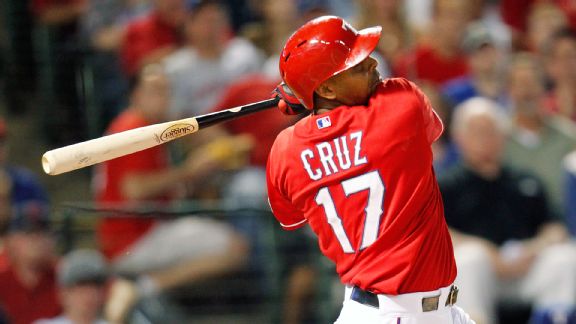
Cruz rode a career year with the Orioles to a massive payday (NBCDFW)
The Seattle Mariners added some much-needed righthanded thump to their lefty-heavy lineup, signing Nelson Cruz to a four-year deal worth $57 million. Cruz, 34, led the major leagues with 40 home runs last year, 13 of which qualified as "just enough" according to ESPN's home run tracker. He also knocked in 108 runs and was worth 4.7 bWAR en route to a seventh-place MVP finish, the first time in his career he drew MVP votes.

That's way too much for an aging, injury-prone slugger who hardly walks, can't run, and plays abysmal defense. Last year, coming off a PED suspension, Cruz settled for a one-year, $8 million contract with the Orioles. No question he was undervalued at the time. But now, another year older, and he gets four years and almost $60 million? In the same neighborhood as Victor Martinez, a far superior hitter in every sense (but also two years older)? Sounds like an overpay to me.

Cruz re-established his value with a tremendous 2014, but Seattle would be foolish to expect another season like that from the three-time All-Star. He is, after all, past his prime and only once played more than 130 games before suiting up for 159 last year, though that number will be more attainable if he abandons playing the outfield altogether and settles in as Seattle's everyday DH (a likely scenario given Safeco's spacious outfield). His 2014 bWAR total exceeded his total from 2011-2013 combined (4.3 bWAR), reflecting just how much of a fluke last year was for him.

It's going to look even flukier after moving into the hitter's nightmare that is Safeco Field. Cruz has benefitted enormously from friendly home parks in Texas and Baltimore throughout his career, posting an .890 OPS at home compared to .769 on the road. Playing half his games in Seattle, plus more in LA and Oakland, is probably going to push his OPS down to that road figure or possibly below, making him a league average bat with decent power (20-25 homer upside).

Basically, I hate this deal for Seattle because Cruz can only provide value with his bat at this stage in his career, and he's going to a place that suffocates offense. He'll improve Seattle's lineup some, but won't provide an impact worthy of his lavish contract, especially given his durability issues. I think the Mariners will be luck to get 20 bombs and one WAR out of Cruz next year, which would be very valuable given their current position on the win curve. But a few years from now, Cruz won't even be able to give them that, and they're going to regret committing so many years and dollars to an injury-prone, one-dimensional corner outfielder/DH in his mid-thirties.


Tuesday, November 25, 2014

Seager Secures Extension

Seager's underrated but still worth the money (FootballsFuture)
The Seattle Mariners just gave Kyle Seager a seven-year, $100 million contract extension that locks up his arbitration years and first four free agent seasons, plus an option for an eighth year.

Hold the phone, Seattle just gave $100 million to whom?

Since debuting in 2011, Seager has quietly established himself as one of the better (and more underappreciated) players in the game. Over the past three years, Seager was the sixth-best third baseman in baseball per fWAR, ahead of established superstars such as Evan Longoria, Hanley Ramirez, and Pablo Sandoval.

While Seager is not well-known, he's worthy of this deal for a number of reasons. One is that he's just 27, smack dab in the middle of his prime. Another is that he's a great two-way third baseman, and thus excels at a tough position.

But really, Seager deserves the dough because he's a terrific baseball player.  He's steadily improved throughout his four big league seasons, peaking with last year's 5.5 fWAR, first All-Star appearance, and first Gold Glove (which should have gone to Josh Donaldson, but Seager's smooth defensively nevertheless). He also popped 25 home runs--his third straight season with at least 20--and knocked in 96 runs, both career highs.

Wait, there's more. Seager's incredibly durable, having played at least 155 games in each of the last three years and leading all third basemen in games played during that span. He doesn't strike out a lot for a guy with good power and walks a fair amount. His offense was 26 percent better than average last year after adjustments for league and park, and like I said his numbers have only trended upwards. Even if 2014 was his peak and he regresses back to the player he was in 2012 and 2013, he's still a 3.5 win guy, which is very valuable, especially to a team on the brink of contention like the Mariners.

This deal makes a ton of sense for Seattle, setting them up at the hot corner for the foreseeable future. It also makes a ton of sense for Seager, because $100 million is a lot of money.

Wednesday, November 12, 2014

Kluber Robs King Felix

Hernandez deserved to win his second Cy Young, but didn't (RotoScout)
The races for the American League and National League Cy Young couldn't have been any different.

In the National League, Clayton Kershaw was the heavy favorite and won easily, securing his third Cy Young in four years (and, let's be honest, he deserved the 2012 award over R.A. Dickey too). It was Kershaw and everyone else, meaning a vote for Johnny Cueto or Adam Wainwright, while defensible, was clearly misguided.

The American League's top two candidates were virtually inseparable. They both had dominant seasons and compelling reasons, but in the end it came down to splitting hairs. In what was destined to be a photo finish, Corey Kluber beat out Felix Hernandez. Kluber nabbed 17 of the 30 first place votes and 169 points, edging out the 13 and 159 compiled by King Felix. Chris Sale finished a distant third with 78 points.

Looking at Hernandez's stats, it's hard to see how he didn't win. He had the league's lowest ERA, WHIP, and hit rate while placing second in pitcher bWAR (to Kluber), innings pitched (to David Price), ERA+ (to Sale), and FIP (to Kluber). He also led in most of the advanced stats like adjusted pitching runs and wins, base-out runs and wins saved, and situational wins saved. Opponents batted just .200/.243/.303 (.244 wOBA) against him, and his average GameScore was 65. For most of the summer, he was the clear favorite as he strung together an MLB-record 16 straight starts with at least seven innings pitched and two earned runs allowed or fewer.

But he slipped just a bit over the final six weeks (2.75 ERA), opening the door for Kluber, who came on like a freight train down the stretch. His first half was hardly Cy-worthy (3.01 ERA), but after the All-Star Break he had a 1.73 ERA over his final 104 innings to lower his final ERA to 2.44. He also struck out 39 batters over his final three starts to give him a whopping 269 K's on the season, second only to Price and 21 more than Hernandez. He also finished in a three-way tie for the league lead in wins with 18 (same as Max Scherzer and Jered Weaver) while pacing the circuit in pitching bWAR (7.4), and FIP (2.35).

While Kluber had an outstanding season, I believe the hardware belongs to King Felix. For one, Kluber wasn't even Cy Young-caliber for most of the first half, while Hernandez was Cy Young worthy from start to finish. Kluber had that great finishing kick, but I think Hernandez deserves credit for being more consistent. Additionally Kluber's average GameScore (63) was a hair lower than Hernandez's, revealing that he was slightly less dominant on a per-start basis. Batters also had more success against him, hitting .233/.279/.345 (.277 wOBA) when he was on the bump--a 78 point difference between him and Hernandez. That's pretty sizable, especially considering Kluber faced slightly weaker hitting talent.

It's true that Hernandez did pitch in a more favorable environment with a better defense behind him, but the park is accounted for in Adjusted ERA+, which has him considerably ahead of Kluber 170 to 152. Furthermore, Safeco doesn't help Hernandez as much as other pitchers because of his ability to induce ground balls. As for the defense, well, it's not like Hernandez was pitching to contact. He still struck out 248 batter's, for heaven's sake! Tony Blengino over at FanGraphs took all these factors into account and calculated Hernandez's true ERA to be 2.29, a touch better than Kluber's 2.45.

All in all, I like Hernandez's case a little better than Kluber's. I'm not sure what swayed the voters over to the latter's side: I hope it was the FIP and gaudy strikeout rates but I suspect the monster second half and shinier win total played a role as well. The voters had to make a really tough choice, so I'm not surprised they got it wrong (look no further than their inability to elect Mike Trout MVP before this year). Kluber was great, but Hernandez was a tad better and deserved to win by the slimmest of margins.

Wednesday, August 27, 2014

What Happened to Cano's Power?

Cano's having another excellent season despite middling power numbers
Robinson Cano went yard in Seattle's 5-0 win over the Texas Rangers last night, crushing a solo homer off Rangers starter Nick Martinez in his first at-bat of the game. The long ball, Cano's only hit of the game, was just his 12th of the year. That puts him on pace to finish the season with 15, his fewest since 2008 and a far cry from the 28 he averaged over his last five seasons in New York. His .143 ISo would be the second-lowest of his career, ahead of only 2008's .139 mark.

Obviously the Mariners were hoping for a bit more pop when they signed him to that crazy 10-year, $240 million contract last winter. Cano has shown some lately with five home runs since the start of August, but it's too little, too late for someone who managed only two through his team's first 64 games of the season.

So what's going on with Cano? The natural inclination is to blame his power drop-off on the switch from Yankee Stadium, a park perfectly suited for his pull-power stroke, to the offense-depressing wasteland known as Safeco Field. But Cano actually has more dingers at home (7) than he does on the road (5), so that's not it.

Rather, what appears to have happened is that Cano altered his swing, focusing on hitting to all fields as opposed to hammering everything to right field. This shift is evident in his splits, which reveal that Cano has become a phenomenal opposite-field hitter this year, but at the expense of success on balls he hits to other parts of the park.

2013 Pull .385/.385/.754
2014 Pull .313/.313/.646

2013 Middle .351/.347/.554
2014 Middle .360/.357/.434

2013 Oppo .387/.379/.548
2014 Oppo .459/.453/.682

So as you can see, what Cano's essentially done is reverse his strengths. In 2013, playing half his games at a park that rewarded lefthanded fly ball hitters, he was lethal when he used right field. Now, playing in a park with fences that are extremely difficult to clear, he's become more of a line drive spray-hitter. Rather than try to make his strengths work in his new digs, he's adjusted to his surroundings and become a different, albeit still great, hitter.

This modification is reflected in Cano's batted ball distribution, which shows a career-low fly ball rate and his highest ground ball rate since 2007. For the first time in his career he's hitting more than twice as many ground balls as fly balls, and when you do that it's very difficult to hit home runs.

The trade-off has resulted in more base hits for Cano, who's sporting his lowest strikeout rate in five years and batting .326, which if he sustains it will be his highest average since he hit .342 in 2006. Those extra hits, combined with his solid walk rate, are fueling his .394 OBP--a career-best and the third-best mark in the American League.

So while Cano's days of threatening 30 homers appear to be over, he's still every bit as effective at the dish as he was in 2012 and 2013--when he slugged 33 and 27 home runs--after adjustments for league and park. His 147 OPS+ this year is almost identical to the 148 mark he posted in both those seasons. He's still the best second baseman in baseball, an elite hitter, obvious All-Star, and intriguing MVP candidate.

Considering Cano hit only one home run each in April, May, and July, that's pretty freaking impressive.

Thursday, June 26, 2014

Buchholz Beats Mariners in Return

Buchholz improved his record to 3-4 and lowered his ERA below 7 with last night's start
Clay Buchholz gave the Red Sox a surprisingly effective outing last night in his first start in a month, helping Boston to a much-needed 5-4 win by getting 22 outs in their series finale with the Mariners.

Buchholz, who last pitched on May 25th before a hyperextended knee forced him to yet another stint on the Disabled List, needed just 76 pitches to get those outs, as he didn't walk anybody and struck out only two. But pitch count be damned, John Farrell lifted him in the bottom of the eighth shortly after Buchholz surrendered a leadoff homer to Brad Miller. Miller's bomb was Seattle's third off Buchholz and drew the M's to within a run. There was no need to push Buchholz any further; he had already done his job by putting the Red Sox in position to win and helping preserve the bullpen after a couple of ugly starts by Jake Peavy and John Lackey.

Farrell brought in Andrew Miller, who finished off the eighth by fanning pinch-hitters Willie Bloomquist and Cole Gillespie (not the stiffest competition, but whatever). After the Sox went down 1-2-3 in their half of the ninth, it was Koji-Time.

Until about a week ago the game would have been as good as over, but not with the way Uehara's walked the tightrope lately. His most recent run of appearances can be best described as adventurous, and last night was no exception. After retiring Robinson Cano, he gave up a single to the red-hot Kyle Seager, who notched his third hit of the day, then proceeded to walk Logan Morrison. (I don't know which was more improbable--Uehara walking his fifth batter of the year or Morrison drawing his seventh free pass of the season).

With Seattle threatening to storm back and tie the game, if not win the thing in walk-off fashion to sweep Boston, (how devastating would that have been?) Uehara bore down. He whiffed Mike Zunino, who'd gone deep earlier in the game, then closed out the win by getting Dustin Ackley to ground out out Brock Holt, who flipped to Uehara at first just in time to nab Ackley.

Shaky or not, Uehara got the job done, as did Buchholz and the top-half of Boston's order (1-4 hitters went 8-for-16 with four of Boston's five runs, two of which scored on David Ortiz's 449th career home run). In the end it proved to be just enough to defeat Hisashi Iwakuma and the streaking Mariners, and so the Sox were able to escape Safeco with a win before traveling back east for a weekend showdown with the Yankees.

Tuesday, February 4, 2014

6 Reasons You Don't Want Nelson Cruz

Cruz is not as good as his power numbers suggest (ESPN)
Nine days until pitchers and catchers report to spring training, and Nelson Cruz is still a free agent (but probably not for long). That probably wouldn't be the case if he hadn't served a 50-game PED suspension last year, but then again so did Jhonny Peralta and he signed a fat deal with the St. Louis Cardinals over two months ago. Cruz is one of the few remaining impact free agents, but while his power may be alluring you should hope your team doesn't commit multiple years and millions of dollars to him. Here's why:

1. He's old
Cruz is going to turn 34 on July 1st, well past a player's prime age. His best years are likely behind him, so whoever signs Cruz is likely paying for the decline phase of his career.

2. He's injury-prone
Cruz has played more than 130 games in a season once in his nine-year career.

3. He doesn't hit well outside of Texas
The Ballpark in Arlington (now Ameriquest Field?) is a hitter's haven. Everyone knows that. It's so advantageous that it makes Cruz hit like Frank Robinson, as he's batted .294/.356/.555 with 58.6 percent of his career home runs there. But away from home he's hit a much less formidable .242/.299/.435. Teams like the Mariners who play in pitching friendly environments need to take that into account and adjust their expectations accordingly.

4. His offense is one-dimensional
Cruz is going to get paid because of his power. He's gone yard 135 times during the past five seasons, a total that exceeds those of Ryan Howard, Josh Hamilton and Joey Votto and works out to be an average of 27 dingers per year. Only 16 players have hit more home runs during that span and just four players have posted a better ISo while playing in more games. Still, power is pretty much the extent of Cruz's offensive contributions these days. He's never topped 90 RBI despite batting in some loaded Rangers lineups. He strikes out a lot, doesn't hit for high averages and is a subpar baserunner. Lastly, his patience leaves something to be desired, for Cruz has never walked 50 times in any season and holds a .319 OBP over the last three years. He's basically an older Mark Trumbo.

5. He's a defensive liability
Never a Gold Glover to begin with, Cruz can no longer hold his own in right field and gives back a good chunk of the value his bat provides, which at about two wins per seasons really isn't that valuable to begin with. At this stage of his career he'd be better-suited as a DH, which limits roster flexibility and should make National League teams wary of signing him.

6. He just got busted for PEDs
Cruz was involved in the Biogenesis scandal that brought down Peralta, Alex Rodriguez and Ryan Braun, among others. Who knows how that's going to affect his performance? Melky Cabrera suffered a notable drop-off in performance in his first season following a PED suspension, and he's four years younger than Cruz.

Cruz is a two-win player at best these days, and probably not even that once you factor in age, ballpark, and PED-related decline. The two-time All-Star is probably going to be a bust wherever he signs, especially if he goes to Seattle and has to play half his games in notorious power-killer Safeco Field.

Steer clear, Mariners!

Saturday, December 7, 2013

M's Marry Cano

The Mariners were stupid to break the bank for Cano
A dizzying week of Hot Stove action concluded yesterday with the stunning announcement that the Seattle Mariners had signed Robinson Cano--easily this offseason's best free agent--to a jaw-dropping ten-year, $240 million contract that ties Albert Pujols' current deal for the third largest in baseball history (behind the two signed by Cano's now-former teammate, Alex Rodriguez, who interestingly enough spent his first seven seasons wuth Seattle).

Obviously this deal is amazing for Cano, who was able to settle for something right in the middle of the $310 million he was reportedly asking for and the $175 million New York was willing to give him. Some called him crazy for leaving the Yankees, perennial contenders as well as the sport's most famous franchise, for a team in the Pacific Northwest that's enjoyed only two winning seasons in the past ten and hasn't reached the postseason since winning 116 games in 2001. But the Mariners simply blew away New York's seven-year offer. If somebody's giving you three extra years of job security and 37 percent more money (which is really almost 50 percent when you take into account Washington's lack of a state income tax), you take that deal every time, no questions asked, and hope you're not somehow selling your soul in the process.

On the other hand, this deal is absolutely terrible for the Mariners for various reasons, none of which have much to do with Cano, who has been baseball's second most valuable player behind Miguel Cabrera over the past four years (according to FanGraphs). To the Mariners' credit, they did spend on their money on a really really good player and not, you know, Ricky Nolasco. That Cano is 31 and plays second base, a position that doesn't age particularly well, doesn't matter as much. It's impossible to know what the next ten years hold for Cano, who could age gracefully like Joe Morgan and Jeff Kent or could fall off a cliff like Ryne Sandberg and Roberto Alomar. With the way Safeco suppresses offense I don't think he's going to be the monster MVP candidate he was in New York, but I also don't think he's going to pull an Adrian Beltre on them, either. Like any marriage, this one is going to have its ups and downs.

The first and most obvious reason Seattle shouldn't have made this deal is the money. $240 million doesn't buy what it used to, but with that amount of dough Seattle easily could have added four or five midlevel free agents, or even two really good free agents (as the Yankees just did with Jacoby Ellsbury and Brian McCann). Lord knows they have plenty of holes to fill, and t's always better to spread the money around and improve multiple positions when you can because it reduces the risk. You're pretty much guaranteed to get some bang for buck.  Blowing your wad on Cano is incredibly risky, because he's just one man who might walk out his front door and get hit by a bus tomorrow.

Think of it in terms of stocks. Sure, if you pour all your money into one Google you might strike gold, but you could just as easily lose everything if the company goes belly-up next month. Investing in multiple stocks means you'll probably turn a profit on some and take a hit on others. The upside is reduced but there's also less risk. That's why smart investors typically have diverse portfolios.

The second reason I hate this deal, not far behind the money, is the length. Ten years is an absurd amount of time to commit to a 31 year-old ballplayer who's best days are probably already behind him. What the Mariners just did is lock up Cano's decline years, and they'll be lucky if he has any use at all at the back-end. Joe Posnanski often writes about how poor the track record is for long-term contracts given to players in their 30s, and I'm sure someday Cano will be at the center of such conversations. But that's just how these deals work. Teams accept the deadweight at the end of the contract to get the value from the first few years. It's trading the not-so-distant future for the present and very near future.

There's more wrong with this deal than the Mariners 's signing Cano for a decade, dropping more money on him than they committed to their entire payroll in the past three seasons combined (which is really quite stammering when you think about it). Players like Cano, Pujols, and Price Fielder, you see, are luxuries that only rich teams can afford. Bad teams are usually bad because they have multiple glaring weaknesses, usually some combination of a thin starting rotation, shaky bullpen, and weak lineup. Even though the Mariners had two of the best arms in baseball last year with Hernandez and Hisashi Iwakuma, they were so poor everywhere else that they finished 20 games below .500. Cano makes their weak offense significantly better, but even if he plays like Mike Trout, he's not going to turn the Mariners into contenders overnight.

Which brings me to my next point: bad teams shouldn't make these kinds of moves in general. A superstar baseball player is just one man on a roster of 25, so without the right talent around him he's not going to be much use. The perfect example of this is what happened during A-Rod's stint with the Rangers. The year before Rodriguez signed with Texas, the Rangers finished last in their division and were 71-91, which coincidentally matches Seattle's 2013 record. Texas did improve the year after signing Rodriguez..to 73-89. They were 72-90 the year after that, then went 71-91 when Rodriguez won his first MVP award in 2003. Rodriguez was as good as any baseball player can possibly be during those three years, and it didn't make a lick of difference. The Rangers had so much money devoted to him that they couldn't afford to address their other needs, mainly a dearth of quality starting pitching, so they finished last every year. It wasn''t until they traded Rodriguez to New York in exchange for Alfonso Soriano and salary relief that they were able to get out of the basement and begin putting the pieces in place for what materialized into back-to-back American League pennants in 2010 and '11.
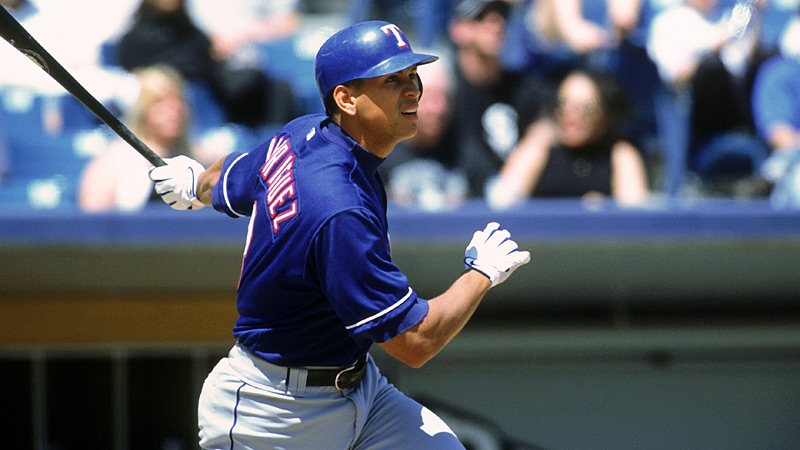
With Texas, A-Rod's numbers were off-the-chart, but the Rangers still sucked
Of course, Rodriguez is a cautionary tale in another way. He was 32 when he signed his second ten-year deal, just one year older than Cano is now, and he hasn't been anything close to the player he was before. Age and injuries have reduced him to a shadow of the player who won three MVPs in five years, so his contract is routinely mocked and one has to imagine the Yankees would do anything short of murder to get out from under the four years and $86 million they still owe Rodriguez, not including the $30 million he could potentially earn by vaulting to the top of baseball's all-time home run list.

Cano won't cause as many headaches as Rodriguez (no one else on this earth is capable of that), but it's likely that his contract will be regarded as an albatross before long, possibly as soon as next year based on what just happened with Josh Hamilton. Time is not on Cano's side, but it is on the side of the man he's replacing in Seattle. And that's what makes this move even more puzzling: Seattle seemed to have a decent second baseman already in Nick Franklin. Franklin isn't Cano and probably never will be, but he's a former first round draft pick who showed a good deal of promise as a 22 year-old rookie last season. He didn't set the world on fire in his first 102 games, but proved he could hit for some power (12 dingers and 20 doubles), work the count (10.2% walk rate) and run the bases capably, which translated to 2.3 bWAR. Still several years away from entering his prime, the switch-hitting youngster has plenty of room to grow. Cano doesn't. Now, Franklin's only use to Seattle is as a trade chip, but almost certainly not in the trade rumors that would make David Price a Mariner (seeing as how Tampa Bay already has an All-Star second baseman in Ben Zobrist).

Meanwhile in the Big Apple, it looks like the Yankees will have to settle for Kelly Johnson at second base, at least for the time being (why not move Jeter?). It's hard to feel bad for them, though, given that they just landed Ellsbury on Tuesday with a seven-year, $153 million mega-contract and secured McCann with a five-year, $85 million deal last month. Cano's departure coincided with Curtis Granderson's, who simultaneously  defected to the Yankees' crosstown rivals for four years and $60 million. Yesterday wasn't a total loss for the Bombers, though, as they still managed to woo Carlos Beltran with a three-year, $45 million pact and convinced Hiroki Kuroda to return for another year (more on those moves to come).

Losing out on Cano was one of the rare times were the Yankees didn't just fail to get their man, but were unable to retain one of their own. From A-Rod to Derek Jeter and CC Sabathia, the Yankees never seem to have trouble keeping their best players in pinstripes. Those days, it seems, might be coming to an end. New York's bloated payroll is burdened by massive commitments to washed up stars like Rodriguez, Sabathia, and Mark Teixeira. With Cano, they drew a line at seven years and refused to budge. Perhaps they've learned some sort of lesson after all.

It's a lesson the Mariners are going to learn soon enough.

Sunday, June 2, 2013

Bay Bouncing Back

Bay, a massive bust with the Mets, has been worth every penny for Seattle
After three frustrating, injury-plagued, and disappointing seasons with the New York Mets, Jason Bay is back.

Well, sort of.

Bay, now a proud member of the Seattle Mariners after signing a one-year, one million dollar deal with them last winter, smashed two solo home runs at Target Field yesterday. His first multi-homer game since July 5th, 2011 gives him four big flies in his past five games and pads his batting line to a solid .239/.343/.479, which translates to a 132 OPS+. The 34 year-old leftfielder hasn't been this productive since 2009, when he landed a four-year, $66 million deal with the Mets after popping 36 homers and driving in 119 runs (both career highs) for the Boston Red Sox.

Bay isn't going to approach those numbers again, but he's proven himself to be an asset with the bat for a team that's been starved for offense in recent years. He ranks second on the M's in slugging and OPS (behind Kendrys Morales), and only Mike Morse has hit more home runs. If not for Mariano Rivera's return to glory, Bay might have an outside shot at winning Comeback Player of the Year.

But playing for the mediocre Mariners means few baseball fans outside of Oregon are aware of Bay's renaissance. Far from the spotlight of the Big Apple, Bay has thrived in his new surroundings and is proving that he still has some juice left in his bat. Left for dead when the Mets released him after he hit just .165/.237/.299 in 70 games with New York last year, Bay, like many washed-up sluggers in their mid-thirties (Eric Chavez, Vernon Wells, and Travis Hafner come to mind), has found a way to prolong his shelf-life by latching on to a new team and exceeding expectations.

Health remains Bay's biggest obstacle--he missed 198 games over the past three years--but if he can stay on the field he has a good shot at surpassing 20 home runs and re-establishing some of the value that evaporated during his trying tenure in New York. If he keeps hitting well, he might even luck into  a midseason trade that sends him to a contender in search of an outfield bat (i.e. the Athletics or Nationals).

Not bad for someone who was out of a job six months ago.

Tuesday, March 26, 2013

AL West Preview

1st Place--Los Angeles Angels
2012 Record: 89-73
2012 Pythagorean: 88-74
2013 Projected: 92-70
After starting last year 7-15 with Mike Trout toiling in the minors and Albert Pujols mired in the worst slump of his career, the Halos dug themselves out of an early hole and produced the best record in baseball from that point forward. Though their wretched April cost them a playoff berth in 2012, the Angels are poised to make the postseason after inking Josh Hamilton--the most coveted position player on the free agent market--to a five-year, $125 million deal. Though the former MVP is on the wrong side of 30 and will likely regress and/or get hurt following a career year in 2012, he'll provide a heavy dose of lefthanded power LA so desperately craves. That said, don't be surprised if Hamilton goes bust and Torii Hunter, now with the Tigers, produces more value in 2013. Mike Scoscia will have the pleasure of filling out a lineup card that features baseball's best all-around player (Trout), baseball's most exciting player (Hamilton) and one of the best hitters of all-time in Pujols. Trout figures to slide a bit following his historic season, but at least his talent won't be wasted in the minor leagues. Pujols shrugged off a slow start to bat .312/.374/.589 from May 15th onward, proving talk about his decline to be premature. Expect similar numbers in year two of his gargantuan contract. Slugger Mark Trumbo has been a mess since the end of July, but I think he reverts to his mashing ways in his age-27 season. I could also see Peter Bourjos breaking out. Jered Weaver, the only American League pitcher to finish in the top five of the Cy Young voting in each of the past three years, is a bona fide ace even though his strikeout rate has plunged from 9.3 K/9 in 2010 to 6.8 K/9 last year. C.J Wilson will improve upon his first season with the Angels when he takes advantage of the run support boost and friendly home ballpark. Jason Vargas and Tommy Hanson are intriguing additions to the starting rotation, though I'm guessing most Angels fans would rather have seen their team keep Dan Haren and Zack Greinke. However, I don't think they'll miss Ervin Santana and Vernon Wells too much. The bullpen should get a nice boost from Ryan Madson, but it remains to be seen how effective he'll be after sitting out all of last year recovering from Tommy John surgery. Given how much worse the Rangers got over the winter, the AL West is theirs for the taking.

2nd Place--Texas Rangers
2012 Record: 93-69
2012 Pythagorean: 91-71
2013 Projected: 88-74
As if blowing their division lead on the regular season’s final day wasn’t miserable enough, the Texas Rangers followed up their late-season collapse with a lean winter. They waved goodbye when sluggers Josh Hamilton and Mike Napoli signed with new teams. They parted ways with veteran leader and fan favorite Michael Young. They winced when Nelson Cruz‘s name surfaced in the latest PED scandal. They whiffed on Justin Upton. Talk about a rough offseason. Faced with limited options and suddenly short on offense, the Rangers turned to Lance Berkman out of desperation. Five years ago that would have been a great get for them, but Big Puma is 37 and doesn't appear to have much left in the tank after needing four separate DL stints last year. He's just one of many Rangers at risk for disappointing seasons. Texas paced the American League in runs and hits last year, and while their lineup is still formidable there's no way that happens again this year. Adrian Beltre is their best hitter, and he'll be 34 two weeks from now. Ian Kinsler is on the wrong side of 30, too, and second basemen age horribly. Cruz will turn 33 and his best days are probably behind him. At 36, A.J. Pierzynski can't possibly repeat his career year and will probably wear down over the course of a long Texas summer. The offense will probably be fine, but there's a lot of downside risk here and not much upside. Yu Darvish made adjustments toward the end of last year and is going to have a big sophomore season (like Daisuke Matsuzaka did). He needs to cut down on his walks, but could win 20 games and the Cy Young award even though the Ballpark in Arlington will likely suppress his numbers. He anchors a strong rotation that also features Matt Harrison, Derek Holland, and Alexi Ogando. Joe Nathan proved he's still an elite closer in his Texas debut last year, making the All-Star team and saving 37 games. Joakim Soria, a former All-Star closer with the Kansas City Royals, will set him up. The Rangers certainly have enough talent to win 90+ games again and challenge the top spot in the division, but I see them taking a small step back in 2013.


3rd Place--Oakland A's
2012 Record: 94-68
2012 Pythagorean: 92-70
2013 Projected: 83-79
I still can't believe these guys won the AL West last year, especially since they ended May seven games below .500. Maybe that's why I can't shake the feeling that they just got red-hot for four months and will probably fall back to earth in 2013 (not quite like the Orioles, but similar). The A's are woefully short on offense without Chris Carter, Stephen Drew, and Jonny Gomes, though the middle of the order has some potential. Yoenis Cespedes is a Vladimir Guerrero-type who can hit the ball out of a canyon and is an MVP-candidate-in-the-making, but I'm not totally sold on Josh Reddick as an All-Star caliber player just yet. Chris Young brings a nice power/speed combo, but it's worth noting that he's a .224/.311/.409 hitter away from Chase Field. Jemile Weeks is almost guaranteed to bounce back from a miserable year in which his BABiP cratered at .256. The bottom half of their lineup is a disaster, so runs will be in short supply. That means Oakland will have to rely on its elite pitching staff, which ranked second in ERA last year. With Jarrod Parker, Tommy Milone, A.J. Griffin, and Dan Straily all poised to build off successful 2012s, the young rotation is brimming with upside. Brandon McCarthy will be missed, but Oakland is hoping Brett Anderson can finally stay healthy after averaging just 13 starts per year over the past three. He's demonstrated the ability to pitch like an ace, so a full season from him would go a long way towards boosting his team's playoff chances (but I wouldn't count on it). The bullpen looks stellar on paper, and the defense is solid, too. The A's could be a great team again if the starting pitching improves and Cespedes makes the leap to superstardom, but I see them settling into the 80-85 win range and missing the postseason.

4th Place--Seattle Mariners
2012 Record: 75-87
2012 Pythagorean: 77-85
2013 Projected: 73-89
The Mariners have lacked adequate firepower for quite some time now--you'd have to go back to the end of the Bush administration to find the last time Seattle didn't finish last among AL teams in runs scored. That's going to change this year after taking on veteran hitters Michael Morse, Kendrys Morales, Raul Ibanez, and Jason Bay. Ibanez and Bay are bench players at this stage in their careers, but Morales and Morse add much-needed pop to the middle of the order. As the cornerstone of Seattle's lineup, Jesus Montero must (and will) improve upon his disappointing 2012 (.685 OPS, -0.2 bWAR). He's just 23 and still has room to grow, as do Kyle Seager, Dustin Ackley and Justin Smoak. Moving in Safeco's fences will help these young hitters, but not enough to make much of a difference. The Mariners have one of the best pitchers around in Felix Hernandez, but he seems to be at risk for a down year after receiving a mammoth contract extension and throwing more innings than any other hurler since 2009. Seattle's rotation is a mess with him and would be downright unwatchable without him. M's are stocked with young pitching talent that could arrive in the Show later this year, but by the time they're ready to contribute it will too late to improve Seattle's non-existent playoff chances. They're still rebuilding and at least another year or two away from making a serious run at one of the wild card spots.

5th Place--Houston Astros
2012 Record: 55-107
2012 Pythagorean: 59-103
2013 Record: 58-104
Welcome to the American League, boys. It's going to eat you alive.