Showing posts with label Fantasy. Show all posts

Wednesday, February 10, 2016

Who's Number One in Fantasy?

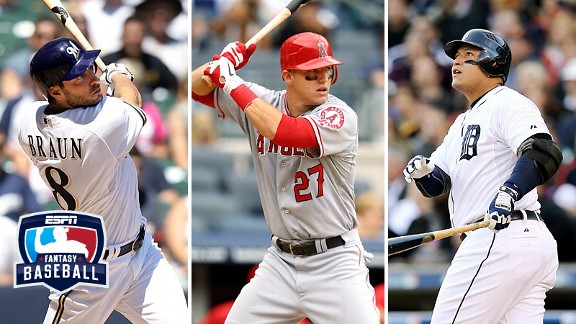
Let the debates begin (ESPN)
With the Super Bowl over and Spring Training just days away, it's time to start making preparations (if you haven't already) for fantasy baseball.

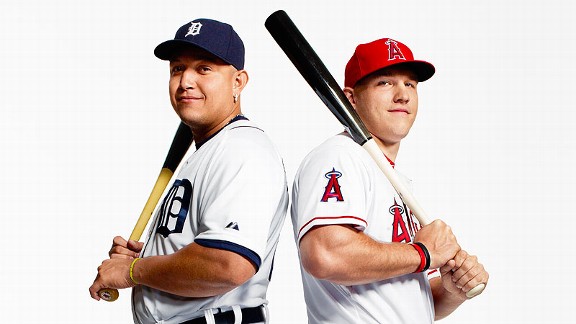
One scenario that every player must prepare for is what he'll do if the fantasy gods bless him with the top pick in his draft. That hasn't required much thought the last few years, as Mike Trout was clearly the top choice in fantasy due to his age and all-around skill set, but with the emergence of Bryce Harper it's not so clear-cut. And could Paul Goldschmidt really be a better fantasy option than both of them? Let's find out.

The case for Trout:
Trout isn't quite as valuable in fantasy as he once was due to his shrinking stolen base totals and back-to-back seasons below .300, but he's still arguably the top choice. Trout's sacrificed some average for power the last two years, which has helped him produce career-highs in home runs both seasons. He's now a threat to go yard 40 times which, combined with his huge runs/RBI figures and double-digit stolen base totals, guarantees elite production across the board. His averages, while not what they once were, are still pretty good, making him a true five-category contributor. Trout's also been phenomenal at making adjustments since arriving in the majors, which makes him a good bet to maintain, if not improve on, his stellar numbers (it'd be nice if the Angels put some decent hitters around him, though). Draft Trout with confidence, make sure he's in your lineup Opening Day, and forget about him the rest of the season.

My Projections: 110 R 37 HR 96 RBI 13 SB .295 BA

The case for Harper
When healthy, Harper has the potential to be the best player in baseball, as he proved last year when he batted .330/.460/.649 (205 OPS+) with 42 home runs and 9.9 bWAR. "When healthy" is the key phrase there, as 2015 marked the first time in four seasons that Harper eclipsed 140 games. He also doesn't run much anymore, with only eight steals in his past two seasons, so he's more of a four-category stud. But man, he'll carry you in those four categories. He might be the only player in baseball capable of winning a batting title and a home run crown (which he nearly did last year), and he should be good for around 100 runs and RBI again. The RBI total might drop to "disappointing" Joey Votto levels because of his weak supporting cast and how often he gets walked with guys on base, but he'll still be a boon in that department. Plus he's only 23, which means he might, you know, get better (only kidding).

My Projections: 111 R 38 HR 105 RBI 7 SB .311 BA

The case for Goldschmidt
Arizona's first baseman is a true five-category monster--Miguel Cabrera if Cabrera could run. He's batted over .300 each of the past three years and exceeded 30 home runs, 100 runs/RBI, and double digits steals in the two seasons where he was healthy. Nobody else has done that multiple times during that span, making Goldy the best bet to provide help in all five departments. He's 28, plays everyday, and calls one of the friendliest hitter's parks in the majors home. All signs point to another big season from Goldschmidt, especially if A.J. Pollock repeats his breakout batting in front of him.

My Projections: 103 R 34 HR 112 RBI 19 SB .316 BA

My gut says to go with Trout, but based on the numbers I actually think I like Goldschmidt a bit more. I'd expect him to hit for a higher average, steal more bases, and knock in a few more runs. However, you usually need at least three (often five) outfielders as opposed to only one first baseman, so positional scarcity might sway me back to Team Trout.

Sunday, March 23, 2014

14 Players to Avoid in 2014

As great as Puig was last year, I'm pessimistic about his 2014 outlook (Fox)
Last week I identified 14 players to shoot for in fantasy baseball drafts, so today I'll discuss 14 that I'm almost guaranteed to pass over. Once again I've included each player's average draft position in parentheses (courtesy of ESPN).

Jacoby Ellsbury (11.7)
I wouldn't spend my first round pick on Ellsbury, who has never exceeded nine home runs or 60 RBI outside of his fluke 2011. He'll score lots of runs, steal tons of bases and bat close to .300 when healthy, but his lack of power prevents him from meriting first round status in my opinion.

Yasiel Puig (29.1)
Several warning signs indicate Puig is likely to fall victim to the dreaded sophomore slump that has plagued Jason Heyward, Eric Hosmer, Austin Jackson and Will Middlebrooks in recent seasons. For one, his .383 average on balls in play last year is unlikely to be repeated. He also exhibited a hyper-aggressive approach at the plate that resulted in him striking out almost three times for every walk. And to top it all off, the 2013 NL Rookie of the Year runner-up had a miserable spring training, batting .122/.136/.195 without a home run in 44 plate appearances. I predict similar struggles in his near future.

Ian Kinsler (36.8)
Kinsler's production has dropped off precipitously over the past two seasons, falling from 32 home runs and 30 steals in 2011 to just 13 and 15, respectively, in 2013. The combination of age (he turns 32 this year), diminishing skills and leaving Texas (where his OPS was almost 200 points higher than it was everywhere else) will likely accelerate his decline and prevent him from rebounding.

Eric Hosmer (52.7)
Hosmer's going much too high for a first baseman who's averaged 17 home runs and 72 runs/RBI per year. He doesn't do enough in batting average (.277 career) or steals (13 per season) to justify getting drafted alongside Adrian Gonzalez.

Jean Segura (72.6)
Segura fell apart after a sizzling start last year, batting a lowly .241 with just one home run and 13 RBI in the second half. He seems unlikely to replicate his power numbers given that he socked only 26 home runs in his 399 minor league games.

Aramis Ramirez (87.2)
Still a productive hitter but his age (36 in June) and injury history (has topped 150 games once in the past ten seasons) are scaring me off.

Josh Hamilton (95.7)
Hamilton has been terrible for a year and a half now, and that's not changing anytime soon so long as he continues to hack away. It also doesn't help that he plays half his games in a pitcher's park, turns 33 two months from now and is prone to injury. Let him be someone else's headache.

Brett Lawrie (123.6)
Lawrie's accrued over 1,000 big league at-bats and has been a major disappointment thus far. His numbers have gotten worse, not better. It looks like the Ryan Braun comparisons made during his rookie season were premature.

Billy Hamilton (125.8)
We know Hamilton can run like the wind, but can he hit? His .280/.350/.378 minor league batting line isn't very promising, so he probably isn't going to be the next Rickey Henderson.

Jonathan Papelbon (138.8)
Age (33) and diminishing velocity mean Papelbon no longer resides among the game's elite closers. His WHIP has risen in each of the past two years. In 2013 alone, his ERA jumped up nearly half a run from his 2012 mark and his K/9 dropped by 3.5 batters per nine.

R.A. Dickey (142.7)
The 2012 NL Cy Young winner suffered major regression in his first season with the Blue Jays as he adjusted to baseball's toughest division and a home park that favors sluggers. Now 39, he figures to be not much better than a league average pitcher from here on out.

Curtis Granderson (143.9)
I'm expecting Granderson to be a huge bust Jason Bay-style. It's bad enough that he's a 33 year-old all-or-nothing slugger, which means he's susceptible to falling off a cliff at any moment. Throw in last year's injury problems and the move from Yankee Stadium to Citi Field, and I'll be looking elsewhere in the middle rounds.

Carl Crawford (169.0)
No reason Crawford should be ranked this high. He's had trouble staying healthy lately and his numbers have suffered. Over the past three years, he's averaged just 50 runs, seven home runs, 35 RBI, 13 steals and a .269 batting average. Crawford was great once, but he's not anymore.

Dan Haren (188.8)
I like his rebound chances as much as anyone, but one has to acknowledge that his 4.50 ERA over the past two seasons hasn't been very good. Late picks should be used for guys with upside, and there's not much upside for a 33 year-old former workhorse who's been well below average in each of the last two years.

Friday, March 14, 2014

14 Fantasy Baseball Targets for 2014

Bumgarner's already an ace but could get even better (FoxSports)
It's March and you know what that means: fantasy baseball season has arrived. Here are 14 players I have my eye on in this year's drafts, mainly because I view them as good value picks. In parentheses I included each player's average draft position from ESPN's live drafts so far and will refer to each in the context of ESPN's standard ten-team, 5x5 leagues. Also thanks to Matthew Berry's always-terrific (and thought-provoking) 100 facts column for some of the information found below.

Joey Votto (19.7)
I see Votto-matic as closer to a first round pick, maybe even top-ten worthy. He's guaranteed to bat .300 (the one year he didn't, he hit .297), score a ton of runs, and hit 25-30 home runs. Last year's 73 RBI were a fluke--he's averaged close to 100 per 162 games in his career. The 2010 NL MVP is one of the best pure hitters out there and is worth reaching for over Prince Fielder, Adam Jones, and the injury-prone Troy Tulowitzki.

Giancarlo Stanton (33.6)
2013 was a rough year for the Marlins slugger, who missed 46 games and set career lows in batting average and slugging percentage. On the bright side he still socked 24 home runs and showed signs of maturity by setting personal bests in walks (74) and OBP (.365). Now 24 and with a better supporting cast, Stanton should reclaim his status as one of the game's premier power hitters.

Madison Bumgarner (48.9)
I'm a big Bumgarner guy. He's exceeded 200 innings and 190 strikeouts in each of the last three years while improving his WHIP each season. During that span, Cliff Lee and Clayton Kershaw are the only other pitchers with at least 191 strikeouts and an ERA under 3.38 each year. The new ace of San Francisco's staff is only 24 and calls AT&T Park home. What's not to love?

Zack Greinke (53.5)
The Dodgers are going to be amazing this year, which puts Greinke in line to set a new career high in wins. He also gets a big boost by pitching in Dodger Stadium, where he had a 2.11 ERA and 5.25 K/BB ratio last year. If he keeps pitching as well as he did during the second half of 2013 (1.85 ERA, 0.98 WHIP) then he's going to give Kershaw a run for his money in the NL Cy Young race.

Matt Holliday (70.3)
Holliday's a virtual lock to give you a .300 batting average, 20-25 home runs and close to 100 runs/RBI. He's 34 but has showed no signs of slowing down and bats in the middle of a loaded lineup. Draft him with confidence.

Matt Kemp (71.1)
Kemp is absolutely worth taking a chance on this late in the draft. He's still just 29 and was an elite player as recently as 2012. Chalk his poor 2013 up to injuries and expect a big bounce back from the 2011 NL MVP runner-up.

Billy Butler (122.7)
Here's a blind player comparison with season averages for the past two years:
Player A: 72 runs, 20 home runs, 104 RBI, .296 batting average, 2 steals
Player B: 67 runs, 22 home runs, 95 RBI, .302 batting average, 1 steal
Player A is Adrian Gonzalez. Player B is Billy Butler. Gonzalez is going in the low 50s, roughly 70 picks ahead of Butler. And Butler is four years younger.

Hisashi Iwakuma (130.9)
Here's another blind comparison, this time with totals for the past two years:
Player A: 345 innings, 2.84 ERA, 3.77 FIP, 286 K
Player B: 343 innings, 3.02 ERA, 3.78 FIP, 259 K
Player A is Hisashi Iwakuma. Player B is Jered Weaver. Weaver's going almost 40 picks ahead of Iwakuma.

Jose Abreu (131.5)
High risk, high-reward pick here. I guess I'm excited that he'll get to play half his games in the homer-friendly U.S. Cellular Field, which should play to his strengths. I'm feeling something close to 30 home runs for him this year.

Hiroki Kuroda (167.2)
Put aside his rough second half and admire his brilliantly consistent track record. He's one of just three pitchers--Kershaw and Gio Gonzalez are the others--to start at least 30 games and have an ERA below 3.40 in each of the past four seasons. In addition, the 2014 Yankees project to be more potent than the 2013 edition now that they have Brian McCann, Jacoby Ellsbury, and Carlos Beltran, plus full or healthy seasons from Mark Teixeira, Derek Jeter and Alfonso Soriano. Translation: Kuroda will get better run support and win more games. Kuroda's much safer (and better) than most of the players getting drafted around him, guys like Carl Crawford, Torii Hunter, Wilson Ramos, Will Middlebrooks, and Ernesto Frieri.

Austin Jackson (180.8)
Jackson's a better real-life player than fantasy player, but he's still going way too low. Over the past four years, only Miguel Cabrera has scored more runs than he has. A-Jax provides decent power with 15-20 home run potential and has shown the ability to hit .300. While it's alarming that his stolen base totals have gone down every year since his rookie season, new manager Brad Ausmus wants the Tigers to be more aggressive on the basepaths than they were under Jim Leyland so look for Jackson to get the green light more often. And don't forget: 2014 is Jackson's age-27 season.

Danny Salazar (183.9)
Jonah Keri over at Grantland has a huge man-crush on the 24 year-old Dominican, and it's not hard to see why. Salazar was sensational in his ten start cameo last year and seems poised to break out. For the record, I like him a whole lot better than Michael Wacha, who's going five rounds earlier largely because of his postseason success.

Johnny Cueto (185.9)
Since Opening Day 2011 Cueto has the third-lowest ERA in baseball behind only Kershaw and Kris Medlen. Health has been an issue for him at times, limiting him to 24 starts in 2011 and just 11 last year, but they haven't hampered his effectiveness. He's still in the heart of his prime at 28 and pitches for a good team, so wins shouldn't be hard to come by.

A.J. Burnett (199.5)
Burnett's been one of baseball's better (and more underrated) pitchers since returning to the National League. In his two seasons with Pittsburgh he compiled a 3.41 ERA and 3.02 K/BB ratio while racking up 389 strikeouts in 393.1 innings, numbers comparable to those of Homer Bailey, Matt Cain, Wade Miley and Mat Latos, all of whom are long gone by the time Burnett's name comes off the board.

Honorable Mentions: Bryce Harper, Justin Verlander, Mark Trumbo, Jedd Gyorko, Jason Heyward, and B.J. Upton

One last word to the wise: if you find yourself needing speed late in the draft, go for Brett Gardner and/or Michael Bourn. Both have been elite basestealers in the past and should outdo their disappointing 2013 stolen base production.

Thursday, March 6, 2014

2014 Red Sox Pitching Projections

Lester looks to add another strong season to his resume in 2014 (SportsWeb)
As promised, albeit three weeks late, here are my Red Sox pitching projections.

Jon Lester
Lester's not a fantasy ace but remains a solid option as a third or fourth starting pitcher. He's always good for 15 or 16 wins, with the potential to threaten 20 if everything goes right for him. Last year's 3.75 ERA was a near perfect match for his career 3.76 mark, so his ERA figures to be in the 3.60-3.90 range this year. Gone are the days of Lester posting elite strikeout totals, but 175 or so still aint too shabby.  His WHIP won't help much, but it's not going to hurt you either. 2014 is going to be a contract year for him, too, but maybe not for long if Boston decides to lock him up.

My Projections:
16-7, 3.63 ERA, 174 strikeouts, 1.30 WHIP

Clay Buchholz
Buchholz just can't stay healthy, but at least he pitches well when he's able to take the mound. He was a frontrunner for last year's Cy Young before a strained neck injury waylaid him. He's the classic case of high-risk, high-reward.

My Projections: 9-5, 3.42 ERA, 87 strikeouts, 1.16 WHIP
(If he's healthy): 14-8, 3.54 ERA, 125 strikeouts, 1.23 WHIP

John Lackey
Lackey's redemptive 2013 was not only a total surprise, but also one of his finest seasons. He's unlikely to repeat it in his age 35 season, especially given how poorly he pitched in his two seasons prior to last, but it seems safe to say that he's an effective pitcher once again.

My Projections: 13-11, 4.02 ERA, 153 strikeouts, 1.24 WHIP

Jake Peavy
Peavy handled himself well his first time through the AL East, posting a 4.04 ERA, 1.16 WHIP and 4-1 record in his 10 starts with the Red Sox last year. The former Cy Young winner got roughed up during the postseason, but it wouldn't be wise to put much stock in two starts against baseball's second and third-best offenses. Durability's an issue for Peavy, as he's started more than 30 games in a season just once in the past six years, and he's not the ace he used to be, but at least his peripherals are still nice.

My Projections: 12-9, 4.32 ERA, 116 strikeouts, 1.20 WHIP

Felix Doubront
Doubront's going to be the fifth starter in Boston's rotation now that Ryan Dempster's out of the picture. The Venezuelan southpaw improved his ERA by more than half a run over his rookie season but failed to show better peripherals. That said, he pitched really well for most of the summer before a couple September shellackings inflated his numbers, so it's conceivable that he continues to improve in 2014 (his third full season as a starter and age 26 season). He could be so much better if he gets his walk rate down from and becomes more economical with his pitches, but until then he's only going to be useful in deep or AL-only leagues.

My Projections: 13-8, 4.16 ERA, 152 strikeouts, 1.40 WHIP

Koji Uehara
The biggest question mark with Uehara is health. He turns 39 in April and has never surpassed 60 innings in consecutive seasons before. But when he's pitched, his track record has been absolutely stellar. My bet is that if he's healthy, he's going to dominate again in 2014, though not to the insane degree he did a year ago.

My Projections: 3 wins, 36 saves, 2.38 ERA, 75 strikeouts, 0.78 WHIP

Thursday, February 27, 2014

Trout or Cabrera?

Cabrera and Trout battle for fantasy's top spot (ESPN)
Imagine your fantasy baseball draft day has finally arrived and you scored the first pick. You're sitting pretty. The only question is: who do you take?

Even though any player in the MLB universe can be yours, you only have to consider two options. One is Miguel Cabrera, back-to-back MVP, three-time batting champion, and the most dangerous hitter in the game. The other is Mike Trout, baseball's best player.

So who do you choose? ESPN, MLB and Yahoo all have Trout at number one and Cabrera at number two. I thought it'd be helpful to compare their 5x5 totals from the last two years, with their major league ranks in parentheses:

Cabrera:  212 R (2nd)  88 HR (1st)  276 RBI (1st)  .338 AVG (1st)  7 SB (82nd)
Trout: 238 R (1st)  57 HR (14th)  180 RBI (22nd)  .324 AVG (2nd)  82 SB (1st)

The numbers favor Cabrera who has a huge edge in home runs and RBI. He's a good bet to provide more runs, RBI, home runs, and a higher batting average than anyone else, though the run total will probably go down a bit now that Victor Martinez is batting directly behind him instead of Prince Fielder. He's not going to provide many steals, but you're not drafting him for his speed.

But Cabrera has reached his peak. He's not going to get any better than this (can he?). Trout, on the other hand, is only 22. He still has room to grow. 40/40 is a very real possibility for him. So is winning a batting title, scoring 130 runs and driving in more than 100.

Even if you don't think Trout can get much better, you have to ask yourself if Trout's huge advantage in steals and sizable edge in runs compensate for Cabrera's superiority in the other three categories. Last year they weren't quite enough, as Cabrera was the most valuable player in fantasy baseball, scoring a 15.04 on ESPN's Player Rater. Trout was a not-too distant second at 14.57. It's worth noting that in 2012 Trout came out on top, and Cabrera was third with Ryan Braun sandwiched between them (Braun, coming off an injury-plagued and PED-ruined season, is too big of a question mark to take first this year).

Cabrera loses a bit of value by moving back across the diamond from third base to first, but manning first should help keep him on the field. He's about to be 31 though--the same age Albert Pujols began to decline--and was slowed by injuries in the second half. Cabrera's 2013 games played total was his lowest since his rookie season, which should be taken into account. He carries a bit more age/injury-regression risk than Trout.

It all comes down to a matter of personal taste, I suppose. Trout's game is more rounded and still has room for improvement. If you like to draft upside and/or power-speed guys, then Trout's your man. But if you love mashers you can plug in on Opening Day and never worry about again (of which there are very few), then Cabrera's a no-brainer.

I'd probably pick Trout because I like well-rounded players who can give me a bit of everything, but you can't go wrong with either of them. So if you're on the clock and become overwhelmed with indecision, don't hesitate to flip a coin.

Tuesday, February 11, 2014

2014 Red Sox Lineup Projections

Here's what I'm expecting in terms of fantasy production from the Red Sox starting lineup this year, assuming Stephen Drew doesn't make a last-second return.

C A.J. Pierzynski
His fluke 2012 notwithstanding, Pierzynski is as steady as they come. He'll be hard-pressed to reproduce what Jarrod Saltalamacchia did last year, but he's a capable fill-in who should still be able to hit a little bit.

44 runs, 10 home runs, 63 RBI, 0 steals, .268 batting average

1B Mike Napoli
Nap was exactly what we thought he'd be: a streak slugger who can carry the team for stretches but disappear during others. He struck out a ton though--187 times in less than 500 official at-bats--which doesn't bode well for a 32 year-old with hip problems. We've seen how similar sluggers like Mark Reynolds, Adam Dunn, Dan Uggla and Jack Cust have fallen apart in recent years, but I think (hope) Napoli's bat still has at least one more good season in it.

74 runs, 21 home runs, 87 RBI, 2 steals, .248 batting average

2B Dustin Pedroia
After a injury-hampered 2012, Pedroia was back to his old self in 2013, batting over .300 and spraying lasers all over the park. His power did drop off a bit--his nine home runs were his fewest since his rookie season and a far cry from the 21 he popped in 2011--but that can be easily explained by his dramatic drop in fly ball rate. It's too early to tell if that was just a statistical blip or the beginning of a trend, but given his age (30) I'm inclined to think it's the latter. He still does everything else well, though.

103 runs, 12 home runs, 70 RBI, 18 steals, .304 batting average

3B Will Middlebrooks
Middlebrooks was terrible in the first half last year, playing his way out of the third base job he stole from Kevin Youkilis the year before. Light-hitting Jose Iglesias took over for him when he was demoted to Pawtucket in late June, but a spot opened up when Iglesias was shipped out in the trade that made Jake Peavy a Red Sock. The time in Triple-A seemed to do Middlebrooks some good, as he batted .276/.329/.476 after returning to the big club in August. I think his numbers will be much closer to (and maybe better than) that than the .192/.228/.389 figures he was sporting prior to his demotion.

66 runs, 25 home runs, 78 RBI, 7 steals, .260 batting average

SS Xander Bogaerts
John Farrell says Bogaerts is the team's starting shortstop at this moment, so it looks like the 21 year-old phenom is going to get every opportunity to prove himself at the big league level in 2014. He looked like a player wise beyond his years during the playoffs and should be ready to hit the ground running in his first full season.

83 runs, 16 home runs, 64 RBI, .281 atting average, 16 steals

LF Jonny Gomes
Gomes is easy to project because he puts up the same numbers year after year: 15 or so home runs, 50 RBI and a batting average in the .250 neighborhood. No reason to expect anything different from the quirky slugger.

44 runs, 14 home runs, 48 RBI, .252 batting average, 2 steals

LF Daniel Nava
There's no way Nava hits as well as he did last year, when he had the league's eighth highest batting average (.303) and fifth best on-base percentage (.385), both of which were fueled largely by his .352 BABiP. The tricky part, then, is predicting how far he's going to fall. He was a .243/.352/.379 career hitter before last year, so I think it makes sense to expect he'll fall somewhere in the middle this year.

62 runs, 8 home runs, 55 RBI, 1 steal, .276 batting average

CF Jackie Bradley Jr.
Bradley disappointed after a blazing Spring Training, looking overmatched and batting just .189/.280/.337 once meaningful games got underway. With Jacoby Ellsbury gone, he should have no problem winning the starting center field job from Grady Sizemore, who hasn't played since 2011. I think I'm higher on Bradley than most, probably because he's going to be 24 in April (near his prime) and because I don't want to put too much stock in last season's 100-odd plate appearances. Plus it's encouraging that he hit well in Triple-A and was better when Boston recalled him in September.

78 runs, 13 home runs, 53 RBI, 17 steals, .264 batting average

RF Shane Victorino
Victorino bounced back from the worst season of his career with one of his best in 2013. It's unlikely he'll repeat that success at age 33, but we shouldn't expect him to crash back to his 2012 depths either. I see him playing well, just not as well as he did last year.

88 runs, 13 home runs, 63 RBI, 24 steals, .277 batting average

DH David Ortiz
Big Papi continued to defy age in 2013, posting his best full season OPS since 2007 and anchoring the Red Sox lineup with 30 home runs and 103 RBI. He's showed no signs of slowing down as he gets deeper into his 30s, batting a sublime .311/.401/.571 over the last three years. He can't keep hitting that way forever, of course, but I don't believe he'll fall off the cliff in 2014, especially since he's playing for another contract.

82 runs, 26 home runs, 94 RBI, 1 steal, .295 batting average

Pitching Projections to come!

Tuesday, December 17, 2013

Thankful for Tucker

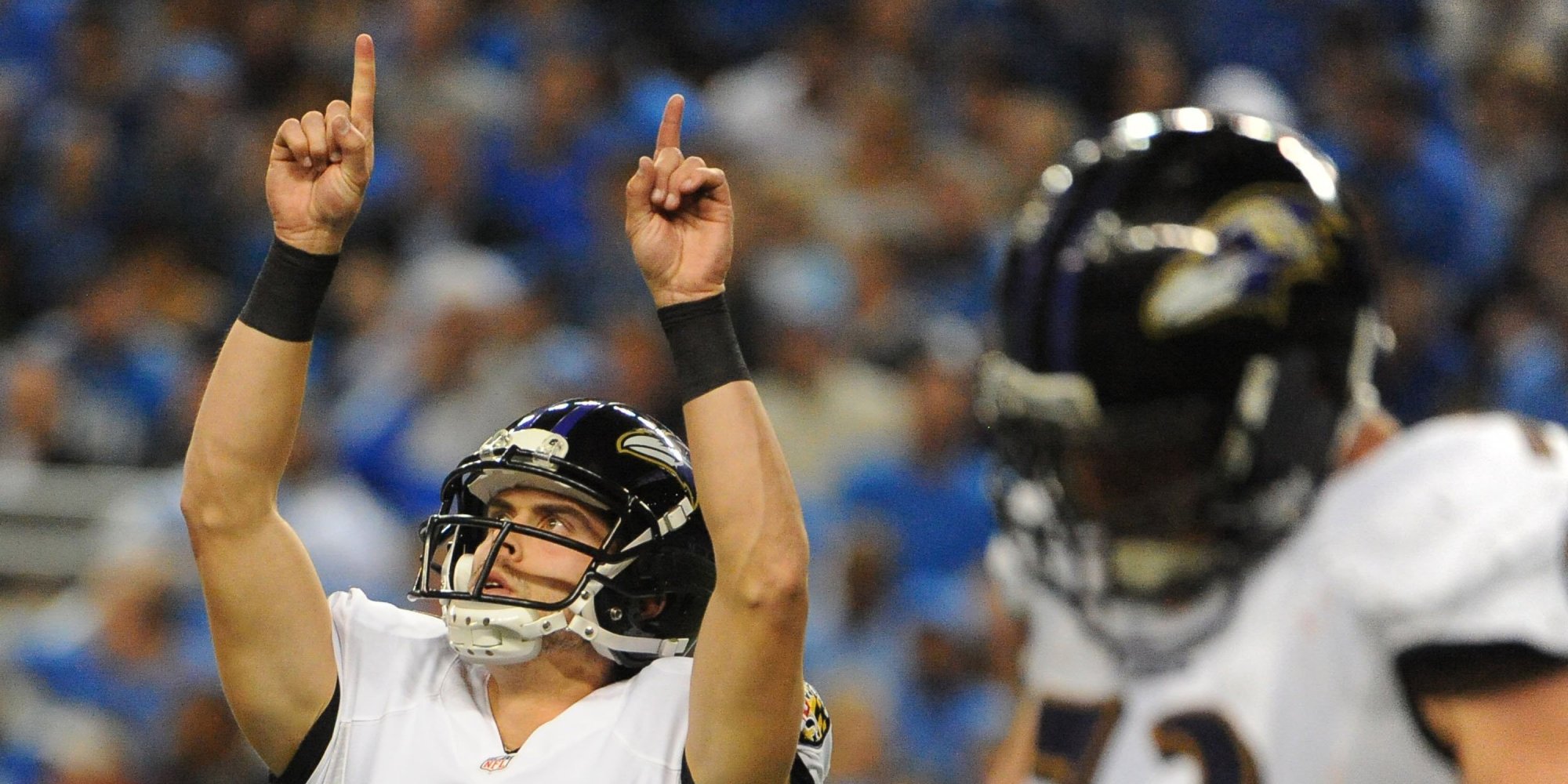
Tucker has made 33 consecutive field goals
Like millions of Americans, I play fantasy football. "Play" is the wrong word, I think, because it implies that there's actually some degree of fun involved. Personally, I find fantasy to be much more frustrating and agonizing than it should be. Drafting is fun, trades are fun, and winning is fun, but that accounts for 10, maybe 15 percent of the fantasy season  I've wasted way too much time scouring the waiver wire, pouring over projections and tinkering with my roster.

Then Sunday rolls around and it becomes a full-blown obsession. I compulsively check my phone from one o'clock onward, watching the points pile up (or not), rooting for my players to score and hoping the other guys' don't. Fantasy consumes my entire day. When I win, it's more of a relief than anything, especially when ESPN pegs me as a 25 point favorite. When I lose, I go back to the drawing board and try to determine where I went wrong.

For much of the season, my most glaring weakness was my kicker, which is strange considering there are plenty of good kickers to be had on the waiver wire since nobody carries more than one. Well, after whiffing on multiple kickers, I've finally found my guy, and just in time for the playoffs.

I've heard fantasy football teams compared to dreams in that they're only interesting to the person talking about them. You snagged Philip Rivers off waivers? Great. Took Aaron Rodgers with your first pick? That blows.

So if that's the case, then you probably don't want to hear my ramble about my kicker issues and how I solved them at the season's 11th hour. That's fine. Feel free to stop reading and check out some of my other content (hint hint: it's mostly baseball), or click off my blog altogether.

But maybe you've had your own kicker-induced headaches/nightmares/frustrations this season. Perhaps you're still looking for a solution. I probably would be, too, except that I've found the answer to my kicker woes. His name is Justin Tucker.

Quick backstory: last year I was undone by Mason Crosby, who converted just 21 of his 33 field goal attempts (63.6 percent). By the time I realized the error of my ways and swapped him out for Dan Bailey, it was already too late. I finished 8-7, narrowly missing the playoffs because I lost or tied several games that would have been victories with a merely capable kicker.

This year I was determined to avoid making the same mistake. Let Crosby be someone else's problem, I told myself. I would avoid outdoor kickers (who must contend with rain, snow, and gale-force winds) like the plague. Not surprisingly, Matt Bryant was my draft day selection. At the time, I was pretty happy about that. Bryant led the league in field goal percentage a few years back and has been one of the NFL's most consistent kickers over the past decade. I figured Atlanta's Matt Ryan-helmed passing attack would give him plenty of scoring opportunities.

Before long, my master plan had been reduced to ashes. Ryan's top two receivers--Roddy White and Julio Jones--both got hurt, and Tony Gonzalez, as great as he still is, can only do so much at this stage in his career. Atlanta's offense sputtered and Bryant's role was greatly diminished. As a result, in ESPN leagues he ranks 20th among kickers in points scored, meaning he's not worthy of a starting spot in my ten-team league. Before long I was looking to the waiver wire for help.

I settled on Garrett Hartley of the New Orleans Saints. Unlike Atlanta, the Saints have one of the league's most explosive offenses. On top of that I already had Drew Brees, so I figured it made sense to get Hartley's extra point every time he threw a touchdown and would settle for field goals when Brees's drives fell just short. While my logic was sound, Hartley's been far from automatic, missing eight of his 30 attempts thus far and ranking 19th at the position, exactly one spot higher than Bryant. That wasn't going to cut it, and when New Orleans' Week 7 bye came around I found myself in need of a new kicker.

I scooped up Nick Novak, San Diego's kicker, and he's been pretty good (eighth). Unfortunately, he was on my team for all of two minutes before I cut him in favor of Detroit's David Akers, who paced the NFL in field goal attempts four out of the past five years.  The opportunities just haven't been there for him this year (only 20 attempts), and as a result he ranks 30th among kickers. I rode him out for three weeks, then cut bait just before Thanksgiving.

By this point I was extremely fed up with myself. Nothing was working. I was in the playoff hunt and couldn't afford to let a kicker sink my season. Desperate for a stable solution, I decided to go out and grab the best kicker on the waiver wire, regardless of team, reputation, or schedule, and settled on Baltimore's Justin Tucker, who was coming off a 15 point game against the Jets. Nicknamed "Mr. Automatic," Tucker hasn't missed a field goal attempt since Week 2. That he had several favorable matchups in front of him (Pittsburgh, Minnesota) made him even more attractive. I was instantly rewarded with a 19 point performance against the Steelers. Tucker won me over. He had me at hello. I committed to him for the rest of the season, even as he was held without a field goal versus Minnesota in Week 14.

Now, thanks to his incredible performance against Detroit last night (six-for-six, connecting from 49, 53, and 61 yards out), Tucker has leapfrogged Stephen Gostkowski and Matt Prater to become fantasy's top-scoring kicker. I have to say, after putting up with subpar kickers all season long, it feels good to have the best. One less thing to worry about as I prepare for my postseason. Now if I could only find a halfway decent wide receiver...

Saturday, November 23, 2013

Projecting Fielder, Kinsler

Can Kinsler and Fielder reverse two straight years of decline?
Since Prince Fielder and Ian Kinsler were swapped on Wednesday, I've been thinking a lot about how they're going to fare in their new homes. That's what I do for fun when baseball season is months away and top fantasy commodities get traded for each other.

I have to admit, it's salivating to imagine what a slugger like Fielder will be able to do with 81 home games in Texas. My first thoughts were that a return to his 35-40 homer, 120 RBI glory days might be in order. Just like Adrian Beltre left skid marks (and a big contract) behind in Seattle, Fielder was going to ditch Detroit and re-find his power stroke in Arlington's hitter heaven.  He's going to be a beast again!

That's not outside the realm of possibility but, after digging through the numbers, I no longer think it's going to be the case. Fielder's power numbers dropped sharply in the first two seasons of his giant contract, seasons in which he was 27 and 28 when the season began. It's easy to blame  Comerica Park's spacious dimensions for the decline, but in each of his two seasons with the Tigers he hit only 12 home runs on the road. Plus he's probably not going to get as much of an edge (power-wise, that is) from trading home parks as one might expect now that he has so many more road games in the offense-suppressing stadiums of the AL West.

Then again, he's still only 29. I like his chances of a bounce-back to at least his 2012 levels with the potential to reach the heights from his Milwaukee days. I'd be perfectly fine with reaching a bit for him, but first base is so deep that I won't get bent out of shape if someone else is willing to reach a little bit farther.

Here's what I think Fielder's numbers will look like next year (very Ryan Howard-esque):

Fielder's 2014: 92 runs, 33 home runs, 112 RBI, 1 steal, .295/.383/.537

Kinsler's a bit tougher to project. He's going to be 32 next season, and his numbers have dropped off dramatically since his monster 2011. His runs, walks, homers, stolen bases, slugging percentage, and ISO are all trending downward. He pops up an awful lot and doesn't run as well as he used to. To make matters worse, he owed much of his success to the Rangers home park, where he was a career .304/.387/.511 hitter. Everywhere else, though, he's been subpar, as his .242/.312/.399 shows. Going to a much softer division with friendlier road parks should help, but whatever boost he sees there will likely be negated by leaving Arlington behind. All signs point to continued decline.

But while I'm skeptical about Kinsler's chances for a bounce-back, I will readily admit that maybe we're being too harsh on Kinsler. He's not the elite player he used to be, but he's still a good player. 31 isn't terribly old, either. As Dave Cameron pointed out on FanGraphs, everyone wrote off Shane Victorino under similar circumstances last year and it turned out talk of his decline was premature. The same has happened to Carlos Beltran, David Ortiz, Derek Jeter, Lance Berkman, and countless other players in recent memory.

Therefore, it seems unwise to predict nothing but gloom and doom for Kinsler. He's going to be hitting near the top of a loaded lineup, probably behind Austin Jackson but in front of Miguel Cabrera and Victor Martinez. If he can stay healthy, which is never a given with Kinsler, he should be able to provide fantasy owners with pretty useful numbers, especially in the underrated runs scored category.

Kinsler's 2014: 96 runs, 16 home runs, 72 RBI, 12 steals, .268/.331/.402

Friday, March 1, 2013

Red Sox Lineup Projections

C Jarrod Saltalamacchia
Salty emerged into one of best power-hitting backstops in baseball by slugging 25 home runs last year and posting a .232 ISO. His inability to hit lefties prompted Ben Cherington to bring in David Ross, who figures to suit up whenever the Red Sox face a southpaw. Nevertheless, another 20-homer season could be in the cards for Salty, and his batting average will improve from last season's dreadful .222 mark.

59 runs, 21 home runs, 63 RBI, 0 steals, .238 batting average

1B Mike Napoli
Hip issues aside, the most difficult component of Napoli's statline to forecast is his batting average. He sandwiched his .320 fluke in 2011 around a pair of sub-.240 seasons. Fenway is a great park for batting average, so I'd expect his average to climb back up to his career .259 mark, if not higher.

66 run,  27 home runs, 82 RBI, 2 steals, .260 batting average

2B Dustin Pedroia
Pedroia was on pace for another terrific season last spring before a thumb injury triggered a June swoon and DL stint in July. After returning to action on July 19th, the Laser Show lived up to his name by batting .318/.372/.508 the rest of the way. Nobody's more pissed off about Boston's embarrassing season than Pedroia, leading me to believe the pint-sized second baseman will come back with a vengeance in 2013.

100 runs, 18 home runs, 74 RBI, 21 steals, .303 batting average

3B Will Middlebrooks
The combination of a lost Red Sox season (93 losse) and the overwhelming star power of the 2012 rookie class (Mike Trout, Bryce Harper, Yoenis Cespedes, Yu Darvish), people forget how well he was playing before an errant pitch broke his hand in mid-August (bringing back painful memories of Jim Rice and Nomar Garciaparra). Before going down he compiled some impressive numbers, raking at a full-season clip of 32 home runs, 117 RBI, and a batting average close to .300. He's a hacker (70/13 K/BB ratio) but hits the ball with authority, which should translate to lots of RBI batting out of the five-hole. At 24 he still has room to grow, so these projections may underestimate his potential.

88 runs, 25 home runs, 94 RBI, 10 steals, .282 batting average

SS Stephen Drew
J.D. Drew's kid brother is perhaps the toughest Red Sox to predict, seeing as how he hasn't played a season uninterrupted by injury since 2010. It doesn't help that he turns 30 in a couple weeks, either, but  shortstop is a thin position in fantasy. If he stays on the field, he could make a run at the top-10.

64 runs, 13 home runs, 55 RBI, 7 steals, .269 batting average

LF Jonny Gomes
Cherington failed to find an everyday left-fielder to replace Carl Crawford, meaning Gomes will get the lion's share of at-bats from this position. Expect a Cody Ross-kind of year from the lefty-masher--batting average in the .260s with around 20 bombs and 70 to 80 RBI and a similar number of runs scored.

70 runs, 19 home runs, 72 RBI, 2 steals, .265 batting average

CF Jacoby Ellsbury
It's his contract year, Scott Boras is his agent, and Ellsbury needs to remind the baseball world of how special he can be when healthy.

102 runs, 16 home runs, 61 RBI, 42 steals, .301 batting average

RF Shane Victorino
The Flyin' Hawaiian is coming off a down year, and at 32 his best days are probably behind him. Even so, he's still a solid fantasy player who can provide plenty of steals and runs along with double-digit homers.

96 runs 14 home runs 58 RBI, 31 steals, .277 batting average

DH David Ortiz
Even at the ripe old age of 37, Big Papi is one of the most dangerous hitters around. His OPS has increased every year since 2009, jumping from .794 all the way up to 1.026 last year. After openly complaining about his contract status and tumultuous state of the team last year, he's a happy camper with his new multi-year contract extension and Ortiz always seems to be at his best when he's enjoying himself.

85 runs, 28 home runs, 93 RBI, 0 steals, .294 batting average

Monday, February 25, 2013

Who's Number One?

Mike Trout, Ryan Braun, and Miguel Cabrera (in that order) were the top three fantasy baseball players in 2012 according to ESPN's Player Rater. Which one deserves to be the first name off the board in your fantasy draft?

The Case for Braun
  • A true five category stud, Braun's average season yields 102 runs scored, 34 home runs, 107 RBI, 21 steals, and a .313 batting average
  • Braun's batted over .300 in five of his six big league seasons and owns a .313 career average
  • Few can match his combination of power and speed: Braun was the only player to go 30/30 in both 2011 and 2012
  • Milwaukee's offense paced the National League in runs scored last year, meaning Braun should have plenty of opportunities to score and drive in runs.
  • Fantasy owners need not worry about injury risk. Braun's averaged 154 games per season over the past five and is one of the safest investments in fantasy
Reasons to think twice
  • Braun's name has been linked to baseball's latest PED scandal and he once again finds himself embroiled in controversy. While it's highly unlikely Braun gets suspended, his performance will once again endure intense scrutiny from fans and media alike
  • After trimming his strikeout rate every year from 2008-2011, in 2012 Braun posted the worst whiff rate since his sophomore season
  • The spike in strikeouts may have something to do with the fact that he offered at 36.8 percent of pitches outside the strike zone, easily the highest mark of his career
My Projections: 104 runs, 36 home runs, 110 RBI, 31 steals, .318 batting average

The Case for Cabrera
  • Whereas outfield is the deepest position in fantasy for hitters, third base tends to be more volatile. It's not as thin as in years past, but many players (Pablo Sandoval, Kevin Youkilis, Chase Headley) have question marks
  • Starting in 2004, Cabrera's average season has produced 102 runs scored, 34 home runs, 118 RBI, 4 steals and a .321 batting average
  • A career .318 hitter and two-time batting champ, Cabrera has batted below .320 just once in his past eight seasons
  • He has Prince Fielder and Victor Martinez, two of baseball's top RBI men, protecting him in Detroit's lineup
  • Surprisingly durable for his size, Cabrera has appeared in at least 157 games each year since 2004. He's one of those players you pencil in on Opening Day and don't touch for the rest of the season
Reasons to think twice
  • Cabrera turns 30 in April, and his weight has been an issue throughout his career. Let's just say he won't be posing shirtless on magazine covers anytime soon
  • His OPS has declined in consecutive seasons
  • His walk rate plummeted from a career-best 15.7 percent in 2011 to 9.5 percent last year, probably because he adopted a more aggressive approach with Fielder batting behind him
  • With just 33 stolen bases to his name, Cabrera is a not a five category monster like Trout and Braun. Owners seeking speed will have to look elsewhere
My Projections: 112 runs, 37 home runs, 124 RBI, 2 steals, .333 batting average

The Case for Trout
  • At the tender age of 20, Trout delivered one of the greatest all-around seasons in baseball history. Assuming he follows a normal aging curve, he should only get better 
  • Despite spending the season's first 20 games in Triple-A, he went on to lead the major leagues with 129 runs, 49 stolen bases, and 10.7 bWAR last year. In addition, the Millville Meteor slugged 30 home runs, finished runner-up to Cabrera for the batting title and posted the AL's highest OPS+
  • If Mike Scoscia continues to bat him leadoff, he's going to score a truckload of runs setting the table for Albert Pujols, Josh Hamilton, and Mark Trumbo.
Reasons to think twice
  • Trout cooled off considerably in the season's final third. From August 1st forward, he batted .287/.383/.500 while striking out in a quarter of his plate appearances. Perhaps pitchers adjusted. Maybe he wore down over the course of his first full major league campaign. Perhaps it was simple regression to the mean. Most likely, all three factors played a role in his late-season slide.
  • Batting leadoff limits a batter's RBI opportunities, so Trout is going to be hard-pressed to reach the century mark in ribbies no matter how successful he is with men on base
  • Trout lacks the distinguished track records of Braun and Cabrera. The sample size is too small to make confident predictions about how he's going to perform in 2013 and beyond...
  • His .383 BABiP ranked third behind Dexter Fowler and Torii Hunter last year. Trout's fast, but he'll probably bat closer to .300 than the .326 mark he posted last year
  • Is the power legit? After all, we are talking about a guy who managed just 23 home runs in more than 1,300 minor league plate appearances
  • Could he possibly be any better than he was last year? Can he avoid the dreaded "sophomore slump" that plagues many of the sport's best young talents? Eric Hosmer, Brett Lawrie and Jason Heyward, all billed as superstars-in-the-making, struggled mightily in their second seasons. While they weren't anywhere close to Trout's level, they displayed how growing pains are part of the game. He won't fall off a cliff, but will probably dip a bit the same way Alex Rodriguez, Ted Williams and Pujols (already Cooperstown caliber players at Trout's age) did
My Projections: 123 runs, 24 home runs, 79 RBI, 52 steals, .306 batting average

The bottom line: if you score one of the first three picks in your draft, you're sitting pretty. Don't agonize over the decision too much, because you can't go wrong. Cabrera and Braun are money in the bank. Taking Trout is more of a calculated risk, albeit one that could also reap the biggest rewards. If the 21 year-old wunderkind somehow improves upon his historic rookie year, watch out.

I prefer to play it safe, so I'd put Braun at number one, Cabrera second and Trout third. How about you?

Saturday, February 23, 2013

Players Entering Age 27 Seasons

The general consensus among baseball pundits is that a player's prime covers his age 25-29 seasons, even if the steroid era has tricked people into believing that it extends into his early thirties.  Joe Posnanski proved it here.  There will always be exceptions such as Vada Pinson (blossomed early) and Dwight Evans (late bloomer), but for the most part this trend holds true.  Players are too young, raw, and inexperienced in their early 20s, and many still haven't filled out yet.  On the flip side, players start o break down in their thirties, when their bodies fall apart and essential skills like reflexes, hand-eye coordination and speed begin to diminish.  Their waistlines expand, their bats slow down, and before you know it they're just too old.  They say baseball is a young man's game, and they're right.  Few 35 year-olds can withstand the rigors and daily grind of a 162 game season.

But a 27 year-old can.  There's something special, something promising about a 27 year-old baseball player on the cusp of stardom.  Maybe it's been blown out of proportion, especially in fantasy circles, but on the surface the infatuation with such players make sense.  27 is smack dab in the middle of his prime, and many believe a player is likely to take his game to new heights.  It's the perfect storm for a baseball player, the brief window when he's still at his athletic peak and has enough experience to complement his natural ability.  Good players become great, and great players evolve into superstars.  For some, watching a player celebrate his 27th birthday has the same effect as seeing him put on ten pounds of muscle or add three miles per hour to his heater.

With baseball season right around the corner, I decided to take a look at this special group of players entering their age 27 seasons.  As the cutoff points I will use the July 1st, 2012 and June 30th, 2013; i.e. anyone who turned/turns 27 in the 365 days between those two dates will qualify.  So some of these guys will turn 28 in July, and others will still be 26 for a few more months, but 2013 will still count as their age 27 season.  Kind of confusing, I know.

In order from oldest to youngest:

Chris Perez-Has already made back-to-back All-Star teams and racked up 75 saves over the past two seasons. Trimmed his walk rate and improved his strikeout rate last season to compiled a 3.69 K/BB ratio, easily the best mark of his career so far.

Ernesto Frieri-Stepped up as the Angels closer last year after coming over from San Diego in early May. There's no denying his ability, but his bloated walk rate (4.5 free passes per nine innings) is a cause for concern.

Wei-Yin Chen-Coming off a solid rookie campaign in which he finished fourth in the Rookie of the Year voting behind Mike Trout, Yoenis Cespedes and Yu Darvish. Proved to be a nice pickup for the Orioles, stabilizing the rotation and serving as the de facto ace after knee surgery derailed Jason Hammel's career year. The Taiwanese southpaw made 32 starts and led the team in wins (12), strikeouts (154) and innings pitched (192.2).

Mat Gamel-Has already spent parts of five seasons with Milwukee but simply hasn't hit at the major league level. The Brewers hoped he would help fill the gaping void left by Prince Fielder, but I just don't see it happening.

Adam Jones-The toolsy center fielder broke through in 2012 by setting career highs in numerous categories and placing sixth in the MVP race A poor man's Matt Kemp, Jones blends speed and power while hitting for solid averages.

Zack Cozart-Didn't set the world on fire as a rookie last year but showed promise. His 52 extra base hits were impressive for a shortstop and he played Gold Glove caliber defense. Dusty Baker let him bat leadoff most of the year in spite of his .288 OBP and four steals.

David Price-Amazingly, the reigning Cy Young winner had nearly identical peripherals in back-to-back years but wound up with vastly different results. In 2011 he went 12-13 with a 3.49 ERA, but in 2012 he went 20-5 with a 2.56 ERA and paced the AL in wins, ERA, and winning percentage. Seeing as how he can't get much better than that, I expect Price to split the difference in 2013.

Tyler Colvin-Flourished in Colorado, batting .290/.327/.531 with 18 home runs and 72 RBI in just 420 at-bats, very similar to the season he had with the Cubs two years ago. Loved hitting at Coors Field (1.032 OPS there, just .687 everywhere else) but then again, who doesn't?

Neil Walker-A herniated disc spoiled what was shaping up to be a promising season for Pittsburgh's keystone defender. He's underrated.

Delmon Young-Posted the lowest batting average and OBP of his career last year and has showed no signs of maturing into the superstar everyone expected him to be when Tampa Bay took him with the first pick in the 2003 draft. His pedestrian power numbers and unwillingness to draw walks have torpedoed what once looked like a promising career.

Matt Harrison-Has evolved into a plus starter for Texas, winning 32 games over the last two years with a 3.34 ERA (134 ERA+). Made his first All-Star team last season and earned Cy Young consideration as well.

Gio Gonzalez-Can't imagine him getting any better than he was last year, when he won 21 games and finished third in the NL Cy Young voting behind R.A. Dickey and Clayton Kershaw.

Ian Desmond-Emerged as an elite shortstop last year by leading the position in home runs (25) and slugging percentage (.511) to go along with 33 doubles and 21 steals.

Kris Medlen-Began last season coming out of Atlanta's bullpen but dominated during his brief stint in the starting rotation. Medlen made a dozen starts in 2012 and the Braves won them all. The converted reliever averaged seven innings per start, compiled a microscopic 0.97 ERA and posted an unreal 84/10 K/BB ratio while limiting opponents to .191/.218/.265 figures. Obviously those numbers are unsustainable and represent a small sample size, but I don't think he's a flash in the pan.

Evan Longoria-Injuries have hampered Longoria over the past two seasons, but that hasn't stopped him from being one of baseball's most valuable players when healthy. He's going to be an MVP one of these years, and 2013 might be it.

Carlos Gonzalez-Like many Rockies before him, CarGo doesn't get the respect his numbers deserve because of their context: they are inflated by the Coors Field effect and were produced under the cover of mediocre teams. Nevertheless, the All-Star outfielder has reeled off three straight 20/20 seasons and netted two Gold Glove awards. While he's yet to approach the Matt Holliday-esque figures that placed him third in the 2010 NL MVP voting behind Joey Votto and Albert Pujols, the .300-30-100-100-30 potential is still there.

Yoenis Cespedes-The AL Rookie of the Year runner-up anchored Oakland's lineup, teaming with Josh Reddick to provide what little punch the A's offered. Adjusted to big league pitching over the course of the season by cutting down on his strikeouts and walking more. He's already one of baseball's most exciting players and seems poised for several big seasons.

Asdrubal Cabrera-Has been one of the best offensive shortstops in the American League over the past two seasons. Proved his 2011 was no fluke, but I'm not sure he can perform much better than he did that year.

Greg Holland-Saved 16 games last year with a 1.98 ERA after inheriting the closer's job from Jonathan Broxton. He misses lots of bats and could be due for a Joakim Soria kind of year with Kansas City.

Carlos Gomez-Enjoyed a B.J. Upton type of season with 19 home runs, 37 steals and a .260 batting average last year. Was streaky in the first half but settled down after the All-Star Break: from July 23rd onward, he batted .281. slugged .506, popped 14 homers and swiped 22 bases. Those kinds of numbers can help any fantasy team, and he'll do enough in the power/speed categories without hurting your batting average.

J.P. Arencibia-Cemented himself as one of the better power-hitting backstops with 41 home runs and a .212 ISO in his first two full seasons. Seems to have Mike Napoli potential, but his high strikeout totals and disdain for drawing walks may prevent him from reaching it.

Mark Trumbo-Second half slide marred an impressive start to the season. Still finished the year with good numbers and improved upon his rookie season, so a 40 homer season could be in the cards.

Tyler Flowers-The slugging backstop is set to inherit A.J. Pierzynski's job for the South Siders and should be a safe bet for 20 home runs in his first full season.

Jair Jurrjens-Jurrjens will get a fresh start in Baltimore, where he hopes to put last season's disaster behind him and rediscover the form that made him an All-Star in 2011.

Todd Frazier-Displayed good power during his rookie season last year with 51 extra base hits, a .498 SLG and .225 ISO, finishing third behind Bryce Harper and Wade Miley in the NL Rookie of the Year balloting. He's the third baseman of the future in Cincy, especially now that free agent Scott Rolen is over the hill and unlikely to return.

Johnny Cueto-Since Opening Day, 2011, Cueto has a 2.58 ERA (159 ERA+) in 57 starts. He's been one of baseball's best pitchers, and yet nobody seems to talk about him.

Yovani Gallardo-YoGa has been a model of consistency the past four years, making at least 30 starts every season, winning between 13 and 17 games, striking out at least 200 hitters and keeping his ERA in the mid-threes. With Zack Greinke gone, Milwaukee needs him to step up and lead the rotation.

Chris Davis-Finally broke through in 2012 with 33 home runs. Could threaten 40 in 2013.

Dexter Fowler-Colorado's center fielder took a big step forward in 2012 when he batted a career best .300/.389/.474 with double digit totals in doubles, triples, homers, and stolen bases.

Carlos Santana-Cleveland's catcher has been a steady source of walks and power but has yet to realize his potential.

Felix Hernandez-Over the past four years, King Felix rates with Justin Verlander as the best pitcher in the American League. The 2010 AL Cy Young winner has tossed nearly 1,000 innings during that span with a 2.81 ERA and almost 900 strikeouts. Expect more of the same in 2013, his ninth season in the majors.

Lorenzo Cain-The Royal center fielder lashed a bit of power and speed last year, making 15 homers and 20 steals a real possibility in his first full season.

Billy Butler-After years of supplying Nick Markakis-type numbers, Butler set personal bests across the board and made significant leaps in the power department. He averaged 15 home runs, 75 RBI and a .458 SLG in his first five years but belted 29 dingers with 107 ribbies and a .510 SLG in 2012. Expect him to threaten or surpass .300-30-100 again next year.

Homer Bailey-Eight years after the Cincinatti Reds selected him with their first round draft pick in 2004 (ahead of Jered Weaver), Bailey finally started to put it all together last year. He made maintained a 3.68 ERA and 3.23 K/BB ratio over 33 starts in 2012 and should be trusted as a solid mid-rotation starter from this point forward.

Matt Wieters-Is this the year he finally puts it all together and surpasses Joe Mauer as the best hitting backstop in the American League? He's improved his home run, RBI and walk totals every year since debuting in 2009, so if those trends continue he's going to have a big year.

Jordan Zimmermann-Has been quietly awesome over the past two years, posting a 3.05 ERA, 1.16 WHIP and 3.74 K/BB ratio, much better than his 20-19 record suggests. He needs to start pitching deeper into ballgames, as he's averaging under six innings per start for his career.

Jonathan Lucroy-The Brewers backstop batted .320/.368/.513 last year despite missing 50 games with a broken hand. No way he reproduces those rate states over the course of a full season, but his power looks legit and I could see him having a Brian McCann kind of year.

Trevor Plouffe-Powered up in the first half of 2012 by blasting 18 home runs in a 39 game stretch from May 16th to July 3rd, but hit just five home runs in his other 80 games. Was the power burst for real, or was it merely a mirage? I could see him topping 20 dingers again but don't think he'll approach the 32 homer pace he displayed last season.

Phil Hughes-Bounced back from an ineffective, injury-plagued 2011 to win 16 games, approach 200 innings and post a career best 3.59 K/BB ratio. Since it's very possible that CC Sabathia, Hiroki Kuroda, Andy Pettitte, and Michael Pineda all miss time in 2013, Joe Girardi is counting on Hughes to be a workhorse.