Showing posts with label 2013. Show all posts

Friday, August 8, 2014

Holliday Heating Up

After three tough months at the plate, Holliday finally looks locked in
You wouldn't know it by looking at the final numbers, but Matt Holliday got off to a painfully slow start last year. When play began on June 3rd he was hitting .244/.329/.415 with eight home runs through his first 51 games of the season. The early season slump, combined with his age (33) and coming on the heels of back-to-back seasons of declining OPS, led many to speculate that Holliday's best days were behind him.

Only the six-time All-Star wasn't done. Far from it, in fact. Holliday proceeded to snap out of his , of course, and was fine from that point forward. He hit .333/.423/.535 the rest of the way, ending up with a .300/.389/.490 batting line in addition to his 22 home runs and 94 RBI. Another typically excellent offensive campaign for the St. Louis Cardinal, who was one of just nine players last year to top 20 home runs, 90 RBI and a .300 batting average. Only three National Leaguers did it; Paul Goldschmidt, Freddie Freeman, and Holliday. Note that Goldy and Freeman play first base, a less challenging defensive position than left field per Bill James's defensive spectrum.

This season appears to be following a similar script; sluggish start, strong finish. Only this time around, the funk was a little deeper, lasting  about a month longer. Through July 7th Holliday was hitting a disappointing .260/.367/.373 with only five home runs, showing none of the power that helped him swat at least 19 every year for the past nine. Once again, it seemed as though Holliday had seen better days.

And once again, he's done everything he can to dispel that notion. In the four weeks before last night's 0-for-3 against Boston, he batted .307/.381/.653 with seven home runs, going yard more times in those 21 games than he did in the previous 87. The power surge has coincided with an increased strikeout rate for Holliday, who whiffed 21 times over that stretch (one per game) as opposed to 54 times prior to that (.62 per game). Holliday may be consciously trying to sacrifice contact for power, but if that's the case it hasn't negatively affected his average. Or it could merely be that July has traditionally been his best home run month.

Whatever the reason, Holliday's swinging the bat well and it's had a positive impact on St. Louis, which went 12-9 during his hot streak. Currently one game behind the first-place Brewers in the NL Central, the Cards could certainly use a big finishing kick from Holliday like the one he provided last year. Though he leads the team in doubles and RBI and ranks tied for second with Matt Adams in home runs, his .792 OPS could stand to jump another 50 or 60 points between now and the end of the season, if not more. 

At least Mike Matheny needn't worry about his number three hitter. Holliday, who's done nothing but hit for the past decade-plus, is hitting now, so there's really no reason to doubt him. He's dug himself out of a big hole before, and here in 2014 he appears to be doing it again.

Saturday, February 8, 2014

Baseball's All-Underrated Team: 2013

Here are, in my opinion, the most underrated and underappreciated players of 2013. None of them made the All-Star team, received MVP votes or won any major award to my knowledge. Most of them were trapped on bad team, played in small markets, or both.

C Jonathan Lucroy
Lucroy put together another great season for the Brewers, batting .280/.340/.455 with 18 homers, 82 RBI and nine steals in ten tries--a performance that was worth about three wins above replacement. Unfortunately, all anybody could talk about in Milwaukee was Ryan Braun.

1B Brandon Moss
After smashing 21 home runs in just 84 games and 265 official at-bats in 2012, Moss was able to stay on the field and prove his power was legit in 2013--his second season with the A's. He blasted 30 home runs, slugged .522, and set career highs pretty much across the board. Another great find by Billy Beane.

2B Daniel Murphy
Murphy's been consistently solid since debuting with the Mets in 2008, a rock at second base and in the lineup. In 2013 he played 161 games and batted second for most of the season, which helped him log nearly 700 plate appearances. All those trips to the plate resulted in some very impressive (and career-best) counting numbers like 92 runs, 188 hits, 13 home runs, 78 RBI, 273 total bases and 23 steals in 26 attempts. He also smacked 38 doubles and batted .286, contributing to an offensive game that was worth 3.6 oWAR according to Baseball-Reference.

3B Kyle Seager
Nobody seems to talk about Seager, but I guess that's what happens when you play for a lousy team from the Pacific Northwest. After breaking out in 2012, the Seattle Mariner took another step forward in his third big league season, setting career highs in numerous categories such as home runs (22), walks (68), bWAR (3.9), total bases (262) and all three triple slash stats (.260/.338/.426. Most of the 2013 Mariners couldn't hit for beans, but Seager can.

SS Jed Lowrie
The perpetually injured Lowrie stayed healthy for the first time, playing 154 games, and delivered his finest season to date. The Oakland shortstop cranked out 175 hits, including 45 doubles (second most in the league) and 15 homers while batting .290/.344/.446 (122 OPS+). His offense was worth more than four wins for the division-winning A's.

LF Starling Marte
Marte was a big reason why the Pirates improved their record by 15 wins from 2012 to 2013. He saw limited action as a rookie on that disappointing 2012 squad, but was a regular in 2013 and emerged as an All-Star caliber player. The 24 year-old's well-rounded game was worth 5.4 bWAR, thanks in large part to his speed (41 steals) and defensive excellence. Although he only walked 25 times, he got on base at a good clip (.343 OBP) by hitting for a good average (.280) and getting hit by 24 pitches. He also showed decent power with 26 doubles, 10 triples and 12 home runs. Andrew McCutchen deserved his MVP award, but I'm kind of surprised Marte didn't pull any votes.

CF Brett Gardner
It would seem impossible that Gardner is both a Yankee and simultaneously underrated, but that's what happened throughout his whole career. When you get down to it, he's not that far from Jacoby Ellsbury, but yet Gardner has never been an All-Star or won any major award. That trend continued in 2013, as he took over for an injured Curtis Granderson in center field and produced another solid season at the plate with several career highs, such as hits (147), doubles (33), triples (10--most in the AL), home runs (8), RBI (52), slugging percentage (.416) and total bases (224). Those numbers would have looked even better had he not missed the final two weeks of the season with an oblique strain

RF Will Venable
Venable was one of baseball's best kept secrets in 2013, enjoying an unexpected power surge at age 30 that was responsible for 22 home runs, 233 total bases and a .484 slugging percentage--all career highs. He also had the highest batting average of his career (.268), topped 20 steals for the fourth straight year and was worth more than three wins to a punchless Padres outfit.

DH Kendrys Morales
Morales acquitted himself well in his Mariners debut, belting 34 doubles, 23 home runs, and hitting .277/.336/.449 (123 OPS+). He gave Seattle almost exactly what he game the Angels the year before, which in this case turned out to be closer to three wins than two.

SP Jhoulys Chacin
Chacin bounced back from an injury-marred 2012 to go 14-10 with a 3.47 ERA, which worked out to be a 127 ERA+. He threw a career-high 197.1 innings with the lowest WHIP (1.26) and walk rate (2.8 BB/9) of his career. The Venezuelan also navigated the always tricky Coors Field, actually holding opponents to a lower OPS there (.683) than on the road (.686). The Rockies are thin on quality starting pitching, so they need Chacin, who was worth almost six wins a year ago, to repeat his success in 2014, which may be tough seeing as how his strikeout rate has tumbled to 5.7 K/9.

CL Steve Cishek
Miami's closer in the wake of their failed Heath Bell signing, Cishek was nothing short of excellent in 2013. He finished 62 games, most in the NL, and did so with a 2.33 ERA and 1.08 WHIP. In addition, he saved 34 games, struck out more than a batter per inning, and maintained a very good 3.36 K/BB ratio.

Monday, December 23, 2013

13 Best Baseball Players of 2013

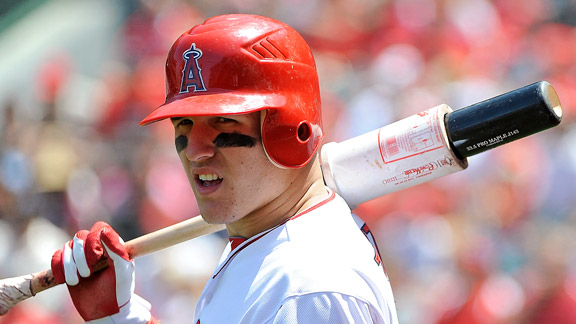
Trout was once again the best player in baseball (ESPN)
Here's my list for the 13 best baseball players in 2013. Their 2012 ranking is in parentheses.

1. Mike Trout (1)
There was no sophomore slump for Trout, who was once again the best all-around player in baseball as well as its most valuable per WAR.

2. Miguel Cabrera (2)
Cabrera cruised to his second straight AL MVP trophy, topping his Triple Crown season of 2012. He won the "sabermetric Triple Crown," leading the majors with his .348 batting average, .442 OBP and .636 slugging. His 44 home runs and 137 RBI were eclipsed by only Chris Davis.

3. Chris Davis (UR)
Crush was baseball's best slugger in 2013, pacing the majors with 53 home runs, 138 RBI, 96 extra base hits, 370 total bases and 11.0 AB/HR ratio. The Orioles first baseman also clubbed 42 doubles and slugged .634.

4. Andrew McCutchen (5)
The National League MVP batted .317/.404/.508 with 21 home runs and 27 steals. Coupled with his strong defense in center field, McCutchen's performance was worth 8.2 bWAR and helped Pittsburgh to its first winning season since 1992.

5. Robinson Cano (6)
Delivered another monster season in his walk year, compiling 7.6 bWAR and keeping New York in the playoff hunt until mid-September. The Seattle Mariners rewarded him with a ten-year, $240 million contract that ties Albert Pujols for the third richest deal in baseball history, behind only the two signed by Cano's former teammate Alex Rodriguez.

6. Paul Goldschmidt (UR)
In just his second full season, Goldschmidt topped the Senior Circuit with 36 home runs, 125 RBI, 332 total bases and a .951 OPS. That, combined with Gold Glove defense at first base, amounted to 7.1 bWAR and made him MVP runner-up.

7. Matt Carpenter (UR)
Carpenter, a second baseman with terrific batting stats, had a legitimate case as the National League's most valuable player. The Cardinals' leadoff man led the majors with 126 runs, 199 hits and 55 doubles in addition to batting .318/.392/.481.

8. Clayton Kershaw (HM)
Kershaw continued to earn comparisons with Sandy Koufax by winning his third straight ERA crown and receiving his second Cy Young award. He also posted the lowest WHIP in the majors, led the NL in strikeouts and was the most valuable pitcher in baseball according to bWAR.

9. Joey Votto (11)
Votto took a lot of heat for totaling just 73 RBI, but the rest of his offensive numbers leapt off the page. His 135 walks were most in the bigs, and his .435 OBP led the National League. More impressively, he played every game after a torn meniscus limited him to 111 games in 2012.

10. Josh Donaldson (UR)
The Oakland third baseman came out of nowhere to post an eight-win season that saw him bat .301/.384/.499 with 24 home runs and 93 RBI.

11. Carlos Gomez (UR)
Gomez had the kind of season B.J. Upton was always supposed to have: 24 home runs and 40 steals in 47 attempts. B-R estimates his defensive prowess in center field, which netted him his first Gold Glove, was worth more than four and a half wins by itself.

12. Yadier Molina (12)
Molina enjoyed another tremendous season behind the plate for St. Louis, winning his sixth straight Gold Glove and setting career highs in batting average, runs, hits, doubles, RBI, and extra base hits

Tie 13. Adrian Beltre (8)
Added another Hall of Fame caliber season to his resume by batting .315, belting 30 home runs and leading the major league with 199 base knocks. His usual stellar defense dropped off, but his bat remains elite.

Tie 13. Evan Longoria (UR)
The Rays returned to the postseason largely because Longoria rebounded from an injury-marred 2012 to play 160 games--a career high--and crack 32 home runs while playing a terrific third base.

Honorable Mentions: Adam Wainwright, Cliff Lee, Buster Posey, Yasiel Puig, Troy Tulowitzki, Adam Jones, Shin-Soo Choo, Jayson Werth

Off the List: Ryan Braun (3), Josh Hamilton (7), Justin Verlander (9), Prince Fielder (10)

Saturday, November 30, 2013

2013 MLB All Breakout Team

My one rule is that I don't include anyone who received Rookie of the Year votes:

C Jason Castro
The rebuilding Astros were terrible again in 2013, losing 111 games and finishing dead last in their first season in the American League West. But Castro, the team's lone All-Star representative, was one of their few bright spots. In his third big league season, the tenth overall pick of the 2008 draft built off a solid 2012 by hitting .276/.350/.485, good for a 130 OPS+. He showed good power, too, crushing 35 doubles and 18 home runs in just 120 games. Throw in his not-terrible baserunning (especially for a catcher) and respectable defense, and he was worth 4.5 bWAR. He's worth keeping an eye on in 2014--his age 27 season.

1B Matt Adams
The beefy slugger asserted himself while Allen Craig was out by popping 17 home runs in just 296 official at-bats. He batted a rock solid .284/.335/.503 in his sophomore season, leading Cardinals fans to wonder what kind of fireworks he has in store for 2014.

2B Matt Carpenter
Carpenter was arguably the most valuable player in the National League this season with more runs (126), hits (199), and doubles (55) than anybody in baseball. And yet, MVP voters felt Yadier Molina to be the more valuable Cardinal.

3B Josh Donaldson
Unheard of coming into the season, he was being hailed as a legitimate MVP candidate come September. He finished fourth behind Miguel Cabrera, Mike Trout and Chris Davis after leading Oakland to its second straight division title. All the 27 year-old did was hit .301/.384/.499 (148 OPS+) with 24 home runs and 93 RBI. Donaldson's potent bat combined with top-notch defense at the hot corner made him an eight-win player in 2013. Manny Machado has a case to be made as well, but we all knew he was going to be great.

SS Jean Segura
The 23 year-old Dominican emerged as one of the best shortstops in baseball. Coming off an unspectacular 45-game debut in 2012, Segura settled in as the Brewers' everyday shortstop and proved he belonged in the Show. He made his first All-Star team on the way to batting .294 with 44 steals--second only to Eric Young in the Senior Circuit. He also flashed decent power with 12 home runs, 10 triples and 20 doubles, putting together a Starlin Castro-esque season that was worth close to four wins above replacement.

LF Domonic Brown
Hailed by many during the preseason as a breakout candidate, Brown made good on those predictions in his first full big league campaign. He was named to the All-Star team after a sizzling five-week stretch from May 2nd through June 8th in which he bashed 16 home runs and drove in 36 runs over a 35-game span. May's NL Player of the Month cooled off considerably after that and was slowed by injuries as well, but still finished the season with 27 big flies, 83 RBI and an .818 OPS. The slugging left fielder needs to show more plate discipline but certainly has the potential for a 30 homer, 100 RBI season in 2014.

CF Carlos Gomez
I covered Gomez's sterling first half in June, and while he wasn't able to maintain that pace he still wound up with some pretty amazing numbers. Like his 8.4 bWAR--more than any National League position player--which he owes mainly to tremendous defense in center field as well as his excellent baserunning. With 24 roundtrippers and 40 steals in 47 attempts, Gomez was the best blend of power and speed in the game (better than Trout, Andrew McCutchen, and the next guy on this list).

RF Will Venable
It's strange to see a 30 year-old break out in his sixth major league season, but that's exactly what Venable did. He had been a serviceable outfielder for San Diego but took his game to new heights in 2013. He set career highs in numerous categories, including the three triple crown categories (.268--22--53) in what was easily his best season to date.

U Daniel Nava
Nava's incredible life story is well-known by this point, but few expected him to be much of anything for the Red Sox in 2013, let alone their best hitter outside of David Ortiz. The 30 year-old outfielder batted .303/.385/.445, posting the fifth-best OBP in the American League and forcing his way into 134 games. He was one of the most pleasant surprises on a team that exceeded everyone's expectations by winning the World Series.

SP Hisashi Iwakuma
Iwakuma took a major leap in his second big league season and his first as an everyday starting pitcher. He finished third in the AL Cy Young race behind Max Scherzer and Yu Darvish thanks to his 2.66 ERA (third among AL hurlers) and 1.01 WHIP (second) in almost 220 innings (second), a marriage of excellence and durability that was worth seven wins above replacement. More impressively, he managed to outpich star rotationmate Felix Hernandez.

SP Andrew Cashner
Following three middling seasons as a reliever, Cashner established himself as a capable starting pitcher after moving into the Padres rotation. Along with the best walk and home run rates of his career, Cashner posted a 3.09 ERA and 1.13 WHIP in 175 innings.

SP Patrick Corbin
Wasn't anything special as a rookie in 2012 but made the All-Star team in 2013 on his way to going 14-8 with a 3.41 ERA and 178 punchouts in 208.1 innings. He emerged as the ace of the Diamondbacks staff, outpitching more established hurlers such as Wade Miley, Ian Kennedy, and Brandon McCarthy.

RP Luke Hochevar
Terrible as a starter (5.44 ERA), the seven-year veteran came out of the Royals bullpen exclusively in 2013 and was one of the team's top relievers. In 58 appearances he managed a 1.92 ERA, 0.83 WHIP and 4.82 K/BB ratio. Finally realizing that Hochevar was not cut out to be a starter has to rate as one of the organization's smartest decisions in the past two decades.

RP Jason Grilli
With Joel Hanrahan gone, Grilli emerged as one of the National League's premier closers. A first-time All-Star at age 36, he saved 33 games for Pittsburgh in his first season as a full-time closer. He also posted a 2.70 ERA, 1.06 WHIP, and an outrageous 13.3 K/9 rate.

Tuesday, November 26, 2013

Hot Stove Roundup

I've already broken down the Prince Fielder-Ian Kinsler blockbuster trade as well as the Brian McCann signing, so now it's time to look at the flurry of smaller moves that have been made over the past week or so.

Phillies sign Carlos Ruiz for 3 years, $26 million
Philadelphia has caught a lot of flak for "overpaying" Ruiz, who's about to turn 35, but frankly I don't think this deal is as bad as everyone's saying it is. I mean yeah, Ruiz is getting older and has trouble staying healthy, but his on-base ability (.358 career OBP) makes him an asset with the bat. I'm willing to chalk up last year's struggles to injury, especially since he batted .274/.327/.384 after returning from the Disabled List for good. His monster 2012 was clearly an aberration, but all he has to do is produce four-to-five wins over the life of this contract to make it work out for the Phillies. If he can stay above average with the stick then that shouldn't be too hard.

Dan Haren signs with Dodgers for 1 year, $10 million
While it seems strange that LA would use its seemingly infinite financial resources on a 33 year-old pitcher who has gone 22-27 with a 4.50 ERA over the past two seasons, this move actually makes a lot of sense. Despite those ugly Triple Crown numbers, Haren's maintained an outstanding 4.25 K/BB ratio as well as a respectable 1.27 WHIP during that time. What's more, in 2013 his xFIP was exactly a full run lower than his 4.67 ERA. This a low-risk deal that could pay big dividends if Haren bounces back but won't hurt them too much if he doesn't. And moving to Dodger Stadium, a notoriously good park for pitchers, greatly improves Haren's rebound chances.

Kansas City Royals sign Jason Vargas for 4 years, $32 million
Another puzzling move by the Royals, who just can't seem to figure out how to invest what little money they have. Vargas is by no means a bad pitcher and has value as a back of the rotation innings eater, but there's absolutely no reason Kansas City should be shelling out more than $30 million for a fourth or fifth starter, especially since their rotation looks pretty thin beyond James Shields.

Jhonny Peralta signs with St. Louis for 4 years, $52 million
While the Cardinals filled an offensive black hole at shortstop, I hate this deal for a lot of reasons, the biggest of which is Peralta's inconsistency. He's either great or he sucks. At his best he's an All-Star caliber player, as he was in 2011 and 2013. But sandwiched in between those two years was a dreadful season in which he batted .239/.305/.384, numbers that look eerily similar to his 2009-'10 production (combined .252/.313/.383). Throw in his PED use, and it's fair to wonder whether his 2013 production was a bit "enhanced." After hitting a career-high .303 last year, the 31 year-old has nowhere to go but down. On top of that, he's a poor baserunner and roughly average defender with the kind of body that doesn't age well, which is only going to make him more of a liability in those two areas going forward My thinking is that almost any alternative would have been superior to Pete Kozma, so why go out and spend $52 million for a PED user who's best days are probably behind him?

Cardinals trade David Freese and Fernando Salas to Angels for Peter Bourjos and Randal Grichuk
This is a pretty solid deal for both sides. The defending National League champs get an upgrade in center with Bourjos, who plays Gold Glove caliber defense and brings speed to a lineup that ranked dead last in stolen bases last year. 2014 will be his age-27 season too, so big things could be in store for him. Grichuk is a fun name to say and has shown power down on the farm, but is going to need to improve his patience if he wants to stick at the big league level.

LA had a terrible bullpen last year and Salas, a mediocre reliever, won't do much to fix that. The real question is which Freese are the Angels getting? Is it the postseason legend who batted .296/.363/.446 in his first four seasons and made the All-Star team in 2012? Or is it the Freese who slumped to .262/.340/.381 last year, looking utterly lost at the plate? He'll be 31 next year, so he still has some bounce back potential, and even if he doesn't rebound to his previous levels he'll still be a significant improvement over the Angels third basemen (mainly Alberto Callaspo, Andrew Romine and Chris Nelson) who batted a measly .246/.304/.333 in 2013.

Tim Hudson signs with Giants for 2 years, $23 million
Huddy's 38 and has seen his ERA rise in three consecutive seasons, but expect that trend to stop now that he'll be making half his starts at AT&T. He still has good command, which makes success in San Fran even more likely. At his age health is hardly a given, but he figures to complement a formidable rotation that already features Madison Bumgarner, Matt Cain and Tim Lincecum.

Angels sign Joe Smith for 3 years, $15.75 million
Not a fan of this deal, but that speaks more about how I feel about multi-year commitments to relievers than it does Joe Smith. Smith's been pretty good the past three years, making at least 70 appearances per season and keeping his ERA under three each year. He's been able to keep runs from scoring despite his middling 2.2 K/BB ratio over that span, which leads me to believe that he's been a bit lucky and is thus not quite as good as his shiny earned run averages suggest. Relievers are particularly volatile, and deals with non-closers typically don't work out. Given that the Angels have more pressing issues (i.e. starting pitching), they would have been wise to focus on rebuilding the rotation first.

Josh Johnson signs with Padres for 1 year, $8 million
The Padres are rolling the dice on Johnson, who posted numbers so unsightly in his lone season with Toronto that they can't be reprinted here. On the bright side, his 9.2 K/9 was the highest of his career and there's just no way he can be that bad again. His 3.58 xFIP suggests he was plagued by extraordinary bad luck, which seems to be the case based on his .356 BABiP, 63.3 LOB% and elevated HR/FB rate. Health is always a concern with Johnson, who's thrown more than 200 innings in a season just once in his nine-year career. Still, I like this low-risk gamble, probably because making half his starts in Petco is going to do wonders for the two-time All-Star.

Rays sign Jose Molina for 2 years, $4.5 million
While he's the least-accomplished of the Molina catching trio, he's still an excellent pitch-framer and game-caller, two skills that are worth their weight in gold. Sure, he's a big 38 year-old who can't hit or run, but the value he provides behind the plate more than makes up for his deficiencies everywhere else. Leave it to the Rays to find a great bargain in an unlikely place.

Monday, November 18, 2013

Chiefs Finally Fall

The Kansas City Chiefs, probably the worst 9-0 team in NFL history, are undefeated no more.

It took 11 weeks before they were finally beaten. Fittingly enough, KC was dethroned by the Denver Broncos, the second best team in the NFL entering last night's game as well as the least team to beat the Chiefs (in 2012). This time KC fell behind early and never led, allowing Denver to go on to win 27-17.

Kansas City's top-ranked defense was unable to put much pressure on Peyton Manning, who completed 24 of his 40 pass attempts en route to 323 yards and a touchdown (to Julius Thomas). Alex Smith was solid but less effective, completing 21 of his 45 pass attempts for 230 yards and a pair of touchdowns, one to the recently arrested Dwayne Bowe and another to Anthony Fasano.

Denver's defense played paricularly well, holding Jamaal Charles scoreless and not allowing any of KC's receivers to log more than 60 yards. The Broncos' D also sacked Smith three times and forced two fumbles, recovering one of them.

Now that Denver has knocked off the Chiefs, expect the Broncos to go about their business of winning the AFC West.

Friday, November 15, 2013

MVP?

For the second year in a row, Miguel Cabrera has won a Most Valuable Player award that he did not deserve. For the second year in a row Mike Trout, who was far and away baseball's most valuable player (this year and last), will go home empty-handed.

For all of his gaudy offensive numbers--his .348/.442/.634 batting line, his 1.078 OPS, his 187 OPS+ (all of which led the major leagues, by the way)--Miguel Cabrera was not the American League's most valuable player this year. He wasn't last year, either. According to WAR, Miguel Cabrera has never been his league's most valuable player, or even its second most valuable player. He's never been the league's most valuable position player, either. He was third once (this year), fourth once (last year) and fifth once (2011). And yet he has not one, but two MVP awards.

Last year he won the Triple Crown, something nobody had done since 1967, and I'm sure the writers felt some pressure to honor that achievement with an MVP award. How would they be able to justify not giving him the award? So they played up his team's postseason status and his willingness to change positions to accommodate Prince Fielder and his countless big hits down the stretch, conveniently ignoring the indisputable fact that Trout was baseball's best player by a huge margin.

This year the reasoning was very similar. Detroit made the playoffs, the Angels didn't. Cabrera hit even better than he did in 2012. He didn't win the Triple Crown again, but was in the running for much of the season before injuries slowed him down in September, allowing Chris Davis to capture both the home run and RBI crowns.

That Cabrera is the sport's best hitter is unquestioned. Joey Votto has his supporters and David Ortiz was impossible to get out in the World Series, but Cabrera's clearly the best. But baseball is more than hitting. Trout, who's a really really good hitter but just a notch below Cabrera, makes up that ground (quite literally) with his legs.  When it comes to speed Trout blows away Cabrera, who's a bad baserunner and an even worse defender at a key position. Trout is so much better at the other aspects of the game that he's worth multiple more wins to his team per season than Cabrera is.

But baseball writers, people who are paid to watch and write about baseball, don't see this. I guess they're missing something. (Side note, the person who voted Trout seventh on their ballot should have their voting privileges revoked. To not have Trout in your top three, let alone your top five, is indefensible).

In a much less infuriating vote, Andrew McCutchen was named the NL's Most Valuable Player, becoming the first Pittsburgh Pirate to take home the trophy since Barry Bonds did so in 1990. Funny thing was, McCutchen won despite dropping off considerably from last year, when he finished third behind Buster Posey and Ryan Braun. Despite playing the same number of games and recording one additional plate appearance this year, 'Cutch hit ten fewer home runs, knocked in 12 fewer runs, scored ten fewer runs, and compiled 32 fewer total bases. He lost ten points on his batting average, 45 points on his slugging percentage and 42 points off his OPS. He grounded into more double plays.

It just goes to show you can't control how the other players in your league perform. Sometimes you have a great year and you're not the most valuable player, but even if you slip a bit you can still be MVP the next year. I think of Alex Rodriguez, whose lone MVP from his three magnificent seasons with Texas came after what was clearly the worst of the three.

And yet, because McCutchen played better defense and ran the bases better (sound familiar?) than he did in 2012, he was actually a more valuable baseball player this year, worth 8.2 bWAR this season compared to 7.2 in 2012. With all due respect to Votto, Clayton Kershaw, and Matt Carpenter, McCutchen was the true MVP this year, especially when you factor in his role of helping Pittsburgh snap its string of 20 consecutive losing seasons. There's no way the Pirates sniff the playoffs without him.

Here's what really bugs me though. The NL race was almost identical to the American League race, with McCutchen and Paul Goldschmidt standing in for lesser versions of Trout and Cabrera. Goldschmidt was the Senior Circuit's top hitter, leading the league in home runs, RBI, slugging, OPS, OPS+, total bases, and extra base hits. McCutchen's numbers were less impressive, but because he's the complete package he out-WARed Arizona's slugging first-baseman.

So if Trout and Cabrera are McCutchen and Goldschmidt on steroids (figuratively speaking), then why didn't Trout win? The only thing I can think of is that McCutchen was part of a much more compelling narrative. He was the best player on a team that made the playoffs, which nobody saw coming. Trout was the best player on a team that massively underachieved and was an afterthought for much of the season. Too much attention was paid to what went wrong with the Angels (Josh Hamilton and Albert Pujols sucking, no pitching) than the amazing feats Trout was performing on the diamond everyday.

I guess my point is that the MVP award has a lot to do with context. Context has not been kind to Mike Trout these past few years, but context is ever-changing. Conventional wisdom says he's still young, and thus has plenty of time to win multiple MVP awards. I hope he does. I hope someday he gets recognized for what he is: the best player in baseball.

Thursday, November 14, 2013

Cy Youngs Follow Script

Scherzer was baseball's most winning-est pitcher in 2013 
To nobody's surprise, Max Scherzer and Clayton Kershaw were named Cy Young winners yesterday.

Scherzer, who had never received any Cy Young consideration in any of his previous five seasons, steamrolled to the trophy on the strength of his 21-3 record and league-best 0.97 WHIP. Removing his stellar record from the equation still leaves him with impressive credentials: 240 strikeouts, a 2.90 ERA and 6.7 pitching WAR. Though he got off to a rocky start, he emerged as the favorite over the summer as his win total mounted (he won his first 13 decisions), the strikeouts piled up (he had eight starts with at least ten) and his ERA dropped with each passing month. He started the All-Star Game and delivered a scoreless inning, striking out Joey Votto and contributing to the American League's 3-0 shutout of the Senior Circuit.

Unlike many pitchers who put together excellent first halves, only to fall off after the All-S-Star Break (Ubaldo Jimenez in 2010, R.A. Dickey to some extent last year), Scherzer did not let up. After winning his 19th game on August 24th, though, it took him four weeks and six starts for him to earn win number 20 (on September 20th, fittingly enough). Though wins and losses are a terrible way to gauge pitchers, his record was a good indication of how well the Tigers played when he was on the mound. They were 25-7 (.781) when he started. That's the definition of an ace.

(For those who care about such things, Scherzer's winning percentage has gone up every year he's been in the big leagues, from his winless 2008 up to his ML-best .875 mark in 2013. I think it's safe to say that trend won't continue next year.)

What was odd about the American League voting was how the remaining pair of first place votes were split by Anibal Sanchez and Chris Sale, both of whom finished outside the top three (fourth and fifth, respectively). Whiff-machine and preseason award favorite Yu Darvish was runner-up largely because of his gigantic strikeout total (277 in 209 and two-thirds innings pitched, which translates to 11.9 K/9). Hisashi Iwakuma was third, posting excellent numbers across the board and leading all AL hurlers in pitching WAR. Other players receiving votes were Bartolo Colon, Koji Uehara, Felix Hernandez, Greg Holland, Matt Moore, and James Shields.
Kershaw's dominance is reminiscent of Sandy Koufax's run in the mid-1960s
Kershaw handily won his second Cy in three years (and probably should have won last year, too) with all but one first place votes going his way. Kershaw was an easy choice after leading the major leagues with a sparkling 1.83 ERA and 0.92 WHIP. He also led the National League in strikeouts, shutouts, and pitching WAR. It seems safe to say that he's inherited the title of Best Pitcher on the Planet from Justin Verlander, who had a down season by his lofty standards and may not be the same now that he's on the wrong side of 30. That should help him in his quest to become baseball's first $200 million pitcher as he pursues a contract extension this winter.

The one dissenting first place vote went to runner-up Adam Wainwright, who topped both leagues in starts, innings pitched, and complete games but with an ERA (2.94) more than one full run higher than Kershaw's. Wainwright, who also won an NL-best 19 games, has managed three top-three finishes in his past four seasons but has yet to capture the award. NL Rookie of the Year Jose Fernandez finished third. Matt Harvey and Craig Kimbrel tied for fourth, which means Cliff Lee's quietly outstanding season was not deemed worthy of a top five finish in the eyes of the voters. Jordan Zimmerman, Zack Greinke, Madison Bumgarner and Francisco Liriano (he's back!) rounded out the voting.

Tuesday, November 12, 2013

Francona, Hurdle Top Managers

Terry Francona and Clint Hurdle were named Managers of the Year today after leading their respective teams to impressive turnarounds and postseason berths.

Following a one-year hiatus in the broadcast booth, Francona returned to the dugout and guided Cleveland to 92 wins and the American League's top Wild Card spot. Few expected the Indians to contend in the wake of a miserable 2012 that saw them lose 94 games, but Francona's touch (as well as key additions like Nick Swisher, Michael Bourn and Scott Kazmir) helped Cleveland reach the playoffs for the first time since 2007. Francona's 2011 Red Sox famously choked away their all-but-guaranteed playoff spot by going 7-20 in September, but this year he flipped the script. Cleveland went 21-6 in September, winning ten in a row to close out the regular season and nearly catch Detroit in the AL Central. They were unable to carry that momentum into their Wild Card playoff game, however, falling to Tampa Bay 4-0.

This selection was a bit of an upset, as many predicted John Farrell would win the award after taking Boston from worst to first. Farrell did a commendable job in the aftermath of the Bobby Valentine fiasco, but he also inherited a much more talented roster than Francona did. Boston's payroll was roughly twice that of Cleveland, meaning Francona had to make do with far less. Both teams drastically exceeded expectations, but the Indians overachieved more so than the re-tooled Red Sox, who made significant upgrades over the winter (Mike Napoli, Shane Victorino) and enjoyed a good deal of positive regression to the mean (such as healthy years from David Ortiz, Jacoby Ellsbury, and John Lackey). Cleveland finished one game behind the Tigers. Who could have seen that coming?

The National League selection was much easier. Clint Hurdle helmed the Pittsburgh Pirates, a team that had not experienced a winning season since 1992, to 94 wins and the NL's top Wild Card slot. Hurdle oversaw the two most recent of those losing years, both of which were heartbreaking disasters that saw Pittsburgh contend for much of the summer, only to fall flat on its face in August and September.

This time around, Hurdle helped them get over the hump. There was no late-season collapse, no slipping on the banana peel just before the finish line. They battled St. Louis for the division crown all summer long and were in first place as late as September 16th, but settled for the Wild Card when they were unable to hold off the Cardinals. The same thing happened in the NLDS when Pittsburgh took a 2-1 series lead, only to let St. Louis storm back and win the series behind the stellar pitching of Michael Wacha and Adam Wainwright.

Oh well. There's always next year.

Myers, Fernandez, and Puig

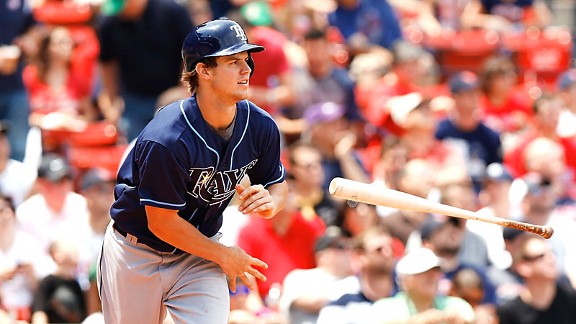
The Rays traded James Shields and Wade Davis for Myers last winter. It paid off
Baseball awards week kicked off tonight with the Rookie of the Year selections, and both choices were the correct ones.

In the American League, preseason favorite Wil Myers ran away with the award. Myers received 23 of the 30 first place votes for his outstanding (albeit abbreviated) campaign. Though he didn't debut until June 18th, the 22 year-old made the most of his shortened season. Myers mashed big league pitching to the tune of .293/.354/.478 (eerily similar to Eric Hosmer's rookie numbers).  He also popped 13 homers and knocked in 53 runs, providing some much-needed firepower for the offensively-starved Rays as well as another big bat to complement Evan Longoria. Just for fun (and to show how productive he was on a per-game basis) here's what his numbers project to over the course of a full season:

92 runs, 180 hits, 42 doubles, 23 homers, 92 RBI, 60 walks, 9 steals, 294 total bases

Those are fine numbers for anyone, let alone a 22-year old kid playing half his games in the pitching-friendly Tropicana Field. Myers had a huge impact on the Rays, who were in fourth place and just three games above .500 when he was called up, but went 56-38 (.596) with him on board. Tampa Bay probably doesn't make the playoffs without him.

Runner-up Jose Iglesias netted five first-place votes and 17 second-place votes. Some thought Iglesias, who logged significantly more playing time than Myers and batted .303 while playing superlative defense, deserved the hardware over Myers. FanGraphs and B-R both have Myers rated as more valuable per WAR because even though he played right field, he was far and away the superior hitter. Iglesias never walked and hit for no power whatsoever despite benefiting from friendly offensive environments in Boston and Detroit, so his 101 OPS+ pales in comparison to Myers' 132 mark.

The remaining pair of first place votes were split by starting pitchers: Myers' teammate Chris Archer and Oakland's Dan Straily. J.B. Schuck, Cody Allen, Martin Perez and David Lough also received consideration. Tampa Bay now has three rookies of the year on its roster: Myers, Longoria (2008) and Jeremy Hellickson ('11).

Fernandez was one of the few bright spots on a horrendous Marlins team
The National League race was even more lopsided, which was surprising given the insane levels of hype generated by Yasiel Puig this summer. Jose Fernandez dominated the voting, hauling in all but four first place votes (which went to Puig) for what was a historic rookie season. The Miami Marlins were god-awful this year, as expected, but Fernandez flourished into one of the league's best pitchers. Just 20 years-old at the season's outset, Fernandez got off to a shaky start (4.50 ERA in April) but quickly settled down and found his rhythm. He got better and better as the season wore on, being voted as the NL's top rookie in July and August. When he was shut down after making just two September starts in accordance with his team-enforced innings limit, Senior Circuit hitters breathed one big sigh of relief.

The former first round draft pick and Cuban defector had emerged not only as Miami's ace, but as a legitimate Cy Young candidate as well. He was all but unhittable, posting the lowest H/9 rate in the majors and holding opponents to .182/.257/.265 figures. His 2.19 ERA and 176 ERA+ ranked second only to Clayton Kershaw among big league pitchers, and his 9.75 K/9 was bested only by A.J. Burnett in the NL. His 0.98 WHIP placed him third, as did his 6.3 pitching WAR. Puig may have been the sexier choice, but there was no denying Fernandez's numbers.

Puig was ridiculously fun to watch, though, and had a tremendous season in his own right. He didn't debut until June 3rd and only got into 104 games, but that was more than enough to know that a new superstar had arrived. The 22 year-old Cuban batted .319/.391/.534, which translated to a robust 160 OPS+ and provided plenty of spark for an underachieving Dodgers club that seemed to have lost its way. His first month in the Show was absolutely off-the-charts, so much so that we were talking about him as an All-Star candidate based on four weeks worth of games. Even at the time it was ridiculous, but like Willie Mays or Bo Jackson, Puig was made for All-Star games. He was must-see TV the way Justin Verlander's starts are, the way Manny Ramirez and Barry Bonds' at-bats used to be.

The human highlight reel eventually cooled off, of course, but still managed to do something SportsCenter-worthy on a nightly basis. I can't think of a rookie baseball player in my lifetime, not even Mike Trout or Bryce Harper, who created as much excitement as Puig did. Everything he did, all the rocket throws, towering home runs and majestic bat flips, even the strikeouts, was jaw-dropping. When it comes to showmanship, he is without peer. It's going to be a blast watching him do his thing.

Extrapolate Puig's performance over a full season, as I did with Myers, and you get these numbers:

102 runs, 190 hits, 32 doubles, 29 homers, 17 steals, 317 total bases

That seems like a good baseline for his performance next year.

Apologies to remaining NL-vote getters Shelby Miller, Hyun-jin Ryu, Julio Teheran, Jedd Gyorko (what a finish!), Nolan Arenado, and Evan Gattis (great start!), but I've run out out of things to say about this year's rookie class.

Thursday, November 7, 2013

2013 NL Silver Sluggers Review

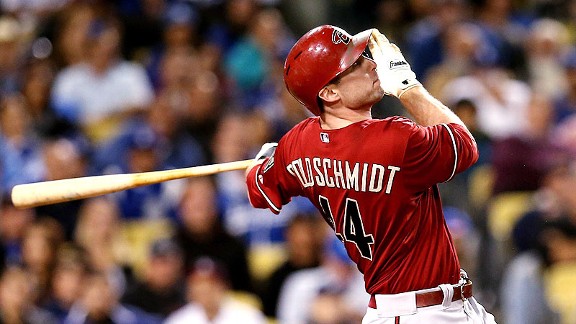
Arizona's Paul Goldschmidt was one of  six first-time winners 
C Yadier Molina
After losing out to Buster Posey last year, Molina proved himself to be the NL's top catcher this season. He batted .319/.359/.477 with 44 doubles, which paired with his terrific defense has made him one of the three finalists for the league's Most Valuable Player award.

1B Paul Goldschmidt
The Diamondbacks' first baseman built upon a quietly stellar 2012 to become the Senior Circuit's top hitter in 2013. His 36 home runs, 125 RBI, .551 slugging, .952 OPS, 160 OPS+, 75 extra base hits and 332 total bases all ranked first in the NL. It's no wonder, then, that he received 19 intentional walks--more than anyone else in the league.

2B Matt Carpenter
As I said in yesterday's Molina/Carpenter MVP debate: "Carpenter might have been the Most Valuable Player in the National League this year. He led all of baseball in runs scored (126), hits (199) and doubles (55) while batting .318/.392/.481. The Cardinal's leadoff hitter for most of the season, Carpenter was an on-base machine at the top of the order and a big reason why St. Louis led the NL in runs scored this past year." The dude flat-out raked.

3B Pedro Alvarez
Alvarez's feast-or-famine approach at the dish yielded more big-time power numbers in 2013: 36 home runs, 100 RBI and a .240 ISO. Not surprisingly, he also batted .233 and led the league with 186 whiffs. Awesome power aside, I think Chris Johnson and Ryan Zimmerman were more worthy of this award. Johnson batted .321/.358/.457 and led all NL third basemen in wOBA and wRC+, but Zimmerman was right behind him in those two categories and hit for more power.

SS Ian Desmond
Desmond won a second consecutive Silver Slugger by putting up the same numbers as last year, albeit with slightly less power. That said, Troy Tulowitzki and Hanley Ramirez were both clearly more deserving of this award. Tulo played 32 fewer games and still managed more home runs and RBI while batting a much more potent .312/.391/.540. Ramirez only played 86 games--barely more than half a season--but matched Desmond's homer total (20) with off-the-charts rate stats (.345/.402/.638).

OF Jay Bruce
Bruce won his second straight Silver Slugger on the strength of some pretty impressive power numbers. His .262/.329/.478 line doesn't leap off the page, but his 43 doubles, 30 home runs and 109 RBI--a career high and second most in the league--sure do.

OF Andrew McCutchen
The likely NL MVP wasn't quite as awesome as he was in 2012 but still put together a fabulous year to merit another Silver Slugger. 'Cutch does everything well, and the numbers bear that out: .317/.404/.508 batting line, 21 home runs, 38 doubles, and 27 steals. That's how he compiled the most oWAR in the league despite not ranking first in any traditional metric.

OF Michael Cuddyer
Ladies and gentlemen, your 2013 NL batting champion! (?) That's right; Cuddyer's .331 batting average was tops in the Senior Circuit this year which makes him the sixth Colorado Rockie to win a batting crown, following in the footsteps of Andres Galaragga, Larry Walker, Todd Helton, Matt Holliday, and current teammate Carlos Gonzalez. While it's true that his numbers were pumped up by Coors Field, where he batted .356/.414./.582 this year, he was hardly a slouch on the road. Everywhere else, Cuddyer was a .311/.367/.485 hitter.

P Zack Greinke
Known more for his excellence on the mound than in the batter's box, Greinke more than held his own with the stick this year. He batted .328/.409/.379 with nearly twice as many hits (19) as strikeouts (10). Not bad for someone who spent all but one and a half seasons in the DH-league prior to this one.

Wednesday, November 6, 2013

Molina over Carpenter?

When the MVP finalists were announced the other day I was shocked, repeat: shocked, that Matt Carpenter was not among the top three National League candidates. Andrew McCutchen and Paul Goldschmidt were obvious choices, as were the three American League selections (Miguel Cabrera, Mike Trout and Chris Davis), and Carpenter seemed to be a no-brainer, too. But instead, Yadier Molina? Can't believe it.

Carpenter might have been the Most Valuable Player in the National League this year. He led all of baseball in runs scored (126), hits (199) and doubles (55) while batting .318/.392/.481. The Cardinal's leadoff hitter for most of the season, Carpenter was an on-base machine at the top of the order and a big reason why St. Louis led the NL in runs scored this past year.

Molina played a big part in that too. He batted .319/.359/.477 while providing his typically stellar defense behind home plate. FanGraphs and BR both agree he was worth a bit more than five and a half wins above replacement this year. Carpenter, on the other hand, was worth closer to seven. That's not a huge difference, but it's not an unsubstantial one, either.

Since their offensive numbers are eerily similar (check those batting lines again), I suspect the difference in value is probably due to their discrepancies in games played. Molina played 136 games which is a good amount, especially for a catcher, but it's 84 percent of the season. He missed the first two weeks of August with a sprained right knee and St. Louis went 6-8 in his absence. Carpenter, who played 157 games, was out there almost everyday.

That matters. Unless a player is so ridiculously productive on a per-game basis that you have to forgive time lost to injury (Mickey Mantle in 1962 is a perfect example of this) then playing time really should be a factor. It's part of the criteria used to select MVPs because unless you're a crappy player, you can't help the team by sitting on the bench.

So with Carpenter holding advantages in hitting, playing time and baserunning, the only way Molina comes out on top is if you give him a big boost for his contributions on defense. I'm more than comfortable giving Molina extra credit for not just handling catching duties, but being probably the best defensive catcher in the game today (those six straight Gold Gloves speak for themselves). I'm just not sure the difference between he and Carpenter is all that great. After all, it's not like Carpenter's a first baseman or a corner outfielder. He primarily played second base, a premium up-the-middle position, and also spent some time at the hot corner. That kind of versatility--the ability to handle multiple positions--is special too.

I'm not trying to take anything away from Molina here. He's a tremendous player, one of the best, and is clearly worthy of serious MVP consideration. I had him eighth on my imaginary awards ballot, and in retrospect that feels a bit too low. But I had Carpenter third and was debating whether he or Goldschmidt deserved to be runner-up behind McCutchen. I think if you asked people who was the most valuable player on the Cardinals this year, the majority would probably respond Carpenter. It's close. Both are indispensable. But when push comes to shove, there's no getting around the fact that Carpenter had the superior season.