Showing posts with label Rookie. Show all posts

Thursday, August 3, 2017

Bellinger Blasts Way Into Record Books

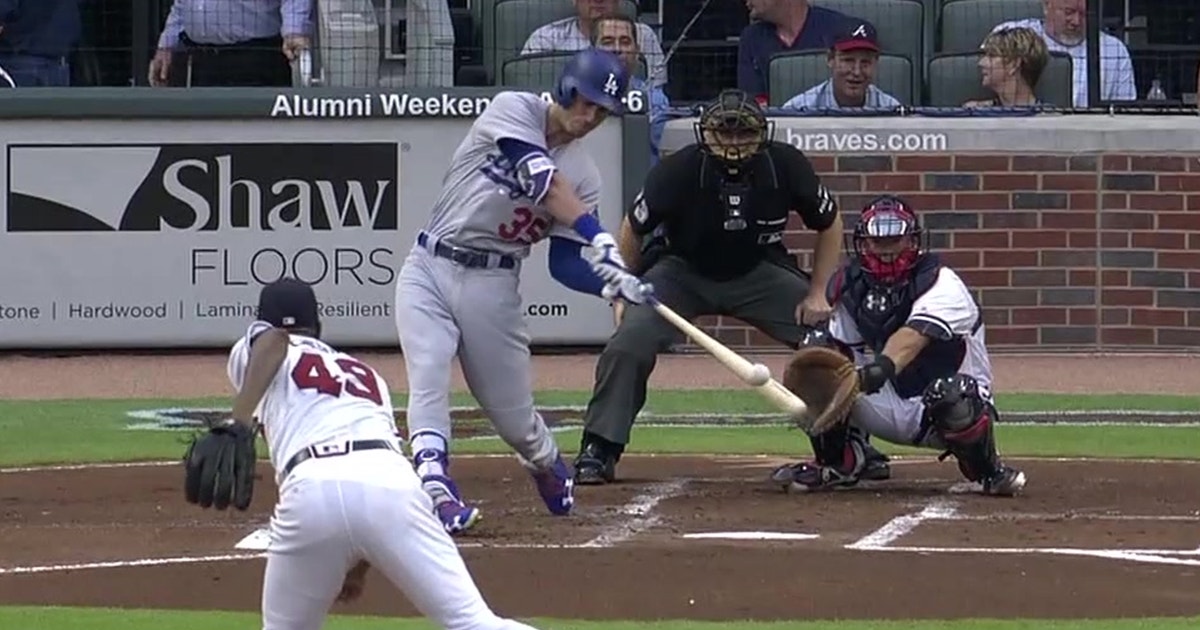
Bellinger leads off the second innings with a 410-foot moon shot (Fox Sports)
Last night Cody Bellinger launched another homer, his second in as many days and his 30th of the season. The milestone blast put the 22-year-old freshman in rare company, making him just the 10th rookie in National League history with at least 30 bombs. That Bellinger reached the mark in only 87 games is even more impressive, as most of the others required a full season. The only one who came close to matching his breakneck pace (which projects to 56 homers over 162 games) was Ryan Braun, who needed 91 games to club 30 homers back in 2007 -- the last time an NL rookie hit that many (as did Chris Young).

With a third of the season to go, Bellinger is a lock to break the Senior Circuit rookie long-ball record of 38 shared by Wally Berger and Frank Robinson, which hasn't been matched since 1956. He still has an outside shot at breaking Mark McGwire's all-time rookie record of 49, although Aaron Judge -- who leads the Majors with 34 -- has better odds. In addition to playing his home games at the homer-friendly Yankee Stadium, where New York will play 29 more times this year, he gets six more games in Toronto, three in Boston, and three in Baltimore (not to mention three in Texas). He could easily go deep multiple times in any of those series, especially against the lesser pitching staffs of the Blue Jays, Rangers, and Orioles.

The deck remains stacked against Bellinger, however, who plays in one of baseball's toughest home run parks and probably baseball's least long-ball friendly division. While the Dodgers only have 21 of their remaining 55 games at home, the constant travel may wear down Bellinger during the dog days of August and September. He's already cooled off considerably from his torrid start, going deep six times in his last 30 games after belting 24 in his first 57. His 26.4 percent strikeout rate isn't doing him any favors, either.

The talk in June of Judge and Bellinger both breaking McGwire's record now appears premature. I still like Judge's chances, but his second-half slump is certainly a concern. Bellinger would have a few more dingers under his belt had he not spent most of April in Triple-A, which may wind up costing him the record. Even if they both fall short, however, they should each clear 40 with relative ease, which would be the first instance in baseball history of multiple rookies with 40 homers in the same season. McGwire is still the only one to reach that rarefied air, but he should have some company before long.

Friday, June 5, 2015

Swihart Swats First Career HR

Swihart's solo shot was a titanic blast onto Lansdowne Street (Fox Sports)
One of the few Red Sox highlights from Boston's ugly 8-4 loss to the Twins yesterday was that Blake Swihart launched the first of what will hopefully be many home runs for the rookie catcher..

With two outs and nobody on, Swihart snapped a 22-game and 75 at-bat homerless streak to begin his career in the bottom of the third. Facing Twins starter Tommy Milone for the second time that day, Swihart laid off two close pitches to put himself up 2-0 in the count. The lefty's third pitch was a mistake, right over the heart of the plate, and Swihart crushed it. His first career blast was a moonshot, clearing the Monster seats and landing 406 feet from home plate. It was a no-doubter, an absolute bomb.

Unfortunately the bases were empty when he left the yard, so it only counted as one. Swihart's blast put the Sox up 3-0, but Boston was unable to hold the lead and ultimately dropped the series finale to Minnesota. It also made him the youngest Sox catcher to go deep since Rich Gedman, a two-time All-Star with Boston, belted his first dinger at the age of 21 during the strike-shortened 1981 season.

The long ball continued a recent resurgence at the plate for Swihart, who has now hit safely in eight of his last nine games. His batting line is still a lowly .218/.247/.295 on the season, but that marks a huge improvement over where it stood just a few weeks ago. The 23 year-old is barely a month into his major league career, after all, and in a perfect world would still be getting additional seasoning down in Pawtucket. But with Christian Vazquez out for the season and Ryan Hanigan sidelined until at least the All-Star Break, Swihart's been thrust into a starting role much sooner than expected. He's learning on the job and experiencing natural growing pains that come with that, which might be more magnified because catchers usually take longer to develop than other position players.

For all of Swihart's struggles at the dish, he's still a better hitter than Boston's other backstop, Sandy Leon. Leon is batting a mere .170 with two RBI on the season and has yet to notch an extra base hit in 57 plate appearances. If Swihart's overmatched, Leon's totally helpless, and it's not like Hanigan was Mike Piazza, either. Catcher has been an offensive black hole for the Sox all season, so it would certainly be nice if Swihart started hitting.

Then again, it would be really nice if every other Red Sock not named Dustin Pedroia and Xander Bogaerts started hitting too.

Saturday, January 3, 2015

Questionable Rookies of the Year: 1950s

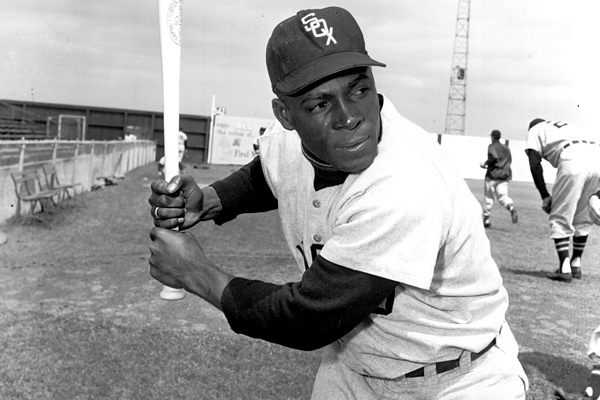
Minoso was always tragically underrated (Grab Some Bench)
1951 AL Gil McDougald over Minnie Minoso
McDougald had an outstanding season for the Bronx Bombers, helping them win their third straight championship by hitting .306/.396/.488 with 14 homers, 14 steals, and 4.6 bWAR. Minoso was even better, however, batting .326/.422/.500 with 112 runs and 5.5 bWAR. Minoso also led the majors in triples with 14 and the American League in steals with 31. The BBWAA correctly recognized Minoso as the more valuable player, for he finished fourth in the MVP voting to McDougald's ninth, so I'm not sure what happened with the ROY vote. Most likely, McDougald benefited from Yankee bias (Minoso was traded from Cleveland to Chicago) and perhaps even racism (Minoso was a black Latin-American star).

1953 NL Jim Gilliam over Harvey Haddix
Big screw-up here, as Gilliam wasn't even worth four bWAR whereas Haddix had over seven. Make no mistake, Gilliam had a phenomenal season in which he scored 125 runs, drew 100 walks, and led the major leagues in triples all while playing second base, but Haddix had the superior season. Aside from winning 20 games, the St. Louis southpaw maintained a 3.06 ERA (139 ERA+) and 1.14 WHIP over 253 innings. He also paced the National League in shutouts with six. Again, the BBWAA identified Haddix as the more valuable player by giving him MVP consideration (Gilliam got none, but probably deserved some) but screwed up in the Rookie of the Year vote. Gilliam undoubtedly benefited from his role on a thoroughly dominant 105-win Dodgers team, whereas Haddix toiled for a more mediocre 83-win Cardinals outfit.

1956 AL Luis Aparicio over Rocky Colavito
Colavito's OPS was 250 points higher than Aparicio's, and he hit seven times as many home runs. While it's true that Aparicio was an everyday shortstop (and a good one at that) who led the league in steals, Colavito was still the more valuable player per bWAR despite playing 49 fewer games and manning right field. My guess is that Aparicio made an impression on voters with his flashy defense and speed--a rarity in the largely white 1950s American League.

1957 AL Tony Kubek over Frank Malzone
Another example of Yankee bias as Kubek beat out a more-deserving Red Sox player. Kubek was a good utilityman who played five different positions and delivered league-average offense, but Malzone played a sterling third base (winning his first of three straight Gold Gloves) while posting much better batting statistics. Malzone's OPS was 35 points higher, for instance, even though he had 203 more official at-bats. Sure enough, Malzone made a serious dent in MVP voting, finishing seventh, while Kubek hardly get any support and finished a distant 26th.

1958 AL Albie Pearson over everyone else
Pearson had a pretty pedestrian season for an outfielder, hitting .275/.354/.358 with little power (three home runs) and speed (seven steals). He did walk more than twice as often as he struck out, but that's really the only good thing one can say about Pearson's rookie campaign (which resulted in 0.9 bWAR). Third-place Gary Bell (2.9 bWAR) had a much stronger season, delivering a 3.31 ERA (112 ERA+) and 1.18 WHIP over 182 rock solid innings. Pearson was barely an average outfielder whereas Bell was clearly an above average starting pitcher, and I don't see how the voters missed that.

Monday, December 29, 2014

Questionable Rookies of the Year: 1970s

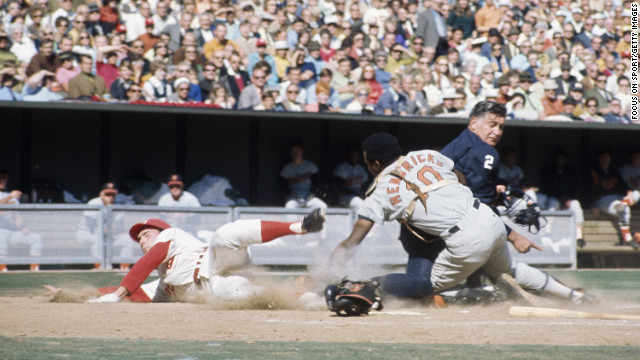
Carbo (left) was robbed despite a monster offensive season (CNN)
1970 NL Carl Morton over Bernie Carbo
Morton made a strong first impression by hurling 284 and 2/3 innings and winning 18 games, but those innings weren't ultra-high quality. He led the league in walks, had a 1.43 WHIP, posted a 114 ERA+, and only struck out 29 more guys than he walked. Carbo, on the other hand, was one of baseball's best hitters on a per-game basis. Besides batting .310/.454/.551 (164 OPS+), Carbo also clubbed 21 home runs, stole 10 bases, and walked 17 times more often than he struck out. Given the depressed offensive environment, Carbo's season (a 1.004 OPS!) was much more impressive and worthy of the award. He also played a key role in helping the Reds win the National League pennant.

1971 AL Chris Chambliss over Bill Parsons
Chambliss would go on to have a fine career, but his rookie season was actually very mediocre, (0.4 bWAR). His nine homers, 48 RBI, and .749 OPS (104 OPS+) were pedestrian for a first baseman. Runner-up Bill Parsons, who compiled a 3.20 ERA over 244 and 2/3 innings, was valued at 3.1 bWAR and would have been my pick.

1976 NL Butch Metzger over Pat Zachry
This one went down as a tie but was a clear foul-up, as Zachry deserved to win outright. For reasons unexplained, voters failed to choose a very good starting pitcher over a decent reliever. Zachry had a superior ERA and WHIP while pitching over 80 additional innings. This disparity was evident in their bWAR totals, as Zachry compiled 3.5--two more than Metzger's 1.5. Zachry also pitched for the World Series-winning Cincinnati Reds, which should have gone in his favor.

1977 AL Eddie Murray over Mitchell Page
Murray wound up with the best career of the 1977 rookie class, but he was not the best rookie in the American League that year. Page, who batted .307/.405/.521 (154 OPS+) with 21 home runs and 42 steals in 47 attempts, was. His raw OPS was 123 points higher than Murray's, which more than made up for the fact that Murray appeared in 15 additional games and logged 110 additional official at-bats. At 6.0 bWAR, Page was nearly twice as valuable as Murray (3.2). Why did Murray win? He played more often, and thus had 27 home runs and 88 RBI to Page's 21 and 75.

1978 NL Bob Horner over Don Robinson
Horner, a slugging third baseman in the mold of Mark Reynolds, won on the strength of his 23 home runs (in just 359 plate appearances) and .852 OPS (124 OPS+). But with a .313 OBP and poor defense at the hot corner, he really wasn't that valuable. Robinson, who placed third, was more valuable in my opinion with his 228 and 1/3 frames of 3.47 ERA-ball. He also had strong periperhals with a 1.14 WHIP, 3.33 FIP, and 2.37 K/BB ratio. Robinson racked up 3.7 bWAR, considerably more than Horner's 2.1.

Sunday, December 28, 2014

Questionable Rookies of the Year: 1980s

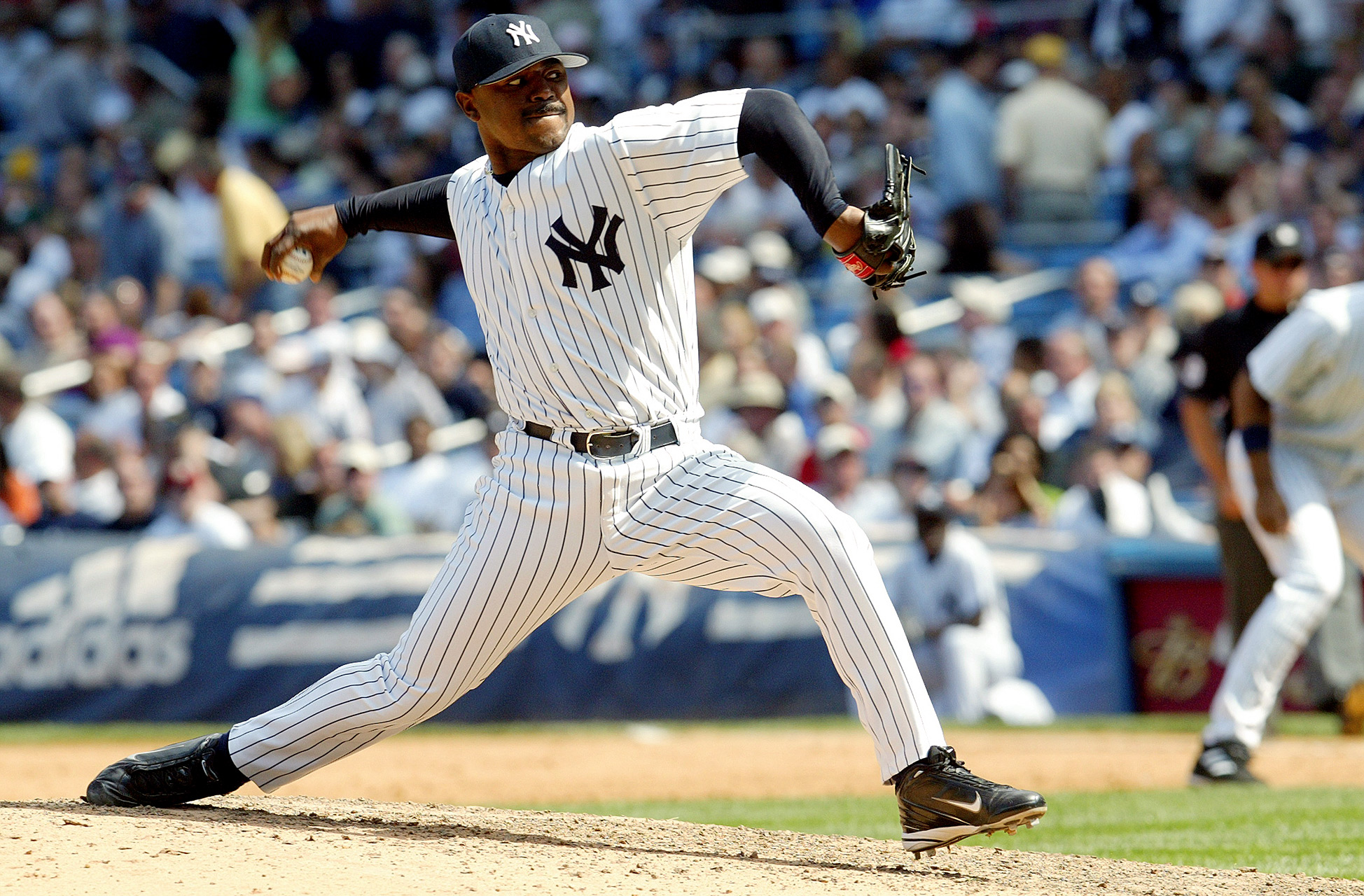
Gordon, shown here with the Yankees, was robbed in '89 (ESPN)
Lots of questionable calls in this decade. Let's get down to it.

1980 NL Steve Howe over Lonnie Smith
Howe had 0.5 bWAR, the second-lowest total of the nine vote-getters. How he won over third-place Smith, who batted .339/.397/.443 (130 OPS+) with 33 steals, is beyond me.

1983 AL Ron Kittle over Mike Boddicker
Kittle had big-time power numbers with 35 home runs, 100 RBI, and a .504 slugging percentage, but he also whiffed a major league-leading 150 times, batted just .254, and was a poor defensive outfielder. In short, he was a one-dimensional slugger. Boddicker, on the other hand, had an unequivocally excellent season for the World Series champion Baltimore Orioles, going 16-8 with a 2.77 ERA (143 ERA+), 1.08 WHIP, and the most shutouts in baseball (5). He also posted the lowest hit rate in the American League at 7.1/9. Boddicker's 4.2 bWAR were more than double Kittle's 1.8.

1985 AL Ozzie Guillen over Teddy Higuera
This one utterly baffles me. Guillen hit an empty .273 (just one home run) with no speed (seven steals) and only a dozen walks. I don't care if you play Ozzie Smith-like defense at short; a 74 OPS+ isn't going to cut it. Higuera, the runner-up, hurled 212 and 1/3 quality innings with a 107 ERA+, 3.77 FIP, and 1.17 WHIP. That's much more valuable than a shortstop who can't hit his way out of a paper bag.

1985 NL Vince Coleman over Tom Browning
Steals are overrated, and so was Coleman. Granted, he stole 110 of them, which is sensational, but he also caught 25 times and hit a lackluster .267/.320/.335 with just one home run. Had he been a shortstop, like Maury Wills, that would have been more tolerable, but a .655 OPS (84 OPS+) from a left fielder is simply unacceptable. Browning, who placed second, won 20 games with a 3.55 ERA and 1.21 WHIP in 261 and 1/3 innings. That combination of quality and quantity made him nearly twice as valuable as Coleman, and thus the more deserving candidate.

1986 AL Jose Canseco over Mark Eichhorn
Once again, voters were swayed by Canseco's monster power numbers (33 bombs, 117 RBI) overlooked his 175 strikeouts, .240 batting average, and .318 on-base percentage. Runner-up Wally Joyner had a more productive offensive campaign, with his .805 OPS (119 OPS+) comfortably above Canseco's /775 (116). But third place Eichhorn, with his 7.4 bWAR, should have walked away with the award. Though he pitched exclusively in relief, his workload was more like a starter's as he delivered 157 innings. And let me tell you, he pitched like an ace with a 1.72 ERA (246 ERA+), 0.96 WHIP, 3.69 K/BB ratio, and 2.31 FIP.

1986 NL Todd Worrell over Robby Thompson
Everyday second baseman with league average bat trumps a good-not-great closer in my book.

1988 AL Walt Weiss over everyone else
Weiss was really mediocre, hitting just .250/.312/.321 (81 OPS+), which is pretty brutal even for a shortstop. He offered neither power nor speed, with only three home runs and four stolen bases. Runner-up Bryan Harvey had a strong season out of the Angels bullpen (2.13 ERA, 1.04 WHIP). Third-place Jody Reed played the same position as Weiss--shortstop--but was a much better hitter with his .293/.380/.376 (110 OPS+) batting line. Don August (13-7, 3.09 ERA) also would have made a fine choice and probably would have been my pick.

1989 AL Gregg Olson over Tom Gordon
Olson's 1/69 ERA and 9.5 K/9 rate must have dazzled voters, because Gordon pitched almost twice as many innings and went 17-9. A true swingman, Gordon made 16 starts, finished 16 games, and made 17 relief appearances in between. He did a little bit of everything and performed well, which I value more than a one-inning closer. I also would have preferred third-place Ken Griffey Jr. (16 homers, 16 steals, center fielder) to Olson.

1989 NL Jerome Walton over Dwight Smith
The writers gave the award to the wrong Cub. Smith posted an OPS that was 154 points higher than Walton while playing only seven fewer games. Granted, Walton was a center fielder whereas Smith was a corner outfield, but at 150+ point differential in OPS is just too great to ignore.

Friday, December 26, 2014

Questionable Rookies of the Year: 1990s

Kenny Lofton (pictured) deserved the 1992 award over Pat Listach (CheapSeatsPlease)
1990 AL Sandy Alomar over everyone else
Roberto Alomar's older brother has to be one of the most overrated players in baseball history. He somehow swindled his way onto six All-Star teams despite totaling a mere 13.7 bWAR across 20 big league seasons. Such was the case in 1990, when he earned the first of those All-Star nods and walked away with Rookie of the Year honors by batting an empty .290. Runner-up Kevin Maas, who slugged 21 home runs and posted a .902 OPS (150 OPS+) was a more deserving candidate, as was another Kevin--third-place Kevin Appier. Appier, who led all rookies that year with 5.3 bWAR, should have been a no-brainer after compiling a 2.76 ERA (139 ERA+) in 185 and 2/3 innings with Kansas City. He would go on to become one of the best pitchers of the 1990s but was rarely recognized as such, making just one All-Star team and drawing Cy Young consideration only once.

1992 AL Pat Listach over Kenny Lofton
I don't get this one at all. Listach and Lofton were basically the same player offensively, only Lofton did everything a little better. He scored a few more runs, hit a handful of more home runs, stole a dozen more bases, got on base more frequently, and slugged a little more. Sure, Listach played shortstop, but he was merely adequate, whereas Lofton became a Gold Glove-winning center fielder. Lofton was actually much more valuable defensively in addition to being a better hitter and baserunner, which is reflected in the fact that he was worth close to six wins while Listach came in around four. It was a fitting beginning to what turned out to be a very underappreciated career by Lofton, a poor man's Tim Raines who fell off the Hall of Fame ballot after his first year of eligibility.

1992 NL Eric Karros over everyone else
Voters were so swayed by Karros's 20 home runs and 88 RBI that they overlooked his terrible .304 OBP and pedestrian (especially for a first baseman) .730 OPS. At 0.4 bWAR, Karros was barely above replacement level and had no business being named Rookie of the Year. Runner-up Moises Alou played 34 fewer games but was much better offensively, hitting .282/.328/.455 (120 OPS+) while throwing in 16 steals. Reggie Sanders, who finished fourth, probably had the best case given his .831 OPS (127 OPS+), power/speed combo (12 dingers/16t thefts), and 77 games in center field. Karros went on to become extremely overrated due to his strong home run and RBI totals, which belied his middling on-base and power numbers.

1996 NL Todd Hollandsworth over Edgar Renteria
Hollandsworth had 1.1 bWAR in '96, but somehow finished in front of Edgar Renteria and Jason Kendall even though they hit roughly as well as he did while playing shortstop and catcher, respectively (Hollandsworth was a left field). His .785 OPS, for instance, is not significantly better than Renteria's .757 or Kendall's .773, both of whom contributed much more defensively. Looking back, it's clear Hollandsworth was not worthy.

1999 NL Scott Williamson over Preston Wilson
An everyday center fielder who bats .280/.350/.502 with 26 home runs and 11 steals should beat out a reliever who doesn't even pitch 100 innings, unless said reliever pitches like Clayton Kershaw or Pedro Martinez. Williamson was very good, but I'm siding with the position player on this one.

Saturday, August 2, 2014

Ranaudo Rises to Occasion

Ranaudo shined in his major league debut last night (NESN.com)
The new-look Boston Red Sox won their first game following Thursday's fire sale that sent Jon Lester, Jonny Gomes, John Lackey, Stephen Drew, and Andrew Miller packing, beating the New York Yankees 4-3 at Fenway Park last night. Allen Craig went 1-for-4 with a double in his Red Sox debut.

The skidding Sox stopped their three-game losing streak in Anthony Ranaudo's first big league start. The 24 year-old, fresh from Pawtucket, notched his first major league win in front of a sellout crowd that included his parents. Ranaudo went six innings, allowing two runs on four hits and four walks while striking out two.

Wearing number 63, Ranaudo kept the Yankees off the board until the fourth, by which point Boston had staked him to a 2-0 lead on run-scoring hits by Dustin Pedroia (ground-rule double) and David Ortiz (single) the previous inning. Ranaudo's shutout bid ended when Carlos Beltran led off the fourth by lining the rookie's second pitch of the inning and 50th of the game into the right field bullpens.

Unfazed, Ranaudo set down the Yankees in order on 10 pitches and needed only nine to dispatch them the following inning. With Boston leading 3-1 and one out in the sixth Beltran struck again, smoking Ranaudo's 80th offering of the evening into center field for a single that plated Jacoby Ellsbury. Ellsbury, who'd reached on a leadoff walk and stolen second, came around to score and trim Boston's lead to one.

Once again, Ranaudo rebounded from a Beltran breakthrough, this time with the potential tying run on base. He effectively neutralized the threat, first by freezing Brian McCann, then by getting Chase Headley to ground out and end the inning. That was all for Ranaudo, who after 91 pitches was done for the evening.

Tommy Layne, also up from Pawtucket, pitched a 1-2-3 seventh by retiring Drew, new Yankee Martin Prado and old Yankee Brett Gardner. Pedroia got Boston a much-needed insurance run in the bottom of the frame, poking a single up the middle to score Mookie Betts and pick up his second RBI of the game.

That run would prove crucial as Derek Jeter greeted Junichi Tazawa with a home run--Jeter's third of the season--over the Monster, cutting Boston's lead in half with one swing of the bat. Tazawa worked around Mark Teixeira's one out double and a two out walk to Brian McCann, escaping the inning with Boston's lead still intact.

The Red Sox were still nursing that one-run lead when Koji Uehara entered the game in the top of the ninth, looking to nail down his 22nd save of the season. The ever-reliable Uehara made quick work of  the Bombers, retiring the side on 13 pitches.

Bolstered by the arrival of Yoenis Cespedes, Boston will go for its 50th win of the season today. Allen Webster, another recent call-up, is making his second start of the year and first career start against New York. Hopefully he fares as well as Ranaudo did yesterday.

Saturday, April 26, 2014

Abreu's Awesome Start

Abreu is tearing it up in his American debut (ESPN SweetSpot Blog)
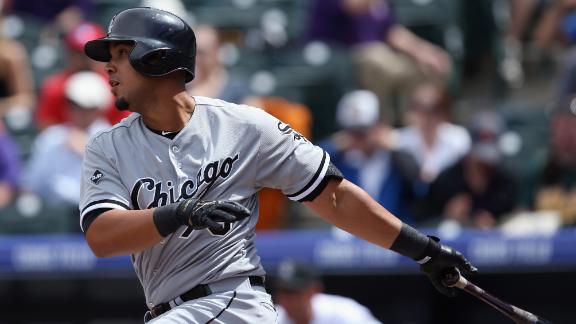
When Cuban sensation Jose Abreu signed a six-year, $68 million deal with the Chicago White Sox last winter, we knew he was going to be good. I'm just don't think anyone expected him to be this good. 

After capping last night's three-hit, six-RBI performance with a walk-off grand slam that lifted the Chicago to a 9-6 win over the Tampa Bay Rays, Abreu became the first rookie in major league history to hit nine home runs before the end of April. The 27-year old first baseman now holds a tie of the major leagues in home runs (with a resurgent Albert Pujols), RBI (with Giancarlo Stanton and Chris Colabello), total bases (Pujols again), and extra base hits (with Josh Donaldson). He's also slugging .632, the fourth-highest mark in baseball behind Troy Tulowitzki, Charlie Blackmon, and Pujols.

I know I'm not breaking any new ground here, but it sure looks like he's the real deal, folks. Baseball's next big thing has arrived.

Abreu, who already has three multi-homer games on the young season, has come out swinging for the fences. He's already struck out 25 times in 24 games, and when he does make contact 40 percent of the time he hits it in the air. Nearly a third of his fly balls have left the yard, an unsustainable pace, but with the homer-friendly Cell as his home park he might be able to keep it up for a little longer.

With five home runs and 13 RBI in his past six games, Abreu can't get much hotter. His sizzling start is a big reason why the White Sox are in second place in the AL Central entering play today, and why they've scored the most runs in baseball thus far. It goes without saying that if Abreu can continue to power Chicago's offense, he'll be a lock for AL Rookie of the Year and serious MVP consideration.

But for now, let's see if he can continue adding to his impressive spring numbers. His 27 RBI are tied with Pujols for the most by a rookie in April. So if you've got nothing better to do on a Saturday night, you might as well check-in on Abreu's at-bats. He might just make history.


Saturday, November 16, 2013

The Myers-McCovey Connection

Since Wil Myers was named American League Rookie of the Year on Monday, several writers have mentioned that Myers was the first position player to win the award while playing in fewer than 100 games.

That didn't sound right to me, and after some investigation I figured out why. Myers was the first AMERICAN LEAGUE player to win the award and appear in fewer than 100 games, and even that is barely true. 1994 Rookie of the Year Bob Hamelin logged 101 games during the strike-shortened campaign.

My research revealed that not one, but two National League position players have won the award despite playing fewer than 100 games. Most recently, there was Bob Horner in 1978. Horner smashed 23 home runs and knocked in 63 runs in just 89 games, an impressive power barrage that helped him surpass Ozzie Smith in the voting.

The one I was thinking of, though, was Willie McCovey, who won the 1959 trophy despite playing only 52 games--barely a third of a season. But Stretch was so ridiculously productive in that short time, hitting .354/.429/.656 with 13 home runs, that the writers had to recognize his awesomeness. McCovey rewarded them by putting together a Hall of Fame career in the two decades that followed, proving that his two month stretch of dominance was no fluke.

Something tells me Myers isn't a fluke either. Like McCovey, he's probably destined for Cooperstown.

Tuesday, November 12, 2013

Myers, Fernandez, and Puig

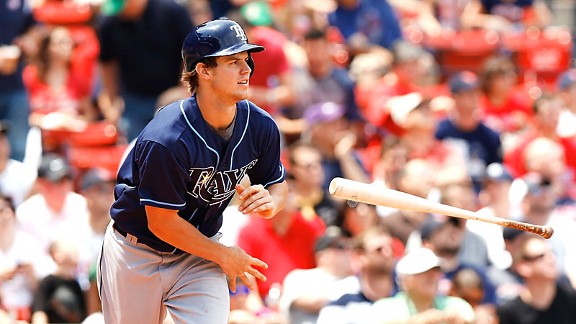
The Rays traded James Shields and Wade Davis for Myers last winter. It paid off
Baseball awards week kicked off tonight with the Rookie of the Year selections, and both choices were the correct ones.

In the American League, preseason favorite Wil Myers ran away with the award. Myers received 23 of the 30 first place votes for his outstanding (albeit abbreviated) campaign. Though he didn't debut until June 18th, the 22 year-old made the most of his shortened season. Myers mashed big league pitching to the tune of .293/.354/.478 (eerily similar to Eric Hosmer's rookie numbers).  He also popped 13 homers and knocked in 53 runs, providing some much-needed firepower for the offensively-starved Rays as well as another big bat to complement Evan Longoria. Just for fun (and to show how productive he was on a per-game basis) here's what his numbers project to over the course of a full season:

92 runs, 180 hits, 42 doubles, 23 homers, 92 RBI, 60 walks, 9 steals, 294 total bases

Those are fine numbers for anyone, let alone a 22-year old kid playing half his games in the pitching-friendly Tropicana Field. Myers had a huge impact on the Rays, who were in fourth place and just three games above .500 when he was called up, but went 56-38 (.596) with him on board. Tampa Bay probably doesn't make the playoffs without him.

Runner-up Jose Iglesias netted five first-place votes and 17 second-place votes. Some thought Iglesias, who logged significantly more playing time than Myers and batted .303 while playing superlative defense, deserved the hardware over Myers. FanGraphs and B-R both have Myers rated as more valuable per WAR because even though he played right field, he was far and away the superior hitter. Iglesias never walked and hit for no power whatsoever despite benefiting from friendly offensive environments in Boston and Detroit, so his 101 OPS+ pales in comparison to Myers' 132 mark.

The remaining pair of first place votes were split by starting pitchers: Myers' teammate Chris Archer and Oakland's Dan Straily. J.B. Schuck, Cody Allen, Martin Perez and David Lough also received consideration. Tampa Bay now has three rookies of the year on its roster: Myers, Longoria (2008) and Jeremy Hellickson ('11).

Fernandez was one of the few bright spots on a horrendous Marlins team
The National League race was even more lopsided, which was surprising given the insane levels of hype generated by Yasiel Puig this summer. Jose Fernandez dominated the voting, hauling in all but four first place votes (which went to Puig) for what was a historic rookie season. The Miami Marlins were god-awful this year, as expected, but Fernandez flourished into one of the league's best pitchers. Just 20 years-old at the season's outset, Fernandez got off to a shaky start (4.50 ERA in April) but quickly settled down and found his rhythm. He got better and better as the season wore on, being voted as the NL's top rookie in July and August. When he was shut down after making just two September starts in accordance with his team-enforced innings limit, Senior Circuit hitters breathed one big sigh of relief.

The former first round draft pick and Cuban defector had emerged not only as Miami's ace, but as a legitimate Cy Young candidate as well. He was all but unhittable, posting the lowest H/9 rate in the majors and holding opponents to .182/.257/.265 figures. His 2.19 ERA and 176 ERA+ ranked second only to Clayton Kershaw among big league pitchers, and his 9.75 K/9 was bested only by A.J. Burnett in the NL. His 0.98 WHIP placed him third, as did his 6.3 pitching WAR. Puig may have been the sexier choice, but there was no denying Fernandez's numbers.

Puig was ridiculously fun to watch, though, and had a tremendous season in his own right. He didn't debut until June 3rd and only got into 104 games, but that was more than enough to know that a new superstar had arrived. The 22 year-old Cuban batted .319/.391/.534, which translated to a robust 160 OPS+ and provided plenty of spark for an underachieving Dodgers club that seemed to have lost its way. His first month in the Show was absolutely off-the-charts, so much so that we were talking about him as an All-Star candidate based on four weeks worth of games. Even at the time it was ridiculous, but like Willie Mays or Bo Jackson, Puig was made for All-Star games. He was must-see TV the way Justin Verlander's starts are, the way Manny Ramirez and Barry Bonds' at-bats used to be.

The human highlight reel eventually cooled off, of course, but still managed to do something SportsCenter-worthy on a nightly basis. I can't think of a rookie baseball player in my lifetime, not even Mike Trout or Bryce Harper, who created as much excitement as Puig did. Everything he did, all the rocket throws, towering home runs and majestic bat flips, even the strikeouts, was jaw-dropping. When it comes to showmanship, he is without peer. It's going to be a blast watching him do his thing.

Extrapolate Puig's performance over a full season, as I did with Myers, and you get these numbers:

102 runs, 190 hits, 32 doubles, 29 homers, 17 steals, 317 total bases

That seems like a good baseline for his performance next year.

Apologies to remaining NL-vote getters Shelby Miller, Hyun-jin Ryu, Julio Teheran, Jedd Gyorko (what a finish!), Nolan Arenado, and Evan Gattis (great start!), but I've run out out of things to say about this year's rookie class.

Friday, March 8, 2013

Best Rookie seasons of all time (Hitters)

A look back at some of the greatest rookie seasons of all time:

Shoeless Joe Jackson 1911 (9.0 bWAR)
More than a century later, Shoeless Joe still has a claim for what might be the most impressive rookie season ever. All Jackson did was bat .408, setting a rookie record that will never be broken. Incredibly, he did not win the batting title that season because some guy named Ty Cobb hit .420. Nevertheless, Jackson's obscene batting average is just the tip of the iceberg. The sweet swinging outfielder also posted a .468 OBP--tops in the majors--as well as a .590 slugging percentage, which adds to a 1.058 OPS (193 OPS+). For good measure, he scored 126 runs, amassed 233 hits (including 45 doubles and 19 triples) and stole 41 bases, but because of Cobb's career year none of those statistics were good enough to lead the league.

Dale Alexander 1929 (4.7 bWAR)
Alexander didn't reach the Show until he was 25 but raked from the start. Besides playing everyday and leading the American League in hits with 215, the slugging first baseman ranked second among AL position players in extra base hits (83) and total bases (367). He also produced a robust .343/.397/.580 batting line, scored 110 runs and drove home 137 runs for the Detroit Tigers.

Wally Berger 1930 (4.0 bWAR)
Berger set a rookie record for home runs--38--that lasted 57 years until Mark McGwire obliterated it. But Berger much more than hit the long ball--he batted .310/.375/.614 with 341 total bases as the biggest star on a sixth place Boston Braves squad. In spite of a lackluster supporting cast, Berger batted in 119 runs.

Hal Trosky 1934 (5.2 bWAR)
Only two players in baseball history have a season with over 160 RBI on their resumes but do not have a plaque hanging in the Hall of Fame. Interestingly enough, both did so with the Cleveland Indians. One is a household name--Manny Ramirez--while the other (Trosky) is merely a historical footnote. But two years before he led the major leagues with 162 RBI and 405 total bases, Trosky enjoyed one of the best rookie seasons a player ever had. The 21 year-old played every game, a feat that allowed him to rack up some impressive counting numbers such as 206 hits, 374 total bases and 142 RBI. He also scored 117 runs, batted .330/.388/.598, smacked 45 doubles and crushed 35 homers. Like most good hitters of the day, he finished the season with more walks than whiffs.

Joe DiMaggio 1936 (4.6 bWAR)
In 1936 the New York Yankees were desperate for new blood. Still reeling from Babe Ruth's retirement, New York was in a bit of a rut, having captured just one American League pennant in the previous seven seasons (despite averaging 93 wins per year). While their pitching had steadily improved under Joe McCarthy, an offense that plated 1,067 runs in 1931 had declined to 818 runs scored in 1935. A 21 year-old DiMaggio helped reverse that trend by batting .323 and stroking 206 hits, including an ML-best 15 triples. He also clubbed 44 doubles and 29 home runs on his way to compiling 367 total bases, which translated to a .576 slugging percentage. Batting third ahead of Gehrig and Bill Dickey, he scored 132 runs and knocked in 125. When it was all said and done, the Yankee Clipper led his squad to 102 wins and their first of four consecutive World Series titles.

Ted Williams 1939 (6.6 bWAR)
Teddy Ballgame burst onto the scene as a brash, cocky, loudmouthed youngster unlike anything baseball had ever seen before. Veterans dismissed his annoying attitude, only to soon find out that his bat talked louder than his words. Williams became the first rookie to lead the league in runs batted in by accumulating 145 RBI, a total that topped both leagues and set a rookie record that still stands to this day. His 86 extra base hits tied Johnny Mize for most in baseball that year, fueling his AL-leading 344 total bases. Williams also batted .327/.436/.609, scored 131 runs, and worked 107 walks in a stellar debut that placed him fourth in the MVP voting behind Joltin' Joe, teammate Jimmie Foxx, and Bob Feller. There was no official Rookie of the Year award yet, but Babe Ruth declared Williams to be the Rookie of the Year, to which Williams later said was good enough for him. In response to his immediate success, the Red Sox doubled his salary and constructed new bullpens in right field to bring the fences 20 feet closer to home plate.

Jackie Robinson 1947 (3.0 bWAR)
Numbers do not do Robinson justice, for statistics can't even begin to tell the whole story of what it was like for the man who broke baseball's color barrier. That said, he still put up some pretty impressive statistics. The ideal number two hitter, Robinson scored 125 runs, posted a .383 OBP, laid down an ML-best 28 sacrifice hits, and walked twice as often as he struck out. He was also aggressive on the basepaths, leading the Senior Circuit in steals with 29. In addition to leading the Brooklyn Dodgerst to the NL pennant, he was honored with baseball's first ever Rookie of the Year award and also finished fifth in the MVP voting.

Walt Dropo 1950 (2.4 bWAR)
Dropo was 27 years old during his rookie season, so it should come as no surprise that 1950 turned out as the best season of his career by far. Moose scored 101 runs, slugged 34 homers and batted .322/.378/.583. His 144 RBI tied with teammate Vern Stephens for most in the bigs. He also topped the Junior Circuit with 326 total bases while ranking second in extra base hits (70) and slugging percentage to Joe DiMaggio. Dropo started the All-Star Game at first base, finished sixth in the MVP voting and beat out Whitey Ford for Rookie of the Year honors.

Al Rosen 1950 (5.6 bWAR)
Like Averill and Trosky before him, Rosen is another Cleveland star who's gotten lost in baseball's rich history. Blocked in his early years by Ken Keltner, Rosen inherited the hot corner job after Keltner was released. Rosen seized the opportunity by ripping 37 home runs, most in the American League, while also posting the league's best AB/HR ratio. On top of that, the slugging third-sacker scored 100 runs, drew 100 walks, and knocked in 116 runs. Not too shabby.

Frank Robinson 1956 (6.2 bWAR)
Robinson was the unanimous choice for Rookie of the Year after matching Berger's freshman home run record with 38 big flies. The 20 year-old also batted .290/.379/.558 with 319 total bases and a NL-best 122 runs scored.

Vada Pinson 1959 (6.3 bWAR)
At the tender age of 20, Pinson produced one of the best-but-least-talked-about rookie seasons ever. For starters, Cincinnati's All-Star center fielder led the majors with 131 runs and 47 doubles. He batted .316/.371/.509 while racking up 205 hits and 330 total bases. Lastly, Pinson blended power with speed by going 20/20 with 20 bombs and 21 steals.

Tony Oliva 1964 (6.6 bWAR)
Oliva secured all but one possible first place rookie of the year vote after leading the bigs with 217 hits, 374 total bases (tying Trosky's rookie record), and 84 extra base hits. His 109 runs, 43 doubles, and .323 batting average topped the American League as well. He was the Junior Circuit's starting right fielder in the All-Star Game and finished fourth behind Brooks Robinson, Mickey Mantle, and Elston Howard in the MVP race.

Dick Allen 1964 (8.5 bWAR)
Allen nearly pushed his Philadelphia Phillies into the World Series with his phenomenal rookie season. The 22 year-old third baseman led the majors with 125 runs scored and 13 triples while topping the NL with 80 extra base hits and 352 total bases. He also notched 201 hits and batted .318/.382/.557. While he committed a whopping 41 errors at the hot corner, the Wampum Walloper did more than enough with the lumber to compensate for his defensive ineptitude. When the dust settled after Philadelphia's devastating collapse, Allen was named Rookie of the Year (receiving all but two first place votes) and earned himself a seventh place finish in the MVP voting.

Fred Lynn 1975 (7.1 bWAR)
Lynn became the first player to take home his league's Rookie of the Year and Most Valuable Player awards in the same season, and he did so in a landslide. The Red Sox center fielder was voted first on every ROTY ballot (split one in a tie with teammate Jim Rice) and secured 22 of 24 possible first place MVP votes after sparking Boston to the World Series with his tremendous all-around play. Lynn whacked the most doubles--47--and posted the highest slugging percentage--.566--of anyone in baseball that year. He also paced the Junior Circuit in runs (103) and OPS (.967)  while ranking second in batting average (.331), extra base hits (75), runs created (120) and OPS+ (162). A graceful defender with great range, Lynn earned his first Gold Glove award. The 23 year-old also made his first of nine consecutive All-Star appearances.

Alvin Davis 1984 (5.7 bWAR)
Few players got off to better starts than Mr. Mariner, who homered in his first two games and cracked three doubles in his third. He also reached base safely in the 44 games that followed to set a record. Though he did eventually cool off, Davis still finished his freshman season with 27 home runs, 116 RBI, and 97 walks (16 of which were intentional). He made his only All-Star team, picked up some MVP consideration and breezed to the Rookie of the Year award by collecting all but three available first place votes.

Mark McGwire 1987 (4.8 bWAR)
Offense spiked in '87, helping Big Mac go yard 49 times to shatter the rookie record set by Berger and tied by Robinson. His .618 slugging percentage was tops in the majors, too, but he skipped the last game of the season to be with his wife for the birth of their first son, Matt, who later served as the Cardinals' batboy when his dad tracked down Roger Maris 11 years later.

Mike Piazza 1993 (6.8 bWAR)
The greatest offensive catcher in baseball history erupted in his first full season, batting .318/.370/.561 with 35 long balls and 112 RBI. For his efforts, Piazza placed ninth in the MVP race and won the Rookie of the Year award unanimously. He also received his first of ten straight All-Star selections and Silver Slugger awards

Nomar Garciaparra 1997 (6.5 bWAR)
Garciaparra's monster rookie season cemented his status as a member of the American League's "holy trinity" of shortstops along with Derek Jeter and Alex Rodriguez. The Red Sox lost more games than they won in '97, but that didn't stop the Fenway Faithful from falling head over heels in love with their new star shortstop. Batting leadoff, Garciaparra scored 122 runs, stole 22 bases and led the American League with 209 hits and 11 triples. He also compiled 44 doubles, 30 home runs, and 365 total bases. Nomah won the Rookie of the Year award unanimously and placed eighth in the MVP vote. He also made the All-Star team and won his first Silver Slugger. He even strung together a 30 game hitting streak, an AL rookie record.

Albert Pujols 2001 (6.3 bWAR)
The 21 year-old Pujols kicked off his Cooperstown-bound career by batting .329/.403/.610 with 37 home runs and 130 RBI, helping St. Louis return to the postseason via the NL Wild Card. Prince Albert rounded out his stat line with 47 doubles, 360 total bases and 112 runs scored. In addition to winning the NL Rookie of the Year award unanimously, he also was voted to the All-Star team, received his first Silver Slugger and placed fourth behind the slugging trio of Barry Bonds, Sammy Sosa, and Luis Gonzalez (194 home runs between them) in the MVP voting.

Ichiro Suzuki 2001 (7.5 bWAR)
Suzuki became an instant sensation as well as the second player to be named Most Valuable Player and Rookie of the Year in the same season. Batting leadoff for a Seattle Mariners team that won 116 games despite losing Randy Johnson, Ken Griffey Jr. and Alex Rodriguez in previous years, Ichiro scored 127 runs while igniting the most prolific offense in baseball that year. Suzuki piled up 242 hits--a rookie record--along with 56 stolen bases, both best in the bigs. With his .350 batting average, Suzuki won the batting crown and became the first player to lead the league in hitting and steals simultaneously since Jackie Robinson turned the trick in 1949. Immensely popular in his home country as well as the United States, Suzuki became the first rookie to lead the sport in All-Star votes.  Suzuki received the first of ten straight Gold Gloves in right field after it became evident that he was a defensive wizard on par with Roberto Clemente and Al Kaline. He also won a Silver Slugger even though no one in his right mind would ever refer to the slap-hitting Suzuki as a quote-unquote slugger.

Ryan Braun 2007 (1.8 bWAR)
Though Braun was not called up until May 24th and missed nearly 50 games, he still bashed 34 home runs, knocked in 97 runs and stole 15 bases. Even more impressive was his .324/.370/.634 batting line which included the National League's top slugging percentage. He narrowly beat out Troy Tulowitzki (6.5 bWAR) for Rookie of the Year in what was the closest vote since 1980.

Mike Trout 2012 (10.7 bWAR)
Where to begin? For starters, Trout's rookie season has to be considered the greatest of all-time, or at least the best season any  20 year-old has ever had  He paced the major leagues in runs (129), stolen bases (49) and bWAR (10.7) something no rookie had ever done before. He became the first rookie to go 30/30. He became the first player to score at least 125 runs, bash 30 homers, and swipe more than 45 bases in the same season. He took home the AL Rookie of the Year in a unanimous vote, as expected, and would have captured the MVP had Miguel Cabrera not won the Triple Crown.

Honorable Mention:
Earle Combs 1925 (3.5 bWAR)
Midway through the 1925 season, Yankee manager Miller Huggins installed Combs as New York's leadoff hitter. An ideal table-setter with phenomenal on-base skills, Combs built a Hall of Fame career batting atop the Yankees' thunderous lineup for more than a decade. The Kentucky Colonel finished his first full season with 203 hits, 117 runs, and a Derek Jeter-esque .342/.411/.462 batting line. Even though the Yanks sunk to 16 games below .500, Combs still picked up some down ballot MVP votes.

Lloyd Waner 1927 (2.5 bWAR)
Paul Waner's younger brother, nicknamed "Little Poison," batted leadoff for Pittsburgh's pennant winners and paced the Senior Circuit with 133 runs scored, a rookie record. He also totaled 223 hits and a .355 batting average, but neither figure is particularly impressive considering that 198 of his 223 base knocks (88.8 percent) were singles. Though the Pirates were swept by the mighty New York Yankees in the '27 Fall Classic, Waner scored five runs and batted .400/.471/.600 in a losing cause.

Earl Averill 1929 (3.8 bWAR)
Averill broke into the bigs at 26 but still managed to put together a Hall of Fame career. Though his name has been largely forgotten, his impressive batting record still sparkles eight decades after he played his last game. In his first big league season he amassed 321 total bases and 198 hits, 74 of which went for extra bases, while batting .332/.398/.538. He also walked more than he struck out, scored 110 runs and batted in 96.

Rudy York 1937 (3.3 bWAR)
York played just 104 games during his rookie season but made the most of them, batting .307/.375/.651 with 35 dingers and 103 RBI. The hard-hitting catcher inflicted most of that damage during the dog days of August, when he slugged went deep 18 times and drove home 49 runs. His defense, however, was another story. He was so poor with the leather that manager Mickey Cochrane had no choice but to move York off third and bench him before sticking him behind the plate.

Johnny Pesky 1942 (5.2 bWAR)
Pesky hit the ground running by putting together one of the more under-appreciated rookie campaigns of all time.  Sox skipper Joe Cronin penciled his fiery rookie in at the two-hole from day one, letting the 22 year-old shortstop use his remarkable bat control to spray line drives all over the field.  "The Needle" scored 105 runs and paced the majors with 205 base knocks.  He batted .331/.375/.416, helping spark Joe Cronin's second place Red Sox to 93 wins and earning a third place finish in the AL MVP balloting behind Joe Gordon and Ted Williams.  He finished second to Williams, winner of the major league Triple Crown that season. in the batting race and laid down a major-league best 22 sacrifice hits.  What a teammate!

Tim Raines 1981 (3.4 bWAR)
Raines was well on his way to baseball immortality before a player's strike wiped away two months of ballgames. Even so, he still stole 71 bases in just 88 games and would have blown past 100 had the season continued uninterrupted.

Vince Coleman 1985 (2.3 bWAR)
Despite pedestrian offensive numbers, Coleman ran away with the Rookie of the Year award (and into the record books) by obliterating the rookie steals record with 110 thefts. Only Rickey Henderson and Lou Brock have over stolen more bags in a single season.

Carlos Beltran 1999 (4.5 bWAR)
Beltran was just 21 when he became the regular center fielder for the Kansas City Royals, but he could do it all. He hit for power (22 home runs), had speed (27 stolen bases) and played tremendous defense at a premium position. He also scored 112 runs, knocked in 108, and rung up 301 total bases on his way to capturing 26 of 28 first place votes for Rookie of the Year.

Hanley Ramirez 2006 (4.6 bWAR)
Originally the most coveted prospect in the Red Sox farm system, Ramirez was traded to the Florida Marlins along with Anibal Sanchez for established big league talent in the form of Josh Beckett and Mike Lowell. Just 22, HanRam won the starting shortstop job and immediately became a star. The Marlins' leadoff man scored 119 runs, roped 46 doubles, stole 51 bases and batted .292, flashy numbers just good enough to edge Ryan Zimmerman in the Rookie of the Year voting.

Also considered: Charlie Keller, Orlando Cepeda, Willie McCovey, Pete Rose, Rico Carty, Carlton Fisk, Jim Rice, Derek Jeter, Tim Salmon, and Scott Rolen, among others