Showing posts with label Managers. Show all posts

Thursday, November 6, 2014

2014 MLB Award Finalists

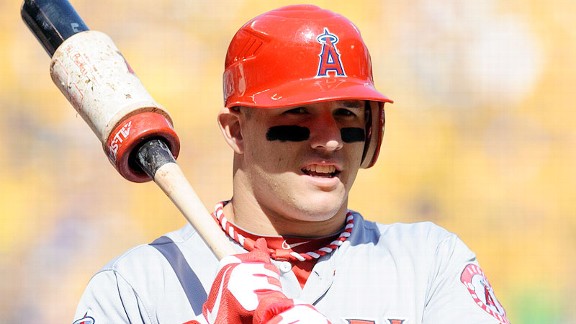
With no Miguel Cabrera to beat him, Trout will win AL MVP (ESPN)
The three finalists for each of the BBWAA's awards were announced the other day, with the winners to be announced next week. Here are my thoughts on and rankings of the finalists for each award.

AL MVP
1. Mike Trout
Duh. There's no way he doesn't win this year. Not only was he the major league leader in runs (115), total bases (338), extra base hits (84), and runs created (137) but he also paced the American League in bWAR (7.9), and RBI (111), smashed 36 home runs and stole 16 bases in 18 attempts, all while playing center field for the team with the best record in baseball. He's a lock despite having a "down" year.

2. Michael Brantley
Brantley was positively Trout-ish this year, posting tremendous numbers across the board en route to a seven win season. While he failed to lead the league in any one category, his name was all over the leaderboards. The first-time All-Star batted .327/.385/.506 (154 OPS+) with almost as many walks (52) as strikeouts (56), not to mention 45 doubles, 20 home runs, 97 RBI, and 309 total bases. He also piled up 200 hits, scored 94 runs, and swiped 23 bases against just one caught stealing. Not a great outfielder, but that can be overlooked when you produce that much offense.

3. Victor Martinez
Not sure V-Mart was one of the three most valuable players in the American League given that he was primarily a DH and is a liability on the basepaths, but he did have a fantastic year at the plate. The best pure hitter in baseball last year, Martinez led the majors in OPS at .974, had the American League's highest OBP at .409, and was the most difficult to strike out with a 13.4 AB/K ratio. The 35 year-old former catcher hit like a man ten years younger, batting a robust .335/.409/.565 (168 OPS+) with 32 home runs, 103 RBI, 317 total bases, and 67 percent more walks (70) than strikeouts (42). The batting title runner-up to Jose Altuve also finished second in slugging (to Jose Abreu), runs created (to Trout), and adjusted OPS+ (to Abreu).

NL MVP
1. Clayton Kershaw
Missed a month, but Pedro Martinez-esque production when he pitched makes up for lost time. Led the major leagues in almost every major pitching category and helped pitch his team to a division title with 7.5 bWAR--most in the NL.

2. Andrew McCutchen
McCutchen was a monster this year, and if he'd played the whole season I'd probably give him the nod over Kershaw. But the defending MVP missed time too (16 games), and so his counting numbers are a bit weak for an MVP with 25 homers and fewer than 90 RBI/runs. His rate stats were certainly MVP-caliber though: .314/.410/.542, giving him the best OBP in baseball as well as the league's highest OPS and OPS+. If he was an elite defensive centerfielder or made more of an impact on the bases I'd be tempted to choose him over Kershaw, but as a complete package (6.4 bWAR) he just wasn't as good.

3. Giancarlo Stanton
Pretty much everything I said about McCutchen applies to Stanton. Through no fault of his own, Stanton was drilled in the face and missed the final 17 games of the season. That didn't stop him from pacing the Senior Circuit in home runs (37), slugging percentage (.555) and total bases (299), but it was enough to effectively finish his MVP chances. At least he got the Hank Aaron award.

AL Cy Young
1. Felix Hernandez
By the slimmest of margins, King Felix deserves his second career Cy. The AL leader in ERA (2.14) and WHIP (0.92) was phenomenal in pretty much every way you can measure a pitcher, with 248 strikeouts in 236 innings and a 5.39 K/BB ratio and the lowest hit rate in the league. I've heard arguments made for Kluber because he pitches in a more neutral ballpark with a less talented defense behind him, but I'm swayed by Hernandez because his ERA, ERA+, and WHIP were all considerably better. To me, WHIP and ERA are the two-most important stats for a pitcher, and in those Felix comes out on top.

2. Corey Kluber
When you get down to it, Kluber's case is just as strong as Hernandez's. Kluber led the league in wins (18), FIP (2.35), and pitching bWAR (7.4). Usually that's good enough to win it, but Felix just barely edges him out.

3. Chris Sale
On a per-inning basis, Sale was probably the best pitcher in the American League this year. His 178 ERA+ and 10.8 K/9 rate were tops in the AL, while his 2.17 ERA and 0.97 WHIP were second. He placed third in the league in pitching bWAR with 6.6 despite completing only 174 innings because of a strained flexor muscle in his elbow forcing him to the Disabled List. That he missed more than a month and still ranked so highly among AL hurlers just goes to show how special his season was, but because of his reduced workload he must take a back seat to Hernandez and Kluber.

Kershaw has the NL Cy Young and MVP sewn up (NextImpulseSports)
NL Cy Young
1. Clayton Kershaw
If he's good enough to be MVP, he's definitely good enough to cop the Cy Young.

2. Johnny Cueto
Cueto had the most innings (243 and 2/3) and strikeouts (242) in the National League, not to mention 20 wins, a 2.25 ERA, a 0.96 WHIP, and 6.4 bWAR. Any other year he wins, but not in the year of the Kershaw.

3. Adam Wainwright
Nobody's better at coming close to, but not winning, the Cy Young than Wainwright, who is set to finish second or third for the fourth time in six years. Always amazing, he was a 20 game winner with a 2.38 ERA in 227 innings, good for 6.1 bWAR. Better luck next year, Adam.

AL Rookie
1. Jose Abreu
Should win unanimously.

2. Matt Shoemaker
Most years, Shoemaker walks home with this award no problem. The 27 year-old emerged as the Angels' second-best starter to Garrett Richards and picked up the slack when he went down with a knee injury in late August. Had Shoemaker not been shut down for the last two weeks of the season, his case would likely look even better as he was on an incredible roll at the time with seven straight wins and just seven earned runs allowed in his previous 48 and 2/3 innings. As it were, he still finished with a 16-4 record (good for the best winning percentage in the American League), 3.04 ERA in 136 innings, and a sterling 5.17 K/BB ratio.

3. Dellin Betances
Betances was about as dominant as a reliever can be, striking out 135 men in 90 innings and maintaining a 1.40 ERA across his 70 appearances. Worth 3.7 bWAR, the All-Star setup man also had a 0.78 WHIP, 5.63 K/BB ratio, 277 ERA+ and a 1.64 FIP. Not surprisingly, his record was a perfect 5-0.

NL Rookie
1. Jacob deGrom
In baseball, as in life, timing is everything. If deGrom debuted last year with the likes of Yasiel Puig, Jose Fernandez, and Julio Teheran, nobody would have noticed him. But because the rookie class was so weak this year, and because they have to give the award to someone, deGrom's the guy. He pitched well in his 22 starts, averaging more than a strikeout per inning and keeping his walk and homer rates down. So while his 2.69 ERA (130 ERA+) looks great, it looks even better backed up by a 2.67 FIP.

2. Billy Hamilton
Were it not for the late-season emergence of deGrom, Hamilton would have won the trophy by default. Cincinnati's speedy leadoff man and center fielder played exceptional defense but struggled at the plate, batting just .255/.292/.355 with 117 strikeouts against just 34 walks (more than three K's per free pass). A terror on the basepaths, he did steal 56 bases, second only to Dee Gordon, but was thrown out 23 times--more than anyone else in baseball. All in all he was a servicable regular worth in the neighborhood of three WAR due to his baserunning and plus defense at a premium position. The 24 year-old is not a leadoff hitter, though, and is likely too flawed at the plate to avoid becoming anything other than a rich man's Jackie Bradley, Jr or a homeless man's Jose Reyes.

3. Kolten Wong
That Wong was one of the three best rookies in the National League this year says a lot about how weak that rookie class was. He hit marginally better than Hamilton (.249/.292/.388), but that's not saying much, and was only okay at second base. He ran the bases well, going 20 for 24 in stolen base attempts, and showed a dash of power with 12 home runs in 402 official at-bats. Still just 24, Wong (like Hamilton) has room to improve and will look to build upon a promising but underwhelming rookie year.

AL Manager
1. Buck Showalter
Nobody, and I mean nobody, gave the Orioles a chance to win the AL East. Showalter squeezed the most out of a team that lost Matt Wieters and Manny Machado for much of the season, got next to nothing out of Chris Davis, and received minimal offensive production from its double play combo. That team won 96 games; at full strength they easily win over 100.

2. Mike Scoscia
The Angels had the best record in baseball, but then they also had Trout, Josh Hamilton, Albert Pujols, Jered Weaver, and C.J. Wilson. LA overachieved everyone's expectations this year, but they wildly underachieved last year (and the year before that, too). Not quite sure where Scoscia fits into all of this.

3. Ned Yost
(Trying not to laugh...)

NL Manager
1. Bruce Bochy
Led an 86-loss team in 2013 back to the playoffs despite continued ineffectiveness from Tim Lincecum and injuries to Matt Cain and a host of regulars, including Angel Pagan, Brandon Belt, and Mike Morse. That he guided them all the way to the World Series title, while unknown at the time ballots were cast, makes this feat even more impressive.

2. Clint Hurdle
Hurdle led a Pirates team ripe for regression back to the playoffs, which I have to admit I did not see coming. But seeing as how he won last year and his team dropped six games in the standings, there's zero chance he repeats this year.

3. Matt Williams
Inherited a ridiculously talented team that under-performed in 2013. To run away with a weak division all they had to do was play up to their true talent level, and that's exactly what happened. Don't see why a push-button manager like Williams should get much credit for that.

Tuesday, November 12, 2013

Francona, Hurdle Top Managers

Terry Francona and Clint Hurdle were named Managers of the Year today after leading their respective teams to impressive turnarounds and postseason berths.

Following a one-year hiatus in the broadcast booth, Francona returned to the dugout and guided Cleveland to 92 wins and the American League's top Wild Card spot. Few expected the Indians to contend in the wake of a miserable 2012 that saw them lose 94 games, but Francona's touch (as well as key additions like Nick Swisher, Michael Bourn and Scott Kazmir) helped Cleveland reach the playoffs for the first time since 2007. Francona's 2011 Red Sox famously choked away their all-but-guaranteed playoff spot by going 7-20 in September, but this year he flipped the script. Cleveland went 21-6 in September, winning ten in a row to close out the regular season and nearly catch Detroit in the AL Central. They were unable to carry that momentum into their Wild Card playoff game, however, falling to Tampa Bay 4-0.

This selection was a bit of an upset, as many predicted John Farrell would win the award after taking Boston from worst to first. Farrell did a commendable job in the aftermath of the Bobby Valentine fiasco, but he also inherited a much more talented roster than Francona did. Boston's payroll was roughly twice that of Cleveland, meaning Francona had to make do with far less. Both teams drastically exceeded expectations, but the Indians overachieved more so than the re-tooled Red Sox, who made significant upgrades over the winter (Mike Napoli, Shane Victorino) and enjoyed a good deal of positive regression to the mean (such as healthy years from David Ortiz, Jacoby Ellsbury, and John Lackey). Cleveland finished one game behind the Tigers. Who could have seen that coming?

The National League selection was much easier. Clint Hurdle helmed the Pittsburgh Pirates, a team that had not experienced a winning season since 1992, to 94 wins and the NL's top Wild Card slot. Hurdle oversaw the two most recent of those losing years, both of which were heartbreaking disasters that saw Pittsburgh contend for much of the summer, only to fall flat on its face in August and September.

This time around, Hurdle helped them get over the hump. There was no late-season collapse, no slipping on the banana peel just before the finish line. They battled St. Louis for the division crown all summer long and were in first place as late as September 16th, but settled for the Wild Card when they were unable to hold off the Cardinals. The same thing happened in the NLDS when Pittsburgh took a 2-1 series lead, only to let St. Louis storm back and win the series behind the stellar pitching of Michael Wacha and Adam Wainwright.

Oh well. There's always next year.

Sunday, November 10, 2013

Expansion Era Ballot: Managers

Basbeall's Expansion Era ballot was announced on Monday, putting 12 men (six players, four managers, and two executives) from the post-1973 era up for induction in baseball's Hall of Fame. First, I'll look at the managers:

Bobby Cox YES
A no-brainer. The Atlanta Braves' dynasty won 14 consecutive division titles, five pennants and the 1995 World Series title in Cox's 21 seasons at the helm. He ranks fourth all-time in managerial wins.

Tony LaRussa YES
Managed for 33 years, winning more games than any manager not named Connie Mack or John McGraw. LaRussa skippered the Oakland A's mini-dynasty of the late-80s, then presided over some awesome Cardinals' squads in the new millenium. In all his teams won six pennants and three World Series, the last of which came in 2011--his final season in the dugout. LaRussa also had a major impact on the game, revolutionizing how managers use their bullpens.

Billy Martin NO
As a player and as a manager, Martin falls short of the Hall. His combative nature and quick-temper quickly wore out its welcome wherever he went, often turning his players against him. He never stayed long at any one place, with George Steinbrenner famously firing him five times. Even so, he still managed to be in charge of some pretty successful teams, such as the 1969 Twins and (more famously) the 1976-'77 Yankees. Only twice in his 18 years did a team have a losing record under his watch. But he was his own worst enemy and proved too intense to build any sort of consistency. An unforgettable personality who will always be linked to Mickey Mantle, Whitey Ford, Casey Stengel, Steinbrenner, and Reggie Jackson.

Joe Torre YES
Never mind that as a player, Torre is a borderline Hall candidate. Throw in his distinguished 29-year managerial career in which he guided the Yankees to a dozen consecutive postseason appearances and won more games than all but four skippers in big league history, and he's a slam dunk.

Tuesday, January 22, 2013

Weaver=Winner


Baseball lost a pair of legends over the holiday weekend when Earl Weaver and Stan Musial passed away. Here are some thoughts on Weaver, who was 82 when he died on Saturday:

Weaver was the best manager the Baltimore Orioles have ever had, and his outstanding track record speaks for itself. He managed 2,541 games--all with Balitmore--over 17 seasons and his teams won 1,480 of them, good for a .583 winning percentage. He presided over five 100-win seasons, four AL pennants, and the 1970 World Series champions. Six times he steered his club to a first-place finish and eleven times his team won at least 90 games. The Orioles were the American League's answer to Sparky Anderson's Big Red Machine always competitive under Weaver's guidance.

Well, except at the end. His only losing season was his last one, 1986, when the O's went 73-89 and finished last in the division. Weaver initially retired following the 1982 season, after Robin Yount and the Milwaukee Brewers crushed Baltimore 11-2 in a one-game playoff for the AL East flag. The front office lured him back in 1985 as the team slid into mediocrity, hoping he'd light a spark under the ballclub. But when Baltimore couldn't turn it around,Weaver walked away. It was good timing, for the Orioles only got worse without him. They dropped 95 games in 1987, then 107 the year after that. It took Baltimore ten years to make the playoffs after Weaver called it quits.

After a brief resurgence in the mid-1990s, the once-proud franchise deteriorated into the doormats of the American League East. The perennial punching bags for the New York Yankees, Boston Red Sox, and Tampa Bay Rays strung together 14 consecutive losing seasons prior to a fluky 2012 in which they made the postseason despite scoring just seven more runs than they allowed during the regular season.

The last quarter century has been filled with lean times for the Orioles, enough to make their glory years feel like they transpired in an alternate reality. But Baltimore was the class of the American League back then, the first dynasty to emerge after the great Yankee run collapsed in the mid-1960s. The O's reaped the rewards of their prolific farm system that churned out waves of multi-talented ballplayers. Weaver, with all his fiery passion, competitive spirit and infamous tirades, was the perfect man to lead a team desperate to escape its losing reputation. No man could erase 60 wasted years in the American League cellar, but damned if this one wasn't going to try.

Of course, it helped that Weaver was blessed with elite personnel throughout his managing tenure. A great manager is only as good as his players, and Weaver had the good fortune of managing a bunch of them. When he first came on the job in 1968 he inherited the core that swept Sandy Koufax, Don Drysdale and the Los Angeles Dodgers in the '66 Fall Classic. was penciling the names of Frank Robinson, Brooks Robinson, and Boog Powell into his lineup cards. Then it was a new crop of stars--Bobby Grich, Don Baylor, Ken Singleton, and Lee May--in the 1970s. His final days at the helm featured Eddie Murray, Cal Ripken Jr., and Fred Lynn.

As for pitching, Baltimore rarely suffered a shortage of quality arms. The Big Three of Jim Palmer, Mike Cuellar, and Dave McNally carried the day, and the 1971 edition featured four 20-game winners (the trio plus Pat Dobson). Players came and went, especially once free agency came into vogue during the mid-'70s, but Weaver remained ever-present.

Weaver wasn't a master tactician or strategist. He didn't know much about pitching. Common managerial maneuvers such as hit-and-runs, sacrifice bunts and stolen bases were foreign to him. And yet, he was one of the winning-est skippers who ever lived. He earned his plaque in the Hall of Fame. He belongs in the pantheon of legendary baseball field generals with the likes of Casey Stengel, Joe Torre, Tony LaRussa, and Bobby Cox.

And even if the Baltimore Orioles revert to their losing ways this year, his legacy as a winner lives on.

Friday, November 16, 2012

Johnson, Melvin Best Managers

Davey Johnson and Bob Melvin were named managers of the year on Tuesday after leading their respective clubs to the postseason. Both were eliminated during the division series, but that disappointing result doesn't take anything away from the phenomenal seasons enjoyed by these two skippers.

Eleven years removed from his last managerial gig, Johnson took over the Washington Nationals halfway through last season three days after Jim Riggleman unexpectedly resigned. The Nats went 40-43 under his command to finish the season one game below .500. Johnson agreed to come back, and the front office deepened his pitching arsenal by signing Edwin Jackson and trading for Gio Gonzalez.

Heading into 2012 the Nationals were viewed as an intriguing team loaded with young talent, but was probably another year or two away from making the leap to bona fide contenders. Certainly nobody expected them to wrestle the division away from the star-studded Phillies, winners of 102 games in 2011. The Braves were going to be tough as always, and the Marlins looked dangerous after adding Jose Reyes, Mark Buehrle and Heath Bell via free agency. Even though the NL East was shaping up to be a crowded field, it was reasonable to assume the Nats would win more than they would lose. In my own preseason predictions, I projected Washington to win 86 games and finish third in their division. Best case scenario, maybe they would win 90, 92 tops.

But 98 wins? In that division? Not even Washington's slickest politicians could have spun that one to make it sound believable.

But it happened. The new-look Marlins tanked. Philadelphia floundered. The Mets disappointed. Washington saw a golden opportunity and seized it by the throat. The Nats hit the ground running, jumping out to a 14-4 start and never looking back. They held first place in the NL East fot all but 13 games, including every day after May 21st. At no point in the season did they ever fall below second place. When the dust settled at the end of the season, Washington owned the best record in the bigs. This year's vintage brought playoff baseball back to the nation's capitol for the first time since 1933, only to choke away a six run lead in Game 5 of the NLDS.

Washington's dominance can be explained in one word; pitching. Stephen Strasburg was the dominant force everyone thought he would be before he was shut down. Gio Gonzalez led the majors in wins and had a Cy Young-caliber season. Jordan Zimmermann retained his title as the best pitcher nobody talks about. Ross Detwiler and Edwin Jackson rounded out the rotation. The starting five missed just a dozen starts between them. The bullpen was just as strong despite losing closer Drew Storen for the first half.

The offense survived injuries to Ryan Zimmerman, Jayson Werth, Wilson Ramos, Ian Desmond, and Mike MorseAdam LaRoche rebounded from a lost 2011 to slug 33 home runs and drive in 100 with a huge contract year. NL Rookie of the Year Bryce Harper had the best season ever by a teenager. Desmond emerged as the league's top shortstop.

Johnson, who turns 70 next year, will manage the Nationals again in 2013 before becoming a consultant. Washington has all the pieces in place and is constructed to contend for years to come. I like their chances of making the World Series next season

Like Johnson, Melvin stepped into the manager's role halfway through last year. He guided the A's to a 47-52 finish, decent enough given their 27-36 start under Bob Geren.

But Billy Beane clearly didn't view his team as a contender in the near future, so he cashed in his established talent for young, unproven prospects. He dealt Trevor Cahill, Gio Gonzalez, Guillermo Moscoso, Andrew Bailey and Ryan Sweeney for the likes of Ryan Cook, Jarrod Parker, Tommy Milone, A.J. Cole and Seth Smith. He let Hideki Matsui, David Dejesus and Josh Willingham, his best hitter, walk.

Hamstrung by his organization's microscopic payroll, Beane blew up his roster and started from scratch. But, as usual, he managed to stretch the money he did have. Beane splurged on Yoenis Cespedes, his one big signing, then raided the bargain bin. The shrewd GM scooped up Bartolo Colon, Brandon Moss, Jonny Gomes, and Brandon Inge for next to nothing. After a busy winter, Beane had somehow managed to cobble together his usual band of misfits. Best case scenario, they'd finish close to .500.

Oakland was written off before Spring Training. The AL West  a battle for supremacy between the Texas Rangers and the Los Angeles Angels, reducing the A's and Seattle Mariners to glorified punching bags. How could Oakland compete against the two-time defending AL champs, who brought back all their key players and added Yu Darvish? How could they possibly beat the Halos, who signed the best hitter (Albert Pujols) and best pitcher (C.J. Wilson) on the market? Surely these two powerhouses would eat the A's alive. Nobody, myself included, gave them a snowball's chance in hell.

For the first half of the season, Oakland was the team everybody thought they would be. In other words, not very good. After losing to the Rangers on June 30th they fell to 37-42. They weren't hitting, and their young players were struggling to find consistency. Then the calendar flipped to July and they became the best team and best story in baseball overnight. From July 1st onward, the Oakland A's went 57-26. That's a .687 winning percentage, folks. They rode this second half surge all the way to the finish line, chasing down the Texas Rangers and stealing the division from them on the season's final day.

The A's racked up 94 wins by squeezing just enough offense out of their lineup to back their outstanding pitching, which ranked second among AL teams in ERA. Cespedes lived up to the hype. Josh Reddick came out of nowhere to become the best all-around rightfielder in the American League. The bullpen, minus Brian Fuentes and Tyson Ross, was untouchable.

But, as Billy Beane's teams are apt to do, the A's folded in the playoffs. They took the Tigers to the brink in the ALDS after falling behind 2-0, but Justin Verlander slammed the door on their Cinderella season with a complete game shutout. Oakland's magical run was over.

By now I should know better than to count them out, but I don't see the A's returning to the postseason next season. I know I said the same thing in the preseason, but the Rangers and Angels are too good. I feel like the A's caught lightning in a bottle this year, like the Mavericks did during their championship run two summers ago. But it's not like everything went right for Oakland, either. Colon was busted for PED use. Brandon McCarthy and Brett Anderson missed time. Jemile Weeks was terrible. If they can stay healthy next year and perform up to their potential, their contributions should help offset some expected regression to the mean.