Showing posts with label Nationals. Show all posts

Friday, September 4, 2015

MLB September Storylines

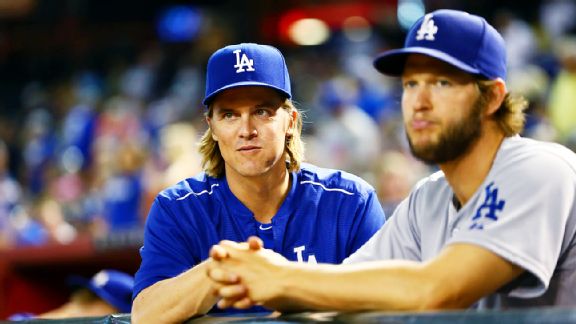
Dodger aces Greinke (L) and Kershaw are players to follow in September (ESPN)
Labor Day weekend is upon us (seriously, how did that happen?), which means there's but one month left of the regular season. Even with most of the divisions and playoff races already decided, several exciting stories have yet to be played out. Will the Blue Jays win their division, thus ending the longest postseason drought in American professional sports? Can Houston hang on in the AL West? And just who is going to put themselves over the top in various award races?

Even if your team is toast and you can't wait for football to start, there's still enough going on to keep fans engaged into October. Here's a sample:

1. David Ortiz's march to 500 home runs
It's been another tough year for the Red Sox but another great one for Ortiz, who's closing in on his 500th career long ball. He has five to go which, given his feverish home run pace (23 taters in his last 70 games), shouldn't take too long.

2. Clayton Kershaw's quest for 300 strikeouts
As Jeff Sullivan noted yesterday, Kershaw's up to 251 K's on the year after fanning 15 Giants in Wednesday night's masterpiece. With five or six starts remaining, he has a chance to become the first pitcher since 2002 to eclipse 300 punchouts. If he does that, a third straight Cy Young award may be in the cards.

3. AL East showdown
As always, the AL East has become a dogfight between its top two teams, one being the Yankees of course. For once, however, the other combatant isn't Boston. It's the Blue Jays, currently clinging to a 1.5 game lead over the Bombers. Toronto will get every opportunity to widen the gap down the stretch with the rest of its games coming against sub-.500 teams and New York.  The Yankees have a similarly easy slate, however, so it wouldn't be surprising to see first place change hands several times over the next month.

4. How will the West be Won?
The fate of the AL West is still up in the air, for it's the only division where the third place team isn't more than 10 games out. It has been turned completely upside down this year, with Houston and Texas (both losers of 90+ games last year) rising to the top while Oakland and Seattle (winners of 88 and 87, respectively) sinking to the bottom. In between are last year's division champs--the Angels--still trying to find their way. LA's coming off a terrible August but could catch up if they play like they did in July. Houston's had control of first place for most of the year, but now find themselves holding on for dear life with a two game edge over the surging Rangers. So hold your breath, Astros fans, and don't exhale until this time next month.

5. Who will snag the second AL wild card?
The Pirates and Cubs have both NL wild card spots wrapped up, and whoever loses the Yankees-Blue Jays duel is guaranteed the first wild card in the AL. The second wild card berth, however, is very much up for grabs. Texas currently leads by one game over Minnesota, with Los Angeles and Tampa Bay looming not far behind. The Twins and Angels are fading fast, while the Rangers have rolled since trading for Cole Hamels. Fingers crossed for a tie, which would mean a play-in game for the play-in game!

6. Will Washington pull it together?
It's now or never for the Nats, who've hovered around .500 all summer and allowed the Mets to break away. They're still close enough (six games) that Washington could steal the division out from under them with a huge September, but time is dwindling. Which team will the Nationals be this month: the one that everyone predicted to win 100 games or the one that might wind up with a losing record? I say they finish strong but still miss the playoffs.

7. St. Louis shoots for 100
Improved parity has made 100-win teams increasingly rare--there were none in each of the past three seasons. Only one team has a legitimate shot to do it this year, and it's not the preseason favorites. The best team in baseball this year has been the St. Louis Cardinals, currently 86-47 and steaming towards their third straight division title. With 29 games remaining on their schedule, the Redbirds need only go .500 to reach the century mark.

8. Does anyone get to 50 homers?
There have been just two instances of a player surpassing 50 home runs during the past seven seasons, but it's possible we'll see two or more players crack that many this year. Nelson Cruz--last year's long ball champion and the current major league leader--needs 11 to get there while Chris Davis--the last to break the 50 barrier--is a dozen away. Look for Carlos Gonzalez, who's cranked 31 over the last three months, to make a run as well.

9. Award races
The AL MVP was seemingly Mike Trout's to lose until about a month ago, at which point he and his Angels went in the toilet while Josh Donaldson and the Blue Jays took off. Now Donaldson appears to have the upper hand, but that could change in an instant if Trout gets back to being himself and leads LA to the playoffs. The NL MVP belongs to Bryce Harper no matter how often Joey Votto reaches base, but Zack Greinke could become the second straight Dodger pitcher to win it if he continues to be lights-out in September.

Speaking of Greinke, he and Kershaw will duke it out for the NL Cy Young award. Wonder which Dodger (and former Cy) voters prefer; Greinke with his sparkling ERA or Kershaw and his gaudy strikeout totals and only slightly less-sparkling ERA? The AL trophy is probably going to Dallas Keuchel (who saw that one coming?), but don't count Chris Sale out just yet.

The AL Rookie of the Year race is a tight one too, with Carlos Correa, Miguel Sano, and Andrew Heaney all having strong cases. The NL field is a two-horse race between Joc Pederson and Kris Bryant, though Noah Syndergaard deserves consideration as well.

10. September call-ups
No matter where your team falls in the standings, it's worth checking in on them throughout September as their future stars get a first taste of the big leagues. For instance, Corey Seager made his major league debut last night.

Monday, May 18, 2015

Analyzing Harper's Hot Start

Harper's having a tremendous start to the season (Zimbio)
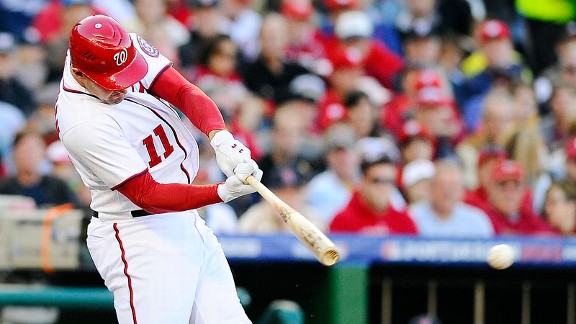
Bryce Harper was at it again yesterday, going 3-for-4 with a triple and home run in Washington's 10-5 rout of the San Diego Padres.  The blast, Harper's NL-leading 14th of the year, was also his ninth in the past dozen days. And while he fell a double short of the cycle, the big day raised his batting line to a Ruthian .338/.476/.729 (221 OPS+).

Granted, we're not even a quarter of the way through the season yet, but it's impossible not to marvel at what Harper's done thus far. He's put the Nationals' slumping lineup on his back, accounting for one-third of the team's home runs and driving in a major-league leading 37 runs. Opponents have pitched around him, intentionally walking him five times already and 36 overall (both lead the majors), but that hasn't stopped him from inflicting major damage on the few strikes he does see.

Harper went yard on Opening Day and hasn't stopped hitting since. Following a strong April in which he posted a .985 OPS, he's been even better thus far in May with nine home runs, 22 RBI, and 14 walks with two weeks to go before the calendar flips to June. His OPS for the month currently stands at an astronomical 1.511.

Harper's been the best hitter in baseball over the first six weeks, and thus appears to have become the superstar he was always destined to be. After three years of coming up short in comparisons to Mike Trout, baseball's other wunderkind, Harper has finally ascended to Trout's level. Right now it's Harper, not Trout, who currently leads all of baseball in refWAR.

There's a lot of interesting trends going on with Harper's hellacious start. The first is his walk rate, which has ballooned to over 21 percent--more than double his career 10.4 percent mark coming into the year. A lot of that has to do with how poorly the Nationals not named Harper and Denard Span have hit, but at the same time Harper's also exhibited improved patience and strike zone knowledge in his fourth big league campaign. His overall swing rate is the lowest of his career, as he's been much more selective on pitches both in and out of the zone.

His batted ball data also reveals major shifts from his first three seasons, starting with his spray charts. Harper's pulled over half the balls he's put in play this year, after never having done so on even 40 percent of his batted balls in any prior season. He's using center field about the same, meaning he's going the other way a lot less often. This shift helps explains Harper's massive power surge, as players rarely hit to the opposite field with power and tend to pull the majority of their home runs.

Harper has also become a different hitter in terms of how he elevates the ball. He's become much more of a fly ball hitter, hitting more fly balls than grounders for the first time in his career. That would also explain why his power numbers are through the roof, and should help them stay up even as his 34.1 percent HR/FB inevitably falls back to earth. Impressively, he's managed to loft the ball much more frequently without increasing his pop-out rate, which is just a tick below his career rate.

Harper's also hitting more line drives than ever before, which helps explain how he's been able to bat .383 on balls in play despite lifting almost half those balls into the air. With FanGraphs classifying nearly one-quarter of his batted balls as line drives, it's no wonder that he's flashing the highest hard-hit percentage of his career, either, with two-fifths of his batted balls qualifying as such.

So what does all of this mean? Harper, the age of a typical college graduate, is still improving. He's walking more (a lot more), striking out less, and hitting the ball with authority. Luck has absolutely played a part in his hot start--that home run rate and BABiP are bound to fall--but Harper has proven himself to be a demonstrably better hitter. His increased patience is indicative of a maturing player, while his superior results on swings suggest he's honing in on pitches he can crush. It's plain for all to see that Harper is locked in, which is always a sight to behold when a player with his unlimited ability develops the right approach to complement it.

The last few years there was no doubt about who the best player in baseball was. Now it's very much up for debate.


Monday, January 19, 2015

Nationals Sign Scherzer

Did the Nationals really need another top-flight starting pitcher? (DodgersNation)
The Washington Nationals won 96 games and the NL East last year, largely thanks to a talented pitching staff that topped the majors in ERA, FIP, and fWAR. Their loaded rotation, comprised of Stephen Strasburg, Doug Fister, Gio Gonzalez, Jordan Zimmermann, and Tanner Roark, were primarily responsible for that, delivering 936 innings of 2.92 ERA-ball and missing just 13 starts between them. With all of them healthy, in their 20s (save Fister), and under contract for 2015, the Nationals did not need pitching help. They were more than set.

Max Scherzer, the 2013 AL Cy Young winner and a free agent*, was a $200 million luxury Washington didn't need. And yet, Scherzer is now a member of the Washington Nationals. Unless the rumors of a possible Strasburg or Zimmermann trade come to fruition, he'll bump Tanner Roark, a borderline Cy Young candidate who compiled a 2.85 ERA in just under 200 innings last year, to the bullpen.

Look out, National League.

*Scherzer, who boldly rejected Detroit's six-year, $144 million contract extension offer prior to the 2014 season, looks like a genius, by the way. He bet on himself, had another big season, and reaped the rewards. 

Just when you thought the Nats couldn't get any more stacked, they go out and ink the prize possession of this winter's free agent pool. In an era where most teams are settling for mediocrity, hoping for 85+ wins and a shot at the second wild card, Washington is one of the few franchises trying to separate themselves from the pack. They're all in.

Thing is, the Nationals were already head and shoulders above the rest of the NL East. Last year, they were the only team with a winning record in their division, which they won by an astounding 17 games. Even with the Marlins and Mets projected to be better this year, Washington was still heavily favored to end up in first place again. The aging Phillies are only getting worse and the re-shuffling Braves will probably be about the same, if not worse. There was no serious challenger threatening Washington's ironclad grip on the NL East in 2015.

Now, the division title that was all but guaranteed to go to Washington is only more of a sure thing. They now claim the best 1-2 top of the rotation punch outside of Clayton Kershaw and Zack Greinke, backed by a former 20-game winner in Gonzalez and a pair of top-notch arms in Zimmermann and Fister. All have received Cy Young consideration at least once in the last three years, and nobody's going to be older than 31 this year. Roark, should he stick around, provides excellent insurance if an injury crops up. Throw in a lights-out bullpen and a formidable starting nine and you have a team that could easily win 100 games in 2015, no small feat given the improved parity throughout the sport.

Did the Washington Nationals need Max Scherzer? Probably not*. But are they a better team with him on board? Absolutely. They say you can never have enough pitching, but it appears the Nats have more than enough to take them all the way. I know it's only January, but I think the Nationals just punched their ticket to the World Series.

*Though I can see why Washington wanted Scherzer. Fister's on the wrong side of 30, Gonzalez got hurt in an uneven 2014, Strasburg and Zimmermann are recovered Tommy John patients, and Roark has a mere 36 big league starts under his belt. Pitchers are inherently risky, and everyone in the Nationals rotation had at least one question mark. There's no such thing as a sure thing in baseball, especially when it comes to pitching. Scherzer's also one of the five best pitchers in baseball, so there's that.

Wednesday, November 5, 2014

Soriano Says Good-bye

Soriano had a stellar 16-year career (Rumors and Rants)
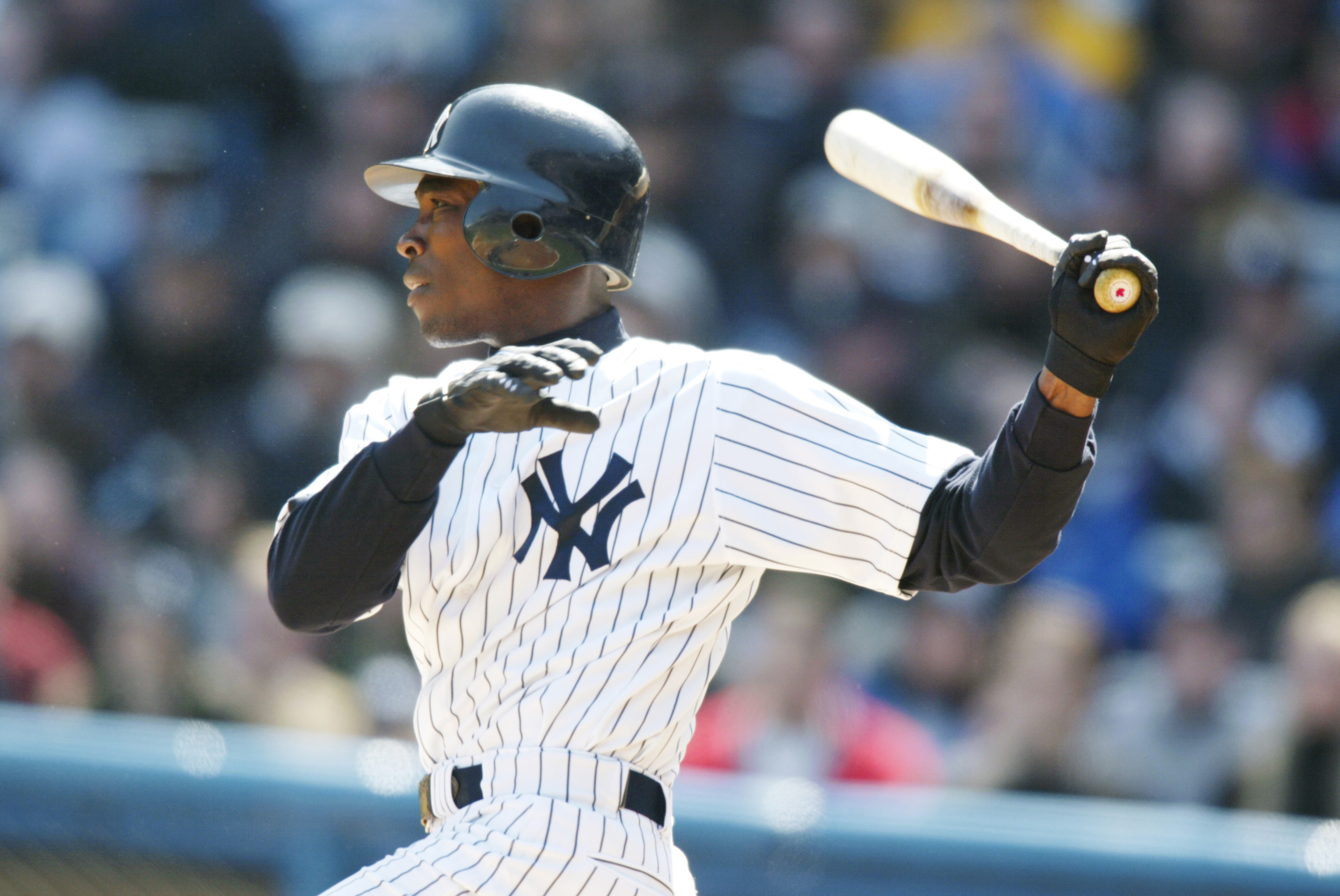
As of yesterday, Alfonso Soriano is officially all done with baseball.

The end came quickly for Soriano, as it often does for whiffing machines in their late 30s. After exceeding 30 home runs and 100 RBI in both 2012 and 2013, Soriano fell apart at age 38 in 2014. Soriano batted a meager .221/.244/.367 with six home runs and 23 RBI in 67 games, snapping his streak of 13 consecutive seasons with at least 18 home run and earning a DFA from the Yankees in early July, followed by an outright release. New York cut him loose little more than a year after trading for him to ail their sinking offense, which he did with 17 homers and 50 RBI in just 58 games.

It was a grand return for Soriano, who began his professional career with the Yankees when they purchased him from Japan in 1998. One year later he made his debut, though his role was limited to a cameo on the championship teams of 1999 and 2000. In 2001 he inherited the everyday second baseman's job from the error-prone Chuck Knoblauch, only to become an error-prone second baseman himself. But like Knoblauch, Soriano could hit, and that more than compensated for his adventures in the field.

Following a third place-finish in the AL Rookie of the Year race in 2001, Soriano emerged as a star in 2002, earning his first All-Star nod, Silver Slugger award, and finishing third in the MVP race behind a pair of slugging shortstops: Miguel Tejada and Alex Rodriguez. Batting leadoff in Joe Torre's lineup ahead of Derek Jeter, Bernie Williams, Jorge Posada, and Hideki Matsui, Soriano led the major leagues with 128 runs, 209 hits, and stole a league-high 41 bases. With 39 home runs he narrowly missed a 40/40 campaign, especially since he hit his 39th with two weeks left in the season. He also batted an even .300 with 51 doubles and 381 total bases, making his 2002 one of the finest offensive seasons ever by a second baseman.

His 2003 was nearly as good (more valuable according to bWAR, actually), as he was again an All-Star, scored well over 100 runs (114), and went 30/30 with 38 bombs and 35 thefts (caught just eight times). He also piled up 358 total bases and knocked in 91 runs while cutting down on his strikeouts and improving his walk rate. Soriano seemed destined to wind up as one of the all-time great Yankee second basemen, in the same league as Joe Gordon and Willie Randolph.

Only fate intervened. Aaron Boone shredded his knee playing pickup basketball, leaving New York in need of a third baseman. Brian Cashman asked if Alex Rodriguez, who was nearly traded earlier in the 2003-2004 offseason to Boston, was still for sale. He was, and became a Yankee after New York sent Soriano and a player to be named later (Joaquin Arias) to Texas for A-Rod and cash.

Soriano played for four teams but started and ended his career in pinstripes (SBNation)
Soriano continued to produce big numbers for two years in the Texas heat before he was traded to the Washington Nationals, where he enjoyed the finest season of his career in 2006. Moved to left field, he responded with just the fourth 40/40 season in baseball history, joining Jose Canseco, Barry Bonds, and Alex Rodriguez. He also posted a career high .911 OPS en route to 6.1 bWAR and a sixth place finish in the NL MVP race.

That monster season, which included 362 total bases, couldn't have come at a better time for Soriano, who was in his walk year. He capitalized by signing an outlandish eight-year, $136 million contract with the Chicago Cubs which was doomed from the start, as he was about to begin his age 31 season when the ink dried.

Sure enough, Soriano's numbers slid as he aged and struggled with injuries, as he missed significant time in 2007, 2008, and 2009. The speed that helped him steal 30 or more bags five times from 2001 through 2006 dried up overnight, limiting him to single digit stolen base totals (outside of his aberrant 18 steal campaign in 2013) after 2008. His outfield defense, solid at first, grew to be truly abhorrent as his range diminished.

The Cubs' fortunes followed Soriano's, as they fell from playoff contender to one of the worst teams in baseball. It was fitting that they were stuck with a .250 hitter who rarely walked, struck out a ton, and couldn't run or field--a daily reminder of their massive misfire. Soriano would accrue 7.9 bWAR across his eight-year contract, worth not even one win per year despite being one of his league's 10 most expensive players from 2009 through 2013. His contract and underwhelming performance was a significant reason, but hardly the only one (see Edwin Jackson signing), for Chicago's rapid descent into irrelevance.

Soriano's age, declining skills and hefty salaries made his contract appear unmovable. Enter the Yankees, who are always willing to play past-their-prime players big bucks to fill out their roster. In desperate need of a power bat to complement Robinson Cano, the great heir to Soriano's second base job, New York sought out Soriano. That's he ended up back in pinstripes for the final act of his career, which included its last hot streak (second half of 2013) and last gasp (2014).

With 27.2 career bWAR, Soriano's not a Hall of Famer, but he's certainly a Hall of Gooder. His 412 home runs are 50th-most all-time, fueled by seven 30-homer seasons. The seven-time All-Star stole nearly 300 bases (289), notched over 2,000 hits (2,095), and eclipsed both 1,000 runs (1,152) and 1,000 RBI (1,159). His combination of power, speed, and low on-base percentages make him something of a modern Andre Dawson.

During the meat of his career from 2001 and 2013, he ranked second in doubles (to Albert Pujols), fifth in long balls, eighth in hits, 10th in runs and stolen bases, and 12th in RBI. It's easy to forget now just how exceptional he was during his prime 10 years ago, and how even in his later years he remained surprisingly durable and a steady source of power. He only had a handful of truly great seasons, but had more than a few good to okay ones. He didn't live up to his contract, but few players would have. It's not like it was a total disaster, either, as he did hit 204 home runs with 599 RBI, 1,004 hits, and an .802 OPS over the life of it.

Don't remember Soriano only for his failures with the Cubs and the massive paychecks he collected from them. Remember him as a good (but flawed), sometimes great ballplayer who combined power and speed like few others, hit wherever he went, then quickly faded away.

Wednesday, September 17, 2014

Birds, Nats Clinch

Washington won its second division title in three years (Vavel)
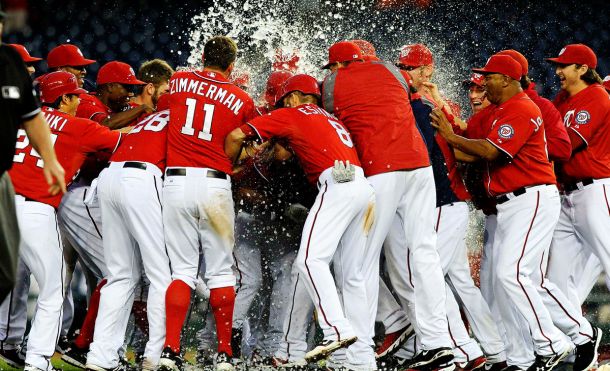
Last night was a great night to be a baseball fan from the D.C. metro area. In Atlanta the Nationals blanked the Braves 3-0 to clinch the NL East for the second time in three years. In Baltimore the Orioles won their first division title since 1997, bludgeoning the Blue Jays 8-2 in front of a celebratory home crowd of 35,000-plus.

But while both of the nation's capital's baseball teams ended up in the same place--at the top of their division and postseason-bound--how they got there turns out to be two very different yet similar stories

It's impossible to talk about this season without first mentioning 2012, when both teams shed their also-ran status by making the playoffs. Washington was the best team in baseball that year, winners of 98 games and clear favorites to win the National League. The former Montreal Expos had been more or less irrelevant since moving to Washington after the 2004 season, never winning more than 81 games and finishing last in their division five times, but thanks to an influx of young talent and a killer pitching staff that had changed practically overnight. For the first time since 1933, there was playoff baseball in our nation's capitol.

That same year, the Baltimore Orioles also came out of nowhere to make the playoffs, winning 93 games and the AL Wild Card. The once-proud franchise had endured 15 straight losing seasons prior to its magical turnaround, going from a 69-93 last-place finish in 2011 to two games out of first the following year.

The Nationals were a veritable juggernaut. The Orioles were a Cinderella story, a good team that overachieved due to extraordinary luck in one-run games. And yet they both met the same fate: eliminated from the Division Series in five games, with Baltimore falling to their mighty division rivals from New York and Washington losing to the defending World Series champion St. Louis Cardinals.

Still, 2012 was a banner year for the Nats, who were poised to be the crown jewel of the Senior Circuit for the foreseeable future. That season marked not just the beginning of a new era in Washington baseball, but also appeared to signal a changing of the guard in the NL East, a transition away from the Braves dynasty and Phillies mini-dynasty. With their tantalizing core of young position players (Bryce Harper, Ian Desmond, Wilson Ramos) and plentiful pitching (Stephen Strasburg, Jordan Zimmermann, Gio Gonzalez), Washington was armed and ready be kings of NL East for years to come.

For the first time since Clinton's presidency, the O's are AL East champs (Baltimore Sun)
The Orioles, on the other hand, were treated as a fluke. There was no such talk of a repeat performance in 2013, much less the next Orioles dynasty. They had an outstanding core of in-their-prime position players (Adam Jones, Matt Wieters, Nick Markakis, J.J. Hardy), but not nearly enough arms to match their competitors in the AL East. Everyone knew that with natural regression they'd likely be a .500-ish team in 2013, and that's basically what happened. They won 85 games and fell back to the pack, finishing tied-for-third with the Yankees behind pitching-rich Boston and Tampa Bay. Nobody saw Baltimore as underachievers that year, but rather a club that played to its true talent level.

Not so with the Nationals, the preseason favorites to win the World Series. Washington was shockingly irrelevant last summer, 16 games out of first and four below .500 on the morning of August 20th. A late surge pushed them 10 games over .500 but still left them 10 back of the Braves and out of the playoffs. Almost the exact same results as the Orioles, one might notice, but drastically different expectations led to the Nationals' season being viewed as a massive disappointment, if not an outright failure.

Both responded with significant roster upgrades over the winter--Baltimore inked Nelson Cruz and Ubaldo Jimenez while Washington stole Doug Fister from Detroit--and have come back strong. The Nationals reclaimed their status as the top dog in their division and, as of this writing, the National League. Not that they had much competition--Atlanta was the only other rival with legitimate postseason hopes and now sits below .500--but first place wasn't guaranteed until mid-August, when Washington won 10 in a row and 12 out of 13 to wrap up the division. They've continued to roll since, breaking away from the pack and building their lead up to its high-water mark of 12.5 games.

Baltimore, on the other hand, wasn't given a snowball's chance in hell to win the AL East before the season began. The Orioles were widely viewed as one of the two weakest teams in the division, with the other being the Blue Jays. Boston, New York, and Tampa Bay were expected to duke it out for the top spot. Nobody gave Baltimore a second thought.

So when the Orioles were in first place for a good while in May, nobody thought it would last. And while they were only a few games over .500 for most of June, that was enough to stay near the top of the division. In early July they made their move, winning 10 of 13 leading up to the All-Star break to finish the first half 10 games above .500 and with a four game lead in the AL East. They've been in first place every day since, putting away the division with a torrid second half. Since the last day of June they've gone 49-21. That's a .700 winning percentage, folks, spanning almost half a season.

It's fitting that both teams ran away with their divisions around the same time, and that they'll likely finish the season with similar records. Because for the second time in three years, both teams will be playing in October, vying for the chance to compete in the first-ever all-DC area Fall Classic (a Beltway Series, I guess?). While I'd rather see a Freeway Series between the more exciting Dodgers and Angels (Yasiel Puig, Clayton Kershaw, and Mike Trout on the game's grandest stage? Yes please), that would be a pretty good series in its own right.


Friday, June 27, 2014

Lincecum's Lost Greatness

Lincecum was lights-out against the Padres in a rare strong performance for him (SBNation)
Tim Lincecum's no-hitter on Wednesday was sad, in a way. Not just because it confirmed how pathetic the Padres offense has been this year (ranking last in runs, hits, OPS, and total bases; barely scoring three runs per game and batting .213), but because it reminded the baseball world of the great pitcher Lincecum used to be. Notice the past-tense. He can still be that pitcher from time to time, but more often than not these days he turns in a bad start rather than a good one. Wednesday's outing was only the second all year in which he completed more than six innings, allowed zero runs, or recorded a GameScore over 70.

Tim Lincecum's no-hitter was a great feat, no doubt. It was his second in less than a year, making him one of just 32 men in baseball history to pitch multiple no-nos. But it is also a reminder of the splendid pitcher he once was, rather than the mediocre pitcher he is today.

Not too long ago, Lincecum was unquestionably the best pitcher in baseball. He won consecutive Cy Young awards in 2008 and 2009, joining Sandy Koufax, Greg Maddux and Randy Johnson as the only pitchers to win back-to-back Cys in the National League. In 2010, he paced the Senior Circuit in strikeouts for the third straight year and topped the majors in K/9. In 2011 he compiled a 2.74 ERA and fanned 220 batters, good for fifth and third in the NL, respectively. He was an All-Star all four years, and at 27 still seemed to have several fine seasons in front of him.

We all know what happened next. Lincecum didn't break down, as so many great young pitchers seem to do, especially nowadays with the Tommy John epidemic ravaging hurlers left and right. Many thought that he would because he was a little guy who whipped the ball so unnaturally hard, but it hasn't happened yet. He's remained remarkably healthy and durable, to his credit, stringing together six straight seasons of at least 32 starts and on pace to do it again here in 2014.

No, his arm didn't fall off. What happened to him happens to everyone who repeatedly throws a baseball upwards of 90 miles per hour hundreds of times a week and thousands of times a year. His arm, once a live wire capable of electric stuff, started wearing down. He lost zip on his fastball, so to compensate he started relying more on his offspeed stuff (mainly sliders). In turn, his command suffered. He became more hittable and less accurate, never a good combination.

And so Lincecum has struggled. Since the start of 2012, a span of 81 starts and roughly 475 innings of work, he has a 4.70 ERA that, when adjusted for league and park, has been 27 percent worse than average. That ERA is so bad, in fact, that it ranks as the seventh-worst in baseball among qualified pitchers, placing him in the same low-rent neighborhood as Edinson Volquez, Joe Saunders, Felix Doubront, and Edwin Jackson. Per Baseball-Reference, Lincecum's also been worth 2.5 wins below replacement level during that time.

And yet, the Giants just gave him a two-year contract last winter that will pay him $17 million this year and $18 million the next. Which begs the obvious question, what was Giants general manager Brian Sabean smoking? Lincecum's deal makes the five-year, $90 million extension he gave Hunter Pence look good.

If Sabean was banking on Big Time Timmy Jim recapturing his glory days, he was sorely mistaken. Predictably, Lincecum's already declining strikeout rate has continued to fallAll pitchers lose velocity as they get older, and once it's gone it never comes back. Not even the best pitchers can avoid this inevitable erosion of skills, as Justin Verlander, CC Sabathia and the now-retired Roy Halladay have recently discovered. All those pitches and innings take their toll sooner or later.

No-hitters aside, Lincecum clearly isn't the pitcher he used to be. So unless he develops impeccable command (like Cliff Lee) or becomes a master at changing speeds (like the deceptive Koji Uehara), he'll continue to be erratic. Occasionally great, but in the end the bad will outweigh the good. In his prime he was the Freak, capable of seasons that rank with the best of Johan Santana, Pedro Martinez and Roger Clemens. Now, he's just another guy, a back of the rotation innings-eater. A washed-up has-been at the age of 30. He's become the next Barry Zito, sans the never-ending contract. At least Lincecum's has a light at the end of the tunnel.

So look on the bright side, San Francisco. On the one hand you're still a World Series-caliber team despite paying your former ace $17 million to actively hurt your team, and on the other you're only stuck with him for one more year. Hopefully next time his contract expires, your front office will be wise enough to let him go.

Friday, February 28, 2014

MLB Offseason Winners

New York put the pieces in place to make a championship run in Derek Jeter's (MSN)
Minus a few exceptions (Stephen Drew, Ervin Santana), most of the key free agents have signed and the offseason is pretty much over. So who "won" the offseason? Here are the five teams I think are most improved:

1. New York Yankees
Losing Robinson Cano didn't devastate the Yankees, who spent over half a billion dollars this winter. Not only did they land prized Japanese hurler Masahiro Tanaka to anchor the rotation, but they also added All-Stars Brian McCann, Jacoby Ellsbury and Carlos Beltran to beef up their lineup. I doubt Kelly Johnson and Brian Roberts will pan out, but they're guaranteed to get more from Mark Teixeira and Derek Jeter. After winning just 85 games last year--their fewest in a non-strike season since 1992--and missing the postseason for only the second time in the past two decades, New York should win at least 90 and reclaim their status as one of the American League's elite.

2. Washington Nationals
Washington added Doug Fister to a rotation that already featured Stephen Strasburg, Jordan Zimmermann, and Gio Gonzalez. Better yet, they didn't give up anyone of value to get him. Nate McLouth brings depth to an outfield that gave way too many at-bats to the likes of Tyler Moore, Roger Bernadina, Steve Lombardozzi and Scott Hairston last year. Expect the Nats to win closer to 98 games (their 2012 win total) than 86 (last year's total).

3. Texas Rangers
Signing Shin-Soo Choo and trading for Prince Fielder should give their lineup some much-needed oomph, especially given the free agent departure of Nelson Cruz. They also got nine years younger at catcher by replacing A.J. Pierzynski with J.P. Arencibia, who ranks fifth among catchers in home runs over the past three years.

4. Tampa Bay Rays
The Rays needed to re-sign David Price and they did, keeping one of baseball's best rotations intact. They also improved their bullpen by signing Grant Balfour and trading for Heath Bell. David DeJesus solidifies the outfield, and first baseman James Loney will return to prove if last year's renaissance was legit.

5. Houston Astros
Houston's still going to be bad, but not as bad as they were last year. They fleeced Colorado for Dexter Fowler, improved their bullpen via Jesse Crain and Chad Qualls, plus landed a decent starting pitcher in Scott Feldman. Things can only get better for a team that lost 111 games last year.

Monday, September 30, 2013

Werth Worth it

In a season where they won 86 games, finished second in their division and made a late push for the playoffs, the Washington Nationals were considered disappointments. But Jayson Werth, their highest paid player, put together a terrific season while starting to shed the "bust" label that described his first two and a half seasons with Washington.

How Werth came to be not just the most expensive National, but the 14th most expensive player in baseball history, is well understood. It was autumn, 2010, and Werth was coming off a career year. He had just led the National League in doubles with 46, scored 106 runs, batted .296/.388/.532 and produced around five wins above replacement. He'd also finished eighth in the NL MVP voting for his contributions as the top position player on a 97-win Philadelphia Phillies squad.

Still, the Scott Boras client did not seem likely to command a nine-figure contract on the open market. He was a late-blooming outfielder on the wrong side of 30 who'd never batted .300 or driven in 100 runs in any of his eight seasons. While a very good complementary player, he was not somebody to build a franchise around.

That's what made it so surprising when the Nationals gave him a seven year deal for $126 million, way more than he deserved and way more than anyone else was willing to give him. It was a curious move by Washington at the time given that they had just lost 93 games and were still a few years away from contending.  To be fair, they did have a huge void to fill in the middle of their order following the departure of Adam Dunn, who signed his own free agent deal with the Chicago White Sox two days prior. Werth could never dream of matching Dunn's power numbers, but he was a vastly superior all-around player who contributed additional value with his defense and baserunning.

The Nationals improved to 80-81 in 2011, but not because of anything Werth did on the diamond. His OPS plunged more than 200 points, he struck out a career-high 160 times and knocked in only 58 runs. Put it all together and he was barely a one-win player. Washington's fans and media, many of whom weren't excited about Werth's arrival in the first place, soured on him.

In 2012 Werth's performance rebounded, but he missed three months with a broken wrist and didn't hit for much power. He played 81 games that year, his fewest since 2003. FanGraphs and BR both agree that Werth was worth just 0.7 WAR. That didn't stop the Nats from winning 98 games, most in baseball. Young superstars Bryce Harper and Stephen Strasburg sucked up all the press with their flamboyant style of play, so nobody cared too much that Werth's numbers projected to 10 home runs and 62 RBI over the course of a full season.

2013 appeared to bring more of the same disappointing results. Werth got off to a slow start and was hitting just .260/.308/.400 through May 2nd before a strained hamstring forced him back to the Disabled List. He missed a month, but the time off seemed to do him some good. He returned to action on June 4th, and from that day forward he was one of the best hitters in the National League. The 34 year-old batted .334/.421/.569 with 21 homers and 72 RBI the rest of the way, prompting Davey Johnson to move him down from the two hole to maximize his RBI opportunities. For the first time in his Nationals career, Werth proved himself capable of shouldering the offensive burden that a middle-of-the-order hitter is expected to carry.

Werth, who got stronger as the season wore on, was particularly lethal over a two month stretch from June 30th-August 29th in which he batted a scalding .393/.484/.669. When Washington roared back into contention in September, they were able to do so largely because Werth's heavy hitting had kept them afloat all summer. Though the Nats ultimately fell short of the postseason, Werth established personal bests in batting average (.318), OPS (.931), OPS+ (154) and bWAR (4.8). He led the team in most major offensive categories and was the team's most valuable position player.

While Werth's big season has done much to salvage his reputation, he still has four years and $83 million remaining on his backloaded contract. As he gets deeper into his thirties, Werth will have a hard time staying healthy and productive enough to justify that salary. But let the record show that in 2013, at least, he was worth every penny.

Thursday, June 6, 2013

What's Wrong With Washington?

Offense has been hard to come by for the Washington Nationals
The Washington Nationals, winners of 98 games last year, just can't seem to get it going here in 2013. The reigning NL East champions came roaring out of the gate with a 7-2 start, seemingly poised to run away with the division once again. But they've sputtered since then, slipping to third place in the standings and entering play today below .500 (29-30) with a minus-34 run differential.

On paper, the Nationals appear to have it all; plenty of starting pitching, a killer bullpen, great defense, and a lineup loaded with power and speed. Many preseason pundits predicted them to win the World Series. So what's gone wrong?

In a word: hitting, as in the lack thereof. Washington's spring struggles can be attributed to the team's offensive woes. After fielding one of the better offensive units in the National League last year, the Nats' lineup has been one of the league's worst this year. Only the moribound Miami Marlins are scoring fewer runs per game and getting on base less often.

Everyone's to blame here. Catcher Kurt Suzuki has been a black hole, but he had to play with Wilson Ramos on the mend. Adam LaRoche and Ryan Zimmerman got off to a painfully slow starts. Danny Espinosa was utterly helpless before (mercifully) landing on the Disabled List with a fractured right wrist. Ian Desmond has hit for power but is making too many outs. Denard Span has disappointed. So has Jayson Werth, who's gone bust since inking his undeserved seven-year, $126 million contract prior to the 2011 season.

The bench hasn't been much help either. Steve Lambardozzi, Tyler Moore, Roger Bernadina, Chad Tracy, and anyone else Davey Johnson throws in there hasn't hit a lick. With Washington desperately needing a spark from its reserves, the role players have come up empty.

In fact, the only National who's been consistently great at the plate is wunderkind Bryce Harper. The 20 year-old has put up MVP-type numbers when healthy, but got dinged up early on and is currently on the DL with a knee injury. If you think Washington was offensively challenged with Harper, just wait and see how bad things get without him. If you think things can't possibly get any worse, think again.

However, the Nats should be able to stay afloat (or at least tread water) because their starting rotation has been almost as good as advertised. Jordan Zimmermann, in his age 27 season, has emerged as an early Cy Young candidate. He's been even better than Stephen Strasburg, who was having an excellent season in his own right before going down with a lat strain. Gio Gonzalez hasn't been able to replicate his dominance from one year ago, but he's still a great number three behind Zimmermann and Strasburg. Before joining Strasburg on the DL, Ross Detwiler managed to keep runs off the board despite some ugly peripheral numbers.

The lone disappointment has been Dan Haren, who Washington hoped would bounce back after enduring the worst full season of his career in 2012. Instead, he's been even worse; he leads the majors in home runs allowed and his ERA ballooned to 5.45 after the New York Mets battered him last night. I don't think he's going to pitch this poorly all season, but it's clear that he's no longer the elite pitcher he once was.

He's not the only Nationals hurler who's struggling though. Their bullpen was lights-out last year but has seen its ERA rise by nearly a full run this year, from 3.23 to 4.13. New closer Rafael Soriano has been everything he was for the Yankees last season, but Washington's other relievers (specifically Drew Storen, Ryan Mattheus and Henry Rodriguez) haven't been quite as sharp. They'll be put to the test more with Strasburg and Detwiler on the DL, so it's critical that the relief corps pitches up to its potential.

There's a lot of unrealized potential on this team, which leads me to believe that Washington is going to rebound sooner or later. But given the loss of Harper, Strasburg, and other key regulars, I' don't see that turnaround happening in the near future. I could, however, see them getting healthy in the second half, hitting more as the weather heats up and making a run after the All-Star Break, so I'm not going to write them off just yet. It's still early, and there's a lot of baseball left to be played.

Saturday, March 30, 2013

NL East Preview

1st Place--Washington Nationals
2012 Record: 98-64
2012 Pythagorean: 96-66
2013 Projected: 102-60
Tom Verducci showed how 100-win teams are dying out in the modern game, but if any team has the potential to crack the century mark in the win column, its the Nationals. Washington posted the best record in baseball last year and returns fully intact (minus Mike Morse), another year older and wiser. This is a team that has to be considered World Series favorites because it has no holes. The Nats have quality bats top-to-bottom, speed, power and on-base ability. The only weak spot is catcher (Kurt Suzuki), but hopefully he hits so poorly that Wilson Ramos earns a chance to win the job back. Their rotation (Stephen Strasburg, Gio Gonzalez, Dan Haren, Jordan Zimmermann, and Ross Detwiler) is the best in baseball, and their bullpen is just as filthy with Tyler Clippard and Drew Storen setting up Rafael Soriano. Full seasons from Strasburg and Bryce Harper (and hopefully Ryan Zimmerman and Jayson Werth) will push this team over the top.

2nd Place--Atlanta Braves
2012 Record: 94-68
2012 Pythagorean: 92-70
2013 Projected: 91-71
The Braves boast a young, exciting lineup loaded with tons of speed and power. Justin Upton and B.J. Upton are the key additions that will balance out Atlant's southpaw mashers with their righthanded pop. Jason Heyward took a big step forward last year to get back on the Ken Griffey Jr. track scouts predicted him to follow. Dan Uggla must improve after submitting the worst season of his career last year. Freddie Freeman should get better after putting his eye issues behind him. Gerald Laird will be forced to catch on a regular basis until Brian McCann returns, and even then there's a chance that McCann won't be the perennial All-Star we're used to seeing. Shortstop Andrelton Simmons plays stellar defense but will be tested in his first full big league season. However it's important to remember that Michael Bourn, Chipper Jones and Martin Prado and their combined 14 bWAR will not return in 2013. The rotation looks good on paperwith the timeless Tim Hudson leading the way, flanked by Mike Minor, Paul Maholm, and budding ace Kris Medlen. Medlen pitched like Sandy Koufax in a dozen starts last year, but it remains to be seen how he'll hold up over the course of a full season. The staff will get a nice boost if/when Brandon Beachy returns from Tommy John, probably near the end of the summer. Atlanta has what is arguably the best bullpen in baseball with Jordan Walden joining Jonny Venters, Craig Kimbrel and Eric O'Flaherty. The Braves are going to be tough to beat in the late innings of close ballgames and shouldn't have much of a problem making it back to the postseason.

3rd Place--Philadelphia Phillies
2012 Record: 81-81
2012 Pythagorean: 81-81
2013 Projected: 87-75
The Phillies were massive disappointments last year, when injuries ruined their roster and resulted in a .500 season. It's easy to write them off as too old and injury-prone (like the Yankees), but don't forget that they're just one year removed from a 102 win season. Philadelphia is still a dangerous, if not top-heavy, ballclub loaded with veteran talent. The offense is an interesting mix of aging stars and unproven youngsters. The infield triumvirate of Chase Utley, Ryan Howard, and Jimmy Rollins are all past their primes, but if they all stay healthy then they're going to be productive. Carlos Ruiz will return from his suspension at the end of the month to provide an offensive lift behind the plate, even if there's no chance he replicates his sensational 2012. Everybody's saying this is the year Domonic Brown breaks out, and one look at his spring training numbers confirms the hype. The outfield (Brown, Ben Revere, and Laynce Nix) is going to miss Hunter Pence and Shane Victorino, though Revere provides a heavy dose of speed and defense as a homeless' man's Michael Bourn. Don't expect much out of newcomers Michael Young and Delmon Young. Philly's rotation is still a three-headed monster with Roy Halladay, Cole Hamels and Cliff Lee all capable of winning a Cy Young award, though Halladay is coming off a poor season and hasn't looked the same in spring training. His age and heavy workloads may have finally caught up to him. Lee pitched much better last year than his 6-9 record indicates and should see his win total bounce back in 2013. Jonathan Papelbon was terrific in his NL debut, but Charlie Manuel needs to deploy him properly. I don't think Philadelphia will make the playoffs, but one has to acknowledge that the talent is there for a 90 win season and a postseason berth.

4th Place--New York Mets
2012 Record: 74-88
2012 Pythagorean: 75-87
2013 Projected: 75-87
As bad as the depleted Yankees look right now, they'll still be better than their crosstown rivals. The last half-decade has not been kind to the team in Flushing, and this season doesn't figure to be any different. The Mets have a nice infield and several premier prospects, but that's not going to cut it in a loaded NL East. 23 year-old Ruben Tejada held his own as the everyday shortstop last year, but his lack of power makes him Elvis Andrus without the wheels. David Wright returned to form last year after a down 2011, but his health woes in spring training lead me to believe he might struggle again in 2013. Slugging first baseman Ike Davis is one of baseball's best kept secrets and should have better luck after posting a .246 BABiP last year. Now if he can just figure out how to hit lefties... He and Lucas Duda are coming into their primes and will be counted on to support Wright in the meat of New York's order. Without Johan Santana and R.A. Dickey, the rotation lacks a true number one. Jonathan Niese was great last year, but he's no ace. Neither is the ever-underrated Shaun Marcum, who missed time with an elbow strain last year and will open the season on the Disabled List. Young power-pitcher Matt Harvey needs to step up and fill the void, though he'll likely face an adjustment period at some point this season. He could be the best pitcher on the Mets this year, or he could just as easily go bust when big league hitters start figuring him out. I can't say I like New York's bullpen, not that it's going to make much of a difference either way. the Mets have the talent to be a .500 team at best, but I see them enduring a fifth consecutive losing season. At least they don't have to worry about finishing in last place.

5th Place--Florida Marlins
2012 Record: 69-93
2012 Pythagorean: 68-94
2013 Projected: 57-105
There's no way this team doesn't lose at least 100 games. Less than a year after spending money like a drunken playboy in a Vegas casino, the Marlins dismantled their roster piece by piece, trading away all their talent Harry Frazee-style. Now, all that's left is the wildly inconsistent Ricky Nolasco, a disgruntled Giancarlo Stanton (who may not see a decent pitch to hit again for the rest of the decade), and Twittaholic Logan Morrison. I envision many solo home runs in Stanton's future, for the basepaths will be just as empty as the seats in Miami's shiny new baseball stadium. The mass exodus began during the summer when the losses began to mount and it became clear the Marlins weren't going to contend for a playoff spot. Hanley Ramirez took his fading star to Hollywood. Anibal Sanchez and Omar Infante packed their bags for Motown. A struggling Gaby Sanchez got dumped on the Pittsburgh Pirates. After the season ended Heath Bell was banished to the Arizona desert. Ozzie Guillen got canned. Then, to top it all off, the Fish pulled off a fire sale that rivaled Boston's late summer housecleaning. Miami jettisoned its remaining stars--Jose Reyes, Josh Johnson, and Mark Buehrle--north of the border in a blockbuster 12-player trade that rocked the baseball world and ignited a media firestorm. It's no wonder Stanton wants to be traded, too.