Showing posts with label AL Central. Show all posts

Tuesday, December 23, 2014

Minnesota's Mediocre Rotation

Santana struggled with the Braves and will be a bust for the Twins (FoxSports)
The Minnesota Twins made a pair of questionable pitching acquisitions over the past week, inking Ervin Santana to a four-year, $55 million contract and extending Phil Hughes through 2019.

Why sign Santana, a below average pitcher in two of the past three years who just turned 32, for four years at nearly $14 million per (not including a $14 million option for the fifth year that vests if he completes 200 innings in 2018)? His numbers got worse after moving to the National League last year, when he was worth just 1.2 bWAR and posted his highest WHIP since 2010. He's durable, yes, and his velocity has held steady, but he's also on the wrong side of 30 and moving back to the American League. He's also been wildly inconsistent throughout his career, with as many seasons with an ERA over 4.25 (five) as below.

Hughes has been just as erratic, not to mention pretty terrible. Before last year, his career ERA was 4.53, his FIP was 4.31, and his WHIP was 1.32. His first seven seasons produced a meager 6.3 bWAR, an average of 0.9 per season. And yet, his extension will pay him $58 over the next five years, his age 29-33 seasons. That means the Twins expect him to be about twice as good as he has been (worth roughly two wins per year) in his early 30s, a risky move for someone only one year removed from a 4-14 season with a 5.19 ERA and 1.46 WHIP. Minnesota's putting a lot of stock in his 2014 and seemingly ignoring the seven years that preceded it, which obviously isn't wise.

The Twins were incredibly lucky with Hughes last year, getting a Cy Young-caliber year out of him when they had no reason to expect one (and at the modest price of $8 million to boot). They still had him under contract for this year and next, however, so there was no need to re-sign him now. Pitchers are incredibly fragile, and a lot could happen between now and the end of 2016. Even if he doesn't get hurt, he could still just as easily turn back into a pumpkin. When will teams learn that extending older players multiple years away from free agency is a terrible idea? (think the Phillies regret doing it with Ryan Howard?)

Hughes has had one great season and will probably never pitch that well again, as there's no way he comes close to replicating his 11.63 K/BB ratio Steamer expects his ERA to rise nearly half a run in 2015 and for him to be about half as valuable as he was last year). The best-case scenario for Santana is that he'll be a league average pitcher over 200 innings, but even that seems unlikely. Steamer projects his ERA to rise nearly half a run next year to 4.41, which would be very mediocre. Considering his ERA rose almost three-quarters of a run from 2013 to 2014 despite his shift to the National League, projecting further regression in his return to the American League seems reasonable.

Since last winter, Minnesota has committed 14 years (excluding options) and around $170 million to Hughes, Santana, and Ricky Nolasco. Investing so much in a trio of pedestrian pitchers, all of whom will be well into their thirties by the time their contracts expire, is going to make it difficult for the mid-market Twins to escape the cellar of the AL Central, where they've been comfortably residing for the past four years. It's hard enough to buy your way up the ladder with perennially thin free agent markets, and even harder still when your acquisitions weren't that good to begin with.

Sunday, December 14, 2014

Here Comes Chicago

With Lester aboard, the Cubs have the pitching to complement their hitting (NESN)
Despite finishing last year with identical 73-89 records, the remade Chicago Cubs and White Sox are teams to be feared in 2015.

The long-suffering Cubs are coming off their fifth consecutive fifth-place finish and 106th straight season without a World Series championship (but who's counting). Even so, 2014 was an encouraging year for the beleaguered Cubbies. Franchise centerpieces Anthony Rizzo and Starlin Castro enjoyed bounce back years, Jorge Soler and Kyle Hendricks made promising debuts, and Jake Arrieta was one of the National League's best pitchers on a per-inning basis. Chicago ranked second in the Senior Circuit in long balls, and Kris Bryant hasn't even arrived yet. Imagine how many bombs they'll hit when he does and with Soler and Javier Baez playing every day.

Entering the fourth year of Theo Epstein and Jed Hoyer's rebuilding project, Chicago appears on the brink of contention. The major league roster finally has the talent ready to compete. Aided by Soler and Hendriks, the Cubs were actually a much better team in the second half last year despite trading away their two best pitchers (Jeff Samardzija and Jason Hammel) in early July. Chicago went 31-28 after July 27th, winning one more game than the eventual World Series champion San Francisco Giants during that span.

It's no secret that Chicago has an abundance of young hitting talent, so the next logical step was to add quality arms this winter. The Cubs did so by re-signing Jason Hammel, who had a 2.98 ERA in 17 starts with them last year before being traded to Oakland, and swaying Jon Lester away from the Red Sox with a jaw-dropping six-year, $155 million offer that sent shockwaves throughout baseball. Chicago's new ace immediately improves a rotation that had the seventh-highest ERA in baseball last year. A vaunted big game pitcher and two-time World Series champion with Boston, Lester brings a furnished postseason track record to the Windy City as well.

Chicago also acquired arguably the game's best manager in Joe Maddon. Maddon, a two-time AL Manager of the year (2008 and 2011), helmed the Rays to five 90-win seasons between 2008 and 2013 (and 84 wins in 2009, the lone non-90 win season in that timeframe). More importantly, he has postseason experience, having managed four playoff teams in Tampa Bay including the 2008 American League champions. Unlike most of the Cubs, he's been to the World Series.

And while the Cubs didn't get the market's top catcher (Russell Martin, who went to the Blue Jays instead), they still got a good one by trading for Miguel Montero. A two-time All-Star, Montero was a four-win player in 2011 and 2012 and should remain productive at age 31. In addition to swinging a pretty solid stick, he also provides veteran leadership and experience behind the plate.

A busy offseason has prepared the Cubs for a competitive 2015 that could very well result in a playoff berth. Chicago will have its hands full with the St. Louis Cardinals, favorites to win the division for the third year in a row,  but the rest of the division looks less than formidable. The Reds are rebuilding, the Pirates keep losing talent (i.e. Martin), and the Brewers haven't improved. The Cubs could easily finish second and ride a wild card berth all the way to World Series glory.
Jose Abreu (pictured) and Chris Sale have help (GalleryHip)
The White Sox, who last made the playoffs in 2008, were essentially a .500 team last year into August (54-56 on the morning of August 2nd) before fading down the stretch. They were second in their division through the first week in June, but ultimately their thin rotation and aging lineup caught up to them.

Don't expect the same issues to derail Chicago this year. The White Sox won't have the MLB's sixth-worst rotation ERA again after trading for Jeff Samardzija, one of the game's premier power pitchers. Paired with Chris Sale, Samardizja gives the Sox an outstanding left-right punch atop their rotation. Chicago also signed David Robertson, a shutdown closer and one of baseball's best relievers over the past four years. He solidifies the back end of a leaky bullpen that finished 2014 with the third-worst ERA in the majors.

The White Sox upgraded their offense as well, inking Melky Cabrera and Adam LaRoche to bolster a lineup that was heavily dependent on Jose Abreu in 2014. LaRoche, a lock for 20 to 25 home runs when healthy, offsets the loss of Adam Dunn as the team's primary lefthanded power source. A former Gold Glove winner, LaRoche will also allow Abreu to DH a few times per week.

Cabrera figures to slide in behind leadoff man Adam Eaton, giving the team two quality table-setters for Abreu and LaRoche. With an OPS above .800 in three of the past four seasons, he's the kind of impact bat Chicago needs, and like LaRoche his power should play well at U.S. Cellular Field. Cabrera's also a switch-hitter, which helps keep Chicago's lineup balanced.

Like the Cubs, the White Sox seem to have an insurmountable foe in their division vis a vis the Detroit Tigers, winners of four straight AL Central crowns. They also must contend with the reigning AL pennant winners (though Kansas City will surely suffer from losing James Shields), and a solid Indians team. Even the Twins have improved. Accordingly, Chicago will be hard-pressed to make the playoffs coming out of such a competitive division, but I'd expect them to at least go .500. They're still a bit top-heavy (they're doomed if Abreu and/or Sale are lost for extended periods of time), but if their stars are healthy and perform then they'll have enough talent to make some noise.

Regardless of which side they stand on, Chicago baseball fans have plenty to be excited about. Both teams are much-improved and will be right in the thick of things, which hasn't been the case very often. Neither club has made the playoffs since 2008, but it wouldn't surprise me to see both playing next October.

An all-Chicago World Series might be a longshot, but at least there's a chance.

Tuesday, September 30, 2014

Cabrera's Forgotten Season

Cabrera was curiously ignored this season despite his impressive numbers (ESPN)
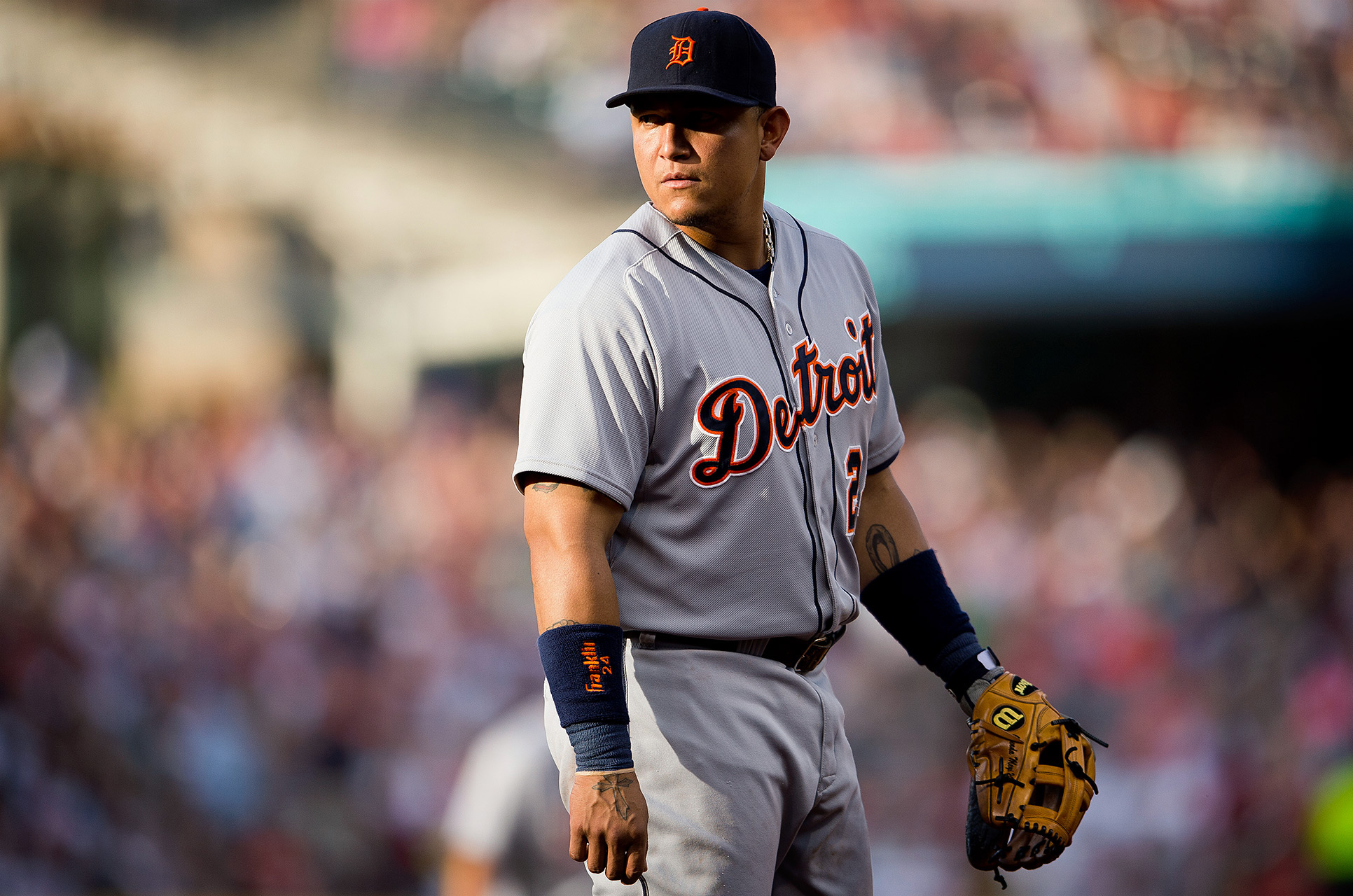
Maybe I wasn't paying close enough attention, but I felt like we just went through an entire baseball season without talking about Miguel Cabrera.

Not only did his Tigers capture their fourth straight division title, but they did so with Cabrera once again posting monster numbers in the middle of their lineup. While his production sagged below his career norms--especially compared to the last four years--it was still outstanding. He batted .313/.371/.524, good for a 147 wRC+ and .384 wOBA (both seventh in the American League). His counting stats were exceptional as well; 25 home runs, 109 RBI, 101 runs, 320 total bases and a league-leading 52 doubles. With 5.4 fWAR he was one of the ten most valuable position players in the American League, but nobody seems to be seriously campaigning for him to win his third straight award.

I just don't get it. The guy puts up huge numbers, his team wins the division, and we forget about him? Like all of the sudden he doesn't exist anymore? What makes this lack of recognition even more strange is that Cabrera was a constant presence, playing all but three games this year. It's not like he got hurt for a few weeks and fell off the face of the earth for a little while. He was out there everyday. How do you think he reached 25 home runs, 100 RBI and 300 total bases for the 11th straight year?

Cabrera's consistency went unnoticed, as a lot of other Tigers got more ink this year. Justin Verlander and Joe Nathan fell apart, and their demise attracted a lot of negative attention. Victor Martinez had a remarkable, MVP-caliber season batting behind Cabrera. Ian Kinsler was phenomenal in his Detroit debut, making everyone forget about Prince Fielder. Torii Hunter somehow warded off age for another year. J.D. Martinez came out of nowhere and emerged as one of the best hitters in baseball. Brad Ausmus replacing Jim Leyland. Detroit trading for David Price at the deadline and still almost not winning the division. Just on the Tigers alone, there were lots of other storylines besides Cabrera this year. He was overshadowed.

Part of me thinks it was a response to Cabrera became a little overrated over the last couple of years. He won the Triple Crown in 2012, something nobody had done in 45 years, but Mike Trout was clearly better. Last year was more of the same. Cabrera once again had awesome statistics, even better than the year he won the Triple Crown, but again Trout was better. Cabrera won the MVP both years even though he was the league's fourth-most valuable player each time. It was like Juan Gonzalez beating out A-Rod, Nomar Garciaparra, and Derek Jeter for MVPs in the late '90s.

Then Cabrera signed that ridiculous contract, the eight-year, $248 million extension that doesn't even kick in until after next year, and for the first time in over a decade baseball's highest paid player wasn't Alex Rodriguez. The love for Cabrera, one of the game's more underrated players for the first ten years or so of his career, had swung too far in the other direction. He'd gone from under-appreciated to horribly overrated.

So, when he had a merely great season this year, nobody seemed to notice. He very clearly declined, but not so much that people started asking "what's wrong with Cabrera?" or began calling him out for being an overpaid bum. He was not extraordinary enough to fawn over like Trout or Giancarlo Stanton or Clayton Kershaw, but he was still productive enough to skirt any criticism that might come his way.

Of course, the Tigers should be worried about Cabrera. Despite moving back to first base, his OPS still fell nearly 200 points compared to last year. He just had the second-worst ISO and third-worst walk rate of his career. After walking more than he whiffed in 2011 and maintaining an almost-even ratio last year, he fanned more than twice as often as he walked this year, something he hasn't done since 2008. He's going to be 32 next April. Alarm bells should be going off. It's Albert Pujols all over again.

But for now Cabrera continues to fly under the radar. That will probably change over the next couple weeks if he comes up with a few big hits or strikes out in key situations. The Tigers are still trying to win their first World Series in 30 years, after all, and if Cabrera helps them do that then he'll be back in the spotlight where he belongs.

Maybe he's not the best hitter on the planet anymore, but he's still among the best, and that's worth talking about.

Thursday, September 18, 2014

The Other Martinez

Martinez has been a force since the calendar flipped to June (CBS)
A lot of praise has been showered on Victor Martinez for his MVP-caliber season, and rightly so. He's been one of the best hitters in baseball this year, putting up monster numbers in the face of sagging offensive production across the sport.

Just don't forget about the "other" Martinez on the Tigers, an unheralded Spring Training pickup who's having an outstanding season in his own right. I'm talking about J.D. Martinez (no relation), this year's Jose Bautista or Adam Lind.

Martinez was virtually unheard of before this year, but so it goes when you're a bad player on an awful team. You see, Martinez was a corner outfielder who didn't hit much or play much in his first three big league seasons, averaging just 84 games per campaign after arriving as a late-July call-up in 2011. Martinez actually hit decently that year with a .274/.319/.423 batting line (104 OPS+) and numbers that, when projected out over 160 games, worked out to be around 40 doubles, 18 home runs and 105 RBI. Martinez, just 23 years-old at the time, was a mild success on an abysmal Astros club that lost 106 games.

2012 wasn't any better for Houston, which lost 107 games, or Martinez, who struggled in his first taste as an everyday player. Despite a strong start his batting line shrunk to .240/.311/.375 (86 OPS+), leaving him below replacement level at -0.6 bWAR. On the plus side he showed a bit more patience and his power held steady, but didn't build off his solid debut so much as he took a step back from it.

2013 marked continued decline for Martinez, who batted an anemic .250/.272/.378 and was worth a full win below replacement despite barely playing half a season (86 games). Whatever strides he'd made in plate discipline the year before had disappeared, as he posted an abominable 82/10 K/BB ratio. The 25 year-old was supposed to be coming into his prime, but instead was merely treading water as a below average player. With minimal contributions in power, speed, and fielding, Martinez was a liability even the horrid Houston Astros couldn't afford to keep around.

So, in March of this year, with Spring Training drawing to a close, the Astros cut him. Based on what they'd seen from him--a .251 batting average, .300 on-base percentage, and sub-.400 slugging percentage in nearly 1,000 plate appearances--they were totally justified in doing so. Most teams would have given up on Martinez as well, I suspect.

The Tigers didn't. They scooped him up two days later, signing him to a minor league contract. Given his age (26) it wasn't entirely unreasonable for them to bank on a breakout, or at least hope he could be a productive fourth outfielder. But I'm guessing not even in their wildest dreams would they ever have expected Martinez to become a full-blown star.

An improved swing has led to better results at the plate (Boston Herald)
That's what happened in June, when Martinez mashed to the tune of .345/.367/.702 with nine doubles, seven home runs and 21 RBI. Given his spotty track record, one would have expected him to cool off sooner or later, but it hasn't happened. He's continued to rake since then and has been especially hot lately with 22 hits, six home runs and 17 RBI already in September. With the Tigers trying to fend off Kansas City, that barrage couldn't have come at a better time.

In Detroit Martinez has not only resurrected his career, but he's also emerged as one of the best hitters in baseball with his .398 wOBA, 157 wRC+, and .928 OPS. With his remade swing he's hitting well over .300, which makes up for his iffy on-base skills (only 25 unintentional walks) but is also completely tied to his .382 BABiP--a ridiculous number given his average footspeed that becomes even harder to explain after seeing only a slight uptick in line drive rate and considerable drop-off in ground ball rate.

But what's been most surprising has been his power. After managing just 24 home runs in his first three seasons (averaging one every 37.5 at-bats) he's already slugged 23 this year, going yard once every 17.6 ABs. He has as many home runs as Miguel Cabrera and his ISo is twice what it was last year. Power progression is to be expected as a player reaches his mid-20s, but seemed unlikely given his shift from a great home run park for righties in Houston to a much tougher one in Detroit. He's hit a few more fly balls than last year, but not enough to explain how he more than doubled his home run frequency.

Rather, that can be explained by his HR/FB ratio, which has more than doubled from last year's 9.5 percent to over 21 percent this year. There's probably some luck in there, as according to the ESPN home run tracker eight of his bombs just barely got out, but even if you take all those shots away he'd still have 15 on the year--a career high.

Martinez has noticeably improved against almost every type of pitch, but none more so than fastballs. After posting negative values against the heater in each of his first three seasons, he's been worth more than 21 runs above average against them this year. That, combined with better success against curveballs, sliders, and changeups, have made him a much more effective hitter.

And that's been huge for the Tigers this year, who've need every one of the four wins above replacement he's provided for them. If Detroit does hold on and win the division, Martinez's breakout season will be a big reason why.


Sunday, August 10, 2014

Martinez Mashing


For more than a year now, playing in the shadow of Miguel Cabrera, Victor Martinez has quietly been one of the best hitters in baseball.

It all started midway through last year, with Martinez scuffling at the plate after missing the entire 2012 season because of a torn ACL. Towards the end of June the then-34-year-old was hitting just .225/.283/.332, still shaking off the rust despite playing everyday for almost three full months.

Then, finally, the hits started falling for the slumping switch-hitter. He ripped off a 14-game hitting streak just before the All-Star Break, part of an incredible July in which he batted .390/.429/.581 with 41 base knocks. V-Mart remained red-hot through the dog days of August, roping 44 hits and batting .386/.449/.491 as a follow-up. In September he finally cooled off, but still strung together a 12-game hitting streak and batted .315/.367/.483 for the month to notch his fourth straight .300 season and seventh overall. All told, Martinez hit .370/.422/.519 over his final 82 games of the season, helping the Tigers go 49-33 in those games in narrowly beat out the Indians for the AL Central crown.

This year's been even better for Detroit's designated hitter, who's hitting for more power now than he has at any other point in his career. His .238 ISO and .560 slugging percentage are easily career bests, with the latter mark good for fifth in baseball among qualified hitters. His 23 home runs have him tied for ninth with Oakland bash brothers Brandon Moss and Josh Donaldson and are only two short of his personal high.

Even at Martinez's advanced age (35), it's not unusual to see him hitting .321 or getting on base more than 38 percent of the time. The five-time All-Star is a .304 career hitter who's career walk to strikeout ratio is nearly even. He still retains the tremendous bat speed, sharp reflexes and remarkable strike zone recognition needed to keep up with today's flamethrowing hurlers.

No, what's curious about this year is his unexpected power resurgence. While Martinez has always been a great hitter, his power appeared to be declining. His slugging and isolated power decreased in the two seasons since he left the Red Sox, and he swatted only 26 home runs in those years after exceeding 20 five times between 2004 and 2010. Given his advancing age, diminishing HR/FB rates, and the cavernous outfield dimensions of his home field, Martinez losing power was only natural. It seemed unlikely to ever return.

He's reversed that trend this year, however, by trading a good number of ground balls for fly balls. With more elevation in his swing, he's kept his GB/FB rate under one for just the second time in ten years. More fly balls typically translates to more big flies, but Martinez is also benefiting from the best HR/FB rate of his career. At 16.2 percent, it's more than double his rates from the last two seasons (both in the low sevens) and much higher than his career rate of 10.5 percent.

Could it be a small sample fluke? Maybe. Martinez crushed 20 home runs through June 25th but has only three since, which could be an indication that regression under way. According to ESPN's nifty home run tracker, seven of V-Mart's bombs have qualified as "just enough." Take those wall-scrapers away and he's sitting on 16, still a good number but nowhere near the pace that has him on track for his first 30-homer season. But with an average true distance of 389 feet and average speed off the bat of almost 104 miles per hour, many of Martinez's dingers have been legit. Five qualify as no-doubters and eleven left the yard by plenty. Even without the aforementioned "lucky" shots he'd have already exceeded his home run totals from his two most recent seasons. His HR/FB rate would be 11.3 percent, still above his career average and the highest it's been since 2009. Put simply, his power surge is not an aberration.

By improving his pop at 35, Martinez has found a new way to defy baseball's aging curve. Ballplayers typically don't have their best power seasons in their mid-thirties unless they're using certain performance enhancing substances (see Mark McGwire and Barry Bonds) or move to a hitting-friendly venue (Adrian Beltre, Hank Aaron). Comerica suppresses home runs, so that means the second explanation is out. I don't mean to suggest that Martinez is on something, but in this day and age a semi-suspicious power spike from a 35 year-old former catcher does make one wonder.

But Victor Martinez has always been a great hitter and displayed the ability to hit for power before, so I'm willing to give him the benefit of the doubt. Great hitters like him stay great longer, especially when they don't have to play the field. All I'm really trying to say with this post is that V-Mart is a phenomenal hitter, and has been one for a long time. This year, he's been a great power hitter, which hasn't always been the case, especially recently, and that merits a closer look.

Monday, July 28, 2014

Santana Smoking Hot

Santana's swinging a hot bat after slumping through April and May (WahoosOnFirst)
The Cleveland Indians are deservedly off today after 11 straight road games to open the second half. And while I'm sure every Indian's thankful for the reprieve, especially with Cleveland having lost six of its last eight, something tells me Carlos Santana wouldn't mind another game tonight.

The former-catcher-turned-corner-infielder has been unconscious over the past week, hitting safely in seven straight games and launching six home runs during that span. His hitting streak, modest as it is, has also produced three doubles and six singles. That makes 15 base knocks in 27 at-bats, a .556 clip that's hiked his season average from a Mario Mendoza-esque .204 to a still-lowly-but-more-respectable .232.

But it's the home runs--five of 'em in the past three days and 14 since the start of June--that have people talking. Santana's slugging percentage rose from .380 after last Sunday to .456, just a tick below his 2014 high-water mark of .462 four games into the season. The 28 year-old Dominican kicked off his monster weekend with a pair of long balls off the young Yordano Ventura Friday night, a performance made even more impressive by the fact that Santana had played 14 innings--a game and a half--the day before.

But despite his big day at the plate, the Indians lost that game and the next one, too, blowing a five run lead on Saturday that Santana started with a solo shot off Jeremy Guthrie. He walked later in the inning and doubled his next time up, but Zach McAllister couldn't keep the Royals at bay and the Tribe fell, 7-5.

After losing the first three games of their series in Kansas City and falling behind early in the fourth, Cleveland salvaged the series and road trip with a 10-3 rout yesterday. The switch-hitting Santana led the way, smashing a two-run homer off Bruce Chen and another off Aaron Crow. The pair of bombs gave him eight on the month and upped his season total to 20, equaling his figure from last year but in 59 fewer games. They also raised his OPS to .827, 101 points higher than where it stood one week ago.

With Cleveland one game below .500 but only 3.5 out of the second wild card spot, Santana's hot streak couldn't have come at a better time for Terry Francona's scuffling club. They need him to keep producing big power numbers out of the cleanup spot if they're going to stay in the hunt for a second straight postseason berth. Thankfully for them he appears to have put his miserable start (.572 OPS through May 21st) behind him. After going through a recent rough stretch where he struck out 14 times in the seven games leading up to the All-Star Break, Santana seems to be seeing the ball more clearly and has had much more success making contact lately, with nine walks against four whiffs in his first 51 plate appearances of the second half.

Santana has always been a patient hitter who's at his very best when he waits for his pitch, putting himself in a position where he can lay back and drive the ball, taking advantage of the natural power that's cranked out 85 homers over the past three and a half seasons. This year's major league leader in walks has definitely been doing that a lot lately, and he'll try to stay hot tomorrow night against Seattle's Hisashi Iwakuma.

Thursday, March 27, 2014

2014 AL Central Preview

Cabrera and the Tigers are the undisputed kings of the AL Central
1st Place Detroit Tigers
2013 Record: 93-69
2013 Pythagorean: 99-63
2014 Projected: 92-70
The Tigers have won the division three years in a row and should have no problem repeating again in 2014. Trading Prince Fielder takes some oomph out of their lineup and I think this is the year that Torii Hunter finally falls apart, but the offense is still dynamite. You have Miguel Cabrera--the best hitter in baseball--surrounded by Austin Jackson, Victor Martinez (who proved he could still hit last year) and now Ian Kinsler, who's in decline but still provides above average offense from the keystone. Shortstop's a problem now that Jose Iglesias is out indefinitely with stress fractures in his shins, and Alex Gonzalez isn't the answer (I hear Stephen Drew is still available...). With Cabrera moving back to first, 22 year-old Nick Castellanos will take over third base duties and has a good shot to win Rookie of the Year honors. Rajai Davis adds a nice dash of speed to an otherwise slow team. The rotation, which features 2011 AL Cy Young winner Justin Verlander, reigning award winner Max Scherzer and 2013 AL ERA champion Anibal Sanchez, is just as formidable. Rick Porcello and Drew Smyly round out what should be one of the best starting fives in baseball (which would be even better, by the way, had Detroit not practically given Doug Fister away for free). Even with Joe Nathan on board the bullpen still isn't great, but that shouldn't be too much of a problem during the regular season if the rotation pitches up to its potential.

2nd Place Kansas City Royals
2013 Record: 86-76
2013 Pythagorean: 87-75
2014 Projected: 90-72
This is the last year KC has James Shields under contract, and their success is more or less riding on him. Losing Ervin Santana means the rest of the rotation (Jason Vargas, Jeremy Guthrie, Bruce Chen) is just meh, so Shields needs to pitch like an ace again in order for the Royals to contend. Rookie Yordano Ventura had a great spring training and could be the X-Factor if he hits the ground running. The lineup is significantly improved over last year's with Norichika Aoki and Omar Infante likely to provide big upgrades at right field and second base. Mike Moustakas has been on fire this spring and looks like he's finally ready to break out. He along with Salvador Perez and Eric Hosmer still have room to grow, which means Kansas City's offense is teeming with upside. Better things might also be expected of Lorenzo Cain and Alcides Escobar, but I wouldn't count on it. Billy Butler and Alex Gordon are already established stars and just need to keep doing what they're doing. The bullpen, led by Greg Holland, is one of baseball's best. Put it all together and the Royals are well-positioned to make the playoffs for the first time since George Brett's heyday in 1985. They're still longshots to win the division and will thus have to settle for one of the two wild card spots.

3rd Place Cleveland Indians
2013 Record: 92-70
2013 Pythagorean: 90-72
2014 Projected: 88-74
Terry Francona guided Cleveland to a surprise postseason appearance last year and much of the talent remains to make another push this season. Like Kansas City, Cleveland has a nice, young team that's a little short on star power and starting pitching, but makes up for it with a deep, balanced lineup and stellar bullpen. The lineup has great depth with plus or average players at almost every position. Jason Kipnis has emerged as one of baseball's top second baseman and a legitimate MVP candidate. His double play partner Asdrubal Cabrera is due for a rebound after hitting a career worst .242/.299/.402 last year. Nick Swisher and Michael Bourn (when he comes off the DL) should also bounce back, though that's less likely with both on the wrong side of 30. Yan Gomez was quietly excellent (133 OPS+) as the team's backstop last year and helps Carlos Santana by allowing him to play mostly first base and DH. David Murphy should be a solid addition to the outfield. The rotation will miss Ubaldo Jimenez and Scott Kazmir, but not so much if Danny Salazar has the breakout campaign that many expect him to have. Justin Masterson can't afford to have a repeat of his disastrous 2012 (4.93 ERA, 1.45 WHIP). Corey Kluber took a big step forward last year and needs to at least stay the same, if not improve again. John Axford makes their already great bullpen even better.

4th Place Minnesota Twins
2013 Record: 66-96
2013 Pythagorean: 63-99
2014 Projected: 71-91
The Twins aren't going to hit at all (except when Joe Mauer's in the batter's box), but at least Ricky Nolasco and Phil Hughes make their pitching more respectable. Jason Kubel's back after a two-year hiatus and could add some punch if he hits like he did in 2012 (30 homers, 90 RBI, .833 OPS), but will only make things worse if he repeats last year's putrid performance (5, 32, .610). Minnesota could also use a big bounce back from Josh Willingham who, like Kubel, fell apart after a big 2012, but seeing as how he's 35 that's probably not going to happen. Former top prospect Aaron Hicks could be okay, but none of this changes the fact that the Twins are woefully short on bats. The rotation, which also includes Kevin Correia and Pelfrey, should be better, but only marginally so. The bullpen's actually pretty pretty good, and Glen Perkins is one of the better closers in baseball, but it won't be enough to make up for their mediocre starting pitchers. Their best talent (besides Mauer) just isn't major league ready yet.

5th Place Chicago White Sox
2013 Record: 63-99
2013 Pythagorean: 67-95
2014 Projected: 68-94
The White Sox were active this winter after bottoming out with a 99 loss season last year, but I'm not convinced they're going to be much better this year. Jose Abreu adds an intriguing power bat to an otherwise ugly lineup. Adam Dunn and Alexei Ramirez are past their primes. Paul Konerko is at the end of the line. The outfield of Avisail Garcia, Adam Eaton and Alejandro De Aza has no power whatsoever. Even though Chicago plays in a homer-friendly park, it's not going to help the team's light-hitting position players..The starting rotation is completely dependent on Chris Sale having another elite season, so if he gets hurt they're screwed. John Danks desperately needs to bounce back from three straight injury-plagued and ineffective campaigns. Jose Quintana made major strides in his sophomore season and is a great number two or three, but probably won't ever develop into an ace. Erik Johnson needs to get his walks down if he wants to make a positive impact on the rotation. Even without Addison Reed, the bullpen should be better than it was last year, so that's a plus.

Friday, August 16, 2013

Examining Torii Hunter's High Batting Averages

Hunter's hitting for the highest averages of his career 
Torii Hunter has been a great baseball player for many years. He's made five All-Star teams, won nine Gold Gloves and smashed more than 300 home runs. His track record includes countless highlight-reel catches, MVP votes, postseason success, and nearly 50 bWAR accumulated across 17 big league seasons. That probably won't be enough to land him a spot in the Hall of Fame, but there's no questioning his plaque in the fictional Hall of Very Good.

But for all of Hunter's accomplishments, he had never batted .300 in a season until 2012, his final season with the Los Angeles Angels. He'd come awfully close in 2009, when he hit .299, but most years his batting average settled near .270 or .280. It was surprising, then, that his average spiked from .262 in 2011 to .313 the next year, the same summer he turned 37. Incredibly, Hunter managed to pump up his BA 51 points--an increase that is almost unheard of for players his age--despite posting the worst strikeout rate of his career.

The explanation behind his batting average boost was a fluky .389 BABiP, the second-highest mark in baseball last year (one point below Dexter Fowler's .390 mark). Hunter's not getting any faster at this stage in his career, so he must have gotten luckier, right?

Well, to some degree, yes. Fortune always plays a part in BABiP and batting average, but there's more to it then that. Hunter did get lucky, but he also altered his batting approach. To compensate for his diminishing power stroke, Hunter leveled out his swing, an adjustment that resulted in a career-best line drive rate and ground ball rate, as well as a career-low fly ball rate. Accordingly, his BABiP went through the roof. Fly balls that don't leave the park tend to wind up in outfielders' mitts. Line drives and ground balls, on the other hand, find holes and take funny hops. They are tougher to convert into outs.

This year Hunter's BABiP and batted ball data have regressed closer to his career norms, though he's still enjoying good luck on balls in play with his .347 mark. One would expect his batting average to suffer a similarly drastic drop off, but instead it's dipped just five points down to .308.

So how is he pulling that off? Hunter's been able to maintain his high average by getting the bat on the ball more frequently and becoming hyper-aggressive at the plate. His strikeout rate is down, his contact rate, is up, and he's swinging at everything. No wonder his walk rate is down to 4.1 percent, easily the lowest of his career. Here's another stat to illustrate just how trigger-happy Henter's become: in a 52 game stretch between June 9th and August 12th, he walked four times.

That kind of approach would spell disaster for most players, but it's working for Hunter. After batting .274 in his first 15 seasons, he's a .310 hitter in his most recent thousand at-bats (which should represent the decline phase of his career). And he's not slowing down. Over the past two months he's batted .329 and slugged .552, providing plenty of offense for the Detroit Tigers, who got hot and lead their division by 6.5 games entering play today. Barring a late season collapse, the defending American League champs will return to the postseason, putting Hunter in position to bolster his already-impressive resume with one more credential: a World Series ring.

Sunday, March 24, 2013

AL Central Preview

1st Place--Detroit Tigers
2012 Record: 88-74
2012 Pythagorean: 87-75
2013 Projected: 92-70
The reigning American League champs should have no trouble winning their third straight division title in 2013. On paper, they're clearly the best team in the division and only got better over the offseason. Victor Martinez returns from a lost 2012 to join Motown mashers Miguel Cabrera and Prince Fielder in the heart of the order. Letting Delmon Young walk is addition by subtraction, whereas signing Torii Hunter is simply pure addition (unless the 37 year-old falls off a cliff). Austin Jackson quietly blossomed into one of the sport's top center fielders after adopting a more patient approach at the plate and could have an Andrew McCutchen-kind-of-year. I think Alex Avila bounces back after hitting .243 with nine home runs last year, but don't see him returning to 2011 form (neither will Jhonny Peralta). The Tigers have the best pitcher on the planet in Justin Verlander and a strong rotation to back him up. Max Scherzer got off to a rocky start last year but still posted the best strikeout rate in the majors last year. What's more, he compiled a sparkling 2.53 ERA after June 13th, better than Verlander's 2.61 mark over the same stretch. I say it every spring, but this might be the year he finally takes the leap. Detroit re-upped with Anibal Sanchez for five years and $88 million, which is a bit pricey for a number three but not bad considering he's pitched about as well as Zack Greinke (who got much more than that) over the past three seasons. Don't worry about Doug Fister's spring training woes--he'll be fine. Overall, the Tigers are deeper and more balanced than last year, so I'd be shocked if anyone else wins the AL Central.

2nd Place--Chicago White Sox
2012 Record: 85-77
2012 Pythagorean: 88-74
2013 Projected: 83-79
Robin Ventura's White Sox spent most of the season in first place, only to falter at the finish line and cough up the division in the season's final week. Chicago had a quiet offseason, letting Kevin Youkilis and A.J. Pierzynski walk but keeping the rest of their roster intact. Youk will be missed at the hot corner, esepcially since his replacement (Jeff Keppinger) offers little power and average defense at best. Pierzynski's departure opens the door for Tyler Flowers to play behind the plate everyday and infuse some youth into a veteran lineup. 37 year-old Paul Konerko has shown no signs of slowing down and should continue to be a force in the heart of Chicago's order along with Alex Rios and Adam Dunn, both of whom rebounded from miserable 2011s. In the outfield, Dayan Viciedo has 30-homer potential and Alejandro de Aza is a rock solid leadoff hitter/center fielder. The rotation is headed by two aces--2012 breakout Chris Sale and former Cy Young winner Jake Peavy--both of whom must sustain their success if Chicago is going to have any chance at keeping up with the Tigers this year. The oft-injured Peavy, 31, is hardly a sure thing given that he averaged just 17 starts per year from 2009-2011. Sale, soon to be 24, is a Verducci effect candidate after approaching 200 innings in his first full season as a starter. John Danks, Gavin Floyd, and Jose Quintana round out the rest of the rotation with Hector Santiago ready to step in if needed. The bullpen looks good for the most part, but Addison Reed needs to be more consistent if he wants to hang on to his closer's gig.

3rd Place--Cleveland Indians
2012 Record: 68-94
2012 Pythagorean: 64-98
2013 Projected: 80-82
Everything that could go wrong did go wrong for the Tribe last year, but they enter 2013 with significantly more talent. They upgraded their outfield outfield by signing Nick Swisher and Michael Bourn, signing slugging corner infielder Mark Reynolds to a cheap one-year deal and trading for Trevor Bauer, who projects to be a future ace. Cleveland is stacked up the middle: catcher Carlos Santana is primed for a breakout in his age 27 season, Jason Kipnis and Asdrubal Cabrera are a great double-play tandem, and Bourn is the best defensive center fielder in baseball not named Mike Trout. All four could be All-Stars this year, and it seems safe to say the Indians won't finish second-to-last in runs scored like they did last year. Of course,  it doesn't really matter how many more times they cross home plate if Cleveland finishes dead last in ERA again. I can't say I love their rotation, which lacks a true number one and two, but the good news is that Justin Masterson, Ubaldo Jimenez and Josh Tomlin have nowhere to go but up. If they can at least pitched as well as they did in 2011, then Cleveland will be in much better shape. Zach McAllister showed some promise as a rookie last year and could be a nice boon if he continues to develop. With veteran skipper Terry Francona at the helm, Cleveland now has one of the best managers of the past decade at the reins. The Indians aren't talented enough to surpass the Detroit Tigers in the AL Central but have the pieces to move above .500 for the first time since 2007.

4th Place--Kansas City Royals
2012 Record: 72-90
2012 Pythagorean: 74-88
2013 Projected: 77-85
Kansas City is loaded with young talent but made a critical blunder in trading future superstar Wil Myers for James Shields, a number two pitcher with a career 4.67 ERA pitching outside of a dome. He's not going to be the difference-maker GM Dayton Moore is expecting, so KC will have to rely on continued growth and maturity from its young core of position players. Lorenzo Cain, Mike Moustakas, Alcides Escobar, Salvador Perez, and Eric Hosmer in particular all need to be better than they were last year (so does Jeff Francoeur, who followed up his strong Royals debut by reminding everyone just how bad he really is). Billy Butler and Alex Gordon just have to keep doing their thing. Whereas the Royals' starting lineup is teeming with potential and upside, their starting rotation is staffed by so-so veterans like Bruce Chen, Ervin Santana, and Jeremy Guthrie. Shields is a lock to provide 220 quality innings, but I see him taking a substantial step back after moving out of the pitcher's haven known as Tropicana Field. Kansas City boasts a bullpen full of live arms, none of whom seem capable of developing into usable starting pitchers. The Royals could have a winning season if everything goes their way, but that's not going to be enough to snap their 27-year playoff drought.

5th Place--Minnesota Twins
2012 Record: 66-96
2012 Pythagorean: 68-94
2013 Projected: 67-95
The Twins were the Junior Circuit's worst team in 2011 and 2012, but lucky for them the Houston Astros switched leagues and will spare them from claiming that dubious distinction for a third straight season. Thanks to a  Harmon Killebrew-type year from slugger Josh Willingham and rebounds from Joe Mauer, Justin Morneau, and Ryan Doumit, the Twins fielded a decent lineup last year. Speedy outfielders Denard Span and Ben Revere will be missed, especially on defense. The Twins are never going to put up big offensive numbers so long as their playing half their games at Target Field. They need to be built around strong starting pitching, an asset that was in short supply last year. Breakout Scott Diamond was the only hurler to make more than 20 starts or complete more than 110 innings. Ron Gardenhire is counting on Diamond to be the ace of the staff, but Diamond is a mid-rotation starter at best. Furthermore, his complete and utter inability to miss bats (4.7 K/9 last year) makes him a likely bust candidate. Unlike last year, he figures to have some help in the rotation. GM Terry Ryan acquired Vance Worley, Mike Pelfrey, and Kevin Correia to fill out the staff, and while none of those names are exciting at least they are all capable big league pitchers. That's not saying much, but it represents a clear upgrade over last year's soft-tossing crew of Nick Blackburn, Brian Duensing, and Carl Pavano. Minnesota fans might as well start thinking about football season, because their baseball team isn't going anywhere anytime soon.